Thousands of nuclear spins are entangled to create a quantum-dot qubit

A new type of quantum bit (qubit) that stores information in a quantum dot with the help of an ensemble of nuclear spin states has been unveiled by physicists in the UK and Austria. Led by Dorian Gangloff and Mete Atatüre at the University of Cambridge, the team created a collective quantum state that could be used as a quantum register to store and relay information in a quantum communication network of the future.

Quantum communication networks are used to exchange and distribute quantum information between remotely-located quantum computers and other devices. As well as enabling distributed quantum computing, quantum networks can also support secure quantum cryptography. Today, these networks are in the very early stages of development and use the entangled quantum states of photons to transmit information. Network performance is severely limited by decoherence, whereby the quantum information held by photons is degraded as they travel long distances. As a result, effective networks need repeater nodes that receive and then amplify weakened quantum signals.

“To address these limitations, researchers have focused on developing quantum memories capable of reliably storing entangled states to enable quantum repeater operations over extended distances,” Gangloff explains. “Various quantum systems are being explored, with semiconductor quantum dots being the best single-photon generators delivering both photon coherence and brightness.”

Single-photon emission

Quantum dots are widely used for their ability to emit single photons at specific wavelengths. These photons are created by electronic transitions in quantum dots and are ideal for encoding and transmitting quantum information.

However, the electronic spin states of quantum dots are not particularly good at storing quantum information for long enough to be useful as stationary qubits (or nodes) in a quantum network. This is because they contain hundreds or thousands of nuclei with spins that fluctuate. The noise generated by these fluctuations causes the decoherence of qubits based on electronic spin states.

In their previous research, Gangloff and Atatüre’s team showed how this noise could be controlled by sensing how it interacts with the electronic spin states.

Atatüre says, “Building on our previous achievements, we suppressed random fluctuations in the nuclear ensemble using a quantum feedback algorithm. This is already very useful as it dramatically improves the electron spin qubit performance.”

Magnon excitation

Now, using a gallium arsenide quantum dot, the team has used the feedback algorithm to stabilize 13,000 nuclear spin states in a collective, entangled “dark state”. This is a stable quantum state that cannot absorb or emit photons. By introducing just a single nuclear magnon (spin flip) excitation, shared across all 13,000 nuclei, they could then flip the entire ensemble between two different collective quantum states.

Each of these collective states could respectively be defined as a 0 and a 1 in a binary quantum logic system. The team then showed how quantum information could be exchanged between the nuclear system and the quantum dot’s electronic qubit with a fidelity of about 70%.

“The quantum memory maintained the stored state for approximately 130 µs, validating the effectiveness of our protocol,” Gangloff explains. “We also identified unambiguously the factors limiting the current fidelity and storage time, including crosstalk between nuclear modes and optically induced spin relaxation.”

The researchers are hopeful that their approach could transform one of the biggest limitations to quantum dot-based communication networks into a significant advantage.

“By integrating a multi-qubit register with quantum dots – the brightest and already commercially available single-photon sources – we elevate these devices to a much higher technology readiness level,” Atatüre explains.

With some further improvements to their system’s fidelity, the researchers are now confident that it could be used to strengthen interactions between quantum dot qubits and the photonic states they produce, ultimately leading to longer coherence times in quantum communication networks. Elsewhere, it could even be used to explore new quantum phenomena, and gather new insights into the intricate dynamics of quantum many-body systems.

The research is described in Nature Physics.

Say hi to Quinnie – the official mascot of the International Year of Quantum Science and Technology

Whether it’s the Olympics or the FIFA World Cup, all big global events need a cheeky, fun mascot. So welcome to Quinnie – the official mascot for the International Year of Quantum Science and Technology (IYQ) 2025.

Unveiled at the launch of the IYQ at the headquarters of UNESCO in Paris on 4 February, Quinnie has been drawn by Jorge Cham, the creator of the long-running cartoon strip PHD Comics.

Quinnie was developed for UNESCO in a collaboration between Cham and Physics Magazine, which is published by the American Physical Society (APS) – one of the founding partners of IYQ.

Image of Quinnie, the mascot for the International Year of Quantum Science and Technology

“Quinnie represents a young generation approaching quantum science with passion, ingenuity, and energy,” says Physics editor Matteo Rini. “We imagine her effortlessly surfing on quantum-mechanical wave functions and playfully engaging with the knottiest quantum ideas, from entanglement to duality.”

Quinnie is set to appear in a series of animated cartoons that the APS will release throughout the year.

This article forms part of Physics World‘s contribution to the 2025 International Year of Quantum Science and Technology (IYQ), which aims to raise global awareness of quantum physics and its applications.

Stayed tuned to Physics World and our international partners throughout the next 12 months for more coverage of the IYQ.

Find out more on our quantum channel.

New class of quasiparticle appears in bilayer graphene

A newly-discovered class of quasiparticles known as fractional excitons offers fresh opportunities for condensed-matter research and could reveal unprecedented quantum phases, say physicists at Brown University in the US. The new quasiparticles, which are neither bosons nor fermions and carry no charge, could have applications in quantum computing and sensing, they say.

In our everyday, three-dimensional world, particles are classified as either fermions or bosons. Fermions such as electrons follow the Pauli exclusion principle, which prevents them from occupying the same quantum state. This property underpins phenomena like the structure of atoms and the behaviour of metals and insulators. Bosons, on the other hand, can occupy the same state, allowing for effects like superconductivity and superfluidity.

Fractional excitons defy this traditional classification, says Jia Leo Li, who led the research. Their properties lie somewhere in between those of fermions and bosons, making them more akin to anyons, which are particles that exist only in two-dimensional systems. But that’s only one aspect of their unusual nature, Li adds. “Unlike typical anyons, which carry a fractional charge of an electron, fractional excitons are neutral particles, representing a distinct type of quantum entity,” he says.

The experiment

Li and colleagues created the fractional excitons using two sheets of graphene – a form of carbon just one atom thick – separated by a layer of another two-dimensional material, hexagonal boron nitride. This layered setup allowed them to precisely control the movement of electrons and positively-charged “holes” and thus to generate excitons, which are pairs of electrons and holes that behave like single particles.

The team then applied a 12 T magnetic field to their bilayer structure. This strong field caused the electrons in the graphene to split into fractional charges – a well-known phenomenon that occurs in the fractional quantum Hall effect. “Here, strong magnetic fields create Landau electronic levels that induce particles with fractional charges,” Li explains. “The bilayer structure facilitates pairing between these positive and negative charges, making fractional excitons possible.”

“Distinct from any known particles”

The fractional excitons represent a quantum system of neutral particles that obey fractional quantum statistics, interact via dipolar forces and are distinct from any known particles, Li tells Physics World. He adds that his team’s study, which is detailed in Nature, builds on prior works that predicted the existence of excitons in the fractional quantum Hall effect (see, for example, Nature Physics 13, 751 2017Nature Physics 15, 898-903 2019Science 375 (6577), 205-209 2022).

The researchers now plan to explore the properties of fractional excitons further. “Our key objectives include measuring the fractional charge of the constituent particles and confirming their anyonic statistics,” Li explains. Studies of this nature could shed light on how fractional excitons interact and flow, potentially revealing new quantum phases, he adds.

“Such insights could have profound implications for quantum technologies, including ultra-sensitive sensors and robust quantum computing platforms,” Li says. “As research progresses, fractional excitons may redefine the boundaries of condensed-matter physics and applied quantum science.”

European Space Agency’s Euclid mission spots spectacular Einstein ring

The European Space Agency (ESA) has released a spectacular image of an Einstein ring – a circle of light formed around a galaxy by gravitational lensing. Taken by the €1.4bn Euclid mission, the ring is a result of the gravitational effects of a galaxy located around 590 million light-years from Earth.

Euclid was launched in July 2023 and is currently located in a spot in space called Lagrange Point 2 – a gravitational balance point some 1.5 million kilometres beyond the Earth’s orbit around the Sun. Euclid has a 1.2 m-diameter telescope, a camera and a spectrometer that it uses to plot a 3D map of the distribution of more than two billion galaxies. The images it takes are about four times as sharp as current ground-based telescopes.

Einstein’s general theory of relativity predicts that light will bend around objects in space, so that they focus the light like a giant lens. This gravitational lensing effect is bigger for more massive objects and means we can sometimes see the light from distant galaxies that would otherwise be hidden.

Yet if the alignment is just right, the light from the distant source galaxy bends to form a spectacular ring around the foreground object. In this case, the mass of galaxy NGC 6505 is bending and magnifying the light from a more distant galaxy, which is about 4.42 billion light-years away, into a ring.

Studying such rings can shed light on the expansion of the universe as well as the nature of dark matter.

Euclid’s first science results were released in May 2024, following its first shots of the cosmos in November 2023. Hints of the ring were first spotted in September 2023 when Euclid was being testing with follow-up measurements now revealing it in exquisite detail.

Quantum simulators deliver surprising insights into magnetic phase transitions

Unexpected behaviour at phase transitions between classical and quantum magnetism has been observed in different quantum simulators operated by two independent groups. One investigation was led by researchers at Harvard University and used Rydberg atom as quantum bits (qubits). The other study was led by scientists at  Google Research and involved superconducting qubits. Both projects revealed unexpected deviations from the canonical mechanisms of magnetic freezing, with unexpected oscillations near the phase transition.

A classical magnetic material can be understood as a fluid mixture of magnetic domains that are oriented in opposite directions, with the domain walls in constant motion. As a strengthening magnetic field is applied to the system, the energy associated with a domain wall increases, so the magnetic domains themselves become larger and less mobile. At some point, when the magnetism becomes sufficiently strong, a quantum phase transition occurs, causing the magnetism of the material to become fixed and crystalline: “A good analogy is like water freezing,” says Mikhail Lukin of Harvard University.

The traditional quantitative model for these transitions is the Kibble–Zurek mechanism, which was first formulated to describe cosmological phase transitions in the early universe. It predicts that the dynamics of a system begin to “freeze” when the system gets so close to the transition point that the domains crystallize more quickly than they can come to equilibrium.

“There are some very good theories of various types of quantum phase transitions that have been developed,” says Lukin, “but typically these theories make some approximations. In many cases they’re fantastic approximations that allow you to get very good results, but they make some assumptions which may or may not be correct.”

Highly reconfigurable platform

In their work, Lukin and colleagues utilized a highly reconfigurable platform using Rydberg atom qubits. The system was pioneered by Lukin and others in 2016 to study a specific type of magnetic quantum phase transition in detail. They used a laser to simulate the effect of a magnetic field on the Rydberg atoms, and adjusted the laser frequency to tune the field strength.

The researchers found that, rather than simply becoming progressively larger and less mobile as the field strength increased (a phenomenon called coarsening), the domain sizes underwent unexpected oscillations around the phase transition.

“We were really quite puzzled,” says Lukin. “Eventually we figured out that this oscillation is a sign of a special type of excitation mode similar to the Higgs mode in high-energy physics. This is something we did not anticipate…That’s an example where doing quantum simulations on quantum devices really can lead to new discoveries.”

Meanwhile, the Google-led study used a new approach to quantum simulation with superconducting qubits. Such qubits have proved extremely successful and scalable because they use solid-state technology – and they are used in most of the world’s leading commercial quantum computers such as IBM’s Osprey and Google’s own Willow chips. Much of the previous work using such chips, however, has focused on sequential “digital” quantum logic in which one set of gates is activated only after the previous set has concluded. The long times needed for such calculations allows the effects of noise to accumulate, resulting in computational errors.

Hybrid approach

In the new work, the Google team developed a hybrid analogue–digital approach in which a digital universal quantum gate set was used to prepare well-defined input qubit states. They then switched the processor to analogue mode, using capacitive couplers to tune the interactions between the qubits. In this mode, all the qubits were allowed to operate on each other simultaneously, without the quantum logic being shoehorned into a linear set of gate operations. Finally, the researchers characterized the output by switching back to digital mode.

The researchers used a 69-qubit superconducting system to simulate a similar, but non-identical, magnetic quantum phase transition to that studied by Lukin’s group. They were also puzzled by similar unexpected behaviour in their system. The groups’ subsequently became aware of each other’s work, as Google Research’s Trond Anderson explains: “It’s very exciting to see consistent observations from the Lukin group. This not only provides supporting evidence, but also demonstrates that the phenomenon appears in several contexts, making it extra important to understand”.

Both groups are now seeking to push their research deeper into the exploration of complex many-body quantum physics. The Google group estimates that, to conduct its simulations of the highly entangled quantum states involved with the same level of experimental fidelity would take the US Department of Energy’s Frontier supercomputer – one of the world’s most powerful – more than a million years. The researchers now want to look at problems that are completely intractable classically, such as magnetic frustration. “The analogue–digital approach really combines the best of both worlds, and we’re very excited about this as a new promising direction towards making discoveries in systems that are too complex for classical computers,” says Anderson.

The Harvard researchers are also looking to push their system to study more and more complex quantum systems. “There are many interesting processes where dynamics – especially across a quantum phase transition – remains poorly understood,” says Lukin. “And it ranges from the science of complex quantum materials to systems in high-energy physics such as lattice gauge theories, which are notorious for being hard to simulate classically to the point where people literally give up…We want to apply these kinds of simulators to real open quantum problems and really use them to study the dynamics of these systems.”

The research is described in side-by-side papers in Nature. The Google paper is here and the Harvard paper here.

Supermassive black hole displays ‘unprecedented’ X-ray outbursts

An international team of researchers has detected a series of significant X-ray oscillations near the innermost orbit of a supermassive black hole – an unprecedented discovery that could indicate the presence of a nearby stellar-mass orbiter such as a white dwarf.

Optical outburst

The Massachusetts Institute of Technology (MIT)-led team began studying the extreme supermassive black hole 1ES 1927+654 – located around 270 million light years away and about a million times more massive than the Sun – in 2018, when it brightened by a factor of around 100 at optical wavelengths. Shortly after this optical outburst, X-ray monitoring revealed a period of dramatic variability as X-rays dropped rapidly – at first becoming undetectable for about a month, before returning with a vengeance and transforming into the brightest supermassive black hole in the X-ray sky.

“All of this dramatic variability seemed to be over by 2021, as the source appeared to have returned to its pre-2018 state. However, luckily, we continued to watch this source, having learned the lesson that this supermassive black hole will always surprise us. The discovery of these millihertz oscillations was indeed quite a surprise, but it gives us a direct probe of regions very close to the supermassive black hole,” says Megan Masterson, a fifth-year PhD candidate at the MIT Kavli Institute for Astrophysics and Space Research, who co-led the study with MIT’s Erin Kara – alongside researchers based elsewhere in the US, as well as at institutions in Chile, China, Israel, Italy, Spain and the UK.

“We found that the period of these oscillations rapidly changed – dropping from around 18 minutes in 2022 to around seven minutes in 2024. This period evolution is unprecedented, having never been seen before in the small handful of other supermassive black holes that show similar oscillatory behaviour,” she adds.

White dwarf

According to Masterson, one of the key ideas behind the study was that the rapid X-ray period change could be driven by a white dwarf – the compact remnant of a star like our Sun – orbiting around the supermassive black hole close to its event horizon.

“If this white dwarf is driving these oscillations, it should produce a gravitational wave signal that will be detectable with next-generation gravitational wave observatories, like ESA’s Laser Interferometer Space Antenna (LISA),” she says.

To test their hypothesis, the researchers used X-ray data from ESA’s XMM-Newton observatory to detect the oscillations, which allowed them to track how the X-ray brightness changed over time. The findings were presented in mid-January at the 245th meeting of the American Astronomical Society in National Harbor, Maryland, and subsequently reported in Nature.

According to Masterson, these insights into the behaviour of X-rays near a black hole will have major implications for future efforts to detect multi-messenger signals from supermassive black holes.

“We really don’t understand how common stellar-mass companions around supermassive black holes are, but these findings tell us that it may be possible for stellar-mass objects to survive very close to supermassive black holes and produce gravitational wave signals that will be detected with the next-generation gravitational wave observatories,” she says.

Looking ahead, Masterson confirms that the immediate next step for MIT research in this area is to continue to monitor 1ES 1927+654 – with both existing and future telescopes – in an effort to deepen understanding of the extreme physics at play in and around the innermost environments of black holes.

“We’ve learned from this discovery that we should expect the unexpected with this source,” she adds. “We’re also hoping to find other sources like this one through large time-domain surveys and dedicated X-ray follow-up of interesting transients.”

How the changing environment affects solar-panel efficiency: the Indian perspective

This episode of the Physics World Weekly podcast looks at how climate and environmental change affect the efficiency of solar panels. Our guest is the climate scientist Sushovan Ghosh, who is lead author of paper that explores how aerosols, rising temperatures and other environmental factors will affect solar-energy output in India in the coming decades.

Today, India ranks fifth amongst nations in terms of installed solar-energy capacity and boosting this capacity will be crucial for the country’s drive to reduce its greenhouse gas emissions by 45% by 2030 – when compared to 2005.

While much of India is blessed with abundant sunshine, it is experiencing a persistent decline in incoming solar radiation that is associated with aerosol pollution. What is more, higher temperatures associated with climate change reduce the efficiency of solar cells  – and their performance is also impacted in India by other climate-related phenomena.

In this podcast, Ghosh explains how changes in the climate and environment affect the generation of solar energy and what can be done to mitigate these effects.

Ghosh co-wrote the paper when at the Centre for Atmospheric Sciences at the Indian Institute of Technology Delhi and he is now at the Barcelona Supercomputing Center in Spain. His co-authors in Delhi were Dilip Ganguly, Sagnik Dey and Subhojit Ghoshal Chowdhury; and the paper is called, “Future photovoltaic potential in India: navigating the interplay between air pollution control and climate change mitigation”. It appears in Environmental Research Letters, which is published by IOP Publishing – which also brings you Physics World.

Two-faced graphene nanoribbons could make the first purely carbon-based ferromagnets

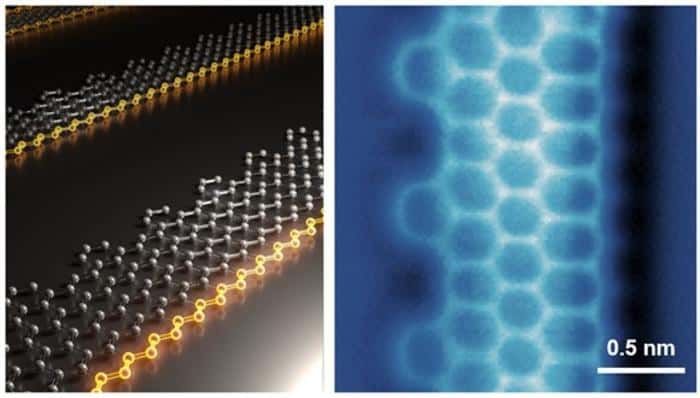
A new graphene nanostructure could become the basis for the first ferromagnets made purely from carbon. Known as an asymmetric or “Janus” graphene nanoribbon after the two-faced god in Roman mythology, the opposite edges of this structure have different properties, with one edge taking a zigzag form. Lu Jiong , a researcher at the National University of Singapore (NUS) who co-led the effort to make the structure, explains that it is this zigzag edge that gives rise to the ferromagnetic state, making the structure the first of its kind.

“The work is the first demonstration of the concept of a Janus graphene nanoribbon (JGNR) strand featuring a single ferromagnetic zigzag edge,” Lu says.

Graphene nanostructures with zigzag-shaped edges show much promise for technological applications thanks to their electronic and magnetic properties. Zigzag GNRs (ZGNRs) are especially appealing because the behaviour of their electrons can be tuned from metal-like to semiconducting by adjusting the length or width of the ribbons; modifying the structure of their edges; or doping them with non-carbon atoms. The same techniques can also be used to make such materials magnetic. This versatility means they can be used as building blocks for numerous applications, including quantum and spintronics technologies.

Previously, only two types of symmetric ZGNRs had been synthesized via on-surface chemistry: 6-ZGNR and nitrogen-doped 6-ZGNR, where the “6” refers to the number of carbon rows across the nanoribbon’s width. In the latest work, Lu and co-team leaders Hiroshi Sakaguchi of the University of Kyoto, Japan and Steven Louie at the University of California, Berkeley, US sought to expand this list.

 “It has been a long-sought goal to make other forms of zigzag-edge related GNRs with exotic quantum magnetic states for studying new science and developing new applications,” says team member Song Shaotang, the first author of a paper in Nature about the research.

ZGNRs with asymmetric edges

Building on topological classification theory developed in previous research by Louie and colleagues, theorists in the Singapore-Japan-US collaboration predicted that it should be possible to tune the magnetic properties of these structures by making ZGNRs with asymmetric edges. “These nanoribbons have one pristine zigzag edge and another edge decorated with a pattern of topological defects spaced by a certain number m of missing motifs,” Louie explains. “Our experimental team members, using innovative z-shaped precursor molecules for synthesis, were able to make two kinds of such ZGNRs. Both of these have one edge that supports a benzene motif array with a spacing of m = 2 missing benzene rings in between. The other edge is a conventional zigzag edge.”

Crucially, the theory predicted that the magnetic behaviour – ranging from antiferromagnetism to ferrimagnetism to ferromagnetism – of these JGNRs could be controlled by varying the value of m. In particular, says Louie, the configuration of m = 2 is predicted to show ferromagnetism – that is, all electron spins aligned in the same direction – concentrated entirely on the pristine zigzag edge. This behaviour contrasts sharply with that of symmetric ZGNRs, where spin polarization occurs on both edges and the aligned edge spins are antiferromagnetically coupled across the width of the ribbon.

Precursor design and synthesis

To validate these theoretical predictions, the team synthesized JGNRs on a surface. They then used advanced scanning tunnelling microscope (STM) and atomic force microscope (AFM) measurements to visualize the materials’ exact real-space chemical structure. These measurements also revealed the emergence of exotic magnetic states in the JGNRs synthesized in Lu’s lab at the NUS.

atomic model of the JGNRs

In the past, Sakaguchi explains that GNRs were mainly synthesized using symmetric precursor chemical structures, largely because their asymmetric counterparts were so scarce. One of the challenges in this work, he notes, was to design asymmetric polymeric precursors that could undergo the essential fusion (dehydrogenation) process to form JGNRs. These molecules often orient randomly, so the researchers needed to use additional techniques to align them unidirectionally prior to the polymerization reaction. “Addressing this challenge in the future could allow us to produce JGNRs with a broader range of magnetic properties,” Sakaguchi says.

Towards carbon-based ferromagnets

According to Lu, the team’s research shows that JGNRs could become the first carbon-based spin transport channels to show ferromagnetism. They might even lead to the development of carbon-based ferromagnets, capping off a research effort that began in the 1980s.

However, Lu acknowledges that there is much work to do before these structures find real-world applications. For one, they are not currently very robust when exposed to air. “The next goal,” he says, “is to develop chemical modifications that will enhance the stability of these 1D structures so that they can survive under ambient conditions.”

A further goal, he continues, is to synthesize JGNRs with different values of m, as well as other classes of JGNRs with different types of defective edges. “We will also be exploring the 1D spin physics of these structures and [will] investigate their spin dynamics using techniques such as scanning tunnelling microscopy combined with electron spin resonance, paving the way for their potential applications in quantum technologies.”

Asteroid Bennu contains the stuff of life, sample analysis reveals

A sample of asteroid dirt brought back to Earth by NASA’s OSIRIS-REx mission contains amino acids and the nucleobases of RNA and DNA, plus brines that could have facilitated the formation of organic molecules, scanning electron microscopy has shown.

The 120 g of material came from the near-Earth asteroid 101955 Bennu, which OSIRIS-REx visited in 2020. The findings “bolster the hypothesis that asteroids like Bennu could have delivered the raw ingredients to Earth prior to the emergence of life,” Dan Glavin of NASA’s Goddard Space Flight Center tells Physics World.

Bennu has an interesting history. It is 565 m across at its widest point and was once part of a much larger parent body, possibly 100 km in diameter, that was smashed apart in a collision in the Asteroid Belt between 730 million and 1.55 billion years ago. Bennu coalesced from the debris as a rubble pile that found itself in Earth’s vicinity.

The sample from Bennu was parachuted back to Earth in 2023 and shared among teams of researchers. Now two new papers, published in Nature and Nature Astronomy, reveal some of the findings from those teams.

Saltwater residue

In particular, researchers identified a diverse range of salt minerals, including sodium-bearing phosphates and carbonates that formed brines when liquid water on Bennu’s parent body either evaporated or froze.

SEM images of minerals found in Bennu samples

The liquid water would have been present on Bennu’s parent during the dawn of the Solar System, in the first few million years after the planets began to form. Heat generated by the radioactive decay of aluminium-26 would have kept pockets of water liquid deep inside Bennu’s parent body. The brines that this liquid water bequeathed would have played a role in kickstarting organic chemistry.

Tim McCoy, of the Smithsonian’s National Museum of Natural History and the lead author of the Nature paper, says that “brines play two important roles”.

One of those roles is producing the minerals that serve as templates for organic molecules. “As an example, brines precipitate phosphates that can serve as a template on which sugars needed for life are formed,” McCoy tells Physics World. The phosphate is like a pegboard with holes, and atoms can use those spaces to arrange themselves into sugar molecules.

The second role that brines can play is to then release the organic molecules that have formed on the minerals back into the brine, where they can combine with other organic molecules to form more complex compounds.

Ambidextrous amino acids

Meanwhile, the study reported in Nature Astronomy, led by Dan Glavin and Jason Dworkin of NASA’s Goddard Space Flight Center, focused on the detection of 14 of the 20 amino acids used by life to build proteins, deepening the mystery of why life only uses “left-handed” amino acids.

Amino acid molecules lack rotational symmetry – think of how, no matter how much you twist or turn your left hand, you will never be able to superimpose it on your right hand. As such, amino acids can randomly be either left- or right-handed, a property known as chirality.

However, for some reason that no one has been able to figure out yet, all life on Earth uses left-handed amino acids.

One hypothesis was that due to some quirk, amino acids formed in space and brought to Earth in impacts had a bias for being left-handed. This possibility now looks unlikely after Glavin and Dworkin’s team discovered that the amino acids in the Bennu sample are a mix of left- and right-handed, with no evidence that one is preferred over the other.

“So far we have not seen any evidence for a preferred chirality,” Glavin says. This goes for both the Bennu sample and a previous sample from the asteroid 162173 Ryugu, collected by Japan’s Hayabusa2 mission, which contained 23 different forms of amino acid. “For now, why life turned left on Earth remains a mystery.”

Taking a closer step to the origin of life

Another mystery is why the organic chemistry on Bennu’s parent body reached a certain point and then stopped. Why didn’t it form more complex organic molecules, or even life?

A mosaic image of Bennu

Amino acids are the construction blocks of proteins. In turn, proteins are one of the primary molecules for life, facilitating biological processes within cells. Nucleobases have also been identified in the Bennu sample, but although chains of nucleobases are the molecular skeleton of RNA and DNA, neither nucleic acid has been found in an extraterrestrial sample yet.

“Although the wet and salty conditions inside Bennu’s parent body provided an ideal environment for the formation of amino acids and nucleobases, it is not clear yet why more complex organic polymers did not evolve,” says Glavin.

Researchers are still looking for that complex chemistry. McCoy cites the 5-carbon sugar ribose, which is a component of RNA, as an essential organic molecule for life that scientists hope to one day find in an asteroid sample.

“But as you might imagine, as organic molecules increase in complexity, they decrease in number,” says McCoy, explaining that we will need to search ever larger amounts of asteroidal material before we might get lucky and find them.

The answers will ultimately help astrobiologists figure out where life began. Could proteins, RNA or even biological cells have formed in the early Solar System within objects such as Bennu’s parent planetesimal? Or did complex biochemistry begin only on Earth once the base materials had been delivered from space?

“What is becoming very clear is that the basic chemical building blocks of life could have been delivered to Earth, where further chemical evolution could have occurred in a habitable environment, including the origin of life itself,” says Glavin.

What’s really needed are more samples. China’s Tianwen-2 mission is blasting off later this year on a mission to capture a 100 g sample from the small near-earth asteroid 469219 Kamo‘oalewa. The findings are likely to be similar to those of OSIRIS-REx and Hayabusa2, but there’s always the chance that something more complex might be in that sample too. If and when those organic molecules are found, they will have huge repercussions for the origin of life on Earth.

International quantum year launches in style at UNESCO headquarters in Paris

More than 800 researchers, policy makers and government officials from around the world gathered in Paris this week to attend the official launch of the International Year of Quantum Science and Technology (IYQ). Held at the headquarters of the United Nations Educational, Scientific and Cultural Organisation (UNESCO), the two-day event included contributions from four Nobel prize-winning physicists – Alain Aspect, Serge Haroche, Anne l’Huillier and William Phillips.

Opening remarks came from Cephas Adjej Mensah, a research director in the Ghanaian government, which last year submitted the draft resolution to the United Nations for 2025 to be proclaimed as the IYQ. “Let us commit to making quantum science accessible to all,” Mensah declared, reminding delegates that the IYQ is intended to be a global initiative, spreading the benefits of quantum equitably around the world. “We can unleash the power of quantum science and technology to make an equitable and prosperous future for all.”

The keynote address was given by l’Huillier, a quantum physicist at Lund University in Sweden, who shared the 2023 Nobel Prize for Physics with Pierre Agostini and Ferenc Krausz for their work on attosecond pulses. “Quantum mechanics has been extremely successful,” she said, explaining how it was invented 100 years ago by Werner Heisenberg on the island of Helgoland. “It has led to new science and new technology – and it’s just the beginning.”

An on-stage panel in a large auditorium

Some of that promise was outlined by Phillips in his plenary lecture. The first quantum revolution led to lasers, semiconductors and transistors, he reminded participants, but said that the second quantum revolution promises more by exploiting effects such as quantum entanglement and superposition – even if its potential can be hard to grasp. “It’s not that there’s something deeply wrong with quantum mechanics – it’s that there’s something deeply wrong with our ability to understand it,” Phillips explained.

The benefits of quantum technology to society were echoed by leading Chinese quantum physicist Jian-Wei Pan of the University of Science and Technology of China in Hefei. “The second quantum revolution will likely provide another human leap in human civilization,” said Pan, who was not at the meeting, in a pre-recorded video statement. “Sustainable funding from government and private sector is essential. Intensive and proactive international co-operation and exchange will undoubtedly accelerate the benefit of quantum information to all of humanity.”

Leaders of the burgeoning quantum tech sector were in Paris too. Addressing the challenges and opportunities of scaling quantum technologies to practical use was a panel made up of Quantinuum chief executive Rajeeb Hazra, QuEra president Takuya Kitawawa, IBM’s quantum-algorithms vice president Katie Pizzoalato, ID Quantique boss Grégoire Ribordy and Microsoft technical fellow Krysta Svore. Also present was Alexander Ling from the National University of Singapore, co-founder of two hi-tech start-ups.

“We cannot imagine what weird and wonderful things quantum mechanics will lead to but you can sure it’ll be marvellous,” said Celia Merzbacher, executive director of the Quantum Economic Development Consortium (QED-C), who chaired the session. All panellists stressed the importance of having a supply of talented quantum scientists and engineers if the industry is to succeed. Hamza also underlined that new products based on “quantum 2.0” technology had to be developed with – and to serve the needs of – users if they are to turn a profit.

The ethical challenges of quantum advancements were also examined in a special panel, as was the need for responsible quantum innovation to avoid a “digital divide” where quantum technology benefits some parts of society but not others. “Quantum science should elevate human dignity and human potential,” said Diederick Croese, a lawyer and director of the Centre for Quantum and Society at Quantum Delta NL in the Netherlands.

A man stood beside a large panel of coloured lights creating an abstract picture

The cultural impact of quantum science and technology was not forgotten in Paris either. Delegates flocked to an art installation created by Berlin-based artist and game developer Robin Baumgarten. Dubbed Quantum Jungle, it attempts to “visualize quantum physics in a playful yet scientifically accurate manner” by using an array of lights controlled by flickable, bendy metal door stops. Baumgarten claims it is a “mathematically accurate model of a quantum object”, with the brightness of each ring being proportional to the chance of an object being there.

This article forms part of Physics World‘s contribution to the 2025 International Year of Quantum Science and Technology (IYQ), which aims to raise global awareness of quantum physics and its applications.

Stayed tuned to Physics World and our international partners throughout the next 12 months for more coverage of the IYQ.

Find out more on our quantum channel.

Copyright © 2026 by IOP Publishing Ltd and individual contributors