Catherine Heymans (Courtesy: University of Edinburgh)
Inquisitive minds from all over the city of Bristol (where Physics World HQ is based) met at the University of Bristol’s Peel Lecture Theatre last night to hear astrophysicist Catherine Heymans give a talk entitled “The Dark Universe”, in which she tackled dark matter, dark energy, the structure of our universe from the largest to the smallest scales, flying pigs and even astronomical tooth fairies!
Heymans’ lecture was the first of a number of talks to celebrate the 25th anniversary of Physics World that we will be running with the Bristol Festival of Ideas, which hosts special events, talks and screenings held throughout the year in the city.
This being the first time that Physics World has been directly involved with the festival, we were pleased that Heymans’ talk was entirely sold out. And having a particular interest in astronomy, I made sure to attend the event, which proved to be a great success.
Physicists have found evidence of a new “magic number” of neutrons in an unstable isotope of calcium. Using the Radioactive Ion Beam Factory at RIKEN in Japan, they have isolated calcium nuclei containing 34 neutrons – the first time 34 has been seen as a magic number. The discovery could improve our understanding of astrophysical processes, such as nucleosynthesis, that involve highly unstable and short-lived nuclei.
Magic nuclei are those with full “shells” of nucleons (protons or neutrons) and they tend to be stable against radioactive decay. A familiar example is the helium-4 nucleus, which has a magic number of both protons (two) and neutrons (two). It is therefore termed “doubly magic” and is extremely stable. Other magic numbers include 8, 20, 28, 50, 82 and 126.
However, there are significant exceptions to this shell model of the nucleus and its magic numbers. In particular, unstable nuclei that have a large imbalance in their numbers of protons and neutrons do not seem to conform. In neutron-rich silicon-42, for example, 28 neutrons (N = 28) is no longer a magic number, whereas N = 16 does appear to be magic in neutron-rich oxygen isotopes.
Predicted in 2001
Studies of neutron-rich calcium nuclei have already shown that N = 32 is a magic number – and theoretical calculations done in 2001 suggest that N = 34 should also be magic. Now, physicists working at RIKEN have found experimental evidence for this magic number at 34.
The experiment was carried out by a team led by David Steppenbeck at the University of Tokyo. The researchers began by firing a beam of scandium and titanium nuclei at a solid target to create large numbers of short-lived nuclei. These nuclei are often in highly excited energy states and, as they decay, emit gamma rays, which the team detected. In much the same way that an atom can be identified by the light it emits, the presence of a particular nucleus – and some information about its internal structure – can be gleaned from its gamma-ray spectrum.
Sub-shell closing
The experiment revealed that the first excited state of calcium-54 is at a relatively high energy and this is indicative of a “sub-shell” closing at 34 neutrons. Nuclear sub-shells are analogous to the familiar atomic sub-shells (s, p, d and so on); if the energy gap between sub-shells is large, then the closure of that shell corresponds to a magic number.
The discovery should provide physicists with important information about interactions between nucleons in highly unstable nuclei. While such nuclei are not encountered in daily life, they can play an important role in the process of nucleosynthesis whereby heavy elements, such as iron and nickel, are forged in violent astrophysical events such as supernovae.
“Enriching our knowledge of the structures of highly unstable nuclei and the nucleon–nucleon forces that drive nuclear-shell evolution and the appearance or disappearance of the nuclear magic numbers in radioactive nuclei plays an important role in understanding astrophysical processes such as nucleosynthesis in stars,” explains Steppenbeck.
An international group of researchers has developed a nanodiamond biosensor that can determine the iron content in blood. The sensor uses defects in the tiny diamonds to detect a particular protein that stores iron in the blood and which is also found in many types of living organisms. The researchers hope to extend their sensor technology to allow it to detect other proteins.
Iron abounds in most living organisms – and proteins containing the metal are found in everything from single-celled micro-organisms to human beings. In humans, iron deficiencies are mainly caused by malnutrition and can lead to anaemia, while an increased level of iron can indicate the presence of an acute inflammatory response. So, accurately measuring blood-iron levels is an essential medical diagnostic tool.
Distinct detection
Detecting specific single proteins in biological samples is no mean feat, however. Current methods either involve using organic markers – dyes and fluorescent proteins – or quantum dots. But the markers tend to bleach after being used for a while and quantum dots can degrade the sample. Standard blood tests involve detecting a protein, known as ferritin, which is responsible for the storage and transport of iron and can contain up to 4500 magnetic iron ions. But thanks to the use of the organic dyes or the quantum dots, the results can be inconclusive, as they indirectly infer the iron amounts.
Now, a team led by physicist Fedor Jelezko at Ulm University in Germany, along with colleagues in Taiwan, has developed a method to detect ferritin using nanometre-sized diamonds that contain lattice imperfections known as nitrogen-vacancy (NV) defects. These defects occur when two neighbouring carbon atoms in the diamond are replaced by a nitrogen atom and an empty lattice site. Such NV sites are capable of detecting weak magnetic fields. This was precisely what the researchers were looking for, as each ferritin-bound iron atom generates a tiny magnetic field that is normally hard to measure.
Special sites
Jelezko told physicsworld.com that the NV sites were crucial for developing the new sensor. This is why the Ulm researchers paired up with Huan-Cheng Chang and colleagues at the Academia Sinica in Taiwan, who irradiated commercially available nanodiamonds with heavy ions to create the NVs.
Stellar spectrum
As a proof-of-principle test the researchers used the nanodiamonds to detect a sample of purified ferritin protein rather than a sample still in the blood. To do this, Jelezko and colleagues had to find a way to adsorb the ferritin onto the diamond’s surface. This was done using electrostatic interactions between the nanodiamonds and ferritin proteins that result in a non-covalent bond being formed between the diamond surface and an amino group in the protein. The researchers then detected the ferritin via the “magnetic noise” that is generated by the iron atoms in the protein constantly flipping their unstable magnetic moments.
“We essentially measure the amplitude of the magnetic noise at the NV sites,” says Jelezko. He also points out that while in most experiments noise of any kind is a hindrance, in this case it is crucial. “In fact, we detect not just the amplitude, but also the frequency and hence the spectrum of the noise,” Jelezko says. He further explains that the researchers can use their results to calculate the number of atoms that are responsible for the noise – the more atoms, the higher the frequency of the flips. Jelezko likens the technique to astronomy, where the spectrum of a star reveals its composition and inner processes. “We don’t touch the iron inside the protein, we measure the noise coming out instead and so we have a non-contact technique,” he says.
Direct sensing
The team observed a significant reduction in both coherence and relaxation time of the spin of an NV caused by the presence of ferritin – in fact, the observed effect was large enough for a single ferritin molecule close to the sensor to be detected. The researchers also used a theoretical model to validate the method, to ensure that the signals they measured were consistent with the presence of ferritin.
The new work shows that NV biosensors are a promising development thanks to their biocompatibility and high magnetic sensitivity at ambient conditions. Jelezko says that the method could soon be used to detect iron in blood samples directly, by simply placing the nanodiamond in a blood sample and then washing away all but the ferritin, or by creating a microfluidic channel in the diamond to send the sample through. He also thinks that clinical trials with actual blood samples could be carried out easily, especially thanks to the fact that only a tiny sample would be required. For now, the team is looking at other proteins and substances in blood that could be detected using the sensor.
Every so often, a new technology emerges from fundamental physics research that has a genuinely transformative effect on society – X-rays and the Internet being two obvious examples from history. As commentators, the tricky part is trying to predict which of today’s emerging technologies has the potential to make such an important impact on the world. But for the 25th anniversary of Physics World magazine we have attempted to do just that. We have selected a handful of spin-offs from physics research that we believe will most alter our everyday lives over the next 25 years.
This short film profiles one of these emerging technologies: the idea of using graphene to produce drinking water. Graphene – or the “wonder material” as it has become known – was first isolated just nine years ago by Andre Geim and Konstantin Novoselov at the University of Manchester in the UK. Much of the hype surrounding this 2D honeycomb of carbon atoms has focused on its extraordinary electronic properties – who could resist the lure of an ultrathin bendable smartphone? But we think that another of graphene’s physical properties could be more important still. It turns out that despite being just one atom thick, graphene appears to be completely impervious to almost every liquid and gas. By drilling holes of the appropriate size in graphene – or creating membranes of graphene flakes stuck together with just the right-sized gaps between flakes – the material can be used to filter impurities from water.
The film is shot mainly at the University of Manchester, where scientists explain why nanoporous graphene has such great potential. “Graphene is very impermeable, even very light gases don’t pass through,” explains materials scientist Sarah Haigh. “If we were able to tailor the size of the pores within the graphene lattice, it might be possible to produce a very selective filter.” Also featured in the film is Vincent Casey, technical support manager at the charity WaterAid, who believes that graphene membranes could help meet water demand in the developing world. “Over the last 40 years there has been a growing trend towards the use of reverse osmosis and membrane technology in the provision of desalinated water, whereby you move the water across a semi-permeable membrane,” he explains.
Despite realizing the vast potential that graphene membranes hold, the scientists at the University of Manchester also understand that many challenges still lie ahead in the pursuit of a robust technology. “There can be a world of difference between what happens on a small scale in the lab and what happens when you have football-fields’ worth of membrane area in a real plant,” says Peter Budd, a membrane researcher based in the university’s chemistry department. For now though, Budd remains optimistic.
Quantum theory is over a century old, yet physicists continue to be perplexed and delighted by the weirdness of the quantum world. Whereas the laws of classical physics successfully explain the phenomena we experience every day, atoms and other tiny objects obey quantum laws that sometimes seem to defy common sense, baffling our feeble human minds. In the 21st century, we hope to put this weirdness to work by building quantum computers capable of performing amazing tasks.
To appreciate how the classical and quantum worlds differ, it is helpful to recall how information gets encoded and processed by physical systems. Just as digital information can be expressed in terms of bits, information carried by quantum systems can be expressed in terms of indivisible units called quantum bits, or “qubits”. A qubit is just a quantum system with two distinguishable states, and it can be realized physically in many possible ways; for example, by the spin of a single electron. But to get to the crux of how qubits differ from classical bits, let us view them more abstractly.
Boxing clever
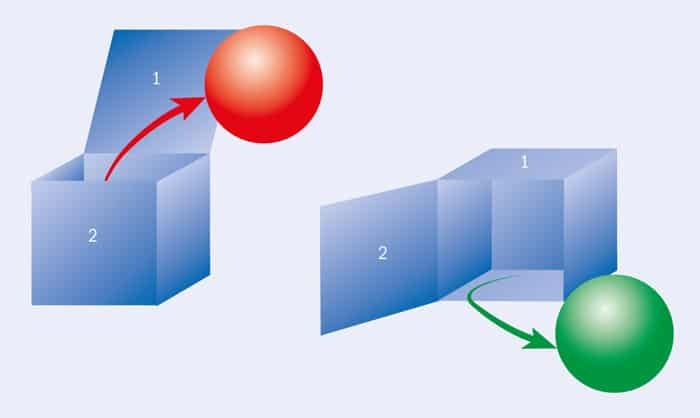
We can picture a bit as a box with a ball inside that can be coloured either red or green. The box has a single door we can open to find out the ball’s colour. A qubit is also such a box, but with two doors marked 1 and 2. Whenever we open the box, we must choose either door 1 or door 2; we cannot open both. However, opening a door not only reveals the colour inside but also unavoidably disturbs what is inside.
If we put a red ball in door 1 and later open door 2, the ball that comes out has a random colour: red with probability ½ and green with probability ½. Although we often use probability to describe classical systems, the randomness exhibited by quantum systems is different. If a classical box has a ball inside and we do not know the ball’s colour with certainty, we assign probabilities to the two possible colours, reflecting our incomplete knowledge. But for the quantum box, we may be powerless to predict what will happen when we observe the colour through door 2, even though we have complete knowledge of how the box was prepared (for example, by opening door 1).
Curious affair A qubit can be viewed as a box containing a ball that is either red or green, the colour of which can be viewed by opening either of two doors (1 and 2). Strangely, we cannot predict what will happen when we observe the colour through, say, door 2, even though we know exactly how the box was prepared, for example, by opening door 1. (IOP Publishing)
The deepest differences between classical and quantum information can be fully appreciated only if we consider systems with more than one part. So consider two qubits: Alice’s in London and Bob’s in New York. This qubit pair can be prepared in a state such that if Alice opens either door of her box in London she sees a random colour, and the same is true for Bob in New York. So neither party acquires any information by measuring his or her qubit. Instead, information is hidden in correlations between what Alice sees when she opens a door in London and what Bob sees when he opens a door in New York – in this particular state Alice and Bob are guaranteed to find the same colour if they both open the same door. There are four distinguishable ways in which boxes in London and New York could be perfectly correlated – Alice and Bob could see either the same colour or different colours when both open door 1 or both open door 2. By choosing one of those four ways, we have stored two bits in the boxes.
Classical systems can also be correlated, of course, but this is different. What’s strange is that the information is completely inaccessible locally; it is entirely stored in the correlations. Though the whole system is in some definite state, the parts of the system are not. That is “quantum entanglement”.
Stranger and stranger
Entanglement gets stranger still for systems with many parts. Picture a 100-page book. If the book were classical, then by reading one page we could learn 1% of the content of the book. But a highly entangled quantum book is different. Looking at any one page we see only random gibberish, learning almost nothing about the content of the book. That is because information does not reside on the individual pages; instead it is recorded in the correlations among the pages. Only by performing a complex collective observation on many pages at once can we discern the differences between one highly entangled book and another.
For a highly entangled state of a few hundred qubits, the correlations among the qubits are so complex that describing them completely using classical information would require an unthinkable number of bits – more in fact than the number of atoms in the visible universe. This extravagant complexity of the quantum world points toward a highly plausible but unproven conjecture: classical systems cannot in general simulate quantum systems efficiently. If true, this statement has extraordinary implications. It means that by building highly controllable, many-qubit quantum systems, we should be able to perform some information-processing tasks far faster than would be feasible if we lived in a classical – rather than a quantum – world.
The technology for controlling quantum systems is advancing rapidly, fuelling the hope that in a few decades human civilization will enter an age of quantum supremacy, in which quantum computers solve problems that are beyond the reach of classical digital computers, such as factoring large numbers and simulating the physics of complex molecules. But to realize that dream, we must overcome a formidable obstacle: that of “decoherence”, which ordinarily makes large quantum systems behave classically. Entanglement among the qubits in a quantum computer is the source of its power, but entanglement between the computer and its unobserved environment is our enemy, driving decoherence.
In a classical computer an error occurs if interactions with the environment flip a bit. But a qubit is more delicate – it suffers an error if any information at all about its state leaks to the environment. That is decoherence. So for a quantum computer to work effectively, the information it processes must be perfectly concealed from the outside world until the computation is completed and the result is announced.
What weapon shall we wield to battle decoherence? Entanglement! The best way to resist decoherence is to encode information in highly entangled states. The state stored in the computer is like an entangled quantum book. The environment, interacting with the pages one at a time, acquires no information about the content of the book, because the information resides not in the individual pages but rather in the correlations among the pages. This principle, dubbed “quantum error correction”, will guide the design of future quantum computing hardware and software.
Today’s scientists and engineers are fortunate to live in an age of emerging quantum technologies. Indeed, our imaginations are poorly equipped to anticipate the many potential rewards to be gained by manipulating highly entangled quantum states. We should expect the unexpected.
The 2013 Nobel Prize for Chemistry has been awarded to Martin Karplus, Michael Levitt and Arieh Warshel for their development of computer models of complex chemical systems. All three researchers have close links to physics. Karplus, who is a US and Austrian citizen, originally studied physics and chemistry at Harvard University and is now based there and at the University of Strasbourg. Levitt, who has a physics degree from King’s College London, is a US and UK citizen working at Stanford University, while Warshel is a US and Israeli citizen based at the University of Southern California. The trio will share the SEK 8m (£775,000) and will receive their medals at a ceremony in Stockholm on 10 December.
Karplus, Levitt and Warshel won the prize for developing computational techniques that use both classical and quantum physics to describe complex chemical processes. Chemical models based on classical physics are relatively easy to compute and can therefore be used to simulate some aspects of the behaviour of large molecules such as proteins. The problem, however, is that these classical models cannot describe crucial aspects of chemistry such as how reactions proceed. To do so requires models based on quantum mechanics, which in turn need huge amounts of computing power. Quantum simulations can therefore only be applied to relatively small molecules.
Focusing on free electrons
In the late 1960s Karplus was developing quantum-based computer models that could simulate chemical reactions. Meanwhile, Levitt and Warshel were both working at the Weizmann Institute of Science in Israel where they developed a classical computer model that could simulate certain properties of large biological molecules. Warshel joined Karplus at Harvard in 1970 and the pair started to combine their classical and quantum approaches. They developed the first ever computer program to use quantum physics to model the behaviour of free electrons during a chemical reaction, while using classical physics to describe the rest of the atoms and electrons in a molecule.
Over the next few years, Levitt and Warshel worked together at the Weizmann Institute and the University of Cambridge with the aim of developing models of enzymes – long-chain molecules that play crucial roles in just about every biochemical process. This they achieved in 1976, but an important feature of the techniques developed by Karplus, Levitt and Warshel is that they can be applied to all types of chemistry. As a result, they are now not only being used to study molecules that are important for life, but also to develop new industrial processes, build better solar cells and synthesize new drugs.
The theoretical chemist Alán Aspuru-Guzik told physicsworld.com: “Karplus, Levitt and Warshel are true pioneers of modern computational chemistry.” Aspuru-Guzik, who is at Harvard, added “The quantum-mechanics/molecular-mechanics approach that they introduced is now a commonplace tool that helps scientists understand important problems related to life and, for example, understand how drug molecules work.”
Physics and chemistry
Karplus was born in Vienna in 1930 and immigrated to the US with his family in 1938. He studied physics and chemistry at Harvard before completing a PhD in chemistry at Caltech in 1953 working under Linus Pauling. After stints at the universities of Oxford and Illinois, he joined Harvard in 1966. In 1996 he took a second appointment at Strasbourg.
I’m a physicist. But that’s okay
Michael Levitt, Stanford University
Levitt was born in 1947 in Pretoria, South Africa and obtained a bachelor’s degree in physics from King’s College London in 1967. After spending a year at the Weizmann Institute working on the theory of molecules he did a PhD on the conformational analysis of proteins at Cambridge. He then worked at the MRC Laboratory of Molecular Biology in Cambridge and the Weizmann Institute before arriving at the Stanford University School of Medicine in 1987. In a Tweet issued today by Stanford, Levitt is quoted as saying: “I never studied chemistry, actually; I’m a physicist. But that’s okay.”
Warshel, meanwhile, was born in 1940 at Kibbutz Sde-Nahum in Israel. He studied chemistry at Technion – Israel Institute of Technology before doing a Master’s and a PhD in chemical physics at the Weizmann Institute. After stints at Harvard and the Weizmann Institute, he joined the University of Southern California in 1976.
The 2013 Nobel Prize for Physics has been awarded to François Englert and Peter Higgs for the theoretical discovery of the Higgs boson. The prize is worth SEK 8m (£775,000) and will be shared by the pair, who will receive their medals at a ceremony in Stockholm on 10 December.
Englert is a Belgian citizen and is Emeritus Professor of Theoretical Physics at the Université Libre de Bruxelles. Higgs is a British citizen and is Emeritus Professor of Theoretical Physics at the University of Edinburgh.
According to the prize citation, the pair are honoured “for the theoretical discovery of a mechanism that contributes to our understanding of the origin of mass of subatomic particles, and which recently was confirmed through the discovery of the predicted fundamental particle, by the ATLAS and CMS experiments at CERN’s Large Hadron Collider”.
In 1964 Englert and Higgs published papers independently of each other that set in motion the 48-year search for the Higgs boson that ended with its discovery last year at CERN.
Winners didn’t meet until 2012
Speaking on the telephone to journalists in Stockholm, Englert said that winning the prize was “Not very unpleasant, of course. I am very, very happy to have the recognition of this award.” Englert also mentioned that the first time he met his co-winner Higgs was at CERN on 4 July 2012 when physicists working on the Large Hadron Collider announced the discovery of the Higgs particle.
Permanent secretary of the Royal Swedish Academy of Sciences, Staffan Normark, said that the committee has so far been unable to contact Higgs. However a statement from Higgs has been issued by the University of Edinburgh. He says: “I am overwhelmed to receive this award and thank the Royal Swedish Academy. I would also like to congratulate all those who have contributed to the discovery of this new particle and to thank my family, friends and colleagues for their support. I hope this recognition of fundamental science will help raise awareness of the value of blue-sky research.”
Brout–Englert–Higgs mechanism
Commenting on the award, CERN’s director-general Rolf-Dieter Heuer says “The discovery of the Higgs boson at CERN last year, which validates the Brout–Englert–Higgs mechanism, marks the culmination of decades of intellectual effort by many people around the world.” Heuer’s comment highlights the contributions of the late US/Belgian physicist Robert Brout, who co-authored Englert’s 1964 paper and who was his long-time colleague at the Université Libre de Bruxelles. Brout died in 2011 and the Nobel prize is not awarded posthumously.
Several other physicists are also associated with the discovery of the Higgs mechanism, including Carl Hagen, Gerald Guralnik and Tom Kibble, who together published a paper in late 1964 in which they independently came to the same conclusions as Brout, Englert and Higgs. Commenting on the award, Kibble acknowledges that “our paper was unquestionably the last of the three to be published in Physical Review Letters in 1964…and it is therefore no surprise that the Swedish Academy felt unable to include us”. In an interview with Physics World in 2012, Higgs was also keen to flag the contributions of the US theorist Philip Anderson.
Symmetry-breaking event
The existence of a Higgs-like mass-generating mechanism plays an essential role in the Standard Model of particle physics. It arises from a symmetry-breaking event that occurred in the very early universe that created a uniform scalar field known as the Higgs field that pervades all space. Elementary particles such as leptons, quarks and the W and Z bosons conveying the weak force “acquire” their distinctive masses by virtue of their unique and different couplings to this field.
Wave–particle duality at the heart of quantum mechanics dictates that vibrations in this field should give rise to a spin-0 particle (or particles) known as the Higgs boson(s). Just as vibrating the electromagnetic field generates waves corresponding to photons, so should shaking the Higgs field create such bosons. The question that faced particle physicists over the past decades was how hard did the Higgs field need to be shaken in order to create detectable quantities of Higgs bosons? The answer came in 2012, when physicists analysed vast numbers of proton–proton collisions at 8 TeV and found very strong evidence for the Higgs boson.
Peter Higgs was born in 1929 in Newcastle-upon-Tyne, UK. He attended Cotham Grammar School in Bristol, which also counts Nobel laureate Paul Dirac as one of its former pupils. He enrolled as a physics undergraduate at King’s College London, where he went on to do a PhD on the theory of molecules. Higgs then worked at several British universities before settling at the University of Edinburgh, where he has been since 1960.
François Englert was born in Belgium in 1932 in the Brussels suburb of Etterbeek. He received a degree in electrical engineering from the Université Libre de Bruxelles before completing a PhD in natural sciences in 1959 at the same university. Englert then worked at Cornell University in the US for two years before returning to the Université Libre de Bruxelles, where he has been since 1961.
A new material that once deformed will automatically return to its original shape when heated has been developed by researchers in the US. While this is not the first such “shape-memory metal”, the latest material can go through 16,000 shape-shifting cycles without significant degradation – making it far more robust than existing materials. The metal was created using a theoretical model that predicts which types of materials should have superior shape-memory properties. The team believes its model will lead to the creation of new types of materials that could have a range of technological applications.
Shape-memory alloys are reversible phase-change materials that can exist in two crystal-lattice structures: one that is more stable above a certain transition temperature and the other favoured at lower temperatures. If the material is cooled through the transition temperature, the lattice reconfigures itself to the low-temperature structure. If it is then heated above the transition temperature, it reverts back to the high-temperature structure.
Deforming a shape-memory metal in the low-temperature phase produces a distorted version of the low-temperature lattice structure. When heated, this distorted low-temperature lattice cannot directly reconfigure itself into the high-temperature version. Instead, the metal reverts to its original shape, which allows it to adopt the high-temperature crystal structure. Applications for these materials include temperature-sensitive switches and guide wires used in catheters.
Highly stressed phase
Traditional phase-change materials undergo this shape change by passing through a highly stressed intermediate phase that introduces cracks and dislocations into the material. As this damage builds up, the shape-shifting abilities of the material degrade and sometimes the material can lose strength and fail altogether.
In 2005 Richard James and Zhiyong Zhang at the University of Minnesota outlined a set of theoretical requirements for a phase-change material to be free of this stressed transition state. If material could be made with these desired “cofactor conditions”, its structural phase could be flipped repeatedly without damaging the material.
Now, James and colleagues have designed and manufactured such a material. They began with a known shape-memory material – the alloy Zn2AuCu – and used computer modelling to find candidate alloys with slightly different proportions of zinc, gold and copper that would better satisfy the cofactor conditions. When they had arrived at their three best candidates, they prepared the alloys in the lab to see which one had the best properties.
Unpredictable array of structures
The researchers found that one of the candidates – Zn45Au30Cu25 – satisfied the theoretical requirements almost perfectly. Furthermore, the team found that the material could be put through 16,000 hot and cold cycles without any damage to its phase-change properties. On the atomic scale, the researchers found that, whereas traditional phase-change materials return to the same, increasingly imperfect, lattice structure every time the material is cooled, the lattice of their material was a complex, unpredictable array of different structures that was reset every time the material cooled through the transition temperature. This verifies a prediction made in 2007 by James and colleagues that multiple lattice structures would be possible in a material that satisfied the cofactor conditions. The meandering domain boundaries between areas of different lattice structure led the researchers to jokingly christen the new structure “riverine”.
This latest research is reported in Nature and the paper simply deals with the preservation of phase-change properties over a large number of cycles. However, James told physicsworld.com that his team has also established that the shape-memory effect is preserved as well. The researchers are also looking for other examples of phase-change materials that satisfy the cofactor conditions. “We would love to try this on a ceramic system where it would be really unexpected to have this reversibility of a big first-order phase transformation,” he says.
New generation of alloys
Ryusoke Kainuma from Tohuku University in Japan, an expert on shape-memory metals, believes that the paper “opens the door to a new generation of shape-memory alloys”, although he suggests that the difficulty of manufacturing the Zn45Au30Cu25 alloy together with the high cost of gold is likely to rule out any direct industrial application.
Meanwhile, materials physicist James Morris of the Oak Ridge National Laboratory in Tennessee is most impressed by the unconventional way that the researchers have used abstract concepts to design a real material. “Without saying what the degradation mechanisms are and without looking at the structures of the interfaces, they’ve said ‘this geometrical thing should minimize the stress that leads to degradation, and so we’re going to try that’,” he says. “And it looks reasonably convincing.”
Welcome to the second instalment of the Physics World at 25 Puzzle. The first puzzle was released last week and your second challenge lies below. #PW25puzzle
Is Schrödinger’s cat alive or dead?
1. Schrödinger’s cat is alive. 2. Schrödinger’s cat is dead. 3. Exactly one of statements 6 and 9 is true. 4. Exactly one of statements 2 and 6 is false. 5. Statements 4, 5 and 10 are all false. 6. Exactly one of statements 1 and 10 is false. 7. Exactly 5 statements are true. 8. Exactly one of statements 3 and 10 is false. 9. Exactly one of statements 6 and 10 is true. 10. Exactly one of statements 1 and 2 is false. 11. Statements 1, 8 and 11 are all false.
Enter your answer as a list, in numerical order, of the number(s) of the statements that are definitely true, as a single string with no spaces, such as, for example, 25811.
The National Institute of Standards and Technology website is on furlough this week.
By Hamish Johnston
This week the magazine and journal Science published an article called “Who’s afraid of peer review?“. It describes a remarkable “sting” operation by the journalist John Bohannon, who submitted a spoof scientific paper to 300 or so open-access scientific journals. The paper claimed to offer evidence for the anti-cancer properties of a naturally occurring compound. It contained several fundamental errors that should have been caught by the peer-review process, not to mention made-up authors working at fictitious institutes. Instead of being rejected by all the journals, more than half of the submissions (157 in total) were accepted for publication.