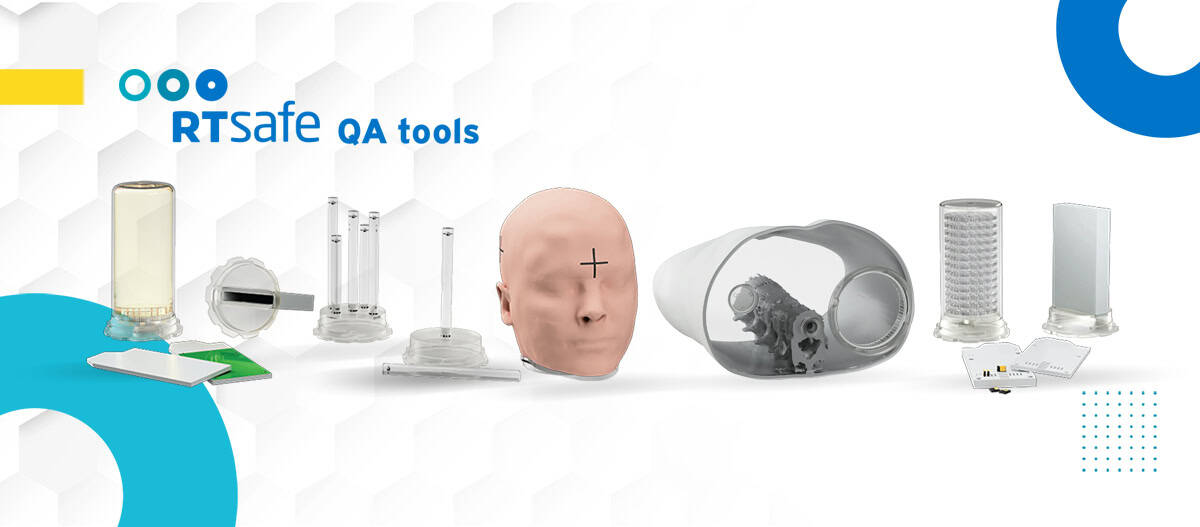
This webinar will present the overall experience of a radiotherapy department that utilizes RTsafe QA solutions, including the RTsafe Prime and SBRT anthropomorphic phantoms for intracranial stereotactic radiosurgery (SRS) and stereotactic body radiation therapy (SBRT) applications, respectively, as well as the remote dosimetry services offered by RTsafe. The session will explore how these phantoms can be employed for end-to-end QA measurements and dosimetry audits in both conventional linacs and a Unity MR-Linac system. Key features of RTsafe phantoms, such as their compatibility with RTsafe’s remote dosimetry services for point (OSLD, ionization chamber), 2D (films), and 3D (gel) dosimetry, will be discussed. These capabilities enable a comprehensive SRS/SBRT accuracy evaluation across the entire treatment workflow – from imaging and treatment planning to dose delivery.
Christopher Schneider is the adaptive radiotherapy technical director at Mary Bird Perkins Cancer Center and serves as an adjunct assistant professor in the Department of Physics and Astronomy at Louisiana State University in Baton Rouge. Under his supervision, Mary Bird’s MR-guided adaptive radiotherapy program has provided treatment to more than 150 patients in its first year alone. Schneider’s research group focuses on radiation dosimetry, late effects of radiation, and the development of radiotherapy workflow and quality-assurance enhancements.
A non-invasive, non-contact technique that focuses light on moving structures in scattering materials has been developed by researchers in the US. Dubbed time-reversed adapted-perturbation (TRAP) optical focusing, the technique can be used in soft tissue and has a range of potential medical and biological applications (Nature Photonics 8 931).
In medicine, the ability to focus light at depth in tissue – a strongly scattering medium – is valuable in techniques including photoacoustic imaging and photoablation therapies. Existing strategies use a “guide star” – a reference source that characterizes scatter in the medium. The problem is that physical versions, such as implanted fluorescence beads, are invasive, while “virtual” guide stars, which use focused ultrasound, have to be placed in direct contact with skin, limiting clinical applications. TRAP, in contrast, seeks out moving structures and uses them instead.
“The original motivation for inventing TRAP was to develop a technology that can focus inside tissue non-invasively and without physical contact,” says lead author Cheng Ma of the Optical Imaging Laboratory at Washington University in St Louis. However, the researchers soon realized that TRAP can enable several diagnostic and therapeutic applications that are not possible with conventional focusing.
Therapeutic and diagnostic applications
For example, by detecting and focusing light on flowing blood, the technique could be used in the targeted ablation of the enlarged blood vessels of port-wine stains (red or purple marks on the skin caused by abnormal blood-vessel growth). “TRAP can guide light to bypass the stationary portion of the tissue, the extravascular space to be protected, and focus only onto the targeted vessels to be treated,” explains lab director Lihong Wang.
The detection of flowing blood could also benefit photoacoustic imaging techniques such as photoacoustic computed tomography (PACT), which exploits the absorption of light in blood vessels to build functional images of how much oxygen is in the blood. By focusing light only on the vessels, the photoacoustic signal is increased, which increases image contrast and the depth at which vessels can be imaged.
TRAP uses a pulsed laser to illuminate a sample of a scattering medium, with the transmitted 2D scatter field recorded by an interferometer downstream. After a short delay, in which the intended focusing target has moved within the medium, the process is repeated. By subtracting one scatter field from the other, the old and new locations of the target are revealed, while eliminating signals from the stationary medium.
The distribution is converted to a map that describes the equivalent modulation in phase between the two images. The map is displayed downstream of the medium on a liquid-crystal spatial light modulator (SLM) – a phase conjugate mirror. A beam that is then fired at the mirror “reads” the map and gets phase-conjugated upon reflection, which time reverses the signal, focusing it onto the moving target. Repeated scatter snapshots allow the focused light to track the target.
In an experimental assessment, the researchers used TRAP to detect and focus light on blood from a cow pumped through a tube embedded between two pieces of chicken-breast tissue. It focused light in the blood to three times the intensity in the surrounding chicken. In a second investigation, TRAP was successfully used to detect a chromium marker and focus light on it after it was moved from outside to inside an illuminated region.
TRAP is far from perfect though. The researchers showed that its focusing ability deteriorates if the scattering medium moves. They are currently trying to minimize the effect with improvements that will speed up the technique. They also plan to improve TRAP’s focusing power.
In its current form, these two issues limit TRAP’s use to experiments in vitro and on excised tissue samples. “We are pushing hard to address these issues to make the technique useful for in vivo clinical uses,” says Ma, adding that the group also plans to explore a reflective implementation of TRAP, which would have a wider range of clinical uses.
Imagine you have been transported to another universe with four spatial dimensions. What would the colour of the Sun be in this four-dimensional universe? You may assume that the surface temperature of the Sun is the same as in our universe and is approximately T = 6 × 10³ K. [10 marks]
Boltzmann constant, kB = 1.38 × 10⁻²³ J K−1
Speed of light, c = 3 × 10⁸ m s−1
Solution
Black body radiation, spectral density: ε (ν) dν = hνρ (ν) n (ν)
The photon energy, E = hν where h is Planck’s constant and ν is the photon frequency.
The density of states, ρ (ν) = Aνn−1 where A is a constant independent of the frequency and the frequency term is the scaling of surface area of an n-dimensional sphere.
The Bose–Einstein distribution,
n(v)
where k is the Boltzmann constant and T is the temperature.
We let
and get
ε(x)
We do not need the constant of proportionality (which is not simple to calculate in 4D) to find the maximum of ε (x). Working out the constant just tells us how tall the peak is, but we are interested in where the peak is, not the total radiation.
We set this equal to zero for the maximum of the distribution,
This yields x = n (1 − e−x) where
and we can relate
and c being the speed of light.
This equation has the solution x = n +W (−ne−n) where W is the Lambert W function z = W (y) that solves zez = y (although there is a subtlety about which branch of the function). This is kind of useless to do anything with, though. One can numerically solve this equation using bisection/Newton–Raphson/iteration. Alternatively, one could notice that as the number of dimensions increases, e−x is small, so to leading approximation x ≈ n. One can do a little better iterating this, x ≈ n − ne−n which is what we will use. Note the second iteration yields
Number of dimensions, n
Numerical solution
Approximation
2
1.594
1.729
3
2.821
2.851
4 (the one we want)
3.921
3.927
5
4.965
4.966
6
5.985
5.985
Using the result above,
616 nm is middle of the spectrum, so it will look white with a green-blue tint. Note, we have used T = 6000 K for the temperature here, as given in the question.
It would also be valid to look at ε (λ) dλ instead of ε (ν) dν.
Question 2: Heavy stuff
In a parallel universe, two point masses, each of 1 kg, start at rest a distance of 1 m apart. The only force on them is their mutual gravitational attraction, F = –Gm1m2/r2. If it takes 26 hours and 42 minutes for the two masses to meet in the middle, calculate the value of the gravitational constant G in this universe. [10 marks]
Solution
First we will set up the equations of motion for our system. We will set one mass to be at position −x and the other to be at x, so the masses are at a distance of 2x from each other. Starting from Newton’s law of gravity:
we can then use Newton’s second law to rewrite the LHS,
which we can simplify to
It is important that you get the right factor here depending on your choice for the particle coordinates at the start. Note there are other methods of getting this point, e.g. reduced mass.
We can now solve the second order ODE above. We will not show the whole process here but present the starting point and key results. We can write the acceleration in terms of the velocity. The initial velocity is zero and the initial position
So,
and once the integrals are solved we can rearrange for the velocity,
Now we can form an expression for the total time taken for the masses to meet in the middle,
There are quite a few steps involved in solving this integral, for these solutions, we shall make use of the following (but do attempt to solve it for yourselves in full).
Hence,
We can now rearrange for G and substitute in the values given in the question, don’t forget to convert the time into seconds.
This is the generally accepted value for the gravitational constant of our universe as well.
Question 3: Just like clockwork
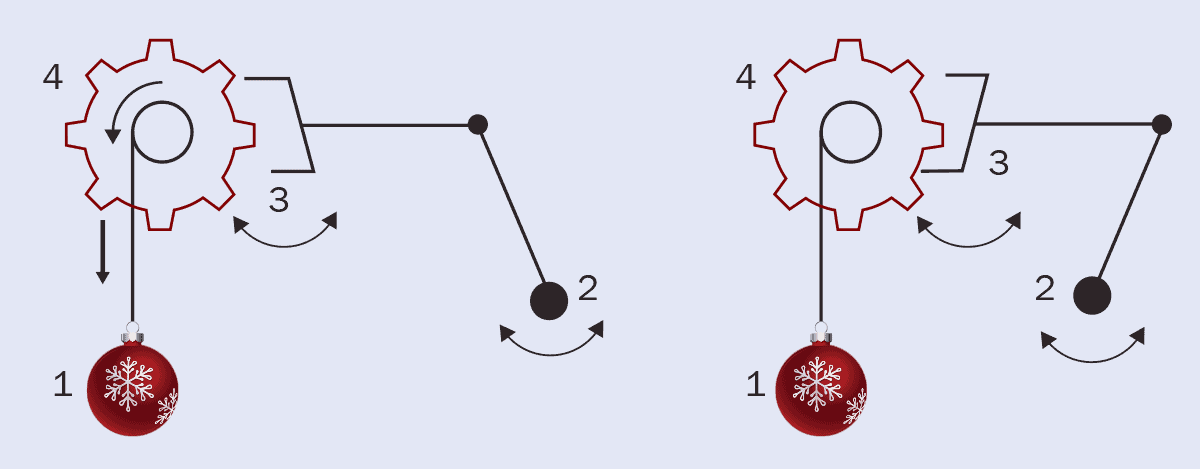
Consider a pendulum clock that is accurate on the Earth’s surface. Figure 1 shows a simplified view of this mechanism.
1 Tick tock Simplified schematic of a pendulum clock mechanism. When the pendulum swings one way (a), the escapement releases the gear attached to the hanging mass and allows it to fall. When the pendulum swings the other way (b) the escapement stops the gear attached to the mass moving so the mass stays in place. (Courtesy: Katherine Skipper/IOP Publishing)
A pendulum clock runs on the gravitational potential energy from a hanging mass (1). The other components of the clock mechanism regulate the speed at which the mass falls so that it releases its gravitational potential energy over the course of a day. This is achieved using a swinging pendulum of length l (2), whose period is given by
where g is the acceleration due to gravity.
Each time the pendulum swings, it rocks a mechanism called an “escapement” (3). When the escapement moves, the gear attached to the mass (4) is released. The mass falls freely until the pendulum swings back and the escapement catches the gear again. The motion of the falling mass transfers energy to the escapement, which gives a “kick” to the pendulum that keeps it moving throughout the day.
Radius of the Earth, R = 6.3781 × 10⁶ m
Period of one Earth day, τ0 = 8.64 × 10⁴ s
How slow will the clock be over the course of a day if it is lifted to the hundredth floor of a skyscraper? Assume the height of each storey is 3 m. [4 marks]
Solution
We will write the period of oscillation of the pendulum at the surface of the Earth to be
.
At a height h above the surface of the Earth the period of oscillation will be
,
where g0 and gh are the acceleration due to gravity at the surface of the Earth and a height h above it respectively.
We can define τ0 to be the total duration of the day which is 8.64 × 10⁴ seconds and equal to N complete oscillations of the pendulum at the surface. The lag is then τh which will equal N times the difference in one period of the two clocks, τh = NΔT, where ΔT = (Th − T0). We can now take a ratio of the lag over the day and the total duration of the day:
Then by substituting in the expressions we have for the period of a pendulum at the surface and height h we can write this in terms of the gravitational constant,
[Award 1 mark for finding the ratio of the lag over the day and the total period of the day.]
The acceleration due to gravity at the Earth’s surface is
where G is the universal gravitational constant, M is the mass of the Earth and R is the radius of the Earth. At an altitude h, it will be
[Award 1 mark for finding the expression for the acceleration due to gravity at height h.]
Substituting into our expression for the lag, we get:
This simplifies to an expression for the lag over a day. We can then substitute in the given values to find,
[Award 2 marks for completing the simplification of the ratio and finding the lag to be ≈ 4 s.]
Question 4: Quantum stick
Imagine an infinitely thin stick of length 1 m and mass 1 kg that is balanced on its end. Classically this is an unstable equilibrium, although the stick will stay there forever if it is perfectly balanced. However, in quantum mechanics there is no such thing as perfectly balanced due to the uncertainty principle – you cannot have the stick perfectly upright and not moving at the same time. One could argue that the quantum mechanical effects of the uncertainty principle on the system are overpowered by others, such as air molecules and photons hitting it or the thermal excitation of the stick. Therefore, to investigate we would need ideal conditions such as a dark vacuum, and cooling to a few millikelvins, so the stick is in its ground state.
Moment of inertia for a rod,
where m is the mass and l is the length.
Uncertainty principle,
There are several possible approximations and simplifications you could make in solving this problem, including:
sinθ ≈ θ for small θ
and
Calculate the maximum time it would take such a stick to fall over and hit the ground if it is placed in a state compatible with the uncertainty principle. Assume that you are on the Earth’s surface. [10 marks]
Hint: Consider the two possible initial conditions that arise from the uncertainty principle.
Solution
We can imagine this as an inverted pendulum, with gravity acting from the centre of mass and at an angle θ from the unstable equilibrium point.
[Award 1 mark for a suitable diagram of the system.]
We must now find the equations of motion of the system. For this we can use Newton’s second law in its rotational form τ = Iα (torque = moment of inertia × angular acceleration). We have another equation for torque we can use as well
where r is the distance from the pivot to the centre of mass and F is the force, which in this case is gravity mg. We can then equate these giving
Substituting in the given moment of inertia of the stick and that the angular acceleration
We can cancel a few things and rearrange to get a differential equation of the form:
we then can take the small angle approximation sin θ ≈ θ, resulting in
[Award 2 marks for finding the equation of motion for the system and using the small angle approximation.]
Solve with ansatz of θ = Aeωt + Be−ωt, where we have chosen
We can clearly see that this will satisfy the differential equation
Now we can apply initial conditions to find A and B, by looking at the two cases from the uncertainty principle
Case 1: The stick is at an angle but not moving
At t = 0, θ = Δθ
θ = Δθ = A + B
At t = 0,
, A=B
This implies Δθ = 2A and we can then find
So we can now write
or
Case 2: The stick is at upright but moving
At t = 0, θ = 0
This condition gives us A = −B.
At t = 0,
This initial condition has come from the relationship between the tangential velocity, Δv which equals the distance to the centre of mass from the pivot point, and the angular velocity . Using the above initial condition gives us where
We can now write
[Award 4 marks for finding the two expressions for θ by using the two cases of the uncertainty principle.]
Now there are a few ways we can finish off this problem, we shall look at three different ways. In each case when the stick has fallen on the ground .
Method 1
Take and , use then rearrange for tf in both cases. We have
Look at the expression for cosh−1x and sinh−1x given in the question. They are almost identical, we can then approximate the two arguments to each other and we find,
we can then substitute in the uncertainty principle as and then write an expression of , which we can put back into our arccosh expression (or do it for Δv and put into arcsinh).
where and .
Method 2
In this next method, when you get to the inverse hyperbolic functions, you can take an expansion of their natural log forms in the tending to infinity limit. To first order both functions give ln 2x, we can then equate the arguments and find Δx or Δv in terms of the other and use the uncertainty principle. This would give the time taken as,
where and .
Method 3
Rather than using hyperbolic functions, you could do something like above and do an expansion of the exponentials in the two expressions for tf or we could make life even easier and do the following.
Disregard the e−ωt terms as they will be much smaller than the eωt terms. Equate the two expressions for and then take the natural logs, once again arriving at an expression of
where and .
This method efficiently sets B = 0 when applying the initial conditions.
[Award 2 marks for reaching an expression for t using one of the methods above or a suitable alternative that gives the correct units for time.]
Then, by using one of the expressions above for time, substitute in the values and find that t = 10.58 seconds.
[Award 1 mark for finding the correct time value of t = 10.58 seconds.]
If you’re a student who wants to sign up for the 2025 edition of PLANCKS UK and Ireland, entries are now open at plancks.uk
This episode of the Physics World Weekly podcast features Mark Thomson, who will become the next director-general of CERN in January 2026. In a conversation with Physics World’s Michael Banks, Thomson shares his vision of the future of the world’s preeminent particle physics lab, which is home to the Large Hadron Collider (LHC).
They chat about the upcoming high-luminosity upgrade to the LHC (HL-LHC), which will be completed in 2030. The interview explores long-term strategies for particle physics research and the challenges of managing large international scientific organizations. Thomson also looks back on his career in particle physics and his involvement with some of the field’s biggest experiments.
This podcast is supported by Atlas Technologies, specialists in custom aluminium and titanium vacuum chambers as well as bonded bimetal flanges and fittings used everywhere from physics labs to semiconductor fabs.
Oil spills can pollute large volumes of surrounding water – thousands of times greater than the spill itself – causing long-term economic, environmental, social and ecological damage. Effective methods for in situ capture of spilled oil are thus essential to minimize contamination from such disasters.
Many oil spill cleanup technologies, however, exhibit poor hydrodynamic stability under complex flow conditions, which leads to poor oil-capture efficiency. To address this shortfall, researchers from Harbin Institute of Technology in China have come up with a new approach to oil cleanup using a vortex-anchored filter (VAF).
“Since the 1979 Atlantic Empress disaster, interception and adsorption have been the primary methods for oil spill recovery, but these are sensitive to water-flow fluctuation,” explains lead author Shijie You. Oil-in-water emulsions from leaking pipelines and offshore industrial discharge are particularly challenging, says You, adding that “these problems inspire us to consider how we can address hydrodynamic stability of oil-capture devices under turbulent conditions”.
Inspired by the natural world
You and colleagues believe that the answers to oil spill challenges could come from nature – arguably the world’s greatest scientist. They found that the deep-sea glass sponge E. aspergillum, which lives at depths of up to 1000 m in the Pacific Ocean, has an excellent ability to filter feed with a high effectiveness, selectivity and robustness, and that its food particles share similarities with oil droplets.
The anatomical structure of E. aspergillum – also known as Venus’ flower basket – provided inspiration for the researchers to design their VAF. By mimicking the skeletal architecture and filter feeding patterns of the sponge, they created a filter that exhibited a high mass transfer and hydrodynamic stability in cleaning up oil spills under turbulent flow.
“The E. aspergillum has a multilayered skeleton–flagellum architecture, which creates 3D streamlines with frequent collision, deflection, convergence and separation,” explains You. “This can dissipate macro-scale turbulent flows into small-scale swirling flow patterns called low-speed vortical flows within the body cavity, which reduces hydrodynamic load and enhances interfacial mass transfer.”
For the sponges, this allows them to maintain a high mechanical stability while absorbing nutrients from the water. The same principles can be applied to synthetic materials for cleaning up oil spills.
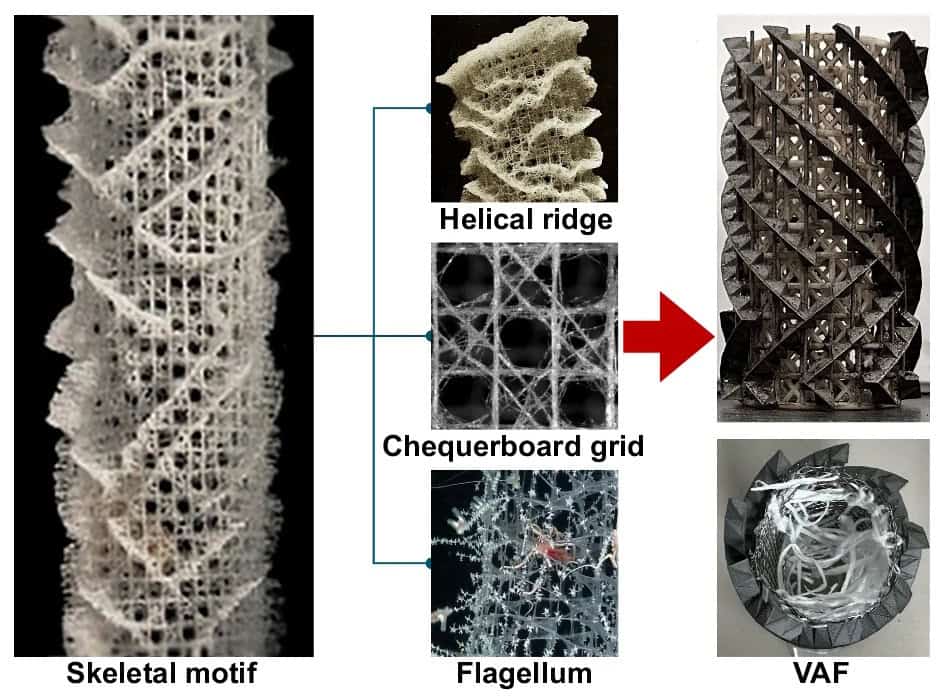
VAF design Skeletal motif of E. aspergillum and (right column) front and top views of the VAF with a bio-inspired hollow cylinder skeleton and flagellum adsorbent. (Courtesy: Y Yu et al. Nat. Commun. 10.1038/s41467-024-55587-y)
The VAF is a synthetic form of the sponge’s architecture and, according to You, “is capable of transferring kinematic energy from an external water flow into multiple small-scale low-speed vortical flows within the body cavity to enhance hydrodynamic stability and oil capture efficiency”.
The tubular outer skeleton of the VAF comprises a helical ridge and chequerboard lattice. It is this skeleton that creates a slow vortex field inside the cavity and enables mass transfer of oil during the filtering process. Once the oil has been forced into the filter, the internal area – composed of flagellum-shaped adsorbent materials – provides a large interfacial area for oil adsorption.
Using the VAF to clean up oil spills
The researchers used their nature-inspired VAF to clean up oil spills under complex hydrodynamic conditions. You states that “the VAF can retain the external turbulent-flow kinetic energy in the low-speed vortical flows – with a small Kolmogorov microscale (85 µm) [the size of the smallest eddy in a turbulent flow] – inside the cavity of the skeleton, leading to enhanced interfacial mass transfer and residence time”.
“This led to an improvement in the hydrodynamic stability of the filter compared to other approaches by reducing the Reynolds stresses in nearly quiescent wake flows,” You explains. The filter was also highly resistant to bending stresses caused at the boundary of the filter when trying separate viscous fluids. When put into practice, the VAF was able to capture more than 97% of floating, underwater and emulsified oils, even under strong turbulent flow.
When asked how the researchers plan to improve the filter further, You tells Physics World that they “will integrate the VAF with photothermal, electrothermal and electrochemical modules for environmental remediation and resource recovery”.
“We look forward to applying VAF-based technologies to solve sea pollution problems with a filter that has an outstanding flexibility and adaptability, easy-to-handle operability and scalability, environmental compatibility and life-cycle sustainability,” says You.
A topological electronic crystal (TEC) in which the quantum Hall effect emerges without the need for an external magnetic field has been unveiled by an international team of physicists. Led by Josh Folk at the University of British Columbia, the group observed the effect in a stack of bilayer and trilayer graphene that is twisted at a specific angle.
In a classical electrical conductor, the Hall voltage and its associated resistance appear perpendicular both to the direction of an applied electrical current and an applied magnetic field. A similar effect is also seen in 2D electron systems that have been cooled to ultra-low temperatures. But in this case, the Hall resistance becomes quantized in discrete steps.
This quantum Hall effect can emerge in electronic crystals, also known as Wigner crystals. These are arrays of electrons that are held in place by their mutual repulsion. Some researchers have considered the possibility of a similar effect occurring in structures called TECs, but without an applied magnetic field. This is called the “quantum anomalous Hall effect”.
Anomalous Hall crystal
“Several theory groups have speculated that analogues of these structures could emerge in quantized anomalous Hall systems, giving rise to a type of TEC termed an ‘anomalous Hall crystal’,” Folk explains. “This structure would be insulating, due to a frozen-in electronic ordering in its interior, with dissipation-free currents along the boundary.”
For Folk’s team, the possibility of anomalous hall crystals emerging in real systems was not the original focus of their research. Initially, a team at the University of Washington had aimed to investigate the diverse phenomena that emerge when two or more flakes of graphene are stacked on top of each other, and twisted relative to each other at different angles
While many interesting behaviours emerged from these structures, one particular stack caught the attention of Washington’s Dacen Waters, which inspired his team to get in touch with Folk and his colleagues in British Columbia.
In a vast majority of cases, the twisted structures studied by the team had moiré patterns that were very disordered. Moiré patterns occur when two lattices are overlaid and rotated relative to each other. Yet out of tens of thousands of permutations of twisted graphene stacks, one structure appeared to be different.
Exceptionally low levels of disorder
“One of the stacks seemed to have exceptionally low levels of disorder,” Folk describes. “Waters shared that one with our group to explore in our dilution refrigerator, where we have lots of experience measuring subtle magnetic effects that appear at a small fraction of a degree above absolute zero.”
As they studied this highly ordered structure, the team found that its moiré pattern helped to modulate the system’s electronic properties, allowing a TEC to emerge.
“We observed the first clear example of a TEC, in a device made up of bilayer graphene stacked atop trilayer graphene with a small, 1.5° twist,” Folk explains. “The underlying topology of the electronic system, combined with strong electron-electron interactions, provide the essential ingredients for the crystal formation.”
After decades of theoretical speculation, Folk, Waters and colleagues have identified an anomalous Hall crystal, where the quantum Hall effect emerges from an in-built electronic structure, rather than an applied magnetic field.
Beyond confirming the theoretical possibility of TECs, the researchers are hopeful that their results could lay the groundwork for a variety of novel lines of research.
“One of the most exciting long-term directions this work may lead is that the TEC by itself – or perhaps a TEC coupled to a nearby superconductor – may host new kinds of particles,” Folk says. “These would be built out of the ‘normal’ electrons in the TEC, but totally unlike them in many ways: such as their fractional charge, and properties that would make them promising as topological qubits.”
Pollution from microplastics – small plastic particles less than 5 mm in size – poses an ongoing threat to human health. Independent studies have found microplastics in human tissues and within the bloodstream. And as blood circulates throughout the body and through vital organs, these microplastics reach can critical regions and lead to tissue dysfunction and disease. Microplastics can also cause functional irregularities in the brain, but exactly how they exert neurotoxic effects remains unclear.
A research collaboration headed up at the Chinese Research Academy of Environmental Sciences and Peking University has shed light on this conundrum. In a series of cerebral imaging studies reported in Science Advances, the researchers tracked the progression of fluorescent microplastics through the brains of mice. They found that microplastics entering the bloodstream become engulfed by immune cells, which then obstruct blood vessels in the brain and cause neurobehavioral abnormalities.
“Understanding the presence and the state of microplastics in the blood is crucial. Therefore, it is essential to develop methods for detecting microplastics within the bloodstream,” explains principal investigator Haipeng Huang from Peking University. “We focused on the brain due to its critical importance: if microplastics induce lesions in this region, it could have a profound impact on the entire body. Our experimental technology enables us to observe the blood vessels within the brain and detect microplastics present in these vessels.”
In vivo imaging
Huang and colleagues developed a microplastics imaging system by integrating a two-photon microscopy system with fluorescent plastic particles and demonstrated that it could image brain blood vessels in awake mice. They then fed five mice with water containing 5-µm diameter fluorescent microplastics. After a couple of hours, fluorescence images revealed microplastics within the animals’ cerebral vessels.
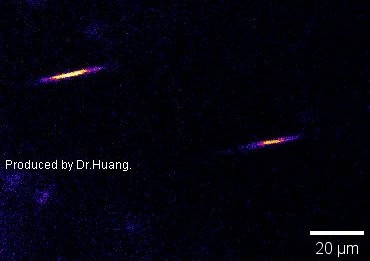
Lightening bolt The “MP-flash” observed as two plastic particles rapidly fly through the cerebral blood vessels. (Courtesy: Haipeng Huang)
As they move through rapidly flowing blood, the microplastics generate a fluorescence signal resembling a lightning bolt, which the researchers call a “microplastic flash” (MP-flash). This MP-flash was observed in four of the mice, with the entire MP-flash trajectory captured in a single imaging frame of less than 208 ms.
Three hours after administering the microplastics, the researchers observed fluorescent cells in the bloodstream. The signals from these cells were of comparable intensity to the MP-flash signal, suggesting that the cells had engulfed microplastics in the blood to create microplastic-labelled cells (MPL-cells). The team note that the microplastics did not directly attach to the vessel wall or cross into brain tissue.
To test this idea further, the researchers injected microplastics directly into the bloodstream of the mice. Within minutes, they saw the MP-Flash signal in the brain’s blood vessels, and roughly 6 min later MPL-cells appeared. No fluorescent cells were seen in non-treated mice. Flow cytometry of mouse blood after microplastics injection revealed that the MPL-cells, which were around 21 µm in dimeter, were immune cells, mostly neutrophils and macrophages.
Tracking these MPL-cells revealed that they sometimes became trapped within a blood vessel. Some cells exited the imaging field following a period of obstruction while others remained in cerebral vessels for extended durations, in some instances for nearly 2.5 h of imaging. The team also found that one week after injection, the MPL-cells had still not cleared, although the density of blockages was much reduced.
“[While] most MPL-cells flow rapidly with the bloodstream, a small fraction become trapped within the blood vessels,” Huang tells Physics World. “We provide an example where an MPL-cell is trapped at a microvascular turn and, after some time, is fortunate enough to escape. Many obstructed cells are less fortunate, as the blockage may persist for several weeks. Obstructed cells can also trigger a crash-like chain reaction, resulting in several MPL-cells colliding in a single location and posing significant risks.”
The MPL-cell blockages also impeded blood flow in the mouse brain. Using laser speckle contrast imaging to monitor blood flow, the researchers saw reduced perfusion in the cerebral cortical vessels, notably at 30 min after microplastics injection and particularly affecting smaller vessels.
Reduced blood flow These laser speckle contrast images show blood flow in the mouse brain at various times after microplastics injection. The images indicate that blockages of microplastic-labelled cells inhibit perfusion in the cerebral cortical vessels. (Courtesy: Huang et al. Sci. Adv.11 eadr8243 (2025))
Changing behaviour
Lastly, Huang and colleagues investigated whether the reduced blood supply to the brain caused by cell blockages caused behavioural changes in the mice. In an open-field experiment (used to assess rodents’ exploratory behaviour) mice injected with microplastics travelled shorter distances at lower speeds than mice in the control group.
The Y-maze test for assessing memory also showed that microplastics-treated mice travelled smaller total distances than control animals, with a significant reduction in spatial memory. Tests to evaluate motor coordination and endurance revealed that microplastics additionally inhibited motor abilities. By day 28 after injection, these behavioural impairments were restored, corresponding with the observed recovery of MPL-cell obstruction in the cerebral vasculature at 28 days.
The researchers conclude that their study demonstrates that microplastics harm the brain indirectly – via cell obstruction and disruption of blood circulation – rather than directly penetrating tissue. They emphasize, however, that this mechanism may not necessarily apply to humans, who have roughly 1200 times greater volume of circulating blood volume than mice and significantly different vascular diameters.
“In the future, we plan to collaborate with clinicians,” says Huang. “We will enhance our imaging techniques for the detection of microplastics in human blood vessels, and investigate whether ‘MPL-cell-car-crash’ happens in human. We anticipate that this research will lead to exciting new discoveries.”
Huang emphasizes how the use of fluorescent microplastic imaging technology has fundamentally transformed research in this field over the past five years. “In the future, advancements in real-time imaging of depth and the enhanced tracking ability of microplastic particles in vivo may further drive innovation in this area of study,” he says.
If you have worked in a university, research institute or business during the past two decades you will be familiar with the term equality, diversity and inclusion (EDI). There is likely to be an EDI strategy that includes measures and targets to nurture a workforce that looks more like the wider population and a culture in which everyone can thrive. You may find a reasoned business case for EDI, which extends beyond the organization’s legal obligations, to reflect and understand the people that you work with.
Look more closely and it is possible that the “E” in EDI is not actually equality, but rather equity. Equity is increasingly being used as a more active commitment, not least by the Institute of Physics, which publishes Physics World. How, though, is equity different to equality? What is causing this change of language and will it make any difference in practice?
These questions have become more pressing as discussions around equality and equity have become entwined in the culture wars. This is a particularly live issue in the US as Donald Trump’s second term as US president has begun to withdraw funding from EDI activities. But it has also influenced science policy in the UK.
The distinction between equality and equity is often illustrated by a cartoon published in 2016 by the UK artist Angus Maguire (above). It shows a fence and people of variable height gaining an equal view of a baseball match thanks to different numbers of crates that they stand on. This has itself, however, resulted in arguments about other factors such as the conditions necessary to watch the game in the stadium, or indeed even join in. That requires consideration about how the teams and the stadium could adapt to the needs of all potential participants, but also how these changes might affect the experience of others involved.
In terms of education, the Organization for Economic Co-operation and Development (OECD) states that equity “does not mean that all students obtain equal education outcomes, but rather that differences in students’ outcomes are unrelated to their background or to economic and social circumstances over which the students have no control”. This is an admirable goal, but there are questions about how to achieve it.
In OECD member countries, freedom of choice and competition yield social inequalities that flow through to education and careers. This means that governments are continually balancing the benefits of inspiring and rewarding individuals alongside concerns about group injustice.
In 2024, we hosted a multidisciplinary workshop about equity in science, and especially physics. Held at the University of Birmingham, it brought together physicists at different career stages with social scientists and people who had worked on science and education in government, charities and learned societies. At the event, social scientists told us that equality is commonly conceived as a basic right to be treated equally and not discriminated against, regardless of personal characteristics. This right provides a platform for “equality of opportunity” whereby barriers are removed so talent and effort can be rewarded.
Actions like these have helped to improve participation and progression across physics education and careers, but there is still significant underrepresentation and marginalization due to gender, ethnicity and social background. This is not unusual in open and competitive societies where the effects of promoting equal opportunities are often outweighed by the resources and connections of people with characteristics that are highly represented. Talent and effort are crucial in “high-performance” sectors such as academia and industry, but they are not the only factors influencing success.
Physicists at the meeting told us that they are motivated by intellectual curiosity, fascination with the natural world and love for their subject. Yet there is also, in physics, a culture of “genius” and competition, in which confidence is crucial. Facilities and working conditions, which often involve short-term contracts and international mobility, are difficult to balance alongside other life commitments. Although inequalities and exclusions are recognized, they are often ascribed to broader social factors or the inherent requirements of research. As a result, physicists tend not to accept responsibility for inequities within the discipline.
Physics has a culture of “hyper-meritocracy” where being correct counts more than respecting others
Many physicists want merit to be a reflection of talent and effort. But we identified that physics has a culture of “hyper-meritocracy” where being correct counts more than respecting others. Across the community, some believe in positive action beyond the removal of discrimination, but others can be actively hostile to any measure associated with EDI. This is a challenging environment for any young researcher and we heard distressing stories of isolation from women and colleagues who had hidden disabilities or those who were the first in their family to go to university.
The experience, positive or not, when joining a research group as a postgraduate or postdoctoral researcher is often linked with the personality of leaders. Peer groups and networks have helped many physicists through this period of their career, but it is also where the culture in a research group or department can drive some to the margins and ultimately out of the profession. In environments like this, equal opportunities have proved insufficient to advance diversity, let alone inclusion.
Culture change
Organizations that have replaced equality with equity want to signal a commitment not just to equal treatment, but also more equitable outcomes. However, those who have worked in government told us that some people become disengaged, thinking such efforts can only be achieved by reducing standards and threatening cultures they value. Given that physics needs technical proficiency and associated resources and infrastructure, it is not a discipline where equity can mean an equal distribution of positions and resources.
Physics can, though, counter the influence of wider inequalities by helping colleagues who are under-represented to gain the attributes, experiences and connections that are needed to compete successfully for doctoral studentships, research contracts and academic positions. It can also face up to its cultural problems, so colleagues who are minoritized feel less marginalized and they are ultimately recognized for their efforts and contributions.
This will require physicists giving more prominence to marginalized voices as well as critically and honestly examining their culture and tackling unacceptable behaviour. We believe we can achieve this by collaborating with our social science colleagues. That includes gathering and interpreting qualitative data, so there is shared understanding of problems, as well as designing strategies with people who are most affected, so that everyone has a stake in success.
If this happens, we can look forward to a physics community that genuinely practices equity, rather than espousing equality of opportunity.
This video has no voice over. (Video courtesy: Space Production)
The aim of the International Year of Quantum Science & Technology (IYQ) in 2025 to help raise the public’s awareness of the importance and impact of quantum science and applications on all aspects of life.
Ukraine-born artist Oksana Kondratyeva has certainly taken that message to heart. A London-based designer and producer of architectural glass art, she has recently created an intriguing piece of stained glass inspired by the casing for a quantum computer.
In this video specially made by Kondratyeva for Physics World, you can see her artwork, which was displayed at the 2024 British Glass Biennale, and glimpse the artist in the protective gear she wears while working with the chemicals to make her piece.
In the feature, Kondratyeva describes how her work fuses science and art – and reveals how the collaboration with Rigetti came about. As it happens, it was an article in Physics World during another international year – devoted to glass – that inspired the project.
Brilliant mind Illustration of the Danish physicist and Nobel laureate Niels Bohr (1885-1962). Bohr made numerous contributions to physics during his career, but it was his work on atomic structure and quantum theory that won him the 1922 Nobel Prize for Physics. (Courtesy: Sam Falconer, Debut Art/Science Photo Library)
One hundred and one years ago, Danish physicist Niels Bohr proposed a radical theory together with two young colleagues – Hendrik Kramers and John Slater – in an attempt to resolve some of the most perplexing issues in fundamental physics at the time. Entitled “The Quantum Theory of Radiation”, and published in the Philosophical Magazine, their hypothesis was quickly proved wrong, and has since become a mere footnote in the history of quantum mechanics.
Despite its swift demise, their theory perfectly illustrates the sense of crisis felt by physicists at that moment, and the radical ideas they were prepared to contemplate to resolve it. For in their 1924 paper Bohr and his colleagues argued that the discovery of the “quantum of action” might require the abandonment of nothing less than the first law of thermodynamics: the conservation of energy.
As we celebrate the centenary of Werner Heisenberg’s 1925 quantum breakthrough with the International Year of Quantum Science and Technology (IYQ) 2025, Bohr’s 1924 paper offers a lens through which to look at how the quantum revolution unfolded. Most physicists at that time felt that if anyone was going to rescue the field from the crisis, it would be Bohr. Indeed, this attempt clearly shows signs of the early rift between Bohr and Albert Einstein about the quantum realm, that would turn into a lifelong argument. Remarkably, the paper also drew on an idea that later featured in one of today’s most prominent alternatives to Bohr’s “Copenhagen” interpretation of quantum mechanics.
Genesis of a crisis
The quantum crisis began when German physicist Max Planck proposed the quantization of energy in 1900, as a mathematical trick for calculating the spectrum of radiation from a warm, perfectly absorbing “black body”. Later, in 1905, Einstein suggested taking this idea literally to account for the photoelectric effect, arguing that light consisted of packets or quanta of electromagnetic energy, which we now call photons.
Bohr entered the story in 1912 when, working in the laboratory of Ernest Rutherford in Manchester, he devised a quantum theory of the atom. In Bohr’s picture, the electrons encircling the atomic nucleus (that Rutherford had discovered in 1909) are constrained to specific orbits with quantized energies. The electrons can hop in “quantum jumps” by emitting or absorbing photons with the corresponding energy.
Conflicting views Stalwart physicists Albert Einstein and Niels Bohr had opposing views on quantum fundamentals from early on, which turned into a lifelong scientific argument between the two. (Paul Ehrenfest/Wikimedia Commons)
Bohr had no theoretical justification for this ad hoc assumption, but he showed that, by accepting it, he could predict (more or less) the spectrum of the hydrogen atom. For this work Bohr was awarded the 1922 Nobel Prize for Physics, the same year that Einstein collected the prize for his work on light quanta and the photoelectric effect (he had been awarded it in 1921 but was unable to attend the ceremony).
After establishing an institute of theoretical physics (now the Niels Bohr Institute) in Copenhagen in 1917, Bohr’s mission was to find a true theory of the quantum: a mechanics to replace, at the atomic scale, the classical physics of Isaac Newton that worked at larger scales. It was clear that classical physics did not work at the scale of the atom, although Bohr’s correspondence principle asserted that quantum theory should give the same results as classical physics at a large enough scale.
Mathematical mind Dutch physicist Hendrik Kramers spent 10 years as Niels Bohr’s assistant in Copenhagen. (Wikimedia Commons)
Quantum theory was at the forefront of physics at the time, and so was the most exciting topic for any aspiring young physicist. Three groups stood out as the most desirable places to work for anyone seeking a fundamental mathematical theory to replace the makeshift and sometimes contradictory “old” quantum theory that Bohr had cobbled together: that of Arnold Sommerfeld in Münich, of Max Born in Göttingen, and of Bohr in Copenhagen.
Dutch physicist Hendrik Kramers had hoped to work on his doctorate with Born – but in 1916 the First World War ruled that out, and so he opted instead for Copenhagen, in politically neutral Denmark. There he became Bohr’s assistant for ten years: as was the case with several of Bohr’s students, Kramers did the maths (it was never Bohr’s forte) while Bohr supplied the ideas, philosophy and kudos. Kramers ended up working on an impressive range of problems, from chemical physics to pure mathematics.
Reckless and radical
One of the most vexing question for Bohr and his Copenhagen circle in the early 1920s was how to think about electron orbits in atoms. Try as they might, they couldn’t find a way to make the orbits “fit” with experimental observations of atomic spectra.
Perhaps, in quantum systems like atoms, we have to abandon any attempt to construct a physical picture at all
Bohr and others, including Heisenberg, began to voice a possibility that seemed almost reckless: perhaps, in quantum systems like atoms, we have to abandon any attempt to construct a physical picture at all. Maybe we just can’t think of quantum particles as objects moving along trajectories in space and time.
This struck others, such as Einstein, as desperate, if not crazy. Surely the goal of science had always been to offer a picture of the world in terms of “things happening to objects in space”. What else could there be than that? How could we just give it all up?
But it was worse than that. For one thing, Bohr’s quantum jumps were supposed to happen instantaneously: an electron, say, jumping from one orbit to another in no time at all. In classical physics, everything happens continuously: a particle gets from here to there by moving smoothly across the intervening space, in some finite time. The discontinuities of quantum jumps seemed to some – like Austrian physicist Erwin Schrödinger in Vienna – bordering on the obscene.
Worse still was the fact that while the old quantum theory stipulated the energy of quantum jumps, there was nothing to dictate when they would happen – they simply did. In other words, there was no causal kick that instigated a quantum jump: the electron just seemed to make up its own mind about when to jump. As Heisenberg would later proclaim in his 1927 paper on the uncertainty principle (Zeitschrift für Physik43 172),quantum theory “establishes the final failure of causality”.
Such notions were not the only source of friction between the Copenhagen team and Einstein. Bohr didn’t like light quanta. While they seemed to explain the photoelectric effect, Bohr was convinced that light had to be fundamentally wave-like, so that photons (to use the anachronistic term) were only a way of speaking, not real entities.
To add to the turmoil in 1924, the French physicist Louis de Broglie had, in his doctoral thesis for the Sorbonne, turned the quantum idea on its head by proposing that particles such as electrons might show wave-like behaviour. Einstein had at first considered this too wild, but soon came round to the idea.
Go where the waves take you
In 1924 these virtually heretical ideas were only beginning to surface, but they were creating such a sense of crisis that it seemed anything was possible. In the 1960s, science historian Paul Forman suggested that the feverish atmosphere in physics was part of an even wider cultural current. By rejecting causality and materialism, the German quantum physicists, Forman said, were attempting to align their ideas with a rejection of mechanistic thinking while embracing the irrational – as was the fashion in the philosophical and intellectual circles of the beleaguered Weimar republic. The idea has been hotly debated by historians and philosophers of science – but it was surely in Copenhagen, not Munich or Göttingen, that the most radical attitudes to quantum theory were developing.
Particle pilot In 1923, US physicist John Clark Slater moved to Copenhagen, and suggested the concept of a “virtual field” that spread throughout a quantum system. (Emilio Segrè Visual Archives General Collection/MIT News Office)
Then, just before Christmas in 1923, a new student arrived at Copenhagen. John Clarke Slater, who had a PhD in physics from Harvard, turned up at Bohr’s institute with a bold idea. “You know those difficulties about not knowing whether light is old-fashioned waves or Mr Einstein’s light particles”, he wrote to his family during a spell in Cambridge that November. “I had a really hopeful idea… I have both the waves and the particles, and the particles are sort of carried along by the waves, so that the particles go where the waves take them.” The waves were manifested in a kind of “virtual field” of some kind that spread throughout the system, and they acted to “pilot” the particles.
Bohr was mostly not a fan of Slater’s idea, not least because it retained the light particles that he wished to dispose of. But he liked Slater’s notion of a virtual field that could put one part of a quantum system in touch with others. Together with Slater and Kramers, Bohr prepared a paper in a remarkably short time (especially for him) outlining what became known as the Bohr-Kramers-Slater (BKS) theory. They sent it off to the Philosophical Magazine (where Bohr had published his seminal papers on the quantum atom) at the end of January 1924, and it was published in May (47(281) 785). As was increasingly characteristic of Bohr’s style, it was free of any mathematics (beyond Einstein’s quantum relationship E=hν).
In the BKS picture, an excited atom about to emit light can “communicate continually” with the other atoms around it via the virtual field. The transition, with emission of a light quantum, is then not spontaneous but induced by the virtual field. This mechanism could solve the long-standing question of how an atom “knows” which frequency of light to emit in order to reach another energy level: the virtual field effectively puts the atom “in touch” with all the possible energy states of the system.
The problem was that this meant the emitting atom was in instant communication with its environment all around – which violated the law of causality. Well then, so much the worse for causality: BKS abandoned it. The trio’s theory also violated the conservation of energy and momentum – so they had to go too.
Causality and conservation, abandoned
But wait: hadn’t these conservation laws been proved? In 1923 the American physicist Arthur Compton in Cambridge had shown that when light is scattered by electrons, they exchange energy, and the frequency of the light decreases as it gives up energy to the electrons. The results of Compton’s experiments agreed perfectly with predictions made on the assumptions that light is a stream of quanta (photons) and that their collisions with electrons conserve energy and momentum.
Ah, said BKS, but that’s only true statistically. The quantities are conserved on average, but not in individual collisions. After all, such statistical outcomes were familiar to physicists: that was the basis of the second law of thermodynamics, which presented the inexorable increase in entropy as a statistical phenomenon that need not constrain processes involving single particles.
The radicalism of the BKS paper got a mixed reception. Einstein, perhaps predictably, was dismissive. “Abandonment of causality as a matter of principle should be permitted only in the most extreme emergency”, he wrote. Wolfgang Pauli, who had worked in Copenhagen in 1922–23, confessed to being “completely negative” about the idea. Born and Schrödinger were more favourable.
Geiger agreed, and the duo devised a scheme for detecting both the scattered electron and the scattered photon in separate detectors. If causality and energy conservation were preserved, the detections should be simultaneous; while any delay between them could indicate a violation. As Bothe would later recall “The ‘question to Nature’ which the experiment was designed to answer could therefore be formulated as follows: is it exactly a scatter quantum and a recoil electron that are simultaneously emitted in the elementary process, or is there merely a statistical relationship between the two?” It was incredibly painstaking work to seek such coincident detections using the resources then available. But in April 1925 Geiger and Bothe reported simultaneity within a millisecond – close enough to make a strong case that Compton’s treatment, which assumed energy conservation, was correct. Compton himself, working with Alfred Simon using a cloud chamber, confirmed that energy and momentum were conserved for individual events (Phys. Rev. 26 289).
Revolutionary defeat… singularly important
Bothe was awarded the 1954 Nobel Prize for Physics for the work. He shared it with Born for his work on quantum theory, and Geiger would surely have been a third recipient, if he had not died in 1945. In his Nobel speech, Bothe definitively stated that “the strict validity of the law of the conservation of energy even in the elementary process had been demonstrated, and the ingenious way out of the wave-particle problem discussed by Bohr, Kramers, and Slater was shown to be a blind alley.”
Bohr was gracious in his defeat, writing to a colleague in April 1925 that “It seems… there is nothing else to do than to give our revolutionary efforts as honourable a funeral as possible.” Yet he was soon to have no need of that particular revolution, for just a few months later Heisenberg, who had returned to Göttingen after working with Bohr in Copenhagen for six months, came up the first proper theory of quantum mechanics, later called matrix mechanics.
“In spite of its short lifetime, the BKS theory was singularly important,” says historian of science Helge Kragh, now emeritus professor at the Niels Bohr Institute. “Its radically new approach paved the way for a greater understanding, that methods and concepts of classical physics could not be carried over in a future quantum mechanics.”
The Bothe-Geiger experiment that [the paper] inspired was not just an important milestone in early particle physics. It was also a crucial factor in Heisenberg’s argument [about] the probabilistic character of his matrix mechanics
The BKS paper was thus in a sense merely a mistaken curtain-raiser for the main event. But the Bothe-Geiger experiment that it inspired was not just an important milestone in early particle physics. It was also a crucial factor in Heisenberg’s argument that the probabilistic character of his matrix mechanics (and also of Schrödinger’s 1926 version of quantum mechanics, called wave mechanics) couldn’t be explained away as a statistical expression of our ignorance about the details, as it is in classical statistical mechanics.
Radical approach Despite its swift defeat, the BKS proposal showed how classical concepts could not apply to a quantum reality. (Courtesy: Shutterstock/Vink Fan)
Rather, the probabilities that emerged from Heisenberg’s and Schrödinger’s theories applied to individual events: they were, Heisenberg said, fundamental to the way single particles behave. Schrödinger was never happy with that idea, but today it seems inescapable.
Over the next few years, Bohr and Heisenberg argued that the new quantum mechanics indeed smashed causality and shattered the conventional picture of reality as an objective world of objects moving in space–time with fixed properties. Assisted by Born, Wolfgang Pauli and others, they articulated the “Copenhagen interpretation”, which became the predominant vision of the quantum world for the rest of the century.
Failed connections
Slater wasn’t at all pleased with what became of the idea he took to Copenhagen. Bohr and Kramers had pressured him into accepting their take on it, “without the little lump carried along on the waves”, as he put it in mid-January. “I am willing to let them have their way”, he wrote at the time, but in retrospect he felt very unhappy about his time in Denmark. After the BKS theory was disproved, Bohr wrote to Slater saying “I have a bad conscience in persuading you to our views”.
Slater replied that there was no need for that. But in later life – after he had made a name for himself in solid-state physics – Slater admitted to a great deal of resentment. “I completely failed to make any connection with Bohr”, he said in a 1963 interview with the historian of science Thomas Kuhn. “I fought with them [Bohr and Kramers] so seriously that I’ve never had any respect for those people since. I had a horrible time in Copenhagen.” While most of Bohr’s colleagues and students expressed adulation, Slater’s was a rare dissenting voice.
But Slater might have reasonably felt more aggrieved at what became of his “pilot-wave” idea. Today, that interpretation of quantum theory is generally attributed to de Broglie – who intimated a similar notion in his 1924 thesis, before presenting the theory in more detail at the famous 1927 Solvay Conference – and to American physicist David Bohm, who revitalized the idea in the 1950s. Initially dismissed on both occasions, the de Broglie-Bohm theory has gained advocates in recent years, not least because it can be applied to a classical hydrodynamic analogue, in which oil droplets are steered by waves on an oil surface.
Whether or not it is the right way to think about quantum mechanics, the pilot-wave theory touches on the deep philosophical problems of the field. Can we rescue an objective reality of concrete particles with properties described by hidden variables, as Einstein had advocated, from the fuzzy veil that Bohr and Heisenberg seemed to draw over the quantum world? Perhaps Slater would at least be gratified to know that Bohr has not yet had the last word.






 This video has no voice over. (Video courtesy: Space Production)