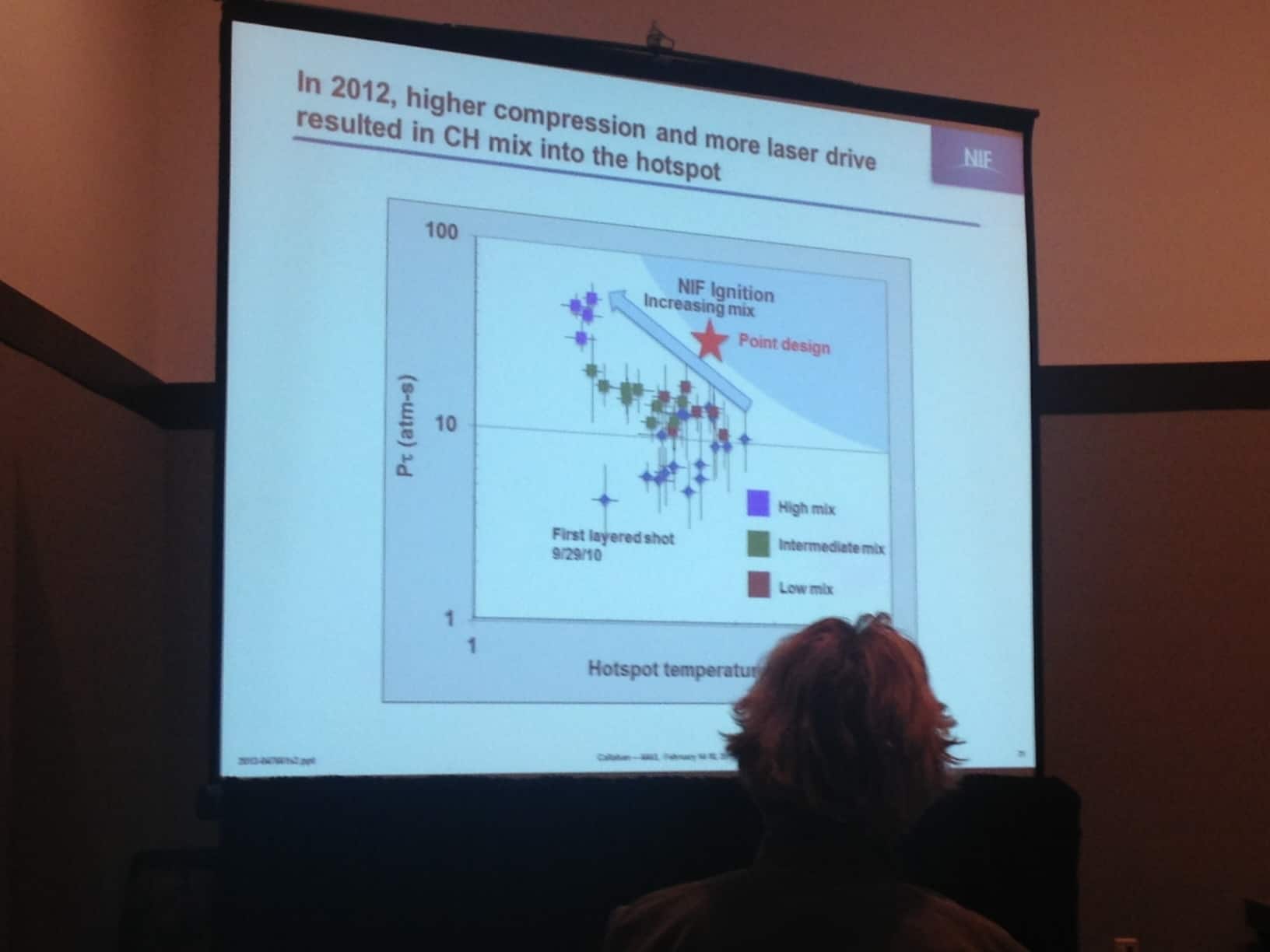
A factor of two

conference image

By Michael Banks in Boston

“A factor of two is not a small thing, it is quite a challenge,” says Robert McCory from the University of Rochester in New York.

McCory was speaking about the latest in laser-based fusion research (known as inertial confinement fusion) at the 2013 AAAS conference.

(more…)

Infinite BBQs

By Michael Banks in Boston

Here is a good quiz question. What contains more water: a cucumber or a glass of milk?

If you happened to guess the humble cucumber then you would be correct.

At least that is, according to Nathan Myhrvold, who says the water content of a glass of milk is around 85%, while for a cucumber it is more like 95%.  This is because milk is made up of other things such as proteins and fat.

Myhrvold, who has a PhD in physics, was speaking at the 2013 AAAS meeting in Boston where he gave a plenary lecture to a packed audience on the science of cooking.

Myhrvold is the brains behind the recently published six-volume, 2400-page tome  Modernist Cuisine that took him and his staff of eight researchers around five years to put together.

Apart from talking about the novel cooking techniques he has developed such as making crispy chips in an ultrasonic bath and spinning peas in a centrifuge to bring out more flavour, Myhrvold had some tidbits of information we could all put to use.

One is how to make wine taste better. Usually when wine goes from a bottle into a decanter the taste improves. However, if you don’t fancy using a decanter then you can just put the wine in a food processor and give it a quick blitz. According to Myhrvold this produces just the same effect.

Another is creating what Myhrvold says is an infinite BBQ. In a BBQ the food is cooked by infrared radiation emerging from the hot coals. As this radiation is emitted in all directions the centre of the grill is much warmer while the outer sections are cooler. His solution is to put foil around the inside of the BBQ to reflect some of the radiation back from the coals that are on the edge of the BBQ. This then acts to cook the outer section just the same as inner part.

Food for thought, indeed.

A trip to MIT

By Michael Banks in Boston

It may have been the prospect of free pizza that led me to hop on a bus heading to the Massachusetts Institute of Technology (MIT).

But apart from a free lunch, we were also promised a tour of MIT’s fusion facilities, which are based at institute’s Plasma Science and Fusion Center (PSFC).

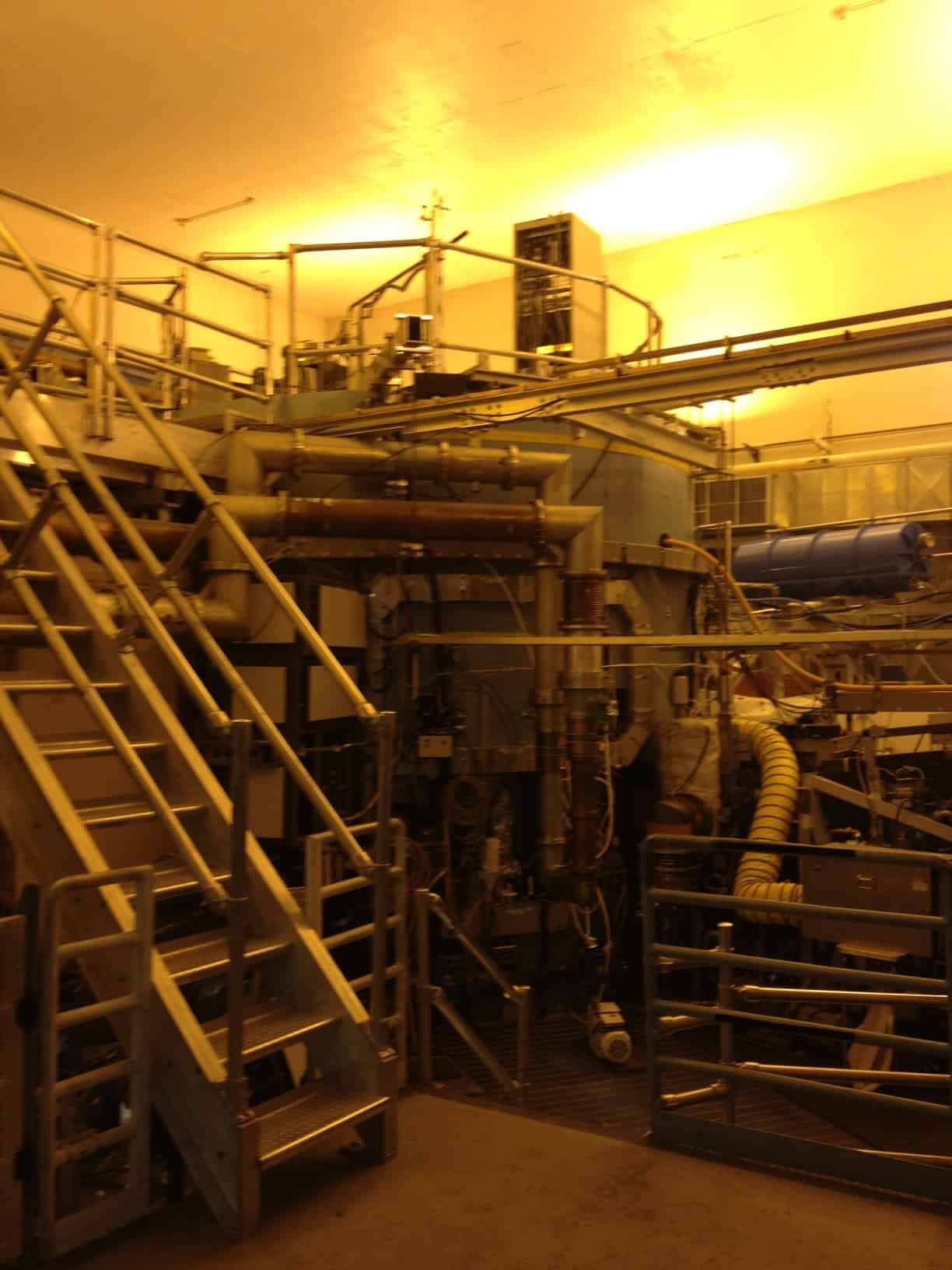
So after a few slices of pepperoni pizza, we donned the hard hats and moved on to the tour, which included a look at MIT’s main experimental fusion facility – the Alcator C-Mod fusion tokamak.

Operating since 1991 and with a budget of around $25m per year, Alcator C-Mod is a magnetic-confinement fusion device. It heats up a plasma of deuterium and tritium atoms to millions of degrees kelvin, which causes the hydrogen isotopes to fuse and release energy.

However, Alcator C-Mod faces an uncertain future. Last year Congress slated the facility for closure after increasing the budget for the ITER fusion reactor in France. Given no increase in the Department of Energy’s budget for fusion – standing at around $450m per year – the cut had to then come from the domestic fusion programme.

(more…)

Curiosity on Mars

Mars

By Michael Banks in Boston

John Grotzinger, project scientist for NASA’s Curiosity mission, might be best known for whipping up a media frenzy in late November when he told NPR that data from one of the probe’s 10 instruments was “gonna be one for the history books”.

While the news that the probe had discovered evidence of organic molecules in the soil but more tests were needed was less than earth shattering, today at the 2013 AAAS meeting in Boston, Grotzinger gave an update on the mission that touched down on Mars on 6 August 2012.

If you don’t fancy reading any more, the bottom line is that everything is working as expected.

(more…)

Quantum computers turn mechanical

Ultra-fast computers of the future might consist of tiny pieces of superconducting material linked electrically to equally small mechanical resonators, the former providing the processing power and the latter the memory. That is the prospect raised by new work carried out by an international group of physicists, showing that quantum information can be passed between the two kinds of component in such a way that this delicate information might be protected from environmental interference.

Quantum computers exploit the counterintuitive idea that tiny objects can exist in more than one state at the same time. Rather than processing bits – which are either 0 or 1 – such devices instead manipulate qubits – which can be 0 and 1 simultaneously – potentially allowing vast numbers of operations to be carried out in parallel and rendering these devices far quicker than classical computers.

Physicists are working on a number of different kinds of quantum computer but all have their downsides. Some exploit the spin of individual particles, such as atoms, molecules or photons. The quantum states in these devices can be made quite robust against interference from outside – one of the biggest challenges in building a workable quantum computer – but they require bulky apparatus that is not well suited to building computers with large numbers of qubits. Suitable scaling up should not be a problem for solid-state designs, however, such as devices that exploit the quantum-mechanical properties of superconductors. But these devices are extremely susceptible to electromagnetic interference.

Hybridization

“Hybrid quantum systems” attempt to overcome these problems by combining the best aspects of different approaches. In the latest research, Mika Sillanpää and colleagues at Aalto University in Finland have combined a superconducting qubit with two kinds of resonators – one mechanical and the other electrical. They have shown that vibrational quanta – known as phonons – from the mechanical resonator can be sent to and from the superconducting qubit, which acts like an artificial atom, and then be detected in the form of electromagnetic quanta (photons) using the electrical resonator.

All three components are made from aluminium laid down onto a single sapphire substrate measuring a little over 1 mm2. The moving part of the mechanical resonator consists of a flat piece of aluminium measuring 5 μm by 4 μm suspended some 50 nm above one end of the superconducting circuit, while its main components are two Josephson junctions – pairs of superconductors separated by a thin insulator. This circuit, in turn, is connected to one end of the electrical resonator – a waveguide into which microwaves are fed.

The researchers’ first step in testing their device was to expose the superconducting circuit to a magnetic field so as to set up two “charge states” within the circuit as if they had created an atom with two energy levels. They then fed an alternating current into the circuit with a frequency equal to the energy-level difference of the created atom. This stimulated the atom to “Rabi oscillate” between these two states. Having determined that the qubit worked as planned, the researchers then coupled the qubit to the mechanical resonator. This was done by reducing the frequency of the alternating current feeding the qubit, to the point where the resulting shortfall in the energy quantum required for Rabi oscillations was exactly equal to the energy quantum of the vibrating arm.

Coupling

To prove that they really had coupled the qubit to the resonator, the researchers monitored the phase of the microwaves in the waveguide. As predicted, they found that they got almost exactly the same phase change as they did when applying all the energy directly to the qubit. Put another way, the phonons had combined with the states of the artificial atom, and these combined states modulated the photons in the waveguide just as the qubit alone had done.

Collaboration member Pertti Hakonen says that the result opens up interesting possibilities for exploring various non-classical states, such as those with a well-defined quantum number of phonons. This is particularly the case, he adds, if the amount by which a single phonon changes the energy spacing in the qubit can be made large as compared with the decay rates of mechanical or electrical oscillations.

Down memory lane

According to Hakonen, the latest research might also form the basis for a quantum memory analogous to the read-only memory of conventional computers in which quantum information is stored as superpositions of different vibrational amplitudes. Many hurdles would need to be overcome to realize this kind of memory, he cautions, such as increasing the frequency of the mechanical resonators in order to raise their energy spacings above the level of thermal noise. This would require making the resonators shorter, which would reduce their coupling with the qubit, thereby making the experiment even harder to perform.

Andrew Briggs of Oxford University in the UK believes that the latest work is an “important step” on the road to long-lived quantum memory. “This shows that an adequate strength of coupling can be achieved to move into the quantum regime,” he says. “It also constitutes progress towards demonstrating quantum phenomena in increasingly macroscopic structures.” He adds that it will be important to extend this research to demonstrate mechanical resonators in the ground state. The lowest state of the Finnish device, which was operated at a temperature of about 25 millikelvin, corresponded to an energy of about 20 quanta.

The research is published in Nature.

Billy Bragg knows nothing

By Matin Durrani

When I was a PhD student at Cambridge in the early 1990s, I remember going to a concert by singer-songwriter Billy Bragg at the Cambridge Corn Exchange. Riding high at the time on a string of classic songs such as “She’s Got a New Spell”, “Shirley” and “Great Leap Forward”, Bragg had an ear for a great tune and was a great lyricist to boot – who can forget the classic line “How can you lie there and think of England if you don’t even know who’s in the team?”.

(more…)

Physicists discover key to ultra-stable bearings

Networks of rotating bearings can better recover from perturbations to their harmonious motion if the masses of the individual discs are proportional to their radii – this is the finding of a team of physicists based in Switzerland and Brazil. Although surprising, the result hints at how to construct more robust mechanical bearings, as well as offering fresh insight into the synchronization of complex oscillating systems such as electrical networks and the Internet.

Bearings are the small workhorses at the heart of many mechanical devices used today. The secret to their success is that they reduce the friction between two surfaces that need to slide past one another by offering them a chance to roll. Think of the Ancient Egyptians transporting gigantic slabs of rock on beds of rolling logs – would the pyramids ever have been realized if the rocks had been shunted along the ground unaided? A more sophisticated example is the wheel on a rollerblade. Its internal casing houses a ring of tiny ball-bearings that allows the outer part to spin smoothly against the inner part, affording the wearer speed for very little effort.

Scale-free synchronization

Hans Herrmann, of the Swiss Federal Institute of Technology (ETH) and colleagues investigated a particular type of bearing known as a 2D space-filling bearing. This component consists of a hierarchical distribution of successively smaller rotating 2D discs nestled into the spaces between larger ones, also known as a “scale-free distribution”.

Each disc turns in the opposite way to any other disc that it is in contact with, and the tangential velocity – the distance traced by a point on the edge of a disc in a given time – is equal for all the discs, regardless of their size. This means that at each contact point the discs roll together without slipping and the whole system is in a stable, synchronized state.

“The synchronization of a regular grid of oscillators is an old problem that has been solved, but rather new is synchronizing oscillators that are connected in a very complex network like ours,” explains Herrmann. A number of recent papers deal with the theoretical conditions necessary for such grand-scale oscillators to synchronize but, says Herrmann, “What we did was to create, for the first time, a physical example that you could realize mechanically.”

Mechanical realization

Herrmann’s colleagues used a mathematical model of the space-filling bearing to explore the forces on the discs, toying with each disc’s inertia by placing holes of different sizes at their centres to hollow them out and rob them of mass. A disc’s mass is normally proportional to the square of its radius, but the researchers found that they could markedly enhance the synchronizability of the whole system by making the holes large enough that the discs’ masses were always simply proportional to their radii. A system with higher synchronizability will, if perturbed, return more quickly to a balanced, no-slip rotating state.

By obeying the one-to-one relation, their system showed it could quickly overcome perturbations and absorb changes. “This is a non-trivial issue that is surprising about the whole work,” says Herrmann, “particularly because the effect is so strong; if you change the relation even slightly, the signal is very strongly diminished.”

In addition, explains co-author Nuno Araújo, also of ETH, the team managed to confirm a key theoretical prediction about scale-free networks – that the most stable synchronization states occur when the interaction strength is inversely proportional to the number of interacting partners of an individual oscillator. “In such networks, synchronizability is improved when there is a coupling strength that is related to the number of contacts. In our network, the large discs obviously have more contacts, but they also have more inertia and this [tempers] the strength of the interaction between the discs,” says Araújo.

“Synchronization in real networks is a timely line of research,” says Adilson Motter, a physicist at Northwestern University who was not involved with the study. “Previous network-synchronization studies have focused mostly on random networks…the specific optimization results [in this study] are also interesting, as they deviate significantly from the results my collaborators and I have previously established for random networks.”

Applications and analogies

“Any mechanical bearing [with spheres/wheels of different sizes] could benefit from this result in principle,” explains Herrmann. Since greater synchronizability would render a bearing both more resistant to failure from perturbation and more durable (reduced time out-of-sync means reduced wearing of parts), finessing the famously accurate and reliable mechanical Swiss watch would be one possible option.

For the more philosophically inclined, by showing that bearings are physical realizations of complex networks of oscillators, the team has constructed something akin to a metaphor for the Internet. “Only in our case it is rolling. The Internet is not rolling anywhere,” says Herrmann. “So I would say that our results have analogies in the world of the Internet.”

The research is published in Physical Review Letters.

Supernova origin of galactic cosmic rays confirmed

The first direct evidence that galactic cosmic rays are accelerated within supernova remnants has been provided by observations by the Fermi Large Area Telescope collaboration. The results make use of four years of data collected by the telescope observing two supernova remnants – IC 443 and W44 – within our galaxy. The observations fit very neatly with predictions of neutral pion decay.

Galactic cosmic rays – the hypothesis

Cosmic rays are highly energetic particles, mainly protons, whizzing through space, most of which have their origins outside the solar system. A popular explanation of the origins of galactic cosmic rays – those produced within the Milky Way – is that they come from supernova remnants (SNRs), but until now there has been no unambiguous observational evidence linking the two.

When a star goes supernova, its remnants – including strong magnetic fields – can linger for thousands of years. According to the SNR cosmic-ray hypothesis, protons are accelerated by the shock front created in a supernova and then further accelerated by the magnetic fields until they gain enough energy to escape this process and become a newly formed cosmic ray. These energetic protons, the hypothesis claims, sometimes collide with other protons – in interstellar clouds, for example – to produce a neutral pion, which decays almost instantly into two gamma-ray photons.

Observing gamma rays

The 4303 kg Fermi Gamma-ray Space Telescope was launched in June 2008 on a five-year-minimum mission. The Fermi Large Area Telescope (Fermi LAT) is an instrument on board this observatory that uses sophisticated particle detectors to measure the trajectories and energies of incoming photons. Between 4 August 2008 and 16 July 2012, the Fermi LAT collaboration studied the SNRs IC 443 and W44 – which are about 5000 and 10,000 light-years from us, respectively – paying particular attention to gamma rays with sub-GeV (a billion electronvolts) energies. Although gamma rays can have significantly larger energies in some objects, the Fermi LAT focused on a range that would provide data crucial to distinguishing between gamma rays emerging from pion decays and those produced by other means, such as accelerated electrons.

Protons can only be accelerated to a certain level by the SNRs before they are ejected. This places an upper bound on the energies of these protons, which also places limits on the energy of the intermediate pions and subsequent gamma rays. More importantly, though, because the neutral pion is a heavy particle with a mass of 135 MeV (more than 260 times heavier than the electron), the gamma rays into which the pions decay are expected to have a minimum energy – that is, below a certain energy, one expects no gamma rays if they are indeed produced from protons accelerated in SNRs. “That is the smoking-gun signature for gamma-ray emission from the decay of pions, which can only be created by accelerated protons,” says Stefan Funk, a physicist at Stanford University and SLAC National Accelerator Center, and a member of the Fermi LAT collaboration.

Finding the smoking gun

Given the abundance of cosmic rays and the many models that could explain them, Funk and colleagues had to take into account the various backgrounds affecting their data before confirming the source of the observed gamma rays. And they believe they have finally observed the smoking gun.

Referring to the SNR spectra (click on the image above), Funk tells physicsworld.com that “if you look at the data points, you will see that they show the two cut-offs: the high-energy one, which corresponds to the maximum energy to which protons can be accelerated within the SNRs in question, and the low-energy one, which corresponds to the pion-decay cut-off, the minimum energy that the gamma rays receive in the pion decay”. Of course, there are several models that could explain the data, including the possibility that the gamma rays are produced by the acceleration of electrons, but the team was unable to match its data to any of them. “The curve labelled ‘pion-decay’, on the other hand, shows what you expect for gamma rays from protons that decay via the pion, which is very consistent with our data,” explains Funk. The significances of these observations are 19σ and 21σ for IC 443 and W44, respectively.

“This paper offers very important information that can shed light on the characteristics of supernova remnants from the point of view of cosmic-ray production,” says Jozef Masarik, of Comenius University in Bratislava, who was not involved in the research. “Understanding of the origin of cosmic rays can even contribute to the verification or dismissal of some beyond-the-Standard-Model theories.”

Cosmic rays were first observed by Victor Hess in the early 20th century. A century later, this result from Fermi LAT is the first to confirm the supernova origin of galactic cosmic rays. What the researchers cannot yet say is whether supernova remnants are the only source of these mysterious particles.

The research is published in Science.

What's the most important feature of a successful science blog?

 By James Dacey

The dramatic rise in traffic on social-networking sites such as Facebook and Twitter in recent years could have left the good “old-fashioned” blog looking a bit like a frumpy relic of the noughties. But I’m convinced that this is not yet the case.

While it is true that we science writers are becoming Face-Twits in our droves, it seems that many of us still see the blogosphere as an important forum for discussion and debate. I view it as a place where you can express yourself candidly in a more freeform style, and do so without stripping away all the complexities of an issue to nothing more than a witty 140-character soundbite #BitterJournoTakesSwipe@Twitter.

(more…)

Boston bound

By Michael Banks

I have just arrived in Boston for the 2013 American Association for the Advancement of Science (AAAS) meeting, which began in earnest today.

(more…)

Copyright © 2026 by IOP Publishing Ltd and individual contributors