Highly charged ions could make better atomic clock

A new atomic clock that promises to be accurate to within 40 ms over the age of the universe has been proposed by physicists in the US and Australia. Based on a bismuth atom that has been stripped of 25 of its electrons, the clock could be used to look for variations in the fine-structure constant – according to its designers. The discovery of such variations could lead to a new unified theory of physics.

Today, the best clocks use an atomic transition as a time standard to measure time to an accuracy of about one part in 1017 – and physicists are keen on building even better timekeepers. A clock with an accuracy of one part in 1019 could help reveal minuscule changes in the values of fundamental physical constants such as the fine-structure constant. This parameter characterizes the strength of the electromagnetic interaction and detecting possible variations could help solve the biggest mystery of physics – how to formulate a single unified theory that describes the four fundamental forces: gravity, electromagnetism and the strong and weak nuclear forces.

In March 2012, a team led by Corey Campbell at the Georgia Institute of Technology argued that the required level of precision could be attained by using a particular nuclear transition in the thorium-229 ion with a charge of 3+. However a practical clock is unlikely because there are two problems with the scheme. The first problem is that the exact frequency of the thorium-229 transition is extremely difficult to calculate and therefore a great deal of time and effort could be spent in the lab just searching for the transition. The second problem is that thorium-229 is radioactive, making it difficult to work with.

Highly charged solution

Now three of Campbell’s collaborators have proposed what could be a more practical way to reach this level of precision using highly charged ions. Andrei Derevianko of the University of Nevada in Reno and Vladimir Dzuba and Victor Flambaum of the University of New South Wales in Sydney, looked at traditional atomic clocks to see if their errors could be brought down to the level of the nuclear clock.

Today, the most accurate current atomic clocks use aluminium ions (Al+) in an electromagnetic trap. However, stray fields can exist in the trap and these perturb the energy levels of the ion – reducing the performance of the clock. Derevianko and colleagues reasoned that as more and more electrons were stripped away from the ion the remaining electrons would be pulled closer to the nucleus and stray fields would have a less detrimental effect on performance.

The researchers calculated, therefore, that observing a specific electronic transition in a bismuth-209 ion (209Bi25+) would allow them to reach the required accuracy level. Like the aforementioned nuclear transition, this transition has not yet been observed. Derevianko explains, however, that, in stark contrast to the nuclear-structure calculations required to locate the nuclear transition, electronic-structure calculations are far more reliable and so the transition’s location can be predicted with much greater accuracy. Furthermore, bismuth-209 has a half-life of greater than 10 billion billion years – so can be considered non-radioactive.

New technology, new challenges

While such a clock would be difficult to build, the trio argue that it should be possible. “It is much harder to trap and cool highly charged ions,” explains Flambaum, “It is a new technique that has just started to appear. But people do this – it is not like our proposal just appeared out of the blue. It is just a new technology that requires new installations. It was much easier to work with neutral atoms or singly ionized atoms so of course people started from this, but now the time has come to search for other opportunities.”

Helen Margolis, an atomic-clock expert at the National Physical Laboratory in Teddington, is intrigued by the proposal but believes that it will pose numerous challenges before it can be experimentally implemented. “People are very clever at dreaming up new ways to do things,” she says, “but working on highly charged ions of this type is certainly not easy and they would need to do a lot of things that have never been done before.”

In particular, she does not share Derevianko’s confidence that the researchers’ calculations can reliably predict the location of the relevant transition. “It is true that for the highly charged ion clock the calculations of where these transitions occur are probably better,” she says, “but they are still not accurate enough to make the search for these transitions easy.”

The research is published in Physical Review Letters.

Earth’s magnetic shield behaves like a sieve

The Earth’s magnetic field is more permeable than previously thought, according to researchers analysing data from the European Space Agency’s Cluster mission. The findings have implications for modelling the dangers posed by space weather and could also help us better understand the magnetic environments around Jupiter and Saturn.

The Cluster mission, launched in 2000, comprises four identical satellites flying in a tetrahedral formation in close proximity to Earth. With highly elliptical orbits, the satellites are able to sweep in and out of the Earth’s magnetic environment, building up a 3D picture of interactions between the solar wind and our planet. The solar wind is a stream of charged particles from the outer layers of the Sun blowing into the solar system. The Earth’s magnetic field is thought to form a protective barrier against it.

It is well known, however, that if the magnetic field of the incoming solar wind has the opposite orientation to the Earth’s magnetic field, then the field lines can break and join up again in a process known as “magnetic reconnection”. This process allows the plasma from the solar wind to breach the boundary of the Earth’s magnetic field – the magnetopause – where it can then potentially reach our planet.

Swirling vortices

In 2004 data from Cluster revealed that this mismatch in magnetic orientation was not a hard and fast rule – 40,000 km-long swirls of plasma were spotted along the magnetopause, creating gateways into the magnetosphere even when the two magnetic fields were aligned. By 2006, researchers had concluded that these vortices were likely caused by Kelvin–Helmholtz waves (KHWs), occurring when two mediums are flowing on either side of a boundary at different velocities. An earthly example is wind blowing over the boundary between the air and the ocean. In space, the boundary is the magnetopause, with the decelerated plasma on the Earth-side travelling slower than the solar-wind plasma beyond.

Once created, the amplitude of these instabilities can build up, tangling the magnetic field lines and triggering magnetic reconnection despite the field lines being aligned. This phenomenon was only thought to happen under special conditions, however. “We thought [it] was restricted to areas around the Earth’s equator,” Arnaud Masson, one of the scientists working on the Cluster mission, told physicsworld.com. Now, new analysis of Cluster data, initially obtained in 2003, shows the same thing happening at much higher latitudes, and at a wider range of magnetic-field alignments. “It seems that no matter what the orientation of magnetic fields, the same effect can occur,” explains Masson. “It appears that it happens all the time, rather than just in special circumstances.”

Modelling space weather

Knowing the range of conditions under which the solar wind can penetrate the Earth’s magnetic defences plays an important role in modelling space weather – a catalogue of effects including disruption to GPS navigation caused by interaction with the solar wind. “You have to know where the doors are open in our protective shield,” explains Masson. Chris Arridge, of University College London, agrees. “It seems there are a lot more holes in the Earth’s magnetic sieve than we thought,” he says. “If we want to develop the ability to predict space-weather effects, then it is important to know the full range of ways that energy, mass and momentum can get into the system.”

Arridge, a researcher on the interaction between the solar wind and the outer planets of the solar system, believes this line of research could also help us understand Jupiter and Saturn. “The exact role of KHWs in the magnetospheres of the giant planets is a hot topic,” he reveals. Understanding the Earth’s KHW mechanisms will help us understand Jupiter and Saturn’s magnetic environments and vice versa.”

The research is published in Journal of Geophysical Research.

Improved diamond-anvil cell allows higher pressures than ever before

An international team of researchers has developed a technique that allows higher-than-ever-before static pressures to be generated in the laboratory, using a newly designed diamond-anvil cell. The team was able to create 640 gigapascals (GPa) of pressure – 50% more pressure than previously demonstrated and 150% more pressure than can be achieved by most typical high-pressure experiments.

At pressures vastly greater than those found on the surface of the Earth, matter can behave in strange ways. Oxygen can become superconductive, while metals can turn into insulators. In a 2007 experiment, sodium was found to turn transparent when squeezed by a pressure of 200 GPa – two million times the pressure at the surface of the Earth. Theorists have predicted, and there have been several unconfirmed observations, that hydrogen can become metallic.

Up the pressure

The diamond-anvil cell is the tool of choice to generate extreme pressures as it squeezes a sample between two tiny, gem-grade diamond crystals – diamond being one of the hardest substances known. Unfortunately, hard as diamonds are, they always fail eventually. This makes it challenging to achieve static pressures above about 250 GPa, and almost impossible above 420 GPa.

The only way to achieve super-high pressures in the laboratory, until now, has been to bombard a sample with shock waves, which compress it suddenly to generate pressures of many hundreds of gigapascals. But there are two problems with this technique: first, it grants only nanoseconds of observation time; and second, it generates a lot of heat as well as very high pressure, which can make it difficult to disentangle the effects of the two as solids are often turned into liquids. This is problematic for geophysicists trying to study the reactions at the centre of the Earth, where the pressure is stable at above 350 GPa, and even more so for those studying the gas giants, for example, where the internal pressures are well above this. A tool to generate static pressures in these ranges would be useful in the geophysicist’s arsenal.

Diamond clusters

To try to develop such a tool, Leonid Dubrovinsky and Natalia Dubrovinskaia of the University of Bayreuth in Germany, together with colleagues from Belgium and the US, took a hard look at the existing diamond-anvil cell. When diamonds eventually fracture, they do so along one of the cleavage planes running through the material. Based on previous work, the researchers knew that a diamond made up of numerous small crystals would not have these well-defined cleavage planes.

The researchers fabricated nanocrystalline diamond hemispheres, about 12–20 μm diameter, from tiny carbon balls at 2200 K and 20 GPa pressure using a newly developed technique. They then made a two-stage diamond anvil. On the outside of the press, they arranged two flat, gem-grade diamond plates. Inside these they placed their nanocystalline hemispheres. The flat edges were placed against the plates, with the curved edges, giving the smallest contact area and the largest pressure, placed against the sample. After some optimization, the researchers were able to generate static pressures of up to 640 GPa of the nanocrystalline diamond on the sample, allowing them to measure the equations of state of rhenium and gold at these extraordinary pressures.

Increasing stability

Dubrovinskaia believes that by implementation of computer control it should be possible to improve the stability of the pressure in the device. “By increasing the stability, we should be able to reach higher pressures,” she says. “That is one side – the other aspect is improvement of the materials themselves. The strength of nanocrystalline diamonds, like any polycrystalline material, is different depending on the size of nanoparticles. So if we play with particles with different sizes and different shapes of nanocrystals, it may play a significant role.”

Katsuya Shimizu, an expert in the study of matter at high pressures from the University of Osaka, Japan, who led the team that demonstrated superconductivity in oxygen, believes the double-stage diamond-anvil technique proposed by the researchers, which requires a tiny amount of the sample to be placed between two “semi-balls”, may limit its applicability. Nevertheless, he believes that “some researchers will perform experiments following this technique”.

The researchers conclude that “achieving 1 TPa in static-compression experiments with double-stage diamond-anvil cells is a viable goal”. The pressure in the cores of gas giants is about 700 GPa, so if Dubrovinskaia and colleagues further perfect their technique, astronomers may soon have a tool to study the conditions within these planets.

The research is published in Nature Communications.

Spooky action with twisted beams

Physicists in Austria have devised a new technique for entangling photons using the property of “orbital angular momentum”. The researchers say that the large amount of orbital momentum they have imparted to the photons paves the way for the entanglement of macroscopic objects and could also find applications in remote sensing and quantum computing.

Entanglement is a connectedness between two (or more) particles that does not exist in classical physics. It means that determining the quantum state of one of the particles automatically and instantaneously fixes the quantum state of the second particle, no matter how far apart those particles are – a phenomenon that Einstein famously called “spooky action at a distance”. Often this is achieved using the polarization of photons – the direction of vibration of a light wave’s electric field – such that pairs of entangled photons are constrained to vibrate at right angles to one another even though each of the photons is randomly polarized.

Entangled pairs

In the latest research, Anton Zeilinger, Robert Fickler and colleagues at the University of Vienna entangled photons in orbital angular momentum (OAM). Giving photons OAM means twisting a beam’s wavefront so that as the beam travels forward its wavefront rotates around the propagation axis. This property has been well studied using laser beams and is exploited in so-called optical spanners, which use lasers to trap and rotate small objects. But Zeilinger’s group was interested specifically in entangling twisted photons; in other words, producing pairs of photons with opposite directions of twistedness. That twistedness is represented by the quantum number l – the number of times the wavefront rotates around the propagation axis in the space of one wavelength. “The goal of our experiment was to see how high we could get this number,” says team member Radek Lapkiewicz.

Other groups have previously entangled photons with OAM by firing laser beams into “nonlinear” crystals and then siphoning off the very small fraction of photons that spontaneously split inside the crystal to produce two lower-energy entangled photons. Those entangled photons carry a broad spectrum of OAM. But, says Lapkiewicz, this approach, being “limited by what nature gives”, yields l values only up to about 20.

Twisting around

The Austrian group also used a nonlinear crystal to generate photons. In this case, however, the photons were entangled in polarization and this entanglement served only as a first step. The next step was to send the photons within each pair down separate optical fibres and then impart them with OAM. The researchers did this by bouncing the photons off a tiny screen known as a spatial light modulator, which is a device that alters the phase of the reflected light from point to point, so changing the shape of the beam’s wavefront. This wavefront deformation depended on the photons’ polarization, so that photons polarized in one direction received a kick of positive OAM whereas those polarized at right angles got a negative kick. The net result was to change the photons’ entanglement from one of polarization to one of OAM.

Using this technique, Zeilinger and co-workers found they could obtain differences in quantum number as high as 600 (in other words l = +300 on one photon and l = –300 on the other). Lapkiewicz points out that there is, in theory, no upper limit to a photon’s l value, which suggests that a photon – a quantum object – could acquire as much OAM as a macroscopic object, leading to what he calls a “tension between the quantum and classical worlds”. But he cautions that the current result is still “many orders of magnitude” too small to rotate even tiny objects. He speculates that such manipulation might one day be possible by combining the momentum of many photons entangled together.

Remote senses and quantum information

Zeilinger’s group also says that its technique could be useful for carrying out remote sensing, particularly in low-light biological-imaging experiments. The idea would be to measure tiny rotations by attaching the rotating object to a circular mask with regularly spaced radial slits. One photon in each entangled pair would be given a high OAM value, while the other would keep its polarization. With the mask placed in the path of the OAM photons and rotated very slightly, the rate of simultaneous detection of the two sets of photons would change. The trick is that a polarizer placed in the path of the polarized photons would need to rotate through l times as large an angle to register the same change, so multiplying the sensitivity of the measurement by l times.

According to Lapkiewicz, the work might also be applied to quantum information. For example, he says, it might allow quantum processors that rely on polarization entanglement to be connected to those that instead exploit OAM.

Hans Bachor of the Australian National University believes that OAM entanglement “will have profound implications for both the communication of quantum information as well as quantum-logic protocols”, and he says that Zeilinger’s group has taken “an important step ahead” in this field. But he argues that it will be crucial to demonstrate entanglement with many modes. “The work here shows entanglement between two modes with widely different quantum numbers,” he adds. “That is important, but it is still only the entanglement between two modes.”

The work is published in Science.

Which scientist has been the best political leader?

By James Dacey

Facebook poll
With the US presidential election now just a few days away, it got us talking here at the Physics World offices about politics and the qualities required for effective political leadership. We were all in agreement that the decision-making process in politics is very different from that in science: in politics decisions often need to be made quickly before all the facts are known. Solutions in politics also tend to be more controversial, with opposing interest groups vying for different outcomes. (Though that’s not to say that science is devoid of politics!) These differences are discussed in a much more nuanced way in this recent article by the philosopher and historian Robert P Crease.

We were also in agreement on two other points. First, that there are not enough top politicians with science backgrounds, and second, that a government made up entirely of scientists would more than likely be a disastrous one. There have, however, been several notable exceptions of scientists who have been political leaders of countries. In this week’s Facebook poll we want you to let us know how effective you think these leaders were.

Which of these scientists has been the best political leader?

Angela Merkel (Germany, physics)
Margaret Thatcher (UK, chemistry)
Yukio Hatoyama (Japan, engineering)
Abdul Kalam (India, physics)
Lucas Papademos (Greece, physics)

To cast your vote please visit our Facebook page, and please feel free to post a comment to explain your decision.

In last week’s poll we looked at the issue of gender bias in the job market. It followed a recent psychological study that found that a set of researchers assessing the employability of early-career scientists subconsciously favoured male students over female candidates. We asked if you believe that physics employers have a subconscious bias towards male job applicants. 67% of respondents replied “yes”.

Thank you for taking part and we hope to hear from you again in this week’s poll.

Between the lines

Artwork of nuclear bomb test

From desert to devastation

The past few years have witnessed a boom in physics-themed graphic novels, with the lives of Marie Curie, Richard Feynman and Yuri Gagarin all getting the high-concept cartoon treatment. The latest example in this genre is Trinity: a Graphic History of the First Atomic Bomb. The book begins with J Robert Oppenheimer explaining the Greek myth of Prometheus to a young soldier at the Trinity test site in the New Mexico desert, and ends with American schoolchildren learning how to “duck and cover” in the event of a nuclear attack. In-between, the book’s New York-based author and artist, Jonathan Fetter-Vorm, mixes physics and history to create an eye-catching account of how the atomic bomb was transformed from a theoretical possibility into a very real – and very world-threatening – device. The text has a spare, elegiac quality that suits its subject matter, and despite its brevity, it manages to cover the most important aspects of the bomb’s scientific, political and moral implications. As for the illustrations, they are done in stark greyscale, and they do not shy away from depicting the horrors of the atomic bombing of Hiroshima and Nagasaki. While Trinity may look like a comic book on the outside, it is certainly not written for children.

  • 2012 Hill and Wang £15.99/$22.00hb 160pp

War and peace

The life of the physicist Joseph Rotblat was long and eventful. Born in Poland to Jewish parents in 1908, he escaped the Holocaust thanks to a timely appointment at the University of Liverpool, and during the Second World War, he joined hundreds of other émigré scientists in contributing to the Anglo-American atomic bomb projects. Unusually, however, Rotblat recognized the peculiar horrors of nuclear warfare even before the first bombs were dropped, and after leaving the US-led Manhattan Project early in 1945, he dedicated the remaining six decades of his life to advocating the elimination of nuclear weapons. Andrew Brown’s new biography of Rotblat, Keeper of the Nuclear Conscience, covers the entire span of its subject’s life, with a special focus on Rotblat’s work with the anti-nuclear Pugwash Conferences on Science and World Affairs – an organization he founded, and with which he shared the 1995 Nobel Peace Prize. The book’s early chapters are full of perceptive details about Rotblat’s character and the forces that shaped it. One particularly good example is Brown’s observation that Rotblat, in his later life, refused to eat potatoes; apparently, they reminded him of the bitter-tasting tubers that he and his family consumed in Poland during the First World War, under near-starvation conditions. It is also interesting to see familiar stories of physics in the 1930s refracted through a Polish lens. As Brown makes clear, during the lean inter-war years, the level of physics talent in this newly reborn country far outstripped the available research funds. As a result, Rotblat and his Warsaw-based colleagues did their nuclear research on a shoestring: while the likes of Enrico Fermi could afford radioactive samples weighing whole grams, Rotblat had to make do with a few tens of milligrams. The chapters on Rotblat’s participation in (and eventual departure from) the Manhattan Project are similarly insightful, and much enhanced by an account of the early atom-bomb work done by Britain’s Maud Committee and Tube Alloys programme. Somewhere in the middle, though, the book loses focus. The back-and-forth politico-scientific discussions on nuclear test bans that took place during the 1950s and 1960s make slow reading, and long passages contain little, if any, mention of Rotblat himself. Things do, however, liven up a little towards the end, as Brown describes how Rotblat became “an old man in a hurry”, anxious to keep the spirit of Pugwash alive into the new millennium and as unconcerned as ever about irritating government officials.

  • 2012 Oxford University Press £18.99/$29.95hb 368pp

Share your photos of animal physics

By James Dacey

mosquito


(Courtesy: Nowack, Dickerson, Hu/Georgia Tech)

All animals obey the laws of physics but some creatures do so with more panache than others. The November issue of Physics World reveals the extraordinary physics behind animal activities from the everyday – such as how cats and dogs drink – to the otherworldly, such as the super shrimp that can fracture aquarium glass with its clubs.

For the latest Physics World photo challenge we want you to share your photos of animal physics. As always we encourage you to be creative in the way you interpret the theme. But if you are looking for inspiration you might want to think about some of the animal behaviour that has dazzled and intrigued scientists over the years. How the peacock’s feathers have structures that produce beautiful shimmering colours to attract female mates, or how pond skaters can skip so effortlessly across water, for example.

To take part please upload your images to our Flickr page by Friday 4 January, and after this date we will showcase a selection of the best animal physics photos on physicsworld.com. Happy snapping!

Members of the Institute of Physics can access the digital version of the November animal physics issue of Physics World via this link. It’s packed with a series of fascinating photos, videos and features on a selection of animals, all of which have some interesting physics involved in their daily lives.

The November 2012 issue of Physics World is out now

By Matin Durrani

PWNov12cover-200.jpg
If you’re a member of the Institute of Physics, it’s time to tuck into the November 2012 issue of Physics World, which is a special issue devoted to the facinating field of “animal physics”. It’s packed with a series of fascinating photos, videos and features on a selection of animals all of which have some interesting physics involved in their daily lives.

Read – and watch – how mosquitoes survive collisions with raindrops, find out why a certain species of hornet has a in-built solar cell, and listen to why lions – strange as it may seem – roar like babies. We also examine the age-old question of why zebras have stripes and ask whether cats and dogs drink in the same way.

Plus, we have a series of seven fabulous images each devoted to a particular animal with some amazing physics powers.

Members of the Institute of Physics (IOP) can access the entire new issue online free of charge through the digital edition of the magazine by following this link or by downloading the Physics World app onto an iPhone or iPad or Android device, available from the App Store and Google Play, respectively.

For the record, here’s a rundown of highlights of the issue.

The industrial academy – IBM’s Zurich Research Centre opened its doors 50 years ago, quickly becoming one of the world’s top research institutions. But does it still live up to its illustrious past? Philip Ball reports

The benefits of reaching out – Publicizing research is becoming more important as part of a physicist’s job. Pablo Jensen argues that rather than just take time away from research, outreach can actually foster it

Primate physics – Having recently discussed in this column whether skateboarders and other athletes really “know” physics, here Robert P Crease wonders if primates do as well

How the zebra got its stripes – Biophysicists are offering new clues to this age-old mystery, as Jon Cartwright reports

Lapping it up – Cats are slow and elegant, dogs are quick and messy – but is the physics of their drinking all that different? Jon Cartwright reports

Vespan voltageTushna Commissariat explains why Oriental hornets are masters of solar power

Fly away home – Far from being “bird brained”, members of the avian family have an amazing array of techniques to help them navigate their way across vast oceans and continents. Mark Denny examines the physics of bird navigation

Riding raindriops – Mosquitoes regularly collide with raindrops up to 50 times their own body mass and yet, remarkably, they live on to bite another victim. Stephen Ornes explains how scientists have figured out how these insects survive such a violent impact

Walking on water – Why can pond skaters skip so effortlessly across water? Stephen Ornes explains how these creatures’ secrets were revealed using dyed water and a high-speed video camera

Why lions roar like babies cry – When an angry lion roars, the sounds it emits can terrify anyone within earshot. But, as Ingo Titze explains, the properties of a lion’s roar have some surprising similarities with those of a crying baby

A strange cat in Dublin’Cormac O’Raifeartaigh reviews Erwin Schrödinger and the Quantum Revolution by John Gribbin

Soft matter’s charismatic pioneer Tom McLeish reviews Pierre-Gilles de Gennes: a Life in Science by Laurence Plévert

Starting from scratchMehdi Yazdanpanah describes how he turned his PhD research into a successful small business, despite starting off with just $500 in his bank account

Consider a spherical cow – In this month’s Lateral Thoughts column, Margaret Harris wonders just what a spherical bovine animal would really be like

If you’re not yet a member, you can join the IOP as an imember for just £15, €20 or $25 a year via this link. Being an iMember gives you a full year’s access to Physics World both online and through the apps.

Walking on water

Gods in Ancient Egypt could do it; so allegedly could Buddha and Jesus. But for the rest of us lowly human beings – at least, those of us without divine parentage or supernatural abilities – the closest we can get to walking on water is to strap on a pair of pontoon shoes and hope for the best (an idea first envisaged in sketches by Leonardo da Vinci). But in the animal kingdom, the ability is nothing new. The basilisk lizard uses its specially shaped feet to slap the surface hard enough to keep from sinking as it runs across water. Dolphins use the same technique with their tails, as do some birds.

Most insects take a different approach. The vast majority of the million or so identified species of insects live either in the air or on land, but a tiny fraction – about 0.1% – live on water, at least part of the time. One of those water dwellers, the pond skater (also known as the water strider), is particularly adept at staying afloat. It can sit still atop the water, or scurry across at speeds of 150 cm/s – about three miles per hour.

The reason why pond skaters can stay afloat is that the surface tension of water acts like a skin. Water molecules have cohesive forces between them, and the pond skater’s weight is too small to overcome those forces. That is fine for standing still, but if the insect wants to move, Newton’s third law of motion dictates that it has to push on something – and the only thing available is the water.

Our latest knowledge of these little animals is largely thanks to the efforts of David Hu, who as a mathematics graduate student at the Massachusetts Institute of Technology (MIT) spent four years studying them, analysing their sizes and shapes and trying to understand the physics that keeps these bugs afloat. He worked on the project with his PhD supervisor, John Bush, who focuses on tackling real-world fluid-dynamics problems.

“They have to row without breaking the surface of the water,” says Hu, now running his own biology-meets-mechanical-engineering lab at the Georgia Institute of Technology in Atlanta. “If they move too quickly, they will break the surface. That’s a non-intuitive idea for people to grasp, but you can see it if you push on the surface of water gently with a paperclip. You see these ripples of waves shoot out, and the pond skaters basically have to row on them very gently.”

Hidden vortices

Before Hu’s work, experiments and observations had suggested that pond skaters propel themselves forwards by making tiny ripples in the water with their legs. This idea was intuitively appealing because these “capillary waves” are readily visible in the wake of a pond skater skipping across a wet surface. But it led to a problem called “Denny’s paradox”, first articulated by biologist Mark Denny in 1993. He pointed out that infant pond skaters cannot move their legs faster than the phase speed of the capillary waves – a feat necessary to create them.

Hu and Bush decided to investigate using pond skaters gathered from local ponds. These creatures reproduced in the laboratory and so gave the researchers plenty of infants with which to investigate Denny’s paradox. And to see what was really happening in the water, Hu and Bush filmed the insects using a high-speed camera.

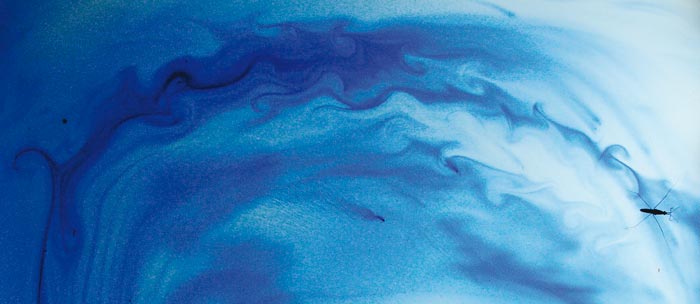
They found that pond skaters use the middle of their three pairs of legs like a rower uses oars in a rowboat. When an oar slices the water, it creates swirling vortices just beneath the surface that twist away from the boat, imparting forward momentum to the boat. Similarly, the pond skater’s legs leave behind the same vortices under the water’s surface. In Bush’s lab at MIT, the vortices became visible when the scientists sent the pond skaters scampering across water filled with colourful floating particles.

Birds-eye view of a pattern left in dyed-blue water by a pond skater that has just moved across it

Bush and Hu noted that the action also created capillary waves – those tiny ripples observed by Denny and other biologists – but calculated that those waves’ contributions to the bug’s forward motion were much smaller than they had anticipated, and not strong enough to move the bug.

Coveted coating

What is also interesting about pond skaters is that specialized hairs coated in a wax-like substance cover their legs, and bubbles on these hairs keep the water out. There are, according to Hu, thousands of hairs per square millimetre and the waxy substance on the hairs is coveted by human designers and materials scientists because synthetic materials usually rely on waterproofing chemicals that wash away. “No-one knows how to make a permanent water-repellent material,” he says.

It is these hairs that make the pond skater’s rowing action possible. Only the very tips of the hairs penetrate the surface of the water, creating those vortices and, in turn, transferring momentum past the air-water barrier. The particular arrangement of those hairs resembles those on a butterfly’s wings that shuttle water droplets towards the wingtips. On pond skaters, those hairs point in a particular direction, giving the insect a preferred direction and ensuring that the pond skater does not veer off course – whether alive or dead.

“If you have a dead water strider and blow on it, it will still go forward,” Hu says.

Hu has gone on to look at how other insects, including land dwellers, survive around water. In 2011 he and a team from his lab described how colonies of Brazilian fire ants, normally abysmal swimmers, weave themselves together to build a waterproof raft. On its own, a single ant is not very water repellent, but when they link together arm in arm they can create “waterproof surfaces similar to how we create Gore-Tex”, Hu says. The principal idea is the same: create a fabric that is highly textured and uses tiny pockets of air to keep water out. But the ants, like the pond skaters – and the gods – are much better at it than human inventors.

“We understand all these great things in nature,” Hu says, “but we still can’t build an equivalent in our everyday lives.”

Unexpected ‘ridge’ seen in CMS collision data again

The first data from proton–lead collisions at the Compact Muon Solenoid (CMS) experiment at the Large Hadron Collider (LHC) at CERN include a “ridge” structure in correlations between newly generated particles. According to theorists in the US, the ridge may represent a new form of matter known as a “colour glass condensate”.

This is not the first time such correlations have been seen in collision remnants – in 2005, physicists working on the Relativistic Heavy-Ion Collider (RHIC) at Brookhaven National Laboratory in New York found that the particles generated in collisions of gold nuclei had a tendency to spread transversely from the beam at very small relative angles, close to zero. A similar correlation was seen in 2010 at CMS in proton–proton collisions and then later that year in lead–lead collisions. (See image below, parts a and b.)

Observing ridges

When a graph is plotted of the fraction of particles versus the relative transverse emission angle and the relative angle to the beam axis, the correlation appears as a distinct ridge. Now, this ridge has been seen in proton–lead collisions for the first time – within a week of data collection at CMS (see image below, part c) (arXiv:1210.5482).

Although observations of ridges in different experiments would suggest a single cause, theorists believe there may be more than one explanation. When pairs of nuclei (such as gold or lead) collide, they can produce a hot, dense medium similar to quark–gluon plasma, a type of matter thought to have existed very soon after the Big Bang. The motion of this plasma probably correlates the underlying particles into the ridge structure.

Proton–proton collisions, on the other hand, are not expected to form a quark–gluon plasma, so theorists have come up with other explanations. One idea, presented by Raju Venugopalan at Brookhaven National Laboratory in the US and Kevin Dusling at North Carolina State University in Raleigh, US, is that the ridge correlation is an unusual type of quantum entanglement in which generated particles carry information about the state of protons before those protons collided.

Particle swarms

At very high energies, protons can fluctuate into quantum states that incorporate not just three quarks – their normal constituents – but a swarm of accompanying gluons, the carriers of the strong force. Venugopalan and Dusling think this swarm could have been so dense in proton–proton collisions at CMS that it reached “maximum occupancy” – saturation, in other words – and thereby turned into a colour glass condensate – a hypothetical and controversial form of matter that could explain certain problems in high-energy physics, such as how particles are generated in collisions.

The colour-glass-condensate interpretation of CMS’s 2010 proton–proton ridge was not widely accepted. However, shortly before the latest CMS results were published, Venugopalan and Dusling predicted that, if it existed in the proton–proton collisions, the condensate should also exist in proton–lead collisions. In other words, the theorists predicted that the ridge in proton–lead collisions should bear a greater resemblance to that in proton–proton collisions than that in lead–lead collisions, which are a consequence of a quark–gluon plasma (arXiv:1210.3890).

As predicted

Venugopalan and Dusling say that the new CMS data match their prediction, and that they are preparing a follow-up paper to describe their conclusions. “A more detailed analysis will cast more light on our theories, and hence [on] the fascinating collective behaviour of gluon states that make up the structure of matter at high energies,” says Venugopalan.

Still, other theorists are likely to have their own interpretations of the data. Writing for the collaboration’s public website, CMS experimentalists Wei Li and Gunther Roland refer to the ridge structure as an unexplained phenomenon, and look forward to a longer proton–lead run at the LHC next year that will increase the data sample a thousand fold. “Combined with the surprisingly large magnitude of the ridge seen by CMS, this will enable detailed correlation studies and open a new testing ground for basic questions in the physics of strongly interacting systems and the nature of the initial state of nuclear collisions,” they write.

The work has been submitted to Physics Letters B. A preprint is available on arXiv.

Copyright © 2026 by IOP Publishing Ltd and individual contributors