A physicist’s guide to ice cream: the complex science behind one of the world’s most popular desserts

What exactly is ice cream? For most of us, it’s a tasty frozen dessert, but to food scientists like Douglas Goff, it’s also a marvel of physics and chemistry. Ice cream is a complex multiphase material, containing emulsion, foam, crystals, solutes and solvent. Whether made in a domestic kitchen or on a commercial scale, ice cream requires a finely tuned ratio of ingredients and precision control during mixing, churning and freezing.

Goff is a researcher in food science at the University of Guelph in Canada and an expert in the science of ice cream. In addition to his research studying, among other things, structure and ingredient functionality in ice cream, Goff is also the instructor on the University of Guelph’s annual ice-cream course, which, having been taught since 1914, is the longest-running at the university.

In a conversation with Physics World’s Hamish Johnston, Goff explains the science of ice cream, why it’s so hard to make vegan ice cream and how his team performs electron microscopy experiments without their samples melting.

How would you describe the material properties of ice cream to a physicist?

Ice cream is an incredibly complex multi-phase system. It starts as an emulsion, where fat droplets are dispersed in a sugary water-based solution. Then we whip the emulsion to incorporate an air phase into it – this is called foaming (see “Phases in ice cream”). In a frozen tub of ice cream, about half of the volume is air. That air is present in the form of tiny bubbles that are distributed throughout the product.

Then we partially freeze the aqueous phase, turning at least half of the water into microscopically small ice crystals. The remaining unfrozen phase is what makes the ice cream soft, scoopable and chewable. It remains unfrozen because of all the sugar that’s dissolved in it, which depresses the freezing point.

So you end up with fat droplets in the form of an emulsion, air bubbles in the form of a foam, a partially crystalline solvent in the form of ice crystals, and a concentrated sugar solution.

Phases in ice cream
Phases of ice cream

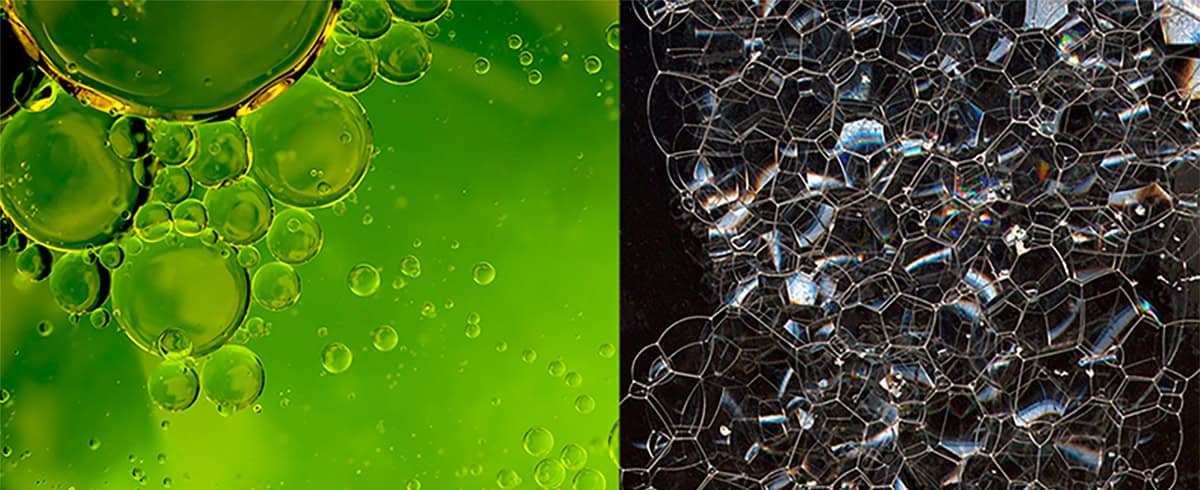
Emulsion: Some liquids, such as oil and water, will not mix if a droplet of one is added to the other – they are said to be immiscible. If many droplets of one liquid can be stabilized in another without coalescing, the resulting mixture is called an emulsion (left image).

Foam: A foam, like an emulsion, consists of two phases where one is dispersed in the other. In the case of foam, many tiny gas bubbles are trapped in a liquid or solid (right image).

Glass: When a liquid is cooled below a certain temperature, it generally undergoes a first-order phase transition to a solid crystal. However, if a liquid can be cooled below its freezing point without crystallizing (supercooling) – for example, if it is cooled very quickly, it may form glass – an amorphous solid with a disordered, liquid-like structure but solid-like mechanical properties. The temperature at which the glass forms, marked by a rapid increase in the material’s viscosity, is called the glass transition temperature.

What are the length scales of the different phases in the ice cream?

We’ve done a lot of electron microscopy research studying this in my lab. In fact, our research was some of the very first that utilized electron microscopy techniques for the structure of ice cream. The fat droplets are about one micron in diameter and the air bubbles, depending on the equipment that’s used, would be about 20 to 30 microns in diameter. The ice crystals are in the 10 to 20 micron size range.

It really is a beautiful thing to look at under an electron microscope, depending on the technique that you use (see image).

Electron microscope image of ice cream shows the air bubbles, ice crystals and fat droplets, each surrounded by a layer of sugary solvent

What are the big differences between ice cream that’s made in a commercial setting versus a domestic kitchen?

The freezing and whipping happen at the same time whether it’s an ice cream maker in the kitchen or a commercial operation. The biggest difference between what you do in the kitchen and what they’re going to do in the factory is the structure of the ice cream. Homemade ice cream is fine for maybe a day or two, but it starts to get icy pretty quickly, whereas we want a shelf life of months to a year when ice cream is made commercially.

This is because of the way the ice phase evolves over time – a process called recrystallization. If ice cream warms up it starts to melt. When the temperature is lowered again, water is frozen back into the ice phase, but it doesn’t create new ice crystals, it just grows onto the existing ice crystals.

This means that if ice cream is subject to lots of temperature fluctuation during storage, it’s going to degrade and become icy much quicker than if it was stored at a constant temperature. The warmer the temperature, the faster the rate of recrystallization. Commercial freezing equipment will give you much smaller ice crystal size than homemade ice cream machines. Low and constant temperature storage is what everybody strives for, and so the lower the temperature and the more constant it is, and the smaller the ice crystals are to begin with, the longer your shelf life before changes start occurring.

There’s also another structural element that is important for the long-term storage of ice cream. When that unfrozen sugary solvent phase gets concentrated enough, it can undergo a glass transition (see “Phases in ice cream”). Glass is an amorphous solid, so if this happens, there will be no movement of water or solute within the system and it can remain unchanged for years. For ice cream, the glass transition temperature is around –28 to –32° C so if you want long-term storage, you have to get down below that that glass transition temperature.

The third thing is the addition of stabilisers. Those are things like locust bean gum, guar gum or cellulose gum and there are some novel ones as well. What those do is increase the viscosity in the unfrozen phase. This slows down the rate of ice recrystallization because it slows down the diffusion of water and the growth of ice.

There are also some other novel agents that can prevent ice from recrystallizing into large crystals. One of these is called propylene glycol monostearate, it absorbs onto the surface of an ice crystal and prevents it from growing as the temperature fluctuates. This is also something we see in nature. Some insect, fish and plant species that live in cold environments have proteins that control the growth of ice in their blood and tissues. A lot of fish, for example, swim around with minute ice crystals in their in their body, but the proteins prevent the crystals from getting big enough to cause harm.
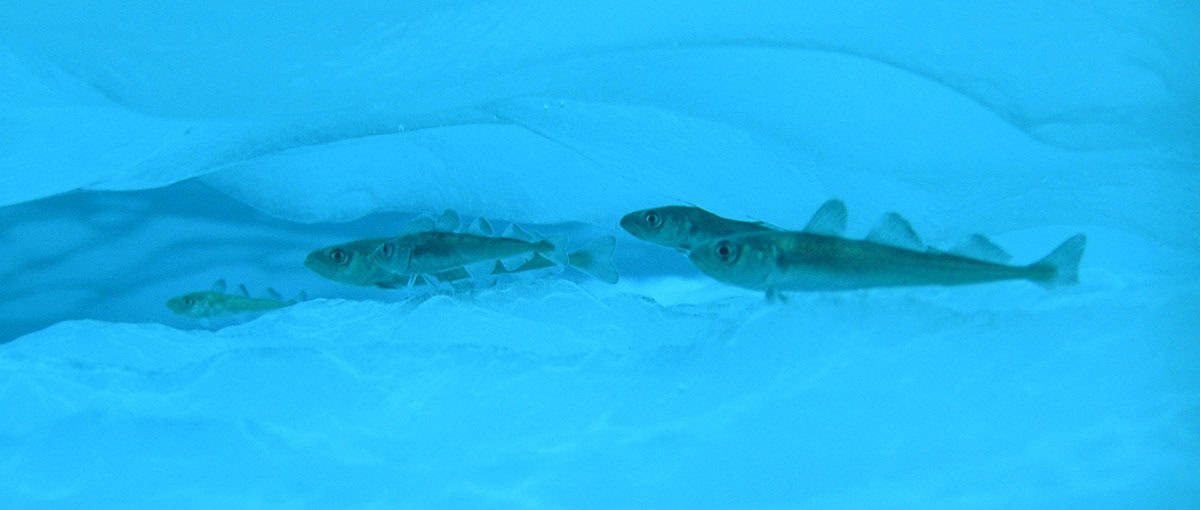
Arctic cod swimming through icy seas

How does adding flavourings to ice cream change the manufacturing process?

When you think about ice cream around the world, there are hundreds of different flavours. The important question is whether the flavouring will impact the solution or emulsion.

For example, a chocolate chip will be inert, it’s not going to interact at all with the rest of the matrix. Strawberries on the other hand, really impact the system because of the high sugar content in the fruit preparation. We need to add sugar to the fruit to make sure it is softer than the ice cream itself – you don’t want to bite into ice cream and find a hard, frozen berry. The problem is that some of that sugar will diffuse into the unfrozen phase and lower its freezing point. This means that if you don’t do anything to the formulation, strawberry ice cream will be softer than something like vanilla because of the added sugar.

Another example would be alcohol-based flavours, anything from rum to Baileys Irish Cream or Frangelico, or even wine and beer. They’re very popular but the alcohol depresses the freezing point, so if you add enough to give you the flavour intensity that you want, your product won’t freeze. In that case, you might need to add less of the alcohol and a little bit more of a de-alcoholized flavouring.

You can try to make ice cream with just about any flavour, but you certainly have to look at what that flavouring is going to do to the structure and things like shelf life and so on.

Pistachio ice cream

Nowadays one can also buy vegan ice creams. How do the preparation and ingredients differ compared to dairy products?

A lot of it will be similar. We’re going to have an emulsified fat source, typically something like coconut oil or palm kernel oil, and then there’s the sugar, stabilisers and so on that you would have in a dairy ice cream.

The difference is the protein. Milk protein is both a very good foaming agent and a very good emulsifying agent. [Emulsifying and foaming agents are molecules that stabilize foams and emulsions. The molecules attach to the surface of the liquid droplets or air bubbles and stop them from coalescing with each other.] Plant proteins aren’t very good at either. If you look at cashew, almond or soy-based products, you’ll find additional ingredients to deliver the functionality that we would otherwise get from the milk protein.

What techniques do you use to study ice cream? And how do you stop the ice cream from melting during an experiment?

The workhorses of instrumentation for research are particle size analysis, electron microscopy and rheology (see “Experimental techniques”).

So first there’s laser light scattering which tells us everything we need to know about the fat globules and fat structure (see “Experimental techniques”). Then we use a lot of optical microscopy. You either need to put the microscope in a freezer or cold box or have a cold stage where you have the ice cream on a slide inside a chamber that’s cooled with liquid nitrogen. On the electron microscopy side (see “Experimental techniques”), we’ve done a lot of cryo-scanning electron microscopy (SEM), with a low-temperature unit.

We’ve also done a lot of transmission electron microscopy (TEM), which generally uses a different approach. Instead of performing the experiment in cold conditions, we use a chemical that “fixes” the structure in place and then we dry it, typically using a technique called “critical point drying” (see “Experimental techniques”). It’s then sliced into thin samples and studied with the TEM.

Experimental techniques
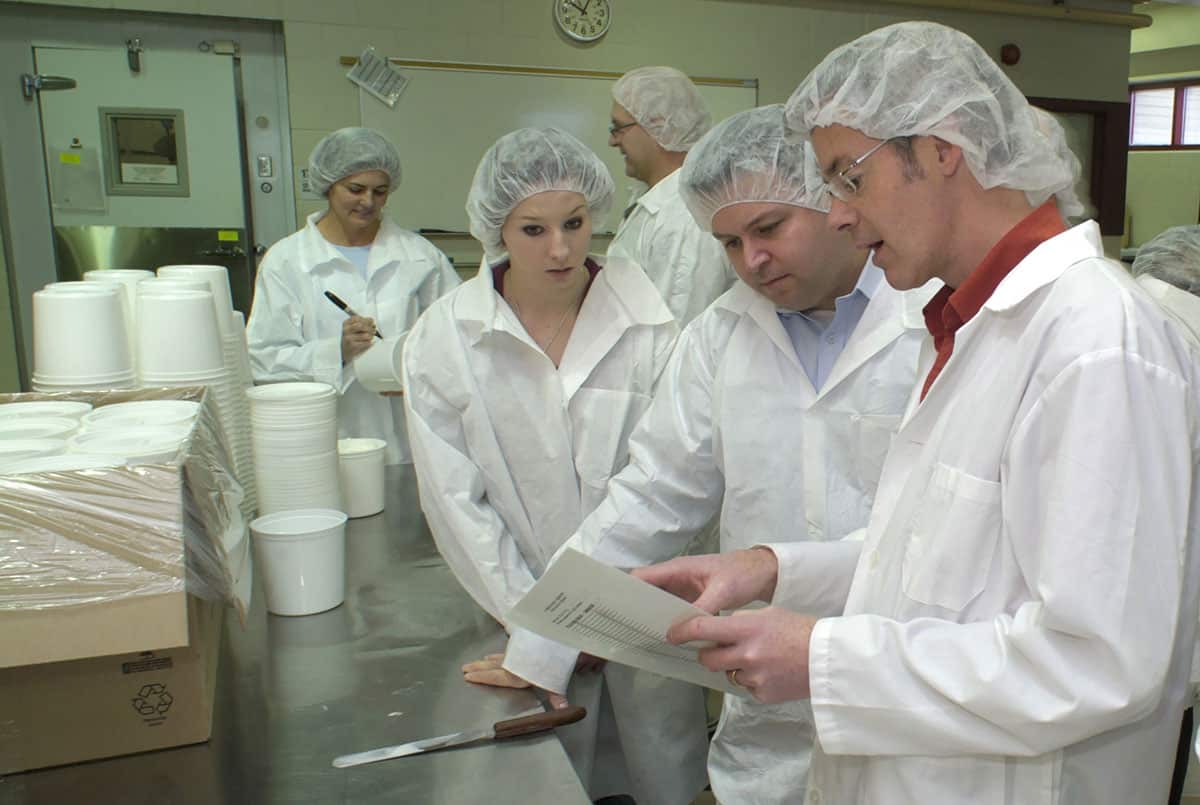
Douglas Goff in the ice cream lab

Rheology: Rheology is the study of the flow and deformation of materials. A rheometer is an apparatus used to measure the response of different materials to applied forces.

Dynamic light scattering (DLS): A laser-based technique used to measure the size distribution of dispersed particles. Dispersed particles such as fat globules in ice cream exhibit Brownian motion, with small particles moving faster than larger particles. The interference of laser light scattered from the particles is used to calculate the characteristic timescale of the Brownian motion and the particle size distribution.      

Electron microscopy: Imaging techniques that use a beam of electrons, rather than photons, to image a sample. Scanning electron microscopy (SEM) and transmission electron microscopy (TEM) are two common examples. SEM uses reflected electrons to study the sample surface, whereas TEM uses electrons travelling through a sample to understand its internal structure.

Critical point drying: When a sample is dried in preparation for microscopy experiments, the effects of surface tension between the water in the sample and the surrounding air can cause damage. At the critical point, the liquid and gas phases are indistinguishable, if the water in the sample is at its critical point during dehydration, there is no boundary between the water and vapour, and this protects the structure of the sample.

After decades of studying ice cream, do you still get excited about it?

Oh, absolutely. I’ve been fortunate enough to have travelled to many, many interesting countries and I always see what the ice cream market looks like when I’m there. It’s not just a professional thing. I also like to know what’s going on around the world so I can share that with people. But of course, how can you go wrong with ice cream? It’s such a fun product to be associated with.

Trump nominates AI experts for key science positions

Incoming US President Donald Trump has selected Silicon Valley executive Michael Kratsios as director of the Office of Science and Technology Policy (OSTP). Kratsios will also serve as Trump’s science advisor, a position that, unlike the OSTP directorship, does not require approval by the US Senate. Meanwhile, computer scientist Lynne Parker from the University of Tennessee, Knoxville, has been appointed to a new position – executive director of the President’s Council on Advisors on Science and Technology. Parker, who is a former member of OSTP, will also act as counsellor to the OSTP director.

Kratsios, with a BA in politics from Princeton University, was previously chief of staff to Silicon Valley venture capitalist Peter Thiel before becoming the White House’s chief technology officer in 2017 at the start of Trump’s first stint as US president. In addition to his technology remit, Kratsios was effectively Trump’s science advisor until meteorologist Kelvin Droegemeier took that position in January 2019. Kratsios then became the Department of Defense’s acting undersecretary of research and engineering. After the 2020 presidential election, Kratsios left government to run the San Francisco-based company Scale AI.

Parker has a MS from the University of Tennessee and a PhD from Massachusetts Institute of Technology, both in computer science. She was founding director of the University of Tennessee’s AI Tennessee Initiative before spending four years as a member of OSTP, bridging the first Trump and Biden administrations. There, she served as deputy chief technology officer and was the inaugural director of OSTP’s National Artificial Intelligence Initiative Office.

Unlike some other Trump nominations, the appointments have been positively received by the science community. “APLU is enthusiastic that President-elect Trump has selected two individuals who recognize the importance of science to national competitiveness, health, and economic growth,” noted the Association of Public & Land Universities – a membership organisation of public research universities — in a statement. Analysts expect the nominations to reflect the returning president’s interest in pursuing AI, which could indicate a move towards technology over scientific research in the coming four years.

  • Bill Nelson – NASA’s departing administrator – has handed over a decision about when to retrieve samples from Mars to potential successor Jared Isaacman. In the wake of huge cost increases and long delays in the schedule for bringing back samples collected by the rover Perseverance, NASA had said last year that it would develop a fresh plan for the “Mars Sample Return” mission. Nelson now says the agency had two lower-cost plans in mind – but that a choice will not be made until mid-2026. One plan would use a sky crane system resembling that which delivered Perseverance to the Martian surface, while the other would require a commercially produced “heavy lift lander” to pick up samples. Each option could cost up to $7.5 bn – much less than the rejected plan’s $11 bn.

No-go theorem illuminates how quantum processes are constrained by classical causality

Physicists have developed a new theoretical framework that helps make sense of how quantum processes are limited by the classical space–time in which they are embedded. One of these processes is the quantum indefinite causal order (ICO), which is a puzzling consequence of quantum physics that has attracted a lot of attention and excitement lately. Quantum ICO systems could have applications in quantum technology, so gaining a better understanding of the phenomenon could have practical implications.

In a quantum ICO process, the temporal order of events is not fixed. Instead, the order is a quantum superposition of event A occurring before event B and event B happening before event A. Usually, such a statement is paradoxical: we are used to speaking about event A causing B, or vice-versa, but how can both be true simultaneously?

While quantum ICO events have been demonstrated in the laboratory, they appear incompatible with the classical interpretation of space–time causality that governs those experiments and indeed, the world that we live in. As a result, some physicists have cast doubt on whether ICO has actually been observed in the lab.

But now, V Vilasini and Renato Renner at ETH Zurich in Switzerland and the University of Grenoble in France have determined what conditions must hold for ICO processes to be possible in space–time. Their result is cast in the language of a no-go theorem, which is a proof that, under certain assumptions, it is impossible for something to occur.

Bell’s famous no-go theorem

Perhaps the most famous no-go theorem in quantum physics is Bell’s theorem. It was derived in 1964 by the Northern Irish physicist John Bell and concerns the purely quantum phenomenon of entanglement. Bell’s no-go test establishes that the correlations observed between two entangled particles cannot be the result of any process of classical physics that obeys space–time causality. Many Bell tests have been done in the laboratory using photons and other particles, and the results of these experiments are consistent with the quantum nature of entanglement. The Bell test has also been put to practical use in the E91 quantum cryptography protocol.

Bell’s no-go theorem puts a limit on classical processes in space–time causality. In their new work, Vilasini and Renner have created no-go theorems that limit quantum processes such as ICO in space–time causality.

The first no-go result demonstrates that it is possible to embed a quantum ICO in classical space–time, which is the space–time we access in the laboratory – and experience on a day-to-day basis – provided that we do not require the involved systems to be localized in space–time.  These systems could, for example, be electrons or photons that are acting as the quantum bits (qubits) of a computation. Locality is the assumption that these particles are fixed at a particular location in space–time, but Vilasini and Renner’s result suggests that in order for the process to play out in classical space–time, it cannot possess this property of locality.

Cyclicity and acyclicity

Central to their work is the notion of cyclicity, and the opposite notion of acyclicity. Acyclic space–time does not contain cycles, meaning that one event cannot occur both before and after another event. ICO processes, on the other hand, are necessarily cyclic.

Their second no-go result says that any quantum ICO process that can be embedded in classical space–time can be realized instead by a process that is acyclic. What this means is that we can achieve the same result of the ICO process by replacing it with a different process that is in fact acyclic. This is something like an unravelling, and referred to by Vilasini and Renner as “coarse graining”.

Vilasini tells Physics World that there is a nice classical analogy: “the demand and price of a commodity may influence each other forming a cyclic causal structure, but upon a closer look this unravels into an acyclic structure where demand at time 1 influences price at time 2, which is greater than time 1, which in turn influences demand at time 3 and so on”.

Quantum ICO processes are not only important from a theoretical standpoint. They have been shown to be useful in a variety of tasks, ranging from refrigeration, or the cooling down of something, to reliable and noiseless communication between people. In particular, the use of quantum ICO’s results in performances that are superior to those achieved by classical machines.

Future research in this field could improve our understanding of the interaction of ICOs and quantum gravity. While ICO processes have been studied in space–times in which gravity and quantum effects play a role, it still remains for no-go results, akin to those of Vilasini and Renner’s, to be worked out. This would shed light on the role of causality in quantum gravitational regimes, an area of research of pressing importance.

The research is described in Physical Review Letters and Physical Review A.

Magnetic particle imaging designed for the human brain

Magnetic particle imaging (MPI) is an emerging medical imaging modality with the potential for high sensitivity and spatial resolution. Since its introduction back in 2005, researchers have built numerous preclinical MPI systems for small-animal studies. But human-scale MPI remains an unmet challenge. Now, a team headed up at the Athinoula A Martinos Center for Biomedical Imaging has built a proof-of-concept human brain-scale MPI system and demonstrated its potential for functional neuroimaging.

MPI works by visualizing injected superparamagnetic iron oxide nanoparticles (SPIONs). SPIONs exhibit a nonlinear response to an applied magnetic field: at low fields they respond roughly linearly, but at larger field strengths, particle response saturates. MPI exploits this behaviour by creating a magnetic field gradient across the imaging space with a field-free line (FFL) in the centre. Signals are only generated by the unsaturated SPIONs inside the FFL, which can be scanned through the imaging space to map SPION distribution.

First author Eli Mattingly and colleagues propose that MPI could be of particular interest for imaging the dynamics of blood volume in the brain, as it can measure the local distribution of nanoparticles in blood without an interfering background signal.

“In the brain, the tracer stays in the blood so we get an image of blood volume distribution,” Mattingly explains. “This is an important physiological parameter to map since blood is so vital for supporting metabolism. In fact, when a brain area is used by a mental task, the local blood volume swells about 20% in response, allowing us to map functional brain activity by dynamically imaging cerebral blood volume.”

Rescaling the scanner

The researchers began by defining the parameters required to build a human brain-scale MPI system. Such a device should be able to image the head with 6 mm spatial resolution (as used in many MRI-based functional neuroimaging studies) and 5 s temporal resolution for at least 30 min. To achieve this, they rescaled their existing rodent-sized imager.

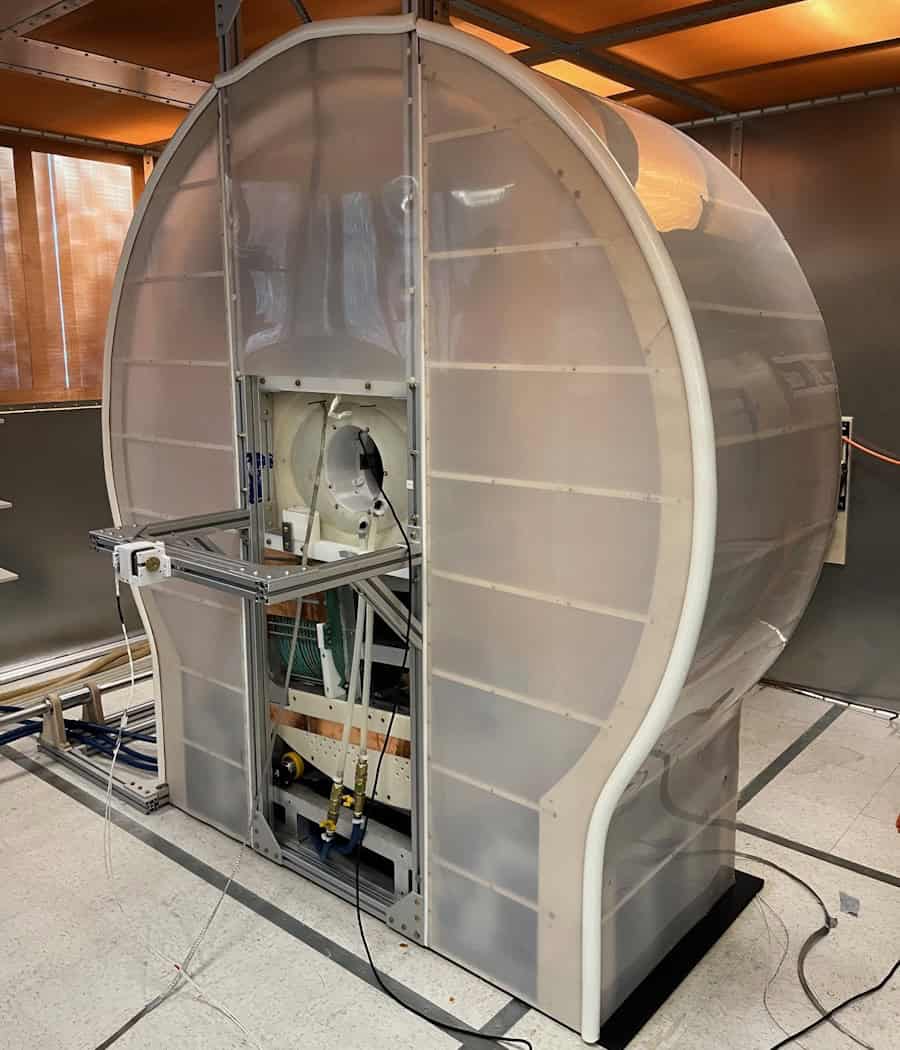
Human brain-scale MPI scanner

The resulting scanner uses two opposed permanent magnets to generate the FFL and high-power electromagnet shift coils, comprising inner and outer coils on each side of the head, to sweep the FFL across the head. The magnets create a gradient of 1.13 T/m, sufficient to achieve 5–6 mm resolution with high-performance SPIONs. To create 2D images, a mechanical gantry rotates the magnets and shift coils at 6 RPM, enabling imaging every 5 s.

The MPI system also incorporates a water-cooled 26.3 kHz drive coil, which produces the oscillating magnetic field (of up to 7 mTpeak) needed to drive the SPIONs in and out of saturation. A gradiometer-based receive coil fits over the head to record the SPION response.

Mattingly notes that this rescaling was far from straightforward as many parameters scale with the volume of the imaging bore. “With a bore about five times larger, the volume is about 125 times larger,” he says. “This means the power electronics require one to two orders of magnitude more power than rat-sized MPI systems, and the receive coils are simultaneously less sensitive as they become larger.”

Performance assessment

The researchers tested the scanner performance using a series of phantoms. They first evaluated spatial resolution by imaging 2.5 mm-diameter capillary tubes filled with Synomag SPIONs and spaced by between 5 and 9 mm. They reconstructed images using an inverse Radon reconstruction algorithm and a forward-model iterative reconstruction.

The system demonstrated a spatial resolution of about 7 mm with inverse Radon reconstruction, increasing to 5 mm with iterative reconstruction. The team notes that this resolution should be sufficient to observe changes in cerebral blood volume associated with brain function and following brain injuries.

To determine the practical detection limit, the researchers imaged Synomag samples with concentrations from 6 mgFe/ml to 15.6 µgFe/ml, observing a limit of about 1 µgFe. Based on this result, they predict that MPI should show grey matter with a signal-to-noise ratio (SNR) of roughly five and large blood vessels with an SNR of about 100 in a 5 s image. They also expect to detect changes during brain activation with a contrast-to-noise ratio of above one.

Next, they quantified the scanner’s imaging field-of-view using a G-shaped phantom filled with Synomag at roughly the concentration of blood. The field-of-view was 181 mm in diameter – sufficient to encompass most human brains. Finally, the team monitored the drive current stability over 35 min of continuous imaging. At a drive field of 4.6 mTpeak, the current deviated less than 2%. As this drift was smooth and slow, it should be straightforward to separate it from the larger signal changes expected from brain activation.

The researchers conclude that their scanner – the first human head-sized, mechanically rotating, FFL-based MPI – delivers a suitable spatial resolution, temporal resolution and sensitivity for functional human neuroimaging. And they continue to improve the device. “Currently, the group is developing hardware to enable studies such as application-specific receive coils to prepare for in vivo experiments,” says Mattingly.

At present, the scanner’s sensitivity is limited by background noise from the amplifiers. Mitigating such noise could increase sensitivity 20-fold, the team predicts, potentially providing an order of magnitude improvement over other human neuroimaging methods and enabling visualization of haemodynamic changes following brain activity.

The MPI system is described in Physics in Medicine & Biology.

Fermilab seeks new boss after Lia Merminga resigns as director

Lia Merminga has resigned as director of Fermilab – the US’s premier particle-physics lab. She stepped down yesterday after a turbulent year that saw staff layoffs, a change in the lab’s management contractor and accusations of a toxic atmosphere. Merminga is being replaced by Young-Kee Kim from the University of Chicago, who will serve as interim director until a permanent successor is found. Kim was previously Fermilab’s deputy director between 2006 and 2013.

Tracy Marc, a spokerperson for Fermilab, says that the search for Merminga’s successor has already begun, although without a specific schedule. “Input from Fermilab employees is highly valued and we expect to have Fermilab employee representatives as advisory members on the search committee, just as has been done in the past,” Marc told Physics World. “The search committee will keep the Fermilab community informed about the progress of this search.”

The departure of Merminga, who became Fermilab director in August 2022, was announced by Paul Alivisatos, president of the University of Chicago. The university jointly manages the lab with Universities Research Association (URA), a consortium of research universities, as well as the industrial firms Amentum Environment & Energy, Inc. and Longenecker & Associates.

“Her dedication and passion for high-energy physics and Fermilab’s mission have been deeply appreciated,” Alivisatos said in a statement. “This leadership change will bring fresh perspectives and expertise to the Fermilab leadership team.”

Turbulent times

The reasons for Merminga’s resignation are unclear but Fermilab has experienced a difficult last two years with questions raised about its internal management and external oversight. Last August, a group of anonymous self-styled whistleblowers published a 113-page “white paper” on the arXiv preprint server, asserting that the lab was “doomed without a management overhaul”.

The document highlighted issues such as management cover ups of dangerous behaviour including guns being brought onto Fermilab’s campus and a male employee’s attack on a female colleague. In addition, key experiments such as the Deep Underground Neutrino Experiment suffered notable delays. Cost overruns also led to a “limited operations period” with most staff on leave in late August.

In October, the US Department of Energy, which oversees Fermilab, announced a new organization – Fermi Forward Discovery Group – to manage the lab. Yet that decision came under scrutiny given it is dominated by the University of Chicago and URA, which had already been part of the management since 2007. Then a month later, almost 2.5% of Fermilab’s employees were laid off, adding to portray an institution in crisis.

The whistleblowers, who told Physics World that they still stand by their analysis of the lab’s issues, say that the layoffs “undermined Fermilab’s scientific mission” and claim that it sidelined “some of its most accomplished” researchers at the lab. “Meanwhile, executive managers, insulated by high salaries and direct oversight responsibilities, remained unaffected,” they allege.

Born in Greece, Merminga, 65, earned a BSc in physics from the University of Athens before moving to the University of Michigan where she completed an MS and PhD in physics. Before taking on Fermilab’s directorship, she held leadership posts in governmental physics-related institutions in the US and Canada.

Antimatter partner of hyperhelium-4 is spotted at CERN

CERN’s ALICE Collaboration has found the first evidence for antihyperhelium-4, which is an antimatter hypernucleus that is a heavier version of antihelium-4. It contains two antiprotons, an antineutron and an antilambda baryon. The latter contains three antiquarks (up, down and strange – making it an antihyperon), and is electrically neutral like a neutron. The antihyperhelium-4 was created by smashing lead nuclei together at the Large Hadron Collider (LHC) in Switzerland and the observation  has a statistical significance of 3.5σ. While this is below the 5σ level that is generally accepted as a discovery in particle physics, the observation is in line with the Standard Model of particle physics. The detection therefore helps constrain theories beyond the Standard Model that try to explain why the universe contains much more matter than antimatter.

Hypernuclei are rare, short-lived atomic nuclei made up of protons, neutrons, and at least one hyperon. Hypernuclei and their antimatter counterparts can be formed within a quark–gluon plasma (QGP), which is created when heavy ions such as lead collide at high energies. A QGP is an extreme state of matter that also existed in the first millionth of a second following the Big Bang.

Exotic antinuclei

Just a few hundred picoseconds after being formed in collisions, antihypernuclei will decay via the weak force – creating two or more distinctive decay products that can be detected. The first antihypernucleus to be observed was a form of antihyperhydrogen called antihypertriton, which contains an antiproton, an antineutron, and an antilambda hyperon It was discovered in 2010 by the STAR Collaboration, who smashed together gold nuclei at Brookhaven National Laboratory’s Relativistic Heavy Ion Collider (RHIC).

Then in 2024, the STAR Collaboration at Brookhaven National Laboratory’s Relativistic Heavy Ion Collider (RHIC) reported the first observations of the decay products of antihyperhydrogen-4, which contains one more antineutron than antihypertriton.

Now, ALICE physicists have delved deeper into the word of antihypernuclei by doing a fresh analysis of data taken at the LHC in 2018 – where lead ions were collided at 5 TeV.

Using a machine learning technique to analyse the decay products of the nuclei produced in these collisions, the ALICE team identified the same signature of antihyperhydrogen-4 detected by the STAR Collaboration. This is the first time an antimatter hypernucleus has been detected at the LHC.

Rapid decay

But that is not all. The team also found evidence for another, slightly lighter antihypernucleus, called antihyperhelium-4. This contains two antiprotons, an antineutron, and an antihyperon. It decays almost instantly into an antihelium-3 nucleus, an antiproton, and a charged pion. The latter is a meson comprising a quark–antiquark pair.

Physicists describe production of hypernuclei in a QGP using the statistical hadronization model (SHM). For both antihyperhydrogen-4 and antihyperhelium-4, the masses and production yields measured by the ALICE team closely matched the predictions of the SHM – assuming that the particles were produced in a certain mixture of their excited and ground states.

The team’s result further confirms that the SHM can accurately describe the production of hypernuclei and antihypernuclei from a QGP. The researchers also found that equal numbers of hypernuclei and antihypernuclei are produced in the collisions, within experimental uncertainty. While this provides no explanation as to why there is much more matter than antimatter in the observable universe, the research allows physicists to put further constraints on theories that reach beyond the Standard Model of particle physics to try to explain this asymmetry.

The research could also pave the way for further studies into how hyperons within hypernuclei interact with their neighbouring protons and neutrons. With a deeper knowledge of these interactions, astronomers could gain new insights into the mysterious interior properties of neutron stars.

The observation is described in a paper that has been submitted to Physical Review Letters.

How publishing in Electrochemical Society journals fosters a sense of community

The Electrochemical Society (ECS) is an international non-profit scholarly organization that promotes research, education and technological innovation in electrochemistry, solid-state science and related fields.

Founded in 1902, the ECS brings together scientists and engineers to share knowledge and advance electrochemical technologies.

As part of that mission, the society publishes several journals including the flagship Journal of the Electrochemical Society (JES), which is over 120 years old and covers a wide range of topics in electrochemical science and engineering.

Someone who has seen their involvement with the ECS and ECS journals increase over their career is chemist Trisha Andrew from the University of Massachusetts Amherst. She directs the wearable electronics lab, a multi-disciplinary research team that produces garment-integrated technologies using reactive vapor deposition.

Her involvement with the ECS began when she was invited by the editor-in-chief of ECS Sensors Plus to act as a referee for the journal. Andrew found the depth and practical application of the papers she reviewed interesting and of high quality. This resulted in her submitting her own work to ECS journals and she later became an associate editor for both ECS Sensors Plus and JES.

Professional Opportunities

Physical chemist Weiran Zheng from the Guangdong Technion – Israel Institute of Technology China, meanwhile, says that due to the reputation of ECS journals, they have been his “go-to” place to publish since graduate school.

Weiran Zheng

One of his papers entitled “Python for electrochemistry: a free an all-in-one toolset” (ECS Adv. 2 040502) has been downloaded over 8000 times and is currently the most-read ECS Advances article. This led to an invitation to deliver an ECS webinar — Introducing Python for Electrochemistry Research. “I never expected such an impact when the paper was accepted, and none of this would be possible without the platform offered by ECS journals,” adds Zheng.

Publishing in ECS journals has helped Zheng’s career advance through new connections and becoming more involved with ECS activities. This has not only boosted his research but also professional network and given these benefits, Zheng plans to continue to publish his latest findings in ECS journals.

Highly cited papers

Battery researcher Thierry Brousse from Nantes University in France, came to electrochemistry later on in his career having first carried out a PhD in high-temperature superconducting thin films at the University of Caen Normandy.

Thierry Brousse

When he began working in the field he collaborated with the chemist Donald Schleich from Polytech Nantes, who was an ECS member. It was then that he began to read the JES finding it a prestigious platform for his research in supercapacitors and microdevices for energy storage. “Most of the inspiring scientific papers I was reading at that time were from JES,” notes Brousse. “Naturally, my first papers were then submitted to this journal.”

Brousse says that publishing in ECS journals has provided him with new collaborations as well as invitations to speak at major conferences. He emphasizes the importance of innovative work and the positive impact of publishing in ECS journals where some of his most cited work has been published.

Brousse, who is an associate editor for JES, adds that he particularly values how publishing with ECS journals fosters a quick integration into specific research communities. This, he says, has been instrumental in advancing his career.

Long-standing relationships

Robert Savinell’s relationship with the ECS and ECS journals began during his PhD research in electrochemistry, which he carried out at the University of Pittsburgh. Now at Case Western Reserve University in Cleveland, Ohio, his research focusses on developing a flow battery for low-cost long duration energy storage primarily using iron and water. It is designed to improve the efficiency of the power grid and accelerate the addition of solar and wind power supplies.

Robert F Savinell

Savinell also leads a Department of Energy funded Emerging Frontier Research Center on Breakthrough Electrolytes for Energy Storage. This Center focuses on fundamental research on nano to meso-scale structured electrolytes for energy storage.

ECS journals have been a cornerstone of his professional career, providing a platform for his research and fostering valuable professional connections. “Some of my research published in JES many years ago are still cited today,” says Savinell.

Savinell’s contributions to the ECS community have been recognized through various roles, including being elected a fellow of the ECS and he has previously served as chair of the ECS’s electrolytic and electrochemical engineering division. He was editor-in-chief of JES for the past decade and most recently was elected third vice president of the ECS.

Savinell says that the connections he has made through ECS have been significant, ranging from funding programme managers to personal friends. “My whole professional career has been focused around ECS,” he says, adding that he aims to continue to publish in ECS journals and hopes that his work will inspire solutions to some of society’s biggest problems.

Personal touch

For many researchers in the field, publishing in ECS journals has brought with it several benefits. That includes the high level of engagement and the personal touch within the ECS community and also the promotional support ECS provides for published work.

The ECS journals’ broad portfolio also ensure that researcher’s work reaches the right audience, and such a visibility and engagement is a significant factor when it comes to advancing the careers of scientists. “The difference between ECS journals is the amount of engagement, views and reception that you receive,” says Andrew. “That’s what I found to be the most unique”.

Altermagnets imaged at the nanoscale

A recently-discovered class of magnets called altermagnets has been imaged in detail for the first time thanks to a technique developed by physicists at the University of Nottingham’s School of Physics and Astronomy in the UK. The team exploited the unique properties of altermagnetism to map the magnetic domains in the altermagnet manganese telluride (MnTe) down to the nanoscale level, raising hopes that its unusual magnetic ordering could be controlled and exploited in technological applications.

In most magnetically-ordered materials, the spins of atoms (that is, their magnetic moments) have two options: they can line up parallel with each other, or antiparallel, alternating up and down. These arrangements arise from the exchange interaction between atoms, and lead to ferromagnetism and antiferromagnetism, respectively.

Altermagnets, which were discovered in 2024, are different. While their neighbouring spins are antiparallel, like an antiferromagnet, the atoms hosting these spins are rotated relative to their neighbours. This means that they combine some properties from both types of conventional magnetism. For example, the up, down, up ordering of their spins leads to a net magnetization of zero because – as in antiferromagnets – the spins essentially cancel each other out. However, their spin splitting is non-relativistic, as in ferromagnets.

Resolving altermagnetic states down to nanoscale

Working at the MAX IV international synchrotron facility in Sweden, a team led by Nottingham’s Peter Wadley used photoemission electron microscopy to detect the electrons emitted from the surface of MnTe when it was irradiated with a polarized X-ray beam.

“The emitted electrons depend on the polarization of the X-ray beam in ways not seen in other classes of magnetic materials,” explains Wadley, “and this can be used to map the magnetic domains in the material with unprecedented detail.”

Using this technique, the team was able to resolve altermagnetic states down to the nanoscale – from 100-nm-scale vortices and domain walls up to 10-μm-sized single-domain states. And that is not all: Wadley and colleagues found that they could control these features by cooling the material while a magnetic field is applied.

Potential uses of altermagnets

Magnetic materials are found in most long-term computer memory devices and in many advanced microchips, including those used for Internet of Things and artificial intelligence applications. If these materials were replaced with altermagnets, Wadley and colleagues say that the switching speed of microelectronic components and digital memory could increase by up to a factor of 1000, with lower energy consumption.

“The predicted properties of altermagnets make them very attractive from the point of view of fundamental research and applications,” Wadley tells Physics World. “With strong theoretical guidance from our collaborators at FZU Prague and the Max Planck Institute for the Physics of Complex Systems, we realised that our experience in materials development and magnetic imaging positioned us well to attempt to image and control altermagnetic domains.”

One of the main challenges the researchers faced was developing thin films of MnTe with surfaces of a sufficiently high quality that allowed them to detect the subtle X-ray spectroscopy signatures of the altermagnetic order. They hope that their study, detailed in Nature, will spur further interest in these materials.

“Altermagnets provide a new vista of predicted phenomena from unconventional domain walls to unique band structure effects,” Wadley says. “We are exploring these effects on multiple fronts and one of the major goals is to demonstrate a more efficient means of controlling the magnetic domains, for example, by applying electric currents rather than cooling them down.”

Very thin films of a novel semimetal conduct electricity better than copper

Metals usually become less conductive as they get thinner. Niobium phosphide, however, is different. According to researchers at Stanford University, US, a very thin film of this non-crystalline topological semimetal conducts electricity better than copper even in non-crystalline films. This surprising result could aid the development of ultrathin low-resistivity wires for nanoelectronics applications.

“As today’s electronic devices and chips become smaller and more complex, the ultrathin metallic wires that carry electrical signals within these chips can become a bottleneck when they are scaled down,” explains study leader Asir Intisar Khan, a visiting postdoctoral scholar and former PhD student in Eric Pop’s group at Stanford.

The solution, he says, is to create ultrathin conductors with a lower electrical resistivity to make the metal interconnects that enable dense logic and memory operations within neuromorphic and spintronic devices. “Low resistance will lead to lower voltage drops and lower signal delays, ultimately helping to reduce power dissipation at the system level,” Khan says.

The problem is that the resistivity of conventional metals increases when they are made into thin films. The thinner the film, the less good it is at conducting electricity.

Topological semimetals are different

Topological semimetals are different. Analogous to the better-known topological insulators, which conduct electricity along special edge states while remaining insulating in their bulk, these materials can carry large amounts of current along their surface even when their structure is somewhat disordered. Crucially, they maintain this surface-conducting property even as they are thinned down.

In the new work, Khan and colleagues found that the effective resistivity of non-crystalline films of niobium phosphide (NbP) decreases dramatically as the film thickness is reduced. Indeed, the thinnest films (< 5 nm) have resistivities lower than conventional metals like copper of similar thicknesses at room temperature.

Another advantage is that these films can be created and deposited on substrates at relatively low temperatures (around 400 °C). This makes them compatible with modern semiconductor and chip fabrication processes such as industrial back-end-of-line (BEOL). Such materials would therefore be relatively easy to integrate into state-of-the-art nanoelectronics. The fact that the films are non-crystalline is also an important practical advantage.

A “huge” collaboration

Khan says he began thinking about this project in 2022 after discussions with a colleague, Ching-Tzu Chen, from IBM’s TJ Watson Research Center. “At IBM, they were exploring the theory concept of using topological semimetals for this purpose,” he recalls. “Upon further discussion with Prof. Eric Pop, we wanted to explore the possibility of experimental realization of thin films of such semimetals at Stanford.”

This turned out to more difficult than expected, he says. While physicists have been experimenting with single crystals of bulk NbP and this class of topological semimetals since 2015, fabricating them at the ultrathin film limit of less than 5 nm at a temperature and using deposition methods compatible with industry and nanoelectronic fabrication was new. “We therefore had to optimize the deposition process from a variety of angles: substrate choice, strain engineering, temperature, pressure and stoichiometry, to name a few,” Khan tells Physics World.

The project turned out to be a “huge” collaboration in the end, with researchers from Stanford, Ajou University, Korea, and IBM Watson all getting involved, he adds.

The researchers says they will now be running further tests on their material. “We also think NbP is not the only material with this property, so there’s much more to discover,” Pop says.

The results are detailed in Science.

Higher-order brain function revealed by new analysis of fMRI data

An international team of researchers has developed new analytical techniques that consider interactions between three or more regions of the brain – providing a more in-depth understanding of human brain activity than conventional analysis. Led by Andrea Santoro at the Neuro-X Institute in Geneva and Enrico Amico at the UK’s University of Birmingham, the team hopes its results could help neurologists identify a vast array of new patterns in human brain data.

To study the structure and function of the brain, researchers often rely on network models. In these, nodes represent specific groups of neurons in the brain and edges represent the electrical connections between neurons using statistical correlations.

Within these models, brain activity has often been represented as pairwise interactions between two specific regions. Yet as the latest advances in neurology have clearly shown, the real picture is far more complex.

“To better analyse how our brains work, we need to look at how several areas interact at the same time,” Santoro explains. “Just as multiple weather factors – like temperature, humidity, and atmospheric pressure – combine to create complex patterns, looking at how groups of brain regions work together can reveal a richer picture of brain function.”

Higher-order interactions

Yet with the mathematical techniques applied in previous studies, researchers have not confirmed whether network models incorporating these higher-order interactions between three or more brain regions could really be more accurate than simpler models, which only account for pairwise interactions.

To shed new light on this question, Santoro’s team built upon their previous analysis of functional MRI (fMRI) data, which identify brain activity by measuring changes in blood flow.

Their approach combined two powerful tools. One is topological data analysis. This identifies patterns within complex datasets like fMRI, where each data point depends on a large number of interconnected variables. The other is time series analysis, which is used to identify patterns in brain activity which emerge over time. Together, these tools allowed the researchers to identify complex patterns of activity occurring across three or more brain regions simultaneously.

To test their approach, the team applied it to fMRI data taken from 100 healthy participants in the Human Connectome Project. “By applying these tools to brain scan data, we were able to detect when multiple regions of the brain were interacting at the same time, rather than only looking at pairs of brain regions,” Santoro explains. “This approach let us uncover patterns that might otherwise stay hidden, giving us a clearer view of how the brain’s complex network operates as a whole.”

Just as they hoped, this analysis of higher-order interactions provided far deeper insights into the participants’ brain activity compared with traditional pairwise methods. “Specifically, we were better able to figure out what type of task a person was performing, and even uniquely identify them based on the patterns of their brain activity,” Santoro continues.

Distinguishing between tasks

With its combination of topological and time series analysis, the team’s method could distinguish between a wide variety of tasks in the participants: including their expression of emotion, use of language, and social interactions.

By building further on their approach, Santoro and colleagues are hopeful it could eventually be used to uncover a vast space of as-yet unexplored patterns within human brain data.

By tailoring the approach to the brains of individual patients, this could ultimately enable researchers to draw direct links between brain activity and physical actions.

“Down the road, the same approach might help us detect subtle brain changes that occur in conditions like Alzheimer’s disease – possibly before symptoms become obvious – and could guide better therapies and earlier interventions,” Santoro predicts.

The research is described in Nature Communications.

Copyright © 2026 by IOP Publishing Ltd and individual contributors