Our Facebook followers have spoken – when I last checked, about 63% of respondents to last week’s poll believe that scientists involved in the discovery of the Higgs boson should share the 2012 Nobel Prize for Physics.
I agree. The Nobel committee should reward the fantastic work done by those who built the Large Hadron Collider and those who designed and ran the ATLAS and CMS experiments while the discovery is fresh in the minds of the public. A public, I should add, who will be left scratching their heads if and when a breakthrough made 30 years ago trumps the Higgs and bags the Nobel.
Some of you may be shouting “But they don’t yet know if it is the Higgs” at your screen. I would argue that the act of building such a colossal facility, getting it to work, analysing vast quantities of data, and finding something, is worthy of a Nobel – regardless of what that something is.
But alas, I don’t think that a Higgs-related prize with come this year – it’s likely to be a shoe-in for 2013, when we will have a much clearer idea of what has been found at the LHC.
So what other topics have our readers tipped for the prize? Runner-up in our poll with 9% is a Nobel related to the first experimental test of Bell’s theorem. Because this pioneering work – done in 1981 by Alain Aspect and others – marks the beginning of the burgeoning experimental field of quantum information, I’d say it’s a frontrunner for tomorrow’s prize.
Just behind at 8% is the discovery of neutrino mass, which could see my fellow Canadian Art McDonald making the trip to Stockholm.
The prize will be announced tomorrow at 10:30 BST, so stay tuned to physicsworld.com for comprehensive coverage of the 2012 physics Nobel.
Researchers in the US have found yet another use for the “wonder material” graphene. Instead of exploiting the material’s exceptional ability as an electrical conductor, the team has found a way to use graphene as an extremely thin “tunnel barrier” to conduction. The team says that this new application is particularly suited to developing spintronics – a relatively new technology that exploits the spin of an electron as well as its charge.
Graphene is a sheet of carbon just one atom thick and ever since the material was first isolated in 2004, researchers have been trying to create electronics devices that make use of its unique properties. Most of this effort has focused on how electrons flow in the plane of the sheet – which can behave both as a conductor and semiconductor. But now Berry Jonker and colleagues at the US Naval Research Laboratory (NRL) have shown that graphene can serve as an excellent tunnel barrier when current is directed perpendicular to the plane of carbon atoms. The spin polarization of the current is also preserved by the tunnel barrier, a finding that could have important implications for spintronics.
Low-energy switching
The spin of an electron can point in an “up” or “down” direction and this property could be used to store and process information in spintronics devices. Circuits that employ a spin current – electrons with opposite spins moving in opposite directions – could, in principle, be smaller and more efficient than conventional electronic circuits that rely on switching charge alone. This is because switching spins from up to down can be done using very little energy.
Spintronics devices are typically made from ferromagnetic materials and semiconductors. Ferromagnetic metals, such as iron or permalloy, have intrinsically spin-polarized electron populations – that is, different numbers of up-spin and down-spin electrons – and thus make ideal contacts for injecting spins into a semiconductor. However, ferromagnets and semiconductors have a large conductivity mismatch, so spin is injected via a tunnel barrier – an electrically insulating barrier through which electrons tunnel quantum mechanically. The problem is that the oxide barriers normally employed as tunnel barriers introduce defects into the system and have resistances that are too high – factors that adversely affect device performance.
Enter the graphene tunnel barrier
To overcome this problem, Jonker and colleagues decided to employ single-layer graphene as the tunnel barrier, because the material is defect resistant, chemically inert and stable. These properties can be exploited to make low-resistance graphene spin contacts that are compatible with both the ferromagnetic metal and semiconductor.
The researchers began by mechanically transferring graphene grown by chemical vapour deposition onto hydrogen-passivated silicon surfaces. They achieved this by floating the graphene on the surface of water and bringing the silicon substrate up from below. This common technique ensures that there is no oxide layer between the silicon surface and the graphene. The team then injected electron spins from a ferromagnetic nickel–iron alloy into the silicon via the graphene tunnel barrier. The voltage arising from the resulting spin polarization in the silicon was then measured using the Hanle effect, a method that is routinely employed by spintronics scientists.
Beyond Moore’s law
“Our discovery clears an important hurdle to the development of future semiconductor spintronics devices – that is, devices that rely on manipulating the electron’s spin rather than just its charge for low-power, high-speed information processing beyond the traditional size scaling of Moore’s law,” Jonker says. “These results identify a new route to making low-resistance-area spin-polarized contacts, which are key for semiconductor spintronics devices that rely on two-terminal magnetoresistance, including spin-based transistors, logic and memory.”
Using graphene in spintronics structures may provide much higher values of the tunnel spin polarization thanks to so-called spin-filtering effects that have been predicted for selected ferromagnetic metal/graphene structures, Jonker adds. “Such an increase would improve the performance of semiconductor spintronics devices by providing higher signal-to-noise ratios and corresponding operating speeds, so advancing the technological applications of silicon spintronics,” he says.
The work, which was supported by programs at the NRL and the US Office of Naval Research, is reported in Nature Nanotechnology.
Physicists in Hong Kong have used tiny spheres to simulate what happens when a crystalline solid starts to melt. Instead of seeing the emergence of crystalline defects during the melting process, the team found that the transition from solid to liquid is driven by small groups of spheres that move co-operatively in small loops.
Almost all solid objects – including ice cubes – melt from the surface in a process that is well understood by physicists. But while some materials could be heated internally by focussing a beam of light at a point well below their surface, actually seeing how the atoms or molecules make the transition from solid to liquid would be extremely hard. As a result, scientists have little understanding of how internal melting occurs.
To get around this problem Yilong Han and colleagues from the Hong Kong University of Science and Technology simulated the melting process using a crystal made of tiny N-isopropylacrylamide (NIPA) spheres. These spheres all have the same radius of about 700 nm, which is about 1000 times larger than a typical unit cell in a crystalline solid. Crucially, though, this is large enough to be seen using an optical microscope.
Tracking the spheres
The team began by compressing a collection of these spheres to create a face-centred cubic (FCC) lattice – the crystal structure adopted by copper, aluminium and many other metals. A light was then focussed to a point about 45 μm beneath the surface, which is well within the bulk of the crystal. The researchers then watched how the spheres moved, using an optical microscope equipped with a camera that could take pictures at a rate of 15 frames per second.
In a crystalline material, melting is driven by the increase in random thermal motion of the constituent atoms or molecules as the material heats up. For much larger spheres, however, the amount of energy that would be needed to make them move about like atoms would be impossible to deliver. But what is interesting about NIPA is that it shrinks as it is heated, with the volume of the spheres dropping by more than 30% as they are warmed up from 26 °C to 31 °C. The spheres therefore have enough room to move around when heated.
The team began with a NIPA FCC crystal in a “solid state” in which more than 54.5% of the volume is occupied by spheres and the rest by water. While this “volume fraction” is much smaller than the familiar 74% for a hard-sphere FCC lattice, Han points out that this is still the most stable configuration until the volume fraction drops below 54.5%. Below this value, the material becomes disordered and resembles a liquid.
Deviating from equilibrium
Han’s team then focused a heating lamp on a spot of the crystal that is about 75 µm across and 20 μm deep and gently heated the spheres for about 107 minutes. The degree to which the spheres deviate from their equilibrium positions is analysed by calculating their Lindemann parameter (L).
The team concluded that the melting process involves two main steps. The material begins in the solid FCC phase with a low L value. As it heats up, large domains of particles then emerge with high L numbers. Finally, a small region of liquid is created that then grows throughout the crystal. According to the team, this two-step process is in line with a century-old principle of melting and crystallization called “Ostwald’s step rule”, which says that an intermediate unstable structure is involved.
When the physicists took a closer look at how melting occurred, they found that the process seemed to begin via “loop rearrangements” of the spheres. This involves a small number of spheres moving in a loop, with one sphere moving into the space vacated by its neighbour and another sphere moving in behind it. While the integrity of the FCC lattice is maintained by these loops, they become surrounded by regions of high L, which then make the transition to the liquid state.
Surprisingly long time
Han told that the team was initially surprised to see that the large L domains lasted for relatively long times of about 30 s. “Then we realized that particle swapping can stabilize the large-L region and the large-L region can, in turn, promote particle swapping,” he says.
One interesting phenomenon that had not been predicted by theory – but that was seen by the team – was the coalescence of two or more liquid regions into a larger region. This big domain rapidly assumes a spherical shape because of the surface tension at the boundary between the liquid and solid phases. However, one thing that is predicted by some theories – but that was not seen in the experiment – is the emergence of crystalline defects, such as disclinations, during the melting process. Han, however, points out that a defect-mediated melting theory is “just a guess without a theoretical derivation”.
Difficult measurement
Gary Bryant of RMIT University in Australia told physicsworld.com that the new work is an important step towards a better understanding of crystal melting, adding that the study “goes a long way to measuring homogeneous melting in bulk materials, which is normally tricky because temperature variations are usually transferred from the container walls, leading to inhomogeneous or heterogeneous melting”.
Although the work provides important insights into the melting process, both Han and Bryant admit that there are few practical applications of understanding internal melting because it rarely occurs in practice. “One possible application might be in selective annealing – for those trying to create large, defect-free colloidal crystals,” says Bryant. Such crystals could find use in photonics or other nanotechnology applications.
Han and colleagues are now planning to use their technique to look at the second stage of melting – when the nucleus of liquid expands rapidly. They also want to study the effect of local heating on regions of a crystal that contain a single defect, such as a dislocation or grain boundary, to see how its presence affects the melting. Studying solid–solid transitions between two crystal structures as well as solid–glass transitions are also on the researchers’ to-do list.
On 6 November Americans go to the polls to elect a president, a third of the US Senate, all 435 members of the House of Representatives, and numerous governors, mayors and local officials. To this extent, it is an ordinary election year. This time around, however, campaigning seems thicker than usual with claims and counter-claims. Many people say they are unsure how to vote.
Not me. I’m a single-issue voter. I vote for the candidates with the most respect for science. I am not saying I necessarily want to see scientists in office; while scientists are prone to wait for definitive answers, political decisions often have to be made before all relevant data are in. I also don’t think political candidates need be scientifically knowledgeable – able to recite π or the periodic table, say. What I am saying is that a necessary qualification for candidates for public office is a respect for the scientific process and its infrastructure.
In case that sounds vague and abstract, let me illustrate. A little over a year ago, Hurricane Irene slammed into the North Carolina coast and made its way north, leaving devastation in its wake. It flooded towns, smashed property, and caused dozens of deaths and many billions of dollars in damage. On Long Island alone it left hundreds of thousands of homes without electricity for days, including mine in Stony Brook. Meteorologists expressed some frustration with their inability to predict the hurricane’s exact path and intensity, citing several unknowns in the myriad factors that govern the paths of storms. More research was needed, they said, before their models would markedly improve. In the light of that uncertainty, what do you think ought to be the rational response for politicians? Is it a to reinforce hurricane safety measures while supporting the efforts of scientists to improve their models? Or b to ignore hurricane warnings, attack hurricane scientists as a self-promoting cabal of dishonest conspirators and de-fund hurricane research?
Ignoring the science
Okay, it’s a stupid example. Only an insane person answers b. But why do more and more political candidates – even current office-holders – resort to a version of b in responding to issues such as climate change, medical care, vaccines, epidemics, evolution and birth control? For instance, the Republican candidate for vice-president, Paul Ryan, wrote an article in the Wisconsin newspaper The Journal Times on 11 December 2009 in which he said that leading climatologists were perverting the scientific method so as to “intentionally mislead the public”. Ryan subsequently reacted to what he felt was uncertainty over climate change by voting to prevent the US Department of Agriculture from implementing a climate-change protection plan, and to eliminate White House climate advisers.
The most outrageous case of ignoring scientific findings in this election – so far – involves Congressman Todd Akin, a Republican from Missouri and a Senate candidate, and a member of the House Committee on Science, Space and Technology. In August Akin defended his opposition to abortion following rape by saying that pregnancy resulting from rape is rare because “the female body has ways to try to shut the whole thing down”. Akin’s remarks directly contradicted numerous studies on pregnancy resulting from rape, such as one published in 1996 in the American Journal of Obstetrics and Gynecology (175 320).
Lest you think that physics is immune from such treatment – or that I am targeting only Republicans – consider Congressman Dennis Kucinich, an Ohio Democrat who, citing possible hazards, introduced a bill requiring radiation warning labels on mobile phones. But although the world’s seven billion people own an astounding 5.6 billion mobile phones, the National Cancer Institute (Journal of the National Cancer Institute93 166) and other federal scientific agencies agree that there is no scrap of evidence that electromagnetic radiation can break DNA bonds. Though not as repugnant as Akin’s remark, Kucinich’s action involves shameless posturing over a health issue that can needlessly frighten innocent people.
Politics and science are two very different professions. Politicians come up with socially desirable visions and fact-based plans for achieving them, balancing side effects and costs. Scientists collect technical data and other information that may enter into these plans. In normal situations, scientific work is uncontroversial and operates below the political radar. The danger arises when issues become political lightning rods, and ideological aims cause people to override basic, unavoidable facts bearing on health and safety.
Candidates’ views about science are important because these views tend to reflect how the candidate approaches other issues. This is why I look carefully at each candidate’s attitude towards science, reflected in their web pages, pronouncements and voting record. Do they arrive at a decision first, and then cherry-pick information to support it? Or do they inquire first before coming to a decision, respecting and supporting the scientific infrastructure that has been build to acquire such data?
The critical point
“But it’s real for us! It’s real for us! Doesn’t matter what the muggles say, it’s real for us!”
Lauren Fairweather’s affecting song, “It’s real for us”, is a cult classic among Harry Potter fans. It is about how a youngster’s love for the fantasy land of the young magician helps her to cope with the more intractable adult world. This election year, I’m hearing more political candidates than ever express the same sentiment, though neither with Fairweather’s self-conscious irony nor the realization that the election is not about who governs Hogwarts but the US. It’s a world where wishes and wands cannot control things such as hurricanes, disease, pregnancy and evolution.
Do any candidates realize that? Do they have a track record of supporting the network of institutions that’s been established to discover what does control these things? If so, they get my vote.
Astronomers using the Keck telescope have found a new star orbiting very near to the supermassive black hole believed to be at the centre of the Milky Way. This is only the second star that researchers have observed completing an entire orbit – and its discovery confirms the black hole’s presence beyond reasonable doubt. Future observations of both orbiting stars could provide a unique test of general relativity.
The Keck telescope atop Mauna Kea in Hawaii has been used since the mid-1990s to systematically probe the area surrounding the centre of the Milky Way. In doing so, astronomers revealed several stars that appear to be orbiting a central object dubbed Sgr A* (“Sagittarius A Star”). From measurements of the stars’ orbital characteristics, it was calculated that Sgr A* must weigh in at around four million times the mass of the Sun. The only known astrophysical object that could be so massive, yet exist in such a small space, is a black hole.
However, only the orbit of one star – S0-2 – had data covering its entire 16.5 year journey around the centre. Data on the rest of the stars cover less than 40% of their orbits – the remainder has been projected using modelling. In order to characterize an orbit, astronomers believe that 50% of a star’s orbit needs to be observed. With only S0-2 breaking this threshold, some sceptics questioned whether a central black hole existed at all.
Better adaptive optics
Now, astronomers, including Andrea Ghez at the University of California, Los Angeles, have revealed the discovery of a new star named S0-102. “The orbital period of this star is just 11.5 years – the shortest of any star known to orbit the black hole,” Ghez told physicsworld.com. “Improvements in adaptive optics have allowed us to find fainter stars and measure them more acurately,” she says. With adaptive optics, the telescope’s mirror is not a single surface, rather a tiled surface made up of smaller mirrors. A laser guide is fired into the sky above the telescope and the distortion of the laser due to atmospheric turbulence is measured. The shape of the mirror can then be adapted by moving individual tiles in order to compensate for the distortion.
This technique will also allow the future observation of S0-102 at apoapsis – its furthest distance from the black hole. “This will reduce our uncertainties in parameters like the black hole’s mass,” says Ghez. Having a second star to observe will also allow astronomers to improve their understanding of S0-2’s orbit. In particular, it will help provide a more precise measurement of S0-2’s periapsis – its closest approach to the black hole – in 2018. During periapsis, the star experiences a stronger gravitational force, causing an additional redshift in its light. The precise amount of redshift is predicted by Einstein’s general theory of relativity. The experiment can be repeated when S0-102 reaches its own periapsis in 2021.
General relativity also predicts the precession of a star’s periapsis. “The fact that space is warped by the gravity of the black hole means that orbits overshoot each time. The point of periapsis moves on in the direction that the star is already orbiting,” explains Ghez. This is similar to the precession of Mercury’s orbit within our own solar system – a puzzle that, when explained by Einstein in 1915, provided an early endorsement of his ideas.
Unknown parameter
However, this particular test of relativity is not possible with a single star. “The situation isn’t as simple as two stars orbiting a single black hole,” says Ghez. “There are likely to be other things orbiting in there too, such as stellar-mass black holes and neutron stars,” she adds. This means that the orbiting stars do not see a symmetrical distribution of mass as they pass through this crowded region. If general relativity is to be tested, it has to be treated as an unknown parameter. If the mass distribution is also unknown, you need two stars to solve the equations. “With future advances in adaptive optics, and the next generation of telescopes, we will now be able to see whether Einstein’s relativity stands up in this extreme gravitational environment,” Ghez hopes.
“It is pretty spectacular that they’ve observed the whole orbit of a second star,” Nils Andersson, head of the General Relativity Group, at the University of Southampton, UK, says. “It shows there has to be a black hole in the centre, and it helps pinpoint how massive it is,” he adds. However, he believes there are stronger tests of general relativity. “I think the best test beyond the solar system is still two pulsars orbiting around each other. That sort of system puts more constraints on Einstein’s theory,” he explains.
IOP president, Sir Peter Knight. (Courtesy: IOP/Mark Earthy)
By Tushna Commissariat
Yesterday, I was in London attending the annual awards dinner of the Institute of Physics (IOP), which publishes Physics World, as well as the first ever IOP Innovation Awards, held earlier in the afternoon. It proved to be an exciting and jam-packed day to say in the least.
The IOP Innovation Awards have been set up to recognize and celebrate businesses from the UK and Ireland that have achieved significant commercial success by finding a niche in the market and developing physics-based applications to fill it. This year, the four inaugural awards went to a wide range of products.
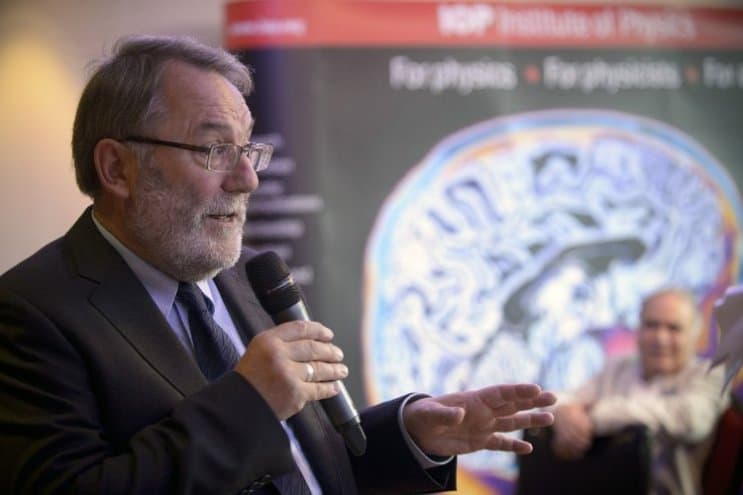
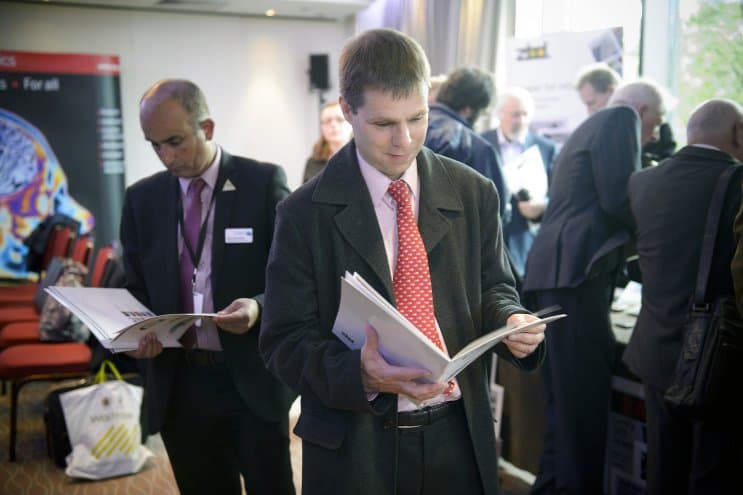
All afternoon long, the Innovation Awards room was full to the brim with scientists, developers, students and recruiters keen on finding out what the companies did and the products they had to offer. In fact, the room was so busy that IOP president, Sir Peter Kinght, who came along to address the ceremony, found it hard to make his way to each event desk and promised a larger space for next year’s meet. He was keen to show the world the “vibrancy of investment in the technology” the various companies had developed. “Physics is not just about cosmology or particle physics – that’s great too – but it’s about making a difference in the world,” he told visitors. Knight finished by promising that next year, the Innovation Awards would be “bigger and better”.
Visitors at the Innovation Awards. (Courtesy: IOP/Mark Earthy)
One winner was a small, noiseless, high-volume pump that has many applications in medical devices, developed by Technology Partnership, based at the Melbourn Science Park in Hertfordshire. The tiny pump runs at 20 kHz and is already being used for wound therapy devices and in an electronic atomizer that is used for more efficient drug delivery. The device has only been on the market for 18 months, but has already earned the company more than £1m in additional revenue.
Another award went to Canterbury-based Naneum, which has developed a portable and easy-to-operate particle monitor to detect and identify nanoparticles pollutants, with applications in environmental monitoring, occupational health and atmospheric physics. The company was keen to develop a device that was easy to transport and could be used by any engineer, rather than someone trained to specifically do so. The device – the Nano-ID NPS 500 – is forecast to earn the company more than £1.5m over the next two years.
“Personal confocal” is how the next award winner, Aurox, describes its microscope attachment that lets researchers take 3D high-resolution images without the costs of investing in a confocal laser scanning microscope. Spun out from the University of Oxford, the firm has now partnered with Andor and Carl Zeiss to develop the Viva Tome imaging system. Having developed the new technology three years ago, it has already earned the company almost £1m in additional revenue. Aurox also won a Queen’s Award for Enterprise in Innovation earlier this year.
Some of ZBD’s e-paper supermarket labelling. (Courtesy: Physics World/Tushna Commissariat)
The final company to be lauded was ZBD Solutions, which has spent the past 12 years perfecting a novel e-paper display that makes shelf-edge labelling easier. The Malvern-based company was spun out from the liquid-crystal research centre at DERA, formerly the UK Ministry of Defence’s research arm. The current avatar of their e-paper (pictured above) was developed four years ago and has created 62 jobs and earned the company an additional £20m. ZBD Solutions was ranked 5th on this year’s Sunday Times Hiscox Tech Track 100 league table.
The IOP Awards dinner took place later in the evening and 600 of the “who’s who” of the UK physics community were out in their finest clothes. IOP medals span the entire spectrum of physics research, physics education and outreach as well as the application of physics and physics-based technologies. They are given to “identify and honour physicists who are today making remarkable contributions and to encourage younger members of our community to greater success in the future”. A complete list of all the many awards and their winners of the 2012 medals can be found here.
In Knight’s address to the gathering he highlighted, among other issues, the lack of girls in physics, after it was noted that only 20% of girls have been taking physics A-levels over the past 20 years. His comments were made in the light of a new report published by the Institute on the same day entitled It’s Different for Girls. The report looks at changing the attitude of school teachers in all subjects, as well as parents, to encourage girls to take up A-level physics.
Professor Brian Cox, who was awarded the President’s Medal 2012 for his “achievements in promoting science to the general public and inspiring the next generation of physicists”, was the guest speaker at the dinner. In his witty and engaging speech, a video of which you can watch below, he addressed the excitement of the Higgs discovery made earlier this year as well as the sophistication of the Large Hadron Collider. But he also had some strong words to say about promoting bad science and how it was not acceptable – he highlighted homeopathy and some ill-advised comments made by Jeremy Hunt, the current health secretary, on the issue.
To much laughter, Cox followed that up with some amusing comments about “faith-based aviation” or the serious lack thereof by saying, “There is a reason why we don’t have…homeopathic aircraft that run on the memory of petrol.” He also spoke of how it was important for the government to invest in increasing the number of STEM graduates in the UK. He ended his address by thanking the physics community, saying “Without you, I would have nothing to say the next time I stand on a mountain!”
All in all, it was an entertaining and illuminating evening for the people in the UK who are involved in physics…and the raspberry and chilli ice-cream for desert was excellent too!
Bright and early on the morning of Tuesday 9 October, a small group of physicists will meet in Stockholm to make the final decision about who will win the 2012 Nobel Prize for Physics.
While I have no way of knowing, I’m hoping that the discovery of the Higgs boson at the Large Hadron Collider will be on the table. I know that there are many good reasons why Higgs hunters won’t bag the prize this year: the discovery came after nominations were closed; it would be too difficult to decide which individuals should share the prize; and physicists are still not 100% certain that the particle discovered at the LHC is the same boson that was first predicted in 1964.
However, my understanding is that the committee could cast aside the various historical conventions conspiring against a Higgs prize, and award the Nobel to those responsible for what surely is the most important physics breakthrough so far of the 21st century.
What breakthrough should be awarded this year’s Nobel Prize for Physics?
Discovery of the Higgs boson Inflationary cosmology Discovery of exoplanets Aharonov–Bohm effect/Berry phase Discovery of neutrino mass Invention of the LED laser Invisibility/transformation optics Slow light/electromagnetically induced transparency First experimental test of Bell’s theorem
Have your say by visiting our Facebook page, and please feel free to explain your response – or suggest another Nobel prediction – by posting a comment below the poll.
Last week we asked “Physicists in Japan have discovered element 113. What should they call it?” Your favourite name was “nishinium”, with 37% of respondents in favour of honouring the Japanese nuclear-physics pioneer Yoshio Nishina.
Several people asked why we included “japonium” instead of “nipponium” – pointing out that Nippon is the transliteration preferred by the Japanese. Japonium is actually a name put forward by physicists at RIKEN, though I’m not sure why they have chosen the French spelling.
Bodenschatz is part of an international team that is developing a technique known as “LEAP”, or low-energy anti-fibrillation pacing. Rather than shocking a patient’s heart with one large electrical pulse, the technique involves applying several weaker signals that manage to terminate erratic electrical activity in the heart. Bodenschatz has brought his background in spatio-temporal dynamics to the study of the electrical processes in the heart.
Bodenschatz and his team have been testing LEAP on animals. He told physicsworld.com that the technique could be ready for medical trials within the next 2–3 years.
Bodenschatz believes that his background in fundamental physics is allowing him to bring a fresh approach to the study of processes in the heart. Naturally, however, there have been challenges along the way, including the need to learn the language of medicine in order to work with medical colleagues.
Barnaby Rowe is a 29-year-old postdoctoral researcher at University College London. An astrophysicist by training, he came to London after a 19-month stint at NASA's Jet Propulsion Laboratory in Pasadena, California, having previously done a two-year-long postdoc at the Institut d'Astrophysique de Paris in France. By the time his contract runs out in 2014, he will have spent nearly seven years in academia, chasing job opportunities and research funding across three countries and two continents. But his current academic post, Rowe has decided, will be his last. "Some of my colleagues laugh about this, because I've been saying it for a long time," he explains. "But this time I think I'll do it."
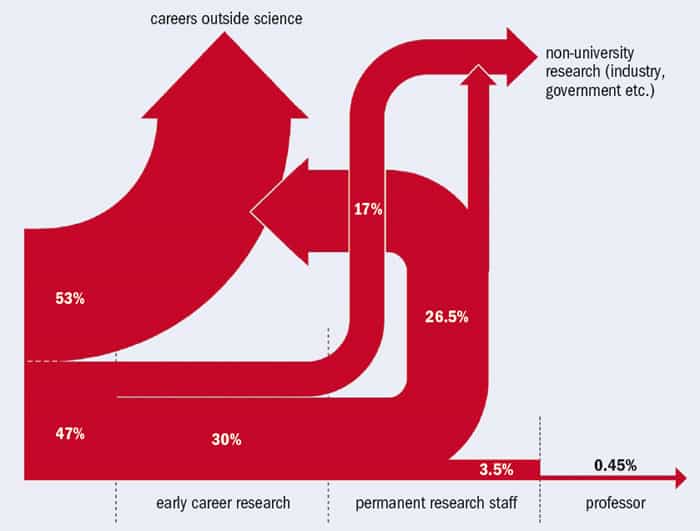
Rowe's story is not unusual. Statistics suggest that the vast majority of people who complete science PhDs will never obtain a permanent academic post. This is vividly illustrated in a diagram published in 2010 by the Royal Society as part of a report on the future of scientific careers in the UK (figure 1). Drawing on data from various UK sources, the diagram follows a "typical academic career" through a series of post-PhD transition points, when large numbers of people leave the university environment for careers in, say, government or industrial research. These data show that less than 0.5% of science PhD students will ever become full professors, while just 3.5% will obtain lower-ranking permanent positions as research staff at universities.
For physicists, that 3.5% figure is probably a little low. Slightly older data collected by the Institute of Physics and the US National Science Foundation suggest that the fraction of physics PhD students who obtain permanent academic jobs has historically hovered between 10 and 20%. Yet even this higher number still indicates a yawning gap between the aspirations of early-career physicists and the realities of the academic job market. Indeed, according to an August 2012 survey carried out by the American Institute of Physics (AIP), nearly half (46%) of new physics PhD students at US institutions want to work in a university. The next most popular career plan among those surveyed, attracting 18% of responses, was "unsure".
1 Career trajectories Transition points in typical academic scientific careers following a PhD. Based on data from the Higher Education Funding Council for England, the Research Base Funders Forum and the Higher Education Statistics Agency’s annual “Destinations of leavers from higher education” survey. (Courtesy: Reused from The Scientific Century: Securing our Future Prosperity, by permission of the Royal Society)
The mass departure of PhD-level physicists from academia is not, in itself, a bad thing – either for society or for individuals. "The knowledge and skills developed [in a physics PhD] are first rate, and can be applied across many disciplines to a huge set of potential problems," notes Steve Hsu, a physicist and vice-president for research and graduate studies at Michigan State University in the US. Jobs in finance and technology, he points out, are usually better paid and more stable than the series of temporary posts that has become the norm for postdocs and other early-career researchers (ECRs). As a result, Hsu says, he often advises PhD students who have an interest in applied research to seek careers in industry, rather than academia.
But for many, the decision to leave the ivory tower is not entirely voluntary, and some postdocs have expressed concerns about their lack of preparation for alternative careers. One person interviewed for this article noted that although most postdocs do make contingency plans, "having a plan B can be seen as lacking commitment to an academic career", and might therefore harm their chances of obtaining that elusive permanent post. There are also indications that a career structure built on a series of short-term contracts is hurting science as a whole, by depriving it of talented people who leave for reasons that have nothing to do with aptitude or enthusiasm.
All of these factors – the shortage of permanent academic posts, the gap between expectations and reality, the anxieties about training and the fact that "success" depends on much more than talent and hard work – have prompted a groundswell of concern for ECRs. In July an article in the Washington Post about the lack of career opportunities for PhD-qualified scientists in the US attracted more than 3500 comments from readers, many of whom shared personal experiences of the tough academic job market. Meanwhile, in the UK, a consultation exercise carried out in mid-2011 by the pressure group Science is Vital received nearly 700 responses from scientists troubled about the structure of academic careers. Their answers to a questionnaire indicated widespread dissatisfaction about the prevalence of short-term contracts, the perceived or actual need to emigrate or relocate for jobs, and the impact of mobility on families and relationships (see "On the move" below). Some of those who responded – including senior scientists as well as ECRs – compared academic research to a pyramid scheme that produces a tiny handful of "winners" and a huge number of "losers" in the scramble for permanent posts.
A paradoxical situation?
When the American baseball player Yogi Berra was asked why he no longer frequented a particular restaurant, he replied, "Nobody goes there anymore. It's too crowded." In some ways, the situation for ECRs seems to echo Berra's words. In essence, the sheer number of junior researchers limits their long-term career prospects, but this does not seem to be stopping people from joining the queue. To put it bluntly, if career progression is so poor, why does the field remain so competitive?
One answer is that an academic career holds many significant attractions. "What I love about working an academia is the independence," says Sarah Kendrew, an astrophysics postdoc at the Max Planck Institute for Astronomy in Heidelberg, Germany. "Not just in terms of working hours and not having to conform to some corporate image, but independence of thought. In research, we're not just 'allowed' to have our own opinions – we're actively encouraged to develop and pursue our own ideas." In comparison with other posts she has held – including an engineering job and an internship in a scientific press office – the independence of academia is "an amazing luxury".
Others echo her views. "The best thing about being a postdoc is having the freedom to do something you are passionate about," says Aimee McNamara, a medical-physics researcher at the University of Sydney in Australia. "Even if you are employed for a particular project, you get the freedom to pursue your own research interests as well. Not many jobs in the world offer that."
But there are also some less pleasant factors contributing to the crowded postdoc pool. One is the economy. Many employers that traditionally offered well-paid research work outside a university environment have shed jobs in recent years, limiting alternative career options. For example, a report carried out in June by the scientific data firm Battelle found that the number of biotech jobs in the US shrank by 1.4% between 2007 and 2011, while employment in aerospace-related jobs fell by 2.4%. Both figures compare favourably with the 6.9% drop across the US private sector as a whole, yet there are signs that cuts in key industries have hit some early-career scientists hard. Indeed, the American Chemical Society found that only 38% of new chemistry PhDs who responded to its annual careers survey had found permanent non-academic jobs since graduating in 2011 – the lowest fraction for seven years. The fraction employed as postdocs, in contrast, went up slightly, rising from 45% in 2010 to 47% in 2011.
Another factor boosting the number of postdocs relative to the number of permanent jobs concerns the "pyramid" structure of scientific funding. At entry level, funding for PhD studentships, research assistantships and postdoctoral fellowships is often relatively plentiful. At more senior levels, however, funding tapers off and competition becomes much more intense. According to Athene Donald, a condensed-matter physicist at the University of Cambridge who often discusses career issues on her personal blog, the "pyramid" problem is particularly acute for biomedical researchers. "So much money has been thrown at 'let's cure cancer' or whatever that there are lots of entry-level positions for students and postdocs that don't go anywhere," she told Physics World. "And they will never go anywhere because there aren't enough jobs higher up."
Advice and training
Funding for physics research is not quite as pyramidal as it is in biomedicine, chiefly because there are fewer entry-level posts available. However, physicists are not immune to other factors driving the postdoc boom. One of these is a lack of advice about possible alternative careers. A recent paper by researchers in the US examined how "adviser encouragement" affects career preferences among PhD students (H Sauermann and M Roach PLoS ONE7 e36307). They found that while academic physicists, as a group, generally encourage their students to seek university-based employment, they tend to adopt a more neutral or discouraging stance towards non-academic work (figure 2a). This was the case even though the students themselves became slightly less interested in physics research and teaching over the course of their PhDs (figure 2b). According to a 2010 report by the UK research organization Vitae, physicists may also be at a disadvantage in their knowledge of alternative careers. The report found that only 24% of physical-science students had a permanent job directly before beginning their PhDs, compared with 57% of students in the biomedical sciences and 49% of biologists.
2 Career advice (a) When giving career advice, PhD supervisors tend to encourage students to follow in their footsteps. Of the 959 US-based physics PhD students surveyed by Sauermann and Roach, 75% reported that their supervisors either “encouraged” or “strongly encouraged” them to seek careers as research faculty in a university. (b) In the same study, a sub-group of physics students nearing the end of their PhDs were asked to compare their current career preferences with their views when they started. Positive numbers indicate the share of those polled who gave each career option the highest rating at the time of the survey, but not initially (their interest in the option increased). Negative numbers show the share who rated a career highly at the start of their PhDs, but not at the end (decreased interest). (Adapted from figures in PLOS ONE7 e36307)
Donald acknowledges that senior academics are partly to blame for the shortage of advice, especially when they give the impression that students who leave academia have failed or "wasted" their scientific training. "That is a terrible message [but] it's pretty pervasive," she says. "I think it happens because professors love what they do and they can't imagine how anyone wouldn't want to do it." However, she adds, the lack of advice can also stem from simple ignorance. "I think there's a real problem with principal investigators who have only ever been in academia not knowing what the job situation is like for people with particular qualifications," she says. "I'm not good at knowing what – other than academia – is out there." To fill this gap, Donald says she often refers students to Cambridge's careers service, which employs a dedicated adviser for postdocs in the physical sciences.
As well as offering better advice, Hsu believes that universities should also be offering more training to ECRs. "We could do more to prepare students specifically for careers outside physics by requiring them to take courses in, for example, computer science and management," he suggests. Exposing students to the career experiences of their predecessors who left academia would help, Hsu says.
Tending the academic dream
There is just one problem with providing better training and advice on non-academic careers: many PhD students and ECRs are not interested, or feel they do not have the time to investigate their options. "I really don't have a back-up plan," says Alan Duffy, an astrophysics postdoc at the University of Melbourne, Australia. "It's something that I often find myself briefly thinking about, but then other tasks in my day demand my attention and it's set aside." David Nataf, an astronomy PhD student at Ohio State University, agrees. "My PhD training was tightly focused on academic careers, but that's what I chose," he says. "Had I been planning to opt out, I would have asked for more teaching duties, or taken some programming and statistics courses...[but] I hope to continue in academia and specifically in research for a very long time."
Duffy and Nataf are not alone. In an informal poll carried out on Physics World's Facebook page last month, respondents were asked to pick which action would be most helpful to physics postdocs. Only 17% chose options related to training or advice on non-academic jobs. The overwhelming favourite, with 73% of the vote, was longer-term contracts – something that would help keep more physicists in academic research, rather than helping them succeed outside it.
Rowe, however, thinks that longer-term contracts would be a major improvement even for physicists who, like him, decide to leave academia. "I can't help but think that the annual-to-every-two-years round of writing applications and proposals to stave off your pre-determined unemployment is bad for productivity," he says. Fewer, longer contracts for postdocs would also benefit scientific projects that have long lifetimes compared with a typical two- or three-year contract, he adds.
Intriguingly, some recent research supports the idea that longer-term contracts would be better for science. After analysing the productivity of 300 physicists, a group of complexity theorists in Italy and the US found that short-term contracts can "amplify the effects of competition and uncertainty" and thus make academic careers "more vulnerable to early termination, not necessarily due to lack of individual talent and persistence, but because of random negative production shocks" (Petersen et al. PNAS109 5213). The theorists also found evidence of a "rich get richer" system, in which an initial bit of luck – publishing a single outstanding paper, for example – can mushroom into a career-long advantage over less fortunate (but no less talented) colleagues.
Changing the pattern
In its report on science careers in the UK, Science is Vital takes the idea of longer postdoc contracts to its logical conclusion by recommending the creation of permanent postdoc-level jobs. Kendrew agrees that this would be a good idea. "A lot of postdocs are involved in what I could describe as 'infrastructure work'," she explains, citing software development, data management and instrument building as examples. "These people often get little credit for their contribution, and as they don't publish as many papers...they fall by the wayside."
Others, however, are more sceptical. "I can see the attraction, and I know a few people for whom a permanent postdoc would be ideal," says Donald. "But if you have a mature team – a professor, a couple of senior lieutenants and a long-term postdoc – they will get into a pattern where it's terribly hard for them to do lateral thinking. Whereas if a new person comes in and asks an incredibly naive question, they can kick-start enquiry in a different way."
One alternative would be to reduce competition for permanent jobs by limiting the number of PhDs and postdocs being offered. Among those advocating this strategy is Jonathan Katz, a physicist at Washington University in St Louis, Missouri. In 1999 Katz posted an essay on his website entitled "Don't become a scientist!" In it, he outlined reasons not to pursue an academic career – including poor job prospects – and he told Physics World that his advice was still applicable today.
But there are problems with this approach too, Rowe argues. "I got a good degree, but I think there were people who had less aptitude as undergraduates who have subsequently shown more aptitude as researchers," he says. "So I would be wary about throttling back the numbers of PhD students." A better strategy, he suggests, would be to make sure that PhD students know they have other options if they choose not to stay in academia. Above all, he adds, they should not feel like their years as researchers were a waste of time.
That sentiment is echoed by Phillip Helbig, a former research assistant who now works as a systems analyst at the stock exchange in Frankfurt, Germany. When asked via e-mail whether his stint as a full-time academic researcher was "useful" to him, his reply began with the words "Define 'useful'!" and the opening lines of Charles Dickens' novel A Tale of Two Cities ("It was the best of times, it was the worst of times..."). "I don't think it was useful in terms of preparing me for other work," he continued. "This aspect is exaggerated. Doing a degree that requires a thesis and programming experience is good for many things, [but] anything beyond that is not helpful in any technical sense, and might be counterproductive among employers who prefer hiring younger people." Still, he wrote, "I am extremely glad that I spent the time I did in academia. It was worth it even if I didn't stay."
On the move
"When I started out with my PhD, the need to move around to pursue a career in science was actually appealing to me," says Aimee McNamara, a South Africa-born medical physicist who is currently doing a postdoc at the University of Sydney in Australia. "I liked the idea of experiencing different research environments as well as different cultures, and I still believe it's a very important thing to experience as a scientist."
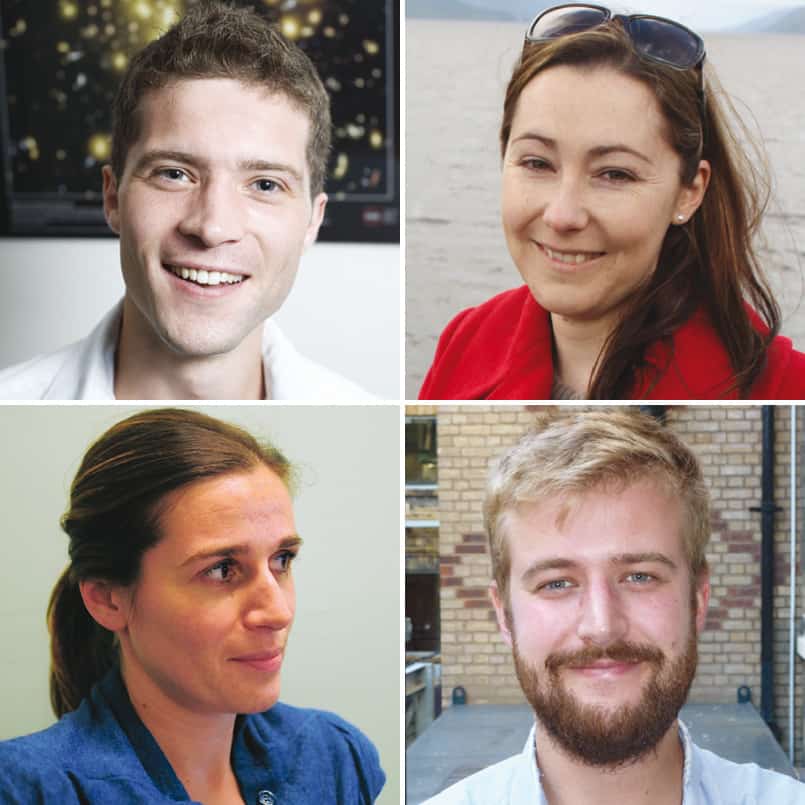
On the move Clockwise from top left: Alan Duffy, Aimee McNamara, Barnaby Rowe, Sarah Kendrew.
Moving from one location to another is relatively common for physicists. When Physics World asked – via an unscientific poll on the magazine's Facebook page – what steps physicists had taken to pursue their careers, 38% of the 111 respondents said they had moved more than 500 miles at least once, while an additional 13% had moved a shorter distance. A separate poll on the most important factor for choosing a postdoctoral position found that "location" got the lowest score of all the options offered, attracting a measly three votes out of 63.
The problem is that after a while, moving around becomes more problematic. "Being on two or three-year contracts throughout our late 20s and early 30s means it's really hard to plan a long-term future – buying a house, having children and so on," says Sarah Kendrew, an astrophysicist who moved from London to the University of Leiden in the Netherlands before obtaining her current post at the Max Planck Institute for Astronomy in Heidelberg, Germany. "I really find that I've had to be flexible and readjust my goals and expectations according to where work takes me."
Moving around can be particularly trying for early-career researchers with spouses, children or other relatives who depend on them. After obtaining his PhD from the University of Manchester in the UK, Alan Duffy – who was, at the time, single – moved to Perth, Australia, to do postdoctoral research at the International Centre for Radio Astronomy. That decision was easy, he says, but now that he has a partner, his subsequent 3000 km move to the University of Melbourne required some hard thinking. "It was too good an offer to refuse, but only because my partner was able to make it work for her career," he says. "Some postdocs just won't be this lucky."
In addition to the infamous "two-body problem", in which academic couples struggle to find two research jobs in the same location, there is also a less well-known dilemma affecting physicists who are gay. Legislation on civil partnerships and social attitudes towards homosexuality varies widely among different countries and US states, observes Elena Long, a PhD student at Kent State University in Ohio who has worked on raising awareness of gay, lesbian and transgender issues in physics. Because of this variation, she says, gay physicists may have to balance an attractive job offer with concerns about being accepted in the local community.
In some cases, the need for mobility can prompt or hasten a decision to leave academic research. "One reason why academia doesn't appeal to me so much is the lack of real freedom to choose where you want to live," says Barnaby Rowe, an astrophysics postdoc at University College London who plans to leave research to train as a secondary-school teacher. "There are a number of places where you can do astronomy, but they're quite thinly spread. If a job comes up, you may not get another job offer, so you take it...That lack of flexibility is tough on family members, and research is not something that I love enough to wish to inflict that on them anymore."
Physicists in the US have developed a new theoretical technique for calculating the properties of ultrathin solar cells. Their method suggests that designs that boost the amount of light absorbed by such cells could sometimes have an unwanted, negative effect on other aspects of the devices' performance. The team is currently developing the technique so it can be used within numerical simulations tools that are used to design solar cells.
Ultrathin solar cells have two key advantages than their thicker counterparts: less material is needed to build them, while the electrons and holes liberated by light do not have so far to travel, so reducing losses that occur when they recombine. These benefits are, however, offset by the fact that thin devices absorb less light than thick devices, which is why researchers are keen to use nanometre-sized structures that increase the amount of light that interacts with ultrathin cells.
These structures take advantage of near-field optical effects such as the interaction of light with surface plasmons – oscillations in the electron density on a metallic surface. Unfortunately, these near-field effects can also affect the rate at which electrons and holes recombine within the cell, which could reduce the performance of the cell.
Thermodynamics in action
While absorption in ultrathin solar cells is relatively well understood, the effect of near-field optics on electron–hole recombination is not. Now, however, Avi Niv and colleagues at the University of California, Berkeley, have developed a new way of evaluating solar-cell efficiencies that they say can be applied to extremely thin devices. The technique takes advantage of the "fluctuation-dissipation theorem", which makes the connection between a system in thermal equilibrium and the response of the system to a tiny disturbance.
In the case of a solar cell, the system at equilibrium involves a number of processes, including the absorption and emission of photons. To calculate the efficiency of a solar cell, physicists must know both the "photocurrent" – the rate at which electron–hole pairs are created – and the "recombination current", which is the rate at which electron–hole pairs recombine to make a photon. The greater the photocurrent is relative to the recombination current, the better the solar cell.
Radiating dipoles
The team treated these recombination events as fluctuations of an ensemble of radiating dipoles. This thermodynamic approach allowed them to use the fluctuation-dissipation theorem to work out the power of the recombinations in terms of thermodynamic variables, such as the temperature and chemical potential.
Niv and colleagues then used this theoretical framework to calculate the key device parameters of voltage, current and efficiency in an ultrathin solar cell. Their idealized cell comprised an ultrathin layer of the semiconductor gallium arsenide (GaAs) on a gold substrate. Light enters the solar cell through air and light that is not absorbed is reflected back from the gold for another pass through the active region of the solar cell. The team identified four possible emission channels that had to be considered – light that is emitted back into the air and light that is emitted into the gold, each of which can occur with two different polarizations.
The team calculated the emission for cell thicknesses in the range 0–300 nm and found that the emission changed as a function of thickness. In particular, the calculations predict a large peak in the emission of parallel-polarized light into the gold substrate – something that the team identify as a clear signature of near-field effects.
Pronounced dip
To examine the effect on solar-cell performance, the team then looked at a detailed balance between the rates at which photons are absorbed and emitted by the semiconductor. A calculation of the voltage created across the cell when exposed to sunlight showed a pronounced dip at 40 nm – which is to be expected because of the large emission peak at that thickness – as well as other structure related to near-field effects. By contrast, calculation of the voltage using a technique based on conventional optics does not reveal any of these features.
According to Niv, the research shows that the use of nanostructures within cells to boost their absorption of light will also have an effect on the emission of light – and both effects must be considered when determining the overall efficiency of the design.
As well as increasing the sophistication of how they used their technique to model solar cells, Niv says that the team are also working on ways that the theory could be incorporated into a numerical simulation tool that could be used to evaluate solar-cell designs.