A look at physics in Japan

PW-20121002-blog-sandhu.jpg

By Michael Banks

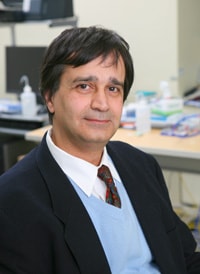
If you have ever thought about studying or working in Japan, or are just curious about the high-profile international research facilities the country has, then make sure you don’t miss a special online lecture next week given by Adarsh Sandhu from the Toyohashi University of Technology (right).

Sandhu has spent around 25 years working in Japan and he will give his personal take on physics in the country, including outlining key international research centres as well as what careers there are for researchers.

Indeed, there are both challenges and opportunities for physicists from abroad to go and work in Japan or to collaborate with Japanese researchers and Sandhu will address these as well as answer any questions you have.

The lecture is on Wednesday 10 October 2012 at 2.00 p.m. BST (9.00 a.m. EDT) and you can register for the free event via this link.

Also, make sure you don’t miss our special report on Japan, which you can view online here. The report draws together a selection of our recent articles about physics in Japan looking at, for example, the world’s first compact X-ray free-electron laser as well as a major upgrade to Japan’s famous KEKB collider.

Venus as you’ve not seen it before

By Matin Durrani

You could be forgiven for thinking that we here at Physics World have a slightly obsession with that astronomical phenomenon known as the transit of Venus.

First we published a great feature by Jay Pasachoff that explained the science and history of this rare astronomical event, in which the planet Venus passes across the face of the Sun, as seen from the Earth. Pasachoff’s article appeared just before this year’s transit, which took place on 5 and 6 June, but the transits are so rare that the next one won’t occur until December 2117.

Then Physics World columnist Robert P Crease examined the question of whether the great Russian polymath Mikhail Lomonosov did – or did not – see the atmosphere of Venus during the 1761 transit. This piece was followed a few months later by Crease’s account of various attempts this summer to carry out historical recreations of Lomonosov’s work. (Crease’s conclusion: yes Lomonosov probably did see Venus’s atmosphere.)

We also ran a photo challenge on Flickr, where we invited you to send us your images of this year’s transit. You can see a selection of the best in this article here.

And if you want to watch a quick overview of why the transit of Venus occurs, then check out Physics World‘s own video, featuring Zoe Leinhardt from the University of Bristol.

New cloak promises to be invisible to electrons

Physicists in the US have proposed a way to make an “electron cloak” – an object that is invisible to electrons. Inspired by cloaks that hide objects from light or sound waves, the electron cloak would be made of a tiny structure that is about the same size as the wavelength of electrons it is hiding from. Although the design has not yet been tested in the lab, it could be used to make novel electronic devices and perhaps even help develop better thermoelectric materials for improved energy harvesting and conversion.

Researchers have already succeeded in making “invisibility cloaks” that hide objects from electromagnetic waves. Such cloaks are made from “metamaterials”, which are artificial structures with special optical properties such as negative indices of refraction. These structures are arranged in such a way that incoming waves flow smoothly around the cloak, meeting up on the other side as if the cloak was not there. The same principle has also been applied to make cloaks that are invisible to sound waves.

Core and shell

Thanks to quantum mechanics, electrons behave like waves, and now new calculations by Gang Chen and colleagues at the Massachusetts Institute of Technology (MIT) suggest that cloaks for electrons could be made. The researchers have put forward a practical design that would be made of nanoparticles that comprise an inner core and an outer shell. The core–shell nanoparticle could then be embedded in a host semiconductor, so that it does not disturb the flow of electrons.

Electrons normally travel as waves over a certain distance before scattering destroys their wave phases. Over this so-called coherent transport length, the particles exhibit characteristic wave behaviour, such as amplitude superposition (or interference).

Reflecting electron waves

“In our electron-cloak design, the core–shell nanoparticles essentially provide multiple interfaces where electron waves are reflected,” explains team member Bolin Liao. “Through careful tuning of the interfaces, the multiple reflected waves from the interfaces can destructively interfere with each other and cancel the total reflection almost perfectly. The electron waves with the ‘correct energy’ can thus travel through the nanoparticle structure without being reflected, as if there was nothing in their way.” The nanoparticle structures are about the same size as the wavelength of electrons themselves – around 10 nm in the MIT study.

Such electron cloaks may find use in applications where high electron mobility is required, such as in semiconductor electronics, says Chen. “We might also be able to design novel electronic switches that go from the visible (‘open’ structure) and invisible (‘closed’) states,” he says. “What is more, the electron scattering versus energy profile of the structures, which varies greatly, could benefit applications that call for strong energy-dependent scattering mechanisms, like those at work in thermoelectric devices.”

The team is now busy putting its theories into practice, by trying to make real core–shell nanoparticle electron cloaks. “We are also looking at extending our idea to lower-dimensional structures,” adds team member Mona Zebarjadi.

The current work is detailed in Physical Review Letters.

My life on Mars

With the lights from the Habitat Module glowing faintly behind me, I turned off my head torch, comms device and air-circulation system. Holding my breath, I stopped for a moment on the edge of a vast darkness. As my eyes adjusted, I could begin to see hills in the distance, their edges smudged into unfocused murkiness like a Monet landscape. But there were no artificial lights over this alien horizon, and I knew that I could walk for days without seeing any traces of human life. “Welcome to Mars,” I thought.

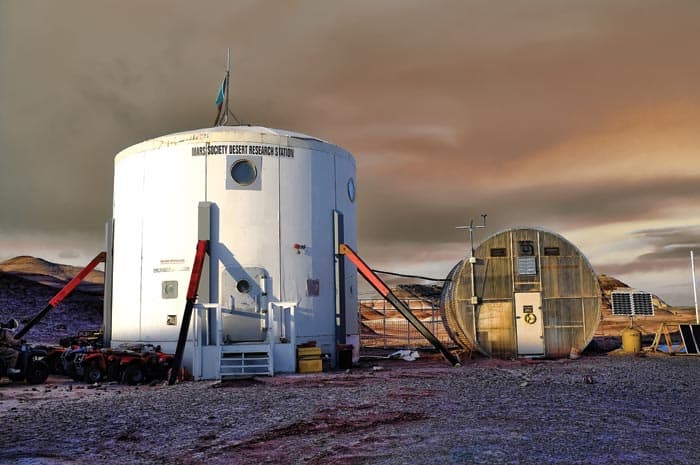
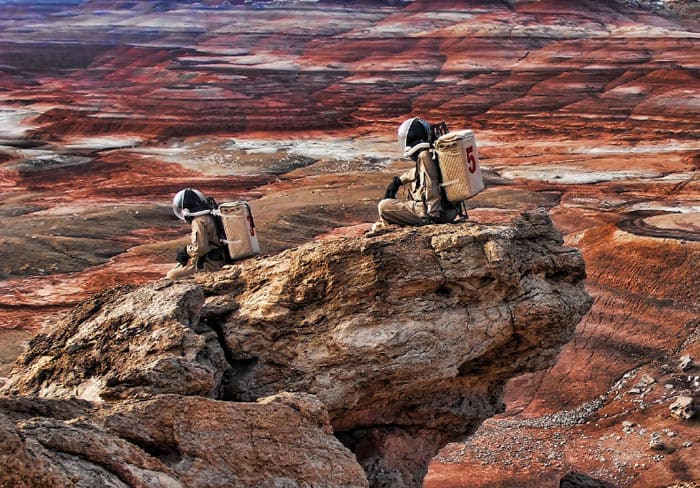
Of course, I had not really travelled millions of miles through space to reach this empty, other-worldly landscape. The Habitat Module behind me was actually part of the Mars Desert Research Station (MDRS), a facility dedicated to developing and testing field tactics and protocols for a human expedition to Mars. Located in a remote area of the Utah desert, the station’s paprika-coloured surroundings mimic the landscape of the red planet, lending an air of realism to research on such topics as design features of habitat modules, psychological studies of crew members, assessment of crew-selection procedures and even tests to determine the best kinds of food for Mars explorers.

My journey to this earthly version of Mars began in August 2011, when I applied for an engineering position at MDRS and was selected as part of a crew of six people. My fellow crew members came from several different disciplines and countries. They included a Spanish-born artist and journalist, Alicia Framis; Michael LeClair, a Canadian geologist, programmer and psychologist; Usha Lingappa, an American astrobiologist; another American, Mike Lotto, who like me is an aerospace engineer by training; and our commander Charlotte Poupon, an industrial designer for extreme environments and naval officer from France. Each year, around 10 of these six-person crews stay at the MDRS, typically for two weeks at a time, while a similar number carry out studies at a sister station in the Arctic for several months at a time. Three additional stations are currently under construction in Hawaii, Iceland and Australia, and all five are run by the Mars Society – a group that mainly consists of professional scientists, engineers and academics with an interest in Mars exploration. The stations also receive significant collaboration and funding from NASA’s Ames Research Center and the entrepreneur and former physicist Elon Musk.

The main purpose of our expedition was to conduct the sorts of fieldwork that might take place during a Mars mission. Within this, my role was to maintain the Habitat Module systems and the quad bike all-terrain vehicles, while also serving as an extra set of hands for scientific projects and fieldwork. In addition, all of us would be partaking in long-term food, protocol and psychological studies.

Welcome to “Mars”

After several months of feverish preparation and eager e-mail exchanges, I finally met the other members of my team at the airport in Grand Junction, Colorado – a 15-hour trip from my home in the UK, where I was then studying for a PhD in aerospace engineering at the University of Liverpool. As we drove from the airport, we received a briefing from Jean Hunter, an expert on space life-support at Cornell University who would be carrying out food studies on all six of us in collaboration with NASA. After several hours of driving through the desert, we swung onto a rib-shattering dirt track, bumping through an increasingly Martian-looking landscape towards our destination. By the time we reached our stark outpost, we had left the rest of humanity far behind. We began what promised to be two weeks of the ultimate Mars experience on Earth.

On arrival, we met John Barainca, the station’s engineering co-ordinator and a walking knowledge bank of physics, chemistry and biology as well as engineering. Barainca has the far-off gaze of someone whose thoughts are always on a distant planet, but from now on he would be one of our main links to “Earth”, advising us on maintenance tasks via Mission Support channels. The rest of Mission Support would observe us via cameras and monitor our daily reports to ensure protocols were followed and unnecessary dangers avoided.

First, however, Barainca gave us a thorough tour of our new home: the Habitat Module, or HAB. Its structure and features are based on the designs and mission architecture for the “Mars Direct” plan for a relatively low-cost manned mission to Mars. This plan was conceived by a group led by Robert Zubrin at the aerospace firm Martin Marietta (now Lockheed Martin) and later developed in collaboration with NASA’s Johnson Space Center. The building is split over two floors and is silo-shaped, with a diameter of 10 m – small enough to fit atop the main rocket booster of a heavy-lift launch vehicle. The engineering and electronics work station on the ground floor had more tools than even the A-Team would know what to do with, while the scientists in our group were in geeky fits of excitement over the array of microscopes, scales, rock saws, incubators and other equipment in the biology and geology labs. The HAB’s lavatory and shower were both quite modest, but the extra-vehicular activity (EVA) room – which contained six spacesuit analogues and their chargers – got Lotto’s and my engineering juices flowing. The upstairs contained our living quarters, which included six compact bedrooms (each a little over 1 m by 3 m), a communal area with plenty of reading and entertainment material, computer workstations and a kitchen. The finishing touches were the airlocks at the front and back of the HAB.

Barainca briefed us on all the procedures we needed to follow and the systems we would have to maintain inside, outside and beneath the HAB. These included an observatory with an 11-inch telescope; communication systems linking team members to each other and to Mission Support; a diesel-powered generator; and the heat tapes under the HAB’s flooring that regulated its temperature. The quad bike all-terrain vehicles (ATVs) we would use to travel around the Martian landscape also needed regular checks, and we had to monitor water levels in the tanks (two external, one internal) if we wanted to avoid unnecessarily harsh water rationing. Finally, the algae septic filter in the greenhouse required regular maintenance, since it recycled dirty water into “grey” water for use in the toilets.

Jet-lagged and hallucinating with fatigue, I shadowed Barainca for several hours, noting down his instructions and suggestions in indecipherable scribbles. Later that evening, when he felt we were sufficiently prepared, he stepped out of the HAB into the desert night. The temperature was –12 °C and the Moon behind him was sending pale, cold fingers of silver across the landscape. “You know, guys,” he said, reflectively, “we all have one thing in common: we’re all nuts.” And with that, he sealed the exterior airlock door behind him. Our two-week simulation had begun.

Settling into a routine

During the mission, our days started at 5 a.m., with breakfast – and an accompanying pot of strong coffee – an hour later. After a plan-of-action meeting, Lotto and I would do a round of engineering tasks, and though we were snowed in for a chilly couple of days, we usually managed to get outside for two three-hour EVAs each day, before and after lunch, to conduct various projects. For safety reasons, nobody was left alone in the HAB or on EVAs, and constant communication was maintained between EVA groups and the HAB crew. While the engineers carried out maintenance on the HAB, ATVs and spacesuits, the scientists typically spent time in the lab or wrote reports. Every evening, each team member completed a set of surveys about the food and our psychological states. Among other things, the latter surveys were aimed at determining whether “cabin fever” was setting in. After this we would watch a film (usually a sci-fi horror of some sort), then end the day at 11 p.m. after another round of engineering tasks.

We each had our own projects to accomplish during the mission, but we also participated in each other’s studies. For example, Poupon, our mission commander, specializes in designing equipment that can operate in extreme environments. One of the projects Lotto and I worked on with her was a small, custom-built, remote-controlled rover that carried wireless video cameras and a monitor. She was trying to assess its functionality as a “scout” in hard-to-reach places, but her research revealed that the need to keep a line-of-sight between the rover and its controller was a significant issue. I intend to carry out a comparable study, but using a low-flying remote-controlled quad-rotor/airship hybrid specially built to deal with the Martian atmosphere. It would avoid rough terrain and ground obstacles entirely by taking to the air.

The astrobiologist on our team, Lingappa, has a background in Mars-analogue geomicrobiology. She is particularly interested in studying a bacterium that is thought to produce a substance called “rock varnish”, which appears in many places on Earth (figure 1). There is photographic evidence that rock varnish exists on Mars, and if its presence there is confirmed – and if rock varnish turns out to be indisputably biological, not geochemical, in origin – then that would be a massive discovery. Finding microbial life on Mars would answer questions about the prevalence of life in the universe. It might also indicate whether the life-forms produced on Earth follow the pattern for all life (for example, using RNA and DNA to pass on genetic information) or whether we are merely one thread in a vast tapestry of what could be considered “alive”.

During the mission, however, Lingappa’s main task was to study how spacesuits impose limitations on a person’s ability to collect samples and isolate organisms – something that is clearly very relevant when planning an actual Mars mission. Similarly, the crew’s geologist, LeClair, carried out geology missions both with and without the spacesuit in order to analyse what delays and problems it caused. He also mapped and developed our understanding of the local terrain as a basis for future geological fieldwork at the station.

Complications and mishaps

As with any human space mission, before we so much as touched a tool, we needed to put forward a proposal to Mission Support detailing exactly what we intended to do, how we would do it and which instrument we would use. To simulate the effects of signals travelling between Earth and Mars, a delay of around 40 minutes was added on to each communication between us and Mission Support. Typically, there would be an extensive discussion between the support engineers on the “Earth” side before they gave us the “go” signal – or, more likely, asked a question.

Another interesting aspect of life during the mission was the fact that Mission Support was observing all of our activities via six streaming cameras in the HAB. These cameras captured a frame every 30 seconds and fed it to the world at large through the MDRS website, so naturally we tried to avoid doing anything ridiculous. However, this did not stop LeClair, who held love letters up to the camera each morning for his girlfriend to read back home in Canada.

One day while the scientists were writing reports and preparing food, Lotto and I (appropriately suited and booted) were outside on an engineering round. Looking across the desert, I recall thinking that I would not be surprised if pre-historic creatures materialized from the mountains that surrounded us, such was the bizarreness of the landscape. Suddenly, our respective comms devices began to resonate with screams in French and Spanish from Poupon and Framis. Through our helmet visors, Lotto and I exchanged a knowing glance indicating near-certainty that our crewmates back in the HAB were going to die in the next few seconds. We dropped what we were doing and sprinted inside for re-pressurization.

Still hearing screams through our comms, we were convinced that one of our crewmates had lost it and was now in the process of murdering the others, possibly with one of the many scalpels in the biology lab. Still suited up, we were making our way up the stairs of the HAB as stealthily as we could when Framis suddenly appeared and tearfully shoved down a bucket containing a desert mouse, which was itself squeaking with terror. We had encountered our first “Martian”!

Later, I was reliably informed that as LeClair set about capturing the mouse, the rest of the crew had heroically continued their food-preparation task even while standing on chairs and screaming. In an effort worthy of the UN, “Marty” the Martian mouse was taken out on the next EVA and released into a more suitable environment. It took several minutes for him to say his goodbyes to each of us before scampering off.

Another mishap – this one potentially more serious – came during the 10-mile return leg of a fossil-hunting field expedition. I was motoring down a hill on an ATV between LeClair and Lotto when the setting Sun momentarily blinded me. When I could see again, I realized I was heading into a bend far too quickly. I overshot the bend, the ATV flung me into the air over a dune and sent me barrelling towards a ditch. I managed a series of graceful pirouettes before landing theatrically on both feet – quite an achievement while wearing a spacesuit!

Through the scratchy comms, a rather agitated Lotto announced that the nearest hospital was some three hours away. Fortunately, I was unhurt, but the incident did highlight the risks of driving instead of walking over rough terrain. The advantages ATVs bring in mobility and expedition range are great, but they also introduce an element of human error that should be taken seriously. Even a minor puncture to a spacesuit would kill an astronaut in minutes as their blood boiled in the low-pressure Martian atmosphere. Isolated on Mars, with the Earth just a “pale blue dot” in the night sky, there would be no room for error.

Some of the problems we faced were more subtle. Although all of us wore watches, and thus had a sense of the immediate time of day, one by one we lost track of how many days we had been in the simulation. Without looking at the logs, our minds’ dependency on our (clearly fallible) internal clocks was exposed. Gradually, events merged and became confused in our memories. On several occasions, members of our team mixed up events that had taken place that day with those from the day before; sometimes as a group we completely forgot what we had shared for lunch several hours earlier. LeClair, the team’s geologist and psychologist, put it best when he commented that “our experience of time is just an illusion”.

Around the dinner table

Food at MDRS consisted of strictly rationed, non-perishable, vacuum-sealed and dehydrated meals – and yes, that’s about as exciting as it sounds. Chewing on food is something I did not realize I would miss, but for astronauts, any time taken away from their duties in order to prepare meals is significant. During an actual Mars mission, the crew would have to spend around 30 months on this dietary regime. Hence, one of the major studies being carried out at MDRS aims to minimize meal preparation and consumption time without harming the psychological well-being of the crew.

Though the food was far from inspiring, our conversations around the dinner table were always a rich and colourful distraction. Everyone in the crew had real enthusiasm and a wealth of knowledge about Mars inside and outside their own fields of expertise, and talking with them was one of my favourite parts of the mission. Naturally, many of these discussions focused on the red planet itself.

Lingappa, our astrobiologist, had strong convictions about its potential habitability. As she pointed out, a day on Mars lasts a very Earth-like 24 hours and 37 minutes, and it was once a warm and wet planet. If we could somehow melt its frozen oceans of water, a “second genesis” of life might be introduced if one is not awoken in the process. I suggested that, with the use of super greenhouse gases, raising the planet’s atmospheric temperature in the southern polar region by a few degrees would begin a self-sustained gasification process of the carbon dioxide in the soil. This would catalyse a runaway process of Martian global warming that would, eventually, return it to its former, more habitable state.

With today’s technology, I reasoned, a relatively small push could help Mars go through a transformation. After 100 years or so, this transformation might produce a planet with an average surface temperature of about 7 °C, oceans of water covering approximately a third of its surface, and an atmospheric pressure and density equivalent to that found in Nepal. Making the Martian air breathable by humans would be more difficult, since it would take thousands of years for plant life to extract sufficient oxygen from the planet’s carbon-dioxide rich atmosphere. However, as Poupon observed, it is always possible that our capabilities – both in altering a planet’s atmosphere and in developing adaptations for humans – will in the next few decades develop beyond our current limited comprehension of what is possible.

LeClair – ever the geologist – added that Mars contains an abundance of many elements needed to sustain a technological civilization, including oxygen, carbon and hydrogen as well as useful metals such as iron, aluminium, copper, chromium and magnesium. He compared it to North America in the previous age of human exploration – “the next logical step towards the furthering of humanity”.

Other discussions took a more political turn. Lotto and I, for example, often discussed the future of manned space exploration. His outlook on the US space programme was fairly gloomy, and he was particularly concerned about the possible knock-on effects on science education. During the Apollo era, he pointed out, the number of students getting scientific qualifications at every level – from high school through to PhD – doubled. What do we have to inspire the next generation?

My own impression is that, after several decades without a clear direction, the US space agency is now entering a period of stagnation or even retreat. A few months after our mission ended, NASA announced its decision to pull out of its collaboration with the European Space Agency (ESA) on the ExoMars project, which was designed to search for Martian bio-signatures. Though I am optimistic that human space exploration will continue, we cannot assume that the first astronauts on Mars will be carried there by NASA or ESA rockets. If western countries continue to be held back by political inertia – if we cannot conjure the courage of a new Columbus or Livingstone – then humanity’s next step will simply be taken by someone else.

As the mission wore on, it became customary for the crew to go out late in the evening and look up at the Milky Way, the backbone of the night sky. The 4500 ft altitude of the Utah desert just about guarantees cold, clear skies at night and we were lucky enough to witness a meteor shower, the Geminids, during our mission. We also saw the International Space Station (ISS) pass over, which sparked another discussion on space funding. One of the main scientific purposes of the ISS was to study the long-term effects of zero-gravity on human biology, but as Lotto commented, “I don’t remember Columbus spending years off the coast of Spain observing the health effects of life at sea before making his voyage over to America”. Simply spinning the spacecraft on a tether in transit to and from Mars would generate an artificial gravity through inertia. When you compare the $196bn spent on the Space Shuttle programme to the $55bn cost of setting up the architecture around and getting the first crew of humans to Mars via NASA’s Design Reference Mission (the equivalent of two weeks’ worth of US defence spending in 2011), you really do have to wonder whether it has been worth it.

Saying goodbye

My “Monet landscape” experience came during our last night together, while the crew was taking in another “Mars” light show. I moved away, turned off all the devices I was wearing and looked up at the sky. As a child growing up in Namibia and South Africa, I would often gaze up at the stars above the Kalahari Desert, wondering who had stuck diamonds into the black sky. For me, that was where my interest in space began, and since then it has taken me from the San Bushman country to the ivory tower of academia. And for two weeks last December, it had even – sort of – taken me to Mars. As our mission came to a close, I realized that I would be bringing a little bit of each of my crewmates back to England with me. The two-week simulation had been a unique experience, and each of us learned valuable lessons not only about our chosen subjects, but about ourselves.

Walking back to my team, I turned on my air-circulation system, head torch and comms device. Soon Lingappa’s voice crackled over the radio. “We were getting a little worried about you!” I could hear the smile in her voice, and for almost the last time, I stepped back to join my colleagues in the artificial world of the HAB.


Dark-matter alternative tackles elliptical galaxies

An alternative theory to dark matter has successfully predicted the rotational properties of two elliptical galaxies. The work was done in Israel by Mordehai Milgrom using the modified Newtonian dynamics (MOND) theory that he first developed nearly 30 years ago. By showing that MOND can be used to explain the properties of complicated elliptical galaxies – as well the much simpler spiral galaxies – Milgrom argues that MOND offers a viable alternative to dark matter when it comes to explaining the bizarre properties of galaxies.

Dark matter was proposed in 1933 to explain why galaxies in certain clusters move faster than would be possible if they contained only the “baryonic” matter that we can see. A few decades later, similar behaviour was detected in individual galaxies, whereby the rotational velocity of the outermost stars was found not to “drop off” as a function of distance but instead remain flat. These observations directly contradicted Newtonian gravity, which should hold true in extragalactic regions just as it does on Earth and in the solar system. But by assuming there are “haloes” of invisible matter in and around galactic structures, Newton’s familiar inverse square law is restored.

Since it was first invoked to explain these galactic irregularities, physicists have tried to make direct measurements on dark matter to try to work out exactly what it is – with very little success. As a result, there are some researchers who do not believe that dark matter exists and have proposed alternative explanations for the strange behaviour of galaxies.

Spectacular success

Now a new analysis suggests that one alternative theory called MOND describes the properties of two elliptical galaxies just as well as dark matter. MOND was originally formulated to describe spiral galaxies and has had spectacular success in predicting certain properties of these structures. Its extension to cover elliptical galaxies could strengthen the arguments in favour of this alternative theory. This is because elliptical galaxies are predicted to have formed by a different process from spiral galaxies and their properties are much more difficult to calculate.

MOND was first proposed in 1983 by the astrophysicist Mordehai Milgrom of the Weizman institute in Israel. The basic premise of the theory is that at extremely small accelerations of less than 10–10 m s–2 Newton’s second law does not hold. Instead, Milgorm modified Newton’s formula so that under certain circumstances the gravitational force between two bodies decays more gently than the inverse square of the distance between them.

Predictably, a theory that advocates changing Newton’s laws is destined to meet with widespread scepticism, and MOND is no exception. Nevertheless, it also has undeniable attractions, such as the ease with which it makes testable predictions and the fact that it does not rely on an as-yet unseen dark matter. And, since a version of MOND consistent with Einstein’s general theory of relativity was derived in 2004 by Jacob Bekenstein of the Hebrew University of Jerusalem, the wider physics community has begun to take notice.

No coincidence

In the new research, Milgrom analyses the hydrostatics of a spherical envelope of hot, X-ray emitting gas in two elliptical galaxies and shows the predictions of MOND are equally valid in these. This is important, Milgrom argues, because elliptical galaxies are thought to have evolved in a completely different way from spiral galaxies and other disc galaxies – they are thought to be formed by the collision and merging of two other galaxies. MOND’s success, he argues, means that its predictive accuracy cannot simply be a coincidence and that it must hint at a deeper underlying truth.

He also suggests that the fact that the same mathematical law can be used to predict the rotation speeds of two different types of galaxies formed in two different ways significantly undermines the dark-matter hypothesis. “In the dark-matter picture” he says, “The galaxies we see today are the end result of very complicated and very haphazard formation processes. You start with small galaxies – they merge, they collide – there are explosions in the galaxies and so on and so forth. During this stormy evolution the dark matter and the normal matter are subject to these processes in very different ways and so you really do not expect to see any real correlations between the dark matter and the normal matter. This is a very weak point of the dark-matter picture.”

Particle astrophysicist and dark-matter expert Dan Hooper of Fermilab in the US, argues that MOND will not win over sceptics by showing its applicability to galaxies, even if those galaxies are of types that have not been previously tested. “I have found it to be the case for quite some time now that MOND does a very good job of explaining the dynamics of galaxies,” he says. “And this paper is yet another example of where MOND succeeds at the galactic scale. Where MOND fails is on larger scales such as in clusters of galaxies and on even larger cosmological scales.” He cites the anisotropy of the cosmic-microwave background as one example of this.

The research is published in Physical Review Letters.

Between the lines

A piezoelectric silicon chip

Playing in the sandbox

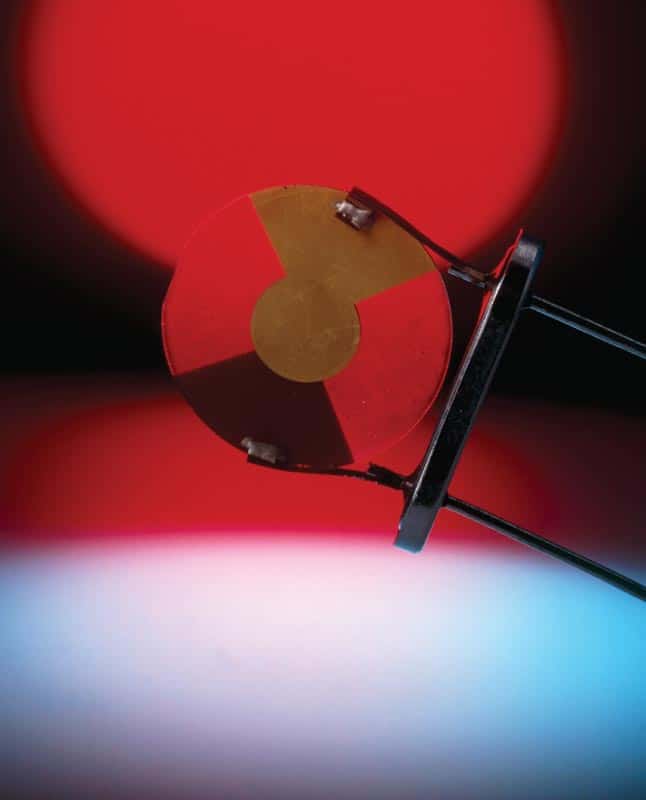
Silicon is the oxygen of human technology. Without it, much of modern civilization as we know it could not exist, since silicon and its compounds – particularly sand and quartz – are found in all manner of electric components and household goods. In Sand and Silicon, the physical chemist Denis McWhan makes an impressive case for the scientific interest of these two related substances, as well as their importance. The book begins with a chapter on piezoelectricity, or the ability of certain types of crystals (including quartz) to become electrically polarized in response to applied pressure. Discovered by Pierre Curie and his older brother Jacques in 1880, piezoelectricity went on to play a major role in the younger Curie’s famous studies of radioactivity. As McWhan describes, piezoelectric crystals lay at the heart of Pierre and Marie Curie’s radiation-detecting apparatus. In the same chapter, the author also delves into the crystal structure of quartz, and shows how piezoelectricity arises from particular types of crystal symmetry. This mixture of theory, applications and history is repeated in later chapters on the crystal architecture of sand, the role of impurities in materials such as semiconductors and the design of photovoltaic solar cells. Written without much mathematics, but with a high level of technical detail, the book would make an excellent introduction for advanced secondary-school students, undergraduates or physicists seeking to fill a gap in their knowledge of materials science.

  • 2012 Oxford University Press £29.95/$55.00hb 160pp

Think carefully

Physics is full of apparent paradoxes that, when examined with due care and attention, turn out to make sense after all. This, in a nutshell, is the premise of Paradox: the Nine Greatest Enigmas in Science, the latest book by the British physicist, broadcaster and science communicator Jim Al-Khalili. The book begins with some of the earliest known paradoxes: those of the Greek philosopher Zeno, who in the 5th century BC articulated puzzles concerning arrows in flight and a race between a tortoise and the mythical hero Achilles. After showing how each of Zeno’s paradoxes can be resolved with a little knowledge of kinematics and infinite series – and offering a tantalizing glimpse of a quantum version of Zeno’s Arrow Paradox – Al-Khalili moves on to more recent enigmas. One of these is Olbers’ Paradox, which asks why the night sky appears dark even though there are stars in every direction you look. Fascinatingly, the first person to resolve this paradox seems to have been the American writer Edgar Allen Poe, who intuited in 1848 that the sky is dark because most stars are too far away for their light to have reached us yet. Poe, however, had no proof – a proper resolution to the paradox would not come until 1901, when Lord Kelvin published full calculations – and, as the book’s subsequent chapters illustrate, intuition is seldom a reliable guide in modern physics. (What would Poe have thought about Schrödinger’s cat?) Professional physicists will find few surprises in Al-Khalili’s book, which is aimed more at readers who have never encountered such bread-and-butter physics topics as the Big Bang, special relativity and the second law of thermodynamics. However, Al-Khalili’s explanations of these topics are clear and well written, and the “paradox” concept is an attractive means of grouping them together.

  • 2012 Bantam Press £16.99hb 256pp

Into the white abyss

A little over a century ago, a patent clerk with a penchant for physics was preparing to embark on the project that would define his life. His name was Salomon August Andrée (who did you think we were talking about?) and in July 1897, he and two companions set off from the Svalbard archipelago in an attempt to reach the North Pole in a giant silk balloon. They expected the journey to take less than a week and, in retrospect, their optimism seems inexplicable. As Alec Wilkinson notes in his book The Ice Balloon, Andrée’s knowledge of polar wind currents was practically non-existent; his balloon leaked hydrogen from some eight million tiny needle-holes in the fabric; and although the group carried extra provisions in case they had to return by foot or boat, none of them had prepared, mentally or physically, for the sheer effort involved in hauling 300-pound sledges across pack ice. But as Wilkinson explains, the Arctic in the late 19th century was a magnet for scientific dreamers. Moreover, some of these dreamers – including the American Adolphus Greely and the Norwegian Fridtjof Nansen, whose expeditions are described briefly in the book – managed not only to survive, but even to achieve a degree of success. Andrée must have believed himself capable of a similar triumph over adversity. One certainly gets a sense from the book that he was not lacking in confidence. In Wilkinson’s words, Andrée acted as if “moving among disciplines [was] not a matter of broadening oneself…so much as applying one’s customary judgement to new circumstances”. There would be no happy ending for Andrée and his fellow adventurers, but this book about their failure is a moving epitaph for what Wilkinson calls “the heroic age of Arctic exploration”.

  • 2012 Knopf $25.95hb 256pp

The October 2012 issue of Physics World is out now

By Matin Durrani

PWOct12cover-200.jpg

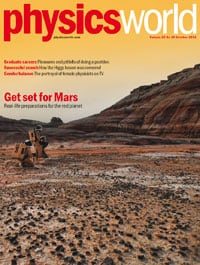
If you’re a member of the Institute of Physics, it’s time to tuck into the October 2012 issue of Physics World, which sees Michael Riordan continue his story of the search for the Higgs boson, taking us from the closure of the Large Electron–Positron collider at CERN in 2000 to the final, joyous days in July this year when the particle – or something like it – finally appeared at the Geneva lab. Elsewhere, PhD student Ashley Dale gives a riveting account of his two-week stay in the Utah desert, where he was part of a mission seeking to simulate a trip to Mars, which saw him do everything from riding on quad bikes to eating dehydrated food.

Don’t miss either our latest graduate special, where Physics World careers editor Margaret Harris examines the pitfalls and positives of doing a postdoc. Finally, we have a brilliant Lateral Thoughts article this month, in which Stephanie Walton describes her attempts to take a break from her PhD studies – and try her hand at writing a fully fledged crime novel. Physicists are a bright bunch; how hard could penning some fiction possibly be?

Members of the Institute of Physics (IOP) can access the entire new issue free online through the digital version of the magazine by following this link or by downloading the Physics World app onto your iPhone or iPad or Android device, available from the App Store and Google Play, respectively.

For the record, here’s a rundown of the highlights of the issue:

Astronomy’s golden future – One year on from sharing the Nobel Prize for Physics for discovering that the expansion of the universe is accelerating, Brian Schmidt tells Jude Dineley why he thinks the future is bright for physics in Australia

Courting controversy – A new independent analysis of global temperature records, led by Richard Muller, has found that humans are indeed contributing to climate change, but the result has proved contentious, as Philip Ball reports

Critical point: How to vote – Ahead of the upcoming US elections, Robert P Crease describes his tactic for determining the qualifications of candidates

Is the ‘Cox effect’ good for us? – Some claim that recent increases in the number of students studying physics in the UK are due to the TV appearances of physicist Brian Cox. But, as Felicity Mellor warns, the “Cox effect” may not be all good news

My life on Mars – In December 2011 Ashley Dale spent two weeks in the Utah desert as part of a simulated Mars mission. This is his account of the experience

Britain and the bomb – On the 60th anniversary of Britain’s first nuclear test, Richard Corfield explores how Operation Hurricane – the British effort to develop the atomic bomb in the 1940s and 1950s compares with states such as Iran that today wish to have such devices

Cornering the Higgs bosonMichael Riordan continues his look back on the Higgs boson search with the early attempts to hunt it down at the Tevatron and the Large Hadron Collider

Hans Bethe’s early life’Jeremy Bernstein reviews Nuclear Forces: the Making of the Physicist Hans Bethe by Silvan Schweber

The science of Prometheus’Seymour Mauskopf reviews Roald Hoffmann: On the Philosophy, Art, and Science of Chemistry edited by Jeffrey Kovac and Michael Weisberg

The academic pyramid – With the world economy struggling, physics graduates might be tempted to ride out the recession by doing a PhD or postdoctoral research. But as Margaret Harris reports, the academic sector has its own career problems

My career as a crime novelist – In this month’s Lateral Thoughts column, Stephanie Walton muses on just how hard it could be to write a crime novel

If you’re not yet a member, you can join the IOP as an imember for just £15, €20 or $25 a year via this link. Being an imember gives you a full year’s access to Physics World both online and through the apps.

Focus on: Big Science

By Michael Banks

POct12-BigScience-cover200.jpg

Just a couple of weeks ago the European Commission kick-started the Extreme Light Infrastructure Nuclear Physics Facility (ELI-NP) project by announcing €180m towards its construction.

ELI-NP, costing €350m and to be built near Bucharest in Romania, will generate laser pulses with a power of some 10 petawatts (1016 W) – intense enough to study nuclear transitions in unprecedented detail.

The facility is one of four centres planned as part of the huge ELI project – the others being a centre in Hungary for attosecond physics, a third working on laser-based particle-beam production in the Czech Republic, and a fourth on ultrahigh-powered lasers. The latter’s location is still up for grabs.

Along with the ITER experimental fusion reactor in Cadarache, France, and the European Spallation Source in Lund, Sweden, ELI is just one of a whole host of “big science” facilities set to come online in the coming decade. Indeed, the Square Kilometre Array is now nearer to construction following a decision in May to split the facility between Australia and southern Africa.

It doesn’t stop there, with physicists looking even further ahead such as to a successor to CERN’s Large Hadron Collider, a muon collider, as well as an electron–ion collider that would be able to study gluons in unprecedented detail.

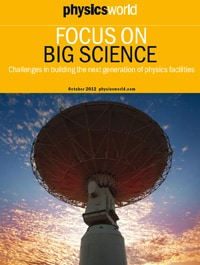
In a special focus issue accompanying the October edition of Physics World, and available to view free here, we take a look at the technical challenges in building and designing some of these big science facilities.

I hope you find this focus issue stimulating and please do let us have your comments by e-mailing pwld@iop.org.

Here’s a rundown of what’s inside:

• A phased approach – Jon Cartwright looks at the technology behind phased arrays – a key part of the planned Square Kilometre Array

• Planning the world’s next collider – An interview with linear collider director Lyn Evans on what comes next after CERN’s Large Hadron Collider

• The attraction of superconductors – Development of a magnet built from high-temperature superconductors will be at the heart of a proposed muon collider, as Tim Wogan reports

• Exploring “the mass that matters” – Peter Gwynne describes plans for an electron–ion collider – a new kind of facility that would study the properties of gluons

• New eyes for a dark world – Technology based on superconducting circuits will allow astronomers to detect every photon that arrives at a telescope’s lens, as David Appell explains

• Turkey accelerates ahead – Michael Banks travels to Ankara to hear plans for a Turkish Accelerator Centre

• Illuminating new frontiers – Brian Stephenson, director of Argonne National Laboratory’s Advanced Photon Source, gives his opinion on why the future is bright for light sources

Read the Focus on Big Science now

Survival of the fittest nanoantenna

Physicists in Germany have used evolutionary algorithms to help them pinpoint the best geometry for a nanoantenna. As well as zeroing in on the optimal design out of more than 10132 alternatives, the technique has provided unexpected new insights into the complex optical properties of nanostructures.

Nanoantennas convert light to electrical power and vice-versa, and are essential in the design of tiny electro-optical devices. They have diverse potential applications in just about anything based on light–matter interaction, including optical sensing and signalling, microscopy, solar-power conversion and quantum cryptography.

An antenna’s ideal size is dictated by the wavelength of the radiation that it handles. For radio waves, this is of the order of metres, and for light it is hundreds of nanometres. Most research so far has focused on designs that are essentially miniaturized radio antennas. However, tiny metal components interact with light in a much different way from how radio waves interact with larger components – and this means that shrinking radio designs is not necessarily the best approach to take.

Employing evolution

Instead, Thorsten Feichtner and colleagues of the University of Würzburg have used evolutionary optimization to wheedle-out the most structurally well adapted nanoantenna for their purposes. Inspired by natural selection, evolutionary optimization algorithms work towards an ideal design rather than evaluating the performance of all possible designs. For the problem tackled by Feichtner’s team, the latter would be impossible because more than 10132 antenna designs would need to be evaluated using a process that takes 20 minutes per structure.

The team’s goal was to find a geometry that would enhance the near-field intensity of an illuminating beam of light as much as possible, so they chose this as the “fitness parameter” that they would judge each design against. Their antennas consisted of 21 by 21 matrices of gold cubes measuring 10 nm on the side. Beginning with patterns that were generated randomly, they ran simulations on batches of 20 designs to establish which were best adapted to the design goal.

Just as in nature, the fittest patterns got the chance to pass on their characteristics to the next generation, while the weaker specimens were discarded. The highest-performing five from each batch were used to build a new generation of 20 structures via crossing techniques and mutations. The new structures were in turn pitted against one another, so the overall fitness of the designs improved generation by generation – over 100 generations – until the near-field intensity enhancement registered almost twice that of the reference antenna.

Puzzling patterns

“In the end, we found that the best shape was a very random-looking pattern of gold blocks,” says Feichtner. The central part of that design was reminiscent of a classical antenna though: two rod-like structures separated by a gap. When the researchers took a close look at the currents flowing in that area, they discovered that the rods were connected by a single gold block, positioned just below the gap between the rods.

“If you look at the problem purely geometrically, you should have no conductive link between two blocks which are just touching at the edges. But the simulation approach we used allowed current to flow along the edges from one cube to another,” explains Feichtner. “This was a bit of a surprise to us … and when we removed just this one block, the fitness decreased by a factor of two.”

“Of course, this whole structure is very complex and we’re far away from understanding what is happening everywhere,” he adds. Rather than pursue that answer too doggedly, the team instead came up with a stripped-down version of their fittest candidate, which might feasibly be built with today’s technology – essentially a hybrid of a two-wire antenna and the split-ring resonator geometry that they discovered – and showed that it, too, boasted the same two-fold increase in fitness factor.

Hot topic

This is certainly not the first study to demonstrate that nanoantennas can be optimized using evolutionary algorithms but,” says Feichtner, “[previous studies] were restricted to changing the shape of one particle, or using a defined-shape particle and moving them round or changing the size. Our approach allows one to build up arbitrary geometries made of one or multiple particles, and also gives the possibility to see how large connected structures will work. The split-ring geometry would never have been found with the approaches that have been used thus far.”

The study indeed “introduces a very original way of designing optical antennas”, according to Sébastian Bidault, who investigates DNA-based fabrication of nanoantennas at the Institut Langevin in Paris, France, and was not involved in the research.

He points out, however, that one of the main drawbacks of metal-based nanoantennas is strong losses due to local heating. “Optimizing local intensity enhancement by adding more metal that will induce more ohmic losses [fails to] consider what happens to this energy afterwards.”

The research appears in Physical Review Letters.

Hair’s where it’s at

Humans have a long and fruitful history of looking towards nature for ideas to build new technologies or solve problems. From Leonardo Da Vinci studying the flight of birds to develop the earliest “flying machines”, to the Swiss engineer George de Mestral developing Velcro after studying the surface of burrs, nature has long been influencing technologies.

A recent review paper published in the journal Smart Materials and Structures takes an in-depth look at the different “hairy” sensors that a whole host of animals possess. This could help us to develop our own sensors to serve a multitude of purposes from gauging flow turbulence to more efficient liquid-dispensing methods to developing robots that can successfully navigate underwater or underground and other biomedical applications. Such sensors would require many capabilities such as short response times and low detection thresholds – capabilities that already exist in animals.

Many life-forms live in conditions that are constantly changing and so have adapted a wide range of sensory strategies to survive. In the paper, the authors point towards many examples. Mexican blind fish rely on a” lateral line system” to detect movement and vibration in the surrounding water. Crickets use their hairy “cerci” or feelers that provide them with flow information that let them know if another creature is approaching them. Caterpillars also use cerci to detect airborne disturbances that let them know when predators, like flying wasps, are overhead. Meanwhile, bats control their flight by monitoring air-flow conditions via hairs on their wings.

According to the paper, “Among the various flow sensors in nature, the instinctive flow sensors of aquatics and arthropods are the most intensively studied.” In the initial sections the researchers look at the “morphology, function and biomechanics of the lateral line neuromas of aquatics and the fusiform hairs of arthropods are examined to shed light on the development of their artificial counterparts”. In later sections they divide the types of sensors that can be developed into six categories: thermal, piezoresistive, capacitive, magnetic, piezoelectric and optical sensors. They look at various groups around the world that are currently developing some of the different types of sensors considered and the different methods they use. The final discussion looks at how to best optimize such sensors, process the information they would provide and how the field will progress in the future.

So for an insightful look into all sensors hairy, take a look at the paper here.

Copyright © 2026 by IOP Publishing Ltd and individual contributors