On the podcast trail in India

James Dacey in Mumbai


A quiet Saturday afternoon in Mumbai.

By James Dacey in India

For the past week I have been roaming around the Indian state of Maharashtra meeting students, researchers and teachers to learn about their experiences of physics education. I have also been recording lots of audio interviews, which will form part of a podcast to appear on physicsworld.com within the next couple of months. I don’t want to give away too much just yet but let’s just say that India is a brilliant and noisy place, so you can also expect to hear the sounds of the subcontinent, from sitars to Mumbai’s unbelievable traffic.

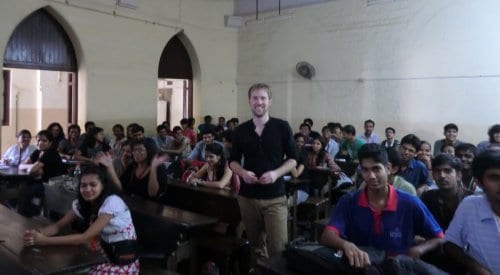
This photograph was taken at Mumbai’s St Xavier’s College, which I visited on Saturday to give a talk about science journalism to some of the undergraduate students. I was a bit concerned when I heard that the talk would be held on a Saturday afternoon – surely no student would turn up on the weekend! Well, they certainly did, with about 70 arriving after attending a morning of mandatory lectures. I was also unsure whether everyone would understand my accent. They assured me they did and following the talk there were many great questions. Among my favourites were “How much do you earn?” and “How much do you suffer as a journalist?” I gave diplomatic answers to both.

I arrived in Mumbai last Wednesday along with the editor of Physics World, Matin Durrani. Matin and I have been visiting research institutions to learn about physics in India – its current state, its history and the interconnected social, political and economic issues. Naturally, in the space of a week you can only see a tiny area of this vast country, but we have managed to squeeze in a fair number of visits. We took a divide and conquer approach and my visits in Mumbai included the Bhaba Atomic Research Centre (BARC) and St Xavier’s College. On Saturday, Matin and I went our separate ways as I came south to the city of Pune and he veered south west to Bangalore.

When we return to the UK, we will be writing articles for a special report about physics in India, which will be available to read online.

Science in a dictatorship

At the turn of the 20th century, German scientists led the world. Four decades later, their nation’s reputation in the field was only a husk of what it had been. The cause of this transformation was the Nazi rise to power in 1933, which went on to precipitate one of the biggest intellectual migrations in history. Many hundreds of scientists, most of them Jewish, fled Germany in the years that followed. As well as diminishing German science, their departure also shifted the focus of world science westwards across the Atlantic.

The contributions of these émigré scientists to intellectual life in their new homes (and to the Allied war effort) have been well documented (see “When physics was ‘made in the USA’ ”). The fate of the scientific community they left behind, however, is less well known in the English-speaking world. The new English translation of The German Physical Society in the Third Reich helps fill this gap. Edited by Dieter Hoffmann and Mark Walker, this dense volume contains 11 scholarly essays (including an introduction) that together provide an incisive and sometimes poignant snapshot of the German physics community during the most tempestuous period of its history. They also display vividly how science can suffer under dictatorships, and how the society’s unpredictable fortunes mirrored the tumult inside Germany.

The most famous member of the German Physical Society (DPG) and its one-time president, Albert Einstein, had presciently left Germany before the Nazis came to power, but for the rest of academia, the Third Reich truly began in April 1933, when the Law for the Restoration of the Civil Service came into effect. Under this new law, state employees of “non-Aryan – particularly Jewish” descent lost their jobs. Even those who were not directly affected had to join the party or sign up for political education. This thunderclap was soon followed by the crushing Nuremberg decrees, which relegated Jews to marginal citizenship and further accelerated the move to migrate.

In his essay “Marginalization and expulsion of physicists”, Stefan Wolff of the Deutsches Museum shows that there was little public protest at these actions. This reaction – or rather non-reaction – was mirrored by the DPG, which at this early stage was still trying to remain aloof from politics. Although the society was not initially forced to purge itself of its Jewish members (it waited until 1938 to expel them formally), many chose to leave of their own accord. The results were stark: as an illustration in the book shows, in some cases the list of editors displayed on the masthead of leading journals shrank by up to 90%. Many of the 100 or so DPG members who resigned because of racial or political discrimination emigrated, while others found niches in industrial research or simply retired. An appendix lists their names and their eventual fates; in some cases, terse statements such as “murdered in USSR” or “survived Buchenwald” invite further research.

The book contains many examples of how the Third Reich politicized science. One authoritative chapter, written by Deutsches Museum historian Michael Eckert, describes how the wretched cult of “Aryan physics” rejected the supposedly “Jewish” sciences of relativity and quantum mechanics, to the obvious detriment of the country’s scientific establishment. Among those affected was Werner Heisenberg, who was stigmatized as a “white Jew” because of his involvement in quantum mechanics. Heisenberg was long thought to be an automatic choice to succeed Arnold Sommerfeld as head of the theoretical physics school in Munich, but after tortuous deliberation by the authorities in Berlin, the position went to a less worthy figure. With such lamentable decisions, the reputation of German physics crumbled.

It was not until war had begun that DPG members, notably Wolfgang Finkelnburg, realized that their rejection of modern physics had led them to an impasse, and tried as best they could to backtrack. At the same time, the society was gradually moving towards a policy of appeasement, a process acknowledged in the book’s subtitle, “Physicists Between Autonomy and Accommodation”. By 1942 the DPG was urging the nation to mobilize its scientific abilities, particularly in the nuclear sector. But this was too little, too late, and it prompted much soul-searching post-1945 – hence the title of the final chapter, “Cleanliness among our circle of colleagues”. “Cleanliness” in this context implies intellectual objectivity rather than “name and shame” denunciation.

The Nazis deemed Nobel awards inappropriate for Aryans

The overriding impression is of a weak and ineffectual society unwilling or unable to put up much resistance against the Nazis’ unilateral decisions. Like the doyen of German physics, Max Planck, the DPG swayed in the face of them like a tree in the wind. A few individual scientists did, however, make a stand. Among them was Fritz Haber, the 1918 Nobel laureate in chemistry. Although Haber was Jewish, he was technically exempt from the Civil Service Law because of his war service (he had pioneered the use of poison gas as a weapon during the First World War) and his stature in the scientific community, and thus could have remained in his position as director of Berlin’s Kaiser Wilhelm Institute for Physical Chemistry. Instead, he resigned and left Germany.

Haber’s efforts to find a new position abroad were snubbed by those who remembered his work with chemical weapons and he died in 1934 before he could find another scientific post. The first anniversary of his death was commemorated with a memorial meeting organized by Planck, who boldly went ahead despite stern political admonition from government officials. Admirers and critics of Haber openly expressed strong feelings about having such a meeting. An astonishing example of such criticism came from Haber’s son Hermann, who apparently wrote “One has no right to celebrate a person dead whom one would not tolerate alive.”

Another source of conflict between the DPG and officials of the Third Reich was the premier DPG award, the Max Planck Medal. First given to Einstein in 1929, subsequent awards went to Niels Bohr, Sommerfeld, Planck himself, Max von Laue and Heisenberg – all of whom had been openly criticized by the Nazis. Awarding of the medal was put on hold during the first few years of Nazi rule, but when it resumed in 1937, the winner was Erwin Schrödinger, who had quit Berlin in disgust in 1933. This did little to enamour the DPG to the Nazis, and in 1938 the society bowed to the political winds again, awarding its medal to the politically neutral figure of Louis de Broglie after Enrico Fermi had been deemed unsuitable because of his Jewish connections. What went on here behind the scenes was more illuminating than the event itself.

At the same time, equally bizarre events were going on in the German Chemical Society and in the Mathematical Association. With its strong ties to industry, German chemistry quickly toed the party line. One of the most prominent examples was Richard Kuhn, who had inherited Haber’s mantle, and who extended Germany’s poison gas armoury from chlorine and mustard gas to sarin and tabun. In 1938 Kuhn, who signed all his letters with “Heil Hitler” and had earlier weaselled on Jewish colleagues, refused the Nobel Prize for Chemistry. By this time, the Nazis had deemed Nobel awards inappropriate for Aryans.

This book holds up a mirror to German science in the Third Reich, but the received image, magnified by the subjective lens of the German Physical Society, is a distorted one. Trying to comprehend science in the Nazi era by focusing on a single learned society is a bit like trying to understand the Eurozone crisis by looking at items in a French supermarket. The signs are there, but you have to look hard. A more complete overall picture emerged in Alan Beyerchen’s 1977 book Scientists Under Hitler: Politics and the Physics Community in the Third Reich.


Web life

So what is the site about?

FYFD is a blog that celebrates “the physics of all that flows”. The site was launched in July 2010 and after two years, it has become a real visual feast, with more than 500 eye-catching entries about vortices, turbulence, circulation and other fluid-dynamics phenomena. Most posts contain brief comments on the physics principles at work in a particular image or video, often with links to more detailed explanations elsewhere. However, a few are presented more or less “as is”, allowing viewers simply to marvel at the beauty of fluid dynamics.

Right, so what does “FYFD” stand for?

The site’s full name is Fuck Yeah Fluid Dynamics, and no, we are not going to repeat that. Many other sites on the Tumblr blogging platform, however, have similar names. For example, there is also a FYCS celebrating computer science and a FYMB that is profanely enthusiastic about molecular biology.

Can you describe a few of the posts?

One early post contains video footage from the launch of NASA’s Solar Dynamics Observatory in February 2010. The observatory zoomed into space on the back of an Atlas V rocket, and as the rocket approached the speed of sound, it happened to pass near a rainbow-like atmospheric phenomenon called a sun dog. The video shows shock waves from the rocket blowing the sun dog apart, leaving behind a ripple effect like the one you get from casting a stone into a still pool of water. It is truly amazing, and must be seen to be believed. More recently, FYFD paid a visit to the Olympics, with posts about the hydrodynamics of “fast” swimming pools and a nifty high-speed archery video showing how the fletches on arrows help straighten their path after they leave the bow.

Who is behind it?

FYFD‘s author spoke to Physics World on the condition that we do not reveal her name, because she wants people to focus on the blog’s science, not on her. However, she is an aerospace-engineering PhD student working on (surprise, surprise) fluid dynamics, and her speciality is “boundary-wave stability in hypersonic fields” – in other words, the transition between laminar and turbulent flow near the surfaces of objects travelling faster than the speed of sound. The physics behind this transition is still poorly understood, she says, because “fluid dynamics is the physics that physicists give up on”. Even Werner Heisenberg, she adds, stopped studying fluids after he realized that quantum mechanics was easier.

Why should I visit?

Although FYFD‘s full name is decidedly NSFFM (not suitable for a family magazine), we love the way it communicates the marvels of fluid dynamics to people who lack the expertise to understand the complex mathematics behind it. The messy technicalities of flowing matter often get short shrift in popular-science writing, but the glorious videos and images on FYFD suggest that the problem was mostly with the medium, not the message. It is impossible to capture the beauty and variety of fluid phenomena with words alone; in fact, why are you still reading? Go adjust the profanity filter on your web browser and check out FYFD for yourself.

Huge cosmic-ray observatory set for Siberia

Construction has begun in the Tunka Valley near Lake Baikal in Siberia, Russia, on one of the world’s largest cosmic-ray observatories. The first prototypes for the $46m Hundred Square-km Cosmic Origin Explorer (HiSCORE) are now being installed and when complete by the end of the decade the facility will consist of an array of up to 1000 detectors spread over 100 square kilometres. HiSCORE will aim to solve the 100-year-old mystery surrounding the origins of cosmic rays – particles that originate in outer space and are accelerated to energies higher than those achieved in even the largest man-made particle accelerators.

HiSCORE is a collaboration between three institutes in Russia – the Institute for Nuclear Research of the Russian Academy of Sciences in Moscow, Irkutsk State University in Siberia and Lomonosov Moscow State University – as well as DESY, the University of Hamburg and the Karlsruhe Institute of Technology, all in Germany. The unprecedented size of the array will allow scientists to investigate cosmic rays within an energy range of 100 TeV to 1 EeV – a relatively unexplored region.

HiSCORE’s detectors are designed to observe the radiation created when cosmic rays hit the Earth’s upper atmosphere. This causes a shower of secondary particles that travel faster than the speed of light in air, producing Cherenkov radiation in the process that can be picked up by HiSCORE’s photomultiplier tubes. This radiation can be used to determine the source and intensity of cosmic rays as well as to investigate the properties of high-energy astronomical objects that emit gamma rays, such as supernova remnants and blazars. “We are especially interested in galactic objects that accelerate cosmic rays to energies around peta-electron-volts – or pevatrons – that have yet to be discovered,” Martin Tluczykont from the University of Hamburg, who is co-ordinating the project, told Physics World. “They are crucial to a solution of the origin of cosmic rays.'”

With its remote location, Lake Baikal is rapidly becoming a hotbed for cosmic-ray research. It already hosts the Tunka-133 cosmic-ray observatory, which has been in operation since 2009, and is also home to the Baikal Deep Underwater Neutrino Telescope (BDUNT), which is located 1.1 km below the surface of the lake and observes the Cherenkov radiation produced by high-energy neutrinos. The BDUNT is set to be replaced by the Gigaton Volume Detector, which will be one of the world’s largest neutrino telescopes when it is complete later this decade.

Physicists unfold the mechanics of origami

Here’s a fun exercise – take a piece of paper and use a compass to draw two concentric circles that define a ring. Then replace the pencil in the compass with a hard tip to indent a concentric crease in the paper halfway between the inner and outer edge of the ring. Cut out the ring and then fold along the crease all the way along its circumference – and if you are careful you will have created a 3D saddle such as the one in the photograph above.

This is a simple example of “curved-crease origami”, the mechanics of which have been studied in detail for the first time by physicists in the US.

Originating in Japan, origami is the art of creating 3D objects by folding paper. Origami can transform a lightweight flat material into a strong and flexible 3D object and as a result its principles have been adopted by engineers to design everything from vehicle airbags to satellite components.

Practical 3D materials

Curved creases are sometimes used in origami – a practical example being the French-fry box used in fast food restaurants. However, little is understood about the mechanics of such structures. Now, Marcelo Dias, Christian Santangelo and colleagues at the University of Massachusetts, Amherst and Harvard University are the first to develop a set of equations to describe the physics of curved-crease structures. As well as providing a better understanding of origami, the team hopes that the work will lead to practical 3D materials that are both strong and flexible.

Santangelo and colleagues focused on a ring because it is a relatively simple example of how a 2D structure can be transformed into 3D object by creating a curved crease. To gain a basic understanding of the physics, the team built a few origami saddles out of paper – from which they deduced which physical properties are key to understanding the mechanics of the curved crease.

At the heart of the transition from a 2D sheet to a 3D object are the planar stresses created in the ring when it is folded. These stresses are relieved by the sheet wrapping around itself to create a saddle-like structure. If the ring is cut, then the stresses are relieved and the saddle will collapse to a ring that will lie flat – albeit with a smaller radius (see image above).

Stiff creases

The team’s mathematical description is based on several parameters, including the ratio of the width of the ring being folded to the radius of the ring. The angle of the crease is also important, along with the “stiffness” of the crease – the latter being a measure of how difficult it is to change the angle of the fold. Another important parameter is the stiffness of the material itself – a measure of how difficult it is to bend the sheet from which the ring is made of.

The team derived an equation for the total energy of a creased ring in terms of these parameters and then calculated the energy using several analytical and numerical techniques. In addition to the angle of the crease, the results suggest that two ratios play an important role in the shape of the 3D structure – the ratio of width of the ring to its radius and the ratio of the stiffness of the crease to the bending stiffness of the material.

When the ratio of the crease stiffness to the bending stiffness is relatively high, the angle of the crease will not change – and the structure will respond to the stresses by bending to create a 3D shape.

In the case of the relative width of the ring, the team found that the wider the ring the more rigid the 3D structure – something that Santangelo believes could be exploited to make strong, flexible yet lightweight 3D structures. The team also extended the model to describe rings with multiple creases, which results in more complicated 3D structures.

The research is described in Physical Review Letters.

First flat lens focuses light without distortion

Physicists in the US have made the first ultrathin flat lens. Thanks to its flatness, the device eliminates optical aberrations that occur in conventional lenses with spherical surfaces. As a result, the focusing power of the lens also approaches the ultimate physical limit set by the laws of diffraction.

“Imagine if you were to replace the lens in a mobile phone with a flat and ultrathin one – you could then squeeze your smartphone down to a thickness approaching that of a credit card,” says team leader Federico Capasso of the Harvard School of Engineering and Applications. “Most optical components found in devices today are quite bulky because the light-beam shaping is done by changing the optical path of incident light rays, which requires changes in lens thickness. In our lens, all the beam shaping is done on its flat surface, which is just 60 nm thick.”

In an ordinary lens, light rays travel more slowly in the thicker, central regions than in the thinner, peripheral ones thanks to the smaller phase velocity of light in glass compared with air, he explains. This distribution of phase delays in the lens leads to light refraction and focusing.

Nanostructured metasurface

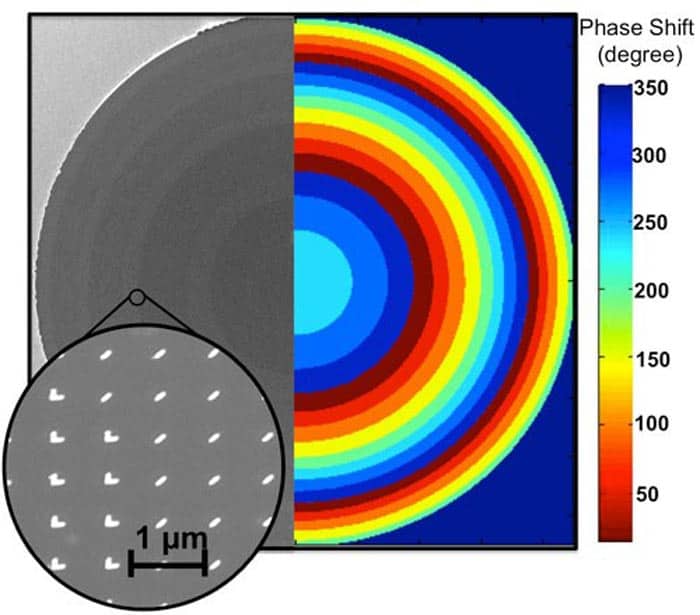
The new flat ultrathin lens is different in that it is a nanostructured “metasurface” made of optically thin beam-shaping elements called optical antennas, which are separated by distances shorter than the wavelength of the light they are designed to focus. These antennas are wavelength-scale metallic elements that introduce a slight phase delay in a light ray that scatters off them. The metasurface can be tuned for specific wavelengths of light by simply changing the size, angle and spacing between the nanoantennas.

“The antenna is nothing more than a resonator that stores light and then releases it after a short time delay,” Capasso says. “This delay changes the direction of the light in the same way that a thick glass lens would.”

The lens surface is patterned with antennas of different shapes and sizes that are oriented in different directions. This causes the phase delays to be radially distributed around the lens so that light rays are increasingly refracted further away from the centre, something that has the effect of focusing the incident light to a precise point.

No monochromatic aberrations

The new lens does not suffer from the image-distorting features, known as monochromatic aberrations, that are typical of lenses with spherical surfaces, adds Capasso. “Spherical aberration, coma and stigmatism are all eliminated and one gets a well-defined diffraction-limited, accurate focal spot. This is true even when light rays hit the lens away from the centre or at a large angle, so no complex corrective techniques are required.”

The Harvard team made its lens by first depositing a nanometre-thin layer of gold. The researchers then stripped away parts of the gold to leave behind an array of V-shaped structures (the nanoantennas) that were evenly spaced in rows across the surface of a silicon wafer.

The most obvious applications for the lens include photography and microscopy, says Capasso. “For example, compact objectives with very large numerical apertures can be envisaged, but we can also imagine optical fibres with patterned facets for new imaging and medical applications, and anywhere in general where a conventional lens could be replaced with a flat one,” he says.

Towards broadband focusing

Although the lens is only at the proof-of-concept stage, Capasso and colleagues have already been inundated with requests from photographers and astronomers from around the world. The focusing efficiency of the lens is still quite small at present but, according to the team, could easily be increased by increasing the packing density of the optical antenna and by using different flat-lens designs. “So far, the lens only focuses specific wavelengths of light but by arranging different antenna patterns onto the metasurface it could be made broadband,” says Capasso.

The researchers fabricated their lens using electron-beam lithography, which is not the most practical technique because it is time-consuming. “Fortunately, there are many emerging nanolithography technologies that could be suitable for mass production, such as nanoimprinting and soft lithography, which might be extremely useful for patterning our lens on flexible substrates,” adds Capasso. “This in itself would open up a host of exciting application areas.”

The results are reported in Nano Letters.

Planck’s law violated at the nanoscale

In a new experiment, a silica fibre just 500 nm across has been shown not to obey Planck’s law of radiation. Instead, say the Austrian physicists who carried out the work, the fibre heats and cools according to a more general theory that considers thermal radiation as a fundamentally bulk phenomenon. The work might lead to more efficient incandescent lamps and could improve our understanding of the Earth’s changing climate, argue the researchers.

A cornerstone of thermodynamics, Planck’s law describes how the energy density at different wavelengths of the electromagnetic radiation emitted by a “black body” varies according to the temperature of the body. It was formulated by German physicist Max Planck at the beginning of the 20th century using the concept of energy quantization that was to go on and serve as the basis for quantum mechanics. While a black body is an idealized, perfectly emitting and absorbing object, the law does provide very accurate predictions for the radiation spectra of real objects once those objects’ surface properties, such as colour and roughness, are taken into account.

However, physicists have known for many decades that the law does not apply to objects with dimensions that are smaller than the wavelength of thermal radiation. Planck assumed that all radiation striking a black body will be absorbed at the surface of that body, which implies that the surface is also a perfect emitter. But if the object is not thick enough, the incoming radiation can leak out from the far side of the object instead of being absorbed, which in turn lowers its emission.

Spectral anomalies spotted before

Other research groups had previously shown that miniature objects do not behave as Planck predicted. For example, in 2009 Chris Regan and colleagues at the University of California, Los Angeles reported that they had found anomalies in the spectrum of radiation emitted by a carbon nanotube just 100 atoms wide.

In this latest work, Christian Wuttke and Arno Rauschenbeutel of the Vienna University of Technology have gone one better by showing experimentally that the emission from a tiny object matches the predictions of an alternative theory.

To produce the 500-nm thick fibre they used in their experiment, Wuttke and Rauschenbeutel heated and pulled a standard optical fibre. They then heated the ultra-thin section, which was a few millimetres long, by shining a laser beam through it and used another laser to measure the rate of heating and subsequent cooling. Bounced between two mirrors integrated into the fibre a fixed distance apart, this second laser beam cycled into and out of resonance as the changing temperature varied the fibre’s refractive index and hence the wavelength of radiation passing through it.

Fluctuational electrodynamics

By measuring the time between resonances, the researchers found the fibre to be heating and cooling much more slowly than predicted by the Stefan–Boltzmann law. This law is a consequence of Planck’s law and defines how the total power radiated by an object is related to its temperature. Instead, they found the observed rate to be a very close match to that predicted by a theory known as fluctuational electrodynamics, which takes into account not only a body’s surface properties, but also its size and shape plus its characteristic absorption length. “We are the first to measure total radiated power and show quantitatively that it agrees with model predictions,” says Wuttke.

According to Wuttke, the latest work could have practical applications. For example, he says that it might lead to an increase in the efficiency of traditional incandescent light bulbs. Such devices generate light because they are heated to the point where the peak of their emission spectrum lies close to visible wavelengths, but they waste a lot of energy because much of their power is still emitted at infrared wavelengths. Comparing a 500nm-thick light-bulb filament with a very short antenna, Wuttke explains that it would not be thick enough to efficiently generate infrared radiation, which has wavelengths above about 700 nm, therefore suppressing emission at these wavelengths and enhancing emission at shorter visible wavelengths. He points out, however, that glass fibre, while ideal for the laboratory, would be a poor candidate for everyday use, since it is an insulator and is transparent to visible light. “A lot of research would be needed to find a material that conducts electricity and is easily heated, while capable of being made small enough and in large quantities,” he says.

Atmospheric applications

The research might also improve understanding of how small particles in the atmosphere, such as those produced by soil erosion, combustion or volcanic eruptions, contribute to climate change. Such particles might cool the Earth, by reflecting incoming solar radiation, or warm the Earth, by absorbing the thermal radiation from our planet, as greenhouse gases do. “The beauty of fluctuational electrodynamics”, says Wuttke, “is that just by knowing the shape and absorption characteristics of the material you can work out from first principles how efficiently and at which wavelengths it is absorbing and emitting thermal radiation.” But, he adds, here too more work would be needed to apply the research to real atmospheric conditions.

One thing that Wuttke and Rauschenbeutel are sure of, however, is that their research does not undermine quantum mechanics. Planck’s theory, explains Rauschenbeutel, is limited by the assumption that absorption and emission are purely surface phenomena and by the omission of wave phenomena. His principle of the quantization of energy, on the other hand, is still valid. “The theory we have tested uses quantum statistics,” he says, “so it is not in contradiction with quantum mechanics. Quite the opposite, in fact.”

Regan describes the latest work as “very elegant”, predicting that it will “illuminate new features of radiative thermal transport and Planck’s law at the nanoscale”. He suggests, however, that using an emissivity model that incorporates the transparency of the thin optical fibres would allow Planck’s law to more accurately describe the radiation from these tiny emitters.

The research is described in a preprint on the arXiv preprint server.

Will it be a cold winter in Britain?

By Hamish Johnston

As someone who spent a few years on the Canadian prairies, where the mercury regularly dips to –40 °C, I should be the last one to describe Britain’s winters as cold and dry. Indeed, just a few years ago I was mowing the lawn in January to ensure that the grass wasn’t a rotting mess come spring.

snowy britain  2010.jpg
But then in 2009 something changed. The winters here in Bristol seemed to go from being warm and wet to being cold and dry. The NASA satellite image on the right shows the entire island of Great Britain blanketed in snow in January 2010 – something that very rarely happens.

The last few winters were so dry that a drought was declared in much of southern and central England this spring (and then it started raining and hasn’t stopped).

It would be nice to be able to predict what the next British winter will be like – but seasonal forecasts are notoriously difficult to make. The UK’s Met Office used to go public with its predictions, but stopped in 2009 when its promise of a “barbeque summer” turned into a washout.

Now, scientists at the Met Office are saying that their latest forecasting system should be able to forewarn of a cold winter. They say that such cold snaps can be caused by the disruption of the “polar vortex” – a large-scale cyclone that blows in the middle and upper troposphere and in the stratosphere above the polar regions during the winter. In the northern hemisphere, the vortex drives the westerly winds that bring warm, damp air to Britain in the winter.

Such vortex disruptions seem to occur when warm air piles into the stratosphere. In order to predict such events better, the Met Office has begun using a so-called high-top version of its GloSea4 seasonal-forecasting model. This version calculates physical quantities such as winds, humidity and temperature to higher levels in the atmosphere and also at more levels.

You can read a news article about the new system on our sister website environmentalresearchweb and a paper is available in the journal Environmental Research Letters.

Which scientific issue should be of greatest importance to politicians?

By Hamish Johnston
Facebook poll

Every four years the organization Science Debate sends a list of questions to the two main presidential candidates in the US. In addition to general questions about science education and public policy, this year’s 12 questions also cover issues such as biosecurity, preserving food and freshwater supplies, and how to manage the Internet.

This week’s Facebook poll is inspired by those questions, which I have edited down to the six issues that I think are of most interest to physicists.

Which scientific issue should be of greatest importance to politicians?

Science’s role in economic growth
Research funding
Science education
Climate change and energy security
Space exploration
Science-based public policy

Have your say by visiting our Facebook page, and please feel free to explain your response by posting a comment below the poll.

You can read the candidates’ responses here and, if you are a US citizen, cast your vote accordingly.

Last week we asked “Do you think the Large Hadron Collider will discover new physics beyond the Standard Model?”. A whopping 84% of you said yes, so let’s hope that there are at least some nascent signs of supersymmetry when the next big round of results are presented at CERN in December.

Hot and heavy at the LHC

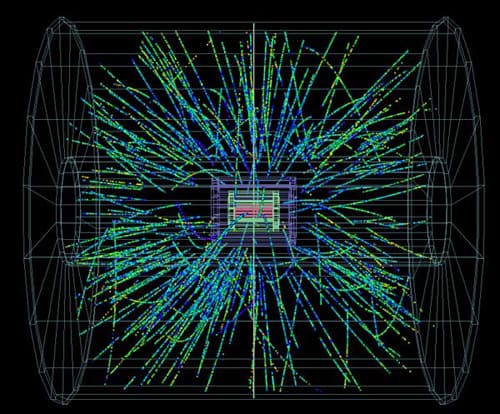
Protons collide with lead nucleiat the LHC's detectors


Protons collide with lead nuclei, sending a shower of particles through the LHC’s detectors. (Courtesy: ALICE/CERN)

By Tushna Commissariat

In the early hours of this morning the Large Hadron Collider (LHC) successfully collided protons and lead ions for the first time, with the collisions being recorded by all of the detectors: ATLAS, CMS, ALICE and LHCb.

Late last year the LHC trialled a similar run, during which it accelerated separate beams of lead ions and protons. However, at that time the beams were not successfully collided, and the run was postponed. To learn more about the 2011 run, take a look at this news story.

The whole business of colliding different particles is a difficult one, as it presents physicists with a number of technical challenges. “Firstly, the collisions are asymmetric in energy, which is a challenge for the experiments,” explains accelerator physicist and lead-ion team leader John Jowett. “At the accelerator level we don’t really see the difference in particle size, but the difference in the beam size and the fact that the beam sizes change at different rates may affect how the particles behave in collisions.”

Also, the LHC normally accelerates two opposing proton beams from 0.45 to 4 TeV, before they collide at a total energy of 8 TeV. Radio-frequency (RF) cavities are used to give the beams the necessary energy boost, as well as to keep them in strict synchrony. But here is where another problem arises: the system ties the momentum of one beam to the momentum of the other, while it needs to account for the differences between the protons and the much heavier lead ions. A lead nucleus, containing 82 protons, is accelerated from 36.9 to 328 TeV, or from 0.18 to 1.58 TeV per proton or neutron, which means that the RF cavities need to be tuned to different frequencies for each beam. This allows both beams to achieve stable orbits within their own ring during injection and acceleration. In the past, other projects have experienced difficulties in getting this just right, as have researchers at the LHC.

“The RF systems of the two rings can be locked together only at top energy before collisions, when the small speed difference that still remains can be absorbed by shifts of the orbits that are acceptably small,” says Jowett. He further explains that the beams then have to be adjusted again by the RF system so that the collisions take place inside detectors, where experiments take physics data, so a lot of preparation has been needed to allow the LHC systems to carry out this new operational cycle.

Researchers are hopeful that this latest short run will deliver the first data for proton–nucleus collisions before a scheduled main run takes place from January to February 2013, just before the accelerator is shut down for maintenance.

Copyright © 2026 by IOP Publishing Ltd and individual contributors