A single rod photoreceptor cell taken from the eye of a frog has been fashioned into an extremely sensitive detector that can count individual photons and determine the coherence of extremely weak pulses of light. Created by researchers in Singapore, the work could lead to hybrid light detectors that incorporate living cells.
The eyes of humans and other living organisms are extremely sensitive and versatile detectors of light, which can often outperform man-made devices. Indeed, a rod photoreceptor cell in the human retina will respond to just one photon – something that only the most sensitive man-made detectors are capable of doing. As well as learning how to make better light detectors by studying the eye, a better understanding of its function could lead to the development of “bioquantum” devices that combine biological and man-made components to study aspects of quantum optics such as “squeezed” light.
In this latest study, Leonid Krivitsky and colleagues at the Agency for Science, Technology and Research in Singapore have focused on rods from the eye of the African Clawed Frog (Xenopus laevis), a species that is much studied by biologists.
Stemming the flow
Each rod has an outer segment (OS) that contains rhodosin photopigment – a substance that undergoes a chemical change when exposed to light. When in the dark, a constant current of sodium, potassium and calcium ions flows in and out of the cell. However, when a photon strikes the rhodopsin, it sets off a chain of chemical reactions that switchs off some of the ion-transport channels. This causes the electrical polarization of the cell, which results in an electrical signal that is picked up by the nervous system and relayed to the brain.
Individual rods are about 50 μm long and about 5 μm in diameter. The experiment begins with a rod being sucked into a micropipette and kept alive by being immersed in a special solution that is similar to that in the eye. The micropipette also acts as an electrode, which allows the ion current to be detected using a low-noise amplifier.
The team used green laser light (532 nm wavelength) to study the optical response of individual rods. The team fired several different types of laser pulse at the rods and measured the response. Before a pulse reaches the rod, the light is split into two paths. One path continues to the rod and the other goes to an avalanche photodiode (APD) – an extremely sensitive light detector capable of seeing single photons. This optical set-up is used as a Hanbury–Brown–Twiss interferometer – which allows the team to determine the coherence of the light arriving at the rod.
Counting photons
In one measurement, the team measured the photocurrent produced by the rod while changing the average number of photons per pulse from 30 to 16,000. As expected, the photocurrent increased as a function of number until it saturated at about 1000 photons. The team also looked at how the rods responded to two different types of light pulse – pulses of coherent laser light and “pseudothermal” pulses. The latter are laser pulses that are focused onto a rotating disk that has been roughened using sandpaper grit. The resulting specked light is then sent through a diaphragm and emerges as a pulse with little coherence.
Coherent and pseudothermal pulses have different photon-number distribution statistics, and the team was able to use the rods to detect the difference. This, according to the researchers, means that the rods could be used as highly sensitive detectors of photon statistics. Putting all of the measurements together, the team was also able to conclude that each photon in the pulse interacts with just one rhodopsin molecule.
While the light sources used by the team are classical, the fact that the rods can distinguish between coherent and pseudothermal pulses suggest that they could be used in quantum optics and quantum communication. Indeed, the team plans to study the response of the rods to correlated two-photon light.
Majorana fermions are a source of great intrigue to theorists because they are their own antiparticle. Beenakker traces the history of Majorana fermions from their prediction in 1937 by the Italian physicist Ettore Majorana. He then brings us to the present day by describing the excitement surrounding a recent experimental result from the Netherlands. The researchers at Leiden University published a paper earlier this year suggesting that they may have seen the first clear-cut signs of Majorana fermions by spotting them in nanowires.
Beenakker is also based at Leiden University, though he was not involved in this latest research. He has proposed a collection of research articles on Majorana fermions, which will be appearing later this year in a special issue of New Journal of Physics.
I often lecture on famous female scientists and if I do not mention Chien-Shiung Wu, someone almost invariably asks why. This shows how well known she is among scientists. Not only is Wu highly respected – she is known to some as the "First Lady of Physics" or the "Chinese Marie Curie" – but there is a general opinion that it was an injustice that she did not receive the Nobel Prize for Physics together with Tsung-Dao Lee and Chen Ning Yang in 1957 for her part in the experiment that proved that parity is violated in the weak force. But was this really an example of gender discrimination? To find out, I decided to look into this question and weigh up the evidence.
Born in China in 1912, Wu's father was himself an advocate of gender equality, founding one of the first schools in China that admitted girls, and he instilled the value of education in his daughter. In 1934 Wu received her bachelor's degree in physics, graduating at the top of her class from the National Central University in Nanjing. She then did a few years of research but, unsatisfied with the opportunities for physicists in China at that time, moved to the US where she completed a PhD at the University of California at Berkeley in 1940, and then took up a brief research position. In 1942 she married Luke Chia-Liu Yuan, who was the grandson of the first president of the Republic of China.
In 1943, with many physicists in the US working on military projects as the Second World War reached its peak, Wu was offered a teaching position at Princeton University in New Jersey – one of several "firsts" in her career (see "Fair treatment" below). Her appointment was remarkable given that at that time women were not even allowed to study at Princeton. As a young immigrant Chinese woman teaching one of the most difficult subjects – physics – to the male students of Princeton, her presence was unprecedented. But Wu's teaching time at Princeton did not last long because the following year she was asked to do defence work, joining the Manhattan Project to work on radiation detectors at Columbia University in New York.
In 1945, with the turbulent war years over, Wu started working at Columbia's physics department where she could continue research in the field that she felt very close to, nuclear physics, and within that, beta-decay – one of the weak interactions associated with radioactive decay. Wu was to stay at Columbia for the rest of her career and took an active interest in physics well into her retirement. Wu died in 1997 at the age of 84 following a stroke.
Concept genesis
The work for which Lee and Yang were awarded the Nobel Prize for Physics in 1957 had its roots in the so-called "tau-theta puzzle", which perplexed particle physicists in the early 1950s. Tau and theta were two subatomic particles – types of K-meson – the behaviour of which was hard to explain. They were identical in every aspect but one: they had the same mass, the same spin and the same lifetime, but they decayed to products with different net "parity".
Parity is an intrinsic symmetry property of particles that is characterized by the behaviour of their wave functions under reflection through the origin of their spatial coordinates. In everyday terms, it refers to the relationship between a particle or a process and its mirror image. The mirror image of, say, a right-handed screw is a left-handed screw. Similarly, a particle spinning clockwise produces a mirror image that spins anticlockwise. Based on its behaviour, the parity of a particle is defined as either +1 or –1, and the net parity of a group of particles is the product of the parities of all particles in the group.
The tau-theta puzzle was that the tau decayed to three pions, with a net parity defined as (–1)(–1)(–1) = –1, while the theta decayed to two pions with a net parity of (–1)(–1) = +1. If tau and theta were indeed the same particle – as their other properties indicated – they should have the same parity as well; according to the parity conservation law the parity of a system cannot change under particle decay or production. The implications were that either tau and theta were different particles and we had not learned how to distinguish them yet, or they were the same particle and parity was not conserved. This latter idea was highly controversial.
At a conference in 1956 Lee and Yang opted for the former explanation and suggested that certain elementary particles might occur in two forms with different parities. But during the conference there followed some discussion about the possibility that parity is violated in weak interactions. Lee and Yang later searched the literature and found that there were many cases confirming parity conservation in strong interactions, but in experiments on weak interactions this conservation law had not been tested, so it was impossible to tell whether it was valid for them. Lee and Yang then published their famous paper "Question of parity conservation in weak interactions" (1956 Phys. Rev.104 254), in which they briefly discussed the possibility that parity might be violated in weak interactions. They also suggested ideas for experiments that might test this possibility, each involving two sets of experiments that were mirror images of each other. If the two gave identical results then parity conservation was valid, while if the two results were different, it showed that parity was violated.
Months before publication of their famous paper, Lee, who also worked at Columbia University, consulted Wu on the subject. As Wu later recounted (1973 Adventures in Experimental Physics: Gamma Volume ed. B Maglich), one day in the spring of 1956 Lee went to Wu's office and asked her about the status of experimental knowledge on parity conservation in beta decay. According to Wu, "People not only took it for granted that parity was conserved in all interactions, but this untested notion was also used to discourage others from doing any experiments to test, much less challenge, the validity of this concept."
Wu asked Lee whether anyone had thought of experiments that could show that parity is conserved in weak interactions. Lee mentioned ideas such as using polarized nuclei resulting from nuclear reactions, or a polarized slow neutron beam from a reactor. "Somehow I had great misgivings about using either of these two approaches," wrote Wu. "I suggested that the best bet would be to use a cobalt-60 beta-source polarized by the demagnetization method." After Lee's visit, Wu realized "This was a golden opportunity for a beta-decay physicist to perform a crucial test, and how could I let it pass?"
Competing experiments
And she did not. That spring Wu started planning the experiment and was so keen to do it that she even gave up a trip to China, which she had not visited for some 20 years. The experiment was a complex task because she had to combine two techniques that had never before been used together (see "The parity violation experiments" figure). Even though she was an expert in beta-decay experiments, she lacked the expertise and the equipment to perform them at the required temperatures of near absolute zero. Wu therefore contacted Ernest Ambler at the National Bureau of Standards (NBS, later renamed the National Institute of Standards and Technology) in Washington DC, who was happy to collaborate. In September Wu met Ambler in Washington, and they also invited three NBS associates to work with them: Ralph Hudson, an expert in cryogenics, and radiation-detection experts Raymond Hayward and Dale Hoppes.
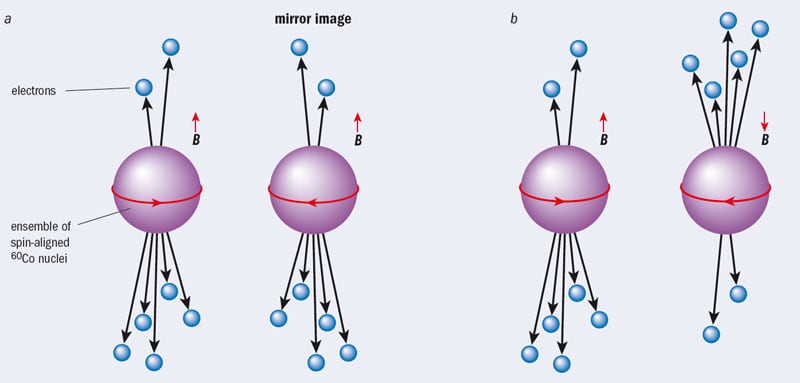
1 The parity violation experiments Until 1956 physicists assumed that fundamental interactions in nature do not change under reflection. The gravitational force, for example, is described in exactly the same way for an object and its mirror image. Parity is a property of elementary particles that expresses their behaviour upon reflection in a mirror. If the parity of a particle does not change during reflection, parity is said to be conserved. In 1956 Tsung-Dao Lee and Chen Ning Yang realized that parity conservation had never been tested for weak interactions, such as radioactive decay. Chien-Shiung Wu suggested an experiment to check this based on the radioactive decay of unstable cobalt-60 nuclei into nickel-60 accompanied by the emission of beta rays (electrons). Very low temperatures were used so that random thermal motion was negligible, enabling a strong magnetic field to align the cobalt nuclei with their spins parallel. The number of emitted electrons was counted in two directions: upward and downward. It was found that the emission of electrons was much greater in the downward direction – the south pole of the spinning nuclei – than the upward direction. In the figure above, (a) shows how a mirror image of this experiment should also produce more electrons going downwards than upwards. However, when the experiment was repeated, with the direction of the magnetic field reversed to change the direction of the spin as it would be in the mirror image, they found that more electrons were produced going upwards (b). The fact that the real-life experiment with reversed spin direction behaved differently from the mirror image proved that parity is violated in the weak interaction of beta decay. The same conclusion – that the weak force does not conserve parity – was also reached by Richard Garwin and Leon Lederman, who observed polarized muons produced by the radioactive decay of pions in a cyclotron by measuring the asymmetry in their decay electrons; and by Jerome Friedman and Valentine Telegdi, who studied the same process using photographic plates.
The group immediately began to work out the details of the joint experiment and started the measurements in October, working through some serious difficulties. Wu could not be at NBS all the time since she had teaching duties at Columbia. This is why she was not present when, on 27 December 1956, her NBS colleagues saw the first signs of the asymmetry that showed that parity conservation can be violated in weak interactions. As part of my research for my upcoming book on women scientists, I was intrigued by Wu's story and tried to collect information about it from the scientists who are still around; Hoppes told me in an e-mail that Wu probably regretted her absence to the last day of her life. As soon as she heard the news, naturally, she hurried to Washington. A few days later, back in New York at Columbia University, she told Lee and Yang about the promising preliminary results.
On 4 January 1957 Lee mentioned the great news to the physicists who had gathered for the regular Chinese lunch that took place at Columbia every Friday. That parity violation may be real triggered the imagination of many experimental physicists. One of those was Leon Lederman, who that night at around 8 p.m. called Richard Garwin at his home with an idea for an alternative experiment to demonstrate parity violation. Lederman had realized that the muons produced at Columbia University's cyclotron might already be polarized and hence also suitable for proving parity violation – Lee and Yang had already suggested trying muon experiments. Garwin, an experienced experimental particle physicist, met Lederman at the cyclotron that very night. Their experiment, for which they used the apparatus built for another project by Lederman's graduate student, Marcel Weinrich, not only worked but did so very convincingly. Within four days they had compelling results and even had a manuscript ready. However, Lee dissuaded them from submitting, saying that this would not be fair to the NBS team, which had by then been working hard on its experiment for months.
The NBS team must have been glad to see confirmation of the effect but the researchers may have felt disappointed by the competition. Having heard their competitors' news, they literally worked around the clock until finally on 9 January at 2 a.m. they were absolutely sure that what they had measured was a real effect. Wu later recalled that "Dr Hudson smilingly opened his drawer and pulled out a bottle of wine and put it on the table with a few small paper cups. We finally drank to the overthrow of the law of parity."
The Department of Physics at Columbia University – with two success stories to boast of – held a press conference on 15 January to announce to the world that a basic law of physics – parity conservation in the weak interactions – had been overthrown. The NBS and the Garwin–Lederman–Weinrich reports were submitted to Physical Review the same day and were published in the February 1957 issue back to back (Phys. Rev.105 1413; Phys. Rev.105 1415).
A third paper describing experimental verification of parity violation was submitted by Valentine Telegdi and Jerome Friedman from the University of Chicago and received by Physical Review on 17 January 1957. They had begun their own experiment the previous summer with no knowledge of the NBS attempt (Phys. Rev.105 1681).
Prize question
Within a year of these historic experiments, Lee and Yang were awarded the 1957 Nobel Prize for Physics – one of the fastest ever Nobel prizes considering that their paper had appeared only in October the previous year. But as their paper suggested but did not prove parity violation, one may wonder whether the 15 January press conference announcing experimental verification of parity violation helped them get the prize – after all, the deadline for submitting Nobel prize nominations is the end of January. Unfortunately, as all nomination records in physics and chemistry have to be kept secret for at least 50 years or for as long as the nominee is still alive, we cannot yet access the official records to see if this was the case.
However, I corresponded with Anders Bárány, the former long-time secretary of the Physics Nobel Committee, who told me that back in 1956 it could not suggest a strong candidate, so when Lee and Yang emerged as truly strong candidates for the 1957 prize, following the experimental verification of parity violation, the committee must have felt pleased to have a compelling recommendation. Bárány's comments are consistent with the citation of Lee and Yang's Nobel prize, as it hints at the importance of the discoveries stemming from the theoretical predictions: "for their penetrating investigation of the so-called parity laws which has led to important discoveries regarding the elementary particles".
And so we arrive at the question at the heart of this story: was it a fair decision not to award Wu a share of the prize? After all, there was an "empty slot" – according to the statutes of the Nobel Foundation a maximum of three people can share a prize in a given category. The NBS experiment was the first to verify parity violation on 27 December and Wu had suggested and was actively involved with the experiment. But Friedman and Telegdi, who also started their experiments in the late summer of 1956 and were already doing measurements in October, may have had some preliminary results by December too. However, what really counts is publications, and in that the NBS group and the Garwin–Lederman–Weinrich group were side by side, with Garwin and Lederman actually finishing their report days before the NBS group did. Whichever way success is measured, it would have been hard to pick one particular experimentalist for the prize.
Fair treatment
Contrary to the view that Chien-Shiung Wu was discriminated against, in line with the idea that she should have received a share of the 1957 Nobel Prize for Physics, there are many examples of her fair treatment and recognition.
First woman to teach at Princeton University (1943)
First woman in the Columbia University physics department to get a tenured position (1952), a professorship (1958) and the Michael I Pupin Professorship of Physics (1973)
First woman to receive an honorary doctorate from Princeton University, with the president of Princeton calling her "the world's foremost female experimental physicist" (1958)
Elected to the US National Academy of Sciences (1958)
First woman elected as president of the American Physical Society (1975)
Received the National Medal of Science from President Ford (1975)
First recipient of the Wolf Prize in Physics (1978)
Posthumously inducted into the American National Women's Hall of Fame (1998)
As it turns out, this discussion is superfluous for legalistic reasons. As Bárány pointed out, "The awarded work must have been published before the year of the prize, in this case before 1 January 1957." Since all three experimental studies were published in early 1957, none of the experimentalists could have been considered for the prize that year. The Nobel Committee could have decided to wait another year to award the prize for parity violation, but with the three experiments and the large number of physicists involved, the decision would always have been a hard one. Also, the committee needed strong candidates in 1957 and it is by no means certain that they had any as strong as Lee and Yang to put forward.
Of course, irrespective of the Nobel prize, the question of which experiment first observed parity violation is important. Telegdi and Friedman, who began their experiment in the late summer of 1956 and started taking measurements in October without knowing of the other attempt, had their progress hampered when Telegdi had to go to Europe for two months that autumn on personal matters. "During this period," says Friedman, "I was starting to see a hint of an effect and I wanted to get more scanning help. But [they] would not give it to me, because the only scanners available were involved in what was thought to be a more promising measurement."
It appears most probable that the NBS team had the first genuine signs of asymmetry, on 27 December, but needed time to verify this under very difficult experimental circumstances. After hearing about these promising preliminary results, Garwin and Lederman began their experiment in early January and it was ready in a flash: they started to measure in the early hours of Saturday 5 January, and – with the machine shut down from Saturday morning until Monday evening – they finished the measurement at dawn on Tuesday 8 January. Theirs was the first clear and conclusive measurement and their article was written on the same day. The Wu et al. paper was completed on 10 January. The two groups submitted their papers on the same day and the papers were received at the journal on 15 January. The Telegdi–Friedman paper was received two days later. Certainly, all the participants of the three papers deserve credit for their hard work, their insight and for embarking on a project that most physicists assumed was a waste of time.
Final thoughts
There is one more question that deserves mention and that is the role of Wu compared with her NBS colleagues in what became known as "the Wu experiment". I wondered about the propriety of this label because of two statements (see "Who deserves the credit?" below) – one by Telegdi and the other by Nicholas Kurti, then at the University of Oxford, and Christine Sutton, current editor of CERN Courier – that questioned it many years ago. Both statements emphasized the importance of the cryogenic measurements and that without the expertise of the respective specialists the experiments could not have been done. Incidentally, Ambler and Hudson of the NBS team had both been Kurti's students at Oxford.
I contacted the surviving participants of the experiment carried out at NBS 56 years ago, and from these interactions I formed the impression that the role of Wu and of Columbia University may have been overemphasized during the first euphoric days following the discovery. On 15 January 1957 a press conference was held at Columbia University. Even though the members of the NBS team were present, the fact that the announcement was made at Columbia added emphasis to Wu's participation. It was also she who had suggested the experiment, which, for brevity, was convenient to call the Wu experiment.
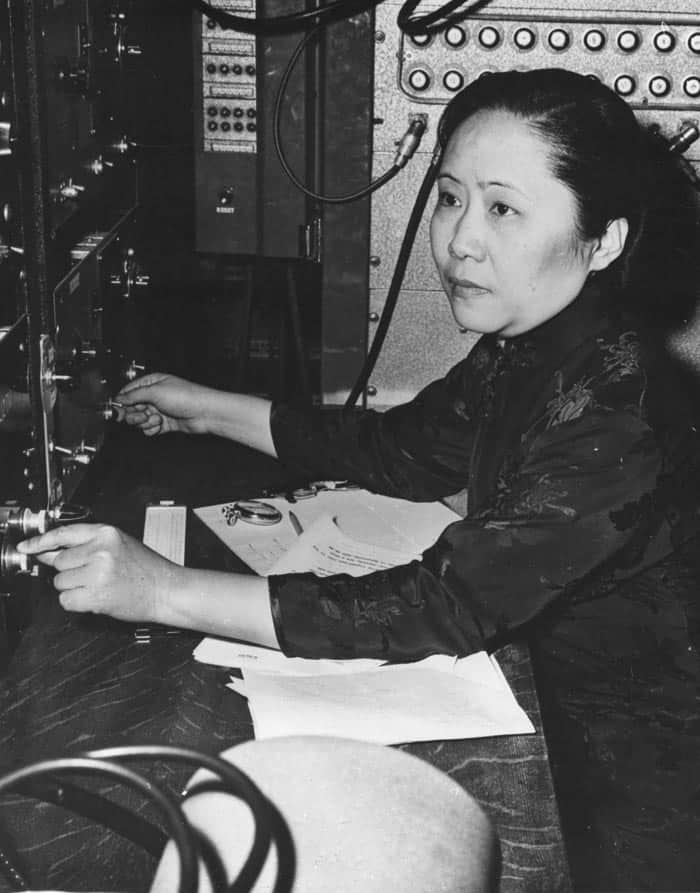
Role model Chien-Shiung Wu at Columbia University in 1963. (Courtesy: Smithsonian Institution Archives)
The notion that it was "the Wu experiment" was further strengthened by the fact that on the report about it Wu was listed as first author, followed by her affiliation, and then came the names of the NBS authors in alphabetical order, followed by their affiliation. This way of presenting the authors was suggested by the NBS team. In Ambler's correspondence with me he said "I invited her to go first in the list of names out of courtesy for having brought the preprint of Lee and Yang's paper prior to actual publication." Other NBS authors think that it was their courtesy towards a woman that made them suggest that her name be listed first, despite this being contrary to the usual NBS custom of following alphabetical order. Wu could have declined this honour had she felt it improper, but apparently she did not.
Furthermore, at no point in the report was it mentioned that the experiment was conducted at NBS. Even its terseness – with the paper comprising a mere two pages – does not justify this omission. This was a misleading oversight; having Wu as first author with her Columbia University affiliation, only the initiated could have known that the experiment might not have been carried out at Columbia. When soon after the event one of the NBS authors was giving a talk at Yale University, during the discussion of the experiment someone in the audience interrupted him to ask if that was the Columbia experiment. The speaker had to respond that yes, it was, but it was done at NBS!
The verdict
My view is that Wu made an outstanding contribution to bringing down the axiom of parity conservation in weak interactions. But to say it was an injustice that she did not win a Nobel prize is an oversimplification of a complex story. In spite of the widespread suggestion that it was discrimination against women that prevented her from sharing the Nobel prize with Lee and Yang, there is no indication in her life that suggests such discrimination. Quite the contrary: from very early on, she was highly respected and by the end of her career she had received an extraordinary number of prizes and other distinctions.
There are plenty of cases in the history of science when talented women were truly denied the opportunity to do research, to participate in university life or to receive proper recognition for their achievements. But Wu was certainly not one of these. She was a remarkable scientist and with her perseverance, her thirst for knowledge, her experimental skills and rigour, and her dedication to her students, she was – and will always remain – a wonderful role model for all young people aspiring to start a career in physics.
Who deserves the credit?
Leon Lederman
Experimentalist who, with Richard Garwin and Marcel Weinrich, submitted evidence of parity violation on 15 January 1957, in an interview with the author in 1997
"[Lee's and Yang's] work was certainly worth the prize. They asked the question. How do we know that parity is conserved?...The breakthrough was that they could consider that there are different forces and that different forces could have different symmetries. That was a tremendous insight."
Valentine Telegdi
Experimentalist who, with Jerome Friedman, submitted evidence of parity violation on 17 January 1957, in an interview with the author in 2002
"I don't think that anybody among the experimentalists deserves the Nobel prize very much in this case. If an experimentalist performs an experiment with known techniques and on top of it that experiment has been clearly suggested by the theorists, where is the merit? This is true for me, too."
Telegdi may not have known that it was actually Wu who had suggested the cobalt-60 experiment to Lee.
Nicholas Kurti and Christine Sutton
Cryophysicist (Kurti) and particle physicist (Sutton), then both at the University of Oxford, writing in a Nature commentary in 1997 (385575)
"At the time many people thought that there was no more to the experiment than for Wu to turn up at NBS and receive from Ambler and Hudson a cerium magnesium nitrate crystal doped with cobalt-60...The purpose of this note is to state for the record that the NBS parity violation experiment was a collaborative team effort in which nuclear physicists and cryophysicists pooled their knowledge and expertise to carry out an experiment proposed by Lee and Yang, thus confirming their hypothesis that parity is not conserved in β-decay."
Kurti and Sutton may not have known either that Wu had suggested the cobalt-60 experiment to Lee.
Val Fitch
Particle physicist who shared the 1980 Nobel Prize for Physics for discovering charge–parity violation, in an interview with the author in 2002
"There were four people...who did the cobalt-60 experiment and they all contributed to it in a major way. Ms Wu is often given the credit but I think that the most dispassionate view would be to recognize that those other guys were very important and it would not have happened without them."
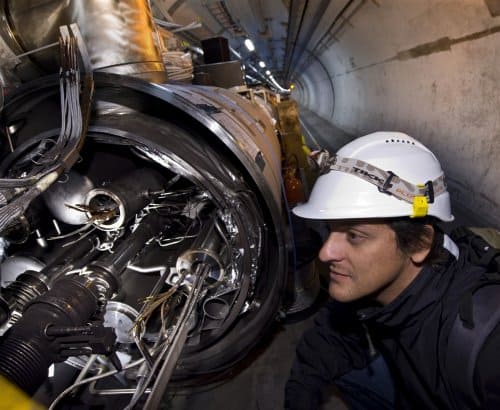
Looking under the hood at the LHC (Courtesy: CERN)
By Hamish Johnston
By all accounts the Large Hadron Collider (LHC) and its experiments are working much better than expected and are gathering data like gangbusters. So it might seem strange that many physicists at CERN are keen to shut the whole thing down for a 20-month overhaul. But that's going to happen at the end of February 2013, when the facility in Geneva will go dark.
One key change that must be made to the accelerator is the replacement of all the connectors between superconducting magnets to ensure that the LHC can run at a collision energy of 14 TeV – compared with the current energy of 8 TeV. This overhaul is seen as crucial because it was the failure of one of these connectors that led to the disastrous explosion of 2008.
Given that no evidence for physics beyond the Standard Model has emerged from the LHC so far, many physicists must be very keen to boost the collision energy in the hope that strange things will happen.
As the connectors are replaced, all four LHC experiments will be upgraded.
Physicists in the US and Germany have discovered yet another surprising property of the "wonder material" graphene – it displays a fractional quantum Hall effect (FQHE) that is different to that seen in conventional materials. The finding will be important for studying correlations among relativistic particles and may even help in the development of quantum computers in the future.
The FQHE occurs when charge carriers like electrons are confined to a 2D plane, as in graphene, and are subjected to a perpendicular magnetic field in the Z-direction. If a current flows in the X-direction, a voltage – the Hall voltage – occurs in the Y-direction. At very low temperatures, this voltage is quantized in distinct steps or Hall states.
Fractional charges
The FQHE is different from the better-known integer quantum Hall effect and is a result of strong interactions between electrons that occur in some materials. These interactions make the charge carriers in a FQHE material behave as quasiparticles with charge that is a fraction of that of an electron. These fractionally charged quasiparticles obey so-called fractional statistics, a feature that may be important for developing future quantum computers. In addition to the FQHE, these strong interactions often lead to important collective phenomena such as superconductivity, magnetism and superfluidity. Therefore understanding strong interactions is of fundamental importance in condensed-matter physics.
Graphene is a layer of crystalline carbon just one atom thick and is different from other materials in that its charge-carrying electrons whizz around at extremely high speeds, behaving like relativistic particles with no rest mass. Researchers have already shown that the relativistic charge carriers in graphene interact strongly with each other and that this phenomenon can be detected as the FQHE.
Unconventional sequence
Now, Amir Yacoby and colleagues at Harvard University and the Max-Planck Institute for Solid State Physics have shown that the FQHE in graphene is different to that in other materials. "We found an unconventional sequence of [fractional quantum hall] states in graphene, which are a consequence of the underlying symmetries in the material," explains Yacoby. "These states provide insights into the interplay between these symmetries and electron–electron interactions in graphene."
The researchers obtained their results by using a scanning single-electron transistor (SET) to probe samples of suspended graphene that were subject to an applied magnetic field. The SET is a special type of local probe that is particularly non-invasive, says team member Ben Feldman. It measures the presence of energy gaps in the electronic spectrum of materials with a sensitivity that no other technique can match and is therefore ideal for exploring phenomena like the FQHE.
"One other important finding of our research is that small regions of very clean graphene exist, even when macroscopic samples are relatively dirty," he says. "Studying graphene with local probes like ours may thus yield further interesting insights into graphene."
Studying electron–electron interactions
The experiments also back up the previous research, which showed that electrons in graphene interact strongly and that the resulting physics is very different to that observed in more conventional systems. "Graphene is therefore a promising material for studying electron–electron interactions," says Yacoby.
The team now plans to continue exploring the unusual FQHE in graphene. "We would especially like to better understand how the electrons are ordered in the various FQH states," he adds. "We are also interested in learning about the FQHE in related materials like bilayer graphene."
With Christmas coming up, for those of you looking for geeky and fun gifts for friends and family, here is one to add to your shopping list – Bletchley Park has officially launched a special edition Alan Turing Monopoly board. The new game-board is based on a unique board housed in the Bletchley Park Museum and hand-drawn by William Newman, son of Turing's mentor, scientist Max Newman, in 1950 and has been created by Winning Moves, which creates new editions of Monopoly.
Above is an image of the new board, and below is a copy of Newman's hand-drawn version. (Images courtesy Bletchley Park/ Winning Moves.)
In Turing's Monopoly, all the banknotes have Turing's face on them and instead of the usual London haunts occupying the squares, the board maps places of significant importance in Turing's life – for example, Bletchley Park and Kings College, Cambridge replace Mayfair and Park Lane, respectively – along with key elements of the original hand-drawn board, which the great mathematician played on with a young William in the early 1950s – and lost, according to Bletchley Park. The special edition also includes a copy of the hand-drawn board, complete with Newman's own rules, unseen pictures of Turing donated by his family as well as historical references for all the places mentioned.
"Bringing this board to life has been one of the most exciting and unique projects we've been involved with here, and we're thrilled to see it finally available for others to enjoy," says Iain Standen, head of the Bletchley Park Trust. "This edition really completes the fantastic story of the board, from it being played on by Turing (and his losing on it!), to it going missing and then being rediscovered and donated to the museum here. Of course, we're also very proud that Bletchley Park adorns the 'Mayfair' square!" Google bought the first 1000 special-edition boards as a donation to the Bletchley Park Trust.
So if you are hankering after some science Monopoly fun, you can pre-order your very own game from the Bletchley Park website here for £29.99, and take a look at the dedicated Facebook page here. Or make sure to put it on your Christmas wish-list – I know it's definitely on mine!
A surprising connection between quasicrystals and topological insulators has been demonstrated in the lab by physicists in Israel. The team has studied how light propagates through a 1D quasicrystal and found that it is similar to how electrons conduct in a 2D topological insulator. The surprising result suggests that quasicrystals could be used to create systems with dimensionality higher than 3D – something that could be useful both in studying fundamental physics and creating materials with new and useful properties.
A topological insulator is a material that is an insulator in the bulk but for reasons related to geometry is a conductor on its surface or edge. Perhaps the most famous example of a topological insulator is the integer quantum Hall effect (IQHE), whereby electrons on the edges of a 2D ribbon conduct electricity but no conduction occurs in the middle (or bulk) of the ribbon. Now Yaacov Kraus, Oded Zilberberg and colleagues at Israel's Weizmann Institute of Science have shown that a similar 2D topological effect can be seen in how light propagates in a 1D quasicrystal – suggesting that the quasicrystal actually has 2D topology.
The team performed experiments using 2D arrays of parallel waveguides. The separation between the waveguides is set so that some of the light propagating down one waveguide can leak into an adjacent waveguide, then into the next and so forth (see figure). If the movement of the light in the direction perpendicular to the waveguides is considered, it is similar to an electron moving through a 1D lattice with lattice spacing equal to the distance between the waveguides. The fact that the light "hops" from one waveguide to the next makes the system analogous to a model of electron conduction.
Sticking to the edge
In one experiment the team created a system in which the optical properties of the waveguides – and the spacing between them – are not identical. Instead, the structure is actually a quasicrystal described by the Aubry–André (AA) model. When a pulse of light is fired into a waveguide in the centre of the quasicrystal it spreads out to adjacent waveguides as it propagates through. However, when a pulse is fired at the waveguide at the left edge of the quasicrystal all the light remains in that channel, which the team say is a "clear signature of the existence of a localized boundary state".
In the next experiment the team focused on an effect called "adiabatic pumping", whereby light is transferred from one edge of a device to the other – a topological effect that is seen in materials that exhibit the IQHE. To see this pumping the team created a second quasicrystal based on a different version of the AA model. When a light pulse is introduced to a waveguide at the edge of the device the light migrates across the device with all of it ending up in the waveguide at the opposite edge (see figure). So once again, a 1D quasicrystal seems to behave in the same way as a system with 2D topology.
The physicists explain this curious behaviour by pointing out that the AA model contains a parameter that provides a mathematical description of the quasicrystal. This, they argue, can be thought of as an extra dimension – effectively boosting the topology to 2D.
According to Kraus, this discovery is exciting because it means that systems with topologies beyond 3D could be created using quasicrystals – something that would be a boon for fundamental physics. Also, it could be possible to use quasicrystals to create practical devices based on materials with specific topologies.
The team is now looking at how to create a 2D quasicrystal with 4D topology.
The Higgs boson...dark matter...nanotechnology...exoplanets...quantum computing...black holes. Physics is an incredibly exciting and diverse field. But with such vast quantities of information available these days (thanks to the Internet) you can sometimes feel like you're drowning in an ever-increasing flow of ideas, facts and figures. Sometimes, all you really want is a concise overview of a topic by someone who really does know what they are talking about. Our new series of videos on physicsworld.com could be the answer to your prayers.
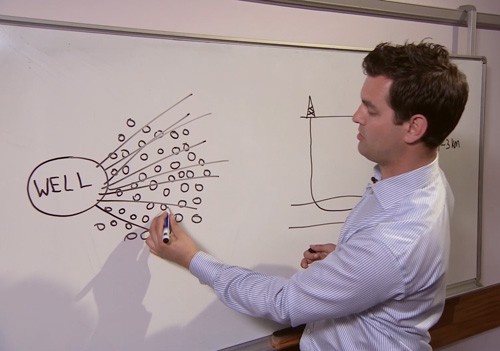
100 Second Science is a series of short films where, as the name suggests, scientists have up to 100 seconds to answer some of the biggest and most intriguing questions in physics. Presenters are armed with nothing more than a whiteboard and a set of marker pens, and we really are strict about the timing. In fact, when recording the films, presenters were faced with a countdown clock that sounded an alarm once their 100 seconds were up, making the experience that bit more exhilarating/nerve-racking.
Topics covered in our first batch of films cover a wide spectrum of physics and its related disciplines. Among the questions answered by specialists are "What is supersymmetry?", "How does quantum teleportation work?" and "How do you recognize a penguin in a crowd?". In filming and producing the videos we certainly learned a lot and we hope that you will too. And the scientists also appeared to take a lot from the experience. Several of them commented about what a vast departure it was from their usual experiences of presenting: standing in front of students and lecturing for an hour or so.
In the future, we hope to record more of these films. So if there are any questions or topics that you would really like to be addressed, then please send your ideas to pwld@iop.org.
The latest results from the Planck space telescope have confirmed the presence of a microwave haze at the centre of the Milky Way. However, the haze appears to be more elongated than originally thought, which casts doubt over previous claims that annihilating dark matter is the cause of the emissions.
A roughly spherical haze of radiation at the heart of our galaxy was identified as far back as 2004 by the Wilkinson Microwave Anisotropy Probe (WMAP). Since then, some astrophysicists have suggested that this haze is produced by annihilating dark-matter particles.
However, some researchers have questioned whether the haze actually exists at all, suggesting that it could be an artefact of how the WMAP data were analysed. Doubts were raised as to whether WMAP was capable of picking out this weak signal buried deep in emissions from galactic dust, the cosmic microwave background (CMB) and other noise from hectic regions of the galaxy.
It is definitely there
The argument now seems to have been settled by the latest results from Planck, a European Space Agency mission launched in May 2009. "Crudely speaking, we agree with all the WMAP results," explains Krzysztof Gorski of NASA's Jet Propulsion Laboratory in California, who is a member of the Planck team. "Planck is more sensitive, and has a greater frequency range, taking us into a realm that WMAP couldn't even see," he told physicsworld.com. One of the telescope's main objectives is to accurately map fluctuations in the CMB, so it is well suited to subtracting that radiation to reveal the haze.
With the presence of the haze independently verified, focus has returned to determining its origin. After its original discovery, some researchers, including Dan Hooper of Fermilab near Chicago, US, argued that annihilating dark matter could explain the galactic haze. Dark matter has long been thought to bind galaxies together, but detecting it directly has remained elusive. In Hooper's mechanism, dark-matter particles annihilate to produce conventional electrons and positrons. These particles then spiral around the Milky Way's magnetic field to produce the radiation we see as the microwave haze.
It still smells like dark matter to me
Dan Hooper, Fermilab
However, as well as confirming its existence, Planck was also able to reveal details of the shape of the haze. "The new results seem to suggest that the haze is elongated rather than spherical [as previously thought]," explains Hooper, who was not involved in the Planck research. "Simulations suggest that we would expect to find dark-matter halos that are roughly spherically symmetric," he adds. There might still be room for a partial dark-matter explanation, however. "Our opinion is that no single current model explains the haze's origin," admits Gorski. So Hooper is not giving up. "It still smells like dark matter to me," he says.
Related to Fermi bubbles?
The Planck observations also revealed a sharp southern edge to the haze. This implies that the formation mechanism is sporadic – if it were continuous, then the edges of the haze would appear diffuse. "The sharpness also implies that the haze might be related to the Fermi bubbles," says Hooper. The Fermi bubbles are two giant, gamma-ray-emitting structures extending 25,000 light-years above and below the centre of the galaxy. Spotted by the Fermi space telescope in November 2010, these bubbles also have sharp, defined edges pointing towards a rapid release of energy as their cause, rather than a continuous, steady process.
It is possible, then, that the two phenomena have a common origin. "There may be some mechanism crossover between the haze and the bubbles," says Andrew Pontzen, a theoretical cosmologist at the University of Oxford in the UK. "The next step would be to see exactly how much overlap there is in the data," he adds. Any areas where the two phenomena do not overlap still leaves the door open for dark matter to play a part. "Maybe the cause [of the haze] is a mixture of dark-matter annihilation and other mechanisms," Hooper adds.
Whichever explanation turns out to be correct, the Planck results have focused the argument. "Observationally, this is a great step forward," Pontzen says. "However, the centre of the galaxy remains an intrinsically complicated place where a plethora of strange things are going on," he adds. In the end, it might take Planck's successors to settle the debate.
The Planck results are presented in a preprint on the arXiv server.
Physicists in the US say they are the first to directly observe single-atom interference over distances much greater than the atom's coherence length. The experiment involves using optical tweezers and a sequence of laser pulses to "bounce" the atom along two different paths that meet up after about 1 ms. The team says that if the precision of the experiment can be improved, it could provide new information about the possible existence of non-Newtonian gravity at micron distances. The researchers say the technique could also be used to study the tiny force that arises between an atom and a conducting surface, dubbed the "Casimir–Polder effect".
In the strange world of quantum mechanics, an atom can exist in a superposition of two or more trajectories until a measurement is made of its position or momentum. This property can be exploited in a matter–wave interferometer, whereby – strange though it may sound – a single atom can simultaneously follow two different paths to a detector. Forces on the atom will cause a relative phase shift between the two paths, resulting in a shift in an interference pattern created where the two paths meet.
Such experiments have been carried out before using large ensembles of atoms, effectively creating pulses of atoms that travel along each path. The atoms then create an interference pattern at the detector, which can be measured and used to infer the gravitational constant or to look for deviations from Newton's theory of gravitation. Until now, however, it has not been possible to carry out matter–wave interference by sending just single atoms through the apparatus because most pulsed-interferometer experiments rely on high atomic throughput to boost the signal at the detector and therefore lack deterministic control at the single-atom level.
Controlling single atoms
The new, single-atom matter–wave technique has been developed by L Paul Parazzoli, Aaron Hankin and Grant Biedermann at Sandia National Laboratories in New Mexico. Their technique differs from earlier experiments in that each atom begins and ends its journey in optical tweezers – laser light that is focused to a small region in which the atom is held.
The Sandi researchers used a cloud of ultracold caesium atoms that are trapped and cooled to 4.2 μK using a combination of laser light and magnetic fields. They then created optical tweezers in the gas that can hold just one atom, before firing a laser pulse at the atom to place it in a specific quantum state. The optical tweezers were then switched off, letting the atom go into freefall.
Kicked up and down
The atom was then subjected to a sequence of light pulses separated by 500 μs. The first pulse puts the atom into a superposition of two states – one that has received an upward photon kick that causes it to rise up, and one that is falling because it has received no kick. The second pulse then either knocks the rising atom downwards or kicks the falling atom upwards – the result being two trajectories that will merge at a point in time 500 μs later where a third laser pulse causes their paths to overlap. When the states merge, the tweezers are switched back on and the quantum state of the atom is measured.
The entire process is then repeated hundreds of times to determine the phase shift between the two paths and thus the gravitational force on the atom at a level of 3 × 10–27 N.
Parazzoli, Hankin and Biedermann were able to see a clear interference pattern emerge when the relative phase of the pulsing lasers was adjusted, hallmarking the self-interference phenomenon of single atoms. In their experiments, the separation between the two atomic states was as large as 3.5 μm, which is more than 200 times greater than the coherence length of the atoms used. As a result, the team claims that its is the first demonstration of "free space" single-atom interference – with free space referring to the fact that the atom is unbound, allowing for its states to separate in space.
"Really cool"
Paul Hamilton of the University of California, Berkeley, who was not involved in the work, told physicsworld.com that the Sandia researchers "demonstrate full interferometry and show a very impressive long-term stability". He also calls the experiment "a really cool textbook demonstration of single-atom interference".
Because the technique employs one atom at a time, the Sandia team believes that it could be used to make extremely localized measurements of forces very near to surfaces, such as the Casimir–Polder force that occurs between an atom and a conducting surface. Like the more familiar Casimir force, this force arises from the zero-point energy of the vacuum and has implications for the design and operation of micron- and nanometre-sized mechanical devices.
The team also claims that if the sensitivity of the technique can be improved by two orders of magnitude, it could be used to place new constraints on theories of non-Newtonian gravity at micron-length scales. Indeed, if gravity is found not to be Newtonian at such tiny distances, it could provide important clues about how the theory of gravity could be unified with the Standard Model of particle physics. "This type of interferometer has shown absolute calibration in other cases, a characteristic that would be very useful for detecting departures from the inverse square law at micron-length scales," says Parazzoli.