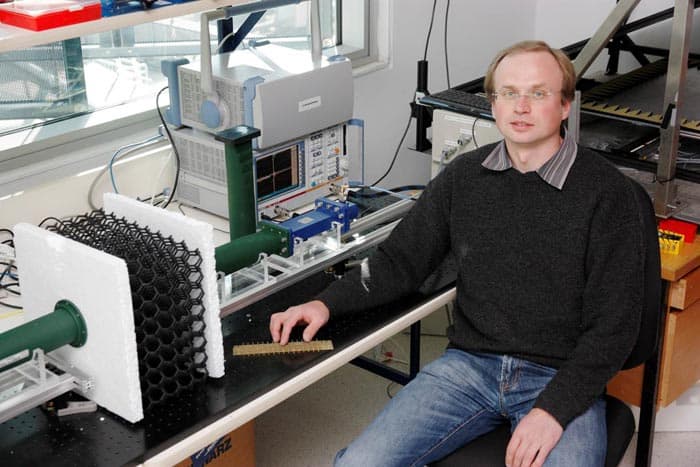
Lessons learned by leading OPERA man

Defending scientific integrity

Ereditato, who is still a member of the OPERA group, defends the scientific integrity of the collaboration but admits he was “naive” in estimating the scale of the response this scientific result would generate beyond the physics community. He argues that scientists, the general public and the media all need to learn from this episode to improve the process of science communication in the future.

What is molecular gastronomy?

In less than 100 seconds, Peter Barham explains how fundamental science can help to produce delicious food.

Power cell generates and stores energy in one step

Researchers in the US have created a power cell that directly converts mechanical energy to chemical energy, which can then be stored and converted to electrical energy upon demand. This new system is unlike other similar technologies that first convert mechanical energy to electrical energy, which is then stored chemically. By skipping the intermediate conversions, the team says that the system is more efficient. If the technology could be further improved, it could be used, for example, in the sole of a shoe, where it could charge a mobile-phone battery while the wearer is walking.

We are using an increasing number of portable electronics every day and keeping all these devices charged can be a challenge. This is particularly difficult for infantry soldiers, who can operate for long periods of time away from reliable sources of electricity and therefore have to carry large numbers of batteries to keep communications, GPS and other devices running. As a result, researchers around the world are working on systems that can generate electricity from routine body motion. Footwear is an obvious place to start because soldiers do lots of walking and a small amount of energy could be extracted from each step by placing a generating device in the sole of a boot or shoe.

Hybrid approach

Several different approaches to shoe power are already in development, and now Zhong Lin Wang and colleagues at the Georgia Institute of Technology have created a new technology in which generation and storage occurs within a single unit.

Their cell comprises a cathode made of lithium cobalt oxide and an anode of titanium-dioxide nanotubes that are grown perpendicular to a titanium surface. The electrodes are separated by poly(vinylidene fluoride) (PVDF) film, which is a piezoelectric material. When the cell is compressed, the PVDF creates a piezoelectric charge, which drives lithium ions from the cathode to the anode. This converts electrical energy to chemical energy, which is stored in lithium titanium oxide. When the compressing force is removed, the cell relaxes but the chemical energy remains stored. More energy can then be stored in successive compression cycles. This energy can then be retrieved as electrical energy by connecting an electrical load between the anode and cathode, allowing the lithium ions to flow back to the cathode, and the device is ready to be charged again.

Powering a calculator

Using repeated compressions at a frequency of 2.3 Hz, the team was able to increase the voltage across the cell by about 60 mV in 4 min. The cell could then deliver a 1 mA current for about 2 min. While this represents a tiny amount of energy when compared with what is needed to charge a mobile-phone battery, the team used several cells connected in series to run an electronic calculator for about 10 min.

To show that their integrated design was more efficient than separate generation and storage, the researchers also created devices in which similar components were used to first generate electrical energy and then use that energy to move ions in a separate cell. Such a system developed less than 5 mV in 4 min when subjected to the same compressions.

While the technology is still in a very early stage, Wang believes that there are several ways that its performance can be boosted. For example, the researchers believe that most of the mechanical energy of compression is being dissipated in the cell's coin-like steel shell, rather than in the PVDF film.

"When we improve the packaging materials, we anticipate improving the overall efficiency," explains Wang. "The amount of energy actually going into the cell is relatively small at this stage because so much of it is consumed by the shell."

The research is reported in Nano Letters.

Pulsar timekeepers measure up to atomic clocks

An international team of astronomers has come up with a new way of keeping track of time by observing a collection of pulsars – rapidly rotating stars that emit radio pulses at very regular intervals. Although the ultimate goal of the research is to use pulsar timing to detect gravitational waves, the group has shown that the pulsar-based timescale can also be used to reveal inconsistencies in timescales based on atomic clocks.

Pulsars are neutron stars that rotate at very high speeds and appear to emit radio pulses at extremely regular intervals. The pulses are actually all we see of a radio beam that is focused by the star's magnetic field and swept around like a lighthouse beacon. Using a radio telescope, astronomers can measure the arrival times of successive pulses to a precision of 100 ns over a measurement time of about an hour. While this level of precision is significantly less than that offered by an atomic clock, pulsars could in principle be used to create timescales that are stable for decades, centuries or longer. This could be useful for identifying fluctuations in Earth-based timekeepers such as atomic or optical clocks, which normally do not operate over such long periods.

The team, which is led by George Hobbs at CSIRO Astronomy and Space Sciences in Australia, looked at data from the Parkes Pulsar Timing Array (PPTA) project. Using the Parkes radio telescope in Australia, the project aims to use a set of about 20 pulsars in different parts of the Milky Way to detect gravitational waves. The idea is that when a gravitational wave passes through our galaxy, its presence warps space/time such that the millisecond gaps between the pulses arriving from various pulsars are affected in a very specific way.

Extremely precise timescale

In developing the PPTA, Hobbs and colleagues in Australia, Germany, the US and China realized that the timing data from a number of pulsars could be combined to create an extremely precise timescale stretching back to the mid-1990s. A timescale is a sequence of marks in time, each separated by a defined time interval. The most precise timescales available today are generated by atomic or optical clocks, which operate using the frequencies of certain atomic transitions.

The team made a timescale based on 19 pulsars by first correcting the data from each pulsar for a number of different things that can affect the measurement of the gap between pulses. These include instrumental effects, the motion of the Earth within the solar system and the effects of interstellar plasma. Also, the frequency of a pulsar drops slowly with time as rotational energy is radiated away, and this must be corrected for.

The team then combined the data from the 19 pulsars to create the Terrestrial Time PPTA11 or TT(PPTA11) timescale, where 11 signifies that the most recent data used are from 2011. To show how their new timescale could be used to evaluate timescales generated by atomic clocks, the researchers compared it with Terrestrial Time (International Atomic Time) – TT(TAI). This is a timescale that is created by combining the results of several hundred atomic clocks worldwide. TT(TAI) is never revized, and therefore provides a historical record of the performance of atomic clocks. Instead, the atomic-clock timescale is gently "steered" towards better timekeeping through revision and reanalysis of the time standard.

Looking for deficiencies

If the new pulsar timescale is indeed precise, it should be able to reveal historical deficiencies in the atomic-clock timescale – and this is exactly what the team was able to do. The researchers compared the two timescales going back to about 1994 and found a distinct departure at around 1998. The team also did a similar comparison between the atomic-clock timescale and a corrected version of Terrestrial Time that is produced annually by the International Bureau of Weights and Measures – TT(BIPM11). The researchers saw the same distinct departure at around 1998, which suggested that, like TT(BIPM11), the pulsar-based timescale is capable of revealing inconsistencies in atomic-clock-based timescales.

The similarity between TT(PPTA11) and TT(BIPM11) also allowed the team to conclude that there are no large unexpected errors in TT(BIPM11). Furthermore, the results corroborate previous research, which concluded that the TT(TAI) timescale is not sufficiently precise to be used for pulsar-timing applications such as the detection of gravitational waves, and that TT(BIPM11) should always be used in such applications.

Team member David Champion at the Max Planck Institute for Radioastronomy in Bonn told physicsworld.com that the next step in developing the timescale is to incorporate pulsar data from other radio telescopes that were obtained over the same time period.

Proof of principle

Setnam Shemar of the Time and Frequency Group at the UK's National Physical Laboratory described the work as "proof of principle that PPTA data can be used to find anomalies in some present-day atomic timescales". While he thinks it is possible that a pulsar-based timescale could outperform the best present-day atomic timescale over long times, Shemar says that it is too early to tell. Indeed, he points out that if improvements in atomic and optical clock technologies outpace improvements in pulsar timing, as he expects to be the case, a pulsar-based timescale may in future be more useful in a search for gravitational waves than a means for checking atomic timescales.

The research will be published in Monthly Notices of the Royal Astronomical Society and a preprint is available on arXiv.


Celebrating 50 years of the diode laser

By Hamish Johnston

Semiconductor diode lasers are everywhere. They created the light pulses that raced along the fibres between our server and yours – allowing you to read this article – and if you stop at the supermarket on the way home, their light will read the barcodes on your purchases.

diode laser.jpg
A few years ago I would have also pointed out that CD and DVD players rely on diode lasers, but those once-revolutionary technologies have already become passé while diode lasers have gone on to new and exciting applications such as healthcare.

So what does the image on the right – which looks more like a bent paperclip than a state-of-the-art laser – have to do with this revolutionary technology? It is the first diode laser (also called an "injection laser") and was made in 1962 at the Lebedev Institute in Moscow. The institute was home to a group of scientists formed in 1957 by Nikolay Basov with the aim of creating a semiconductor laser. The team succeeded, and Basov's pioneering efforts in the development of lasers earned him a share of the 1964 Nobel Prize for Physics – along with his institute colleague Aleksandr Prokhorov and Charles Townes of the Massachusetts Institute of Technology.

One member of Basov's team was Yuri Popov, who is still at the institute and who has written a historical account of the group's effort for a special issue of the journal Semiconductor Science and Technology – published by IOP Publishing, which also produces Physics World.

As well as historical papers documenting the development of the diode laser, the special issue also contains a number of invited papers that look at a range of contemporary research, including quantum-dot-based lasers and cascade lasers for the generation of terahertz radiation.

And if you can't get enough about diode lasers, the Institute of Physics is putting on a conference in Leicester in September called The Celebration of the 50th Anniversary of the Diode Laser.

What is supersymmetry?

In less than 100 seconds, Helen Heath explains why SUSY is so beautiful.

What is dark energy?

In less than 100 seconds, Luke Davies explains how we know dark energy exists.

Metamaterial switches on to the tune of light

An international team of researchers has created the first metamaterial where its properties can be controlled with light. The material – made of metallic resonators with electronic circuits incorporating photodiodes – might find use in radar and communications applications, say the researchers.

Metamaterials, which were first made around 10 years ago, are artificial sub-wavelength patterned structures containing arrays of tiny elements such as rods and rings that respond to light and other electromagnetic waves in unusual ways. For example, a metamaterial can be designed to have a negative refractive index so that it bends light in the opposite direction to normal materials. Such a unique property means that metamaterials have already been used to make "superlenses" that are able to focus light to a point smaller than its wavelength, allowing optical microscopes to view much smaller objects than is possible today. They can also be used to make "invisibility cloaks" for electromagnetic waves.

Light sensitive

Up to now, however, most metamaterials had fixed architectures and their properties could not be tuned across the structure. A team led by Ilya Shadrivov and Yuri Kivshar, from the Australian National University and the University of Information Technologies, Mechanics and Optics in Russia, has now come up with a new idea that overcomes this problem. The researchers decided to build a metamaterial lattice not just with simple metal tracks as in previous experiments, but one that contains electronic circuits incorporating light-sensitive photodiodes.

"The voltage generated by this photodiode when it is illuminated with light can be used to change the resonance of the metamaterial structure," explains Shadrivov. "This means that we can control the refractive properties of the structure at will and bend the microwave light beams passing through the material in whichever direction we like."

Illuminated array

The metamaterials used in this study were made in much the same way as a conventional printed circuit board with a lattice of engineered copper tracks. In this case, the tracks comprise 24 so-called broadside-coupled split-ring resonators (SRRs) placed in front of a metallic screen. The components in this structure interact with microwaves like ordinary glass atoms in a lens interact with light. The SRR itself is made of two broken copper rings placed on the opposite sides of 1.6 mm printed circuit board. The inner radius of the SRR is 3.25 mm, the width of the metal strip is 0.5 mm, the copper thickness is 30 μm and the gap between them is 1 mm. Each ring has an extra gap of 0.4 mm in which an electronic circuit with photodiodes is placed. These diodes generate a voltage that increases as the intensity of the incoming light increases.

"Our set-up also allows us to change the properties of the metamaterial non-uniformly by illuminating the array with light beams of varying intensities," says Shadrivov. "This concept of being able to tune a metamaterial's optical properties could potentially be used to make reconfigurable satellite dishes or reflectors for antennas that can operate at different light wavelengths," he told physicsworld.com. "We could change the properties of such a dish (for example its focal length or reflectivity) without changing its physical shape in any way and could, for instance, create a satellite dish that is not a dish at all but a flat disc."

Such structures might also be designed to become strong absorbers of light or they could be used to make the first invisibility cloaks that are fully reconfigurable. "These devices might find use in both military and civilian applications," he adds.

The research is published in Physical Review Letters.

What steps have you taken to pursue your career in physics?

By Margaret Harris
Thumbnail image for Thumbnail image for hands smll.jpg

In last week's Facebook poll, we asked for your views on the most important criterion for choosing a postdoc position. The results weren't quite what I had expected. While it makes sense that "institutional resources" came out on top – you can't do much experimental physics without lab space and equipment, and theory is certainly easier if you've got a good bunch of colleagues – I was surprised by how much it outpaced the other poll options. A whopping 65% of voters rated "institutional resources" as the most important factor, with "prestige" of the supervisor and institution coming a distant second and third at 17% and 13%, respectively.

But the thing that really puzzled me was the low emphasis placed on "location", which picked up a measly 5% (three votes out of 63). Are physicists really not that fussy about where they go to do postdoctoral research?

To find out, I've constructed this week's Facebook poll so that it focuses on mobility – both geographic and intellectual.

What steps have you taken to pursue your career in physics?

Moved to a new location (less than 500 miles away)
Moved to a new location (more than 500 miles away)
Changed my field of research or expertise
Switched to a different sector (e.g. from academia to industry)
Two of the above
Three or more of the above

Have your say by visiting our Facebook page, and please feel free to explain your response or give us more suggestions by posting a comment below the poll or by e-mailing us at pwld@iop.org.

How does quantum teleportation work?

In less than 100 seconds, John Rarity explains why it is tricky to copy quantum information.

Copyright © 2026 by IOP Publishing Ltd and individual contributors