What is the most important criterion when choosing a postdoc position?

By Tushna Commissariat

We’re taking a slightly different tack with our Facebook polls over the next few weeks, with a series of polls focused on careers. More specifically, we’re after your views on postdocs – that crucial stage of an academic physicist’s career that lies between earning a PhD and finding (or, in many cases, not finding) a permanent academic post.
Thumbnail image for Thumbnail image for hands smll.jpg

This is a topic that’s been in the news a lot lately, with a growing number of voices arguing that there is something seriously wrong with an academic career path that supports large numbers of PhDs and postdocs but produces very few permanent or tenure-track academic jobs for them to move into. We’ll look into that a bit more over the next few weeks, and if you have a personal experience of postdoc-hood – good or bad – that you’d like to share, please get in touch via pwld@iop.org. For this week’s Facebook poll, however, we’ve got a comparatively simple question that anyone – not just postdocs – can answer.

What is the most important criterion when choosing a postdoc position?

Location
Institutional resources
Prestige of supervisor
Prestige of institution

Have your say by visiting our Facebook page, and please feel free to explain your response or give us more suggestions by posting a comment below the poll.

Last week we asked you which planet from our solar system, apart from the Earth, you find the most captivating. Unsurprisingly, Mars came out on top with about 38% of votes, followed by 20% for Jupiter, 14% for Venus, and 12% for Saturn, while 10% of you felt that exoplanets are a much more interesting option. Sadly, Uranus got only four votes, Neptune three votes and Mercury just the one vote. So it looks like Mars is still captivating Earth.

Thank you to everyone who took part and we look forward to hearing from you again in this week’s poll.

Giving physics some soul

The Congregation


The Congregation performing live (Hooper is fourth from right). (Courtesy: D T Kindler)


By Michael Banks

It seems as if Fermilab physicist Dan Hooper has finally hit the big time. Not for his latest theory on the Higgs boson or dark matter but rather through his involvement in the soul band The Congregation.

Guitarist Hooper formed the band about three years ago and it now consists of a drummer, bass player, singer, horn player and keyboard player.

On 9 August the “60s-era soul band” opened a joint gig by the US rock bands Garbage and the Flaming Lips in Madison, Wisconsin. “The show went great – although we did get some rain,” Hooper told physicsworld.com. “We were well received, and had a great time.”

Not resting on their laurels, the band is getting ready to release its latest album on 28 September. Right Now Everything will be available to buy on the band’s website.

Hooper, who goes by the stage name Charlie Wayne and who also writes the band’s lyrics, says that the band steers clear of anything physics related, as well as any rock-band antics. “We don’t do a lot of smashing guitars and such anymore,” says Hooper.

So will the band’s success force Hooper to give up his physics career? “I can’t imagine doing that,” he says. “Doing physics is the best job someone like me could have – even compared with playing rock and roll for a living.”

First room-temperature maser developed

British researchers have, for the first time, built a prototype solid-state maser that works at room temperature, with no permanent applied magnetic field. Masers, which do the same thing with microwave radiation that lasers do with visible light, have not become widely used thanks to their difficult operating conditions – some require cryogenic refrigeration or vacuum chambers and sometimes strong magnetic fields. The researchers claim that their device could have a range of applications in the future – from the detection of explosives to detecting the atomic states of atoms in quantum computing.

Extreme conditions

There are two basic types of masers. Atomic and molecular masers were the first type to be invented back in 1958. They require bulky vacuum chambers and can only emit very low powers. The second and more useful type – solid state masers – exploit transitions between spin states of paramagnetic ions in a solid crystal. They are far more powerful and can produce perhaps the most sensitive, low-noise detectors of faint microwave signals yet developed. Unfortunately, to sustain the necessary population inversion in a conventional solid-state maser requires liquid-helium refrigeration, usually accompanied by a strong DC magnetic field.

The need for these extreme conditions has meant that, while NASA has been willing to invest in maintaining solid-state masers to receive the faint signals transmitted by the Voyager space probes, more everyday applications have been ruled out. “For example, you could use a maser to improve the accuracy of an airport body scanner,” says lead author Mark Oxborrow of the National Physical Laboratory in Teddington, UK, “but that would increase the cost of the device considerably. So I think there are many applications that have just been rendered impracticable by the requirement of cryogenics.”

New operating mechanisms

Oxborrow and colleagues at Imperial College London produced their maser by substituting a soft polymer – p-terphenyl doped with pentacene – for the usual crystalline ruby as the gain medium. In addition, instead of pumping it with a microwave source, as is traditional for a solid-state maser, they used a 585 nm medical laser designed for the treatment of vascular lesions. These changes allowed them to utilize a phenomenon known as “spin-selective intersystem crossing”, which had never been used in a maser and is still not completely understood, to sustain the population inversion in the absence of cryogenic temperatures or a strong, permanent magnetic field. “It is not just that we have taken the traditional technology and just improved things in various directions to get it to work at room temperature.” explains Oxborrow. “The operating mechanism of our room-temperature maser is completely different from the conventional solid-state maser.”

Impressive but potentially problematic?

Aharon Blank, a chemist at the Technion-Israel Institute of Technology in Haifa, Israel, who was part of a previous, unsuccessful project 10 years ago to develop a room-temperature solid-state maser, is impressed by the research. However, he points out a number of aspects of the design that could potentially prove problematic. First, although the device can operate at zero field, a magnetic field is required to tune the magnetic field at which it operates. While inconvenient, he does not believe this would prove fatal for a commercial device based on the technology. “There are commercial devices in use today that use a static magnetic field to vary the frequency,” he says, “so that is not a major problem.”

One problem, however, is serious. At present, like the first lasers, the device is only capable of operating in pulsed rather than continuous mode. Masers are used mainly to detect and amplify very faint incoming microwave radiation, and the uses of a detector that cannot stay continuously on are limited. On the flip side, Oxborrow suggests that it could be used to listen for radar echoes, for example. The team are currently experimenting further with their device to ascertain whether or not it can be made to operate in continuous form and, if so, how this can be achieved.

The research is published in Nature.

What is antimatter?

In less than 100 seconds, Helen Heath explains why some particles have equal but opposite partners.

How do you recognize a penguin in a crowd?

In less than 100 seconds, Peter Barham explains how penguins possess unique coats.

Colour printing hits ultimate resolution

Researchers in Singapore have developed an innovative inkless printing method that uses metal nanostructures to build sharp full-colour images at a resolution of 100,000 dots per inch (dpi) – 10 times the current best resolution. Scaled up, the technique could find applications in anti-counterfeiting, high-density optical data storage or in transmitting hidden messages.

Even with today’s best optical microscopes, there is a hard resolution limit – half the wavelength of the light used for imaging – that dictates how close two juxtaposed colour pixels can be while still being distinguishable from each other. Any closer than this “optical diffraction limit” and the light reflecting from the two elements diffracts, overlaps and the colours blur into one.

For mid-spectrum visible light of about 500 nm, colour pixels are bound by the optical diffraction limit to a minimum size of 250 nm – or a resolution of about 100,000 dpi. But even the best industrial inkjet and laserjet printers struggle to achieve resolutions one-tenth that fine, because of their micron-scale ink spots.

Stained-glass inspiration

Recently, nanotechnologists have looked to the medieval art of glass staining for inspiration. Here, metal-dust additives create characteristically vivid colours when light hits the metal particles and certain wavelengths are absorbed to excite plasmons – coherent oscillations of conduction electrons on the metal’s surface. Based on this knowledge, reflective metal films dotted with selective light-transmitting holes have already been successfully used to make micron-sized colour pixels, but no one has hit upon a method to shrink them any further, until now.

Finely tuned reflectors

Karthik Kumar and colleagues from Singapore’s Agency for Science, Technology and Research combined the idea of nanohole reflectors with another tried-and-tested idea – arrays of isolated metal nanoparticles that absorb or reflect different wavelengths of light according to their diameters. Using electron-beam lithography, they etched silicon-oxide pillars, tens of nanometres wide, on top of a silicon substrate. Next they used a metal evaporation technique to deposit an ultrathin film of plasmonically active silver (15 nm) and gold (5 nm) on to the tips of the pillars and the substrate.

The raised nanodiscs were arranged two-by-two on the back reflector, in pixels measuring 250 nm. Different colours were encoded into each pixel by altering the diameter of the nanodiscs (from 50–140 nm) and the distance between them (30–20 nm). By tweaking the diameters of the discs, the researchers were able to control the frequency of the plasmon resonances across their surfaces – in much the same way that altering the length of a violin string alters its resonant frequencies – and thus control which wavelengths of light were removed from the incident light and which were reflected.

“The distance between the structures also seems to make a difference in what we think is the two structures coupling with one another,” explains Kumar. “Basically they seem to be talking to each other at these small distances, and that is why we also see that we need to have a small group of these structures in order to be able to see the colours effectively.”

Striking demonstration

In demonstrating their novel technique, the team perfectly reproduced the “Lena test image” – a cropped image of a 1972 Playboy centrefold used extensively as an image-processing standard – in all her detailed colour and tone, small enough to fit on a human cell – just 50 µm across.

“[We] built a database of colour that corresponded to a specific nanostructure pattern, size and spacing. These nanostructures were then positioned accordingly,” explains co-author Joel Yang, also from the Agency for Science, Technology and Research, adding that the colours appeared “all at once, almost like magic” when the metal film was applied.

“With the ability to accurately position these extremely small colour dots, we were able to demonstrate the highest theoretical print-colour resolution of 100,000 dpi,” says Kumar. “As far as we could see, we were getting all the colours of the rainbow,” he adds, although mixing in different amounts of other metals such as gold should provide more of the warm red and yellow hues.

Prospects and applications

Possible applications of the technology range from security tags and secret messages, to high-density optical data storage along the lines of Blu-ray discs. According to Kumar, “Reflector colour displays – something like a Kindle in colour should be possible for this technology as well.”

The team has already tried substituting the silicon oxide for quartz, and are now investigating various polymers and alternative lithography techniques that might make the whole architecture easier and more economical to mass-produce.

The research appears in Nature Nanotechnology.

Further proof of extraterrestrial origin of quasicrystals

An international team of researchers has found nine new samples of naturally occurring quasicrystals. The work also provides further proof that quasicrystals were delivered to the Earth by a meteorite. The team’s discovery challenges our understanding of both crystallography and solar-system formation.

Conventional crystal structures are made of atoms, or clusters of atoms, that repeat periodically. These patterns are normally restricted to two, three, four or sixfold rotational symmetry – the numbers corresponding to how many times the crystal appears the same during a rotation through 360°. For a long time these were considered hard and fast rules, and no crystals that broke these conditions were thought to exist.

Ordered, but not periodic

However, Israeli physicist Daniel Shechtman found just such a rule-breaking crystal in 1984 and was awarded the 2011 Nobel Prize for Chemistry for his efforts. Shechtman had discovered a quasicrystal – a crystal that, while ordered, does not contain structures that repeat periodically. Schectman’s crystal also had 10-fold rotational symmetry. Even after his discovery, there was a lot of scepticism about the existence of such a material. But as the years went by, other physicists began to construct quasicrystals of their own and now more than 100 different types have been found. These, however, are synthetic and have been created under precisely controlled laboratory conditions. Just as it was originally assumed that quasicrystals could not exist, after their discovery it was assumed that they could not exist naturally in the wider world.

That assumption was called into question in 2009 when Princeton University’s Paul Steinhardt – the man who originally coined the term “quasicrystal” – appeared to have discovered a naturally occurring variety in a rock sample from Russia. Steinhardt and his colleague Luca Bindi, from the University of Florence, Italy, measured the ratio of oxygen isotopes within the sample and their results suggested that the rock belongs to a class of meteorites known as carbonaceous chondrites. Not only did this rock contain a naturally occurring quasicrystal, it also came from outer space.

Thrilling past

But the scepticism that had followed quasicrystals around since their discovery continued. The rock sample was traced back to Valery Kryachko, a Russian who in 1979 had been panning for platinum in a stream flowing through the Koryak mountains in far-eastern Siberia. The rock had somehow turned up in Bindi’s museum collection in Italy. “People were sceptical of the rock’s back story as the tale of how it got to Florence involves secret diaries, smugglers and KGB agents,” Steinhardt told physicsworld.com.

“The only way to settle the debate was to take a shot at finding more samples,” Steinhardt explains. He put together a team of 10 scientists, two drivers and one cook and set out on a four-day expedition across Siberia back to the stream where Kryachko had found the original sample. Once there, they panned 1.5 tonnes of sediment from the stream bank, eventually isolating a few kilograms for analysis.

After six weeks of painstaking grain-by-grain analysis, they hit on something special. “We found a grain with a fleck of metal on it. Not only did it contain quasicrystals, but the oxygen-isotope ratio was exactly the same [as the original sample],” says Steinhardt. “It was an incredible moment. Out in the field, no-one bet on a more than 1% chance of successfully finding anything,” he adds. The team isolated a total of nine quasicrystal samples. It is thought these samples all come from the same meteorite, and analysis of the sediment layers suggests it landed within the last 15,000 years.

Extreme formation

As the quasicrystals come from a carbonaceous-chondrite meteorite, they must have formed in the earliest days of the solar system. Carbonaceous chondrites are thought to have collided together to form the cores of the rocky planets, and so Steinhardt’s quasicrystals are older than the Earth itself. However, current models cannot account for the presence of these quasicrystals. “We need a novel kind of geological process to form them and so it challenges our ideas of solar-system formation,” Steinhardt says.

The intense conditions present in the solar system’s youth also challenge the prevailing view of quasicrystals as objects that need a carefully controlled laboratory set-up to produce. “Quasicrystals are not the delicate materials previously thought. The ones we found must have been formed under robust and hardy conditions in the early solar system,” Steinhardt says.

Others agree that the world of quasicrystals could be changed by this 10-fold increase in the number of known naturally occurring examples. “This result emphasizes how normal quasicrystals are and will hopefully make them less of an eccentricity,” Renee Diehl, a surface physics researcher at Pennsylvania State University, US, told physicsworld.com. “It opens our eyes to the fact that they may have been all around us and we just have not noticed,” she explains.

The research is published in Reports on Progress in Physics.

Why would quantum computers be so much faster than classical computers?

In less than 100 seconds, John Rarity explains how quantum mechanics could speed up computing exponentially.

Photon shape could be used to encode quantum information

An international team of researchers has succeeded in measuring the shape of individual photons for the first time. The result could prove extremely useful for secure data transmission using light.

Pulses of light can have almost any shape in space and time, and these shapes depend on the amplitudes and phases of the pulse’s frequency components. Data can be encoded in light pulses by modulating the amplitude or phase of the light. Single photons and other quantum light states can also be generated in a variety of complex shapes and encoding information in these different shapes could be an efficient way to securely transmit data. Indeed, a single photon shape could represent, for example, any letter in the alphabet, or even a quantum combination (or superposition) of several letters.

However, the problem is that once a photon has been sent through apparatus – such as an optical fibre – its shape can become distorted and the information contained within becomes impossible to decipher. A team led by Marco Bellini of the Istituto Nazionale di Ottica in Florence, Italy, and colleagues have now managed to measure the precise shape of the mode of a quantum light state that appears at the receiving end by means of a “mode-selective” detector.

Evolutionary algorithms

The method is based on evolutionary algorithms commonly used in femtochemistry experiments and biology that optimize a particular experimental outcome by adjusting a set of initial parameters. “What is new in our work is that we have applied this approach to the detection of ultrashort quantum light states, combining for the first time very complex and advanced techniques from two distant fields of research: quantum optics and femtosecond coherent control,” explains Bellini.

The researchers begin by “mixing” the photon to be measured with a reference intense laser-light pulse or a “local oscillator” as it is called. The photon and the laser pulse interfere and either reinforce or cancel one another out, depending on their shapes. The closer their shapes, the more likely it is that the photon will be detected.

What Bellini and co-workers do is to continually change the shape of the laser pulse in the detector until it best matches the shape of the photon. “If the shape of the photon is unknown, we start from a set of random shapes for the local oscillator and try them all to find those that perform better in detecting the quantum light state,” explains Bellini. “These best shapes are then slightly modified and mixed among themselves to create a new generation of shapes that we test again against our single photon. The process continues until the best matching shapes are found in a sort of evolutionary adaptation.”

Recovering encoded information

The researchers showed that their scheme could recover information intentionally encoded in the shape of a photon. For example, they created photons that had two separate frequency components with a particular phase difference. The photons could be detected using local oscillator pulses that had a matching phase difference but were not detected when the components of the laser pulse were exactly out of phase with the photons.

Until now, most quantum-optics experiments have relied on generating, manipulating and detecting quantum states of light in one or just a few well-defined modes. For instance, most quantum-communication protocols – such as quantum cryptography – are based on the different polarization directions (horizontal or vertical, for example) of a photon. This means that information is encoded in just two possible states of the photon and all their superpositions – a so-called qubit. “By providing access to the full spatiotemporal-mode structure of a quantum light state, the number of orthogonal modes that a single photon can occupy (the possible letters in the ‘alphabet’) is virtually unlimited, so our approach could greatly enhance the capabilities of a quantum communication or computation system,” Bellini told physicsworld.com.

The researchers says that they are now testing the limits of the technique. “We are also trying to improve the analysis of particular quantum light states and trying to increase the number of independently addressable modes that a single photon can occupy,” adds Bellini.

The work is detailed in Physical Review Letters.

Up, up and away

By Matin Durrani

The Physics World editorial team has been to a fair few places in the last couple of years as we try to make some interesting, entertaining and (hopefully) informative films about the world of physics.

We’ve been inside CERN to investigate the latest in the search for the Higgs boson. We’ve travelled to major international conferences from San Francisco to Boston. And then there was the time we went one mile underground to a dark-matter experiment in the north of England.

Yesterday, however, we shot a set of new films at this year’s Bristol International Balloon Fiesta, where thousands of people gather to watch as a series of hot-air balloons take off over a four-day period.

balloon fiesta

balloon fiesta

So what, you might wonder, is the link with physics? Well, as Alan Watson describes in this new article, this week marks the centenary of the discovery – during a balloon flight – by the Austrian physicist Victor Hess of what we now know as cosmic rays.

Physicists from the University of Bristol, led by David Cussans, decided to use the fiesta as an opportunity to showcase not only the centenary but also a new project that has allowed school pupils to build their own cosmic-ray detector.

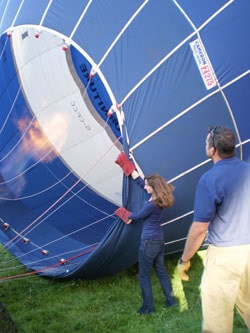
The university launched two balloons, one of which you can see being filled with hot air (right). No, don’t ask me the cost in wasted greenhouse gases.

Sadly we didn’t hitch a ride in either of the balloons, but three of the pupils who were involved in the detector-building project were on board, as were three others who won a competition to take part in the flight.

As you can see, the view from the balloon over the festival site was fabulous.

balloon fiesta

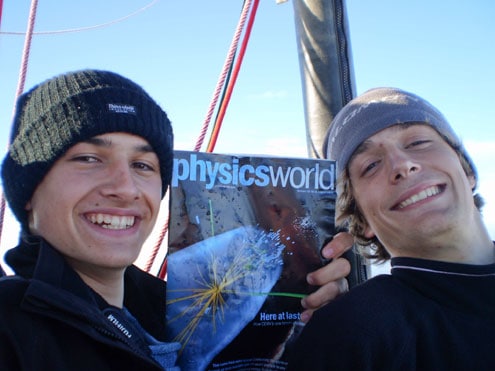
Although Physics World editors didn’t manage to thumb a lift, a copy of the August issue of Physics World, which contains Watson’s article, did make the trip.

balloon fiesta

The pupils even took their detector in the balloon, but unfortunately – as is the way with experimental physics – someone had accidentally left the battery running and it had discharged completely so no data could be collected during the flight. Oops.

Apart from that, as we discovered when we returned to the fiesta this morning, the flight was a success and took the pupils and crew to a height of some 3000 m.

We’ll now set about turning our footage into a set of films, so stay tuned.

Meanwhile, for more about the cosmic-ray centenary, don’t forget the Physics World feature.

All pictures courtesy: Beth Cotterell

Copyright © 2026 by IOP Publishing Ltd and individual contributors