

In less than 100 seconds, Luke Davies explains how we know dark matter exists.
Condensed-matter trio scoop Dirac prize
Three condensed-matter physicists, who have advanced our understanding of a strange type of material known as a “topological insulator”, have won this year’s Dirac medal from the International Centre for Theoretical Physics in Trieste, Italy. Duncan Haldane of Princeton University, Charles Kane of the University of Pennsylvania and Shoucheng Zhang of Stanford University, all in the US, have scooped the $5000 prize, which is named after the British Nobel-prize-winning theorist Paul Dirac. First awarded in 1985, the prize is given each year on 8 August – the day on which Dirac was born in 1902.
At the surface
Topological insulators are currently one of the hottest topics in condensed-matter physics. Insulators on the inside, they manage to conduct electricity on their surface thanks to special surface electronic states that are “topologically protected”, which means that – unlike ordinary surface states – they cannot be destroyed by impurities or imperfections. Moreover, the conducting electrons arrange themselves into spin-up electrons travelling in one direction and spin-down electrons travelling in the other. Such a “spin current” could be useful for anyone wishing to build a practical “spintronic” device that exploits the spin, rather than the charge, of the electrons.
These insulators have an unusual history because – unlike almost every other exotic phase of matter – they were characterized theoretically before being discovered experimentally. Kane was among those who were involved in that early work, which was based on the band theory of solids – the standard quantum-mechanical framework for understanding the electronic properties of materials. The topological insulator states in 2D and 3D materials were predicted theoretically in 2005 and 2007, before being experimentally discovered in 2007.
Novel properties
Given that the 3D topological insulators are fairly standard bulk semiconductors and their topological characteristics can survive to high temperatures, their novel properties could lead to some exciting applications. But as well as constituting a new phase of quantum matter that should keep physicists busy for some time, topological insulators have also aroused interest because they have been shown to harbour quasiparticles resembling “Majorana fermions” – particles that are also their own antiparticle.
But it is the potential applications of topological insulators that drives much of the current interest in these materials. “When developing nanosize electronics and pursuing coveted goals such as quantum computers, the availability of conducting channels that do not spoil and will work no matter what is something that seems quite important,” says ICTP condensed-matter physicist Erio Tosatti. The Dirac medal is awarded annually but anyone who has already won a Nobel prize, Fields medal or Wolf Foundation prize is excluded from the award.
Charles Kane wrote an article on “Topological Insulators” in the February 2011 issue of Physics World, along with Joel Moore. Institute members may access the article here.
Dirac seen in a new light
By Matin Durrani
It’s probably because he was born and raised in Bristol, UK – the city where Physics World is based – that my colleagues and I perhaps give a disproportionate amount of coverage to Paul Dirac compared with other great theoretical physicists of the 20th century.
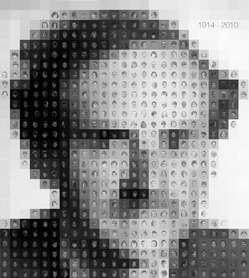
But although Dirac did his most famous work at the University of Cambridge, where he was Lucasian professor for more than 35 years, it is nevertheless true to say that his approach to science was forged by his educational experiences in Bristol, as Graham Farmelo’s classic 2009 biography makes clear.
Dirac studied for two separate degrees in engineering and mathematics at the University of Bristol and before that gained a wealth of practical experience, particularly in the art of technical drawing, when he was a pupil at Merchant Venturers’ Technical College – an institution that was the forerunner of today’s Cotham School.
Given that 8 August is the day on which Dirac was born back in 1902, I thought today an appropriate moment to mention an interesting new artwork (see right, click to enlarge) that is currently on show at Cotham School.
Created by Eric Hardy, the work is an alternative version of the traditional end-of-year school photograph and consists of a pixelated image of Dirac himself. All the pixels, however, have been replaced by photos taken in 2010 – when Hardy was still at Cotham School – of fellow pupils, teachers and other members of staff.
“As such it connects the past to the present, the individual to the collective,” says Hardy’s father Tim.
The original artwork, which is printed on a canvas about 100 × 90 cm in size, was on display at the school in May when its other great former pupil – the University of Edinburgh theorist Peter Higgs – paid a visit.
If you can’t make out Dirac in the image, try scrunching up your eyeballs.
And talking of Dirac, don’t forget that today is also the day that the International Centre for Theoretical Physics in Trieste awards its annual Dirac prize, which this year went to Duncan Haldane, Charles Kane and Shoucheng Zhang for their work on a new class of exotic materials called “topological insulators”.
X-ray spectroscopy detects single atoms
Researchers in Japan are the first to have succeeded in detecting single atoms using X-ray spectroscopy. Although a difficult technique, the work is an important step forward in studying and characterizing nanoscale structures and devices using X-rays.
Previous work in this field has largely focused on using electron energy-loss spectroscopy (EELS) to detect single lanthanide metal atoms and light atoms like carbon. However, EELS can only be applied to certain elements thanks to the high-energy beams used in this method that can damage samples. Nobel metals, such as gold and platinum, are also difficult to detect with high sensitivity using EELS – a major drawback when it comes to investigating meteorites, catalytic clusters or anticancer drugs, where only a very small number of noble metals are looked at in any given sample.
While energy-dispersive X-ray spectroscopy (EDX) is a good way to chemically characterize a wide range of materials, researchers have been reluctant to use the technique to detect single atoms because of the difficulties involved in obtaining good photoemission spectra. Kazu Suenaga of the Nanotube Research Center at AIST in Tsukuba and colleagues at JEOL Ltd in Akishima and Kyushu University in Fukuoka are now saying that they have successfully used EDX to sense single atoms of erbium thanks to advanced excitation and detection apparatus.
Metallofullerene peapods
Suenaga and colleagues studied metallofullerene peapods in their experiments and, in particular, erbium peapods (Er@C82) – so-called because the atoms are lined up in rows like peas in a pod. Each peapod is made up of a single erbium atom inside a carbon-82 cage, supported in a carbon nanotube. The advantage of looking at such a sample is that the structure is well ordered, with each metal atom separated from its neighbour by around 1 nm. The atoms can thus easily be distinguished in the resulting X-ray spectra.
The team obtained its results by using a finely focused electron beam (down to a few angstroms) to excite single Er atoms in an electron microscope so that they emitted X-ray photons. A newly developed large-sized (around 100 mm2) silicon drift detector was also employed to collect as many X-rays as possible from the sample.
“X-rays are typically emitted in all directions, so a normal-sized detector misses a lot of them and only a few per cent can be collected,” says Suenaga. “Our new large SSD greatly improves on collecting efficiency – by at least several times,” he told physicsworld.com.
“Being able to perform X-ray spectroscopy on single atoms in this way will be of great help in nano-optics research,” he adds.
The research is published in Nature Photonics.
What is fracking?
In less than 100 seconds, James Verdon describes how to squeeze out hard-to-reach shale gas.
Physicists see hints of Majorana fermions
Evidence for the existence of “Majorana fermions” – theoretically proposed particles that are also their own anti-particles – could be seen in the behaviour of a novel Josephson junction. That is the view of physicists at Stanford University in the US, who have examined the properties of a Josephson junction that incorporates material called a “topological insulator” sandwiched between two superconducting contacts. The researchers found significant deviations from what is seen in conventional Josephson junctions – differences that they believe could be explained in terms of Majorana-like quasiparticles.
First predicted by the Italian physicist Ettore Majorana in 1937 – shortly before he mysteriously disappeared aged just 31 – Majorana fermions are interesting not just because they are their own antiparticles but also because they should be resistant to environmental noise. Majorana fermions, in other words, could be used to store and transmit quantum information without being perturbed by the outside world, which is the bane of anyone trying to build a practical quantum computer.
Although definite proof of the existence of Majorana fermions has not yet been obtained, theorists have calculated that particle-like excitations, or quasiparticles, which look like Majorana fermions could exist at the interface where a topological insulator – a material that only conducts electricity on its surface – is placed next to an ordinary superconductor. These quasiparticles are called “zero-energy modes” because they lie along the Fermi energy of the material.
In the case of a Josephson junction containing a topological insulator as the “weak link” between two superconductors, there are actually two superconductor–topological insulator interfaces back-to-back, and the Majoranas are expected to couple to each other and depart from zero energy. However, if a tiny magnetic field – even as small as half a superconducting flux quantum – is applied to the junction, the two Majorana modes decouple and both reside at zero energy.
The weakest link
David Goldhaber-Gordon and colleagues at Stanford have now studied such junctions and have found some bizarre behaviour, which they have tried to explain in terms of Majorana fermions. When experimentalists plot a graph of the superconducting current flowing across a Josephson junction against the value of an applied magnetic field, they usually see a distinct “magnetic diffraction pattern” (MDP). Normally, the MDP has a strong central peak, but in topological-insulator Josephson junctions, Goldhaber-Gordon and colleagues saw a much more complicated MDP with several unexpected peaks. Indeed, the first minimum occurs at about one-fifth of the magnetic field strength that is expected in a conventional Josephson junction.
According to Goldhaber-Gordon, this more complicated structure could be related to the zero-energy Majorana modes that are expected to occur at specific values of magnetic flux. However, to explain the observed diffraction pattern, Goldhaber-Gordon points out that three – rather than one – zero-energy modes are required. One of these modes could be associated with a Majorana fermion, whereas the other two could be associated with other conventional fermions – something that Goldhaber-Gordon says has been suggested by some theorists.
Smaller critical currents
Another atypical feature seen by the team is the value of the device’s critical current (above which it no longer superconducts) multiplied by its resistance in the normal, non-superconducting state. This product is usually proportional to the superconducting energy gap, but the team measured a value that is much smaller than expected. The value was also found to be inversely proportional to the width of the Josephson-junction device – that is, the distance across the device perpendicular to the flow of the supercurrent.
Building on a theoretical description published in 2008 by Charles Kane and Liang Fu at the University of Pennsylvania in the US, Goldhaber-Gordon and colleagues assume that the Majorana fermions are confined to a 1D wire that runs along the width of the Josephson junction. The result is a series of quantized energy levels that are inversely proportional to the width of the device. The team speculates that the gap between these energy levels provides a new and smaller energy scale above which superconductivity ceases to occur – explaining the smaller measured values.
Although the team analysed its results in the context of Majorana fermions, Goldhaber-Gordon stresses that his team are still only at the early stages of exploring the behaviour of junctions between superconductors and topological insulators. “Many aspects of the materials and junctions are not yet well understood,” he says. “We welcome ideas for the explanation of these data, whether they are Majorana-related, or not.”
The research is described in Physical Review Letters.
How do you hunt for planets that are outside our solar system?
In less than 100 seconds, Zoe Leinhardt explains how astronomers are discovering alien worlds.
Martin Fleischmann: 1927–2012
By Hamish Johnston
In the autumn of 1989 I was doing what many physicists were also doing at the time – I was trying to get deuterium atoms to fuse together in a solid after hearing about the work of Martin Fleischmann and Stanley Pons. Working at the University of Utah, the pair used electrolysis to “load” metal electrodes with deuterium and claimed to have seen excess heat and particles that could be interpreted as by-products of nuclear fusion. This process was dubbed “cold fusion” and was touted in the popular press as a solution to the world’s energy problems – if only it was…
Fusion normally occurs at extremely high temperatures and therefore it was very difficult to understand how the nuclei could overcome the considerable electrostatic repulsion in order to fuse. A popular explanation at the time was that the positive charges of deuterium nuclei within a solid such as palladium were screened by the negatively charged electrons in the metal, thereby allowing two nuclei to get close enough to fuse.
Like the hundreds of others worldwide, my little experiment found no evidence for cold fusion. With the exception of a few diehard enthusiasts, interest in cold fusion has since withered. Indeed, for physicists of my generation, the cold-fusion saga was a public embarrassment and an example of “bad science” – so much so that even legitimate investigations into its possibility are still viewed by many with scorn.
Fleischmann died on Friday at the age of 85 in England, where he had arrived from his native Czechoslovakia in 1938. I find it sad to think that things could have been so very different for him – and humanity – if he had indeed discovered cold fusion.
What is a polymer?
In less than 100 seconds, Peter Barham describes the science of molecular chains.
Curiosity is winched down to Mars
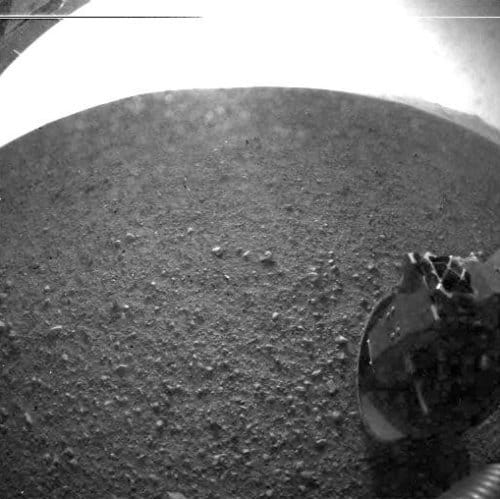
An early view of Mars from Curiosity. (Courtesy: NASA/JPL-Caltech)
By Hamish Johnston
It cost about one billion dollars and took hundreds of scientists and engineers more than eight years to build – and earlier today NASA’s Curiosity rover landed on Mars and is now sending back images.
The above photograph is one of first sent back by Curiosity. It was taken through a wide-angle lens on the left “eye” of a stereo pair of “hazard-avoidance” cameras on the rover. The object on the right of the image is one of the rover’s wheels.
The image is in black and white and is taken at a relatively low resolution. Larger colour images from higher-resolution cameras should be beamed back to Earth later this week when Curiosity’s mast is deployed.
Because it is five times heavier than NASA’s previous Martian rovers, Curiosity was winched down to the surface of the planet by a retro-rocket-firing “sky crane”.
“Ambitious, audacious and unconventional” is how one NASA scientist described the landing.
Curiosity landed on target in a huge crater, where it will look for evidence that the local area has – or ever had – conditions that could support life. The rover will be able to travel up to 200 m per day and the mission is expected to last one Martian year or 687 Earth days.
During that time it will use a suite of scientific instruments to study the Martian soil and atmosphere. Curiosity’s alpha-particle X-ray spectrometer was built by a team led by the physicist Ralf Gellert of the University of Guelph in Canada – my alma mater. Guelph physicists have a long history of using X-ray spectroscopy to study everything from precious works of art to Martian rocks and it was learning about this work many years ago that first got me interested in the practical applications of physics.
Copyright © 2026 by IOP Publishing Ltd and individual contributors