Do you find that regular exercise helps you to focus on academic study?

By James Dacey

Earlier this week we learned the sad news that Sally Ride, the first American woman in space, died of cancer at the age of 61. Ride made history as a crew member on the _Challenger _mission that blasted off from the Kennedy Space Center in Florida on 18 June 1983. She was also aboard the 13th shuttle flight, STS 41-G, which launched on 5 October 1984.

Before embarking on her space travel Ride had a strong and diverse academic background, holding degrees in physics and English from Stanford University. Then in 1989 she returned to academia by joining the University of California, San Diego as a professor of physics and director of the California Space Institute.

Alongside her academic activities, Ride of course underwent intense physical training in preparing for her space missions. And the biography on Ride’s website reveals that her passion for athletic activities began at an early age. She apparently competed in national junior tennis tournaments and was good enough to win a tennis scholarship to Westlake School for Girls in Los Angeles.

Clearly, Ride is an extreme example of somebody with drive who achieved incredible things during her lifetime by devoting countless hours to both academic study and physical training. Both of these passions brought a focus to her life that helped her to achieve her goals. But I wonder whether we mere mortals could also benefit to a more modest extent from this combination of physical and mental exercise.

Thumbnail image for Thumbnail image for hands smll.jpg

We all know of people who excel in academia and sport. And we’re forever being told that regular exercise can help contribute to a balanced lifestyle – improving our concentration, sense of wellbeing, yada yada yada. But then equally I’m sure you know plenty of clever, successful, happy people who despise physical activity, can’t think of anything worse in fact. We’re interested to know where you fall in this debate, so please take part in this week’s poll

Do you find that regular exercise helps you to focus when studying?

Yes
No

Have your say by visiting our Facebook page, and please feel free to explain your response – or suggest something in-between – by posting a comment below the poll.

In last week’s poll we looked at the impact of science and technology on society. We asked you to select which physics-based technology to emerge from the Second World War has had the most significant impact on society. The most popular choice with 65% of the vote was modern computing, followed by nuclear power/weapons with 19%, then radar and microwave technology with 8%. In 5th and 6th place were the jet engine with 5% and rocket systems with just 3%.

Thank you to everyone who took part and we look forward to hearing from you again in this week’s poll.


Prototype ‘Mott transistor’ developed

Researchers in Japan have unveiled a prototype of a “Mott transistor”. If implemented commercially, such a transistor could offer significant advantages over current designs in energy efficiency and switching speed.

As transistors are the basis of modern electronics, scientists are continually seeking ways to improve and enhance them. Transistors used for switching in modern computers are based on the field effect. In such transistors, a voltage applied between the gate and drain electrodes increases the conductivity of a semiconductor, allowing electricity to flow between the source and drain electrodes. A transistor should ideally carry as little current as possible when there is no voltage between the gate and drain (the off state) and as much as possible when gate voltage is present (the on state). A low off current is important for energy efficiency, while a large on current is important because it allows circuits to run faster.

Ideal transistor

An ideal transistor would be a total insulator in the off state and a perfect conductor in the on state. Therefore, an important measure of the quality of a transistor is the ratio of the on current to the off current. However, with a standard field-effect transistor (FET), this change in conductivity is influenced by only a thin layer close to where the current flows between gate and drain. This limits the ratio of on current to off current that can be achieved.

Scientists have suggested that it might be possible to improve this ratio by exploiting Mott insulators in transistors. Mott insulators are materials that should behave as metals according to conventional band theories but that act as insulators under certain conditions owing to quantum-mechanical correlations between neighbouring electrons. For reasons that are complex and not entirely understood, however, sudden phase transitions can be induced between the insulating state and the metallic state. Among other things, this metal–insulator transition can be induced by an electric field. While the gate voltage in an ordinary transistor simply modulates the resistance of a semiconductor, the gate voltage in a Mott transistor could turn an insulator into a metal.

Bulk transitions

Various research groups have tried to produce Mott transistors in the past, but they have failed to generate the electric fields needed to induce the metal–insulator transition at the surface of the Mott insulator. Now, scientists from the RIKEN Advance Science Institute in Wako, Japan, have covered the surface of the vanadium-dioxide Mott insulator with a drop of ionic liquid. When a small gate voltage was applied to the ionic liquid, this generated a huge electric field at the surface of the Mott insulator, inducing it to change to the metallic state. Best of all, unlike in a standard transistor, the phase transition – and so the change in conductivity – occurred not just at the surface, but also throughout the entire bulk of the material. The researchers are not entirely clear why this is the case, but they suspect that the electric field at the surface of the Mott insulator induces a phase transition in a thin layer near the surface, and that this introduces energy to the lattice of the material, thereby triggering a kind of cascade effect with the phase boundary propagating into the material like a wave.

The researchers achieved an on current to off current ratio of 100:1. This might seem disappointing alongside the figures for modern FETs, which can achieve ratios as high as a million to one, but Jochen Mannhart, a condensed-matter physicist at the Max Planck Institute for Solid State Research in Stuttgart, Germany, insists that is not the case. “The most significant feature of this research”, he says, “is that the researchers showed that in some material – in this case vanadium dioxide – by applying a gate voltage one can switch the whole volume of the material from being insulating to being conducting and thereby switch a very large volume of electrons from being immobile to being mobile.” He explains that, while the modern FET is the result of 30 years of optimization, the Mott transistor is a proof of principle and has not been optimized at all. Mannhart says the only real problem for the device is the presence of the ionic liquid, which would be impractical in a real circuit component and will need to be replaced by a solid insulator.

Masaki Nakano, who led the research, agrees that will be important, but he says that, for the moment, the group is not focusing on developing its device further. “Currently, we still have to spend a lot of time understanding our device,” he explains, “and there are many things still unclear.”

The research is published in Nature.

The nomadic life of a particle physicist

Fermilab podcast


By Margaret Harris

When I heard that Fermilab’s Tevatron particle accelerator was going to be shut down, my first thought wasn’t about the race to discover the Higgs boson, or the shutdown’s implications for CERN and the rival Large Hadron Collider (LHC). Instead, it was “What will happen to the scientists?”.

One of the great things about being a science journalist is that, once in a while, you get the chance to find answers to questions like this. So when Physics World sent me to Fermilab last autumn to learn more about the lab’s scientific plans for a post-Tevatron future, I added a few personal questions to my interviews, such as “What are you going to do now?” and “What was the day of the shutdown like?”.

You can hear a few of the answers in this podcast, which is drawn from more than nine hours of interviews with 25 different physicists. Most of the interviews were conducted at Fermilab, but I also did a few at CERN, because I wanted to hear from people who had followed the “energy frontier” as it moved from the Tevatron to the LHC. As one of these emigrants explained to me, being a particle physicist is sometimes a little like being a surf bum: “you go where the waves are good, where the beam is good”.

You can listen to the podcast here, or download it via this link.

Going where the beam is good

I travelled to Fermilab and CERN to learn more about the changing geography of high-energy physics and how it affects individual researchers. In this behind-the-scenes podcast, you’ll hear senior scientists and early-career researchers talking candidly about their working lives, their reactions to the Tevatron’s shutdown and their plans for the future.

Artificial jellyfish engineered from rat heart cells


Scientists in the US have created an artificial jellyfish out of silicone and rat heart muscle cells. The creature, dubbed “Medusoid”, swims just like its living analogue by pumping water in and out of its dome-shaped body in rhythmic pulses. Ultimately, the researchers hope to apply the same reverse-bioengineering techniques to design better artificial hearts for medical implant.

The motivation behind this new work was borne out of team member Kevin Parker’s frustration with the state of the cardiac field. An applied physicist and bioengineer at Harvard University in the US, he worried that the drug-development pipeline for cardiac disease was “starting to look a little bit lean”.

“[Medicine is] kind of running out of ideas as to how to treat heart cellular problems,” he says, suggesting “We might just not understand the fundamental rules nature has for building a good muscular pump.”

On a trip to the aquarium, Parker was struck by the similarities between how jellyfish and the human heart pump fluid, and decided to try building a replica. It’s an unprecedented move, building an entire functioning organism, but Parker was adamant that he wanted to challenge the traditional view of synthetic biology that has thus far “focused on genetic manipulations of cells”.

Grow your own jellyfish

Jellyfish pump liquid to propel themselves through water by employing the same basic principles used by the human heart to pump blood around the body. Both use a smooth wave of muscular contractions to squeeze liquid quickly and forcefully from a cavity, which then refills slowly by elastic recoil. “In our engineered system, we needed to have these two components,” explains another team member John Dabiri, an expert in biological pulsing at the California Institute of Technology.

The team used rat cardiac cells, which were activated with a jolt of electricity, to provide the “power stroke”. These were arranged on a thin sheet of silicone polymer, which assumed the role of the jelly by slowly recovering the creature to its original shape ahead of the next stroke. Medusoid was built to resemble a juvenile moon jellyfish (Aurelia aurita). Less than a centimetre in diameter when flat, it possesses eight arm-like appendages that bend to give it a characteristic dome shape when it surges forward.

 Morphologically and functionally, it’s a jellyfish; genetically it’s a rat   Kevin Parker, Harvard University

In the quest to mimic the propulsion of real moon jellyfish, lead author of the paper on the new work published in Nature Biotechnology, Janna Nawroth, also at the California Institute of Technology, began by mapping the alignment of subcellular proteins in real specimens, using immunostaining – an antibody-based method used to detect a specific protein in a sample – techniques borrowed from forensic science. The blueprint she obtained was used to pattern the Medusoid’s silicone sheet with proteins and coax the rat cardiac cells into their desired arrangements upon it.

Looks like a jellyfish, swims like a jellyfish…

When the researchers put the Medusoid into salty water and applied an electric current, their creation proved to be as competent a swimmer as its real-life counterpart. Not only that – their detailed flow field measurements showed that the Medusoid had the mimicry down to such a fine art that it was even producing the same vortices that real jellyfish create at the end of each power stroke to sweep food up into their mouths. “We said – if we’re really good, we’ll be able to not just match the propulsion, we’ll be able to match the vortices of the feeding currents. And we were able to do that,” says Parker, adding “Morphologically and functionally, it’s a jellyfish; genetically it’s a rat.”

“I was surprised that with relatively few components – a silicone base and cells that we arranged – we were able to reproduce some pretty complex swimming and feeding behaviors that you see in biological jellyfish,” says Dabiri.

Landmark paper

Suwan Jayasinghe, a biophysicist from University College London who was not involved in the study, says the fact that the researchers managed to mimic the functionality and behaviour of the jellyfish in 3D is “unique” in a field where most people still focus on 2D systems. “There is no doubt that this is a landmark paper. The potential applications in humans are tremendous – it’s mind-blowing really.”

In the near future, the researchers hope that versions built with human heart cells could be used as an early screening device to study the effect of new heart drugs on pump function. In the longer term, they hope to build synthetic creatures with much more detailed musculature, and eventually to reverse-engineer a human heart. “This project is really just the beginning of what we see as a re-imagining of synthetic biology,” says Dabiri.

“Physicists really have a role to play here,” adds Parker. “Regenerative medicine is never going to be a possibility until we conquer the cell, and the cell is more of a physics problem than most people realize – it’s a microscale self-assembling self-fuelled system, and we need to understand the physics of the cell before we can use it as a building substrate.”

The work is published in Nature Biotechnology.

So you want to get published?

By Matin Durrani

For every researcher, getting published is the name of the game.

 IOP Publishing author guide

You might be a brilliant blogger, a terrific Tweeter or a frenetic Facebook fan, but having a scientific paper published in a professional scientific journal is still your best bet for getting your results recorded, archived, peer-reviewed and disseminated.

If you’re new to the publishing game, however, IOP Publishing, which publishes physicsworld.com, has brought out a handy little online introductory guide.

Aimed at early-career researchers, the guide is designed to provide an overview of academic publishing and advice on how to make the most of the process for sharing your research.

There are sections on choosing where to submit your paper, how to go about writing it, how the peer-review process operates, and what to do when you receive your referee’s report.

Check out the guide to getting published.

PS Talking of Facebook, we’ve started posting “images of the day” on our Facebook page. They seem to be quite popular, so let us know if you have any suggestions.

Farewell Sally Ride

Sally Ride


Sally Ride talks to ground controllers during the six-day Challenger mission.
(Courtesy: NASA)


By James Dacey

Sally Ride, the physicist and astronaut who became the first US woman in space, has sadly passed away aged 61. Ride made history as a crew member on the Challenger mission that blasted off from the Kennedy Space Center in Florida on 18 June 1983. Ride was also aboard the 13th shuttle flight, STS 41-G, which launched on 5 October 1984.

In 1989 Ride joined the University of California, San Diego as a professor of physics and director of the California Space Institute. In addition to holding this faculty position, Ride was also engaged in a number of other educational activities to encourage students to pursue careers in science and technology.

A statement released on her company’s website reads “Sally Ride died peacefully on 23 July 2012 after a courageous 17-month battle with pancreatic cancer.

“Sally lived her life to the fullest, with boundless energy, curiosity, intelligence, passion, joy and love. Her integrity was absolute; her spirit was immeasurable; her approach to life was fearless.”

X-rays probe the origins of hotspot volcanoes

Researchers in France have added a new twist to one of the most controversial debates in geophysics – how “hotspot” volcanoes such as the Hawaiian Islands are formed. By probing hot, pressurized rock samples with intense X-rays, they have shown that molten rock deep within the Earth’s mantle should be buoyant. This finding, the researchers say, supports the much-debated hypothesis that hotspot volcanoes are created by deep plumes of rock rising almost 3000 km to the Earth’s surface.

In geology, “hotspots” are regions of high volcanic activity that are not located at a tectonic plate boundary and are thought to be fed by underlying mantle that is anomalously hot compared with the mantle elsewhere. Hot plumes originating from the boundary between the Earth’s outer core and lower mantle were first proposed in 1971 to explain volcanic regions that do not fit the theory of plate tectonics. The Hawaiian volcano chain, for instance, is located far from any plate boundaries, and so it has been suggested that it forms as the Pacific plate moves over a hotspot that is fed by a deep-seated mantle plume. Similar plumes have been proposed to explain volcanic activity in places as diverse as Iceland, Siberia and India’s Deccan Plateau.

Many predictions of the mantle-plume hypothesis, however, remain unconfirmed, prompting some geophysicists to develop an alternative model. The “plate hypothesis” involves much shallower processes such as internal deformations within tectonic plates that would allow magma to leak upwards from the upper mantle. Over the past decade, this model has attracted a dedicated army of supporters, creating a schism that today divides the geophysics community.

Hell on Earth

Now, a team of researchers led by Denis Andrault, a mineral physicist at Blaise Pascal University in Clermont-Ferrand, France, has tested one of the key requirements of the plume hypothesis: that molten rock at the core–mantle boundary should be buoyant enough to move upwards. To investigate this, the researchers set about recreating the hellish conditions found 2900 km below the Earth’s surface.

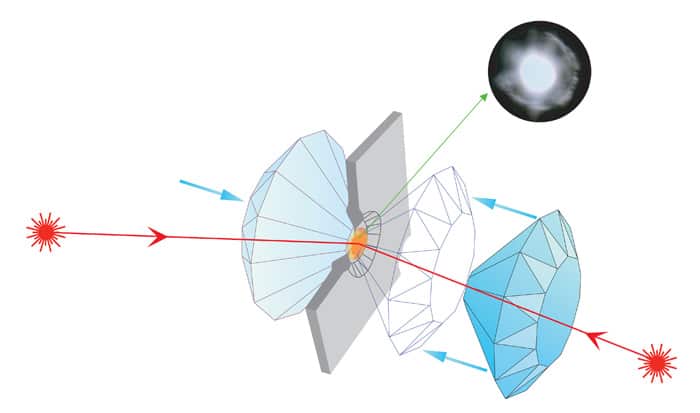
At the European Synchrotron Radiation Facility in Grenoble, tiny specks of rock nearly 10 times thinner than a human hair were compressed between the tips of two conical diamonds, subjecting the samples to immense pressures of up to 120 gigapascals. Then, infrared lasers heated the samples to temperatures as high as 4000 °C. “All of our observations show that the melting of the rocks follows the same laws of physics and chemistry as the melting of much larger samples,” says Andrault, “so the results can be confidently transferred from the micron scale up to the kilometre scale.”

Next, the samples were mapped and probed using a high-pressure X-ray beam. By analysing the X-ray diffraction patterns and fluorescence spectra, the researchers determined the chemical compositions of the regions where the rock had melted or remained solid. This allowed them to calculate the distribution of iron between the solid and liquid phases – crucial for determining the buoyancy of the molten rock.

Sink or swim?

Andrault and colleagues discovered that the molten rock contained about twice as much iron as the solid rock. Combining this result with the liquid’s expected silica content, the researchers concluded that the melt would be buoyant.”“If there was a lot more iron in the liquid, as suggested in previous work, then the density of the molten rock would be significantly higher and the magma would sink towards the core–mantle boundary,” says Andrault. “This is not the case.”

Instead, Andrault proposes that the buoyant rock moves towards the Earth’s surface – an idea that tallies with the mantle-plume hypothesis. “The melt could penetrate through the mantle by at least two different mechanisms,” says Andrault. “One is related to the size of the liquid pond: if it is big enough, gravitational forces will finally succeed in moving the liquid upwards. Another mechanism involves the dissolution of mantle material at one end of the liquid drop and recrystallization at the other end, resulting in a progression of the liquid.”

Plumes versus plates

But not everyone is convinced. “The melt may be more buoyant than previously thought,” says Gillian Foulger of Durham University in the UK. “But melts don’t just zoom up like water in a plumbing pipe. They’re reabsorbed, they mix with other melts, they’re trapped, and they have to get through the transition zone.” Furthermore, she adds, the mantle-plume hypothesis involves solid materials, not liquids, convecting towards the surface.

Andrault admits that the fate of the liquid during its travel upwards is uncertain. “Still,” he says, “even if the liquid did crystallize, its composition and temperature would be very different from the mantle, and the material would likely be buoyant thanks to its relatively high silica content.”

So how might the “plumes versus plates” debate be resolved? Foulger believes that scientists need to test the predictions of the plume hypothesis at the Earth’s surface, looking for the geochemical signatures of lavas that have risen from the deep. Others believe that the answer lies in using large arrays of high-resolution, ocean-bottom seismometers to search for evidence of these ascending plumes. Either way, the debate is likely to rumble on for some time yet.

The research is described in Nature.

New chemical bonds possible in extreme magnetic fields

In the extreme magnetic fields of white dwarves and neutron stars, a third type of chemical bonding can occur. That is the finding of theoretical chemists in Norway, who have used computer simulations to show that as-yet-unseen molecules could form in magnetic fields much higher than those created here on Earth.

High-school chemistry students are taught that there are two types of chemical bond – ionic bonds, in which one atom donates an electron to another atom; and covalent bonds, in which the electrons are shared. In fact, real chemical bonds usually fall somewhere in between.

When two atoms come together, their atomic orbitals combine to form molecular orbitals. For each two atomic orbitals combined, two molecular orbitals are formed. One of these is lower in energy than either atomic orbital and is called the bonding orbital. The other “anti-bonding” orbital is higher in energy than either atomic orbital. Whether or not the atoms will actually bond is determined by whether the total energy of the electrons in the molecular orbitals is lower than the total energy of the electrons in the original atomic orbitals. If it is, bond formation will be energetically favoured and the bond will be formed.

Bonding and anti-bonding

The Pauli exclusion principle forbids a single orbital from holding more than two electrons (it can hold two if they have opposite spins). If the atomic orbital of each atom contained just one electron, both can go into the bonding orbital when the orbitals combine. Both electrons are therefore lowered in energy and the bond formation is energetically favoured. But if the atomic orbitals contained two electrons each, two of the four electrons would have to go into the anti-bonding molecular orbital. Overall, therefore, two electrons would have their energy lowered by bond formation, while two electrons would have their energy raised.

Under normal circumstances, the anti-bonding orbital is always raised in energy farther above the energy of the higher-energy atomic orbital than the bonding orbital is lowered below the energy of the lower-energy atomic orbital. This means that a chemical bond with both its bonding and its anti-bonding orbitals full would always have a higher energy than the atomic orbitals from which it would be formed. Such a bond would therefore not form. This is why noble-gas atoms, which have full outer atomic orbitals, almost never form molecules on Earth.

But now Kai Lange and colleagues at the University of Oslo have used a computer program developed by their group called LONDON to show this is not always true elsewhere. LONDON creates mathematical models of molecular orbitals under the influence of magnetic fields of about 105 T. This is much stronger than the 30–40 T fields that can be made in laboratories and that have little effect on chemical bonds.

Changing the rules

Large fields could be relevant to those studying astronomical objects such as white dwarves – where magnetic fields can reach 105 T – and neutron stars, where fields could be as high as 1010 T. Under such conditions, the team has shown that the rules of bonding change. In particular, the anti-bonding orbital is lowered in energy when a diatomic molecule is subjected to a strong perpendicular magnetic field. Molecules with full bonding and anti-bonding orbitals, such as diatomic helium, can still be energetically favoured.

Team leader Trygve Helgaker explains the sophistication of LONDON enabled the group to perform calculations that others have found impossible. “We can do accurate calculations with all orientations of the molecule to the magnetic field,” he says. “People have done the same kinds of electronic-structure calculations before, but I believe their calculations were limited to the situation where the field is parallel to the molecular axis.”

The research is published in Science; in an accompanying commentary, Peter Schmelcher of the Institute for Laser Physics at the University of Hamburg, Germany, said “Atoms, molecules and condensed-matter systems exposed to strong magnetic fields represent a fascinating topic, and this work has added a key bonding mechanism.” Interestingly, while he accepts the fields present around a white dwarf will be unachievable in a laboratory in the foreseeable future, he sees an alternative way the group’s models might be tested experimentally. Rydberg atoms are highly excited atoms that can be the size of the dot of an “i”. Because the bond length between Rydberg atoms is so great, the Coulomb interaction is much smaller, and Schmelcher believes it might therefore be possible to use them to produce magnetic fields of comparable strength.

Which physics-based technology to emerge from the Second World War has had the most significant impact on society?

By James Dacey

Thumbnail image for hands smll.jpg

There is a fascinating article in the current issue of the Bulletin of Atomic Scientists in which the historian Paul N Edwards tries to unravel the “entangled histories” of climate science and nuclear weapons. One of Edwards’ central arguments is that climate science is only in its relatively advanced current state because of the scientific work carried out in the field of nuclear-weapons research. He backs up this assertion by tracing the histories of the different aspects of climate science, from the atmospheric models that were initially developed to monitor nuclear fallout to the facilities that were founded for nuclear purposes but have since switched to climate interests as a result of shifts in political interests.

The article got me thinking about the huge role that politics plays in the development of new technologies, particularly when there is a focused political will, such as during times of war. This was clearly evident during the second half of the 20th century when societies across the developed world were dramatically transformed by technologies that had emerged from scientific and engineering advances of the Second World War. Work and leisure have been transformed by modern computing. The invention of the jet engine opened up the world to speedy travel. Von Braun’s rocket carved a path that led us to the Moon. Radar is used to scan the skies, tracking everything from planes to clouds. The harnessing of nuclear energy transformed power supplies, while the power wielded by nuclear weapons has been a dominant theme in global politics ever since the US developed The Bomb.

Clearly, all of these technologies have had vast impacts on the world. In this week’s Facebook poll we want you to answer the following question:

Which physics-based technology to emerge from the Second World War has had the most significant impact on society?

Nuclear power/weapons
Modern computing
The jet engine
Rocket systems
Radar and microwave technology

Have your say by visiting our Facebook page, and please feel free to explain your response – or suggest an alternative technology – by posting a comment below the poll.

In last week’s poll we asked you to exercise your brain in thinking about the role that physics can play in professional sport. We asked whether you think athletes could benefit from an understanding of the physics of their sports. The outcome was as conclusive as the outcome of a race involving the average university academic and the Jamaican sprinting phenomenon Usain Bolt. 93% of respondents had strong faith in the importance of physics as they selected the option “Yes, it could help them to perfect their techniques”, while the remaining 7% chose the option “No, any knowledge would be purely theoretical”.

We asked this question in connection with the July issue of Physics World, which looks at physics and sport, including features on the physical principles underpinning sport, and the roles technology plays in enabling and enhancing sporting performance. For a limited time this special issue is available as a free PDF download.

Thank you to everyone who took part and we look forward to hearing from you again in this week’s poll.

Copyright © 2026 by IOP Publishing Ltd and individual contributors