

Do dolphins think nonlinearly?

Dolphins may rely on a nonlinear analysis method to “see” through clouds of bubbles that they create to trap fish, according to scientists at the University of Southampton in the UK. The researchers have devised a nonlinear sonar processing scheme that enables them to identify targets through clouds of bubbles, opening up the possibility that dolphins may employ similar tactics when they hunt by creating bubble nets that disorient their prey.

Unlike solid objects such as the sea floor or fish – which reflect acoustic signals linearly, as straight-forward echoes – bubbles reflect nonlinearly. This means that acoustic echoes from bubbles contain harmonic frequencies in addition to the fundamental frequencies of the outgoing signal – producing a “clutter” that is incredibly confusing to sonar. And to make matters worse, bubbles are extremely efficient at reflecting sound.

“Bubbles are the most powerful naturally occurring acoustic objects in water,” explains team member Timothy Leighton. “When you send sound at them, they’ll emit sound rather like any instrument would – if you shout at a guitar, the strings will rattle back at you.”

Blinded by bubbles

Given this, Leighton was taken aback when he saw a wildlife documentary showing dolphins purposely blowing nets of bubbles to catch fish. “There should be no way the dolphins’ sonar can get through these bubbles – it’s like they’re making fog while hunting and blinding their own sonar,” he says. “Unless there’s something spectacularly good about their sonar that we haven’t discovered yet.”

Considered alongside manmade sonar devices, a dolphin’s sonar equipment appears fairly mediocre in terms of the frequencies it can cover and the power it can generate. Dolphins’ agility and speed in the water lends them the advantage of being able to send sonar from a number of different directions and thereby see in 3D, but, even so, the bubble problem remains.

“They’ve got these huge brains though, and they’ve been living in the oceans for 10 million years where there’s always bubble clutter. Why shouldn’t they have developed a way of navigating it?” asks Leighton.

Mathematical minds

Inspired by dolphins, Leighton has spent the last decade attempting to design a sonar scheme that can penetrate bubble clouds. His most recent proposal focuses on the variation in amplitude between the successive clicking sounds that dolphins are known to make as they use echolocation.

If a dolphin sends out two successive clicks, with the second being 1/3 the amplitude of the first, a fish will return faithful echoes of these sounds while a bubble will mainly return sounds in the second harmonic at a specific amplitude. For example, if the original clicks are sent with amplitudes of 1 and 1/3, respectively, then a fish will return sounds with amplitudes of 1 and 1/3, while a bubble will return sounds with amplitudes 1 and 1/9.

In Leighton’s scheme, the sonar processor (or dolphin) multiplies the second returned click by 3 and then chooses to add or subtract this from the amplitude of the first returned click. In the sum, the linear echo from the fish is accentuated; in the subtraction, the nonlinear echo is suppressed a little, but the linear echo from the fish disappears altogether. Comparing these two pictures allows the receiver to distinguish between fish and bubbles.

When Leighton and colleagues tested this theory out in a 200-tonne tank of water with a sonar source that produced dolphin-like click trains, they found that, indeed, they were able to “see” a target within a cloud of bubbles. Although this proves nothing about the tactics dolphins employ, it shows that it is possible for dolphin pulses to see through bubble clouds, given the right processing.

Behaviour bypass

But is it plausible that dolphins’ brains recognize that bubbles and fish scatter sound differently, and that they then subconsciously add and subtract echoes to distinguish targets from bubbles? Simon Ingram, a dolphin biologist at the University of Plymouth’s Marine Institute in the UK wonders if the underwater acousticians might have missed the biological point slightly.

“We need to zoom out and think about the biology behind this particular foraging method. Dolphins cast a bubble net around a concentrated ball of fish that they’ve already worked cooperatively to aggregate together,” he says. “Why do they even need to be able to see the individual fish inside that bubble curtain?”

Once the net is created, he suggests, the dolphins could pierce it at speed and snatch their prey using echolocation once they are within it.

Field observations needed

Sonar expert Hugh Griffiths of University College London says he has “huge admiration” for the work, which he labels “very novel”.

“I think you would need to do quite a bit more work before you could say for certain that dolphins are using this, but it’s certainly plausible,” he says. Along with Ingram and the Southampton team, he agrees that field observations are the next step in either adding weight to or ruling out the theory.

If wild dolphins can be recorded dropping the frequency of their sounds while employing the bubble-net hunting strategy – specifically to at least half that of their upper hearing limit – it would be a strong indication that they could be using nonlinear processing. But even then, says Leighton, a conclusive answer might prove elusive.

“It’s an extremely difficult thing to do, to work out what mental signal processing a creature such as a dolphin does. Controlling an activity where you’ve got 200 dolphins blowing nets, snapping away with their teeth in the wild and not interfering in that process while you make a measurement – you can see it’s almost impossible to do.”

The work is published in the Proceedings of the Royal Society A.
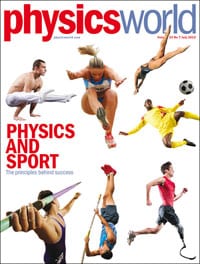
Check out some physics and sport

By Matin Durrani

PWJul12cover-200px.jpg

Ernest Rutherford used to enjoy “noisy and appalling” golf at Cambridge with his Trinity College colleagues. Niels Bohr was a keen footballer who played in goal for the top Danish side Akademisk Boldklub in the early 1900s. Arthur Eddington was a passionate cyclist who coined the “Eddington number”, E, which is the number of days on which you have cycled at least E miles. (He reached an incredible 84.) And, of course, CERN physicists are handily placed for a spot of Alpine hiking, climbing and skiing.

But for some physicists, sport is more than just something they take part in – it is what they study too. This month’s issue of Physics World looks at some of the challenges in the “physics of sport”, including:
• the effects of technology and rule change on sporting performance;
• the physics of the prosthetic devices that are leading disabled athletes like Oscar Pistorius to success;
• and how gymnasts, divers and long-jumpers are all unconscious masters of manipulating the law of conservation of angular momentum.

Members of the Institute of Physics (IOP) can enjoy the entire new issue online through the digital version of the magazine by following this link or by downloading the Physics World app onto your iPhone or iPad or Android device, available from the App Store and Google Play, respectively.

But for those of you who are not yet members of the IOP, to show you what you’re missing out on, we’re offering for a limited period only the opportunity to download a free PDF of the July issue via this link. The PDF version doesn’t contain all the features of the digital issue, which include reading articles in plain-text or page-view formats, the ability to share articles and have them read out loud, as well in-built multimedia content.

Remember that if you’re not yet a member, you can join the IOP as an imember for just £15, €20 or $25 a year via this link. Being an imember gives you a full year’s access to Physics World both online and through the apps.

Click here to download a free PDF of the July issue of Physics World.

Graphene defects tracked as they creep and climb

Researchers in the UK and Japan have succeeded in tracking dislocations with unprecedented resolution as the defects move through graphene – a sheet of carbon just one atom thick. The work may help scientists better understand plasticity in 2D structures and how dislocation motion affects the mechanical properties of graphene and other technologically important materials.

The strength of a material and how it deforms under a load are often related to how dislocations – lattice defects such as an extra half plane of atoms – move through a material. Although dislocations in 3D samples have been studied using high-resolution transmission electron microscopy (TEM), it is much more challenging to examine 2D materials such as graphene. This is because the high-energy electrons normally used for imaging in TEM will quickly destroy carbon-based nanomaterials like graphene.

In order to study graphene, the accelerating voltage of the electrons in TEM needs to be reduced to relatively low values of about 80 kV to limit damage. The problem, however, is that doing TEM with such low-energy electrons results in an increase in spherical and chromatic aberrations that blur the images and reduce their spatial resolution. Although newer electron microscopes contain in-built hardware that can correct for spherical aberrations, this resolution is still not high enough to allow scientists to locate the exact positions of individual atoms in graphene.

Reducing energy spread

Now, Jamie Warner and colleagues at the University of Oxford have teamed up with a researcher at the Japan Electron Optics Laboratory in Tokyo to reduce chromatic aberration effects by passing the electrons through a monochromator and so improve spatial resolution. The technique reduces the energy spread of the electrons before they actually hit the sample.

“Our approach allows for sub-angstrom resolution at 80 kV and the ability to pinpoint the exact position of single carbon atoms within the graphene lattice,” explains Warner. “We used this enhanced resolution to study edge dislocations (a unique form of defect that distorts the lattice structure) in graphene for the first time with true atomic resolution.”

The researchers were also able to measure carbon–carbon bond elongation and compression within a dislocation too, and map the strain caused by the dislocations using an image-processing technique known as geometrical phase analysis (GPA). “We found that we could not only map the full strain tensor from the dislocations, but also study how the strain fields moved as dislocations shift positions, or ‘creep and climb’, within the lattice,” says Warner. Comparing these experimental strain maps with those predicted by theory shows a good match with the so-called Foreman dislocation model, he adds.

Impurities are next

The researchers say that the results provide a detailed map of how the atoms in dislocations are configured in graphene, and will help them better understand how plasticity emerges in the material. They are now studying single substitutional impurity atoms in graphene and how these induce strain within the lattice. “We have already discovered that only some defect structures are stable,” says Warner. “We can readily create highly disordered regions within graphene, but in many cases these can ‘unwind’ and revert back to a pristine lattice.”

The team is also busy compiling a catalogue of defect and impurity families in the carbon material.

The results are published in Science.

Dancing at the quantum disco

Hiddens Fields art-physics collaboration


Dancers move together to create interesting patterns. (Courtesy: Paul Blakemore)


By James Dacey

Hidden Fields is a new art–physics collaboration that will be premièring at the Arnolfini art centre this Saturday as part of the Bristol Harbour Festival. Dancers interact with virtual quantum particles and fields to create colourful abstract images that are projected onto screens. The show is also accompanied by live music as a performer uses software to map the particle dynamics into musical scales.

The project’s mastermind is David Glowacki, who developed the idea using knowledge acquired through his day job as a theoretical chemist, as he explains in this video.

Keeping the lights on after 2100

As the presidential election campaign hots up here in the US, it is inevitable that energy issues will loom large on the political agenda. Being Americans, our focus will inevitably be local and short term, although I admit to hoping that maybe – just maybe – this time around, politicians on both sides will finally tell the public what they mean by “clean energy”. Right now, I haven’t got a clue.

Putting such limited optimism aside, however, it is clear that energy strategies for the future will pose challenges far beyond the next election (and the next, and the next…), and not only for those of us living in North America. By the year 2100 our planet’s population will exceed 10 billion souls, all striving for a North American or European standard of living, with its attendant thirst for energy. This is a staggering (and likely unsustainable) prospect, but it is just this scenario that the Stanford University physicist and Nobel laureate Robert Laughlin addresses in his book Powering the Future.

As with any complex and fundamentally nonlinear physics problem, the devil is always in the details. Fortunately, Bob Laughlin is a details kind of guy. His subtitle, “How we Will (Eventually) Solve the Energy Crisis and Fuel the Civilization of Tomorrow”, tells us who that devil is, and that he or she resides within the parenthetical remark “eventually”. Through 11 chapters and accompanying notes (which make up half of the book’s total 224 pages), Laughlin guides us through the jungle of the energy economy: from coal to its combustion; gas to gasoline (petrol); fission dynamite to deuterium fusion; the transport of energy by electrons and protons; the possible future generation of electricity and fuels from waste substances such as manure and maize husks; and prospects for exploiting sources of energy that stem from cosmic radiation or pressures from within the ocean depths.

All of these processes are governed by a “Jungle Law”, the title of Laughlin’s third chapter. This chapter resonated with me personally, as it reflects my own metamorphosis from an industrial basic-research physicist to someone concerned with energy and the environment. Determining the direction of the energy enterprise is not like creating the market behind the next iToy, where scientific and technical matters are paramount. With energy, science plays at best a 50% role, the remainder being driven by raw economics skewed by political and social perceptions. Realizing this was an epiphany indeed.

Laughlin gives readers a great example of such an energy epiphany in his chapter on “Carbon fever”. Seven decades ago, Linus Pauling taught us the marvels of the 2s–2p hybridization of carbon’s outer shell, which lie behind all of the element’s subsequent manifestations, from life to locomotion. Laughlin points out that the economics and physics of energy production from loosely bound carbon – in whatever form it is found, whether mineral, gaseous or organic – is overwhelmingly favourable compared with those of other “alternatives”. Because of this simple fact, it is very likely that we humans will continue to oxidize pretty much every atom of available number six we can find.

Fortunately, there is a lot of mineral and organic carbon around, and this is likely to remain true at least for a while. A problem may arise in dealing with the element’s greenhouse-gas form, carbon dioxide, although some economists have argued that the wealth created and banked by using fossil fuels to their limit could underwrite whatever climate-change adaptation technologies may be needed in the next century. Regardless of your views on carbon dioxide and climate change, though, we are likely to run out of the useful forms of cheaply available carbon sometime in the next 40–60 years. Then what? The first half of this book provides some hints of the answers, and for that reason alone, it should be mandatory reading for the next president of the US and their cabinet, and for those who follow – even if one or more of them does possess a Nobel Prize for Physics.

For readers who do not have enough time for the entire book, let alone Laughlin’s extensive endnotes (which, though great for physicists, can be tedious for non-specialists), I strongly recommend at least perusing the chapter “Inspiring mammoths”. The title is a Laughlin-euphemism for nuclear energy of any origin, and in the chapter he explains that the chief economic barrier to a renaissance of nuclear-fission power is the expanding availability of coal and natural-gas reserves worldwide. There are other hurdles too, but they are mostly political and environmental in origin. The political argument against nuclear fission encompasses some sound concerns, such as weapons proliferation, and Laughlin suggests that these should be addressed by international enforcement, not just agreement. The environmental arguments, in contrast, essentially stem from a lack of proper perspective. It is instructive to point out that the death toll from a single commercial airline crash is approximately twice that of the confirmed number of radiation-exposure deaths from every nuclear-plant disaster to date, including Chernobyl and Fukushima. As far as we know, the toll from the latter remains zero (see our May feature article).

Concerns about running out of “burnable” fission material – for example uranium and thorium ore – seem likewise overblown based on Laughlin’s analysis, which also covers issues of waste, reprocessing and “breeding” fissile material in specialist reactors. Given the vast amounts of uranium and thorium in the earth and the sea, the extension of such supplies through deployment of the above technologies, and the economic drivers that will come into play with the soaring costs of exploiting disappearing fossil reserves, my “take home” message from Powering the Future is that uranium and thorium nuclei will probably be the source of the parenthetical “eventually” in the book’s subtitle. What about fusion? Well, judging from Laughlin’s “Inspiring mammoths” chapter, fusion could indeed be the energy of the future – but it will likely remain so for a long time.

Those of us who are personally acquainted with Bob Laughlin know him as a colourful character. In New York, where I grew up, we would call him, warmly, a “wise guy”. It is just this delightful attitude that makes his book so readable, and I can think of no better way to illustrate this than to quote his words in the book’s closing sentences. After thoroughly exploring present and foreseeable energy resources for humanity, Laughlin ends with a prosaic, but most profound, warning that “The most terrible cosmic explosion of all will occur if I show up late again for dinner. It might be a good idea to stop worrying about the universe and hustle home.”

The physics of running

At its best, athletics is about sporting dramas. When leading athletes push their bodies to the limits it can create national heroes and inspire new generations of sports enthusiasts. But behind the stellar sporting performances there is also a lively arena of fascinating science and technology. In this series of videos for Physics World we will take you on a scientific tour of three of the most fundamental and iconic sports: running, cycling and swimming.

This short film focuses on running, as Physics World journalist James Dacey visits the city of Sheffield in the north of England. He takes a jog around Don Valley stadium with sports engineer Steve Haake who talks about how footwear and athletics tracks have evolved over the years to assist runners in their strides towards new world records. Dacey also visits the Centre for Sports Engineering Research (CSER) at Sheffield Hallam University to observe an elite athlete undertake a physiology test designed to gauge his fitness levels.

You can also watch our films about cycling and swimming. These were produced in association with the July issue of Physics World, a special edition that looks at the physics of sport. It includes features on the physical principles underpinning athletics, and the roles technology plays in enabling and enhancing sporting performance.

The physics of cycling

This short film is sure to get your wheels spinning as the sports engineer Steve Haake takes you on a tour de science of professional cycling. Haake breaks cycling down into its physical principles as he talks about how road and track bikes have been optimized in different ways to offer speed and control. Haake – a physicist-turned-engineer – showcases a bike that has been specially designed to cut through the air with minimal resistance.

You can also watch the two other films in this series on the physics and technology of professional sport, which focus on running and swimming. These were produced in association with the July issue of Physics World, a special edition that looks at the physics of sport. It includes features on the physical principles underpinning athletics, and the roles technology plays in enabling and enhancing sporting performance.

The physics of swimming

In this short film, the sports engineer Steve Haake takes you beneath the surface of professional swimming. Haake explains how science and technology have helped top swimmers to get around the fact that humans are not adapted for water. He dives in and addresses some of the big questions in the world of swimming, such as whether there is such a thing as “fast water” and why the international governing body of swimming has decided to ban the full-body swimsuits that led to so many world records falling a few years ago.

You can also watch the two other films in this series on the physics and technology of professional sport, which focus on running and cycling. This was made in conjunction with the July 2012 issue of Physics World, a special edition that looks at the physics of sport. It includes features on the physical principles underpinning athletics, and the roles technology plays in enabling and enhancing sporting performance.

Scientists craft the lightest material in the world

aerographite


(Courtesy: TUHH)

By Tushna Commissariat

Two teams of researchers in Germany have fabricated a material that they say is the lightest in the world. Aerographite – as the researchers have dubbed it – is a 3D network of porous carbon nanotubes and weighs only 0.2 mg per cubic centimetre, making it 75 times lighter than Styrofoam. Nevertheless, the researchers say that it is very strong and can withstand large amounts of compression (up to 95%) and tension loads. This is one of its many unique features, as most lightweight materials can easily be compressed but become weak when exposed to large amounts of stress. Aerographite, on the other hand, becomes more solid (up to a certain point) when compressed, making it stronger.

The researchers at Kiel University and Hamburg University of Technology, both in Germany, say that aerographite is jet-black, stable, electrically conductive, ductile and non-transparent, and has a very low density thanks to the fact that it is composed of hollow carbon nanotubes. Aerographite weights four times less than the hitherto lightest material in the world – a nickel material that was revealed only six months ago. The scanning-electron-microscope image above shows the hollow carbon tubes that form a fine mesh.

The researchers say that aerographite could have innumerable applications – it could be used to make lightweight lithium-ion batteries, to build satellites and even in water-purification systems.

Physicists solve Casimir conundrum

Physicists in the US may have ended a decade-old debate about how the Casimir force – which affects objects separated by tiny distances – should be calculated for two metal objects. They say that the so-called Drude model, which treats metal as a collection of billiard-ball-like positive ions and electrons, wins out over the “plasma model”, which assumes the electrons move in a fixed lattice of positive ions. Understanding how to determine the force could play an important role in the design of micrometre- and nanometre-sized machines.

The Casimir force was first predicted in 1948 by Dutch physicist Hendrik Casimir, who considered what happens when two uncharged, perfectly conducting metal plates are placed opposite one another in a vacuum. According to quantum mechanics, the energy of an electromagnetic field in a vacuum is not zero but continuously fluctuates around a certain mean value. However, resonance means that only certain wavelengths will exist between two plates separated by a particular distance.

What Casimir worked out was that the radiation pressure of the field outside the plates will tend to be slightly greater than that between the plates, which will therefore be attracted to one another. As it is so tiny, the Casimir force proved extremely difficult to measure and it was not until 1997 that Steve Lamoreaux, then at the University of Washington in the US, provided the first firm experimental confirmation of Casimir’s theory. Although Lamoreaux and others have since made better measurements, an important mystery remained regarding how the Casimir force should be calculated for realistic objects.

Larger gap, weaker force

Although successful Casimir measurements have been made between two gold surfaces, the problem is that gold is not a perfect conductor – which means that electromagnetic radiation can penetrate a finite distance into the metal. The gap between the surfaces is effectively greater and the force weaker than if the metal were a perfect conductor, explains Thorsten Emig of the University of Paris Sud, an expert on the Casimir force who was not involved in this latest work.

Both the plasma and Drude models are good at describing how short-wavelength light interacts with the metal surfaces – and can therefore be used to calculate the Casimir force at relatively short separations of less than about 1 µm. At larger separations, however, the models differ. The plasma model predicts that the “static transverse” electric mode of the electromagnetic field within the gap contributes to the Casimir force, whereas the Drude model says that it does not. Unfortunately, physicists had not been able to use one apparatus to measure the Casimir force over a large enough range of distances to decide which model works best at all separations.

Drude works best

Lamoreaux, who is now at Yale University, has joined forces with Hong Tang and colleagues to measure the Casimir force over the widest range of distances to date – from 100 nm to 2 µm. In doing so, the team is the first to show that the Drude model works best at both long and short distances.

While Casimir originally formulated his theory for parallel plates, actually measuring the force in this way is tricky because it is very difficult to align the plates well enough to perform the experiment. Lamoreaux’s breakthrough in 1997 involved measuring the force between a metal plate and a metal sphere – an arrangement that does not require precise alignment. His latest experiment involves measuring the force between a gold-covered sphere of radius 4 mm and an extremely thin membrane of silicon nitride that is also coated with gold. The membrane is just a few hundred nanometres thick and the gold coating is 200 nm think. An important feature of the resulting gold surface is that it is flat to within 3 nm throughout the entire membrane, which is a square with sides measuring 1 mm.

Vibrating membrane

The membrane is stretched drum-like across a silicon frame, which is vibrated using a piezoelectric actuator. A measurement is made by bringing the sphere to within about 1 µm of the gold surface while monitoring the vibrations of the membrane using a fibre interferometer. The presence of the Casimir force can be detected by its effect on how the membrane vibrates, with the force measured by varying the separation from between about 100 nm to 2 µm.

In theory, all points on a metallic surface should be at the same electrical potential, but in practice the molecules adsorbed on the surface make the potential vary such that it can affect force measurements – particularly at relatively large separations. To allow for this effect, the team raster-scanned the sphere across several membranes to measure the surface potential as a function of position. This allowed the researchers to select a membrane with the smallest variation for their Casimir measurements. Information from the scan is also used to correct for spatial variations during the measurement.

As well as showing that the Drude model is best at describing the Casimir force, the research also reveals the important role that variations in potential across the surfaces play in Casimir measurements. Indeed, the team suggests that an important next step in Casimir measurements will be to map the potential variations on the surface of the sphere. If successful, this could allow measurements to be made at even greater separations, which is something that Lamoreaux sees as an important next step in our understanding of the Casimir force.

The experiment is described in Physical Review Letters.

Copyright © 2026 by IOP Publishing Ltd and individual contributors