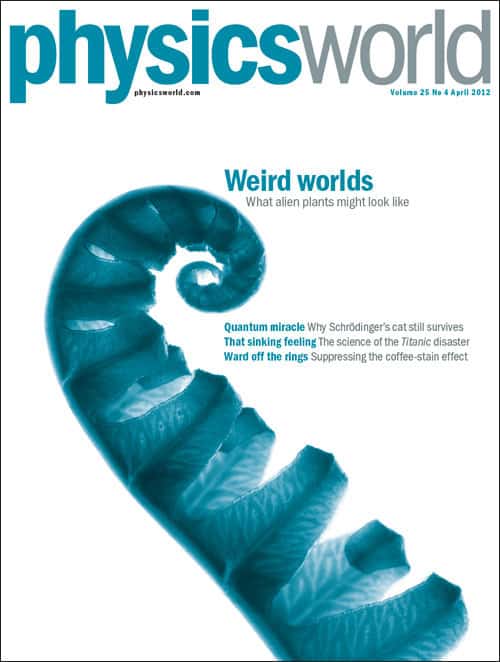
The April 2012 issue of Physics World is out now

By Matin Durrani

PWApr12cover-120.jpg

Alien plants, coffee stains and the sinking of the Titanic are three topics you probably wouldn’t expect to see back-to-back in any publication, let alone the April issue of Physics World. Strange as it may seem, however, there is a physics theme to them all. So for your delight, here’s a quick summary of what’s in the new issue – and there are details at the end of this blog about how to access the entire content of the magazine via our digital issue and apps. And remember, let me know what you think of any of the topics by e-mailing me at pwld@iop.org.

Taking on the climate – James Dacey interviews the US cosmologist Richard Muller, who has started two separate projects that both led to Nobel prizes and who is now tackling the nature and extent of global warming.

Putting Goonhilly back on the map – Michael Banks reveals how a derelict communications facility in Cornwall, UK, is being refashioned into a state-of-the-art astronomy facility that could one day join the UK’s leading array of radiotelescopes

Mending the broken pipe – Lesley Cohen from Imperial College London examines what can be done to encourage more women into physics.

The cat that never diesPhysics World columnist Robert P Crease wonders why the idea of Schrödinger’s cat is still so alive today, some 75 years after its birth.

The perfect storm – a century on from the Titanic tragedy, Richard Corfield says that the cascade of fateful events that led to her demise was partly caused by the science of the ship’s construction.

Life under alien skies – Lewis Dartnell from University College London describes some preliminary, but increasingly well founded, efforts to predict what alien plants and animals might look like.

Say goodbye to coffee stains – H Burak Eral, Dirk van den Ende and Frieder Mugele from the University of Twente explain how the stains that liquids leave behind, which can be a major annoyance in some biology techniques, can be altered for the better using a technique called electrowetting.

We are cosmic nomads – in this month’s Lateral Thoughts, Pangratios Papacosta from Columbia College in Chicago muses on our home in the universe.

Members of the Institute of Physics (IOP) can read the new issue online free right now through the digital version of the magazine by following this link or by downloading the Physics World app onto your iPhone or iPad or Android device, available from the App Store and Google Play, respectively. The digital version lets you read, share, save, archive and print articles – either fully laid out or in plain text view – and even have them translated or read out to you.

If you’re not yet a member, you can join the IOP as an imember for just £15, €20 or $25 a year via this link. Being an imember gives you a full year’s access to Physics World both online and through the apps.

How common is life in the Milky Way?

By James Dacey

As Captain Kirk and his crew explore the Milky Way (and far, far beyond) they regularly encountering alien life. Often these life forms resemble humans, and frequently they have developed into civilizations far more advanced than those seen on Earth.

hands smll.jpg

Star Trek – I hate to break it to you – is a work of fiction. But while screenwriters have been sending the Starship Enterprise on its voyages to the final frontier, astronomers here on Earth have also been searching for alien worlds. They have been using telescopes to hunt for exoplanets and for signs that life could exist on them, such as whether these planets resemble Earth and whether they orbit within a habitable distance away from their parent stars.

Yesterday, astronomers announced a discovery that could give second-Earth-hunters a reason to be optimistic. Results from the European Southern Observatory’s High Accuracy Radial velocity Planet Searcher (HARPS) instrument revealed that our galaxy could be awash with rocky super-Earths orbiting within the habitable zones around faint red stars. The international team of researchers claims that there may be tens of billions of such planets in the Milky Way alone, and probably about 100 in the Sun’s immediate neighbourhood.

So is this a sign that life more than likely does exist in our galaxy? Or should we interpret this new finding the other way? Despite this abundance of potentially habitable planets, we are yet to be visited by one of our alien neighbours. Does this suggest that there is indeed something unique about the conditions on Earth beyond the composition of our planet and its proximity to the Sun? Even if life did emerge on one of our galactic neighbours, is it likely to have evolved into intelligent organisms?

We want to know your thoughts on this issue, via this week’s Physics World Facebook poll.

How common is life in the Milky Way?

We are alone in the galaxy
The galaxy is teeming with primitive organisms
We are by no means the most intelligent civilization in the galaxy

Have your say by casting your vote on our Facebook page. As always, please feel free to explain your response by posting a comment.

In last week’s poll we asked you a question relating to a more terrestrial issue: how to respond to climate change. Specifically, we asked whether you think it’s a good idea to engineer the climate to counter the effect of global warming? And the results are now in.

It seems that few respondents want to take a gung-ho approach, as only 14% opted for the “let’s do it!” option. The most popular choice – 49% of responses – is that “we should prepare to do it as a ‘plan B’ if carbon emissions continue to rise”. 24% of respondents opted for “No way! The environmental risks are too high”. Just 12% chose “No, because it won’t work anyway”.

Along with the votes, the poll also attracted some interesting comments on the issue. For instance, Joseph S Loveless, in Virginia, US, who opted for the preparing to use geoengineering as a plan B, said “Man meddling with nature rarely seems to have positive outcomes. That being said, since we are ‘engineering’ the climate as a by-product of reckless behaviour anyway, perhaps counter-engineering is the better argument than proposing we play God with the planet.”

Thank you for your participation and we look forward to hearing from you in this week’s poll.

‘Nanorefrigerator’ is cooled using sunlight

Researchers in Belgium have drawn up plans for an electronic “nanorefrigerator” device that is driven by high-energy photons, and so could potentially be directly powered by the Sun. The device consists of two electrodes, one of which is cooled by replacing hot electrons with cool ones via photon absorption. While this is definitely not the first system that applies the “cooling by heating” concept, it is the first that can be applied for a nanosized device, with no moving parts or electrical input, allowing a lower temperature to be achieved at the nanoscale.

Cooling with heat is not a new idea – the simplest description of the concept would be “sweating” or more scientifically evaporative cooling. While physicists have been using coherent laser light to cool gasses since the 1980s, a theoretical method for cooling a quantum system with noncoherent light, by using an “optomechanical device”, was proposed only last year.

Cool Sun

What Bart Cleuren and colleagues at Hasselt University, Belgium, have proposed is a rather simple solid-state device that would potentially use solar energy directly to cool. While that might not sound immediately impressive – many houses that run on solar energy have a refridgerator – what is new about this device is that it does not first convert solar energy into electricity. Rather, the device bypasses the need to generate another form of energy – which usually results in some amount of energy loss.

The electrode to be cooled is electrically connected to another electrode that is much warmer. Between the two electrodes are two quantum dots that act as a highway for electrons to shuffle along from one electrode to another. Quantum dots are tiny semiconductor structures where electrons are confined in all three dimensions. They have electronic and optical properties that can be controlled by adjusting the shape and size of the structures and have been studied intensively over the last two decades. In this work, the adjoining quantum dots each have a lower and higher energy level, such that each dot could hold an electron at any given time in one of the levels.

Electron hop

The researchers then suggest using high-temperature photons – solar radiation is generally at a temperature of about 5800 K – to make cold electrons flow from the warm electrode to the cool one, and vice versa for the warm electrons in the opposite direction.

To create this flow, a cold electron from the warm electrode would hop into the lower energy level of the first dot, where it must absorb a photon for it to jump to the lower energy level of the second dot. From there, the cold electron can make its bid for freedom to the cold electrode, where it would further decrease the temperature of that electrode. Hot electrons would make a similar trip in the opposite direction, hopping across the higher energy level of the dots instead. This net circulation of electrons would allow one of the electrodes to be efficiently cooled.

The researchers say that one can imagine that the electrons are “evaporating” out of the cold object and “condensing” in the warm object, somewhat like an absorption refrigerator. While the net heat flow for the device as it is currently described will probably be quite small, an array of dots could be placed in between the hot and cold objects to increase the heat exchange. The researchers also state in the paper that maximum efficiency might be reached by fine-tuning specific heat – exchange parameters of their system.

The research is published in Physical Review Letters.

Quantum interference: the movie

The first real-time movie of large molecules creating an interference pattern after passing through two slits has been made by an international team of physicists. As well as being a beautiful example of the wave–particle duality of quantum mechanics, the technique could provide further insight into the boundaries between quantum and classical physics.

The build-up of an interference pattern as individual particles pass through two side-by-side slits in a screen is one of the most famous examples of how an entity such as an electron can behave both as a particle and a wave. This research has its roots in the famous double-slit experiment carried out by Thomas Young in the early 1800s. When Young shone light through his apparatus, he saw a pattern of bright and dark fringes that could only be explained by the interference of wavefronts. In the 1920s it was shown that the same occurred to electrons, establishing the concept of wave–particle duality. More recently, similar behavior has been seen using molecules containing as many as 400 atoms.

Physicists have also shown that individual particles create an interference pattern that builds up as they pass through the slits one by one and then arrive at a detector. This confirms that each individual particle does indeed behave like a wave as it passes through the slits. Observing this behaviour in large molecules is particularly interesting because it allows researchers to investigate whether there is a threshold at which particles stop behaving like waves and begin to obey the classical laws of physics.

Innovative interference

Now, physicists at institutes in Austria, Israel, Switzerland and Germany have watched in real time as interference patterns were created by 58-atom phthalocyanine molecules (C32H18N8) and 114-atom phthalocyanine derivatives (C48H26F24N8O8) – the latter being the largest ever molecule to be studied in this way. The molecules were produced using micro-evaporation, in which a laser was focused on a thin layer of the compound. This reduced the heat load to the sample, preventing the molecules from decomposing and providing the researchers with an intense and coherent beam of large organic molecules.

The team also created a silicon-nitride diffraction grating with a separation of 100 nm between slits. This ensured that the diffraction angle was large enough to be resolved after the molecules passed through the slits. Furthermore, the grating was just 10 nm thick – around 16 times thinner than previous gratings – in order to reduce interactions between the molecules and the grating material.

Another important innovation was the use of fluorescence microscopy to detect the molecules. This involved exciting the molecules with a laser, and their emitted light was imaged onto an electron-multiplying charge-coupled device (EMCCD) camera. This technique, which allowed each molecule’s position to be determined with an accuracy of 10 nm, was around 10,000 times more sensitive than previous detection methods.

A textbook pattern

The end product is a movie showing the gradual build-up of the quantum interference pattern over 90 min, with each molecule appearing as a fluorescent speck against the dark background.

“The arrival of each single radiating molecule is objectively unpredictable and yet the ensemble reveals the perfect deterministic interference pattern,” says team member Markus Arndt from the University of Vienna. “Previous experiments could see interference but they were not able to store the particles on a detector for future analysis. Fluorescence imaging visualizes the particle nature of the molecules much better than any of the earlier methods and it can do that for hours after the experiment.”

The team used these images to plot 1D diffraction curves, integrating the patterns over a section of the molecules’ velocity distribution. As expected, the curves show a strong central peak, surrounded by weaker secondary peaks – described by the researchers as a “textbook-like diffraction of plane waves at a grating”.

Quantum limits

“Studying quantum interference of large molecules is important because it is a way to explore how far the realm of quantum behaviour can be extended to macroscopic objects,” says Wieland Schöllkopf, a physicist at the Fritz-Haber-Institut der Max-Planck-Gesellschaft in Berlin who was not involved in the study. “I think with ever more ingenious experimental techniques like, for instance, the nanotechnologies used by the Vienna group, it will be possible to push the limits further and further.”

Arndt believes that their technologies can now be scaled up to higher molecular masses. “Quantum mechanics has never been tested for this parameter regime and it is the task of experimentalists to explore the unexplored,” says Arndt. “Whether our world is purely quantum or whether there is a factual transition to classical physics is open to future experiments.”

The research is described in Nature Nanotechnology.

A video of the movie can be viewed here.

The time of our lives

There is something about time that seems to perplex us. Time is everywhere, and nowhere; it is easy to measure, but hard to define; the past seems different from the future, but our equations do not tell us why. No wonder books about the nature of time have appeared almost as regularly as, well, clockwork, from Stephen Hawking’s A Brief History of Time (1988) to Paul Davies’ About Time (1995), Sean Carroll’s From Eternity to Here (2010) and Roger Penrose’s Cycles of Time (2010). In fact, I am guilty of adding to the heap myself, with In Search of Time (2008).

The latest contribution is another book called About Time, this one written by Adam Frank, an astrophysicist at the University of Rochester in upstate New York. With all the good titles having been taken, Frank can perhaps be forgiven for re-using Davies’ from 17 years ago. More importantly, he has found a largely untapped branch of the temporal landscape to explore. Time, it seems, is the dimension that keeps on giving.

In this ambitious and sprawling work, Frank attempts to weave together the cosmological and the cultural – to show that our theories about space and time, and how we live in time, are deeply intertwined. One example of what Frank calls the “braiding” of cosmology and culture concerns the mechanical clock, which in his view is “without a doubt, the most important invention of the last thousand years”. Clocks became widespread in Europe in the 14th century, bringing a more structured workday and, arguably, a more rushed way of life. But the ubiquitous clock also changed the way we imagine the cosmos itself, as the metaphor of the “clockwork universe” began to take hold. The medieval philosopher Nicole Oresme, Frank tells us, described the world as “a regular clockwork that was neither fast nor slow, never stopped, and worked in summer and winter”. As for the planets circling above, Oresme found them “similar to when a person has made a horologe [a clock] and sets it in motion, and then it moves by itself”. To drive the point home, Frank adds that “People had refashioned their daily, intimate worlds to the beat of the clock, so it was only natural that their conception of the surrounding universe should follow.”

At this point we are about one-quarter of the way into the book. Next comes Newton and his postulate of absolute space and time, which formed the foundation for his laws of mechanics and his law of universal gravitation. Often described as the climax of the scientific revolution, this is an oft-told tale, but Frank gives it new life by telling, in parallel, the story of Ambrose Crowley. An English industrialist and contemporary of Newton, Crowley built an ironworks near Newcastle that was, in its own way, as revolutionary as Newton’s physics. This ironworks operation was the forerunner of the modern factory, and Frank argues that it succeeded because of Crowley’s “genius for organizing human activity across space and time”.

Frank finds these “braids” everywhere. After the scientific revolution came the industrial one, accompanied by the huffing and puffing machines that nurtured the study of thermodynamics. And it was the laws of thermodynamics that gave rise to our conception of the “heat death” of the universe, a far-off but terrifying (and seemingly inescapable) catastrophe. Then, a few decades later, radio broadcasting gave us, for the first time, a “national now”, just as Einstein’s theory of relativity was showing just how fragile the notion of “now” really is.

Frank includes quite a lot of material here, from the birth of agriculture and the social effect of washing machines to the pros and cons of multiple universes. Considering the scope of the text, it is a remarkably tight narrative. And he is very much up to speed on the latest speculations on what may have preceded the Big Bang, from the “colliding branes” imagined by Paul Steinhardt and Neil Turok in an offshoot of string theory to the “eternal inflation” model championed by Sean Carroll and others. But there are a few bumps along the way. He loves the phrase “material engagement” a little too much; in one spot it appears four times in about a page. In discussing 21st-century time pressures, a surprisingly large chunk of text is devoted to the effects of Microsoft Outlook; I found myself wondering whether life would really be any less rushed under iCalendar or Windows Live Mail. The Gregorian reform of the calendar, meanwhile, gets barely a mention, while some digressions, such as a discussion of the “Sokal hoax” of 1996, come out of the blue.

Then there is the feel-good ending. Aficionados of popular-physics writing will remember Steven Weinberg’s claim in The First Three Minutes (1977) that “[The] more the universe seems comprehensible, the more it seems pointless.” Frank, however, is untroubled by such Weinbergian pessimism. Because of the braiding of the cultural and the cosmological, he argues, we are “participants” in the universe; we are its “co-creators”; the universe contains “a vital place for us”. For Frank, there is meaning to be found in this vast, dark cosmos, and “If we can recognize the enigmatic entanglement between cultural time and cosmic time, we might stop looking for God in the form of ‘final theories’ and find our rightful – and rightfully central – place in the narratives of creation.” Our universe, Frank argues, is “suffused with meaning and potential”.

Some readers will no doubt warm to this message. A sceptic, however, might counter that such a reader is like a carpenter who builds their house with a window, peers out at the world outside – and then takes comfort in the fact that they happen to have built the window that frames their view of the universe. Sure, being human requires that we experience the universe in a particular way, but does that really make us cosmic “participants”? I will also say that, in a book of this length, the second-to-last page is a bit late in the game to suddenly declare that Buddhism may hold the answer. (The author observes that “Buddhist philosophy emphasizes a doctrine called dependent arising [in which] everything in the universe…depends on everything else. Nothing ever exists entirely alone.”)

For those who have been sampling the recent “time” books, there is much that will be familiar here. Even so, the book contains enough that is original to keep even seasoned “time buffs” engaged, and its author is a first-rate storyteller. Reading About Time would be time well spent.


Billions and billions?

Sunset seen from the super-Earth Gliese 667Cc


An artist’s impression shows a sunset seen from the super-Earth Gliese 667Cc. The brightest star in the sky is the red dwarf Gliese 667C, which is part of a triple-star system. The other two more distant stars, Gliese 667A and B, appear in the sky also to the right.
(Courtesy: ESO/L Calçada)

By Tushna Commissariat

The field of exoplanetary research has been abuzz over the past year as the first exoplanet – called Gliese 581d – was found within the habitable zone of a star last May and three others were found by March this year. Most of these are super-Earth planets – exoplanets that are two to 10 times more massive than the Earth.

Today, new results from the European Southern Observatory’s (ESO) High Accuracy Radial velocity Planet Searcher (HARPS) instrument reveal that rocky super-Earths might abound in our galaxy, orbiting within the habitable zones around faint red stars. The international team of researchers claims that there may be tens of billions of such planets in the Milky Way alone, and probably about 100 in the Sun’s immediate neighbourhood.

The work is described in two papers here and here that are currently available on the arXiv preprint server, one of which will soon be published in the journal Astronomy & Astrophysics. This is the first direct measurement of the frequency of super-Earths around red dwarfs – faint and cool stars compared with the Sun that are common and long-lived – as they account for 80% of the stars in the Milky Way.

“Our new observations with HARPS mean that about 40% of all red-dwarf stars have a super-Earth orbiting in the habitable zone where liquid water can exist on the surface of the planet,” says Xavier Bonfils from the University of Grenoble, France, who is leader of the HARPS team. “Because red dwarfs are so common – there are about 160 billion of them in the Milky Way – this leads us to the astonishing conclusion that there are tens of billions of these planets in our galaxy alone,” he says.

The HARPS team surveyed a carefully chosen sample of 102 red-dwarf stars in the southern skies over a six-year period. Over this time the researchers found nine super-Earths, of which two reside inside the habitable zones of Gliese 581 and Gliese 667C, respectively. The astronomers were able to estimate how heavy the planets are and how far from their stars they orbit.

From a study of all the data, including observations of stars that did not have planets, the team says that the frequency of occurrence of super-Earths in the habitable zone is 41%, in a range from 28% to 95%.

In addition, the researchers say that more massive planets – gas giants like Jupiter and Saturn in our solar system – are rarely found orbiting red dwarfs, with less than 12% of them having such giant planets in their systems. All of this means that there is the exciting possibility of 100 super-Earth planets in close vicinity to us, given that there are many red-dwarf stars close to the solar system at distances of less than about 30 light-years.

“The habitable zone around a red dwarf, where the temperature is suitable for liquid water to exist on the surface, is much closer to the star than the Earth is to the Sun,” says Stéphane Udry from the Geneva Observatory, who is also a member of the team. “But red dwarfs are known to be subject to stellar eruptions or flares, which may bathe the planet in X-rays or ultraviolet radiation and so make life there less likely.”

One of the planets discovered in the HARPS survey of red dwarfs is Gliese 667Cc. This is the second planet in this triple-star system and it orbits almost exactly in the centre of the habitable zone of its parent star. Although more than four times heavier than the Earth, it is considered to be the Earth’s closest twin found so far and almost certainly has the right conditions for the existence of liquid water on its surface.

“Now that we know that there are many super-Earths around nearby red dwarfs, we need to identify more of them using both HARPS and future instruments. Some of these planets are expected to pass in front of their parent star as they orbit, which would open up the exciting possibility of studying the planet’s atmosphere and searching for signs of life,” concludes Xavier Delfosse, one of the authors of the papers.

Can GPS find variations in Planck’s constant?

Physicists in the US say that they have used publicly available data from global positioning system (GPS) satellites to put a limit on how much Planck’s constant might vary from place to place. Their technique involves analysing the tiny corrections that are applied to the atomic clocks used in GPS satellites – corrections that are made to account for relativistic effects caused by the orbits of the satellites. However, not all physicists agree that the analysis is meaningful.

GPS relies on extremely accurate measurements of how long it takes signals to travel from several satellites to a receiver on the ground. As these timings have to be incredibly precise, atomic clocks are used on board the satellites. These clocks measure the frequency of electromagnetic radiation involved in a specific atomic transition, which is related to its energy via Planck’s constant.

For reasons outlined in Einstein’s special and general theories of relativity, the clocks in space must be corrected on a regular basis so that they agree with atomic clocks on Earth and with each other. Once the appropriate relativistic corrections are made, however, the time on the clocks should be identical regardless of any differences in the local gravitational potentials of the clocks. So if there is still a deviation once relativity is taken into account, Planck’s constant might vary from place to place – in other words, the concept known as local Planck invariance (LPI) might not hold true.

James Kentosh and Makan Mohageg of California State University at Northridge now say that they have used these publicly available satellite data to put an upper limit on the possible violation of LPI in the value of Planck’s constant. By comparing the corrections that were actually made to the clocks with those defined by relativity, Kentosh and Mohageg have calculated an upper limit on the extent that LPI violation is occurring.

Comparing corrections

Planck’s constant defines the size of energy quanta in a physical system: a quantum of electromagnetic radiation (the photon) has energy proportional to Planck’s constant multiplied by the frequency of the electromagnetic field, for example.

Kentosh and Mohageg looked at seven of the 32 GPS satellites on the basis that these had the most stable clocks. The clock corrections are published at 15 min intervals and the pair looked at 13 months of data in 2010–2011. They looked at how the corrections varied as a function of the radial distance of the satellite from Earth and found a small discrepancy in what would be expected from relativity.

This, however, is not enough to put a limit on LPI violation for Planck’s constant because it is possible that the way time dilation affects the different clocks could also violate LPI. The team says that it has taken this into consideration by looking at a study done in 2010 by Victor Flambaum of the University of New South Wales, and colleagues in Australia and France. Flambaum and the team compared the time kept by an atomic clock with the time on a cryogenic sapphire oscillator clock at the Paris Observatory. According to Kentosh and Mohageg, the results of Flambaum’s experiment can be used to place a limit on the LPI violation of time dilation in their study. Putting all of this together, Kentosh and Mohageg find that Planck’s constant satisfies LPI to within 0.007.

Three faults?

However, not everyone agrees with this conclusion, including Flambaum himself. He told physicsworld.com that he finds three faults with a paper describing the analysis, which has been published in Physical Review Letters. Planck’s constant has the dimensions of energy multiplied by time and Flambaum says there is no point in looking for variations in fundamental constants that have dimensions because the units defining those dimensions could also be varying.

Instead, he believes that physicists should focus on dimensionless quantities, such as the fine-structure constant. He also points out that the atomic clocks used in the study were all similar and therefore their operations have the same dependencies on physical constants – making it impossible to look for violations of LPI. Instead, he argues that two different clocks are required. Finally, Flambaum does not agree with Kentosh and Mohageg’s interpretation of his 2010 clock-comparison paper.

Kentosh told physicsworld.com that he and Mohageg are aware of the limitations of their analysis: “It is important to note that our results apply only within the context of general relativity, which predicts that the speed of light, rest mass, energy and length are invariant when measured locally. If any of those macroscopic variables were to vary with gravitational potential, as measured locally, it would skew our findings.”

Kentosh and Mohageg are now working on a new paper that describes their technique in more detail. Meanwhile, Flambaum and colleague Julian Berengut have submitted a comment on the topic for publication in Physical Review Letters.

Further doubts cast over lunar formation models

An international team of researchers claims that nearly all of the material that makes up the Moon came from the early Earth. These findings contradict astronomical models of the formation of the Moon by the impact of a Mars-sized object with the early Earth that suggests more than 40% of the Moon-forming material came from the Mars-sized impactor known as “Theia”.

The study, published in Nature Geoscience, is based on the popular Moon-formation scenario that suggests that Theia collided with a young proto-Earth and that this giant impact threw up a disc of material that then orbited the Earth. The disc is thought to have condensed within a few centuries and then rapidly accreted to form the Moon as we now know it. Many numerical simulations of this scenario have suggested that a maximum of 60% of the disc-forming material would have come from the Earth’s mantle, with the other 40% being Theia material. This means that the distinct geochemical compositions of the Earth and Theia should be found in lunar material, as Theia matter should be easily distinguishable from Earth matter.

Tricky titanium

But Junjun Zhang from the University of Chicago in the US and other colleagues in Switzerland found that when they compared the relative abundance of titanium isotopes in samples of rocks from the Earth and the Moon – after correcting the lunar signature for any “noise” that might be caused by cosmic rays – they found both signatures identical to about four parts per million. According to the researchers, this isotopic homogeneity of titanium suggests that the Moon is composed almost entirely of material from the mantle of Earth. This result seems to contradict most numerical giant-impact models or suggests that Theia’s composition was surprisingly similar to that of the Earth’s.

In the past, other researchers have looked at the isotopic signatures of lunar material and have found that silicon, chromium, tungsten and oxygen isotopes for Earth and lunar material are very similar. Silicon, chromium and tungsten work in accordance with the giant-impact numerical calculations, working on the assumption that Theia’s composition is quite similar to that of Mars. But, as it is with the titanium isotopes, the oxygen isotopic signatures of both terrestrial and lunar rocks are so similar that Theia cannot have contributed more than a few per cent of material to the Moon-forming disc.

Earth’s twin?

The researchers do consider the possibility of Theia having a surprisingly similar composition to that of the Earth; but they also point out in the paper that “this idea seems to be contrived and requires special circumstances for an embryo [Theia] to have the same titanium, oxygen and tungsten isotopic compositions as a growing planet [Earth]”. An alternative scenario that the researchers suggest is that isotopic differences between Earth and Theia matter could have been erased during the volatile exchange of matter in the aftermath of the impact. But for this to happen with titanium, unrealistic scenarios – such as extremely slow cooling of the Moon-forming disc or large-scale turbulent mixing would be needed to be invoked. Other possibilities, including the fact that the lunar material may have been created by an exchange of material between the Earth’s magma ocean and the proto-lunar disc, or by being thrown off from a rapidly rotating post-impact Earth are now being considered.

The work is published in Nature Geoscience.

Fermilab told to rein in planned neutrino experiment

Physicists in the US working on a major new experiment to study the properties of neutrinos have suffered a major setback with the announcement that the US Department of Energy (DOE) will not fund their current plan. Known as the Long-Baseline Neutrino Experiment (LBNE), it would involve creating a beam of neutrinos at Fermilab and detecting them 1300 km away in a new detector to be built deep underground in South Dakota’s Homestake mine. But writing to Fermilab director Pier Oddone last week, William Brinkman, who is director of the DOE’s Office of Science, says that the DOE “cannot support the LBNE project as it is currently configured”.

Brinkman adds that the decision has not been based on the scientific merits of the LBNE proposal, but rather because the full cost of the project (expected to be more than $1bn) cannot be accommodated by the current US budget or by projected budgets over the next decade. The LBNE would also involve building a new neutrino detector at Fermilab, which is located just outside Chicago, and physicists had hoped to have the experiment running by 2020. The LBNE is supposed to be the successor to the NOvA experiment, which should start sending neutrinos 810 km from Fermilab to an underground detector in Minnesota in 2014.

In a separate letter to Fermilab staff, Oddone insists that the laboratory remains committed to achieving the scientific goals of the LBNE. “We will work closely with the DOE and the particle-physics community over the coming months to outline options for a phased approach to long-baseline neutrino experiments,” he says. Fermilab now plans to work with the DOE and neutrino physicists to develop a new strategy for building the LBNE.

Phased approach

Neutrinos come in three “flavours” – electron, muon and tau – with the neutrinos able to change, or “oscillate”, between the different types. However, physicists also believe that neutrinos can be described in terms of combinations of three mass states – m1, m2 and m3. Interference between these mass states gives rise to the observed oscillations of neutrino flavour – a muon neutrino could change into an electron or tau neutrino, for example, as it travels through the Earth.

Under Fermilab’s plans for the LBNE, a pure beam of muon neutrinos would be created at Fermilab, and then when reached the Homestake neutrino detector it would be a combination of all three flavours. Measuring the rates at which these oscillations occur would therefore provide new information about neutrino mixing angles. The LBNE would also allow physicists to compare the oscillation rates of neutrinos and antineutrinos, and look for differences. Any such differences would violate the Standard Model of particle physics, which incorporates a fundamental symmetry between particles and antiparticles known as CP (“charge–parity”) symmetry.

Neutrinos from elsewhere

Fermilab physicists also hope to use the underground detector to study neutrinos produced naturally in a number of places, including the Earth’s atmosphere and distant supernovae. Brinkman now suggests that, instead of building the LBNE all at once, Fermilab should take “an affordable and phased approach that will enable important science results at each phase”. He also says that the plans for Homestake facility should be revised to include the option of co-locating other physicists experiments – such as a facility for doing dark-matter experiments.

Multiverses in the movies

By Matin Durrani

Far from being an arcane concept in theoretical physics, the idea of “parallel worlds” and “parallel universes” has for many years served as a source of inspiration for numerous artists, movie-makers and writers, as the Stony Brook University philosopher and historian Robert P Crease discussed in his column for Physics World last December.

The latest – and probably not the last – example of multiple universes in popular culture comes with a new German film released earlier this month entitled Schilf, which means “Reeds” in English.

The film’s based on the bestselling book of the same name by German author Juli Zeh, the English translation of which, rather confusingly, was entitled Dark Matter in the UK and In Free Fall in the US.

Reviewing the book for Physics World in 2010, US science writer Jennifer Ouellette called it “a compelling intellectual thriller”, which she commended for its “meticulous plotting…and lyrical turns of phrase”. You can read her review here.

Anyway, the film version, like the book, features – unusually in the movie world – not one, but two bona fide physicists, in the form of a professor at the University of Jena called Sebastian Wittich (played by Mark Waschke) and an old pal from his student days called Oskar Hoyer (Stipe Erceg), who’s now based at CERN.

According to Ouellette’s review of the book, Sebastian and Oskar are passionate rivals when it comes to physics, and the story begins with the pair discussing the philosophical implications of the possibility of parallel worlds, before quickly veering off to include a kidnapping, a ransom, a grisly death and the unravelling of Sebastian’s life.

“Eventually, an unorthodox detective with a love of physics and an inoperable brain tumour steps in to solve his final case by connecting these seemingly random events,” Ouellette writes.

I’ve only watched the trailer for the film – directed by Claudia Lehmann – so I can’t comment on how closely it follows the novel or if the movie is worth watching.

But the trailer itself looks okay, with realistic-looking shots of a physics lecture hall and a scene inside Sebastian’s home, where his son starts going on about Schrödinger’s cat. Then the cheery (cheesy?) accordion music turns predictably sinister, various mobile phones go off, assorted trains/cars/bikes come and go, an old, beardy guy with dark glasses and a scarf stumbles into view, before a character, with his back to us, admits “I’ve killed someone – but not in this world.” There’s also a glimpse of a place that might, or might not, be CERN.

By the way, a gripe of mine: why is it that mobile phones in movies never have silly ring tones?

More details of the film can be found at IMDb.com.

Copyright © 2026 by IOP Publishing Ltd and individual contributors