Voyager sets sights on Milky Way

An international group of researchers has reported the first ever detection of a particular atomic hydrogen line emission from the Milky Way, using instruments on board the Voyager spacecraft. This emission, has already been seen from much more distant objects and is used to find star-forming galaxies. It is also used to probe the epoch of reionization – the formation of the first stars post the “dark ages” of the universe – and so is of considerable significance to astronomers.

Astronomers routinely look at astronomical objects and phenomena that are many millions of light-years away – currently, the furthest object observed is at a distance of 13.14 billion light-years. But surprisingly, there are phenomena that occur within the bounds of our parent galaxy – the Milky Way – that have not been seen or studied. An example of this is the “Lyman-alpha (Lyα) emission” (121.6 nm) that is generated when there is an electron transition between the first and second energy levels of hydrogen. The galactic Lyα emission is an essential marker of the young-star-formation rate in the Milky Way, the ionization environment in which the atmospheres of young planets evolve, and the amount of shocked gas in the interstellar medium.

Star birth marker

Although Doppler-shifted Lyα lines emission has been seen from other galaxies, it has been undetectable for the Milky Way as a result of very bright local sources that drown out the galactic Lyα radiation, in a similar manner to which the glare of bright lights from a city blocks the light from all but the brightest of stars. This local brightness is mainly attributed to the “H glow” – solar Lyα photons scattered by neutral hydrogen gas in the solar system. Like getting away from a big city to see a clear sky, astronomers are using data from the two Voyager spacecraft – both of which have now reached the heliosheath at the very edge of the solar system and are beyond the worse of the H glow.

Using the recently acquired data from the Voyager spacecraft, launched by NASA in 1977, Rosine Lallement from the Observatoire de Paris run by the French research council (CNRS), and colleagues in the US and Russia are the first to study this galactic emission and confirm that most of it originates in the regions where hot young stars are being formed. As both spacecraft are moving out of the solar system, they can perceive the much fainter radiation that comes from the galaxy. “For us, it is like beginning to see small candles within a brightly lit room,” explains Lallement. The team has been busy “disentangling the two [local and distant] signals” that have two different consequences.

Glowing Milky Way

In the distant case, the astronomers study the amount of ultraviolet Lyα radiation emitted by a galaxy because it corresponds to the rate at which stars are being born within that galaxy – that is, the star formation rate (SFR) of the galaxy. Lallement explains that one of the major goals for astronomers is to pinpoint when stars first appeared in the young universe, and so detecting the Lyα emissions from the most distant galaxies and correctly interpreting the signal is essential. “However, the correspondence between Lyα and the SFR is not an easily derived due to the complex manner in which the radiation propagates through the distant galaxy. A single Lyα photon can be absorbed and scattered by the numerous neutral hydrogen clouds present within galaxies, and hence its history is essentially lost due to its complex “random walk” from its origin to its escape from the ionized regions of a distant galaxy.”

She goes on to say that the star, gas and dust distributions are not known in those galaxies that are extremely faint and so accurately observing and deciphering the Lyα galactic signal to test and calibrate Lyα photon propagation models for distant galaxies was impossible. “In the case of the Milky Way we have for the first time the Lyα signal and all the necessary information, thus models can be tested,” says Lallement. The Lyα emission can trace the SFR in much more distant galaxies, with redshifts from z = 2 to z = 6.

Closer to home

The study of the other signal – the local signal – is important to understand the heliosphere – the bubble formed due to the solar wind that contains our entire solar system and marks the extent of the Sun’s environment, including the boundary between the Sun and the ambient galactic interstellar medium. Both Voyager spacecraft are currently crossing the boundary region, moving into the galactic gas. “The H glow due to penetrating neutral hydrogen atoms from interstellar space is part of the whole structure. Understanding how this local H glow evolves with the distance to the Sun and confirming the best models of the glow brings information that is complementary to in situ data”, says Lallement, explaining that although the data from the Voyager spacecraft shows a preliminary distribution of the emissions; precise maps will have to wait a dedicated mission. NASA’s New Horizons spacecraft, on its way to Pluto, has an ultraviolet-imaging spectrometer that could observe galactic Lyα emission in a more systematic way.

Unfortunately, power on board the Voyager spacecraft decreases as they move further and further away from the Sun. Indeed, no data will be received beyond 2020–2025. To save power, the UV instruments on board are no longer capable of pointing towards a certain source; data are still recorded but in a fixed direction. Hopefully, they will still generate new and useful information about the galactic Lyα emissions as well as the interstellar gas until then.

The research is published in Science 10.1126/science.1197340.
Higgs rumours fly as meeting approaches

CERN art


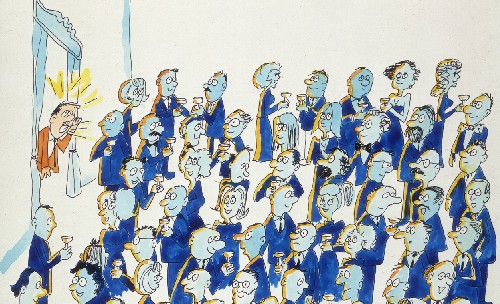
Physicists chatter excitedly at CERN. (Courtesy: Georges Boixader)

By Hamish Johnston
The particle-physics rumour mill is going into overdrive as physicists look forward to next week’s meeting of the CERN’s Scientific Policy Committee – which will include Higgs updates from the LHC’s ATLAS and CMS experiments.

If various blogs are to be believed – and a trusted source assures us that the claims are credible – the two experiments are closing in on the Higgs boson. This undiscovered particle and its associated field explain how electroweak symmetry broke after the Big Bang and why some fundamental particles are blessed with the property of mass.

The latest rumour is that both ATLAS and CMS have evidence that the Higgs mass is about 125 GeV/C2 at confidence levels of 3.5σ and 2.5σ respectively. At 3.5σ, the measurement could be the result of a random fluke just 0.1% of the time whereas at 2.5σ the fluke factor is about 1%.

If you are really optimistic, I believe you can add these two results together in quadrature to get an overall result with a significance of 4.3σ.

While these might sound like fantastic odds to you and me, particle physicists normally wait until they have a confidence of 5σ or greater before they call it a “discovery”. Anything over 3σ is described as “evidence”.

Blogger Lubos Motl has reproduced what he says is an e-mail from CERN director general Rolf-Dieter Heuer inviting CERN staff to a briefing on 13 December to hear about “significant progress in the search for the Higgs boson, but not enough to make any conclusive statement on the existence or non-existence of the Higgs”.

This seems to tie in nicely with the rumoured ATLAS and CMS results, which together are strong evidence for the Higgs at about 125 GeV/C2 – but not yet a discovery.

So why are particle physicists so conservative when it comes to claiming a discovery?
Last year, Robert Crease explored this issue in his regular column for Physics World, and you can read that column here.

Crease wisely cites past experience as the number-one reason for caution. Indeed he quotes University of Oxford physicist and data-analysis guru Louis Lyons as saying “We have all too often seen interesting effects at the 3σ or 4σ level go away as more data are collected.”

As Crease points out, nearly everyone he spoke to in writing his article “had tales – many well known – of signals that went away, some at 3σ: proton decay, monopoles, the pentaquark, an excess at Fermilab of high-transverse-momentum jets”.

So if the rumours are true, 2012 could be a very exciting year for the LHC as more data are collected and this interesting effect grows. But until the key CERN briefing on 13 December, when more information emerges, it would be wise to “keep calm and carry on”.

Blogs that have been buzzing include those of Philip Gibbs, Lubos Motl and Peter Woit.

Cavity spectroscopy does carbon dating

A new way to carbon-date old samples has been developed by physicists in Italy. Unlike current methods, which involve large and costly laboratory equipment, the new technique can be performed using portable and low-cost equipment. The researchers claim that their idea could have other applications, including biomedical procedures, environmental monitoring, fundamental physics and explosives detection.

Carbon dating is an essential tool of modern archaeology because it allows the age of a biological sample to be determined from the radioactivity of its carbon compounds. Carbon-14 is a radioactive isotope produced in the upper atmosphere by cosmic rays and accounts for one in every 1012 atoms of carbon in every living organism. When an organism dies, it stops taking in carbon, so the number of carbon-14 atoms decreases with a half-life of about 5730 years – a timescale that makes it ideal for investigating human history.

However, for samples aged around 50,000 years or older, accelerator mass spectrometry (AMS) is the only method that is sensitive enough to detect the minute amounts of remaining carbon-14. This involves ionizing the carbon compounds, accelerating them to extremely high energies with a particle accelerator and bending the ions’ paths with an electric field. The equipment required to do this is extremely large and costly.

Focusing on vibrations

Now, Paolo de Natale and colleagues of the National Institute of Optics and the European Laboratory for Non-Linear Spectroscopy, both in Florence, Italy, have developed a much cheaper alternative that they say is almost as sensitive. This new method is based on infrared laser spectroscopy, which probes the quantized vibrational modes of molecules. A specific type of molecule will absorb infrared light only at energies corresponding to its vibrational modes. Therefore, the concentration of a particular molecule in a sample can be measured by tuning a laser to the appropriate energy and measuring how much light is absorbed.

The vibrational modes of carbon dioxide differ slightly depending on whether the carbon atom is carbon-14 or standard carbon-12. By burning a sample and performing infrared laser spectroscopy on the carbon dioxide produced, scientists can work out the proportion of carbon-14 in the original sample and thus deduce its age. However, owing to fluctuations in the output of the laser, this has never been sensitive enough to use for dating.

De Natale and colleagues have overcome this problem by using a technique they first unveiled last year, called saturated absorption cavity ring-down (SCAR) spectroscopy. SCAR involves firing the laser into a cavity with a mirror at either end – essentially “filling” the cavity with light that bounces back and forth. The laser is switched off and a measurement is made of the rate at which the intensity of the light in the cavity decays or “rings down”. A SCAR measurement is made with the cavity filled with the carbon-dioxide sample, which affects the decay rate because light is absorbed by the molecules. Because the laser light is injected into the cavity in advance and switched off during the measurement, SCAR is not affected by fluctuations in laser intensity. Another benefit of the technique is that the multiple reflections ensure that the light interacts with the gas for a much longer time than if the laser were just fired through a sample.

Room for improvement

By measuring how quickly the sample absorbed the laser light, the researchers were able to work out the proportion of carbon-14 that it contained. They measured concentrations of radiocarbon as low as four parts in 1014. The very best AMS machines – which are 10 times as expensive and 100 times the size of the SCAR prototype – can achieve one part in 1015, but De Natale believes their system can be improved further. He points out that carbon-14 is also used for biomedical applications in which AMS accuracy levels are not needed. “There are small-scale mass spectrometers that could in principle be replaced [by SCAR] now, even though the ultimate sensitivity is not yet at the level of the best mass spectrometers,” he explains.

De Natale says that, in future, the technique could be adapted to detect tiny quantities of other rare molecules. This could allow it to be used to monitor the concentrations of hazardous pollutants in the environment, to detect drugs or explosives on passengers or in cargo at airports or to conduct research in fundamental physics.

“It is an incredibly sensitive measurement of a very small quantity of this very rare isotope,” says David Nelson, atmospheric scientist at Aerodyne Research in the US. However, he points out that the technique benefits from the fact that carbon dioxide “has an extraordinarily strong infrared line strength. So while you could certainly use this technique with other molecules, you won’t get the same sensitivity”.

The research will be described in an upcoming issue of Physical Review Letters.

Diamonds entangled at room temperature

Two diamonds separated by about 15 cm have been put into a state of quantum entanglement. The experiment, carried out by physicists in the UK, was performed at room temperature and involved creating phonons (quantized vibrations) within the crystals. By showing that quantum entanglement can be achieved in two large and distant diamonds at room temperature, the research team has provided further evidence that a practical quantum computer could be within our grasp.

Quantum computers, which exploit purely quantum phenomena such as superposition and entanglement, should in principle be able to outperform classical computers at certain tasks. But building a practical quantum computer remains a challenge because the physical entities that store and transfer quantum bits (qubits) of information are easily destroyed by contact with the outside world.

Diamond is one material that shows great promise for quantum computing because it contains quantum systems that are well shielded from the environment. It has, for example, phonons that can interact with light from an external source but are in general unaffected by random thermal vibrations within the material itself.

In principle, quantum information could be stored in diamond by firing a laser pulse to create a phonon, with the information being retrieved sometime later by firing a second pulse that interacts with the phonon. Furthermore, entangled pulses of light could be used to entangle phonons in two different diamonds – something that could ultimately be useful in creating quantum computers.

Splitting photons

In the new work, Ian Walmsley and colleagues at the University of Oxford have used such a scheme to entangle two diamonds – each about 3 mm across. They begin by firing a “pump” laser pulse at a beamsplitter, which sends one half of the pulse to a diamond on the right and the other half to a diamond on the left. When an individual photon in the pulse encounters the beamsplitter, quantum mechanics dictates that it is put into a superposition of a photon that has gone left and a photon that has gone right.

When such a photon strikes a diamond, some of its energy can be absorbed to create a phonon – a high-frequency vibration of the atoms in the crystal. As phonons behave like particles that obey quantum mechanics, the diamonds are left in a superposition of the right-hand diamond having a phonon and the left-hand diamond having a phonon. In other words, the two diamonds “share” the same phonon, which is a hallmark of entanglement.

When a phonon is created, the original photon is re-emitted at a lower energy. This “red” photon is then detected in such a way that the physicists know that a phonon has been created in one of the diamonds, although which of the two is not revealed. In other words, this red photon “heralds” the entanglement of the two diamonds.

Scattered into the blue

Very shortly after the phonon is created, a second “probe” pulse is fired into the beamsplitter and the two resulting pulses arrive simultaneously at the both diamonds. If a phonon is present in one of the diamonds, one of the photons from the second pulse can absorb the phonon, thereby boosting its energy to create a “blue” photon. Because the two diamonds are entangled by a single phonon, this blue photon is in a superposition of either being emitted by the right-hand diamond or the left-hand diamond.

This superposition is confirmed by combining the blue light from both diamonds in a beamsplitter to create just one beam. This beam is then sent into a final beamsplitter, where it is again split into two beams. If a blue photon is indeed in a superposition of the left- and right-hand diamonds, it will always emerge from a specific output port of the beamsplitter. If the photon is not in a superposition, there is an equal probability that it will emerge from either port.

The team measured the output at both ports for blue photons that are heralded by a red photon – and found that the majority of the blue photons emerged from the expected port. This shows that the blue photons are indeed in a superposition as a result of the diamonds being entangled by a single phonon, according to Walmsley.

Picoseconds are enough

The entire process – from entanglement being created between the diamonds to detecting it using the probe pulse – lasts a mere 0.35 ps. Such a short timescale is needed because the phonons are only expected to survive for about 7 ps in diamond. Although such phonons could not be used to store quantum information for long periods of time, they could be used to perform very rapid quantum calculations – at least in principle.

Jeremy O’Brien of the University of Bristol in the UK calls the work “a tremendous development” that further extends the size of objects in which we can see quantum effects such as entanglement and superposition. Although practical applications of the work may not be immediately obvious, O’Brien believes it will capture physicists’ imagination of what could be possible in future quantum computers and information systems.

The research is described in Science 334 1253.

When will we see the first nuclear fusion reactor?

By James Dacey

hands smll.jpg

A Canadian company is planning to build a prototype fusion demonstrator that would be a fraction of the cost of a standard fusion reactor, as physicsworld.com editor Hamish Johnston reported today in this feature. Undoubtedly this is exciting news for those who have been following the development of nuclear fusion as a potential energy source, especially given these times of dwindling fossil-fuel supplies and environmental concerns linked with increasing carbon-dioxide emissions. But even if the prototype is a success, this is still a long way from the real deal: a fully functioning fusion reactor hooked up to a grid.

But we want to know your opinion on this issue. In this week’s Facebook poll, we want you to answer the following question:

When do you believe we will see the first working nuclear fusion reactor supplying electricity to a grid?

Within the next 30 years
Within 30–60 years
Within 60–90 years
Not until the Sun goes supernova

To cast your vote, please visit our Facebook page and please feel free to explain your answer by posting a comment.

Last year, this same question was put to David Ward from the Culham Centre for Fusion Energy in the UK during an interview with Physics World. Ward believes that, realistically, we will not see practical fusion until 2040–2050 at the earliest. IOP members can view this video interview here.

In last week’s Facebook poll we asked you what is your biggest peeve about popular-science writing. 53% of respondents told us that authors “blurring fact and speculation” is their biggest bane, while 24% of pollsters found it more annoying when writers give “bad or unclear explanations”. A further 13% said that they think authors “talking down to readers” is the biggest crime, and just 10% believe that the worst offenders are the writers who use “clichés and overblown language”.

As always, the poll also generated some interested discussion. One respondent, Kate Scaryboots Oliver, who is based in the UK, wrote that authors “not explaining methodology” was her particular pet hate. And you can almost picture the steam escaping from her ears when she added: “Also, if I have to read about space being like a rubber sheet one more time!”

Phil Barker, another respondent based in the UK, feels disgruntled by the fact that popular-science writers often gloss over the mathematics. “Look at how many people each year now graduate with science, engineering, computing, business and other degrees that require a reasonable amount of maths. I’m not saying that every science book or article should be entirely maths-based, just that there is an audience that can cope with and would appreciate something other than hand-waving.”

Thank you for all your responses and we look forward to hearing from you again in this week’s poll.

Searching for SUSY

CMS


The CMS collaboration has so far seen no evidence of sparticles. (Courtesy: CERN/Michael Hoch)

By Matin Durrani

The first full year of data-taking at CERN’s Large Hadron Collider (LHC), which is now drawing to a close, has been a wake-up call for supersymmetry (SUSY) – a theory that has captivated physicists (or at least some of them) for the last 40 years.

SUSY’s central prediction – that for each of the Standard Model particles there exists a heavier “sparticle” sibling – remains firmly in the realm of imagination.

Quite simply, no firm evidence for SUSY has yet emerged, despite its aficionados claiming it’s been round the corner for the last 20 years.

But SUSY’s supporters remain undeterred.

In article in the December issue of Physics World magazine by science writer Matthew Chalmers, Savas Dimopolous of Stanford University insists “it’s very early to draw conclusions”, with Nobel laureate David Gross of the Kavli Institute for Theoretical Physics in Santa Barbara saying supersymmetry’s “alive and well”.

Whether evidence for SUSY emerges at the LHC partly depends on if – and where – the Higgs boson shows. If the Higgs weighs in at about 120 GeV, then “it really smells like SUSY”, according to Oliver Buchmuller of the CMS experiment at the LHC. A Higgs heavier than about 135 GeV could see SUSY running into trouble.

As Chalmers points out, for most physicists, the discovery of SUSY would be more remarkable than that of the Higgs. After all, the Standard Model of particle physics has withstood 35 years of tests at six or more decimal places, suggesting that the Higgs or something like it pretty much has to turn up at the LHC. “SUSY, by contrast, is more a well-founded hope”, writes Chalmers, and “the non-discovery of SUSY or something like it would just leave thousands of physicists felling gutted…and weaken the case for another multi-billion dollar collider”.

All eyes are now on an upcoming meeting at CERN on 12 and 13 December, at which results from the full 2011 dataset are due to be presented and discussed. The key sessions on the Higgs searches are set to take place at 2 p.m. local time on 13 December, featuring talks by Fabiola Gianotti of ATLAS and Guido Tonelli of CMS.

Members of the Institute of Physics (IOP) can read the article “Searching for SUSY” online through the digital version of the magazine by following this link or by downloading the Physics World app onto your iPhone or iPad or Android device, available from the Apple store and Android Marketplace respectively.

If you’re not yet a member, you can join the IOP as an imember for just £15, €20 or $25 a year via this link. Being an imember gives you a year’s free access to Physics World, both online and through the apps.

Radio-wave excess could point to dark matter

An excess of radio waves recorded by a balloon-borne experiment could be a signal of dark matter, a new study suggests. Data from the ARCADE mission seem to fit in with other direct, recently reported evidence for dark matter, although some believe they may have a mundane explanation.

Dark matter is an elusive substance thought to make up more than 80% of the matter in the universe. While dark matter is invoked to explain the anomalous rotational velocity of galaxies and other mysterious astronomical phenomena, no-one has yet detected it conclusively. In recent years, however, hints of detections have been reported by several experimental collaborations, namely CRESST and DAMA at the underground lab in Gran Sasso, Italy, and CoGeNT at the Soudan mine in Minnesota, US. Other secondary evidence for dark matter has been reported by the satellite-borne experiment PAMELA and possibly the balloon-borne experiment ATIC – both of which have looked for excesses of electrons and positrons generated by dark-matter collisions.

Surfeit of radio waves

Now, it seems there may be secondary evidence from another balloon-borne experiment to add to the mix. In 2009 the ARCADE 2 collaboration reported that their experiment, which had taken radio measurements of the sky at frequencies between 3–90 GHz, had recorded a directionless or “isotropic” component of radio waves that was five to six times higher than contributions recorded in other surveys. Since then, studies have attempted to explain the excess as the remnant of, for example, supernovae or quasars, but none of these explanations has worked out.

Now, Nicolao Fornengo of the University of Turin in Italy and colleagues believe that the most likely explanation of the ARCADE excess is the existence of lots and lots of very faint sources, rather like the make up of “haloes” of dark matter outside galaxies. When dark-matter particles – known as weakly interacting massive particles, or WIMPs – collide and annihilate one another, they are thought to generate electrons and positrons, which subsequently generate radio waves via synchrotron emission as they travel through magnetic fields.

If such WIMPs were the root of the ARCADE radio excess, say Fornengo and colleagues, they would probably be quite light, with a mass between 10–20 GeV. That’s “in the right ballpark of DAMA, CoGeNT and CRESST,” says Fornengo. The results are due to be published in Physical Review Letters.

“Messy astrophysics”

Opinion is mixed among astrophysicists on how likely the researchers’ dark-matter interpretation is. Douglas Scott at the University of British Columbia thinks a mundane interpretation is more likely. “If we’re missing something, then the most likely candidate is that it’s something to do with ‘messy astrophysics’ – i.e. details of the formation and evolution of galaxies,” he says. “But it’s worth keeping an open mind to the possibility that this is telling us something about particle physics and the nature of dark matter.”

Alan Kogut, leader of the ARCADE collaboration at NASA’s Goddard Space Flight Centre in Maryland, US, is “a little sceptical of any astrophysical result involving dark-matter annihilation”, although he admits that the explanation fits. The Square Kilometre Array (SKA), a huge radio telescope in development in the southern hemisphere, should be able to provide corroboration, he adds.

Fornengo agrees that the SKA will shed more light on the ARCADE excess, and that an independent estimate of the universe’s total isotropic radio background is needed. In the meantime, he likes the dark-matter interpretation because it “can reproduce the radio observations in a natural way, namely without introducing any further particularly optimistic assumption”.

“I think it is an interesting exercise, and a suggestive one, but there a number of parameters that could entirely change the interpretation,” says Stefano Profumo at the University of California, Santa Cruz, US. “So this is to be taken as a ‘proof of principle’ of a possible interpretation of the ARCADE excess, but not in any sense something that might point towards exotic origins such as dark-matter annihilation or decay.”

A preprint of the paper is available at arXiv:1108.0569.

Introducing the phoniton

By Hamish Johnston

Condensed-matter physicists have their own particle zoo – a menagerie filled with familiar and exotic quasiparticles including old favourites like holes and phonons, and newer additions such as surface plasma polaritons. Quasiparticles are excitations in a solid that behave like tiny particles and obey quantum mechanics. A phonon for example, is a quantized sound wave that propagates through a crystal.

Now Charles Tahan and colleagues at the Laboratory for Physical Sciences just outside Washington, DC have shown that the interaction between phonons and electronic excitations in certain semiconductors can be described in terms of a brand new quasiparticle called the phoniton.

The team studied phonitons in silicon doped with phosphorous. As a phonon moves through the material it stretches and squeezes the crystalline lattice such than an electron associated with a phosphorous atom absorbs the phonon’s energy and is promoted into a higher energy level. This electron then decays back to its original energy, re-emitting the phonon, which can be absorbed and re-emitted at another phosphorous atom. The propagation of this phonon/excitation hybrid through the lattice can be described as a quasiparticle they have called the phoniton.

So what use could a phoniton be? Because they combine the electronic and mechanical properties of a material, they could be put to work in mechanical sensors that detect vibration, strain or other movement. Looking further into the future, they could also find use in quantum computers that use phonons to store and process information.

You can read more about phonitons in Phys. Rev. Lett. 107 253502.

If you don’t have access to APS journals, you can read a preprint of the article here. Before you click through to the PDF, look at the comments where is says “Changed ‘phononitons’ to ‘phoniton’ by negotiation with PRL editors…”. I have to agree with the editors, phononitons is a real mouthful!

Between the lines: Christmas special

Do-it-yourself time travel

Most of us have at some point wondered whether time travel is possible. In Build Your Own Time Machine, author Brian Clegg uses this widespread interest as an excuse to explore the many avenues of time travel – or, more specifically, human perceptions and the scientific concept of “time”. While readers sadly will not find a chapter containing blueprints for a working time machine, Clegg does explain complex fundamental ideas such as relativity, thermodynamics and quantum theory in a simple and clear style, interspersed with chapters that cover everything from Plato and Aristotle’s view of time to the evolution of the modern-day calendar, cryogenics and wormholes. The book is peppered with quirky facts such as “A frequent flyer ages around one-thousandth of a second less than a counterpart on the ground after 40 years of weekly Atlantic crossings,” and it also features short biographies of famous people involved in the study of time. One especially nice twist occurs when Clegg draws the reader’s attention to the fact that they are constantly moving through time, even as they read his book. So although you will not have built your time machine at the end of the book, you will certainly have done some time travelling.

  • 2012/2011 Duckworth/St Martin’s Press £14.99/$25.99hb 300pp

Do try this at home…

Marvin the cat and Milo the dog love science. In fact, they love science so much that they have burst out of their usual home on the back page of the Institute of Physics’ Interactions newspaper and into a bright little book called Marvin and Milo: Adventures in Science. Like the original cartoon series, which has appeared regularly in Interactions since 2004, the book features a series of fun, simple experiments in which Marvin and Milo illustrate basic principles of physics using ordinary household items. The pair specialize in counterintuitive demonstrations, so the results of their experiments often seem magical. A good example is experiment 26, in which Marvin shows Milo how to make water run down a string as it is poured out of a jug. Of course, as Marvin explains, this is not really magic – instead, it is a fluid-physics phenomenon called the Coanda effect – and the text on the facing page notes that the same principle can make flowing water “stick” to the underside of a sloping gutter. Like Marvin and Milo themselves, artist Vic Le Billon and author Caitlin Watson (who is the Institute’s head of public engagement) form a great team, and their book would make an excellent gift for the under-11 crowd.

  • 2011 Macmillan £9.99hb 96pp

…or perhaps not

With its lurid green, yellow and red colour scheme, exclamation marks and comic-book styling, the cover of The Book of Potentially Catastrophic Science screams with excitement. “Smashing atoms! Making gunpowder!” it shouts. “Hey kids! Try these experiments at home!” Unfortunately, anyone who looks inside expecting to actually smash atoms or make gunpowder will be sorely disappointed; the book’s most dangerous experiment involves nothing more hazardous than boiling water in a paper cup. Author Sean Connolly’s explanations are clear and entertaining, and young scientists who manage to reset their expectations will certainly find some fun activities for a winter’s day. Still, the book’s most valuable lesson is that old cliché: you can’t judge a book by its cover.

  • 2010 Workman Publishing $13.95hb 205pp
Books on time travel, calculus and radioactivity

Life, maths and everything

In the spring of 1977 Steven Strogatz wrote a letter to his former high-school calculus teacher, Don Joffray, about a mathematical puzzle known as a “chase problem”. Suppose four dogs start from the corners of a square with sides of length a, Strogatz suggested. If each runs (at the same speed) directly towards the one counterclockwise from it, how far will each dog have travelled when the four meet in the centre? The answer (it is a, the length of the square’s sides – can you figure out why?) was not important, but the letter proved to be the start of an extraordinary mathematical correspondence, one that would ebb and flow for nearly three decades. During that time, Strogatz would graduate, earn a PhD and become a professor of applied mathematics at Cornell University. Meanwhile, “Joff” would remain in the classroom for another 22 years, admiring his former star pupil’s exploits from afar, before eventually retiring to spend more time canoeing on his beloved Long Island Sound. For most of this period, the two men’s correspondence was almost exclusively calculus-based. The only problems they talked about were the sort you could solve with clever substitutions and a few pages of algebra. Eventually, though, things began to change: first gradually, like the continuous functions of calculus, then in a series of abrupt shifts that echoed phenomena in Strogatz’ own research on chaos theory. Strogatz’ chronicle of the two men’s correspondence, The Calculus of Friendship, is simultaneously a fun collection of mathematical puzzles and a moving, bittersweet account of how his relationship with Joff evolved. The hardcover version was first published in the US in 2009, but it is now available in paperback – so there is no excuse not to send your favourite mathematician a copy.

  • 2011 Princeton University Press £10.95/$14.95pb 184pp

Cosmic soundbites

It sounds a neat idea: a book that answers 140 different questions about the solar system, our galaxy and the wider cosmos in segments of no more than 140 characters each (the standard length of Twitter messages). Tweeting the Universe: Tiny Explanations of Very Big Ideas by science writers Marcus Chown and Govert Schilling does pretty much what it promises to do, with bite-sized sentences about, for example, whether there is water on Mars (yes, but it is frozen), what happened before the Big Bang (not sure) and whether it is dangerous to fly through the asteroid belt (not really). While the restriction in character numbers was no doubt a diverting and useful constraint for the authors – brevity is the soul of wit and all that – the resulting Tweets are far from poetic, with definite articles and conjunctions often lopped off to save space. Moreover, each question is answered in the form of a dozen or so Tweets, making the explanations more like 1700 characters long and spread over two printed pages. So why not, if there are two pages, use them all up with old-fashioned prose? In fact, the introduction, which is conventionally written, is probably the best part of the book. Still, if this book’s ploy, which emerged from a column Schilling writes for the Dutch newspaper De Volkskrant, encourages an interest in physics among the Twitter generation, it
will have served a useful purpose.

  • Faber and Faber £12.99/$18.56hb 311pp

Adventures in the outside

In the year 2110 the world’s population is divided. After decades of fruitless activism, a separatist “Ecommunity” has cut itself off from the technologically advanced “Outside” world, seeking refuge from climate change and the degenerate values of modern society. Ecommunity members are free to grow their own food, worship nature and study ancient cultures – but their vaguely sinister hierarchy prohibits them from inquiring about science, because “prying leads to meddling leads to destruction”. As the premise of a science-fiction novel, this is promising stuff, but Zvi Schreiber’s Fizz quickly takes an unexpected turn. It turns out that the book’s eponymous heroine wants a bit more out of life than eco-hymns and harvest festivals; in particular, young Fizz is passionately curious about physics and astronomy. So when a loophole in the Ecommunity’s rules allows her to visit the Outside on her 18th birthday, she seizes the opportunity to learn more. What follows is a time-travelling adventure that takes Fizz from ancient Greece to 21st-century England as she seeks to understand how the physical world works. Along the way, she is aided by many of history’s most famous scientists, as well as a few well-chosen plot devices (for example, her time machine is thoughtfully equipped with a 3D printer that produces era-appropriate clothing). This mixture of popular physics and young-adult fiction is unusual, to say the least, but it works surprisingly well and readers will quickly find themselves caring about Schreiber’s characters and Fizz’s personal dilemmas.

  • 2011 Zedess Publishing $11.95pb 516pp

Just add cartoons

“Physics with a chuckle is physics more easily remembered.” So says Richard Muller in his introduction to The Instant Physicist, which puts this principle to the test by pairing short discussions of non-intuitive physics with a series of cartoons. The book – which seems tailor-made for the stocking-filler season – concentrates on topics related to hot-button issues, including energy, climate science and (especially) radioactivity. Joey Manfre’s sketches add a nice touch, but cartoons aside, The Instant Physicist is essentially a slimmed-down version of Muller’s previous book Physics For Future Presidents (2008 W W Norton). Readers who crave a bit more substance from their festive reading should probably look there instead.

  • 2011 W W Norton £12.99/$16.95hb 144pp

Copernicus’s revolutionary moment

In 1510 Nicolaus Copernicus conceived the project that would become the major work of his lifetime: working out the mathematical details of a heliocentric universe. By 1539 his project was substantially finished, but not only was he reluctant to publish it, he had evidently abandoned all hope of completing it successfully. Aside from his fear of rejection at the hands of biblical literalists and Aristotelians, he had encountered numerous difficulties with some of his mathematical models. In the case of the planet Mercury, the problems seemed intractable. They had, in fact, arisen from Copernicus’s axiomatic adoption of the idea that planets and other heavenly bodies must follow the uniform, circular motions of celestial spheres, which meant that his models retained geocentric residues that even his considerable ingenuity could not dispel. The complications were discouraging, and Copernicus evidently realized that something had gone terribly wrong, but he could not figure out what.

Into this depressing state of affairs stepped a young Lutheran mathematician and astrologer called Georg Joachim Rheticus. He had heard of Copernicus’s theory while on a visit to Nuremberg, Germany, and decided to travel to Frombork in north-east Poland to learn the details directly from its creator. In the course of this strange and improbable meeting, Rheticus – who was completely convinced of the correctness of the theory – persuaded Copernicus to complete the remaining details and have the book published. Though Rheticus was unable to help the older man resolve the problems with his models (the solution would come some 70 years later, when Johannes Kepler replaced circular models with elliptical orbits), his enthusiasm was evidently so infectious that Copernicus let him complete the preparations for the book’s publication. Without Rheticus, On the Revolutions of the Heavenly Spheres might have completely disappeared.

When science writer Dava Sobel first heard about the meeting between Copernicus and Rheticus, and how it led to the publication of On the Revolutions, she imagined these events as a drama. Eventually, she wrote a play in two acts called And the Sun Stood Still that dramatizes the meeting, its context and Copernicus’s last days. As she explains in a foreword, however, her editor persuaded her to place this play between two narratives: one covering the life of the astronomer up to his meeting with Rheticus; and the second summarizing the circumstances of publication and its aftermath down to the present day.

Source material

The resulting book-play-book A More Perfect Heaven may or may not be a new genre, but the decision to mix fact and fiction magnifies the already inherent tensions of the story. Most notably, the narrative portions of the book acknowledge incomplete evidence, diverse interpretations, ambiguity and – in a word – uncertainty about the actual events. The dramatic part, however, requires Sobel to select from many possibilities and write in a way that is consistent with her selections.

Rheticus’s own biography suggested how Sobel should depict his initial meeting with Copernicus. When a young student, Valentin Otto, visited him in 1574, Rheticus remarked that he had been the same age as Otto when he first met Copernicus, and exclaimed “If it had not been for my journey, his work would never have seen the light of day” – so Sobel makes him a somewhat impetuous, excitable youth. Rheticus’s visit also coincided with an anti-Lutheran decree issued by Copernicus’s bishop in Frombork, so in the play Copernicus has to keep him hidden, with his close friend Tiedemann Giese aiding in the subterfuge.

More controversially, Sobel makes dramatic use of Copernicus’s relationship with his housekeeper, Anna. We do not know for certain whether she was Copernicus’ de facto wife – he consistently denied it – but Sobel leaves no doubt. Nor does she avoid Rheticus’s apparent homosexuality and alleged pederasty. In 1551 the father of a Leipzig student charged Rheticus with sodomy. The punishment for such a crime was “death by fire” so, rather than risk a trial, Rheticus fled Leipzig. After some months the university sentenced him in absentia to banishment for 101 years.

Scientific legacy

Historians may object to several details, but Sobel’s handling of these tensions is deft, light-handed and at times even humorous. Of all the decisions she makes, the most contentious for historians by far is her portrayal of Copernicus as a man totally unconcerned with astrology, even dismissive of it. The fact is that Copernicus was silent on the subject. Not a single astrological prognostication is attributable to him with certainty, whether in treatises with a different disciplinary focus, his correspondence or in comments related to his work as a medical doctor. Rheticus, by contrast, was adept at astrology, and promoted a sort of astrological interpretation of On the Revolutions in his own Narratio Prima (First Account) of 1540. Copernicus did not repudiate this interpretation, but Sobel nonetheless depicts him as disagreeing with Rheticus about astrology – albeit not in a way that would disrupt their collaboration.

The play is very short, and a performance would probably take less than an hour. I do not know whether anyone suggested that Sobel expand it, but had she wished, she could have done so by dramatizing other episodes in Copernicus’s life. His meeting in 1496 with his teacher in Bologna, the well-known astrologer Domenico Maria Novara, is a possibility, as are his decisions in 1510 to leave the retinue of his uncle, Bishop Lucas Watzenrode, and to embark on his heliocentric project.

As it stands, though, Sobel has given us accessible and readable accounts of Copernicus’s life that serve as book ends for one of the most fortuitous and fateful meetings of minds in the history of science. The play brings that meeting to life with wit and boldness. Adding the suggested preliminary scenes, however, would have made it into a full-length play, set up the dramatic encounter and denouement of the last two acts, and perhaps resolved in a more satisfactory way some of the tensions arising from Copernicus’s doubts and personal ordeals.

Copyright © 2026 by IOP Publishing Ltd and individual contributors