When East meets West

Wroclaw


Centennial Hall in Wrocław, where the meeting took place

By Susan Curtis

I was recently in the Polish city of Wrocław to attend the second Asian-European Physics Summit (ASEPS), where one message emerged loud and clear – scientists from West and East need to collaborate with each other more.

The summit brought together representatives of the European Physical Society with those from the Association of Asian Physical Societies. The latter is an umbrella organization that represents the physical societies of countries such as Japan, China, Korea, Australia and India.

Physicists at the meeting argued that working together is the best way to push the boundaries of scientific discovery, while policy-makers recognized that the drive for ever-more-sophisticated research facilities can only be realized by combining global resources.

There was good news in Wrocław from speakers from Japan, Korea and China, who reported that science funding is increasing across Asia. While Japan already has a reputation for research excellence, China and Korea are making big investments in basic research in a bid to move up the value chain from product supply to a knowledge-based economy. They are keen to work with European research centres to speed up that transition, and to learn from Europe’s approach to developing a structured and collaborative research infrastructure.

A good example of how that’s happening in practice is Korea’s activity in fusion research. Having established its capability with the KSTAR research tokamak, Korea has become a key member of the ITER consortium, which is building a proof-of-concept fusion reactor in the south of France. Korea plans to exploit the experience gained at ITER to build a commercial nuclear-fusion facility sometime between 2022 and 2036.

But collaborations like that are few and far between. Asian scientists have traditionally viewed the US as the best place to develop a physics career, so much so that Asia is suffering a brain drain as talented scientists relocate for better pay and research opportunities. And while some Asian scientists come to Europe to work on particular projects, very few European researchers spend significant time in Asia.

In January 2009 the EU set up a project called KORANET to investigate the reasons why. One obvious problem is the eight- or nine-hour time gap, combined with the cultural and linguistic differences that make it hard for Asian scientists to live and work Europe, and for Europeans to move to Asia. More practical problems also discourage mobility, such as finding suitable accommodation and ensuring continuity of pensions provision and healthcare insurance.

One idea suggested by KORANET is for European research organizations to set up “branches” in Asia. A particularly successful initiative has been the Sino-German Center for Research Promotion, a joint venture formed 10 years ago to co-ordinate and encourage collaborative activities between China and Germany. The Max Planck Society has also established 24 partner groups in China, which allows Chinese students and postdocs to gain research experience in Europe before returning to work in well funded, well equipped Chinese facilities.

For their part, delegates at the ASEPS event said that more exchange opportunities should be developed for small research programmes as well as for large projects, and that a network of local contact points should be set up to help scientists who are working in an unfamiliar part of the world.

To encourage student mobility – which will be crucial for future collaboration – delegates were keen to ensure mutual recognition of degrees, and suggested a joint summer school to address some of the key challenges facing young physicists, such as the need for sustainable energy technologies.

A small working group will take these ideas forward so that real progress can be reported at the next ASEPS meeting, which is due to take place in Asia at some point over the next two years.

In the meantime, don’t forget to check out our Physics World special report on China, which can be read via this link.

How to turn darkness into light

Quantum mechanics tells us that the vacuum is not empty but is filled with virtual particles that pop into and out of existence. Normally these particles are hidden from our view, but now a team of physicists has used the electrical equivalent of an ultrafast mirror to convert virtual photons into real electromagnetic radiation. Known as the dynamical Casimir effect, it was first predicted more than 40 years ago.

The static Casimir effect, put forward by Dutch physicist Hendrik Casimir in 1948, involves two perfectly reflecting parallel mirrors that, when placed in a vacuum, will be attracted to one another. This attractive force is caused by the radiation pressure exerted by virtual photons outside the mirrors and the fact that this pressure exceeds the pressure between the mirrors because of the limited number of modes of electromagnetic vibration that are permitted within this gap. In other words, the force results from a mismatch of electromagnetic modes in space.

The dynamical effect was proposed by Gerald Moore in 1970 and is caused by a mismatch of modes in time. The phase of an electromagnetic wave goes to zero at the surface of a mirror, if that mirror is a perfect electrical conductor. When the mirror is moved slowly through a vacuum, this zero point can move with the mirror. However, if the mirror is moved at a significant fraction of the speed of light, then the electromagnetic field does not have time to adjust but instead becomes excited and as a result generates real photons. Put another way, the mirror prises virtual photons (always produced in pairs) apart so that instead of rapidly annihilating, the particles are free to remain as real photons.

High-speed challenge

The static effect has been observed in many experiments carried out over more than a decade, whereas confirmation of the dynamical version has until now proved elusive, partly because of the challenges involved in moving a mechanical object at such high speeds. Christopher Wilson of Chalmers University of Technology in Sweden and colleagues have managed to get round this problem by rapidly varying the electrical properties of a mirror rather than moving it in space.

The researchers place a tiny device used for measuring extremely weak magnetic fields – a superconducting quantum interference device (SQUID) – at one end of an electrical transmission line. The idea is that the SQUID reflects the electromagnetic waves associated with virtual photons, with its inductance determining how imperfect a mirror it is. This imperfection is related to how large (i.e. different to zero) the waves’ phase is at that point. Applying a varying magnetic flux across the mirror causes its inductance to oscillate, which allows the researchers to vary the extra distance that the waves need to travel beyond the mirror before their phase falls to zero. “It turns out that the equations are exactly the same as moving a physical mirror along that distance,” explains Wilson.

Quarter the speed of light

By switching the magnetic flux billions of times a second, the researchers made the mirror vibrate at up to a quarter of light speed. As a result, they were able to detect microwave electromagnetic radiation at the far end of the transmission line. The radiation has the properties expected of photons produced via the dynamic Casimir effect. Its frequency is about half that of the mirror’s oscillation frequency and the relationship between the strength of the magnetic flux and the intensity of the measured radiation is broadly in line with theoretical predictions. The team also found that the flux strength–intensity spectra contained duplicated patterns of noise, which is strong evidence that photons are being produced in correlated pairs.

While the research was not aimed at practical applications, Wilson says that their apparatus might conceivably provide a way of generating entangled photons for experiments in quantum information processing. He also believes that the work could help advance fundamental physics, pointing out, for example, that the Hawking radiation believed to be emitted by black holes involves the production and then splitting of pairs of virtual photons, one of which falls into the black hole while the other is then emitted as a real photon.

“Beautiful experiment”

John Pendry of Imperial College London, who is not a member of the team that carried out the research, describes the demonstration by Wilson and colleagues as “a beautiful experiment that explores in an entirely novel way the delicate features of Casimir forces” but adds that “the whole argument turns on whether you believe that wobbling the parameters of a SQUID really is identical to wobbling a real mirror”.

Meanwhile, Giuseppe Ruoso of the INFN National Laboratory of Legnaro in Italy says that “if the result is confirmed by other independent measurements, it will mean another great step in understanding the nature of the vacuum, yet again confirming the validity of quantum mechanics”. Ruoso is part of a group of physicists in Italy that is also trying to observe the dynamical Casimir effect, but doing so using repeated laser pulses to periodically vary the reflectivity of a slab of semiconductor inside a microwave cavity. “I don’t see any practical applications on a short timescale, but I’m sure there will be some in the future given that the vacuum is the most abundant ‘element’ in our universe.”

The research is reported in Nature.

Unleash your geeky day-tripper

By James Dacey

Be it a day spent relaxing at the beach, a long stroll through the rolling countryside, or an afternoon blowing all your wages at an out-of-town shopping centre: you simply cannot beat a fun day out every once in a while. But there are some people out there who crave a little more intellectual nourishment from their hard-earned days off. Well, a solution is at hand, thanks in part to the science blogger and Guardian columnist, Ben Goldacre, who came up with the concept of NerdyDayTrips.

hands smll.jpg
The story begins with Goldacre asking his followers on the social-networking site Twitter to suggest half-day trips to unusual destinations in London, listing his interests as “industrial archaeology, urban-explorer type stuff”. The response was huge and it inspired a medical journalist, Jo Brodie, to begin collating the various ideas and organizing them into a searchable list. By September this year the concept had evolved into its current form: a giant world map dotted with tourist attractions and other curious sights that meet with the nerd seal of approval.

So, we thought we would borrow this idea by coming up with a short-list of locations that might be of particular interest to the physicist day-tripper. We want to know your thoughts on this via our latest Facebook poll, in which we ask the following question:

If money were no object, which of these nerdy places would you most like to visit on a day trip?

The CERN particle-physics laboratory, France/Switzerland
The Trinity test site where the first atomic bomb was detonated, New Mexico, US
Bletchley Park code-breaking centre, Buckinghamshire, UK
The Baikonur Cosmodrome, the world’s first space-launch facility, Kazakhstan
Woolsthorpe Manor, birthplace of Isaac Newton, Lincolnshire, UK
The Very Large Telescope, Cerro Paranal, Chile

To cast your vote, please visit our Facebook page. But it’s a big old world, populated by varied demographics of geeks, so please feel free to suggest other physics sites not included on our list. Do this by posting a comment on the Facebook poll.

In last week’s poll, we looked at the issue of physics education. We asked what people considered to be is the “single most important quality of a great physics teacher”. The question was prompted by the recent announcement by the UK government of a new £2m-a-year scholarship programme to help persuade 100 graduates to become physics teachers in English high schools.

The results were conclusive, as 70% of respondents believe that the single most important quality is for a teacher to have an enthusiastic and entertaining teaching style. Some 25% of respondents disagreed, as they believe that a deep knowledge of the subject is more important. Our final three options attracted very little support: 2% felt that prior experience working as a physicist is most important; 2% opted for the teacher having a proven track record of getting good grades out of their students; and just 1% believe that an ability to maintain classroom discipline is the most important attribute.

The poll also attracted a fair number of comments. For instance, Glilium Ho, one of the respondents who opted for enthusiasm and entertainment in the classroom, believes that knowing about physics is of little value to education if it cannot be communicated to others. “To have a deep knowledge is important, but to be able to pass down the knowledge to the others is the most important thing. So that others, too, can stand on the shoulders of giants and look further,” he wrote.

Another interesting comment came from Dileep Sathe from Mumbai, India, who accepts that not everyone will appreciate the theoretical aspects of physics, so flashy experiments are important to maintain students’ interest. “If you are presented with cool experiments every few weeks, you’ll be more likely to give the theory of the phenomenon a chance, instead of just not caring at all,” he wrote.

Thank you for all of your responses and we look forward to hearing from you again on our Facebook page.

Geophysicists solve mystery of Antarctica’s ice-bound mountains

A team of geophysicists has solved a problem that had puzzled scientists for more than half a century: how did East Antarctica’s subglacial Gamburtsev mountain range come into being?

A comprehensive survey of the ice-covered region has revealed the base of a one-billion-year-old mountain range that forms the foundation of the present-day mountains. “We have discovered the largest rift system in the world,” says Fausto Ferraccioli, lead author of the study from the British Antarctic Survey. “The root under the Gamburtsevs is very old and might be related to the original process that brought together East Antarctica – it’s potentially the key to the stability of this region.”

Ghostly mountains

Discovered by Soviet researchers in 1958, the Gamburtsev mountains are the most enigmatic of the Earth’s tectonic features as they are hidden underneath the immense East Antarctic Ice Sheet (EAIS). This mountain range, buried under as much as 4 km of ice and snow, has an estimated length of 1200 km and a maximum elevation of more than 3000 m, making it comparable to the Alps.

Since their discovery, these mountains have been a geological mystery. The last large-scale plate tectonic activity in this region occurred more than 500 million years (Myr) ago, and a mountain range that formed this long ago should have eroded by now. One explanation is that the ice sheet has protected the mountains from the harsh Antarctic elements. However, the ice sheet itself is only 35 Myr old; so either the mountains are much younger than previously thought, or there has been some unexpected geological activity in the interior of Antarctica.

Looking beneath the ice

Understanding the formation of the Gamburtsev mountains was a key goal of the seven-nation Antarctica’s Gamburtsev Province Project (AGAP), a flagship initiative of the 2007/2008 International Polar Year. In late 2008 members of the AGAP team travelled to East Antarctica to collect remote-sensing data using two Twin Otter aircraft equipped with ice-penetrating gravimeters, radars and magnetometers. In total, the aircraft travelled more than 120,000 km back and forth across the range, providing a detailed cross-section of the ice sheet and underlying mountains.

Analysing these data, Ferraccioli and colleagues discovered that a rift-valley system 2500 km in length surrounds the Gamburtsevs, below which extends a deep crustal base, or “root” – the remnants of an ancient mountain range.

The researchers propose that this root formed through continental collisions around one billion years ago. Although the ancestral mountains created during this event subsequently collapsed and eroded away, their dense root was preserved.

A rejuvenated root

This crustal root was later rejuvenated by rifting – the process whereby part of the Earth’s crust is pulled apart – during the Permian (around 250 Myr ago) and Cretaceous (100 Myr ago) periods. This, the researchers believe, reduced the density of the root, increasing its buoyancy and triggering uplift.

The result was a rift-valley system, similar in length to the East African Rift, which today stretches from East Africa across the ocean to India. The steep peaks and valleys that characterize the Gamburtsev mountains were carved by rivers and, from 34 to 14 Myr ago, by glaciers. The subsequent growth of the EAIS immaculately preserved this rugged topography, freezing the mountains within their subglacial crypt.

“This is the first extensive, detailed mapping of the bedrock surface and subsurface of this region,” says John Veevers, a geologist at Macquarie University in Sydney, Australia. “The next step is to drill through the ice to sample the bedrock itself. This would constrain the modelled origin of the Gamburtsevs.”

The birth of an ice sheet

This study also has important implications for understanding how the EAIS formed, as the Gamburtsevs are thought to have been a key nucleation site for early ice-sheet growth.

“The Gamburtsevs really formed in the right place at the right time,” says Ferraccioli. “Their height and position in the interior of the continent made them an ideal site to form local ice caps, from which the ice sheet formed. A future project is to try to understand with the modellers if we can develop improved views of ice-sheet growth, perhaps to explain how resilient these ice sheets are to a warmer climate.”

The research is described in Nature.

Uplifting thoughts

Let’s get the main message out straight away, before we get down to the details and maybe a few quibbles: in Rising Force, James Livingston has written an account of magnetic levitation that is a pleasure to read, informative, succinctly explained and scientifically accurate. This is a “popular-science” book, so the level of explanation is aimed at anyone who has vague memories of school physics. However, even if you remember much more, or are practising physics now, I guarantee that you will still learn something new.

Sometimes in a popular-science book, one finds that the author has oversimplified and distorted the truth. As a dyed-in-the-wool physicist, I could not resist the temptation to search for examples, but I was delighted to be disappointed in this case. Not only does Livingston know his stuff (he is now an emeritus lecturer at the Massachusetts Institute of Technology, and has spent a lifetime working in applied superconductivity and magnetism), he also knows how to get it across with a telling phrase. I savoured with pleasure his deft but accurate one-sentence explanation of how the always-downward force of gravity on Earth can nonetheless cause the upward motion of a hot-air balloon – the first physical means by which humans floated in the air.

Livingston is clearly well-rounded intellectually, and at the outset of the book he takes us on a magic carpet ride around the history of levitation. In addition to balloons, this account takes in the ancient stories of St Teresa of Avila, the magnetically supported island of Laputa in Gulliver’s Travels, Freudian dreams of flying, fake levitation by conjuring and (of course) the magic of Harry Potter, before the book gets down to the main business of magnetic levitation.

There are many reasons to be fascinated by magnetic levitation. One is an important practical consideration: by counteracting gravity you can remove a great deal of friction, and the consequences of this simple fact include 400 km h–1 trains already in passenger service in Shanghai. However, Livingston is equally captivated by newly acquired levitating toys, such as a spinning “levitron”. Livingston describes how he deduces the internal workings of his latest acquisition by plotting the fields around it with a gaussmeter – a great example of the importance of retaining a sense of “physics as play”.

Whether as a toy or practical application, however, all magnetic levitation has somehow to avoid the dictates of Earnshaw’s theorem, which states that it is impossible to set up an arrangement of static magnetic fields that will stably support another static magnet in empty space. Practical experience – whether as a child playing with magnets, or as an adult trying to make a friction-free bearing – strongly suggests that this theorem is true. Livingston makes extensive use of Earnshaw’s theorem, but he does not attempt to demonstrate why it must be true. I will now essay to do so in the style and at the level of the book, but in the context of electrostatics, to which it also applies. If you feel that my following demonstration is too complicated, then you may understand why Livingston did not include a proof!

Suppose we were able to levitate a single positively charged particle stably in empty space. “Complete stability” means that if the charged particle were to move away in any direction from its supposed point of equilibrium, there would have to be an electric field pointing back towards that point, to return the particle to its position of equilibrium. However, we know that electric field lines always end on charges and if all the field lines are directed towards the supposed equilibrium point, then there must be a negative charge there, and not empty space as we assumed. Hence, stable levitation is impossible and the particle must accelerate away from its supposed point of equilibrium in at least one direction. To make the proof more complete, I should add that the force of gravity can be represented as though it were an additional weak uniform electric field, so adding gravity to the picture does not change the conclusion.

Permanent magnets, of course, behave like dipoles, with north and south poles rigidly connected together. However, if we imagine such a pair of “opposite magnetic charges” moving together in any given direction, then because both the charges individually are unstable, the total force on the two charges is just as unstable. The other way that the dipole could change its position is by the magnet twisting around. This may or may not be unstable as well: anyone who has tried to balance one horizontal bar magnet above another will recognize that exchanging the positions of its north and south poles is one way that the top magnet can stop floating and stick to the bottom one. What is certainly true, though, is that whatever direction the dipole points in, it will still be unstable to sideways motion, so its ability to rotate does not help, and may hinder.

The one way that rotation can help make a magnet more stable is that if the magnet is set spinning at the right speed, then conservation of angular momentum will prevent it from turning over. Earnshaw’s theorem applies only to static magnets, so it has not prevented a certain Nate Tarler, of Florida, from keeping his toy “levitron” floating for nearly two years (with an external power supply to keep it spinning). In the book, you can find out much more about this toy, and the legal battles over its invention. Another “violation” of Earnshaw’s theorem described in the book will be more familiar to people working in condensed-matter physics: the levitation caused by the repulsion between a magnet and a superconductor. This phenomenon also escapes the famous theorem because it arises from induced diamagnetism, which acts as a feedback mechanism for stabilizing the magnet’s position, since the response of the superconductor depends on the position and strength of the magnet above it.

In a weak imitation of superconductors, a large number of materials, including water and alcohol, are slightly diamagnetic, so they are noticeably repelled by sufficiently large magnetic fields. This can lead to the “Moses effect”. An early report of this inspired André Geim to try levitating a frog in a high magnetic field, an achievement that won him an IgNobel prize (which was followed in 2010 by an unrelated Nobel prize for his work on graphene). However, I feel that he should also have levitated a ham sandwich, which would have led to the headline “Scientists show pigs can fly”!

Enough of this levity. Levitation by whatever means (and you will have to read the book to explore the multitude of others) has applications that range from nuclear proliferation, where it makes possible the enrichment of uranium in centrifuges, to microcircuit processing, where it facilitates dustless and frictionless movement of wafers. Livingston’s book discusses all of these, although one subject received rather too much coverage: his exhaustive list of levitating train projects that never took off was a little – well, exhausting.

My final comment is not so much about the book as the production values of Harvard University Press. It has brought out a hardback, but all the illustrations are a somewhat indistinct black and white, like those in a cheap paperback. If it had published Rising Force as an attractive “coffee-table” book, then maybe Livingston’s work would have reached a wider readership. As it is, readers will simply have to allow the brightness of its prose to illuminate its somewhat dull pictures.

Particle physics inspires classical composer

In an exciting new collaboration, the internationally renowned composer Edward Cowie is teaming up with particle physicist Brian Foster and the violinist Jack Liebeck. Cowie has been commissioned to produce a major new series of works for violin that will trace the history of particle physics from the late 19th century through to the present day. This video offers an exclusive insight into the creative process as the trio meet at Oxford University to discuss the work and Liebeck and Foster to make their first tentative efforts at playing the music.

Cowie is no stranger to physics, having studied the subject at Imperial College London before focusing his energy on more artistic activities. He has long believed there are deep connections between mathematics and music. And in this latest work, called “Particle Partitas”, he has composed a series of 20 short pieces that he says are directly inspired by particle physics.

“The music is shaped by the activity of particle physics,” explains Cowie in the film. “In terms of the way subatomic particles are observable in their collisions, in their traces, in their impacts, music can do the same thing. You can make music that has a device into which it is forced to impact – fragments fly off it and they have behaviours, which can parallel.”

Cowie’s collaborator Foster is a high-profile figure in the particle-physics community. Based at Oxford University, Foster also holds the Humboldt Professorship in association with Hamburg University and the DESY lab, as well as being affiliated with CERN. Foster is also a keen violinist and he will be familiar to physicsworld.com readers from his involvement in “Einstein’s Universe”, a music–science show that was documented in this video from 2010.

Completing the trio is Liebeck, who previously worked with Foster on “Einstein’s Universe”. Liebeck is a highly regarded classical violinist who has performed with many of the world’s leading orchestras. He is signed to Sony Classical and last year was awarded the 2010 Young British Classical Performer or Group prize at the Classical BRIT Awards.

For the performances of “Particle Partitas”, the music will be interspersed with short lectures by Foster on the history of particle physics, and he hopes that the shows will be of great interest to the general public. “There will be a narrative there that will explain the development of physics and particle physics,” says Foster. “I think it’s a fascinating story with the various extraordinary imaginations of the scientists who really took the leaps of understanding.”

All three collaborators are aware of the potential pitfalls of art–science collaborations, but they are confident that “Particle Partitas” will offer something engaging and unique. Musician Liebeck is already impressed by what he has seen so far. “Sometimes, I suppose that something inspired by science could end up being dry and theoretical, but there seems to be a lot of colour and interest in [this work],” he says. “I’m really looking forward to digging deeper into the depths of the music.”

The trio will now practise the music and Foster will prepare his lectures, with a plan to perform the show during the 2012/2013 concert seasons. Foster says that the debut performance will be in the UK, but he then hopes to take the concert to particle-physics facilities in Europe and the US, including DESY and CERN.

Has ‘new physics’ been found at CERN?

Physicists working on the LHCb experiment at the CERN particle-physics lab have released the best evidence yet for direct charge–parity (CP) violation in charm mesons. Speaking at the Hadron Collider Physics Symposium in Paris, Mat Charles of the University of Oxford in the UK presented an analysis of collision data that suggests a larger-than-expected CP violation in the decay of charm and anticharm mesons. While more data must be analysed to confirm the result, the work could point to new physics beyond the Standard Model and help physicists understand why there is more matter than antimatter in the universe.

One of the smaller experiments on the Large Hadron Collider (LHC), LHCb is designed to study the physics of B-mesons – particles that contain a bottom quark or an antibottom quark. However, when protons smash together in the LHC, they also produce other mesons, including the D0 – a charm quark and an anti-up quark – and its antiparticle. In this latest analysis, LHCb physicists looked at the decay of D0 into either a kaon/antikaon or pion/antipion pair.

CP violation refers to a process whereby CP symmetry does not occur. CP symmetry says that a process involving a particle and a process involving the mirror image of its antiparticle should be identical. This means that D0 and anti-D0 particles should decay at exactly the same rate, which can be tested by creating the particles and watching them decay. Such a test can reveal “direct” CP violation, which has already been seen in kaons and B-mesons. In contrast, “indirect” CP violation – which was first seen in 1964 – involves such neutral mesons transforming into their antiparticles.

Dealing with asymmetries

One challenge in testing CP violation at the LHC is that the proton-proton collisions produce about 1% more anti-D0 particles than D0 particles and this asymmetry must be taken into account when searching for CP violation. Fortunately, the LHCb physicists have found a clever way around this problem. They measure the asymmetry in the decay of both D0 and anti-D0 to kaon/antikaon pairs and the asymmetry of these D-mesons in the decay to pion/antipion pairs. Then they subtract one from the other, which eliminates the production asymmetry and enhances the asymmetry caused by CP violation.

Speaking in Paris, Charles presented an analysis of about half of the collision data gathered so far, which reveals an asymmetry value of –0.82% with statistical and systematic uncertainties of 0.21% and 0.11%, respectively. The significance of the result is 3.5σ, which means that there is about a 0.05% possibility that the result is not real but rather a fluke. While this might seem like good odds, particle physicists usually require a 5σ significance to avoid being caught out by unknown systematic errors.

Beyond the Standard Model

While physicists had expected a negative value – previous analysis of data from Fermilab’s CDF experiment and theory point in that direction – the magnitude of the asymmetry comes as a surprise. In fact, the Standard Model suggests that the effect of direct CP violation on any decays involving charm quarks should be no larger than about 0.1%.

According to LHCb physicist Tim Gershon of the UK’s University of Warwick, one possibility for the discrepancy is that the CP violation involves new physics beyond the Standard Model. “But we also have to ask if there could be subtle effects that make the Standard Model CP violation larger than previously thought,” he cautions.

Alex Kagan of the University of Cincinnati, who works on the theory of direct CP violation, agrees that the new finding is “on the large side of what would be expected”. However, he points out that calculations of phenomena in charm-quark decays are notoriously difficult. “In the case of this measurement, I would say that the experimentalists are ahead of the theorists,” he says.

But with LHCb physicists only half way through analysing their 2011 data, Gershon believes that there may already be enough collisions lurking within the remaining data to bring the significance up to 5σ – making this the first important discovery of the LHC. As Charles told delegates in Paris, “Watch this space.”

Iran pushes synchrotron plans

SESAME
Shamin Kharrazi talks about plans for the Iranian Light Source Facility

By Michael Banks

You may remember a few weeks ago when I wrote about Turkey’s plans to build a 3 GeV synchrotron in Ankara. In fact the next decade will see two other new synchrotrons springing up in the Middle East.

One – SESAME – is near Amman, Jordan, and I visited the facility earlier this week to hear how progress is moving towards completion by 2015 (see this story for more details).

Synchrotrons accelerate electrons to high energy and then make the particles generate flashes of X-rays as they travel around a circular ring. The X-rays are then sent down beamlines where they are used in a range of experiments from condensed-matter physics to biology.

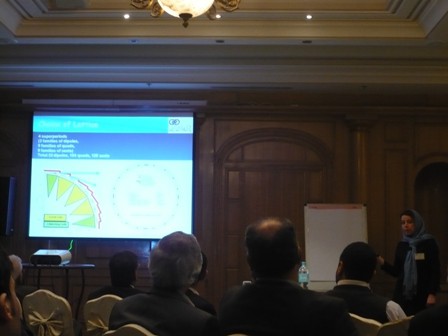
However, a talk given by Shamin Kharrazi at the SESAME users’ meeting also outlined plans Iran has to build its very own synchrotron – the Iranian Light Source Facility (ILSF) – by 2020.

A conceptual design review for the 100 m diameter facility has just been completed and it is estimated that construction will begin by 2015.

Plans for the ILSF, like its Turkish equivalent, are still firmly on the drawing board, but researchers in Iran are hoping the facility will get funding. Kharrazi remarked that around seven years ago synchrotron radiation was not widely known to the authorities in Iran. Now, in a matter of only a few years, the country has plans for its own facility.

Indeed, over the past few years Iran has been building a community of those who could use their own national facility as well as SESAME. At times this has been painstaking and even involved researchers searching via Google for others around Iran who work with X-rays.

Kharrazi reassured SESAME users that Iran will still play an integral part in that project. “We think that by 2020 there will be enough demand for Iran to have its own synchrotron and also use SESAME,” says Kharrazi. “Just like France has the Soleil synchrotron as well as the ESRF.”

Tests begin at new Middle East synchrotron

Work on the Middle East’s first synchrotron light source received a major boost yesterday after scientists began commissioning parts of its accelerator system. The $110m Synchrotron-light for Experimental Science and Applications in the Middle East (SESAME), which is being built in Jordan, is designed to act as a bridge between scientists in the troubled region. However, there are still concerns about a $35m hole in its budget to enable researchers to finish building the 2.5 GeV facility by 2015.

Located about 30 km north of the Jordanian capital Amman, SESAME is being funded by 10 countries: Bahrain, Cyprus, Egypt, Greece, Iran, Israel, Jordan, Pakistan, Palestine and Turkey. It is modelled institutionally on CERN, which was founded in 1954 to act as a link between European countries that had previously been at war.

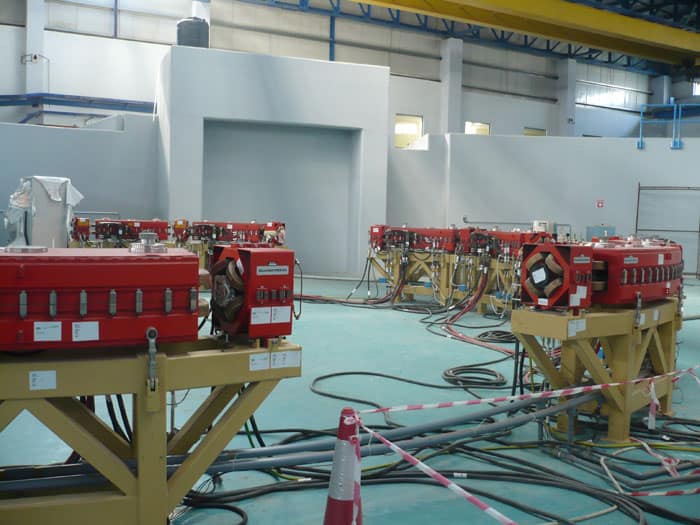
When fully complete by 2015, SESAME will have a circumference of 133 m and accelerate electrons to an energy of 2.5 GeV before making them produce X-rays for a range of experiments from condensed matter to biology. “Rather than just building a new facility, SESAME is more about building a capacity in the region to work with synchrotron radiation,” says Hafeez Hoorani, scientific director of SESAME.

The synchrotron will consist of a “microtron”, which injects elections and accelerates them to 22.5 MeV before sending them into the pre-accelerator ring – with a circumference of 20 m – to further accelerate the particles to 800 MeV. The electrons will then be injected into the main storage ring, which will boost their energy to 2.5 GeV. Both the microtron and the pre-accelerator ring come from the decommissioned BESSY-1 synchrotron in Berlin, Germany, but the storage ring will be bought new.

Money concerns

Yesterday, scientists at SESAME began commissioning of the microtron, testing it at its full operating voltage of 450 keV for the first time. The tests were made possible because most of the facility’s protective concrete shielding is now in place. Early next year researchers will then begin to move the pre-accelerator into position to begin full testing of the microtron together with the pre-accelerator.

However, progress is still hampered by the $35m hole in SESAME’s budget that is needed to buy components, including magnets, for the main storage ring. Researchers are hoping to have at least some of the funding to start buying parts for the storage ring by next year. Funding difficulties have meant, however, that when SESAME comes online, it will have just four beamlines rather than seven as originally planned. Work on the other three will begin only after the facility opens. In total, SESAME will have room for about 14 beamlines.

“Progress is going well in some regards,” says Massaoud Hafouche, who works at SESAME as a beamline scientist for one of the four instruments that will be online when the facility is complete. However, he admits that funding problems are having an impact. “Getting staff to work on the machine is going well, but progress on it is slow mainly because of the lack of money at the moment,” he says.

Mars craft looks set to crash to Earth

Hopes are fading that Russian technicians will be able to fire the engines of the Phobos-Grunt spacecraft, which is currently stuck in Earth orbit. Launched last week, Phobos-Grunt was designed to travel to Mars’ moon Phobos and return up to 200 g of its soil to Earth in a three-year trip. However, the spacecraft’s engines failed to fire once it separated from the launch rocket.

Since then, technicians from Russia’s Roscosmos space agency have being trying to establish contact with the spacecraft in an attempt to fire the engines and send it on its way. However, Phobos-Grunt is currently about 200 km above us in a rapidly decaying orbit – and could plummet to Earth before the New Year.

According to the Russian news agency RIA Novosti, mission scientists say that they have until early December to recover the mission. However, because the spacecraft is not designed to operate in such an orbit, communication is proving difficult. Also, it is possible that Phobos-Grunt’s batteries died before its solar panels deployed, leaving it powerless.

Two-hour warning

NASA satellite expert Nicholas Johnson of the Johnson Space Center in Texas told physicsworld.com that the spacecraft is “anticipated to fall back to Earth in late December”, with the exact time depending on “both the level of solar activity and the attitude/stability of the spacecraft”. He adds that NASA would be able to give only a two-hour warning prior to re-entry with an uncertainty of about 25 minutes either way, thus making it difficult to predict exactly where any debris would land.

Indeed, it is uncertain if the spacecraft will break-up completely during re-entry, or if larger pieces will fall to Earth. “We cannot predict what components might survive re-entry since we do not have sufficient engineering details on Phobos-Grunt,” says Johnson, alluding to a lack of information emerging from Roscosmos about the mission.

In particular, there is some concern about the fate of several tonnes of fuel aboard Phobos-Grunt. Johnson told physicsworld.com that the fuel could reach Earth intact if it is encased in tanks made of a material, such as titanium, with a high melting temperature. However, he believes that aluminium tanks would melt during re-entry, dispersing the fuel. RIA Novosti has reported that the tanks are indeed made of aluminium.

Chinese probe

Phobos-Grunt (which means Phobos-soil) was launched on Tuesday 8 November from the Baikonur launch pad in Kazakhstan on a Zenit-2SB rocket. The craft initially took off successfully and separated from its Zenit launch vehicle, but its own propulsion system then failed and the craft began to veer off course.

Costing a total of $163m, the mission was also carrying a Chinese-built probe called Yinghuo-1. The plan was that the probe would separate from Phobos-Grunt to orbit Mars for 12 months to study the planet’s atmosphere. With a mass of 115 kg, Yinghuo-1 was the first Chinese probe intended for another planet.

Copyright © 2026 by IOP Publishing Ltd and individual contributors