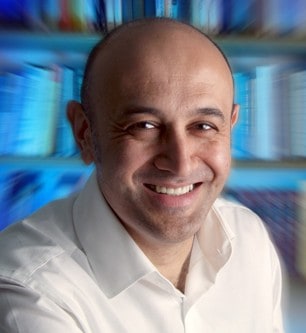
Q&A with Jim Al-Khalili

Jim Al-Khalili

By Margaret Harris
One of the highlights on physicsworld.com last week was an online lecture by the University of Surrey physicist and science communicator Jim Al-Khalili, who spoke on the subject of his recent book Pathfinders: the Golden Age of Arabic Science.

If you missed the live version of Al-Khalili’s lecture “On the shoulders of eastern giants: the forgotten contributions of medieval physicists”, you can watch an archived version of the hour-long event here. Be sure to stay all the way to the end, when Al-Khalili tackles some probing questions from audience members – including one asking why these physicists’ contributions have been forgotten in the West, and another wondering why science declined in the Arabic-speaking world after the medieval period.

As usual with these question-and-answer sessions, we ran out of time long before you ran out of questions. On this occasion, several of the ones we couldn’t fit in were so interesting that we asked Al-Khalili to send us written answers so we could share them with you. Below are his replies.

(more…)

Counting wrinkles reveals pressure

Poking a living cell and counting the number of wrinkles that form could provide scientists with a new way of measuring its internal pressure. That is the claim of physicists in the UK, the US and France, who have shown that the number of wrinkles that appear on a pressurized shell is determined by its internal pressure. The technique could be used to study how cells react to changes in their environment and improve tiny capsules used by the pharmaceutical industry.

If you push your finger into a beach ball, the indentation that you create will include a number of wrinkles that radiate outwards from your finger. However, if you do the same thing with a table-tennis ball, the result will be a much simpler three-lobed geometric pattern (see figure). An important difference between these examples is that the beach ball is pressurized and the table-tennis ball is not.

Dominic Vella of the University of Oxford and colleagues at Northeastern University in the US and the University of Lyon in France thought that this effect could be used to create a new technique for measuring the pressure inside such a shell – without the need to make a hole in it. Now, by using theory, computer simulations and experiments carried out on an exercise ball, they have worked out the relationship between the internal pressure of a shell, its elastic properties and the number of wrinkles that appear when it is prodded.

Pressure threshold

In its work, the team used a commercial software package for finite element analysis (called ABAQUS) to simulate a large shell of aluminium 1 m in radius and 2 mm thick. The simulations were performed at pressure differences between the inside and outside of the shell that ranged from zero to 15 MPa. The simulations suggest that, above a certain pressure, the number of wrinkles can be calculated from the square root of the pressure. Below this pressure, the three-lobed pattern seen in a table-tennis ball is predicted.

The computer simulations agree with both the team’s mathematical derivation of the relationship between wrinkle-number and pressure, and a small number of experiments done on a Pezzi exercise ball.

Vella told physicsworld.com that the team’s findings could be used to study how the pressure inside a living cell changes in response to changes in the local environment, such as the concentration of salt. If the thickness and elasticity of the cell wall or membrane is known, then the internal pressure can be determined by carefully poking the cell with a known force and counting the wrinkles. He also believes that the technique could be used to determine the internal pressures of tiny spherical capsules (about 100 µm in diameter) that are used to deliver drugs.

‘Beautiful’ finding

Pedro Reis of the Massachusetts Institute of Technology in the US describes the work as “an extremely elegant and thorough investigation of wrinkling in thin shells under pressure”, adding that Vella and colleagues’ technique is “beautiful”.

“It is an open invitation for experimentalists, biologists, physicists and material scientists alike, to get to the lab and use this new testing framework as a tool to measure the mechanical properties of synthetic and biological pressurized shells,” he adds.

The research is described in Phys. Rev. Lett. 107 174301.

Plasmonics produces extreme UV light

An international team of researchers has invented a simple way of creating ultrashort pulses of extreme ultraviolet (EUV) light. The system uses a new 3D metallic waveguide, or “nanofunnel”, that coverts pulses of infrared light to EUV.

EUV light has a wavelength of around 5–50 nm, which is about 100–10 times shorter than that of visible light. As a result, ultrashort pulses of EUV light are ideal for studying fundamental physics phenomena – such as how electrons move in atoms, molecules and solids.

However, it is difficult to produce EUV radiation using conventional methods that rely on using amplified light pulses from an oscillator (a source of laser light) to ionize noble gas atoms. The electrons liberated during this process are accelerated in the light field and their surplus energy is freed as attosecond (10–18 s) pulses of light of different wavelengths. The shortest wavelengths of light can then be “filtered out” to produce a single EUV pulse – a complicated process.

Simpler way of making pulses

Now, researchers at the Korea Advanced Institute of Science and Technology (KAIST), the Max Planck Institute of Quantum Optics (MPQ) in Germany and Georgia State University (GSU) in the US have come up with a different – and much simpler – way of doing things.

The new technique works by converting femtosecond (10–15 s) infrared pulses into femtosecond EUV pulses. The process exploits surface-plasmon polaritons (SPPs), which are particle-like collective oscillations that occur when light interacts with a metal’s conduction electrons.

The nanofunnel made by the KAIST-MPQ-GSU team was devised so that it concentrated incident infrared light pulses into a spot that is smaller than the wavelength of the incident light. The funnel is a metallic nanostructure made of silver that contains a hollow hole shaped like a tapered cone. The cone is just a few micrometres long and filled with xenon gas. The tip of the funnel is around 100 nm across.

Concentrating fields

The researchers sent infrared light pulses (at a rate of 75 MHz) into the funnel, which is designed so that it contains patches of metal that are positively charged, followed by patches that are negatively charged. This arrangement produces electromagnetic fluctuations on the inside walls of the funnel, which result in the creation of SPPs. These particles then travel towards the tip, where the conical shape of the funnel concentrates their fields.

“The field on the inside of the funnel can become a few hundred times stronger than the field of the incident infrared light,” explains Mark Stockman of GSU. “This enhanced field results in the generation of EUV light in the Xe gas.”

An important feature of the nanofunnel is that it can be produced at frequencies of up to about 75 MHz. Seung-Woo Kim, team leader at KAIST, where the experiments were carried out, adds: “Due to their short wavelength and potentially short pulse duration, EUV light pulses can be an important tool for exploring electron dynamics in atoms, molecules and solids. Electrons move very fast – on the attosecond timescale – and light flashes that are shorter than attoseconds long are therefore needed to image these particles. Although scientists routinely use attosecond light flashes for such studies, they have much lower frequencies. Our new nanofunnel could change all this.”

The results are detailed in Nature Photonics.

Flux pinning in action

By Hamish Johnston

The above video shows a very nice demonstration of flux pinning in a superconductor. This effect occurs in high-temperature superconductors, which when exposed to a magnetic field will allow some magnetic field lines to penetrate their bulk. This is unlike most conventional superconductors, such as lead, which expel all magnetic field lines.

The field lines inside the superconductor don’t like to move around, which pins the magnetic field in place. The result is that the magnet and the superconductor don’t want to move relative to each other, which is demonstrated in the video.

Exceptions occur when there is a degree of symmetry in the magnet field. This is illustrated nicely by showing that a superconductor will rotate on a magnetic disk but not on a rectangular-shaped magnet. Even better is when the superconductor is placed above โ€“ and then below โ€“ a magnetic track and given a shove.

Supercapacitor electrodes go for a dip

A new and simple “dipping” technique that can significantly improve the performance of supercapacitors has been developed by researchers at Stanford University in the US. The method, dubbed “conductive wrapping”, could be applied to a range of electrode materials. It might even be used to improve next-generation electrodes made from sulphur, lithium manganese phosphate and silicon for use in lithium-ion batteries.

Supercapacitors – more accurately known as electric double-layer or electrochemical capacitors – can store much more charge than a conventional capacitor. This is thanks to a double layer that forms at the electrolyte–electrode interface of such devices when a voltage is applied.

The conductive-wrapping technique can further increase the capacitance of a supercapacitor by boosting the conductivity of the electrodes – which enhances the device’s ability to store charge. Developed by Zhenan Bao, Yi Cui and colleagues, the process involves dipping a composite electrode made of graphene and manganese oxide into a solution containing either carbon nanotubes (CNTs) or a conductive polymer. The CNTs or polymer coat the electrode and boost its ability to store charge by more than 20% for the CNT coating and 45% for the polymer.

Higher specific capacitance

The specific capacitance obtained by the researchers (about 380 F/g) is comparable to other manganese-oxide-based electrodes, which typically have specific capacitances of between 250–400 F/g. However, the hybrid electrodes also show good “rate capability” – which means that they maintain their high capacitance at high charging and discharging rates. This is in contrast to conventional metal-oxide-based electrodes, which usually have poor rate capability because they have low electronic and ionic conductivity.

As a result, the new electrodes can also be used for more than 3000 charge–discharge cycles while retaining more than 95% of their capacitance. When combined with the fact that the electrodes have a much higher specific capacitance than existing commercial carbon-based supercapacitors (150–250 F/g), the conductive-wrapping technique looks promising.

Large-scale energy-storage applications

“The hybrid electrode system we have developed shows promise for large-scale energy-storage applications,” says team member Guihua Yu. “From the perspective of materials selection, both graphene and MnO2 are attractive electrode materials given that both carbon and manganese are cheap and abundant. From a processing point of view, our coating method is solution-based and easy to scale up.”

The researchers are now busy working on improving the performance of the electrodes in lithium-ion batteries using the method. “Our novel approach could be applied to a wide range of energy-storage electrode materials that have high energy density but that show limited performance because of their insulating nature,” says Yu.

The results are reported in Nano Letters.

Ergodic theorem passes the test

For more than a century scientists have relied on the “ergodic theorem” to explain diffusive processes such as the movement of molecules in a liquid. However, they had not been able to confirm experimentally a central tenet of the theorem – that the average of repeated measurements of the random motion of an individual molecule is the same as the random motion of the entire ensemble of those molecules. Now, however, researchers in Germany have measured both parameters in the same system – making them the first to confirm experimentally that the ergodic theorem applies to diffusion.

The experiments developed from the work of Christoph Bräuchle and a team at Ludwig-Maximilians University in Munich, who developed a technique for tracking individual dye molecules dissolved in alcohol that then pass through a nanoporous material. Such diffusion is of more than just academic interest because it plays an important role in a number of technologies, including molecular sieves, catalysis and drug delivery.

Pinpoints of light

To confirm the ergodic theorem, Bräuchle’s team tracked the molecules by illuminating the sample with light. This makes the molecules fluoresce so that they appear as pinpoints of light when viewed using a high-powered optical microscope. By using dye molecules at very low concentration, the researchers ensured that each point of light corresponded to just one molecule. So, by measuring the intensity profile of a point and finding its centroid, the Munich team was able to determine the position of a dye molecule to within about 5 nm. Individual molecules could then be followed as they moved through the sample by taking a series of snapshots.

Meanwhile, a team led by Jörg Kärger at the University of Leipzig used a nuclear magnetic resonance (NMR) technique to track the diffusion of all the dye molecules in a similar sample. The pulsed-field-gradient NMR method is sensitive only to the collective motion of all the dye molecules and cannot determine individual molecules. Comparing the results from the two groups showed that the average of many measurements of the diffusivity of individual dye molecules (as measured in Munich) was identical to the collective diffusivity of the dye molecules (as measured in Leipzig). Given that diffusion involves the random motions of molecules, the study therefore confirms the ergodic theorem.

Conflicting requirements

Bräuchle told physicsworld.com that the main challenge was to find a system that could be studied using both techniques. The fluorescence method works best when the dye concentration is extremely low and the molecules move very slowly – whereas the NMR measurements need much higher concentrations and faster motion. The compromise involved using a special microporous material that slowed down the molecules and constrained them to a plane so that they were easier to track with the microscope. In addition, the dye concentration in the NMR experiments was about 10 times greater than that used for the fluorescence measurements.

Now that the researchers have worked out a way to confirm the ergodic theorem, they are keen to use the technique to search for systems that do not obey the theorem. Bräuchle believes that this could occur when some molecules diffuse through living cells – something that could have important implications for how drugs are designed.

The research is described in Angewandte Chemie.

Which is the most significant popular-physics book?

By James Dacey

hands smll.jpg

Last Friday we expanded our coverage of the literary world with the release of the debut Physics World books podcast. The programme looks at the topic of “women in science”, and it is the first in a series devoted to physics books and the issues they cover.

I personally believe that reading about the history, the personalities and the issues surrounding science can be just as inspiring as doing the science itself. But we want to know what you think. In this week’s poll, we are looking specifically at popular science and the books that may have inspired your interest in physics. The question is:

Which do you believe is the most significant popular-physics book?

A Brief History of Time Stephen Hawking
The Elegant Universe Brian Greene
A Short History of Nearly Everything Bill Bryson
Longitude Dava Sobel
The Physics of Star Trek Lawrence Krauss

To cast your vote, please visit the Physics World Facebook page.

These five titles have been taken from a list drawn up in 2008 by the Physics World editorial team to celebrate the most significant popular-physics books of the past 20 years. As we acknowledged at the time, our criteria for selecting these books was, by necessity, highly subjective. So if your favourite book is not included then please let us know by posting a comment on the Facebook poll.

In last week’s poll we looked at the issue of carbon emissions and personal behaviour. My colleague, Tushna Commissariat, had recently attended a talk by James Hansen, the US space scientist who is also well known for his advocacy of action to limit the impacts of climate change. A member of the audience had challenged Hansen on his decision to fly to the UK to talk about the need to rapidly reduce fossil fuel consumption. Hansen replied that it is already too late for his minor sacrifice to make a significant difference, and that the more important thing is to communicate the message that urgent government action is required.

We asked you the following question: Would you consider not attending a conference because it would involve a flight? And it seems that the majority of respondents share similar sentiments to Hansen, with 51% choosing the option No. My sacrifice would have no useful impact. A smaller number of people, however, may be inclined to take action, as 26% of respondents selected Possibly. I try to significantly limit my air travel. 18% of respondents said that I would take another means of transport, even if it drastically increased my travel time. And just 5% said that Yes. I would not attend, even if it could hurt my career.

And in a busy week on our Facebook page we also wanted to hear from you about a new development in astronomy. The Very Large Array, the famous bank of radio telescopes in New Mexico, is about to be renamed following an upgrade, and the National Radio Astronomy Observatory (NRAO) is asking the public to come up with ideas. We encouraged you to enter the NRAO competition, and then share your ideas on our Facebook page.

We’ve seen some creative suggestions! My two favourites were: the Eyes of Hope, suggested by Helmy Parlente Kusuma in Indonesia; and Contact, suggested by Velin Ivanov in Bulgaria. It appears that the facility’s biggest fan is Kyle Murphy in the US – he believes it should be renamed the Serious Gravitas Array because “everything about this scientific achievement is awesome”. Thank you for all your contributions.

Opportunities lost

Nancy Marie Brown’s The Abacus and the Cross is a book with a hero and a villain. The hero is Gerbert of Aurillac, a 10th-century shepherd boy who became a monk, schoolmaster, scientist, mathematician and abbot before reigning at the turn of the first millennium as Pope Sylvester II. Gerbert is the first person in the Latin world known to have used Arabic numerals and the place-value system of counting. His much-used textbook on geometry was not supplanted in the West until 200 years after his death, when full translations of Euclid became available. He designed his own abacus and constructed such instruments as armillary spheres, which were used to represent important celestial circles such as the ecliptic, along with astrolabes, which were used to tell the time and latitude, and to predict the positions of heavenly bodies.

The villain is Gerbert’s lifelong intellectual and political enemy, Abbo of Fleury. Like Gerbert, Abbo became monk, schoolmaster, scientist, mathematician and abbot. Though he was never pope, he has been named a saint, whereas Gerbert’s legacy has been complicated by his popular reputation as a sorcerer. For Brown, a science writer and journalist, the most crucial difference between Gerbert and his nemesis Abbo is that the former showed great creativity, introducing a whole new tradition in mathematics and science in a manner that was distinctively modern and “experimental”. Abbo, in contrast, was much less creative: Brown describes the copious written works he left behind as “disappointingly derivative”, involving merely “well-organized rearrangements of sources commonly used” to create a “fine and tidy summation”.

Brown’s approach in this book is more Abbo than Gerbert. While she provides a good, lively, readable synthesis of scholarly evaluations and translations of the primary source materials, her ample endnotes show little evidence of direct work with primary sources from Gerbert, Abbo or their contemporaries. As Brown observes, not much remains of Gerbert’s own writings, so evidence for his genius can be inferred only indirectly, by tracing how his knowledge spread to his students. She compensates for the lack of documentary evidence by describing what life would have been like for someone like Gerbert. For example, she discusses in vivid detail the typical diet, style of life and pattern of education of a monk; the manufacture and use of parchment, paper and ink; the construction and use of books; and the processes and dangers involved in travel.

Brown’s account of Gerbert’s accomplishments in mathematics and science whets the appetite, but it may not satisfy readers with a scientific background, who will expect to learn in greater detail what was distinctive about Gerbert’s abacus, and how he used it. Her discussion of Gerbert’s complicated political entanglements and ascent to the papacy may be difficult to follow for readers who lack previous familiarity with turn-of-the-millennium history and political intrigue, particularly because she focuses more on what happened (with many names and dates) than on why. A specific point of frustration is her account in chapter 9 of Gerbert’s “figurative poem”. Brown communicates that it was an extraordinary accomplishment, marvellously complex and well worth exploring, but she does not help her reader enter into the poem and its complexities: she sets the table, but she does not serve the meal.

Three themes run through this book. First, Gerbert’s work in mathematics and science serves to show that the European Dark Ages were not that dark after all: creative things were happening, knowledge was advancing, and mathematics and science were already rational and experimental. For Brown, Gerbert served as an important conduit to the West of mathematical knowledge and insight from the Arab-speaking world. The second theme is that science and religion are not (and were not) really at war. Gerbert is an important example of a religious person who did first-rate work in mathematics and science. It was only much later that Petrarch, Washington Irving, William Whewell, John Draper and Andrew Dickson White popularized the whiggish notion of eternal war between science and religion, by circulating the charge that religious people persisted in the uncritical belief that the Earth is flat, not round – a version of history that Brown is at pains to refute.

The third theme of the book is the ways in which history could have been different. If only Gerbert’s hopes and ideals had been realized, Brown argues, religion and science would be more closely linked, and science would bridge the tensions and differences that separate Christianity, Islam and Judaism. But the death of Emperor Otto III in the year 1002 thwarted the plans and ambitions of Gerbert, who had relied on the emperor’s support to become pope in 999. After Gerbert’s own death in 1003, his “enlightened” dark age gave way to a world of deeper darkness: a world dominated by apocalyptic fear, religious intolerance and crusades; a world in which the idea of a scientist–philosopher pope was no longer thinkable; and a world in which Christian and Jewish scholars were no longer able to work together to translate Greek and Arabic scientific texts.

The Abacus and the Cross represents an intellectually honest, good-faith effort to portray Gerbert and his accomplishments for a popular audience. But both scientifically and theologically minded readers may echo Brown’s plaint of “what might have been”. If only she had gotten more deeply into the scientific issues – it would have been interesting, for example, to hear in some technical detail how Gerbert’s abacus actually worked, or how his “figurative poem” played out on multiple levels of meaning. And if only she had entered into some of the relevant theology – it seems strange that a book which is concerned to debunk the notion of a “war” between science and religion does not address any theological issues, but Brown deals with religion only as an institutional and sociological force. In this book, the only place the Cross shows up is in the title.


On the shoulders of eastern giants: the forgotten contributions of medieval physicists

We learn at school that Newton is the father of modern optics, Copernicus heralded the birth of astronomy and Snell deduced the law of refraction. But what debt do these men owe to the physicists and astronomers of the medieval Islamic Empire? What about Ibn al-Haytham, the greatest physicist in the 2000-year span between Archimedes and Newton, whose Book of Optics was just as influential as Newton’s seven centuries later? Or Ibn Sahl, who came up with the correct law of refraction many centuries before Snell? What of the astronomers al-Tusi and Ibn al-Shatir, without whom Copernicus would not have been able to formulate his heliocentric model of the solar system? In this lecture, Jim Al-Khalili recounts the stories of these characters and more from his new book Pathfinders: the Golden Age of Arabic Science.

Date: Thursday 20 October 2011

Speaker: Jim Al-Khalili
Jim Al-Khalili is a physicist, author and broadcaster. He is professor of physics and also professor of public engagement in science at the University of Surrey, UK. As well as his work on radio and television, he has written a number of popular-science books, the most recent of which is Pathfinders: the Golden Age of Arabic Science. His awards include the Royal Society Faraday Prize (2008), the IOP Kelvin Medal (2011), an OBE in 2008 and a Bafta nomination.

Moderator: Dr Margaret Harris, reviews and careers editor, Physics World

Virus helps build new materials

Scientists in the US have used a common virus to produce materials that resemble skin and bone. In addition to providing new insights into how such materials develop in the natural world, the work also brings synthetic production of tissue in the laboratory closer to reality.

In nature, completely different materials are often assembled from many copies of the same basic molecule such as a protein. Collagen type I, for instance, is a protein molecule that can combine with various other chemicals to form skin, bone or even eye tissue. This process is called self-templating because individual molecules are not assembled according to an external template. Instead, thermodynamic factors such as temperature and solution concentration are controlled to ensure that the desired configuration is the one that is energetically favoured.

Scientists are keen to mimic these processes – but the extreme sensitivity to thermodynamic factors that drives self-templating makes such molecules extremely difficult to work with in the lab. Indeed, it remains a mystery how nature can achieve the precision control that has so far eluded the laboratory chemist.

Going viral

An elegant solution to this problem is to use the M13 phage as a base unit, rather than a molecule such as collagen. M13 is a virus that attacks E. coli bacteria but is harmless to humans. It is relatively easy to grow and control in the lab because its protein coat can be manipulated by genetic engineering – a trick discovered by Seung-Wuk Lee, Angela Belcher and colleagues at the University of Texas at Austin in 2002.

In this latest work, researchers led by Lee, now at the University of California, Berkeley, and the Lawrence Berkeley National Laboratory, have looked at the physical conditions under which different molecular structures would form from genetically modified M13 viruses. They started with solid plates immersed in a virus-rich salt solution and carefully drew the plates out of the solution, allowing the salt solution to evaporate, leaving a thin film of viruses on the plates.

As the concentration of the virus solution was increased, so too did the complexity of the patterns on the plates. At concentrations of 0.1–0.2 mg/ml, the researchers saw a simple alternating pattern of ridges and grooves. However, at a concentration of 6 mg/ml, the patterns on the plates showed much more complex, long-range order that the researchers say is reminiscent of dried ramen noodles.

Pulling noodles

The researchers also investigated the effect of extraction speed. They found that the optical properties of these “ramen-noodle-like” structures varied quite distinctly depending on how fast the plate was withdrawn from the solution. Increasing the pulling speed from 50 µm/min to 80 µm/min reduced the peak reflected wavelength of one film from 490 nm to 388 nm. The scientists point out that natural materials with such wavelengths are what give some bird feathers and beetle shells dazzling structural colour.

The team produced bulk 3D structures by using their films as substrates on which to grow cells. The cells grew differently on different films. On one substrate, the scientists even managed to grow mineralized tissue similar to tooth enamel.

Lee underlines that his group does not claim to have replicated the processes used to produce these materials in the natural world – something that is still poorly understood. “We believe the actual process of how nature produces these materials is very far from our process, but the important thing is that we begin to test the importance of the kinetic factors and then begin to engineer, and very closely mimic, the structures that nature produces,” he says.

Belcher, who now works at the Massachusetts Institute of Technology and was not involved in the recent work, is impressed. “I think the most exciting aspect of this work is the ability to use a genetically tunable single molecular building block to finely control the self-templating and assembly of materials over multiple levels of organization. The researchers then exploit this ordering for a diverse set of applications. This system should be readily adapted to other applications and materials,” he says.

The research is described in Nature.

Copyright © 2026 by IOP Publishing Ltd and individual contributors