Subluminal neutrino news from Italy

icarus.jpg
By Hamish Johnston

Physicists were buzzing last month when scientists at the OPERA experiment in Italy hinted that neutrinos may move faster than the speed of light. If you missed all the excitement, the experiment measured the time it takes the particles to travel 730 km from CERN in Switzerland to Gran Sasso in Italy – and came up with a relativity-defying result.

Although there was much coverage of the “Was Einstein wrong?” sort in the popular media, I suspect that most physicists were quietly thinking “there must be something wrong with the experiment”. Others have been more vocal, with nuclear-physicist-turned-TV-presenter Jim Al-Khalili famously declaring that he will eat his boxer shorts if it turns out to be true.

Well, it looks like Jim won’t be tucking into his briefs any time soon because new data from OPERA’s sister experiment ICARUS have failed to yield any evidence for superluminal neutrinos. More precisely, ICARUS has shown that neutrinos travelling from CERN to Gran Sasso do not emit electron–positron pairs. Emission of such pairs is expected if the neutrinos travel faster than the speed of light, according to a preprint published recently by Andrew Cohen and Sheldon Glashow.

The emission of electron–positron pairs would have a noticeable effect on the energy distribution of neutrinos arriving at both OPERA and ICARUS, but now neither experiment has seen evidence of it.

OPERA’s superluminal result is based on the time it took for neutrinos to travel the 730 km – and now this speed measurement contradicts both the OPERA and ICARUS energy-distribution measurements.

I should point out that the Cohen–Glashow paper has yet to pass peer review (as far as I can tell). However, the preprint seems to meet with the approval of physicists who have blogged about it – and the ICARUS collaboration repeatedly uses the word “must” to describe the effect. And the fact that one of the authors is a Nobel laureate must give it additional kudos.

If you haven’t yet had your fill of superluminal neutrinos, the BBC will be airing a television programme on that very subject tonight. It will be hosted by the mathematician Marcus du Sautoy and you can find more details here.

UPDATE: The Cohen-Glashow paper has been accepted for publication in Physical Review Letters.

Famous physicists on the BBC

randall.jpg

By Hamish Johnston

If you happened to be listening to BBC Radio 4 last night, you would have heard interviews with two famous American physicists. First up was Lawrence Krauss of Arizona State University, who is in London to give a lecture on Sunday about our relationship with the cosmos.

Krauss chatted with Quentin Cooper – host of Radio 4’s Material World science programme – about physics in the news, including dark energy, superluminal neutrinos and quasicrystals. You can listen to the programme here and Krauss appears after about 15 minutes.

Next up was cosmologist Lisa Randall (right) of Harvard University, who spoke with Radio 4’s Andrew Marr on his Start the Week programme – which this week was entitled “God and science” and also featured Richard Dawkins and the Chief Rabbi of England, Jonathan Sacks.

Dawkins kicked off with a discussion of his new book entitled The Magic of Reality: How We Know What’s Really True, which aims to show children and their families that the myths surrounding phenomena such as earthquakes and rainbows pale in comparison with the magic and wonder of science. Particularly interesting was Dawkins’ argument that space aliens must have eyes.

Randall speaks about her latest book Knocking on Heaven’s Door about 25 minutes into the programme, which you can listen to here. Earlier this year, she also spoke to our very own Michael Banks, and you can listen to that interview here.

Three electrons for the price of one

Researchers have created a new material that can produce three or more free electrons every time it absorbs a single photon. This is unlike conventional semiconductors, which produce just one free electron per photon. Based on tiny semiconductor structures called quantum dots, the new material – developed by researchers at Delft University of Technology in the Netherlands and Toyota Europe in Belgium – could someday be used to make more efficient solar cells.

Solar cells work by absorbing photons, each of which liberates an electron and positively charged hole that travel in opposite directions, thereby creating a voltage and current that can do work. However, when an electron is liberated, a lot of its kinetic energy is lost to the semiconductor as heat, rather than being available as useful electrical energy. Researchers are therefore keen to develop new materials in which some or all of this energy is captured rather than wasted.

One way of capturing this energy is to use thin films of quantum dots in which the energy needed to liberate an electron can be fine-tuned by adjusting the size of the dots. An electron can therefore liberate more electrons as it travels through a dot in a process known as “carrier multiplication”. Unfortunately, this approach does not involve truly free electrons and holes – but rather excitons, which are bound pairs of electrons and holes. Although excitons can be separated into free charges by applying an electric field or connecting the dots to another semiconductor material, both techniques reduce the efficiency of the devices.

Now, Michiel Aerts and colleagues have made a film of quantum dots in which carrier multiplication occurs with free electrons, rather than excitons. The quantum dots are each about 5 nm in diameter and are made from the compound-semiconductor lead selenide. The films themselves are made by dipping quartz substrate into a solution of the dots.

Stable, yet conducting

One challenge for Aerts was to make sure that electrons can move easily between individual quantum dots. This is normally a problem because the nanoparticles have to be coated with an electrically insulating organic layer to prevent them from degrading while the film is being made. So, what Aerts and colleagues did was to work out a way to remove the organic layer of the dots in the film so that conduction can occur.

The carrier-multiplication process begins when a photon is absorbed by a quantum dot, which liberates an electron and hole that can then travel into adjacent dots to liberate further electron and holes. Using a technique called time-resolved microwave conductivity (TRMC) to measure the conductivity of the films, the team was able to show that – on average – about three free electrons are created per photon when the films are illuminated with 400 nm ultraviolet light. This wavelength is right on the edge of the visible spectrum and therefore abundant in sunlight.

Aerts told physicsworld.com that the team now wants to try to make solar cells from the films. In theory, such solar cells could achieve efficiencies of 44%, compared with the theoretical limit of 35% on conventional silicon cells. Although the quantum-dot films are relatively cheap and easy to produce, making devices out of them is not easy. Apart from lead selenide being a toxic material, the quantum dots deteriorate quickly when exposed to air.

The research is described in Nano Letters 10.1021/nl202915p.

Listen to our debut books podcast

PW books podcast


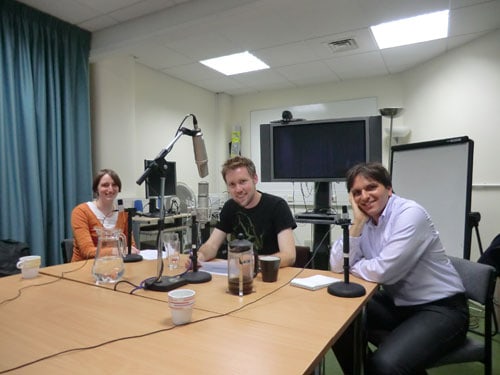
Physics World podcasters. Left to right: Margaret Harris, James Dacey, Matin Durrani

By James Dacey

Followers of this blog may remember that a little over a month ago, I wrote an entry about how I had just been in the studio with my colleagues, Matin and Margaret, to record a special podcast about physics books. The theme of the podcast – our first ever – was “women in science” because all the books that we discussed were in some way connected to this theme. Well, after various discussions and good chunk of time spent in the editing suite, the programme is finally available to listen to online. You can also subscribe to our podcast service.

In the show, we discuss the following titles:

The Madame Curie Complex by Julie Des Jardins;
Discoverers of the Universe: William and Caroline Herschel by Michael Hoskin;
Science Secrets: the Truth About Darwin’s Finches, Einstein’s Wife and Other Myths by Alberto Martinez; and
Soft Matter: the Stuff that Dreams are Made Of by Roberto Piazza

In our next podcast, to be released in December, we will be discussing a selection of our favourite books reviewed in 2011, and announcing Physics World’s top 10 books of the year. In the meantime, you can continue to read book reviews each month in Physics World and on physicsworld.com.

Six rules for nano-design

One of the big challenges facing nanotechnology researchers is understanding how particles interact at the nanoscale, in order to design devices that are robust and reliable. Now, a group of scientists in the US has formulated a set of basic rules that could help in this task.

Chad Mirkin and colleagues at Northwestern University have looked specifically at the case of nanostructures formed by gold nanoparticles connected into lattices using DNA. However, they say that the findings should apply to any type of spherical nanoparticle that can be densely packed and connected via DNA.

The aim of the research was to determine the rules that lead to specific interactions between the gold particles and the DNA, and to build profiles of the resulting nanostructures. Using small-angle X-ray scattering, Mirkin’s team determined the structural characteristics for 41 different crystals that had adopted one of nine lattices. The researchers learned that for each structure, they could tune lattice parameters such as size and stability by modifying nanoparticle sizes and the length of the DNA connecters. The methods used to create specific lattices are condensed into a set of six basic rules – which are outlined in a paper in Science.

Playing with marbles

“Imagine having a bunch of marbles of different colours, let’s say red, yellow and green. We can take those tiny structures and attach DNA to them and get the reds to go to certain spots, and the yellow and the green to go to certain spots, with sub-nanometre precision,” says Mirkin. The Northwestern researcher explains that, in theory, these rules could be followed to build any sort of crystal lattice. The work, the researchers say, will make it easier to fabricate nanotechnologies, such as solar cells with nanoparticle arrays designed to harvest light at far higher efficiencies than current technologies permit.

“The most innovative aspect of the research is the possibility of designing nanoparticle crystals à la carte,” says Alex Travesset, a materials scientist at Iowa State University in the US. Travesset believes that, in the medium term, the set of rules could help in the design of new sensors and improved catalysis systems.

Oleg Gang, a bio-nanomaterials researcher at the Brookhaven National Laboratory, also believes that these rules could help in the development of a wide range of applications – including solar-energy harvesting. “In the longer term, these materials will definitely impact all fields of our life, like polymers did in the second half of the last century,” he says.

Women in science: a books special

The shows – the first of which you can hear above – are designed to uncover the stories behind the stories, as they will look at the themes present in some of the books recently reviewed in Physics World and on physicsworld.com. Presented by reporter James Dacey, alongside Physics World‘s editor Matin Durrani and the magazine’s reviews editor Margaret Harris, the shows will also include interviews with some of the authors of the books being reviewed, who will discuss the ideas and inspirations behind their latest publications.

Our first programme considers the theme “women in science”. The show begins with an interview with the feminist historian Julie Des Jardins about her book The Madame Curie Complex [running time 1.38]. Des Jardins offers some fascinating ideas about the sort of challenges that women face when considering a career in science, and why Curie is as much a hindrance as an inspiration.

Following on from this, Margaret provides an interesting historical overview of the brother–sister astronomy pairing of William and Caroline Herschel, as told in Michael Hoskin’s book Discoverers of the Universe [running time 8.44]. Harris describes how the Herchels, who hailed from Germany, went to work in England in the late 18th and early 19th century with Caroline helping William to become of one the most influential astronomers of all time. Harris discusses how, historically, this male-leader–female-assistant relationship represented one of the few ways that women could participate in science.

The sexist norms of the period kept Caroline Herschel in her brother’s shadow for much of her life. But can a similar case be made for the early 20th-century physicist Mileva Maric – better known as Albert Einstein’s first wife? In his book Science Secrets: The Truth About Darwin’s Finches, Einstein’s Wife, and Other Myths, Alberto Martinez argues that this assertion, along with many other popular stories in the history of science, is likely to be false. But the truth, he argues, is no less interesting. The Physics World presenters discuss the merits of Science Secrets and whether Martinez could ever be successful in his mission to debunk some of the common myths of popular science [running time 10.55].

The final book under discussion is Soft Matter: the Stuff that Dreams are Made Of by Roberto Piazza [running time 13.54]. The connection to the women in science theme is perhaps less obvious than with the other titles but it is there, and for some reason the book managed to really irritate Matin.

In the next podcast to be released in December, the Physics World team will be discussing a selection of their favourite books reviewed in 2011, and announcing the magazine’s top 10 books of the year. In the meantime, you can continue to read book reviews each month in Physics World and on physicsworld.com.

Nanotube muscles twist and turn

An international team of researchers has invented a new type of artificial muscle that is made from carbon-nanotube threads. The new structures differ from other artificial muscles in that they can twist and turn very quickly.

The new threads could play an important role in technologies that require mechanical movement but where space is limited, says Geoff Spinks from the University of Wollongong in Australia, who was involved in the work. Examples include microfluidics, valves and robotics. The development will be welcomed by nanotechnologists, who have struggled to create nanoscale mechanical actuators. New ideas are required because it can be difficult to build tiny versions of conventional devices – and even when it is possible, such miniature versions often perform poorly.

The muscles, made by a team led by Spinks and Ray Baughman of the University of Texas at Dallas, are composed of thin carbon-nanotube threads, or “yarns”. Carbon nanotubes are themselves hollow cylinders of rolled up carbon sheets, which can be just one atom thick. Key to making the torsional structures is twisting the carbon nanotubes as they are made into a thread, explains Spinks. “The twisting produces a helical structure of intertwined carbon nanotubes,” he says.

Unwinding with a twist

The researchers take lengths of the nanotube thread and partially immerse them in an electrically conducting liquid (or electrolyte). They then hold each end of a thread firmly and connect one end of it to a power supply such as a low-voltage battery. When the power is applied, the thread absorbs some of the liquid and swells. The pressure subsequently produced by the swelling causes the twisted structure to partially unwind, thus creating a rotating action similar to that seen when stretching a helical spring. The structure can be made to rotate in the opposite direction by decreasing the applied voltage.

The team observed the rotation by attaching a plastic paddle to the thread. They found that they could produce rotations of about 250° per millimetre of thread length. This value is roughly 1000 times larger than those observed in previous torsional artificial-muscle systems that are based on ferroelectrics, shape-memory alloys or conducting organic polymers, claims Spinks. And that is not all: the output power per unit mass of the yarn already rivals that of conventional electric motors.

“Carbon nanotubes, which are normally stiff and strong but that have been made more flexible by spinning them into yarns, are ideal for making such muscle-like structures because they have good electrical conductivity,” adds Spinks. “Our work also shows that we can efficiently charge the thread with just a few volts of electricity, and that the threads are strong enough to sustain large weights – for example, the plastic paddle we attached is nearly 2000 times heavier than the thread itself.”

Propelling microrobots

The structures could be useful in applications such as microfluidic pumps, valve drivers and mixers. Indeed, the set-up used by researchers (a plastic paddle attached to the rotating yarns) is a simple mixer in its own right. Mixing fluids on the micro- and nano-scales is difficult but will be crucial for lab-on-chip diagnostics, for example. “Other likely applications are difficult to predict, but we are fascinated by the possibility of using our torsional muscle like a flagellum that would propel a microrobot in the same way it propels a bacterium,” says Spinks.

The team – which also includes scientists from the University of British Columbia in Canada and Hanyang University in Seoul, South Korea – now hopes to study the muscle-like structures in more detail and optimize the yarn geometry. It also hopes to produce even better performing carbon-nanotube torsional muscles by adjusting twist angle and diameter.

The work is reported in Science.

Irish folk meets particle physics

By Matin Durrani

The guys who in 2008 came up with the annoyingly catchy “There’s no-one as Irish as Barack O’Bama” – more than a million hits on YouTube and counting – have re-recorded their song with new lyrics describing the latest mystery in particle physics.

Jumping on the huge interest in claims that neutrinos may travel faster than light, the musicians, known as the Corrigan Brothers and featuring someone called Pete Creighton, have called their new version simply “The neutrino song”.

The song’s not bad if cheesy synths and breezy pop are your thing, although it does that awful thing of going up a key near the end, which is a pet hate of mine.

But as I’ve learned to expect from a string of recent physics-meets-pop disasters, it’s the lyrics that will make your toes curl up.

I won’t spoil the lyrics by reprinting them here in full except to warn you of what is possibly the worst rhyme ever in the history of physics:

Now physics for ever may not be the same
And boffins are gonna be driven insane
If light’s not the fastest
What can this mean-o
And is something faster than the neutrino.

Would you consider not attending a conference because it would involve a flight?

By James Dacey

hands smll.jpg

As you may have just read in Tushna Commissariat’s account, on Monday and Tuesday scientists gathered at the Royal Society’s headquarters in London for a meeting about the Earth‘s climate history. One of the speakers at the event was James Hansen, a highly respected US space scientist, who is also well known for his advocacy of action to limit the impacts of climate change. In his talk, Hansen argued that – based on recent observational data – rapid reduction of fossil fuel consumption is essential if we are to avoid environmental catastrophe.

Following his talk, Hansen was asked the inevitable question of whether he saw any conflict of interest in his taking a transatlantic flight to deliver a lecture on the importance of cutting greenhouse gas emissions. His response was to say that at this stage it is already too late for this sort of minor sacrifice to make a significant difference, and that the more important thing is to communicate the message that urgent government action required. Hansen argued that the key to avoiding further rapid warming is for policy makers to establish high taxes on carbon emissions, which would act as an incentive for the development of green energy technologies.

But we want to know your opinion on this in relation to your professional life. Would you consider not attending a conference because it would involve a flight?

Yes. I would not attend, even if it could hurt my career.

No. My sacrifice would have no useful impact.

Possibly. I try to significantly limit my air travel.

I would take another means of transport, even if it drastically increased my travel time.

Please have your say by visiting our Facebook page and taking part in this week’s poll. And feel free to post a comment on the poll to explain your answer.

In last week’s Facebook poll we looked at the issue of financing large-scale science projects such as CERN’s Large Hadron Collider or the ITER project – the world’s largest experimental tokamak nuclear-fusion reactor, under construction in the south of France. We asked whether, in general, you think that “big science” facilities are value for money? 49% of respondents answered that yes they are worth the money, with just 3% answering no. The remaining 48% selected the measured option of “depends on the project”.

Craig Levin, one of our Facebook followers based in Chicago, Illinois, who voted yes, believes that funding agencies must look beyond the scientific goals of a project when making decisions. He commented that “one also has to take into account the return on investment and economic impact that these programmes can have on the economy, not just the scientific discoveries”. Marios Barlas, a follower based in Patrai, Greece, who also voted yes, takes a more Promethean view of science, commenting that “science never goes to waste. Be it theoretical or applied medical or humanitarian. There is always something to gain even out of utter failure.”

'A different planet'


NASA’s Dr James Hansen (Courtesy: Greenpeace)

By Tushna Commissariat

This Tuesday I was in London meeting some exciting and important people in science. While you will have to wait until tomorrow to find out who I met with in the morning, in the afternoon I went along to the closing lecture at Royal Society’s paleoclimate conference Warm Climates of the Past – a Lesson for the Future?. The lecture was given by Dr James Hansen – the head of the NASA Goddard Institute for Space Studies who has been very vocal on the subject of climate change since the 1980s.

In “Earth’s climate history: lessons for the future” Hansen spoke about how observations of past climates coupled with current-day observations suggest that hard-hitting and immediate measures need to be put in place to avoid further global destruction. Rapid reductions in the use of fossil fuels are the best way to do so, he argued.

Hansen began his talk by saying that our basic understanding of the Earth’s paleoclimate history should depend more on global “real-world” geological observations, rather than climate models and theories. He feels that the Earth’s history provides the information that is necessary to better understand climate change today and that researching “climate sensitivity” at any given point depends on the timescale taken into consideration and the “climate state” at that given time.

Hansen went on to say that when some generally “intelligent people” say that the Earth has been a lot colder or warmer in the past, he is quick to point out that he doesn’t think that the global mean temperature was ever more than a degree higher, as far back as the last glacial period.

He categorized the three main factors affecting the global climate over the past 65 million years and presented the amount of warming change they would cause in Watts/m2:

*external effects (solar irradiance): +1 W/m2

*surface effects (continental location – geological changes): ~1 W/m2

*atmosphere (CO2 change): >10 W/m2

He pointed out that the natural change in CO2 has been steady at about 0.0001 ppm/year, whereas the human-generated rate today is at about 2 ppm/year. He also showed that the sea level has been rising at about 3 m per millennium, as compared with the near-constant level it has maintained for the past 6000–7000 years. His hard-hitting statement that “Humans could produce ‘a different planet’” makes it clear that he feels very strong measures need to be put in place to preserve the planet as we know it.

His main suggestion to achieve a more stable climate was a drastic cut in the use of fossil fuels worldwide, by levying high taxes on their use. “We cannot burn all the fossil fuels and yet our governments go along with that,” he said. “A solution has to be a gradually rising carbon tax.” He went on to explain that such a tax would mean that fossil fuels derived from tar sands, for example, would almost immediately stop as it would not make economic sense and that coal would follow soon after. He also feels that such a tax would go a long way toward making clean fuel sources the norm. “Rapid reduction of fossil-fuel emissions is required to succeed in preserving a planet resembling the one that civilization developed,” he said.

On a similar note, a recent Physics World opinion piece, titled “How big is your footprint?” and written by astrophysicist Phil Marshall of the University of Oxford, talks about how physicists carry the responsibility to reduce their own carbon footprints. These can be considerable when you consider the amount of energy that is required to run physics facilities or fly across the Atlantic frequently for conferences. For example, he points to CERN’s Large Hadron Collider energy bill – estimated at about €10m per year – comparable to that of all the households in the region around Geneva. He estimates that US astronomers use an additional 130 kWh per day more than the average citizen.

Marshall also talks about a workshop in Lund, Sweden, this week, where researchers are discussing energy for sustainable science to identify ways to do large-scale physics research with a reliable, affordable and sustainable energy supply that is “carbon neutral”. To read about that and maybe take a look the wiki Marshall runs for green-minded astronomers, take a look here.

Copyright © 2026 by IOP Publishing Ltd and individual contributors