Ultrafast interference technique makes a splash

Physicists in the US have developed a new imaging technique that has allowed them to observe the splashing process in great detail. They used the method to look for an air gap that was believed to form when a liquid drop strikes a solid surface, causing tiny droplets to splash out. While they did see such a gap form, they were able to conclude that it is not responsible for splashing – at least in the water–glycerol drops studied.

For more than a century, physicists have used high-speed photography to capture often-beautiful images of the splashes that occur when a liquid drop strikes a solid surface and produces a ring of smaller droplets. However, this beauty belies the complex physics underlying splashing and successive generations of physicists have struggled to understand the process – which is important in practical pursuits as diverse as spray-painting and pesticide application. In 2005 Sidney Nagel and colleagues at the University of Chicago added to the mystery by discovering that a reduction in the ambient air pressure reduces the amount of splashing. This seemed counterintuitive because it had been thought that greater air pressures would tend to hold the drop together, while lower pressures would allow it to break up into a splash.

One proposal put forth by Michael Brenner and colleagues at Harvard University is that air gets trapped under the drop when it nears the surface – and it is this thin layer of air that causes the splash. The lower the pressure, the less trapped air and therefore the splash should be smaller. Others, including Nagel, believe that splashing is driven by interactions between liquid and air at the edge of the drop as it flattens and spreads out on the surface. Now, however, Nagel and Michelle Driscoll have come up with a new technique to monitor how much air is trapped under a drop. Their measurements suggest that trapped air has nothing to do with making the splash, at least for the liquids they studied.

Mind the gap

Their technique is based on an established method for measuring the thickness of very thin films. Monochromatic light from an LED is fired at the drop as it flattens on the surface. Some of this light reflects from the surface and some from the interface between the liquid and the trapped air. The result is an interference pattern from which the thickness of the air gap can be deduced. The challenge for Driscoll and Nagel was to capture this pattern in real time – with particular emphasis on the first few hundred microseconds, which proved to be crucial to understanding the role of trapped air. To do this, they used a high-speed camera that was able to capture the diffraction pattern at 67,000 frames per second. Nagel and Driscoll also had to make sure that they measured the thickness of the air gap and not the thickness of the liquid – which they did by dying the liquid black.

The liquid used by the pair was a mixture of glycerol and water that was chosen because its higher viscosity means that splashing occurs a relatively long time after impact. This makes the process easier to study than the splashing of lower-viscosity fluids such as water. The measurements revealed that a bubble is present under the fluid after about 50 μs after impact. “The behaviour of this air bubble is, to the extent that we are able to investigate in our experiments, consistent with what was predicted in the theory and simulations of Michael Brenner and his collaborators,” Nagel says.

However, as the liquid spreads out, the bubble appears to flatten out slightly, but nowhere near as rapidly as the liquid itself. After about 600 μs a thin sheet of liquid lifts off from the edge of the expanding liquid. It is this sheet that physicists believe will eventually break up to form a splash. However, after 2 ms this thin sheet is still expanding but there is no sign of any splash droplets forming.

Indeed, the main finding of the experiment is that the bubble is completely formed by about 150 μs after impact, whereas the splashing occurs much later and far away from the bubble. As a result, Driscoll and Nagel believe that the splashing is likely to be caused by interactions between the uplifting sheet at the edge of the flattening drop – not by air trapped under the drop.

Brenner told physicsworld.com that the experiments do not rule out the air-layer theory completely because the viscosity of the fluids used are much higher than the fluids considered in the theory. “The air layer was predicted for drops with low viscosity, such as water,” he explained. “It is abundantly clear that when the viscosity increases too much, the assumptions of the calculations break down – and then we have no idea what should happen.”

So it seems that Nagel and Brenner have more experimental and theoretical work to do, respectively, before the mystery of the splashing drops is solved.

These latest results are described in Phys. Rev. Lett.107 154502.

Vacuum Expo hosts a range of technical meetings


Currently the only event of its kind in the UK, this year’s Vacuum Expo incorporates the 2nd Vacuum Symposium, organized by the Institute of Physics’ Vacuum Group and the RGA Users Group, and a one-day meeting on Nanostructured Metal Oxide Thin Films & Integrated Devices. Vacuum Expo also includes a comprehensive exhibition of the UK’s leading vacuum-technology suppliers and will offer opportunities for learning and networking. The two-day Vacuum Symposium will include free technical meetings for the more experienced vacuum user plus free training seminars for those new to vacuum. Day one features sessions focusing on residual gas analysers (RGAs). It will include a presentation from Chris Klepper of the ITER fusion project, who will discuss the development of ITER’s diagnostic RGA. Janez Šetina of the Institute of Metals and Technology in Ljubljana, Slovenia, will describe the challenges of RGA calibration, while Dave Seymour of Hiden Analytical Ltd will explain how RGA durability can be improved.

Day two of the Vacuum Symposium will focus on pump technology and will include an introduction to vacuum pumps and their applications by Clive Tunna of Oerlikon Leybold Vacuum. Consultant Ron Reid will speak about the challenges of pushing the limits of ultrahigh-vacuum pressures and Oleg Malyshev of the UK’s Daresbury Laboratory will talk about non-evaporable getter pumps.

Training seminars

Available on each day of the symposium will be two half-day training seminars run by specialist vacuum trainer Austin Chambers. One session will deal with the basic principles involved in creating and maintaining a vacuum, while the second will focus on vacuum in practice, covering how vacuum is produced and measured.

The Nanostructured Metal Oxide Thin Films & Integrated Devices meeting will be held on Wednesday 19 October and includes three sessions. The first will cover the synthesis, growth and modelling of films and devices, and will include an invited talk from Sarah Thornley of Plasma Quest Ltd on remote plasma sputtering plus a panel discussion. The second session is on characterizing and monitoring the properties of thin films and devices. It will include an invited talk on the direct optical monitoring of advanced metal-oxide films from Alfons Zoeller of Leybold Optics. The final session is on integrated devices and industrial application, and it will feature an invited talk from Martynas Audronis of Gencoa Ltd.

Vacuum Expo will include representatives from many of the vacuum industry’s leading companies and delegates will have access to this extensive pool of vacuum knowledge. New technologies on display at the exhibition will include surface-engineering equipment such as plasma-enhanced chemical-vapour-deposition sources and sputtering systems. Visitors will also be able to get a close look at a variety of pumping technologies, including ion, turbomolecular, rotary-vane and root pumping systems.

A wide range of vacuum-related equipment will be on show, including sample-handling systems, isolation valves and analytical instruments such as mass spectrometers and residual gas analysers. Power supplies and other electronics systems for vacuum systems will also be on display.

The event is held in conjunction with the Photonex exhibition at the Ricoh Arena in Coventry. Photonex is the UK’s largest event dedicated to optics, photonics and vision technologies. Photonex also has a conference programme and it includes sessions on optical metrology, biophotonics and the funding and innovation of new technologies.

Moon’s shadow creates a wake

During a total solar eclipse the Moon comes directly between the Sun and the Earth, casting a dark shadow that moves across land and sea. Now, researchers in Taiwan and Japan have shown that this shadow creates a pocket of high-pressure air that cuts through the atmosphere much like a boat through water – leaving a discernible wake. As well as confirming a 40-year-old prediction, the discovery could have implications for how nuclear tests are monitored.

Along with plunging a region into darkness, an eclipse also causes a sudden cooling of the atmosphere. The effect this has on atmospheric pressure is complicated and not properly understood. Some places cool faster than others, creating regions where the pressure increases and regions where it decreases.

Jianlin Liu of the National Central University in Taiwan and colleagues have used Global Positioning System (GPS) technology to confirm a 40-year-old prediction that “shadow boats” are created in the atmosphere during an eclipse. These are thought to be pockets of high-pressure air directly under the Moon’s shadow that push their way through low-pressure air much like a boat pushing through water.

Bow and stern waves

Indeed, the phenomenon can be understood in terms of a toy boat in a bathtub. If the boat is dropped in the water, ripples will spread out at a fixed speed. If the boat is moved forward, it generates waves at its bow (front) as it pushes water out of the way and at its stern (back) as water rushes in to fill the space behind. If the boat is pushed faster than waves propagate through the water, successive wavefronts will pile up and the waves grow until they become unstable and break.

In 1970 George Chimonas and Colin Hines at the University of Toronto used computer models of the atmosphere to predict that, during a solar eclipse, two pockets of high-pressure air would be created, travelling at over 3200 km/h – one at 30 km above ground level, the other at an altitude of 80 km. Since this is much faster than the speed of sound in air, these “shadow boats” would create bow and stern waves in the atmosphere.

That same year two physicists at Stanford University reported possible evidence of these pressure waves – known as acoustic gravity waves – originating from a solar eclipse. But acoustic gravity waves can be caused by many sources, such as earthquakes, nuclear explosions and even thunderstorms. Therefore a lot of data and sophisticated mathematical modelling are needed to say that a particular set of waves definitely came from a particular source – and over the next four decades scientists had not been able to unambiguously identify acoustic gravity waves from a solar eclipse.

Lucky break

Then, on 22 July 2009, researchers got lucky. Between 10 a.m. and 11 a.m. a total solar eclipse crossed Japan and Taiwan – regions that are covered by dense networks of ground-based GPS receivers. Liu and colleagues were on hand to record the event using about 13,000 GPS receivers and analyse the data collected.

The team used the GPS signals to map fluctuations in the total electron content (TEC) of the ionosphere – the upper part of the atmosphere above about 85 km in altitude. The TEC is related to atmospheric pressure, allowing the researchers to see distinct bow and stern waves from the shadow boats for the first time. They measured an interval of about 30 minutes between the bow and stern waves, which allowed them to calculate that the shadow boats were about 1700 km long.

While bow and stern waves have finally been observed, Liu is cautious about saying that the standard explanation for the effect – pockets of high pressure forcing their way through regions of reduced pressure – is beyond doubt. “Most likely we think it’s regions of high pressure but we don’t have any exact numbers for that. What we observed are the facts; we still need time and effort to work out what really happened in that atmosphere,” he explained.

Jean-Bernard Minster, a geophysicist at the Scripps Institute of Oceanography in California believes that the work’s principal importance lies not in what it tells us about solar eclipses but in its advances in monitoring the ionosphere. “From the point of view of monitoring the nuclear test ban treaty, being able to understand what ionospheric disturbances look like and what their sources may be is really important.”

The work is described in Geophys. Res. Lett. 38 L17109.

How big is your footprint?

Physics, like everything else, has an energy problem. Big science – from huge particle accelerators to massive ground-based telescopes – not only costs big money, but also needs lots of energy to run. CERN’s Large Hadron Collider, for example, has an energy bill comparable to that of all the households in the region around Geneva – estimated at about €10m per year. Telescopes with huge air-conditioned domes churn out terabytes of data that are analysed on thousands of desktop computers worldwide and compared with simulations run on supercomputers housed in air-conditioned centres. As facilities get ever larger they will need more and more energy to run.

The issue of large facilities’ power needs is set to be tackled this month when researchers meet in Lund, Sweden, to discuss “energy for sustainable science”. The meeting’s goal is to identify ways to do large-scale physics research with a reliable, affordable and sustainable energy supply that is “carbon neutral”. Indeed, big science does not have to be a big polluter. Those building the European Spallation Source in Lund, for example, will be able to claim that theirs will be the first carbon-neutral big-science facility when it is completed towards the end of the decade. All of its electricity will come from renewable sources, built as part of the project, and more than half of the heat it generates will be recycled and fed back into the local heating system.

Facilities such as the ESS are becoming more carbon conscious – but what about individual scientists? Are their personal footprints relevant? In 2009, together with colleagues across the US, I carried out an approximate energy audit of US astrophysics for the US 2010 decadal survey (see arXiv:0903.3384). The study reached a surprising conclusion: in astronomy it is not the big facilities that are the most polluting, but the astronomers themselves, as they fly all over the world to observatories, conferences and meetings. We estimated that astronomers were averaging some 23,000 air miles per year during the course of their work, which at 1.8 kWh per mile added up (in our simple model) to about 85% of the professional energy consumption of astrophysics. For comparison, the average US citizen uses about 250 kWh per day on transport, heating, lighting, food, consumer goods and so on; US astronomers use an additional 130 kWh per day doing astronomy.

Fortunately, there are only a few thousand astronomers in the US, so the actual impact of astronomy is very small, accounting for a tiny fraction – about 1000th of a per cent – of total US energy use. But astronomy’s consumption per astronomer is high, about the same as that of a high-flying businessperson – and because it is carbon footprint per capita that needs to be decreased, we have an opportunity to lead the way. Individual physicists can help to solve the energy problem, and not just the ones whose research is in new technologies; we can all contribute by setting the right example.

In it together

Well-established climate science summarized by, among others, the Intergovernmental Panel on Climate Change, has shown that the Earth is getting warmer, and predicts severe consequences for humanity if our greenhouse-gas emissions are not significantly reduced. Fortunately, many countries have pledged to take action, with the UK, for example, passing the 2008 Climate Change Act, which commits it to reducing its emissions by at least 80% by 2050 (compared with 1990 levels). Achieving this, in the UK and across the world, will require mass action, because the bulk of the consumption is done by the bulk of the consumers.

Yet many still seem disengaged with the problem. A recent survey by the information provider Nielsen shows that more than half of Americans are not concerned about climate change. For many people climate change seems distant in either or both of its causes and effects, while some are sceptical about the scientific evidence that links human activity to increasingly high global mean temperatures and extreme weather events.

Physicists need to talk about climate change, and can play a small but important role by putting evidence and numbers in such conversations. Indeed, trusted voices are at a premium at the moment: it matters what physicists say. It matters even more what they do. The staff at the Gemini Observatory South in Chile, for example, are reducing their environmental impact in all areas with their “green initiative”. Calculating and logging the facility’s energy consumption every month, in 2009 alone they reduced their overall number of observatory air miles by 23%.

Many physicists are doing remarkable work tackling climate change, and the least the rest of us can do is to champion their work in support

Significant energy savings such as these are actually not too difficult to make. Some travel is very high value, with some workshops and conferences exponentially increasing research productivity – but some is not, and could be replaced by video conferences without much loss in outcome. The gain in time not wasted sitting in planes may tip the balance: push for video meetings, make them happen and often there will be a net gain in research output.

My experience from attending all-night workshops across the Atlantic by video is that the main thing required to make them work is the will to make them work; the technology is already good enough, and increasingly widespread. Informal discussion is indeed important, but there is no reason why it cannot happen in the presence of a videoscreen – it is not difficult to imagine “teleschmoozing” in meeting breaks.

Everyone is used to cheap travel, but it turns out that its true cost – the environmental one – is high. Currently, one carbon permit in the European Union Emissions Trading Scheme (worth one tonne of emitted carbon dioxide) costs about £20. Just how high this price will need to rise in the future is an active area of research, but the results so far are eye-opening.

The price is right

Last year I attended a seminar at Stanford University by management scientist John Weyant about modelling the world’s ecosystems and economies in various climate-change scenarios. The models, fitted to data and then cautiously extrapolated over the next century, were being used to explore various mechanisms for achieving one future history over another. In the discussion afterwards someone queried the estimated level of the carbon tax in 2050: was Weyant’s value of $2000 per tonne of emitted carbon dioxide an overestimate or would $1000 per tonne be sufficient? As a physicist in the audience, I took away the following message: while the uncertainty in the global modelling was a factor of two, these scientists were discussing a required increase in the price of carbon emissions over today’s value by one to two orders of magnitude. They were talking about a very different world – and one that may take quite a bit of getting used to. Will ships and airships make a comeback, making travel cheap in carbon but expensive in time? Will governments heavily subsidize jet fuel for airlines to allow poorer people to travel? Will research budgets increase to match the rising cost of carbon? Low-carbon research methods seem like a very good investment for the future.

Many physicists are doing remarkable work tackling climate change, which may be the greatest challenge humanity has ever faced. The least the rest of us can do in return is support them by championing their work. We can also act on the ecologists’ warnings by reducing our own carbon footprint, while encouraging those around us to do likewise, and keeping up the pressure on our governments to make and honour global commitments. Some may object to scientists being advocates for action – but anyone who understands the science can see the need for it. As Nobel laureate Sherwood Rowland from the University of California, Irvine, put it: “What’s the use of having developed a science well enough to make predictions, if all we’re willing to do is stand around and wait for them to come true?”

Discovering the human side of science

Pictures of famous scientists

By James Dacey

Scientists frequently feature on the radio these days, usually to provide the expert voice on the technicalities of an issue in the public interest – be it climate change, energy issues or the latest medical advance. But these researchers are rarely given the airspace to tell us anything about themselves, such as what first inspired them to pursue a career in science and what motivates them to keep going. A new series on BBC Radio 4 is offering just this.

The Life Scientific, which first aired today, will be a series of 30-minute programmes hosted by Jim Al-Khalili, the nuclear physicist, author and broadcaster based at the University of Surrey in the UK. Each week Al-Khalili will meet an eminent scientist from diverse fields and invite them to talk about their lives and careers in science. Regular Radio 4 listeners will be familiar with the format, which is similar to Desert Island Discs – the show in which celebrities discuss their favourite songs in the context of their life experiences.

In the first episode, which you can listen to here, Al-Khalili meets the Nobel-prize-winning geneticist Sir Paul Nurse, who is also the reigning president of the Royal Society. Despite his lofty status, Nurse comes across as a very open guest. He speaks in earnest about how he reached his current status in part thanks to his humble upbringing in northwest London – Nurse’s dad was a chauffeur and his mum a cleaner. “It wasn’t that I grew up in a bookish family and only got used to speaking to intellectuals – I like talking to people and I like talking to people from all backgrounds,” he says.

Like many scientists of his generation, Nurse says that his passion for science was fuelled by the space age. He recalls the excitement he felt at reading as a boy of eight or nine that Sputnik II would be passing over the UK that evening. When the Soviet spacecraft appeared as a bright star in the sky, Nurse tells of how he ran down the street in his pyjamas trying to keep up as the light vanished over the horizon.

A little later in the programme we hear about how in his 50s Nurse discovered a great revelation about his private life that was to change his view of the past forever. When applying for a Green Card to take up a position at the Rockefeller University in New York, Nurse was informed that his registered mother was the woman he had thought was his sister; and his father was unknown. It transpired that at just 18, Paul’s mum gave birth but the baby was immediately adopted unofficially by her mother (Paul’s actual grandmother). So Paul’s sister suddenly became his mother and his brothers became his uncles.

It all sounds a bit messy but Nurse tells the story in good spirits. “I now have to refer to everyone with a sort of joint relationship like ‘sister–mother’ or ‘brother–uncle’, just to keep things straight in my head,” he tells a surprised Al-Khalili. “Think of the irony of it: I’m a geneticist and here’s my own genetics I didn’t have a clue about.” Perhaps this resilience and wry sense of humour goes a long way to explaining Nurse’s rise to success.

Next week on the programme Al-Khalili will be chatting with the US-based cognitive scientist Stephen Pinker. Other confirmed guests for future episodes include the Northern-Irish astronomer Jocelyn Bell-Burnell, who co-discovered pulsars as a postgrauate student in the 1960s.

Meanwhile, on Thursday 20 October Al-Khalili will also be hosting a special online lecture on physicsworld.com about some of the relatively unknown scientists of the medieval Islamic Empire. In his new book Pathfinders: the Golden Age of Arabic Science, Al-Khalili tells the stories of some of these characters and how their works paved the way for the likes of Newton and Copernicus to revolutionize science. You can register here to attend this lecture.

New twist on Brownian motion seen for the first time

An important aspect of Brownian motion predicted decades ago has been observed for the first time by researchers in Europe. The team has measured how micrometre-sized spheres interact with a surrounding fluid and have shown that the spheres “remember” their previous motion. Their experimental technique, the researchers claim, could be used as a biophysical sensor.

Famously explained by Albert Einstein in 1905, Brownian motion describes the erratic motion of a tiny particle in a fluid. It is caused by the many small “kicks” that the particle receives as a result of the thermal motion of the fluid. Initially, Einstein and other physicists believed these kicks to be independent of the motion of the particle and to be characterized by white noise.

Remembering motion

In the mid-20th century, however, physicists began to realize that when the densities of the particle and fluid are similar, the kicks are not completely random. Instead, “persistent correlations” are predicted between the motions of the fluid and the particle. These arise because particles moving through a fluid will cause the surrounding fluid to move, which in turn will affect the motion of the particle and so on. For example, a person swimming at a constant speed will pull some of the surrounding water with them. But if they stop suddenly, they will feel a push forward from the moving water. Researchers refer to this as “hydrodynamic memory”, but its observation has remained elusive for the tiny single particles that undergo Brownian motion.

Now, Sylvia Jeney at EPFL in Switzerland and colleagues in Switzerland and Germany claim to have seen clear evidence for this effect in the Brownian motions of particles. Their measurements are based on the idea that this hydrodynamic “memory” gives rise to the power spectrum of the particle being described by “coloured noise”, rather than white noise.

In the context of Brownian motion, white noise means that the particle fluctuates with the same magnitude (or power) regardless of the frequency of the fluctuation. Jeney’s experiments, however, show that higher frequencies actually have higher magnitudes of fluctuation – which means that the noise is no longer white but is coloured.

Specialized trap

Jeney’s group made the measurement by trapping a single micrometre-sized melamine sphere in optical tweezers created by a tightly focused laser beam. Although similar to a commercial set-up already used by biophysicists, the researchers spent several years optimizing their apparatus. In particular, they improved the time resolution of the system by a factor of 1000 and boosted its spatial resolution so it can measure distances of less than a nanometre.

The experiments involved single particles trapped by the tweezers and immersed in liquid. The parameters of the experiment were chosen so that time it takes for the fluid to diffuse over the diameter of the particle is about one-sixth of the time it takes for the sphere to reach its equilibrium position in the tweezers. This diffusion time is the timescale on which the hydrodynamic memory is expected to occur and therefore the set-up allowed the researchers to study the correlated behaviour.

“Currently, there are two maybe three labs in the world that have similar high-precision set-ups,” explains Jeney. She says that the team wants to establish the optical-trapping technique as an advanced biophysical tool.

Andrew Harrison takes over at ILL

Director General of the Institut Laue-Langevin

By Hamish Johnston

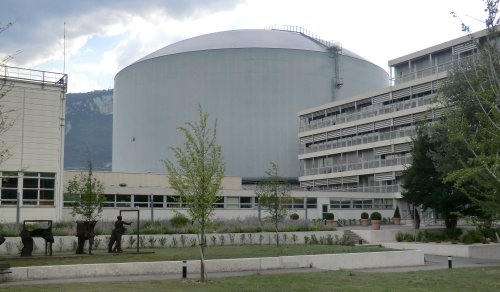
It just might have been the audio interview with physicsworld.com that swung it – Andrew Harrison has been appointed Director General of the Institut Laue-Langevin (ILL) in Grenoble, France. He replaces Richard Wagner, who has retired.

Harrison had been scientific director of the neutron lab – a post that is now filled by Helmut Schober, who has been at ILL since 1994.

Harrison is pictured above right, with Schober centre and José Luis Martínez Peña, who will continue in his role as director of ILL’s Projects and Technique Division.

When I spoke with Harrison earlier this year, I discovered that we had both spent time at Canada’s McMaster University, where Harrison did a postdoc with the chemist John Greedan. Harrison spent much of his time at the Chalk River lab, where he tells me he shared a house with McMaster graduate student Thom Mason. Mason is now director of the Oak Ridge National Laboratory in the US – and I wonder if the two had any inkling back then that together they would control a huge chunk of the world’s neutron flux!

You can listen to my interview with Harrison here. One thing we chat about is the relationship between ILL and the European Spallation Source (ESS), which is currently being built in Sweden. Two weeks ago, ILL and ESS signed a memorandum of understanding that defines how the two neutron labs will collaborate on the development of new instrumentation and other technologies.

Oxygen isotopes boost neutron scattering

Neutron-scattering measurements using different isotopes of oxygen have been made for the first time by an international team of researchers. The scientists have used the new technique to determine important differences between the molecular structures of normal and heavy water, saying that it could be used to study a wide range of oxide materials including some glasses.

Neutron scattering involves firing a beam of neutrons at a sample and studying the resulting diffraction pattern that occurs when the wavelength of the neutrons is about the same size as the distance between nuclei in the sample. While normally associated with the study of crystalline materials, the technique can be useful for studying disordered materials such as liquids.

Scientists cannot normally extract much information from a disordered sample because it is impossible to differentiate between scattering from different pairs of atomic nuclei. However, much more information can be obtained by repeating the scattering experiment with a sample in which atoms of one type (typically hydrogen) are replaced by a suitable isotope of the same atom (typically deuterium). This alters the diffraction pattern because neutrons scatter differently from different isotopes of the same nucleus. Subtracting one pattern from the other therefore leaves the contribution to the pattern from the substituted nuclei alone.

The same, but different

Substituting hydrogen with deuterium has become a successful technique because the scattering between these two isotopes is so markedly different. However, there are two drawbacks. First, the technique is based on the assumption that hydrogen and deuterium are chemically identical, which is only true up to a point. Deuterium is twice the mass of hydrogen, which means that the two isotopes do not always behave the same way within molecules. The second problem is that physicists have long assumed that for some other important atoms of interest – particularly carbon and oxygen – the scattering contrast between the isotopes would be too small to give a useful signal.

Now, Philip Salmon and Anita Zeidler of the University of Bath, Henry Fischer at the Institut Laue-Langevin (ILL), and their colleagues at the Oak Ridge National Laboratory, Stanford University and the Vienna University of Technology, have demonstrated a new isotope-substitution technique that solves both problems. Their breakthrough draws on a technique developed in 2008 by several members of the team, who had hoped to exploit the difference in scattering between two isotopes of carbon. Although that difference proved to be smaller than previously thought, the researchers then turned their attention to oxygen-18 and oxygen-16. This time they found a much larger difference than expected – so much so that the researchers went ahead with an oxygen-isotope substitution measurement of water using the D4C instrument at the ILL neutron source.

In their experiment, Salmon and colleagues made one neutron-diffraction measurement on a water sample comprising oxygen-16 and hydrogen, and a second on a sample comprising oxygen-18 and hydrogen. Subtracting one diffraction pattern from the other gives the separation between the oxygen and hydrogen nuclei in water – the oxygen–hydrogen bond length. The measurements were then repeated using deuterium instead of hydrogen. Using these data, the team was able study important differences between normal and heavy water for the first time.

Competing effects

In particular, the researchers found that there is a 0.5% difference between the lengths of the oxygen–hydrogen and oxygen–deuterium bonds. This finding supports a “competing quantum effects” model that describes the structure and dynamics of liquid water. This information can now be used to create more realistic computer simulations of liquid water – a substance that has proven very difficult to simulate effectively.

Alan Soper of the ISIS neutron lab in the UK says that the researchers’ apparent confirmation of the viability of the oxygen-isotope method is “a major breakthrough”. However, he points out that even with the revised difference in scattering between the two oxygen isotopes, an extremely stable instrument is required. “Currently, D4C at ILL is ahead of the game in terms of stability,” Soper told physicsworld.com. He also warns that the next generation of neutron sources will be spallation sources – based on accelerators rather than reactors like that of the ILL – and may therefore not be stable enough for these kinds of measurements.

Salmon is more confident, and points out that tests on the NOMAD instrument – currently being built for the SNS spallation source at Oak Ridge by team member Jörg Neuefeind – suggest that it will offer comparable stability to D4C.

As well as studying water, Salmon and colleagues believe that oxygen isotope-substitution could be applied to other materials with oxygen contents that are greater than about 33%. It could, in principle, be applied to glassy solids – materials that have so far proved very difficult to model. However, Soper points out that such analysis would have to work around the possibility that small, random structural differences between different glass samples could overwhelm any differences arising from isotope substitution. Salmon, on the other hand, believes that the potential rewards associated with applying the technique to oxide glasses “will more than offset any remaining technical issues”.

The work is reported in Physical Review Letters.

Link found between solar output and colder winters

Cold winters
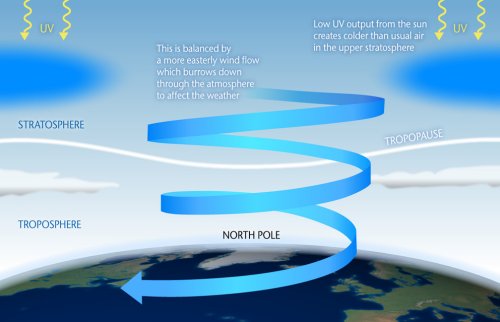
How solar output affects northern winters (Courtesy: Nature)

By Hamish Johnston
The last two winters in north-western Europe have been relatively cold. Here in normally mild Bristol, for example, our garden was frozen and snow-covered in November 2010 – something that is very rare indeed.

In a paper published yesterday in Nature Geoscience, UK-based researchers at the Hadley Centre, the University of Oxford and Imperial College have proposed a link between the recent dip in the output of the Sun and the recent cold winters.

You can hear an interview with one of the scientists on BBC Radio Four’s Today Programme here. The interview has the unfortunate title “Sun spots explained” – but solar physicists can rest easy because they haven’t been!

Fire from a celestial dragon

Comet Giacobini-Zinner, a fairly frequent visitor to the inner solar system, was captured by the Kitt Peak 0.9 m telescope on 31 October 1998 (Credit: N A Sharp/NOAO/AURA/NSF)

By Tushna Commissariat

If you have some time to spare tomorrow evening and especially if you live anywhere in the UK and Northern Europe, then I would suggest putting together a picnic supper and going out to the park or an open space from where you have a clear view of the sky because the heavens might just be putting on quite a show! This Saturday on 8 October, the Draconids meteor shower will be at its peak – and scientists predict that we might be in for a meteor storm!

As the Earth revolves around the Sun during the year, it passes through clumps of comet dust – some of which fall towards the Earth’s surface and burn up in the atmosphere creating meteor showers. The Draconids are dust left behind by the periodic comet 21P/Giacobini-Zinner. Generally, the Draconids that peak from around the 8 to 11 of October are a quiet affair, but every now and then the Earth travels through a particularly dense patch of dust. This year, researchers predict that the shower might be much stronger than normal. Indeed, you could see up to 10 meteors a minute, which is well worth camping out for on a chilly autumn evening. While the shower will begin tonight on 7 October and last until 11 October, the peak is set to occur on 8 October at 9 p.m. (20:00 UT), and activity is expected to begin at about 5 p.m. (16:00 UT) so probably the best views for the UK will be just after sunset.

Unfortunately, as the Moon is waxing right now, there will some bright moonlight, so try to keep the Moon behind you by keeping your gaze directed towards the northern half of the sky. Here are a few more pointers for observing meteorite showers:

• Look up a star chart before you embark, or at least pull it up on your phone app so that you can identify the constellation Draco. The shower is called the Draconids because the meteorites look as if they originate from the Draco constellation.

• Keep your eyes open – even the slowest shooting star streaks across the sky in seconds. This is literally a blink-and-you-miss-it situation!

• Take along a reclining chair or a picnic blanket so that you can comfortably lie on your back and not have a crick in your neck to deal with come Sunday morning. And wrap up warm!

• Even if you are in possession of a good pair of binoculars or a telescope, do not bother – meteorite showers are best seen with the naked eye thanks to how quickly they zip across the sky.

• Wherever you are watching the sky from – be it your back garden, the neighbourhood park or from the top of a multi-storey building – try keep away from all sources of light. This means not only bright city lights, but also not flashing a torch in someone’s face once their eyes have become used to the dark. Take along a few coloured plastic sheets – most sheets are red or blue – and fold it over your mobile phone, tablet and even your torch bulb and just secure it with an elastic band.

While just going out and enjoying the sight is lovely, some of you might want to record your observations and contribute your data for a number of global organizations that collate information about meteorite shower from amateur astronomers the world over. If you know how to professionally record your observations, then you can send your data to the International Meteor Organization which also provides you with information on how to do this. In the UK, the British Astronomical Association (BAA) is happy to receive data from any individual or society wherever they are in the world. Their website contains information on how to submit data and some handy maps and charts.

Lastly, with today’s <a href="http://twitter.com/“>Twitter generation, it is of course possible to tweet your data about the meteors you see. The Meteorwatch website is hosting a “Twitter Meteor Map”.

Tweet your observations using one of the hashtags #meteorwatch, #bbcstargazing, followed by your postcode, your country code (UK, US, etc) and, optionally, the meteor count. An example on their website reads – #meteorwatch SW5 0TR uk 1.

If you do happen to take any pictures of the showers do send them in to <a href="http://physicsworld.com/“>Physics World at pwld@iop.org or tag them on our official Facebook page here.

And lastly, don’t forget to do your special no-rain dance/good-weather chant at least an hour before sunset tomorrow to ward off all the rain clouds and mists that plague any starry sky! Then lie back and enjoy the view.

Copyright © 2026 by IOP Publishing Ltd and individual contributors