Calcium ions simulate the quantum world

The first digital “quantum simulator” based on trapped ions has been built by physicists in Austria. The system, developed by Ben Lanyon and colleagues at the University of Innsbruck, comprises a number of trapped calcium ions that are manipulated using sequences of laser pulses. The team has used the system to simulate the time-evolution of several multi-particle systems.

A quantum simulator uses one quantum system to simulate the behaviour of another, less accessible system. For example, by carefully manipulating the laser light and magnetic fields trapping an ensemble of ultracold atoms, researchers can control the interactions between atoms – and therefore simulate interactions that occur between electrons in solids. But unlike electrons in solids, the strength of these interactions can be easily adjusted, allowing physicists to test theories of condensed-matter physics.

Analogue to digital

Most quantum simulators are “analogue” in the sense that the interactions between the trapped atoms are directly analogous to those between electrons. A digital quantum simulator, in contrast, contains an ensemble of interacting quantum particles that act as quantum bits (qubits) and can be used to create quantum logic gates. The quantum system to be simulated is then encoded into the system and the behaviour of the electrons is determined by performing a quantum calculation.

Unlike analogue simulators, which address specific systems, a digital simulator could be used to study a wide range of quantum systems. Furthermore, digital simulators can benefit from error-correction schemes, which means that physicists can be more confident in their results.

But while researchers have had some success creating digital quantum simulators using nuclear magnetic resonance (NMR) techniques, these work with just two or three qubits and it has proven difficult to scale up to the 40 or so qubits needed to do a useful quantum simulation. The new trapped-ion quantum simulator created Lanyon and colleagues means that it should, in principle, be much easier to scale up such a system to do useful simulations.

Easily scalable

The team’s experiments begin with a small number of calcium ions (a maximum of six) that are lined up in a row in an electromagnetic trap. Each ion can exist in two electronic states – “0” and “1” – and can therefore act as a qubit. Interactions between individual ions can be controlled by firing carefully selected laser pulses at the trapped ions.

A calculation begins by putting the ions into a specific quantum state. In an experiment involving four ions, for example, each qubit was given the value “1”. A series of laser pulses was then fired at the ions, which causes them to interact with each other creating a sequence of logic gates that process the quantum information held in the initial state.

It is this sequence that simulates the interactions that occur in a real (or imagined) quantum system. In this particular example, the qubits were used to simulate four spin-1/2 particles in which the spin of each particle can interact with the three other particles.

Approximate solutions

Lanyon and colleagues were interested in calculating the time evolution of the spins, which is particularly difficult to do using a classical computer. To do this, the team implement the “Trotter approximation” on their system. This is done by firing a series of pulses that simulates the evolution of the system over a certain period of time before the values of the qubits are read out. The system is then reset and an identical simulation is repeated many times to obtain average values for the qubits – which is an approximate solution to the problem being simulated.

This entire process is then repeated to simulate a number of different time periods, building up a map of the time evolution of the spins. Time evolution simulations were done for as many as six trapped-ion qubits and involving up to 100 quantum gates.

Towards quantum chemistry

“Six qubits and a 100 gates for quantum simulation is a feat that paves the way for more complex and rich digital quantum simulations in the future,” says Alán Aspuru-Guzik of Harvard University in the US. “What Ben Lanyon and his colleagues did was to implement one of the most important building blocks for quantum simulation, what we call a ‘Trotter step’ in a generic or universal sense. This is one of the required and essential building blocks to do exact quantum chemistry on quantum computers, when they become powerful enough.”

Lanyon told physicsworld.com that his team’s next challenge is to perform the simulations with 10 or more ions. Creating such a system is not the problem – the team has already trapped and entangled as many as 14 ions. However, performing large numbers of operations on the ions is tricky because the qubits tend to lose their quantum nature over time as they interact with their surroundings.

The work is described in Science 10.1126/science.1208001
The end of astronomy’s golden age?

The James Webb Space Telescope (JWST) – the planned successor to the Hubble Space Telescope – is in serious trouble. The most powerful body in the US House of Representatives – the Appropriations Committee – has adopted legislation that would specifically terminate the JWST, as part of a drastic reduction of NASA’s 2012 budget by $1.9bn to $16.8bn. The cancellation is not expected to be included in the US Senate’s separate spending bill, which is to be released this month. However, the negotiations for a compromise bill between the House and the Senate would entail substantial risk for the JWST under “normal” circumstances. In the current political climate, the risks are even greater – early autumn will be a critical time for the JWST.

Hubble is arguably the most widely recognized scientific mission of all time, delivering thousands of images of the cosmos. The JWST will be immensely more productive and powerful than Hubble via its much larger primary mirror and its hugely advanced technology. The JWST will continue the tradition of NASA’s “great observatories” – Hubble, the Chandra X-ray observatory and the Spitzer infrared telescope – by shedding light on the first galaxies and stars, as well as studying exoplanets for evidence of water and other molecules related to life. No existing or planned telescope, on the ground or in space, could do the amazing science that the JWST would do.

Lost generation

So far, $3.5bn has already been spent on the JWST, with excellent technical progress being made. Roughly 75% of the hardware for the mission has been delivered or is in the final fabrication stage. Indeed, in June polishing of the JWST’s 18 beryllium mirrors was complete and their cryogenic performance is now being tested. The mirrors are so smooth that if each were the size of the US, the typical surface ripples would be just 5 cm high. Unfortunately, all this good news has not percolated as widely as it should have to government, and we are now in the invidious situation of possibly losing the most powerful observatory ever conceived. In doing so we would not only harm US astronomy but also seriously damage our collaborations with Europe and Canada, which have already spent hundreds of millions of dollars on the JWST programme.

The cancellation would spell a dangerous time for US science. The ability of NASA and the wider science community to establish and sell “flagship” missions to Congress would be seriously hampered in future. Given that the JWST was first proposed 22 years ago, it is likely that US astronomy would not recover for at least a decade or two, effectively losing a generation of scientific progress.

Management issues

The JWST took its first major step in 2000, when it was included as the top-ranked space-based mission in the “decadal survey” – where astronomers in the US identify the highest priority research activities in astronomy and astrophysics for the coming decade. The mission’s initial cost of around $1bn was, however, underestimated and substantial efforts were made to put the JWST on a firmer fiscal footing in the early 2000s. Then in 2005 US President George W Bush (and Congress) placed further stress on NASA’s budget by requiring that the space agency do “everything” with no additional funding. This included continuing with the space shuttle for five more years, replacing it with a new rocket capability, finishing the International Space Station and planning for missions to the Moon and Mars. Following the adoption of Bush’s plan, the science budget was cut, losing roughly $10bn since 2005. It was then very hard for spending on JWST to be ramped up in its most critical funding years.

Budgetary stress, however, was not the only issue. Progress of the JWST was hit by poor oversight and lack of independent validation, together with communication and leadership issues at NASA’s Goddard Space Flight Center and the Science Mission Directorate. Following concerns about schedule delays and cost overruns, the Independent Comprehensive Review Panel (ICRP) was set up in June 2010 to look into NASA’s management of the telescope.

Chaired by John Casani from NASA’s Jet Propulsion Laboratory, the ICRP concluded that while the JWST project had made considerable technical progress that was “commendable and often excellent”, there were concerns that NASA was not exercising adequate independent oversight and evaluation of project performance (see “Hubble successor hit by budget setback”). NASA has since implemented virtually all of the ICRP’s 22 recommendations and has released its revised plans for the JWST’s completion, setting a possible 2018 launch. However, the full cost of the mission has not been announced, although some estimates put it in the range $7–8bn, which is consistent with extrapolating the ICRP’s estimate of $6.5bn if the JWST was launched in late 2015.

The answer to why the JWST has problems is simple. Any and every project that involves new technology and is on the scale of the JWST will have difficulties. This is not bridge-building – nobody has made a telescope like the JWST before. If the JWST did not have problems, it would mean that we lacked ambition and were not utilizing our full technological potential. What must be done is to plan for resolving and fixing problems quickly. In my view, it is impossible to carry out a one-off project of this scale, with such challenging technologies, without adequate funding and substantial contingency to minimize the inevitable problems. The core issue for the JWST is that it did not have the contingency needed to address such problems immediately.

Counting the costs

If the House of Representatives’ budget for NASA becomes law and the JWST is cancelled, I would compare the damage to astronomy to that the high-energy physics community suffered in the early 1990s when the Superconducting Super Collider was canned. There would be a similar devastating change in scientific opportunities, but with a very important difference – no other nation (or group of nations) could currently build a JWST. There is no plan B for the JWST as US particle physicists had with CERN’s Large Hadron Collider. China and Europe could build a replacement for the JWST in the coming decades, but only far into the future.

Cancellation would also mean that more than a third of the long-term astronomy budget would disappear overnight. The full expectation and understanding has been that as the JWST is completed, its funding would revert to the astrophysics budget and be available for new missions. But with no JWST, those funds would not be available. The recommendations of the 2010 decadal survey could not be implemented, meaning no Wide-Field Infrared Space Telescope, no International X-ray Observatory, no Laser Interferometer Space Antenna and no significant post-Kepler exoplanet mission. Astrophysics would become one of the smaller programmes in NASA space science, similar to what heliophysics is now. Study of the entire universe would receive similar funding to that of one star – the Sun.

Once Hubble and Chandra die by end of the decade, US space-based astronomy would consist of a series of small missions. This would be a devastating retreat from where we are now, and certainly from where we would be with the JWST. Astronomy research would lose more than $30m per year of funding for research students and postdocs at institutions across the US. While small missions have done great science, and will do so in the future, they are narrowly focused, infrequent and have a narrow research support base. They are far from being “observatories” that can respond quickly to new scientific issues and involve a broad swath of the international science community and its students and postdocs. If we are to continue the remarkable productivity and iconic visibility of NASA’s great missions such as Hubble, Chandra and Spitzer, then we must continue with the JWST. Scientists, and the public, need to have their voices heard if astronomy is to remain as dynamic and exciting as it is today. Amazing discoveries await when the JWST flies.

Graphene could make ‘perfect’ solar cells

A new device that combines graphene with special metallic nanostructures could lead to better solar cells and optical communications systems. That is the claim of researchers in the UK who have measured a 20-fold enhancement in the amount of light captured by graphene when it is covered by such nanostructures. The work provides further evidence that the material might be ideal for making photonics and optoelectronics devices, despite the fact that it does not have an electronic bandgap.

Graphene is a sheet of carbon atoms arranged in a honeycomb-like lattice just one atom thick. Since its discovery in 2004, this “wonder material” has continued to amaze scientists with its growing list of unique electronic and mechanical properties. Some believe that graphene could find uses in a number of technological applications – even replacing silicon as the electronic industry’s material of choice. This is because electrons whiz through graphene at extremely high speeds, behaving like “Dirac” particles with no rest mass.

Graphene also shows great promise as a candidate for photonics applications – especially optical communications, where speed is an issue. The material has an ideal “internal quantum efficiency” because almost every photon absorbed by graphene generates an electron-hole pair that could, in principle, be converted into electric current. Thanks to its Dirac electrons, it can also absorb light of any colour and has an extremely fast response to light. The latter suggests that it could be used to create devices that are much faster than any employed in optical telecommunications today.

Drawbacks addressed

Researchers have also already shown that they can make basic solar cells, light-emitting devices, touch screens, photodetectors and mode-lock ultrafast lasers from the material. However, there are, of course, drawbacks: graphene’s “external quantum efficiency” is low – it absorbs less than 3% of the light falling on it. Furthermore, useful electrical current can only be extracted from graphene-based devices that have electrical contacts with an optimized “asymmetry” – something that has proven difficult to achieve.

Now, researchers at the University of Cambridge and the University of Manchester may have solved both these problems by pairing up graphene with plasmonic nanostructures. These are metal devices that enhance local electromagnetic fields in a material by coupling incoming light with electrons on the surface of the metal. The nanostructures are fabricated on top of graphene samples to concentrate the electromagnetic field in the region of the material where light is converted to electrical current, so as to dramatically increase the generated photovoltage.

The team, which includes Manchester’s Andre Geim and Kostya Novoselov, winners of the 2010 Nobel Prize for Physics for their discovery of graphene, started out by preparing samples of graphene using the now-famous “sticky tape” method. This involves mechanically shaving off single layers of graphene from a block of graphite. The researchers then made two-terminal electronic devices from the material by forming contacts made of titanium and gold on the graphene using electron-beam lithography. Next, various plasmonic nanostructures were assembled close to the contacts.

Highest efficiency so far

The new devices have an external quantum efficiency of almost 50%, the highest value to date for graphene, says team member Alexander Grigorenko of Manchester. This boosts the light-harvesting capacity of graphene by more than an order of magnitude compared to its non-contacted counterpart, without sacrificing its speed. “If the plasmonic nanostructures we employed were optimized, it should be possible to realize perfect light-to-current conversion, where every photon falling on graphene is converted into current,” he told physicsworld.com. “This is exactly what the solar cell industry is waiting for.”

Furthermore, the problem of creating contacts with the desired asymmetry is addressed through the use of titanium and gold in the device.

“Our work is the first step towards ‘perfect’ photodetectors and solar cells because we have shown that plasmonics helps graphene convert light into electricity with ideal efficiency,” says Andrea Ferrari, who led the Cambridge effort in the collaboration. “Optimizing light interaction and photovoltage generation in graphene will be key for a range of applications, such as solar cells, imaging and telecommunications.”

Profusion of charge carriers

Graphene could also be a viable alternative to conventional plasmonic and nanophotonic materials, he added, because it has many advantages over these materials. It can absorb light over any wavelength in the electromagnetic spectrum from the ultraviolet to visible and far-infrared wavelengths, which means there is no need for bandgap engineering; and it can confine this light into unprecedented small volumes. The profusion of charge carriers in graphene and the fact that researchers can now produce the material in large quantities and over large areas means that it could outperform all existing semiconductor technologies in applications as diverse as photodetectors, tunable ultrafast lasers and imaging, claims Ferrari.

“Graphene seems a natural companion for plasmonics,” adds Grigorenko. “We expected that plasmonic nanostructures could improve the efficiency of graphene-based devices, but did not expect that the improvements could be so dramatic.”

Spurred on by its new results, the team now plans to study how light interacts with graphene in more detail. The researchers also hope to optimize their plasmonic nanostructures, for example by exploiting coupled or “cascaded” plasmon resonances that could further enhance the photovoltage generated. “We might also be able to increase light absorption even more by employing several layers of graphene, something that could lead to a 100-fold enhancement of the photovoltage,” states Ferrari.

The work is published in Nature Communications 10.1038/ncomms1464.

Tracking tsunamis with radar

Tsunamis such as the one that devastated parts of Japan in March could be monitored by an early-warning system based on radar measurements, claims a group of geoscientists.

Large tsunamis can be triggered by a number of geological phenomena, including earthquakes, landslides and the eruptions of marine volcanoes. When triggered in the deep ocean, these waves can travel at speeds in excess of 800 km per hour, but because of their very long wavelengths their amplitudes at the surface of the water are very small, which makes them difficult to detect. As a tsunami approaches land, most of its energy becomes focused into one giant wave, often with devastating results.

To limit the impacts of these hazards, national authorities need to identify any tsunamis as early as possible and to gain an idea of what profile the giant waves will take when they strike the coast. In regions with relatively steep continental shelves, such as the west coast of the US, some quantative real-time observations of tsunamis have been possible using deep-water pressure sensors to observe changes in the elevation of the sea surface. But in regions with wider, shallower continental shelves, such as South East Asia and the east coast of the US, the effectiveness of these systems is limited.

Signature currents

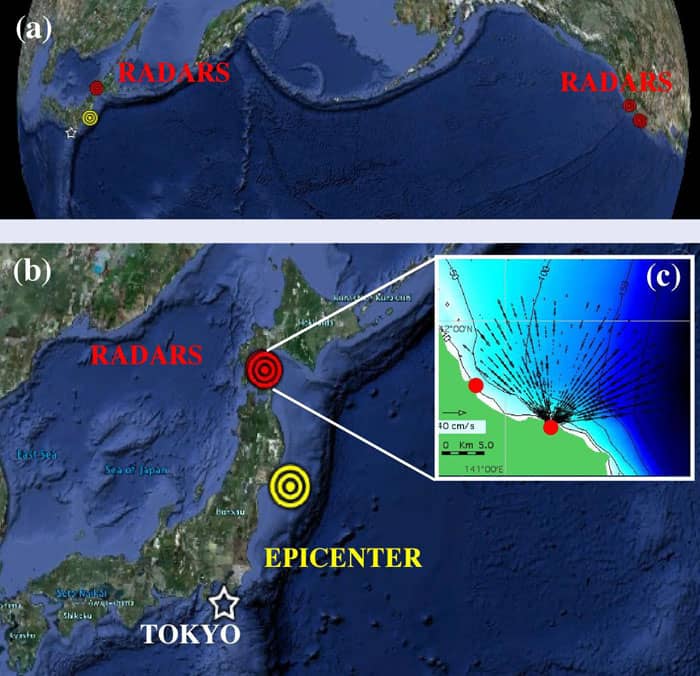
Now, an alternative method based on radar has been developed by a group of researchers in California, working with colleagues in Japan. The technique capitalizes on the fact that networks of coastal radar systems are routinely used by many countries to measure surface currents. Rather than tracking the tsunami directly, the technique uses these signals to identify unusual current flows that are generated by the giant waves as they propagate across the ocean.

In demonstrating the feasibility of their technique, the researchers say that they were able to recreate a profile of the recent tsunami in Japan, which was triggered on 11 March by a magnitude 9.0 earthquake off the coast of Sendai. They analysed data captured by five high-frequency radar sites spanning 8200 km located on the coasts of Japan and California. By combining three different types of analyses the researchers were able to identify the tsunami using three different frequencies of radar signal: 5 MHz, 13.5 MHz and 42 MHz.

The researchers report their findings in a paper published in Remote Sensing under the lead authorship of Belinda Lipa of Codar Ocean Sensors in California. They say that the Japanese tsunami could have been detected up to 45 min prior to its arrival at the nearest tide gauge – devices used to measure sea levels and detect tsunamis. The researchers make it clear, however, that the signals can only be detected once the tsunami reaches a continental shelf. This is why the technique could offer the earliest warning when tsunamis pass through wide shallow shelves such as those off the coast of Japan and the UK.

“Because of the diversity in local bathymetry [water depth], there is considerable variation in the warning time available” write the researchers. These times, they say, vary “from minutes on the US Pacific coast to hours for some areas of the Atlantic coast and South East Asia”.

Christophe Vigny, a seismologist at the Ecole Normale Supérieure (ENS) in Paris, believes that the new system is promising because it uses shore-based instruments, making it easier to maintain than oceanic systems. “A tsunami detected by a ground network is certainly something that people might trust more than a probability of something happening,” he says. Vigny cautions, however, that the system still needs to be demonstrated in real time before it can be considered effective.

Lipa and her team now intend to develop their research through further study of data from coastal radar on the shores of the north Atlantic. They say that a more detailed analysis of the weaker radar signals could lead to a unique view of the propagation of a tsunami and its interaction with the ocean floor.

Manipulating the middle ground

An international group of researchers has developed a new way of controlling light using nanotechnology. The technique focuses on the boundary between two media, such as air and water, treating the boundary itself as a third medium. This allows the scientists to manipulate the reflected and refracted beams in ways that are not possible with natural materials, creating “designer light”.

The scientists, based at Harvard University in the US, claim that their discovery has inspired them to derive a more general expression of Snell’s law, which predicts the path determined by a beam of light travelling from one medium to another. This could help in designing new optical components such as planar lenses and polarizers.

At the boundary

Reflection and refraction occur whenever light crosses the boundary between two different media, at an angle. It is this incident angle and the optical properties of the two media that decide the angles of refraction and reflection, according to classical optics. But now, Nanfang Yu and colleagues from the Capasso research group have shown that if the boundary contains structures on the nanoscale, these laws need to be updated.

Standard reflection and refraction treats the boundary between media as a homogenous interface separating the two media. “What motivates us is the question: ‘Why not treat the interface as a third ‘active’ medium?'” says Yu, who is also lead author of a paper on the research published in Science. “We realized that if we artificially structure the interface using nanotechnology, it can introduce an abrupt phase shift and a resultant time delay between the incident light beam and the reflected and refracted beams,” he explains.

Yu says that this is the first time anyone has manipulated the boundary between media in the optical regime. “Interestingly, decades ago people working on microwaves and millimetre-waves demonstrated the so-called “reflectarrays” and “transmitarrays” that can shape the reflected and transmitted beams. The connection between that and our results is that both use abrupt phase changes associated with antenna resonances,” says Yu. But that research was not at the nanoscale and the structures involved cannot be regarded as an interface or a boundary because the spacing between the array elements was larger than the wavelength.

The light fantastic

The Harvard team uses gold V-shaped plasmonic antennas – or pixels – patterned on silicon wafers as optical resonators. The array is structured on a scale much smaller than the wavelength of the incident light, allowing the engineered boundary between the air and the silicon to impart an abrupt phase shift or “phase discontinuity” to the light passing through. Yu points out that, while previous research concentrated on enhancing the near-field properties of optical antennas, his group uses “a somehow overlooked property of such structures – their phase response”. The phase difference between the incident and scattered light varies considerably over one antenna resonance. By operating the antennas at different resonance conditions, a wide range of phase – and therefore time – delays are achieved. Effectively, each antenna captures the incident light, stores it for a given time and then reemits the light into the free space.

The researchers’ interface is designed pixel by pixel as a series of optical resonators, such that the structure of the array determines the phase shift. By doing this, they can tailor the interface to reflect or refract in arbitrary directions, allowing a great degree of freedom in “shaping” the light. “For example, light coming in at an angle can be reflected back towards the light source – we call this phenomenon “negative” reflection because ordinarily the reflected beam is directed away from the light source,” says Yu. There is also “negative” refraction, where the refracted light bends in the “wrong” direction as compared with the prediction of Snell’s law. Yu says that there are two critical angles for total internal reflection, depending on the relative direction of the incident light and that of the gradient of the phase delay along the interface.

In one of the experiments they conducted, the scientists made the light ray hit the interface perpendicularly, from below, where the scattered light propagated at an angle, rather than perpendicular to the surface ( which is how it would naturally propagate), due to the varying structure of the antennae (see image “Perpendicularly incident light ray”). They also produced a vortex beam – a helical, corkscrew-shaped stream of light – from a flat surface (see image “Vortex beam and other strange optical effects”).

Integrated optics

The researchers are now working on applications such as planar lenses that could focus an image without the necessity of a compound lens to correct aberrations. “The advantage of the plasmonic interface is that it moulds optical wavefront right after the light passes through it, unlike conventional optical components like bulk lenses, which rely on gradual phase accumulation along the optical path to change the wavefront of propagating light. This makes our design favourable for integrated optics,” says Yu. He claims that some of their designs – such as the vortex beam – perform so well that they do not expect major difficulties in producing useful planar optical components for the long-wavelength (mid- and far-infrared) range. For the shorter wavelength range, however, they need to find a better non-metal resonator design.

Computer architecture recreated on quantum device

Physicists in California claim to be the first to implement a quantum version of the “Von Neumann” architecture found in personal computers. Based on superconducting circuits and integrated on a single chip, the new device has been used to perform two important quantum-computing algorithms. Conventional Von Neumann architecture includes a central processing unit (CPU) linked to a memory that holds both data and instructions.

Quantum computers, which exploit purely quantum phenomena such as superposition and entanglement, should in principle be able to outperform classical computers at certain tasks. However, building a practical quantum computer remains a challenge because the quantum states that such systems employ are difficult to control and are easily destroyed.

In implementing the Von Neumann architecture using superconducting quantum circuits, Matteo Mariantoni and colleagues at the University of California, Santa Barbara have taken an important step towards a working computer. Mariantoni told physicsworld.com that, to the best of his knowledge, he and his colleagues are the first to create such a quantum version of the architecture.

Marrying CPU and memory

The research team’s quantum CPU, or “quCPU”, comprises two superconducting “phase quantum bits” (qubits) connected by a superconducting microwave-resonator data bus. A phase qubit is a single Josephson junction, which consists of two pieces of superconducting material separated by a very thin insulating barrier. The logic levels – 0 and 1, for example – are defined by the phase difference between the electrodes of the junction.

Each qubit is connected to its own quantum random access memory (quRAM) element, which is made up of a superconducting resonator that stores quantum information in the form of trapped microwaves and a “zeroing register” – a two-level system that clears a qubit of information. The quRAM effectively acts like ordinary RAM that preserves the quantum nature – such as entanglement – of the information it stores.

The bus and the quRAM operate at fixed frequencies, whereas the working frequency of a qubit changes when special “z-pulses” are applied. When the frequency of a qubit matches that of a quRAM or the bus, then quantum information can be exchanged between the two.

Quantum operations

To perform an operation, Mariantoni’s team begins with the qubits “detuned” from the other components. Microwave pulses are then applied, which loads the system with quantum information, before z-pulses are applied to exchange information. Quantum operations are performed by the careful application of specific sequences of pulses.

In one experiment, the team performed the “quantum Fourier transform” operation with a process fidelity of 66%. In another experiment, Mariantoni and colleagues used the system to implement a three-qubit Toffoli OR phase gate with a 98% phase fidelity. Both of these operations are seen as essential for the operation of practical quantum computers.

“These figures of merit are very encouraging,” says Mariantoni. “However, numbers above 98% or even higher will be needed for a practical quantum computer to function.”

Long coherence times

Another important feature of the system is that the quantum memory can retain quantum information for much longer than the qubits. Such long “coherence times” are another practical requirement of a quantum computer. While the fidelity of the qubit states dropped below 20% after about 400 ns, the fidelity of the memories stayed above 40% for at least 1.5 µs.

The team is now working on increasing the number of quantum devices integrated on a single chip. According to Mariantoni, while boosting integration is fairly easy, operating such chips involves many more quantum operations. This means that the coherence times of the individual components must be boosted – something that is more of a challenge. The team is addressing this by finding ways of improving the quality of the dielectric and metallic materials used to make the devices.

The work is published in Science.

Reining in an asteroid

Commissariat hayabusa 3a.jpg


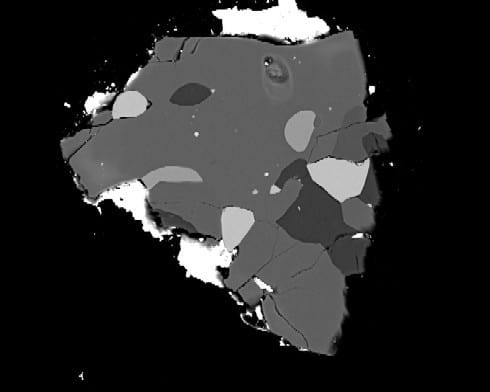
A single particle from the Itokawa asteroid. Courtesy: Science/AAAS

By Tushna Commissariat

When you think about near-Earth asteroids, they mostly bring to mind discussions about how to blow them up or move them out of the way, if they are headed towards us, perhaps with an afterthought of Bruce Willis. It is rather strange to think of engineering a method to ‘capture’ a neighbouring asteroid into an Earth-bound orbit. But that is exactly what a recent paper published on the arXiv pre-print server is looking at.

The researchers, from Tsinghua University in Beijing, China, have proposed coaxing a near-Earth object (NEO) into a “temporary capture”, such that it becomes a satellite of the Earth. A likely candidate for this type of acquisition would be an NEO with a low-energy orbit that can be captured by Earth with a slight increase in the asteroid’s velocity. The authors point out that some Jovian comets are routinely claimed by Jupiter, orbiting around the gas giant from one to several orbits, which would be a period of a few Earth years.

Unfortunately, this is not something that will occur with the Earth and any of its NEOs naturally. But some NEOs will be tauntingly close to Earth’s orbit and would require just a gentle nudge in the right direction. In the paper, the researchers consider the necessary conditions to artificially engineer this. They look at the mechanics of a three-body problem – the Sun, the Earth and the asteroid – and calculate at which orbital co-ordinates the capture would be successful and how much of a change in orbit and velocity, with respect to the NEO in question, would be required.

Using these parameters, they then listed possible candidates from the known NEOs. A candidate that caught their eye is a 10 m NEO that will pass within a million kilometres or so of Earth in 2049. Its orbital velocity is close enough to that of the Earth that it could be captured into an Earth-bound orbit by a velocity change of only 410 mps. This would allow it to orbit Earth at nearly twice the distance of the Moon, before it wanders off like Jupiter’s comets.

But what is the point of it, you ask? As the researchers themselves point out, “a 2 km-size metallic NEO, for example, may contain rich metals and materials worth more than 25 trillion dollars”. While the concept of mining an asteroid had been around for a while, a practical method has not been found. The recently returned Hayabusa mission from the Itokawa asteroid was delayed by three years and its final sample was of about 1000 particles of asteroid dust – more than enough for research but not exactly a bountiful harvest in terms of minerals (see image above). Having an asteroid “on a leash” would make it a lot easier to study and mine them.

What was Rutherford’s greatest discovery?

By James Dacey

hands smll.jpg

This year is the 100 year anniversary since Ernest Rutherford published his seminal paper describing his discovery of the atomic nucleus. But Rutherford was an industrious researcher who many remarkable contributions to science, including three discoveries that revolutionised our view of matter.

Rutherford’s first major scientific work was to lead to him being awarded the Nobel Prize for Chemistry for his investigations into the disintegration of the elements, and the chemistry of radioactive substances. One major experimental breakthrough during this period was to discover that thorium gave off an “emanation” that was radioactive. Essentially, Rutherford had discovered thorium gas.

Rutherford received the Nobel prize in 1908, about 18 months after he had begun working at the University of Manchester, where he held the chair of physics for 12 years. It was during this time that Rutherford, working with colleagues including Hans Geiger and Ernest Marsden, carried out his famous scattering experiments, designed to probe the structure of the atom. The results led to Rutherford’s second “eureka moment” when he realised that the majority of an atom’s mass is concentrated in a relatively tiny volume at its centre — he had discovered the nucleus.

Rutherford’s third big contribution was to effectively become the world’s first alchemist when he transformed nitrogen into oxygen. This finding was a result of bombarding nitrogen gas with alpha particles so that higher energy protons were ejected.

Of course all three of these discoveries have transformed our view of atomic physics in different ways. But, just for a bit of fun, if you had to single out one of these three discoveries, which do you think is the greatest?

• That atoms are not always stable (his Nobel-Prize-winning work on radioactivity)

• The atoms have the majority of their mass concentrated in a nucleus

• The world’s first alchemy (converting nitrogen into oxygen)

Have your say and take part in our facebook poll. And feel free to post a comment on the poll to explain your reasoning.

IOP members can also watch this short feature length film about Rutherford’s discovery of the atomic nucleus. It includes interviews with keynote speakers at the Rutherford Centennial Conference, which was held in August at the University of Manchester.

In last week’s poll we asked posed a question that is highly pertinent to the big questions surrounding the future of astronomy and the financial situation in the US. We asked whether funding be reinstated on the $6.8 billion James Webb Space Telescope, which is poised to be the successor to Hubble Space Telescope (JWST). The question arose following a move by the US congressional committee to cancel the project after a series of over-run costs. The findings of our poll, however, were highly conclusive as 90% of respondents voted that “yes, jeep the JWST”.

Between the lines

Photo of red onion

The “onion questions” in physics

Most questions in physics and astronomy are like onions. They may seem smooth and uncomplicated on the surface, but inside, many layers of subsidiary questions await anyone with the patience and talent to strip them away. “What are gamma-ray bursts?” is definitely an onion-type question, and Joshua Bloom’s book of the same title does a thorough job of unpeeling it. As Bloom writes in the preface, at one level the answer is simple: gamma-ray bursts (GRBs) are “unannounced flashes of high-energy light detected from seemingly random places on the sky”. But this bald explanation does not even begin to address the origins of these events, nor what Bloom, an astronomer at the University of California, Berkeley, calls the “engine” behind their creation. What astrophysical processes could possibly compress so much energy – as much, in fact, as the Sun will release in its entire lifetime – into just a few seconds? And then there is the most intriguing question of all, which Bloom addresses in the book’s final chapter: what can GRBs tell us about the universe as a whole? These are still very active topics of research, and it is a pleasant surprise to find them discussed in a book aimed at a semi-popular audience. What are Gamma-ray Bursts? is, in fact, the second in a promising new series from Princeton University Press on the “frontiers of physics”. Like its 2010 predecessor, Abraham Loeb’s How Did the First Stars and Galaxies Form?, it seems best suited for readers who want a “big picture” of a field before embarking on in-depth study. Although the book contains numerous equations, as well as graphs taken from research papers on GRBs, it is written in an accessible style. Moreover, unlike a journal article, it is possible for a newcomer to read it without constantly referring to earlier work for basic definitions and background. There are a few niggles, including a proliferation of acronyms, but on the whole, Bloom (and Princeton) deserves kudos for filling this gap.

  • 2011 Princeton University Press £19.95/$27.95pb 280pp

Written wonders of the universe

The BBC’s two critically acclaimed Wonders series saw millions tuning in each week to watch physicist Brian Cox deliver mountain-top
lectures on the magnificence of the cosmos. But for some, particularly sticklers for traditional media, these programmes placed so much focus on the spectacle of nature that the wonder of scientific facts too often came second place to the special effects (and to Cox’s radiant haircut). If you are among them, then Seven Wonders of the Universe (That You Probably Took for Granted) by C Renée James offers a pleasant alternative to Cox and his crew. The book’s fly-by tour of the cosmos, with its seven stop-offs that include “gravity”, “stuff” and “time”, does not contain a single photograph. Instead, James, an astronomer at Texas’ Sam Houston State University who regularly contributes essays to popular-science magazines, opts for old-fashioned prose, interspersed with the occasional sketchy cartoon. James defends this concept in her preface, pointing out that with so many stunning pictures of the heavens freely available from websites such as NASA’s, it feels a bit arbitrary to pick a crop for a published book. It is an excellent point, and James’ witty, lucid writing style brings humanness and a sense of perspective to a subject where technicolour blockbusters can leave viewers numbed. In James’ cosmic journey, everything in nature is assigned a personality, from antiparticles being the evil twins of matter to the hailing of Jupiter as the solar system’s king. Particularly enjoyable is the chapter on light, in which the Sun is painted in varying portraits, including “happy visible” and “creepy ultraviolet”, to convey the idea that astronomers study different types of light to learn about different processes in the universe. At times, James overcooks the jokes, and the frequent references to American culture can sometimes leave foreign readers feeling on the outside of the joke. But on the whole, this geeky comedy is an effective strategy for taking the wonder of astrophysics and grounding it firmly in everyday life.

  • 2010 Johns Hopkins University Press £13.00/$25.00pb 256pp

Rutherford’s big discovery – 100 years later

In 1911 the New-Zealand-born physicist Ernest Rutherford published a paper that was to revolutionize science. Rutherford’s famous alpha-particle scattering experiment transformed our understanding of the atom and it inspired the new areas of physics including the theory of quantum mechanics.

The pioneering work was carried out at the University of Manchester where Rutherford held the Chair of Physics for 12 years. To mark the centenary of these landmark experiments, the university hosted a special week-long conference in August 2011. The event was organized by the UK’s Institute of Physics, which publishes Physics World.

In this short film, Physics World journalist James Dacey reports from the conference where he caught up with two of the keynote speakers. First, Dacey meets the University of York physicist, David Jenkins, who describes how Rutherford’s experiments overthrew the prevailing picture that atoms were solid building blocks of nature.

In this discussion, Jenkins talks about how Rutherford’s work has led to some important practical applications, including big advances in the field of medicine. “Understanding the nucleus and radioactivity has led to many diagnostic techniques for medicine like positron emission tomography, or the radiotherapy cancer treatments that people receive.”

For a different take on Rutherford’s discovery, Dacey also met physicist John Schiffer of Argonne National Laboratory, who has been an active nuclear researcher since completing his PhD in 1954. Schiffer explains how, after visiting Rutherford’s laboratory, Niels Bohr was able to develop a coherent theory of quantum mechanics based on the idea of a nuclear atom.

Dacey also encourages Schiffer to take his imagination beyond fundamental physics by asking what might have happened if Rutherford had not made his discovery in 1911. In a fascinating response, Schiffer speculates that other scientists would have been unlikely to make the discovery before the onset of the First World War. Continuing this line of thought, Schiffer believes that the discovery of fission may then have been delayed until after the Second World War. “Would the first use of nuclear weapons have been in a third world war? You can write science fiction books about that,” he says.

And it is not just professional physicists who are celebrating the centenary of Rutherford’s discovery. Manchester’s Museum of Science and Industry is also hosting a special exhibition until the end of October, which provides an overview of Rutherford’s work and his legacy in the city of Manchester. Dacey takes a trip to the museum to meet the exhibit’s curator, Cat Rushmore. Rushmore gives Dacey a guided tour of the exhibit, which includes a number of artefacts from Rutherford’s lab such as his desk and chair and a letter to Rutherford from Bohr describing how much he admired the Manchester laboratory.

Copyright © 2026 by IOP Publishing Ltd and individual contributors