Revelations of a golden age

For roughly 700 years, many of the greatest scientists lived in the Islamic world. The Western narrative, however, has often neglected the contributions of major figures such as the chemist al-Jabir, the mathematician al-Khwarizmi and the medic al-Razi, preferring instead to jump directly from Aristotle, Euclid, Archimedes and Ptolemy to Copernicus and Galileo in reporting scientific development over the ages. Yet the fact is that between the eighth and 15th centuries AD, the scientists of the Islamic world developed original theories in mathematics, astronomy, physics, medicine and engineering – frequently with the help of works translated into Arabic from Greek, Sanskrit, Pahlavi and Syriac sources.

Pathfinders: The Golden Age of Arabic Science is brimming with examples of scientific breakthroughs from this period, assembled with enthusiasm and written in a style that makes it compelling reading. The author, Jim Al-Khalili, was born in Baghdad and his book blends well his passion for his illustrious birthplace with his family history and a desire to engage a larger audience with not just the facts of science, but its history too. His knowledge of Arabic and physics provides the book with an authority that he is careful not to exceed by making unsubstantiated claims for “Arabic science”. Indeed, he initially defines “Arabic science” rather narrowly, as science “carried out by those who were politically under the rule of the Abbasids, whose official language was Arabic, or who felt obliged to write their scientific texts in Arabic”. However, he also discusses scientific activities in other dynasties and at different periods, such as the Andalusian Umayyad caliphate in Spain (929–1031) and the Fatimid Caliphate in Egypt (909–1050).

One way round the difficulty of encompassing such a wide canvas would be to refer to “Islamic science” instead, but Al-Khalili provides plausible reasons for not doing so. Among them is the fact that the three scientists whose careers feature most prominently in the book – the polymaths al-Biruni and Ibn al-Haytham, and the physician-philosopher Ibn Sina – all viewed their scriptures as religious guides and not as scientific manuals. Indeed, al-Biruni, who measured the circumference of the Earth to within an accuracy of 1%, once warned that “the extremist would stamp the sciences as atheistic and would proclaim that they led people astray, in order to make ignoramuses of them, and to hate the sciences. For this will help him conceal his own ignorance”.

However, Al-Khalili’s wise choice of “Arabic” rather than “Islamic” science as his theme makes it all the more frustrating when he proceeds to label ancient Indian science as “Hindu science”. It is, in fact, a weakness of this book that its author seems preoccupied with the transmission of knowledge through Greek texts, to the neglect of contributions from the East, notably India and China. This is particularly so in the chapters on numbers and algebra. It is not sufficient just to state that the mathematical activities of these traditions have been covered well elsewhere. They are integral to any discussion of transmissions to and from the medieval Islamic world – as I have shown in my own book on the non-European roots of mathematics, The Crest of the Peacock (2010, Princeton University Press). It might have helped the author to recognize that “Arabic science” went through three stages, not necessarily chronologically: first, a period of growing awareness of other scientific traditions and the emergence of the translation project; second, a period of assimilation of scientific knowledge of different cultures (including Mesopotamian, Iranian, Indian and, of course, Greek); and last, a period of creativity and original scientific endeavours, culminating in the transmission of knowledge to Europe and elsewhere.

Aside from this flaw, the book provides a very readable account of many developments, including what the author describes as “the world’s first state-funded large-scale science project”. During the caliphates of Harun al-Rashid (786–809) and his son al-Ma’mun (809–833) an ambitious programme of construction was carried out in Baghdad that included an observatory, a library, and an institution for research named Bayt al-Hikma (“House of Wisdom”). This project brought groups of scholars together to address issues such as determining the Earth’s curvature and the coordinates of the world’s major cities and landmarks. The seminal influence of mathematical models developed by Islamic scientists on Copernicus is likewise well summed up by the author, who suggests that Copernicus should be seen as the last of the Maragha school of astronomers rather than the first modern one – a reference to an astronomical tradition that began in the 13th century at the Maragha Observatory in modern-day Iran, where scholars attempted to produce alternatives to the Ptolemaic model.

A notable point made in the book is that despite the impressive list of Arabic scientists and their achievements (a useful glossary of which is found at the back of the book), what is more important is the scientific method that they championed. They were the first group of scientists who relied on experiment and observation as well as theory, and if the data they gathered did not support the theories of Aristotle, Galen or Ptolemy, they went with the empirical results. The spirit of Mutazilism, or critical thinking and rationalism, prevailed in this culture at a time that predated the European enlightenment by about a thousand years.

A question then arises: why did Arabic science falter instead of creating a full-blown scientific revolution? Al-Khalili’s answer is interesting. He is dismissive of the usual arguments, which blame the victory of religious orthodoxy, the wars between different caliphates, or the destruction of Baghdad by the Mongolian army in 1258. Instead, the author suggests that the reason should be sought in the Islamic world’s “intense aversion” towards printing, which lasted well into the 17th century both because of the aesthetic value attached to calligraphy and because of the technical problems of typesetting Arabic script. This would have constrained the spread of ideas, preventing them from travelling as fast as they did in Europe a few centuries later. As for other technologies that might have enabled a scientific revolution, it is worth pointing out that although Al-Khalili discusses paper production (a technology of Chinese origin) and its role in the diffusion of ideas in the Islamic world, his book is short of any discussion of other technological advances made in the Islamic world.

The first book printed in Arabic (the Koran) was so riddled with errors that the Ottomans refused to buy copies from its Venetian printers. There are errors in Pathfinders as well, although they are not as serious. For example, in the chapter on numbers, there is no such thing as the “Bakhshali Theorem” referred to in endnote 2, and the earliest example of Indians working out square roots is not the “Bakhshali Manuscript” (now dated to the 7th century AD) but the Sulbasutras (dated 800–500 BC), which is also the earliest source of the Pythagorean result (i.e. a2 = b2 + c2 for a right-angled triangle). Also, the author of the Chinese text The Arithmetical Classic of the Gnomon and the Circular Paths of Heaven is not Zhou Bi Suan Jing (this is in fact the text’s Chinese title), but an unknown scholar.

For the most part, such errors are not enough to confuse the reader. However, the errors in the illustrations in the book are irritating, if not misleading. Among other mistakes, the reader is led to expect on Plate 15 a crater on the Moon named after the Córdoban polymath ibn Firnas, only to find instead a drawing of the muscles of an eye from an ophthalmological treatise by ibn Ishaq. Also, the two maps provided at the beginning of the book do not show the locations of some places, such as Khurasan, despite the fact that they are frequently mentioned in the text; in one map, the name of the river Ebro is spelt incorrectly. Careless editing has done a great disservice to a book that otherwise has much to recommend it, as it excavates and lightens up a hidden history of Islamic science and creativity of which we are also the inheritors.

Physicists take stock of quake damage

Physicists in Japan are assessing the state of the country’s research facilities in the aftermath of Friday’s major earthquake and tsunami. The 8.9 magnitude (on the Richter scale) earthquake, with an epicentre around 130 km off the eastern coast of Japan, has wrought untold devastation on the country’s eastern coastline. As the clean-up begins, scientists are now beginning to evaluate how much damage has been caused to the country’s research infrastructure and facilities.

Currently the massive new $1.5bn Japan Proton Accelerator Research Complex (J-PARC), which opened two years ago, remains closed and will stay shut for at least another three days while safety inspections are carried out. Lying on the eastern coast of Japan around 200 km south of Sendai – one of the worst hit areas of the quake – the facility currently has electricity but is without running water. J-PARC produces a range of particles including neutrons, muons, kaons and neutrinos from three accelerators: a 200 MeV linear accelerator; a 3 GeV proton synchrotron; and a 50 GeV proton synchrotron.

According to J-PARC director Shoji Nagamiya the lab has, however, been unaffected by the tsunami because the facility was built with enough defences to withstand a 10 m wave. “Fortunately, no-one from J-PARC has had any injuries,” says Nagamiya. “There are also no radiation problems.”

Fortunately, no-one from J-PARC has had any injuries, there are also no radiation problems J-PARC director Shoji Nagamiya

A preliminary inspection from researchers who battled for hours to reach the facility on Sunday also revealed that the earthquake has done little damage to buildings at J-PARC thanks to strict building codes. However, roads around the facility have been severely damaged with cracks as big as 50 cm wide. Nagamiya says he is unsure how long it will take before the facility is fully back up and running again.

Masatoshi Arai, deputy director of the Materials Life Facility (MLF) at J-PARC, which operates the facility’s neutron spallation source, adds that no MLF personnel have been harmed during the earthquake. However, he says that the mercury target used to produce neutrons has moved around 30 cm and that although the extent of the damage is not yet known, it could take more than six months for the MLF to return to normal.

Delayed results

Meanwhile, the Tokai to Kamioka (T2K) experiment, which involves generating neutrinos at J-PARC’s 30 GeV proton synchrotron and sending them to the vast SuperKamiokande detector that lies 300 km away in an underground mine in the city of Hida, also seems to have remained unscathed. David Wark, from Imperial College London and former international co-spokesperson of T2K, told physicsworld.com that the experiment was running at the time of the earthquake, but was shut down immediately and has not restarted since.

“The condition of the experiment and accelerators is unknown,” he says. “There is some superficial damage to the buildings and some damage to roads and services caused by ground failure. However, the major facilities are supported by pillars reaching the bedrock so hopefully subsidence will be less.” Researchers have not yet entered any of the buildings, so cannot currently assess any damage to experiments.

Wark says the earthquake struck last Friday just a few minutes before T2K researchers were going to present their first results from the facility. Those results will now be revealed on Wednesday at a neutrino telescopes conference in Venice.

Meanwhile, the KEK high-energy physics lab, which lies around 50 km north-east of Tokyo in Tsukuba, has established an earthquake emergency response team. Led by Atsuto Suzuki, director general of KEK, the team will start an investigation of the facilities this week. In a statement the lab says there has been some damage to the buildings and facilities, although there are no reports of casualties at the site.

Elsewhere in Japan, Hitoshi Murayama, director of the Institute for the Physics and Mathematics of the Universe (IPMU), which is based at the University of Tokyo, says there has been no damage to the university’s campus or the IPMU’s building. Murayama, is however, concerned for researchers at Tohoku University in Sendai, which lies around 10 km inland from the coast. “While I was told there has been no collapse of buildings, the lack of power, water and gas, and shortage of food is becoming serious.”

Finally, three researchers from J-PARC are among those to have been sent to the Fukushima reactor to undertake radioactivity surveys. Since Friday’s earthquake there have been two explosions at the facility where engineers are pumping seawater into the reactor to stop a potential meltdown of the nuclear fuel.

If you are a physicist working in the region with any information about how your institute or university has been affected by the earthquake then please contact michael.banks@iop.org

Update: 14:00 GMT 15 March. In an e-mail to members of the Japanese Physical Society (JPS), Miyanaga Masaharu, JPS chairman, says that the society’s board has decided to cancel its annual meeting. The conference was to be held at Niigata University on 25–28 March. More details will be posted on the JPS website on 18 March.

Update: 16:20 GMT 15 March. The Japan Society of Applied Physics (JSAP) has also cancelled its spring meeting, according to Tatsuzo Dazai, publishing and business-development director at the JSAP and the JPS. The meeting was due to have taken place at the Kanagawa Institute of Technology in Atsugi, Kanagawa Prefecture, on 24–27 March.

Update: 08:50 GMT 16 March. Soichi Wakatsuki, director of the Photon Factory – a national synchrotron radiation facility based at the KEK particle-physics lab – wrote in an e-mail that the facility’s linear accelerator has suffered “substantial damages”, including the displacement of three radio frequency modules by about 10 cm and one magnet that fell onto the floor. Wakatsuki says engineers will need to turn the facility back on before knowing the true extent of the damage and it will be “at least two to three months” before the facility is back to normal again.

Star-hungry black hole could blow galactic ‘bubbles’

Giant bubbles of gamma-ray-emitting materials surrounding the Milky Way are created by our galaxy’s central black hole – and its appetite for stars – according to an international team of astronomers.

Back in November 2010 astronomers using the Fermi Gamma-ray Space Telescope released details of a colossal but previously unseen structure burgeoning out from the core of the Milky Way (see figure). Stretching some 25,000 light-years above and below our galaxy’s main disc, the well-defined edge of these two gamma-ray-emitting “bubbles” hints at a sizeable and rapid release of energy as their creator.

Some astronomers have suggested that our galaxy’s central super-massive black hole is powering the mysterious bubbles, but the exact process remains unclear. Now, a team of researchers led by K S Cheng at the University of Hong Kong has created a model that makes the connection.

Capturing stars

“I’d been working with Vladimir Dogiel, based at the P N Lebedev Institute of Physics in Moscow, on the link between the unusually high-energy phenomena at the galactic centre and star capture by the central black hole,” Cheng told physicsworld.com. “When we saw the discovery of the bubbles last year we realized it too was a phenomenon that could be included in our model,” he added.

The black hole at the centre of the Milky Way is a behemoth with a mass four million times that of the Sun. It has long been known to consume anything that ventures too close, and Cheng’s model suggests it chews up stars at a rate of 100 every 3 million years. Astronomers believe that only 50% of the mass of the dilapidated star gets swallowed by the black hole; the other half gets “burped” back out into space before it reaches the point of no return.

This regurgitation blasts very hot plasma – with energies of around 10 keV, according to Cheng – out into the surrounding galactic halo, raising the ambient temperature. Having been heated, the halo then expands. Cheng’s model describes how, as the black hole continues to devour stars, shockwaves are created as hot plasma is repeatedly and periodically injected into the halo. “We used the analogy of the Sun ejecting the solar wind into the solar system,” says Cheng. “When the solar wind blows out plasma it too causes a bubble: the heliosphere,” he explains.

Particle accelerators

Each shockwave acts as a particle accelerator, increasing the speed of electrons within the plasma to near that of light. Indeed, Cheng expects that the energy of the shock front at the galactic centre is nearly 100 times greater than that created by a supernova explosion. These speedy electrons interact with photons in the galactic halo, boosting some of them up to the gamma-ray energies observed in the bubbles.

However, Cheng and colleagues are not the only scientists with a theory. Stefanie Komossa, an astrophysicist at the Max Planck Institute for Extra-Terrestrial Physics, Germany, told physicsworld.com: “More continuous accretion onto the black hole from interstellar matter or molecular clouds, like we see ongoing in other active galaxies, could be responsible too.” But she does recognize strength in Cheng’s argument. “The disrupting of stars by the central black hole is still a very plausible explanation as we know that these events are unavoidable,” she added.

Confirmation of Cheng’s theory could be around the corner. “We’re currently running our next simulation and then we expect to have a theoretical map of the distribution of gamma rays in the galactic halo. Our map can then be compared to those constructed through telescope observations,” Cheng explains. “The work is ongoing but we expect to have some results in the next six to nine months,” he adds.

Cheng’s model is described in a paper submitted to Astrophysical Journal Letters and a preprint is available on the arXiv preprint server.

Michio Kaku looks to the physics of the future


What benefits will science bring to the average person in the future?

Today a conventional MRI machine occupies a space about the size of this office, limiting where it can be installed and used. This is because huge coils are needed to make the magnetic field as uniform as possible in order to get those gorgeous pictures of the inside of the body. Using computer technology, which in turn is applied physics, you can now compensate for inhomogeneities of the magnetic field. The world’s smallest MRI machine, made by physicists in Germany, is about one foot tall. Eventually it will be the size of a mobile phone and could be used anywhere.

In the future, chemotherapy will seem as primitive as leeches and bloodletting

We will also benefit from DNA chips that use Silicon Valley technology to locate cancer colonies decades before they form a tumour. The cancer will then be cured using nanotechnology. I had lunch recently with one of the world’s leaders in research in nanoparticles. She’s at the National Institute of Health in Washington and uses molecules like smart bombs to zero in on cancer cells. We are talking about a revolution in cancer research. In the future, chemotherapy will seem as primitive as leeches and bloodletting.

You write that Moore’s Law – the theory that computer speed doubles roughly every two years – is not going to hold much longer for silicon devices, could you explain?

We are seeing the beginning of the end of Moore’s Law for two reasons. One is heat build-up as a result of doing so many electronic operations in a very tiny space. The second is quantum leakage – Heisenberg’s uncertainty principle eventually catches up with chip designers. In tiny circuits the uncertainty principle means that you can’t know exactly where the electron is. And if you shrink a transistor to the size of a few atoms, the atoms themselves can leak out. We physicists are desperately trying to create the post-silicon era: quantum computers, atomic computers, molecular computers.

Given all the technical and financial constraints, what do you see as the future of Big Physics?

In 1993 Big Physics took a huge blow because plans to build the Superconducting Super Collider in the US were cancelled. The Europeans are now benefiting from a much smaller machine, the Large Hadron Collider. Physicists want to go to the next generation beyond that and build the International Linear Collider, but ultimately society as a whole has to make the decision – and unfortunately physicists don’t interact with the larger society.

Science is getting more expensive and the public may simply pull the plug

Science is getting more expensive and the public may simply pull the plug. That’s why we have to interact with the rest of society. That’s one reason why I write books. Even though we physicists created the architecture of the 20th century, the public doesn’t know that. The public only looks in terms of those who massage money. Those who create wealth through things like the transistor or the laser, their names are mostly unknown.

How do you see the interplay of science, politics and society in the future?

Science is a double-edged sword. The positive side can cut against ignorance, poverty and disease. The negative side can be very destructive when wielded by dictatorships, evil monarchies, governments that want to take other people’s resources and subjugate them. Take a look at the two world wars; out of those came poison gas, saturation bombing and nuclear weapons. Scientists create the sword and we are the ones who have to interact with society and explain both sides – that is where I think we have been negligent. Which I think is very sad.

Being a tireless science popularizer must exact demands. How does it affect your research work?

I am a theoretical physicist. If I was an experimental physicist and my vacuum pump broke I would have to drop everything and fly back to New York to repair it. My laboratory is my own mind and I have chunks of equations in my head. If they don’t fit properly into the right form, I have to massage them, manipulate them, take them apart and put them back together again.

My laboratory is my own mind

Travelling does not interfere so much with this process – I can work while I stare out of an aeroplane window or a hotel window. An analogy would be a musician. A musician has partial melodies dancing in their head. When the melodies start to come together they go to a piano and plunk out a few notes, then they go back to daydreaming about melodies. Most of what a musician does is not with a piano at all.

Are you optimistic about the future?

I think we are headed for a type I civilization, a planetary civilization where humans can do things like control the weather and harness all the light from the sun. Type II is a stellar civilization that can control the power of an entire star. Type III is a galactic civilization that controls the output of a 100 billion stars, plays with black holes and zips around the galaxy.

Today we are type 0 and get our energy from dead plants, oil and coal. When I open the newspaper I see the birth pangs of type I. For example, the Internet is the beginning of a type I telephone system. We are privileged to be alive to witness the birth of a type I technology – a truly intelligent planetary communications system. Overall I’m pretty optimistic. I think we’ll get to type I. The danger point is between type 0 and type I; that’s when you have the power to destroy all life on your planet.

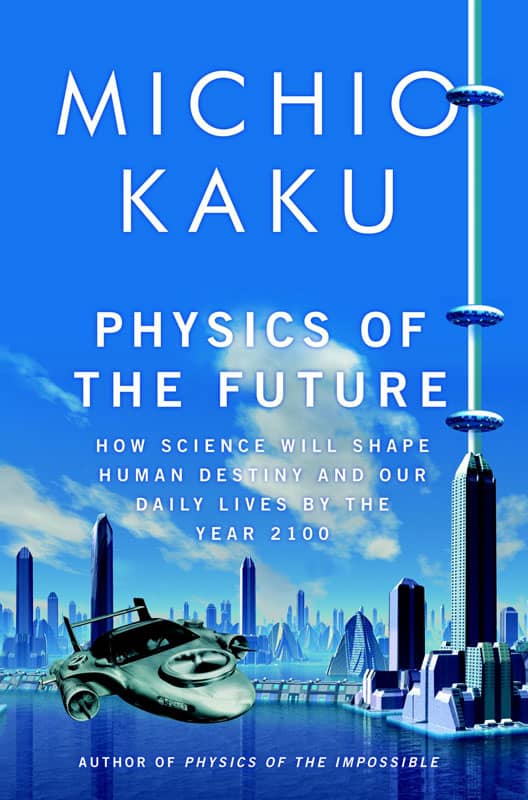
Physics of the Future will be published in the US on 15 March by Doubleday.

Phase-change memory becomes more portable

Phase-change materials are already used to store data on rewritable discs, but their relatively high power requirements make them impractical for use in mobile phones and other portable devices. Now, researchers in the US have found a way to decrease the volume of phase-change material in the memory bit, cutting power requirements 100-fold compared with the best devices on the market today.

Phase-change materials are the active material in rewritable DVDs and are usually made of chalcogenides like germanium antimony telluride – GST for short. Using voltage pulses to produce heat, the materials are switched between an amorphous state (“off”) and crystalline state (“on”). The amorphous state has a very high resistance and the crystalline state a very low resistance.

Faster than Flash

These states endure once the power is turned off, so the materials are ideal for making nonvolatile memory similar to Flash or hard drives. What is more, the phases can be switched in just a matter of nanoseconds, which is much faster than Flash. However, the snag is that relatively high power levels are usually required to switch between the amorphous and crystalline states in GST memory bits.

To get around this problem, Eric Pop and colleagues at University of Illinois Urbana-Champaign used carbon nanotubes to “house” nanometre-scale GST memory bits. They began by creating tiny gaps within the nanotubes using a method called electrical breakdown. This simple technique produces gaps that vary in size from 20 to 300 nm – usually in the middle of a nanotube. Next, the researchers filled the nanogap with a small amount of GST.

The devices are initially in the off state because the as-deposited GST bits are amorphous, with a high resistance of around 50 MΩ. When a voltage is applied across the nanotube (which effectively acts as a contact or interconnect), an electric field is created across the nanogap and switches the GST bit to the crystalline phase. The resistance of the crystalline phase is around 100 times lower, at roughly 0.5 MΩ.

‘Extremely low power dissipation’

The switching only occurs in the small amount of material contained within the nanogap. “This means extremely low power dissipation compared to state-of-the-art devices that use much larger metallic wires to contact the phase-change material,” explained Pop.

The results are very important, say the researchers, because phase-change materials are the most promising technology for replacing Flash memory in laptops, cellphones and many other portable applications. “A 100-fold power reduction could go very far in extending battery life and portability, and could also ultimately lead to many novel applications,” says the team.

Although the Illinois researchers have reduced power dissipation by two orders of magnitude, it is possible that it may have not yet reached the fundamental lower limit for such a technology. “We will now seek to further reduce the programming power (we think another factor of 10 is possible) and also improve the long-term reliability of the memory bits,” Pop told physicsworld.com.

The work was described in Sciencexpress doi:10.1126/science.1201938.

Laser heats up fusion quest

Physicists at the $3.5bn National Ignition Facility (NIF) say they have taken an important step in the bid to generate fusion energy using ultra-powerful lasers. By focusing NIF’s 192 laser beams onto a tiny gold container, researchers have achieved the temperature and compression conditions that are needed for a self-sustaining fusion reaction – a milestone that they hope to pass next year.

Located at the Lawrence Livermore National Laboratory in California and officially opened last year, NIF will provide data for nuclear weapons testing as well as carry out fundamental research in astrophysics and plasma physics. The facility will also aim to fuse the hydrogen isotopes deuterium and tritium in order to demonstrate the feasibility of laser-based fusion for energy production.

These hydrogen isotopes will be contained within peppercorn-sized spheres of beryllium, which will be placed in the centre of an inch-long hollow gold cylinder – known as a hohlraum. By heating the inside of the hohlraum, NIF’s laser beams will generate X-rays that cause the beryllium spheres to explode and, due to momentum conservation, the deuterium and tritium to rapidly compress. A shockwave from the explosion will then increase the temperature of the compressed matter to the point where the nuclei overcome their mutual repulsion and fuse.

One of the main aims of NIF is to achieve “ignition”, which means that the fusion reactions generate enough heat to become self-sustaining. Researchers hope that by burning some 20–30% of the fuel inside each sphere the reactions will yield between 10 and 20 times as much energy as supplied by the lasers.

Hotter than the Sun

NIF first began testing the laser beams last year and now two groups at Lawrence Livermore have shown that they can obtain the desired conditions inside the hohlraum. They did this by using plastic spheres containing helium, rather than actual fuel pellets, since these were easier to analyse, and by combining their experimental measurements with computer simulations, the researchers found that the hohlraum converted nearly 90% of the laser energy into X-rays and that it heated up to some 3.6 million degrees Celsius. They also found that the sphere was compressed very uniformly, its diameter shrinking from around two millimetres to about a tenth of a millimetre.

People were concerned that we wouldn’t be able to achieve the desired temperature and implosion shape, but those fears have proved unfounded NIF boss Edward Moses

“These results are better than we were hoping,” says NIF boss Edward Moses. “People were concerned that we wouldn’t be able to achieve the desired temperature and implosion shape, but those fears have proved unfounded.” Moses says that the next step will be to replace the plastic spheres with beryllium ones containing unequal quantities of deuterium and tritium, in order to study how hydrodynamic stabilities might lead to asymmetrical implosions. The final step will then be to switch over to actual fuel pellets, which will contain equal quantities of the two hydrogen isotopes, and which, it is hoped, will ignite.

Moses says he hopes that ignition will take place in 2012. But he is keen not to raise expectations, having had to deal with many technical problems since construction started on NIF back in 1997. Indeed, he and his colleagues had predicted last January that ignition would be achieved by the end of 2010. “We might be able to reach ignition around spring or summertime next year,” he says. “But there’s a lot of physics that can run us off course in the meantime.”

David Hammer, a plasma physicist at Cornell University in New York, says that the latest results are encouraging. However, he warns that the study was done without fully understanding the interactions taking place between the laser beams and plasma inside the hohlraum and that such interactions could wreck the very precise symmetry of the implosion needed for ignition.

The work is described in Phys. Rev. Lett. 106 085003 and 106 085004.

Doppler shift is seen in reverse

The Doppler shift of sound or light waves from a moving source is familiar to physicists and non-physicists alike. Now, researchers in China and Australia have seen the more exotic inverse Doppler effect in light passing through a material made from tiny silicon rods. They say the result could enhance the use of the Doppler effect in all sorts of applications, from astronomy to medicine.

In the conventional Doppler effect, the frequency of waves that are emitted by, or bounce off, a moving object increases when the object is moving towards an observer and decreases when the object is moving away. This is because in the former case the waves become compressed as they travel towards the observer – and in the latter case the waves spread out.

In 1968 Soviet physicist Victor Veselago predicted that electromagnetic waves travelling through materials with a negative permittivity and a negative permeability would do the opposite. The frequency should drop for a source moving towards an observer and increase for a source moving away. This is because the magnitude of the Doppler effect is proportional to the refractive index of the medium through which the waves propagate. Whereas the refractive index of air and all other natural media is greater than (or equal to) one, the index of the artificial materials considered by Veselago was negative.

The inverse Doppler effect has already been observed at radio frequencies, by two physicists at BAE Systems in the UK in 2003. This work involved tuning the dispersion properties of an electrical transmission line, then bouncing a radio-frequency wave off a moving current pulse within the line and measuring the wave’s frequency shift.

Optical observation a first

Now, a joint team led by Songlin Zhuang of the Shanghai University of Science and Technology and Min Gu of the Swinburne University of Technology in Australia has seen the effect at optical frequencies. To do this the researchers shone an infrared laser beam through a lattice of 2 µm diameter silicon rods attached to a moving platform and recorded the frequency shift of the light leaving the lattice. Being a photonic crystal, the lattice has a characteristic band-gap that forbids the passage of a narrow range of wavelengths, and the researchers say that by tuning the output of their laser so that its wavelength matched the edge of the bandgap they are able to negatively refract the laser light.

The challenge is proving that the light is inverse Doppler shifted as it passes through the photonic crystal. Not being able to position the source and the detector inside the crystal, the researchers had to find a way to subtract the normal Doppler shift that the light experienced as it travelled through the air outside the lattice. To do this, they use interferometry. They split the beam emerging from the laser into two components and adjust the path length of the beam not passing through the photonic crystal so that it experiences the same conventional Doppler shift as the beam passing through the crystal. The beat frequency resulting from the interference of the two beams reveals the frequency shift due only to the inverse Doppler effect.

According to Gu, the trick is to arrange the silicon rods to ensure the laser beam follows the simplest path through the photonic crystal. Otherwise, he says, it would have been too difficult to calculate the expected inverse Doppler shift and therefore impossible to compare theory with experiment. The team also carried out the same experiment using a normal zinc-selenide crystal instead of the photonic crystal, and saw the conventional Doppler shift as expected.

Practical applications

Gu says that his group’s result is important scientifically, partly because of the fundamental role of the Doppler effect in physics and partly because it provides further experimental proof of the still-contested phenomenon of negative refraction. Plus, he adds, the latest work could have practical applications. For example, he says, it might lead to improved analyses of blood circulation, with the use of the inverse as well as the conventional Doppler effect potentially halving the number of measurements that have to be made when measuring the speed of complicated blood flows.

Vladimir Shalaev of Purdue University in the US describes the latest work as an “important breakthrough” that shows “how a fundamental phenomenon can manifest itself in an unusual way”. He says the experiment was “rather smart and technically challenging”, pointing out that it required the measurement of a tiny shift in frequency (about 10 Hz, compared with the central frequency of some 1013 Hz). And in terms of practical applications, he believes the research could benefit any technique currently exploiting the conventional Doppler effect, such as the Doppler cooling of atomic gases.

The work is described in Nature Photonics doi:10.1038/nphoton.2011.17.

Respectability for Dirac's Drunkards

rsz_img_2032.jpg
Dirac’s Drunkards in full flow (Courtesy: Caroline Prew)

By Michael Banks

It was a respectable/mediocre (delete as appropriate) result for the Physics World team at yesterday’s Big Science Pub Quiz held at Imperial College London.

The Physics World “dream team” – including myself, Matin Durrani, Margaret Harris and James Dacey – ventured down to London to test our general science knowledge in a quiz for journalists and academics, which was organized by the science PR office at Imperial.

A total of 16 teams entered from outlets such as Science (Professor Palin and the Fruit Flies), the Times (Meaty You’re Right), the Daily Mail (Imperial Storm Troopers) and Channel 4 (which must have had the team with the best name: Euclids on the Block).

Each team of journalists was put together with a team of academics from Imperial and we joined physicist John Tisch and four members of his quantum optics group for our team, which we called “Dirac’s Drunkards”.

After a few hairy questions in the true or false, science in the movies and picture rounds – for example, is it true that while babies have 300 bones, adults have only 206? – the half-time break couldn’t come quick enough, where we delved into (a rather bland) curry before getting on with the second half of the quiz, with a more taxing pot luck and music lyrics round.

In the end it was not meant to be for Dirac’s Drunkards. We shared eighth place with the BBC News Website (team-name: Denialists) with a score of 52.5 out of 95 – narrowly beating the BBC science radio unit (Radio Gaga) with 51 points and just missing out on seventh place from Euclids on the Block who managed 54 points.

To add further excitement to the night (as if that was at all needed), both teams from New Scientist were in the lead at the end of the quiz with a score of 66.5.

rsz_1img_2293.jpg

So a tie-breaker question was needed and quiz master Gareth Mitchell asked one surely any particle physicist would know: what is the circumference of the Large Hadron Collider at CERN?

Indeed, it was the team that actually named itself after the collider (mischievously misspelling “Hadron” in Hadron Collider) who won, with a guess of 23 km while the Particle Zoo New Scientist team went for 50 km. Of course, as you will know, the answer is 27 km.

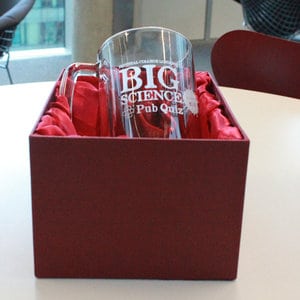
The picture on the right shows what the lucky winning team won, with each member taking home a Big Science Pub Quiz tankard.

Below are some example questions from yesterday’s quiz to see how you would have done (that is without using the internet/Wikipedia/Google of course).

Q) What element in the periodic table has the atomic number 36?
Q) Which Nobel laureate had the original name of Gábor Dénes?
Q) True or false? Women in Sweden have a lower body mass index than women in any other country in the European Union?

Answers on a postcard.

The battle to find Maxwell’s perfect image

To make a perfect lens – one that produces images at unlimited resolution – you need a very special material that exhibits “negative refraction”. Or so researchers had thought.

Now scientists in the UK and Singapore have published experimental evidence that shows perfect lenses don’t need negative refraction at all – and that a simpler solution lies in a 150 year-old design pioneered by James Maxwell. If true, the discovery could be a goldmine for the computer-chip industry, allowing electronic circuits to be made far more complex than those of today. However, the work is proving so controversial that the lead scientist has become embroiled in a fiery debate with other experts in the field.

The route to perfection

Until the turn of the century, perfect imaging was thought impossible. Light diffracts around features the same size as its wavelength, which should make it impossible for a lens to resolve details that are any smaller.

But in 2000 John Pendry of Imperial College London found a way to beat this “diffraction limit”. He understood that, in addition to the light captured by normal lenses, an object always emits “near field” light that decays rapidly with distance. Near-field light conveys all an object’s details, even those smaller than a wavelength, but no-one knew how to capture it.

Pendry’s answer was negative refraction, a phenomenon that bends light in the opposite direction to a normal substance like glass. If someone could make such a negative-index material, he said, it would be able to reign in an object’s near-field light, producing a perfect image.

It was a controversial prediction, but in 2004 researchers at the University of Toronto proved the sceptics wrong by creating a negative-index material and using it to focus radio waves beyond the diffraction limit. And that might have been where the story ended, except that negative-index lenses ultimately proved to be impractical for many applications. They absorb a lot of light, and only work within a wavelength’s distance of the object.

Maxwell’s fisheye

In 2009 Ulf Leonhardt of St Andrews University in the UK realized there may be another way forward. He had been examining a flat “fisheye” lens, first conceived by Maxwell in the mid 19th century, in which a unique refractive-index profile forces light rays to travel in circles, as though they were hugging the surface of an invisible sphere. Indeed, light rays emitted from an object anywhere on the flat surface would always meet at a point precisely opposite.

Leonhardt solved the standard equations of light propagation for the fisheye and came to a remarkable conclusion: all light, including the near field, is refocused at the image point as though it were travelling backwards in time to the source. In other words, said Leonhardt, the image would be the object’s exact, perfect, replica.

The fisheye did have a slight problem. For one half of the lens, the change in refractive index implied light would have to travel faster than it does in a vacuum – a known impossibility. Leonhardt’s solution again played on the symmetry: replace that half with a mirror, he said, so the semicircles of light on that side are simply reflected from the other.

But like Pendry’s nine years before, the prediction met fast resistance. Within two months, Richard Blaikie of the University of Canterbury in New Zealand published a response claiming that any enhanced focusing would not be intrinsic to the fisheye, but an artefact left by having a “drain” where the image is. “An everyday example I can think about is a lightning rod, which concentrates electric fields around its sharp tip,” says Blaikie. “Leonhardt and others somehow confuse this natural (and very well understood) field concentration with imaging.”

A perfect illusion?

The drain, which is essentially a detector, was mentioned as a requirement in Leonhardt’s paper. Yet he admits that he wasn’t initially aware of its role – that it captures the image before the light continues on its circular track back to the source. “It turns out that perfect imaging is only possible when the image is detected; the perfect image appears, but only if one looks…Purists may call it an artefact, but if the ‘artefact’ creates a perfect image, it’s a useful feature.”

Others, including Pendry, were not convinced: at least five other papers have been published arguing against Leonhardt’s prediction. However, in a paper published today in the New Journal of Physics, Leonhardt and colleagues from St Andrews and the National University of Singapore claim “unambiguous” proof that they have beaten the diffraction limit with the fisheye for microwaves.

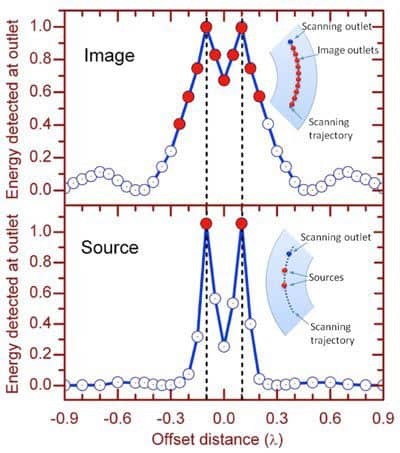
In its experiment, Leonhardt’s group forms the fisheye’s varying refractive index profile with concentric rings of copper, surrounded by a mirror. Microwaves enter on one side from a pair of cables just one-fifth of a wavelength apart, and travel across the rings to a bank of 10 cables, functioning as drains (see “Leonhardt’s fisheye”).

Crucially, the researchers show that the signal arriving at the bank is not smoothed out over all the cables, as would be the case in a normal, diffraction-limited lens. Instead, only those two drains precisely opposite the two cables register strong signals (see “Perfect evidence?”). For Leonhardt, this is proof of imaging beyond the diffraction limit, and the basis of a perfect lens. “The behaviour cannot be explained as an artefact of the drains,” he adds, “because otherwise all 10 drains would register intensity spikes.”

Clone wars

Yet despite this demonstration, all authors of the original arguments against Leonhardt’s prediction told physicsworld.com that they are not convinced. Pendry believes the lens works only when the drains are a “clone” of the source, so that the near-field light is tricked into reappearing. “If the clone is removed, resolution degrades and is limited by wavelength as in a normal lens,” he says. The need of a clone would make the lens useless for imaging features that are too small to see.

Leonhardt disagrees. His drain cables were half the length of the source cables, so were not clones, he says. Indeed, he believes that it would be possible to repeat the experiment for visible light, with photographic film recording the perfect image. And he has supporters: Matti Lassas, a mathematician at the University of Helsinki, Finland, thinks Leonhardt has answered his critics’ arguments convincingly. The ideas are “true breakthroughs in transformation optics”, Lassas says.

“It will take time and more experiments,” says Leonhardt, “but I’m sure in the end even the most hard-nosed critics will be convinced that it works. Maybe they need to see a perfect photograph of fine structures that are otherwise impossible to see. Seeing is believing, but then it will be too late for the sceptics to be ahead of the game.”

The research is described in New Journal of Physics 13 033016 and the video abstract of the paper is below.

The sights – and sounds – of AAAS

lela-th.jpg

By Margaret Harris

A couple weeks ago, the physicsworld.com blog brought you some of the sights and insights from the AAAS conference in Washington, DC. Today I’d like to bring you a few sounds as well, courtesy of Lelavision Physical Music, a dance-sculpture-music duo who formed part of the sonic backdrop to “Family Science Days” in the conference exhibit hall.

Lelavision were at the conference to perform a piece called “Accumulations of change”, which they had developed with David Lynn, an Emory University biochemist, as a way of representing the origins of life and evolution. During the actual performance, Lelavision dancer/gymnast Leah Mann was a little too busy balancing on a rotating DNA sculpture (see photo above left) to talk to me. Fortunately, I’d caught up with her earlier, when her sculptor/musician collaborator Ela Lamblin was laying down some patterns of sound to use in their performance. In the clip below, you’ll hear him in the background, making a “tink-tink” noise with the spheres shown in the photo above right.

Balancing act

And here’s what it sounded like when everything came together.

Patterns of sound
Copyright © 2026 by IOP Publishing Ltd and individual contributors