Kepler basks in its success

By Michael Banks in Washington, DC

It was all things exoplanets this morning at the 2011 annual meeting of the American Association for the Advancement of Science here in Washington, DC.

It’s quite amazing what NASA’s planet hunter – the Kepler mission – has managed to find. So far, in data released in February, the Kepler probe has discovered 1235 planet candidates. 68 of them are Earth-sized planets with 54 thought to be in the habitable zone of a star – an orbit that is not too close or far away from the star so the conditions are ideal for life.

Maybe one of the most interesting potential planets is “KOI 326.01”. It is actually smaller than Earth and is in the habitable zone of its star. However, like most of the planets Kepler has so far spotted, the planet has yet to be confirmed.

When asked further about the planet, William Borucki, from the NASA Ames Research Centre, who gave an overview of the mission, would not single it out for special attention.

The next speaker in the session was Matthew Holman from the Harvard-Smithsonian Centre for Astrophysics, who told delegates that Kepler has found 45 three-planet systems, eight systems with four planets in them, one with five and one with six planets.

Even though Kepler will be studying exoplanets for another three years, astronomers are also thinking about what comes next.

Sara Seager from MIT is planning to send a host of Cubesats into orbit in the next few years to study exoplanets. These small-sized satellites – each around 20 × 20 × 20 cm – would each study a single star to look for planets orbiting them.

Only a few years ago, exoplanet science was thought of as a “cottage industry” according to Seager. “No-one thought how dominating the field of exoplanet research would now be,”she says. As the planets found by Kepler are confirmed and studied further over the coming years, that dominance is likely to continue.

Talking particle physics

By Michael Banks in Washington, DC

Today I met up with Harvard University theorist Lisa Randall to speak to her about all things particle physics.

Randall was speaking about the Large Hadron Collider at CERN in a plenary lecture here at the 2011 American Association for the Advancement of Science meeting in Washington, DC. She is definitely a physicist in demand with a crowd of no fewer than 20 people wanting to ask her a question after the talk.

Randall(web)3.jpg

Randall is looking forward to the next few years now that the LHC is finally starting to deliver data but would not single out one particular area of LHC research for special attention. “It’s all exciting,”says Randall.

Randall has been vocal about the decision to close the Tevatron at Fermilab later this year. It was proposed that the accelerator continue for another three years in search for the Higgs boson but it will now close by October 2011 to make way for experiments in neutrino and muon physics. “I was trying to push them to keep it running,” says Randall. “[Researchers at Fermilab] would have something significant to say about the search for the Higgs boson [if it was allowed to continue].”

Will the prospect of no leading high-energy accelerator now hit US particle physics? “Physics is universal so it doesn’t matter where the experiments are performed,”says Randall. “But it does impact on the training of young physicists. It would be nice for Americans to be a part of it more.”

Randall is also busy putting the finishes touches to a new book called Knocking on Heaven’s Door, which is about the LHC and other topics such as dark matter as well as covering the “nature of what science is and what scientific creativity is”. The theorist will publish the book in the autumn and will no doubt be hoping it has a similar success to her 2005 hit book Warped Passages.

Make sure you catch the full interview with Randall on physicsworld.com in the coming weeks.

AAAS by the numbers

By Margaret Harris

As a physicist, I’m a big fan of numbers, so here are a few outstanding ones I collected from today’s sessions at the AAAS meeting:

NASA’s Space Shuttle can carry up to 16,000 tonnes of cargo back to Earth from the International Space Station (ISS). After the shuttle is retired later this year, any cargo that needs to be shipped from the ISS will have to fit inside a Russian Soyuz capsule, which has a cargo capacity of 50 kg. (Source: NASA astronaut Sunita Williams)

Of the estimated 60 million tonnes of krill in the ocean around Antarctica, up to 5 million tonnes can be harvested each year without harming the long-term sustainability of the population. (Source: George Watters, US Antarctic and Marine Living Resources Program)

2.1% of the 2900 employees of NASA’s Goddard Space Flight Center have a disability – one of the highest percentages of any US government employer. (Source: Dan Krieger, program manager, NASA/Goddard)

Once it’s up and running in the early 2020s, the Square Kilometer Array radio telescope will produce 400 terabytes of compressed data every second. Without compression, it is estimated that the amount of data generated by SKA would exceed the current traffic of the entire World Wide Web. (Source: Bernie Fanaroff, project director, SKA South Africa)

And finally…

A 10 stone person would have to expel bodily gases at a rate of 17 million m/s in order to achieve lift-off by farting. (Source: Chris Smith of The Naked Scientists)

Avoiding nuclear famine

rsz_p1010004.jpg
Hotting up: Michael Mills from the National Center for Atmospheric Research in Boulder, Colorado, shows how a nuclear war could affect the ozone

By Michael Banks in Washington, DC

“It’s a real bummer – quite depressing.” That is the summary of the first session I attended at the 2011 American Association for the Advancement of Science (AAAS) conference here in Washington, DC. Well at least according to Alan Robock from Rutgers University in New Jersey.

The session was about nuclear conflict and its effect on the climate, or more specifically what would happen to it if India and Pakistan had a nuclear war. Rather depressing stuff to hear at 8.30 a.m.

Luke Oman from NASA’s Goddard Space Flight Center studied what effects 100 nuclear bombs – each 15 kilotonne of TNT equivalent in explosive force – would have if detonated in the area. The number of bombs represents around 70% of the total number of warheads the two countries have.

Oman says such a concoction of explosions would create around 5 terragrams of black carbon – or soot – in the atmosphere. This would quickly rise towards the troposphere causing it to increase in temperature by around 30 degrees. The result of the soot would also lead to a global surface temperature drop of around 1.25 degrees and a 10% decrease in global precipitation.

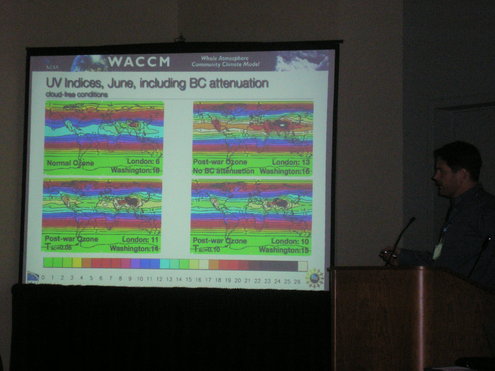
All gloomy stuff, but the next speaker had even more bad news. Michael Mills from the National Center for Atmospheric Research in Boulder, Colorado, used similar models and found that around 30% of the ozone layer would be obliterated only two years after the event.

This would have untold consequences on ultraviolet (UV) levels all over the world. Indeed, Mills calculates UV radiation would increase so much so that in London the level would be around 13 (anything above 11 is considered extreme and with the recommendation to stay indoors) while Washington would be around level 16. This, Mills concluded, would all have a major effect on agriculture leading to a “nuclear famine”

A bummer indeed, and Robock summed up the ultimate aim of all this work. “We hope that people in this city will hear [the conclusions of these talks] and rid the world of nuclear weapons for good.”

Researchers favoured in UK migration cap

Scientific researchers are among those to be prioritized under the UK government’s new immigration rules that will impose an annual cap on the number of work visas issued to people from outside the European Union. The new rules, which will take effect from 6 April, will place an annual limit of 21,700 workers divided up into monthly allocations. But despite being billed as more “business friendly”, the move will reduce the number of highly skilled workers from outside of Europe by as much as 6300 compared with two years ago.

The government released details of its new points-based scheme on 16 February following the announcement last November that it intended to alter the work-based route to entering the UK. As with the existing system, the scheme is designed to heavily favour people entering designated shortage occupations – a regularly updated list that currently includes roles in geophysics and medical physics. But the system has also been tweaked to give preference to PhD-level jobs over those who simply earn high salaries. For instance, an applicant who has a job with a salary of £23,000 that requires a PhD or equivalent would be preferred over someone looking to take up a £74,000 job that does need a PhD.

Striking a balance

Beth Taylor, director of communications at the Institute of Physics [which publishes Physics World] welcomes the reforms. “We are very pleased with the outcome,” she says. “[The changes] include the two main safeguards we were hoping for: striking a better balance between qualifications and salary, so that applicants with PhD status will be on a par with those earning higher salaries; and awarding more points in shortage areas, including physics.”

This view is shared by Imran Khan of the Campaign for Science and Engineering (CaSE), who sees the proposals as a victory for science and engineering. “For a long time now the visa allocation system has rewarded wealthy investors and premier league footballers, and discriminated against top scientists and engineers – it’s great to see this finally being addressed,” he says. CaSE had sent a letter to the UK government last October in response to the impending cap, warning that the nation “must not isolate itself” from the global world of research. The signatories included eight Nobel laureates such as Andre Geim and Konstantin Novoselov who won the 2010 Nobel Prize in Physics.

The changes are part of wider reforms, which the government claims will attract the best oversees talent while ensuring that migrants do not restrict opportunities for UK nationals. This was a theme that formed part of the Conservative party’s manifesto in the lead up to the general election last May. “Britain needs to attract the brightest and the best to fill jobs gaps but this should never be at the expense of workers already here,” says immigration minister Damian Green. “We have worked closely with businesses while designing this system, and made it clear employers should look first to people who are out of work and who are already in this country.”

Student immigration

In a separate speech, Green also stated his intent to impose stricter rules on non-EU citizens coming to the UK for study. Changes will include more robust English language tests and restrictions on sub-degree-level courses that students from outside the EU can take. But this proposal has been strongly criticized by the Higher Education Policy Institute (HEPI) – a UK think tank. HEPI estimates that if these proposals had been implemented since 2005 the number of international students entering UK universities would be at most 25% of the present number, and the cumulative loss of income from students excluded would be as much as £12bn. One reason they cite is that many students come to the UK to study pre-university courses before remaining to continue study.

“This proposal, if implemented, will reverse what has become one of this country’s most successful recent economic growth areas – one that contributes more than £5bn per year to the economy – and will seriously weaken the finances of our universities at a time when they are facing serious pressure because of public expenditure cuts,” says HEPI director Bahram Bekhradnia. A spokesperson for the Home Office told physicsworld.com that the UK government will announce its official reforms to the student immigration system shortly.

LHC comes back to life

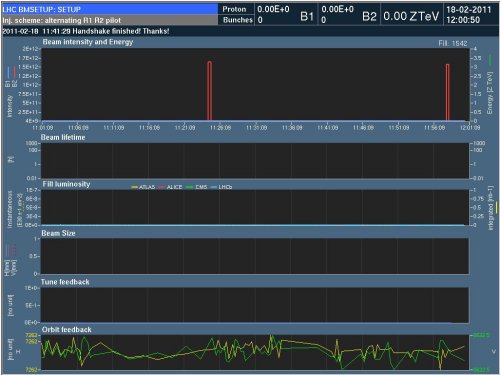
lhc dash.jpg

By Hamish Johnston

Every day I look at the LHC Dashboard website, and for several months it has been very quiet.

But today the site – which gives LHC beam parameters in nearly real time – has a few red spikes (above) suggesting that one of the proton beams has been on, if just momentarily.

Indeed, today is the day that CERN plans to switch on the accelerator after its winter hibernation. However, I believe that we will have to wait until March before there are any collisions.

In the meantime, I’ll keep checking the dashboard.

Marshall Stoneham: 1940–2011

The theoretical condensed-matter physicist Marshall Stoneham died earlier today at the age of 70. Stoneham, who was a fellow of the Royal Society, spent much of his career studying the effects of defects in solids and published several books on the topic. In October 2010 he took over as president of the Institute of Physics, which publishes physicsworld.com. His duties for the Institute will for the moment be taken over by the Institute’s immediate past-president Jocelyn Bell Burnell.

Stoneham was born in Barrow-in-Furness on 18 May 1940. He completed a PhD in physics at the University of Bristol in 1965 and spent much of his career at the UK Atomic Energy Research Establishment (AERE) in Harwell, Oxfordshire, where he led the solid-state and quantum-physics group of the theoretical division between 1974 and 1989. The following year he was appointed director of research at AEA Industrial Technology and later took up the position of chief scientist of AEA Technology.

In 1995 Stoneham moved to University College London, where he became director of the university’s interdepartmental Centre for Materials Research. With his wife Doreen, who is also a physicist, Stoneham founded Oxford Authentication Ltd in 1997 and remained a director at the time of his death. The small firm uses thermoluminescence techniques to establish the provenance of earthenware, stoneware, porcelain and the casting cores of bronzes.

Stoneham also served as vice-president of IOP Publishing, the publishing arm of the Institute, and was editor-in-chief of the Institute’s Journal of Physics: Condensed Matter. In his spare time, Stoneham was an enthusiastic French horn player and even published two books in this area. He is survived by his wife Doreen and two daughters. In a statement, the Institute said that “he will be greatly missed by the physics community, and by all of us in the Institute”.

Stoneham had a wide range of research interests, including the electronic structure of defects, the properties of surfaces and interfaces, the true nature of scanning-probe microscopy and diamond films. However, in recent years he had taken a growing interest in quantum-information technology and hoped to create solid-state quantum gates that are compatible with silicon and could operate at room temperature. Stoneham was also involved in various projects linking physics and medicine, including one that sought to understand how humans can discriminate between different scents and whether left- and right-handed versions of chiral molecules should smell the same or not.

Adaptive optics on a human scale

By Margaret Harris in Washington, DC

Greetings from Washington, DC, where the 2011 meeting of the American Association for the Advancement of Science is getting off to a gentle start this afternoon before the firehose of information switches on tomorrow.

Between today and Monday (17–21 February) there will be more scientific symposia, plenary talks, career workshops and poster sessions here in America’s capital city than you can shake a very large stick at. In fact, there’s so much going on that I’m not the only one from physicsworld.com attending this year: my colleague Michael Banks is navigating DC’s excellent Metro system as I type this, and between the two of us we’ll try to bring you as much of the conference’s physics news as possible.

One of the themes of this year’s conference is interdisciplinary science, and that was certainly on display at this afternoon’s press briefing on adaptive optics. Regular readers of Physics World will already know that adaptive optics is not just for astronomers anymore – we published a feature by Alan Greenaway on adaptive optics in cell biology just a few months ago, in August 2010 – but it was still surprising to find an astronomer (Norbert Hubin of the European Southern Observatory) sharing the stage with a biophysicist (Eric Betzig of the Howard Hughes Medical Institute) and an opthalmologist (Joseph Carroll, Medical College of Wisconsin).

Hubin, of course, is interested in adaptive optics on a grand scale – tools like laser guide stars, and systems of actuators that can make 100 adjustments to a telescope mirror every milisecond, producing images up to three times sharper than the Hubble Space Telescope despite Earth’s turbulent atmosphere.

Betzig, for his part, uses genetic engineering to label clumps of mouse neurons with a fluorescent marker. Once the mouse matures, these glowing clumps become his “guide star” when he images processes that take place up to 500 microns below the surface of a live mouse’s brain.

And Carroll is using adaptive optics to image the human retina on a cellular level, with the goal of diagnosing diseases like glaucoma and diabetic retinopathy at earlier stages, before they cause irreversible damage. “We hope to be able to tell people 10 years before they would have known otherwise that they have this disease, and then treat them,” he told me.

Both Carroll and Betzig emphasized that their adaptive-optics work is still in its early stages – “We are neophytes compared to astronomers,” Betzig admits – but there’s a clear sense of excitement about where this technology could go in the future, as more and more scientists pick up on these astronomy-inspired “tricks of the light” and adapt them for their own needs.

Physicists create ‘anti-laser’

In a fascinating case of physics being turned on its head, a group of researchers at Yale University in the US has created an “anti-laser” that almost perfectly absorbs incoming beams of coherent light. The invention is based on a theoretical study reported last summer in which Douglas Stone and his Yale colleagues claimed that such a system could be possible in a device that they call a coherent perfect absorber (CPA). Instead of generating coherent light beams with a laser, the devices absorb incoming coherent light and convert it into either heat or electricity.

Now, having teamed up with experimental physicists at Yale, Stone has built a version of the device by creating an “interference trap” inside a silicon wafer. Two laser beams – originally split from a single beam – are directed onto opposite sides of the wafer and their wavelengths are fixed so that an interference pattern is established. In this way, the light waves get stalled indefinitely, bouncing back and forth within the wafer, with 99.4% of both beams being transformed into heat.

The group argues that there is no theoretical reason why 100% of the light could not be absorbed using the technique. The researchers are also confident that the current size of the device, 1 cm in diameter, can be reduced to just 6 µm. “It is surprising that the possibility of the ‘time-reversed’ process of laser emission has not been seriously discussed or studied previously,” says Stone.

Focus on applications

Stone’s group believes that its “anti-laser” could prove to have many exciting applications. These might include filters for laser-based sensors at terahertz frequencies for sniffing out biological agents or pollutants, which requires detecting a small backscattered laser signal against a large background of thermal noise.

Another idea is to use the device as a type of shield in medical applications to enable surgeons to fire laser beams at unwanted biological tissue, such as tumours, with greater accuracy. “With our technique an appropriately engineered incident set of light waves could penetrate deeply into such a medium and be absorbed only at the centre, enabling delivery of energy to a specified region,” explains Stone.

The group also speculates that by adding another “control” beam it could control the device to toggle between near complete absorption and 1% absorption. This property could enable the devices to function as optical switches, modulators and detectors in semiconductor integrated optical circuits.

One limitation of all such devices, however, is that they will only work at specific wavelengths, meaning that the technology will not be particularly useful in photovoltaic cells or cloaking devices.

The findings are reported today in Science.

DNA puts a new spin on electrons


A new and highly efficient way of filtering electrons according to their spin has been built using double strands of DNA. The technique, which has been developed by physicists in Israel and Germany, is about three times more efficient than using magnet-based spin filters. The method could be used in spintronic circuits, which exploit both the spin and charge of electrons, and could even lead to a better understanding of the possible role that spin plays in biological processes.

Spintronics holds great promise for creating circuits that are faster and more energy efficient than standard semiconductor devices. This is because the energy required to transport and process spins is much less than that needed to create electron currents. Creating spins is not a problem as magnetic metals such as iron are full of them. The challenge, however, is extracting the spins to form a spin-polarized current and injecting them into a circuit without the polarization degrading along the way.

Today, spins are often made using a filter that exploits the phenomenon of giant magnetoresistance (GMR). This involves passing a current of unpolarized electrons through a material containing alternating layers of magnetic and non-magnetic material in the presence of a magnetic field. In principle, only electrons with their spin pointing in the “up” direction can pass through the filter, but the currents obtained by the device are never entirely pure, with a significant fraction of the electrons emerging spin “down”.

Dense forest of DNA

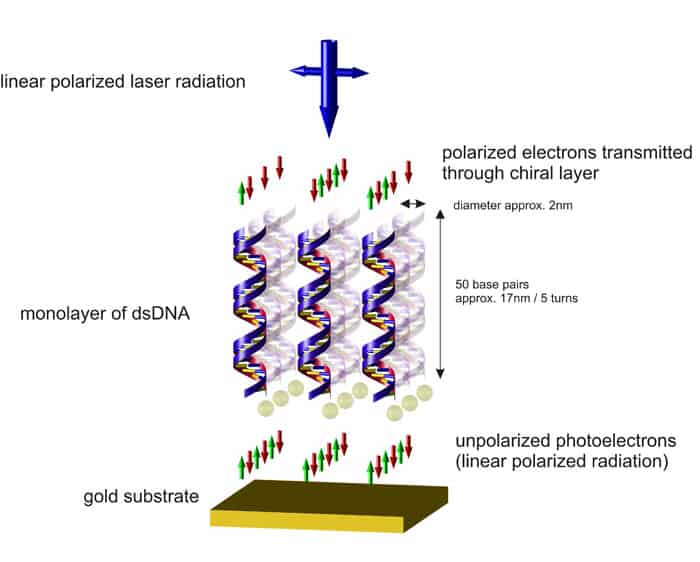
Now, however, Ron Naaman and colleagues at the Weizmann Institute in Israel and the University of Münster in Germany have found that a 60% spin polarization at room temperature can be achieved by passing free electrons through a gold surface covered with a densely packed layer of DNA strands. Although DNA does not normally adhere to gold, the researchers treated one end of each strand with a sulphur compound to make it stick. The result is a dense forest of DNA chains all standing tall on the gold surface.

The researchers then shone a laser on to the gold, which liberates electrons via the photoelectric effect. Some of these electrons travel through the DNA forest and are fed into a device that measures their spin polarization. The team performed the experiment using linearly polarized laser light, which liberates unpolarized electrons. However, after travelling through the DNA, the electrons became polarized by as much as 60%.

The longer the better

The researchers found that the polarization was a strong function of the length of the DNA strands – with 80 base-pair-long strands giving 60% polarization but 25 base pairs only yielding about 10%. The team also found that the filter does not work when the DNA coverage is sparse, suggesting that the electrons are polarized by interactions with the lattice of strands, rather than individual strands.

Despite the strength of polarization effect, Naaman told physicsworld.com that the researchers are not certain why the effect occurs, but he believes that it is probably related to the “handedness”, or “chirality” of the DNA double helix. While other physicists have shown that passage through a vapour of chiral molecules can affect the spin polarization of electrons, the effect is minuscule compared with what is seen with DNA. As a result the interaction at work in the vapour – spin–orbit coupling – is simply too weak to explain these recent results, according to Naaman.

Geert Rikken of the CRNS High Magnetic Field Laboratory in Toulouse, France, speculates that the effect could be a “Bragg-like resonance”, which is a diffraction effect that occurs because the De Broglie wavelength of the electrons is about the same as the lattice spacing of the DNA strands. He points out that a similar spin-filtering of photons due to Bragg diffraction has been seen in cholesteric liquid crystals, which also have a helical structure. To gain a better understanding of the physics at work in the filter, the team is now studying the polarization of electrons that flow through the DNA strands, rather than the free electrons that travel past the strands.

Benefits of DNA

Looking ahead, Naaman believes that spin devices based on organic materials such as DNA could offer several benefits. One is that spin-polarized currents should travel further in such materials – compared with metals – because the strength of the spin–orbit coupling is much smaller and because the spins are less likely to interact with vibrations in the material. Another benefit is that the ends of the DNA can be modified with a wide range of chemicals, which could make it possible to connect DNA devices to spintronic circuits in such a way that the spin polarization is not degraded at the connection.

However, Rikken is more cautious about the work. “I do not think that DNA films would be a welcome component in spintronic devices,” he says. But he does think that other chiral structures could find application in spintronics – if chirality is found to be the mechanism behind the filtering, that is.

Beyond spintronics, the discovery that DNA has a strong effect on electron spin suggests that spin interactions could also play a role in some biological processes. Indeed, Naaman believes that studies of spin in biomolecules could shed light on poorly understood low-energy biochemical processes that occur in nature.

The spin filter is described in Science 331 894.

Copyright © 2026 by IOP Publishing Ltd and individual contributors