

Miracle or no miracle?
By Matin Durrani, Sydney, Australia
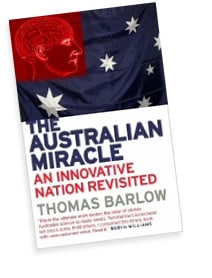
Australia is a big country but, as far as science is concerned, it does just about as much one might expect for a country with a population of just 23 million.
But according to Thomas Barlow, a former academic and journalist who is now a kind of freelance policy wonk and science adviser, Australians are far too pessimistic about their scientific future. In other words, while Australians believe they are an inherently inventive people, they are less good, or so the thinking goes, at capitalizing on their smart ideas.
I met Barlow yesterday during my visit to Sydney at the home of Peter Pockley – a veteran Australian science journalist and broadcaster who also regularly reports on Australian science for Physics World.
Barlow has outlined his thoughts in his 2006 book The Australian Miracle, which offers an honest, well written and sober perspective on Australian science.
It’s worth reading if you’re at all interested in the country’s science and Barlow has as good a perspective as any – he’s married to Michelle Simmons, who’s a leading quantum-computing physicist at the University of New South Wales and who directs a successful national Centre for Quantum Computer Technology funded by the Australian Research Council.
Still, I just can’t get away from the nagging feeling that Australia, being physically so far removed from the US, Europe, China, Japan and other centres of power in global science, is destined to always remain one step behind the rest of the world.
In his book, Barlow denies that there is a brain drain of talent from Australia, which may be true. But unless there is a steady flow of people and ideas in and out of the country, true innovation may struggle. And being so far away, that flow is simply hard to sustain.
MINOS confirms muon-to-electron neutrino oscillation

Neutrino mixing angles from T2K and MINOS
By Hamish Johnston
Less than a fortnight ago we brought you news that the T2K experiment in Japan has caught the first glimpse of muon neutrinos changing (or oscillating) into electron neutrinos as they travel 300 km under Japan.
Now researchers at the MINOS experiment in the US have seen the same neutrino oscillation. The MINOS physicists sent a beam of neutrinos more than 700 km underground from Fermilab in Chicago to the Soudan Underground Laboratory in Minnesota. At Soudan, the team detected a total of 62 electron neutrinos, which is 13 more than they should have seen if some muon neutrinos had not changed to electron neutrinos.
Neutrinos exist in three “flavours” – muon, electron and tau – that change or “oscillate” from one to another as they travel in space. The oscillation strength between different types of neutrino is characterized by three “mixing angles” – known as theta-12, theta-23 and theta-13. Theta-12 and theta-23 have already been measured but theta-13 requires the observation of the muon-electron neutrino oscillation.
More data are required before theta-13 can be nailed down – you can see the uncertainties in the T2K and MINOS results in the diagram. Then physicists will try to measure the same quantity for anti-muon and anti-electron neutrinos. Comparing the two angles could help physicists understand why there is much more matter than antimatter in the universe.
You can read Fermilab’s announcement here.
Los Alamos National Lab narrowly avoids fire
Los Alamos National Laboratory (LANL) appears to have escaped unscathed after a large wildfire threatened it yesterday. At one point the blaze triggered a small “spot fire” within the lab’s boundaries, which has since been controlled by emergency services.
The Las Conchas fire began on Sunday afternoon in the Jemez Mountains approximately 19 km south-west of the boundary of the lab in New Mexico. By Sunday evening, as the fire began to spread, LANL announced that all facilities would be closed on Monday, and non-essential employees were directed to remain off-site.
Late on Sunday evening, the fire was reported to be less than 1.6 km from the lab’s south-western boundaries, as LANL emergency crews teamed up with Los Alamos County and federal fire crews to tackle the blaze. “I’m asking all our employees to stay clear of the lab so the fire crews can do their jobs,” said lab director Charles McMillan on Sunday night. “And please keep those crews in your thoughts tonight.”
The situation appeared to be escalating by mid-afternoon on Monday as a one-acre spot fire had been identified within a technical area on the lab’s south-western boundary. Reports from the field said that the fire had jumped north across New Mexico Route 4 and Los Alamos County conducted a forced evacuation of the town site. LANL emergency officials announced that the lab would remain closed today (Tuesday) as they continued to fight the fire.

‘No facilities face immediate threat’
But by 16:45 local time (23:45 GMT) officials were able to breathe a heavy sigh of relief as they announced that the spot fire was under control after air crews had dumped water at the site. “About one acre burned and the lab has detected no off-site releases of contamination,” read the update from the LANL Emergency Operations Center. “No other fires are currently burning on lab property, no facilities face immediate threat, and all nuclear and hazardous materials are accounted for and protected.”
There had been fears because the area under threat in this latest fire – Technical Area 49 – had been the site of underground hydronuclear experiments in the early 1960s. But subsequent testing has revealed that no contamination exists today at points of public access.
The lab’s latest update at 22:00 stated that important lessons had been learned from the Cerro Grande fire of 2000, which caused damage to lab buildings and employees’ homes. “Our efforts in recent years to thin ground fuels around the laboratory, coupled with the reduction in fuels caused by historic fires in the area, are helping protect the Laboratory and townsite,” said McMillan.
Having been established in 1943 to develop the first nuclear weapons, LANL now has more than 2000 individual facilities covering a wide variety of research including energy and environment. The 93 square kilometre site, owned by the US Department of Energy, has nearly 12,000 employees and its operating costs for 2010 were $2bn.
Famous black hole confirmed after 40 years
Using a vast array of radio telescopes, astronomers in North America are the first to make a direct measurement of the distance to Cygnus X-1, allowing them to conclude that the mass of its dark star is so great it can only be a black hole. They have also discovered that the black hole spins faster than most of its peers.
“There’s no doubt about its distance now, and there’s not much uncertainty anymore about its mass,” says Mark Reid of the Harvard-Smithsonian Center for Astrophysics in Cambridge, Massachusetts. “It’s definitely a black hole.”
A black hole is a star that has run out of fuel and died, collapsing into a small body with such enormous gravity that nothing escapes its grip. First identified as harbouring a possible black hole in 1971, Cygnus X-1 was one of the first sources of X-rays discovered by astronomers. It is found in the constellation Cygnus the Swan, also known as the Northern Cross, and is one of the most studied objects in the sky. It even inspired a 10-minute song by the Canadian rock band Rush about how the stars of the Northern Cross were “in mourning for their sister’s loss”.
A neutron star instead?
However, some scientists were sceptical of its black hole and in 1974 Stephen Hawking bet Caltech’s Kip Thorne that Cygnus X-1 did not have a black hole. Instead, the dark object might be a neutron star, a less extreme type of dead star. The key to the controversy involved a mundane fact: its distance from Earth.
The dark star in Cygnus X-1 orbits a hot blue star every 5.6 days. But without knowing its distance from us, no-one could say how much light the blue star emits. The closer Cygnus X-1 is to us, the less powerful this star must be, therefore the less mass it must have. And the less massive this star, the less mass the dark star whose gravity tugs the bright one has. If the dark star has less than three times the Sun’s mass, it could be a neutron star rather than a black hole.
Recent distance estimates have favoured a higher mass – Hawking conceded defeat two decades ago – but these have been indirect. The best way to measure distance is through parallax – the small shift in a star’s apparent position that results as we view it from different perspectives while Earth goes around the Sun. But Cygnus X-1 is so distant that optical astronomers can’t measure its tiny parallax.
Huge array of telescopes
Fortunately, Cygnus X-1 emits radio waves, so Reid and his colleagues took aim at the object with the Very Long Baseline Array (VLBA), which consists of ten 25 m radio telescopes scattered from New England and the Virgin Islands to California and Hawaii. This huge array measures positions 100 times better than the Hubble Space Telescope.
“Cygnus X-1 produced beautiful data,” says Reid, “and we were able to get a very accurate distance.” The parallax indicates that Cygnus X-1 is 6050 light-years from Earth, with an uncertainty of just 400 light-years. From this the astronomers deduce that the dark star is 14.8 times more massive than the Sun; the uncertainty is just one solar mass, so the object is far above the dividing line between neutron stars and black holes. The blue star it orbits is even more massive, at about 19 solar masses.
“The radio estimate of the parallax is a wonderful achievement,” says Douglas Gies, an astronomer at Georgia State University in Atlanta who is not affiliated with the research team. “It is an extraordinary result.”
Spinning rapidly
The researchers also found that the black hole spins at 97% of its maximum possible speed. They deduce this by observing X-rays from a disc of hot gas that whirls around the black hole – gas that the black hole has torn from its unfortunate partner.
The general theory of relativity says that the faster a black hole spins, the closer an object can circle it on a stable orbit. The part of the gaseous disc closest to the black hole is the hottest. For Cygnus X-1, the inner edge is so hot that it must be very close to the black hole, thus the black hole spins fast. The gas at the disc’s inner edge revolves at half the speed of light, completing 670 orbits every second.
The astronomers have submitted three papers to The Astrophysical Journal, one on the distance, one on the mass, and one on the spin. Preprints are available on arXiv.
Avoiding the grump
By Matin Durrani, Marsfield, Australia
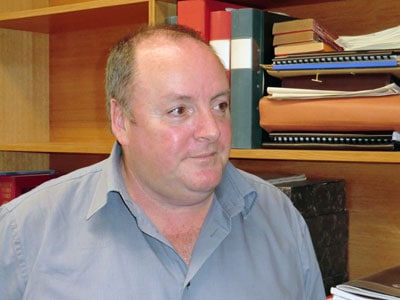
There’s someone who says he’s going to be “in a grump” if the Square Kilometre Array (SKA) is not built in Australia. That’s Phil Diamond (above), head of astronomy and space science at the country’s Commonwealth Scientific and Industrial Research Organisation (CSIRO).
Diamond took up his post last year after moving from the University of Manchester in the UK, where he was director of the Jodrell Bank Centre for Astrophysics and co-ordinator of PrepSKA – the preparatory study for SKA itself.
I caught up with Diamond earlier today at CSIRO’s radiophysics laboratory at Marsfield, about 20 km north-west of Sydney, where I’m on a fact-finding tour of Australian science with three other European science journalists. The newly appointed CSIRO chief is obviously keen for SKA to be built in Australia, having upped sticks from the UK, but unfortunately the Australian plan is faced with a rival bid from various nations in southern Africa.
Both bidders are planning to construct an array of some 3000 radio-telescopes, about a third of which (in the Australian case) will be located in an area about 5 km across in the remote outback in the west of the country, with about a half distributed over another 180 km, with the final fifth spread over several thousand kilometres (including some as far away as New Zealand).
Given that the smallest object a telescope can resolve is inversely proportional to its diameter, spreading lots of dishes far apart means that SKA will have a really high “resolving power”.
And the big advantage of locating SKA in the outback is that there will be hardly any radio interference from mobile phones, power lines or other effects of modern civilization. That’s because almost no-one lives there: the shire of Murchison, where the central SKA core will be located, has a population of just 110 spread over an area that’s 20% bigger than the whole of the Netherlands. And the lack of interference is essential given that the radio emissions that SKA’s interested in are so weak that, says Diamond, it’s like having to detect the signal from an airport radar located 50 light-years away from Earth.
So the Australians think they have quite a strong case, but no doubt the Africans do too and the final decision will be made on 29 February 2012 by the international astronomy community spearheaded by the SKA project office, which is based in Diamond’s old haunt of Jodrell Bank. Not that anyone is suggesting any bias of course.
One thing both bids are having to deal with is the huge amount of information spewing out from the array – with 2 terabits of data per second from each dish, we’re talking the equivalent of a kilometre-high stack of CDs every minute. That information has to be filtered and then sent down high-performance optical cables to a central data centre.
And the point of the project? Oh, just the small matter of finding out how the first black holes and stars formed, how galaxies evolve, the nature of dark energy, the origin of cosmic magnetic fields, the nature of gravity under extreme conditions and possibly even whether we are alone in the universe.
Plus whoever wins will have the world’s astronomers knocking on their doors. So you can see why Diamond will be in a grump if it doesn’t work out for Australia.
physicsworld.com wins at the online media awards
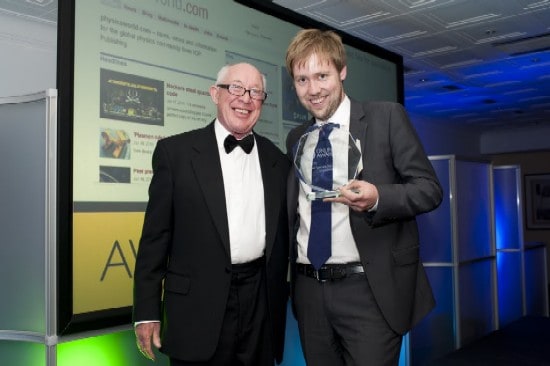
Me (James Dacey, right) receiving the award from Noel Young, one of the judges
By James Dacey
I was absolutely delighted to be in London on Thursday night on behalf of physicsworld.com, to receive the award for Best Specialist Site for Journalism at the Online Media Awards. It was humbling just to be shortlisted for the award alongside the likes of popular sports sites Espn.com and foxsports.com – but to win was really fantastic!
The awards, which are sponsored by the Press Association, are said to “identify the best and boldest of online news-based creativity and also the most original.” Websites in the different categories were assessed by a panel of 11 judges based in a number of countries including the US, China and Australia.
Other winners included bbc.co.uk and theguardian.co.uk, which shared the award for Best Site For News-Led Journalism. And the biggest haul of the evening went to thesundaytimes.co.uk, which took six awards including Best Video Journalism and Best Campaigning/Investigative Journalism.
The award ceremony was held at the swanky Marriott Hotel in Kensington and the opening address was given by Gordon Young, editor of The Drum, the magazine that organized the event. “We believe that online media is really becoming a discipline on its own,” he said. “It’s important to establish an event that gets down to the business of comparing like with like and really celebrating and appreciating the very best of these skills.”
Flattering words indeed! I have to admit that I wasn’t entirely convinced that we’d win the prize, largely because we were up against some websites with far more general remits. But it’s great that a specialist site like ours can occasionally get recognition from the mainstream. Of course, it helps that it’s a really exciting time for physics right now. You’ve got particle physicists closing in on exciting new understandings of nature at the Tevatron and the LHC. Then there are exoplanet hunters who seem to be discovering new alien worlds every other day. I could go on.
But online media – including videos and embedded audio clips – is bringing new opportunities for us to tell these exciting stories to new audiences in different ways. We’ve plunged headfirst into digital publishing in the last few years, having existed as a print publication for over two decades. Who knows how you will be able to digest Physics World content two decades from now. But whatever form it takes, I’m sure it will be the fascinating stories from the world of physics that will give the magazine its enduring appeal.
Solar wind sheds light on early solar system
In 2004 NASA’s Genesis space mission made an unplanned crash landing, damaging its precious cargo of solar-wind particles. Now, after years of painstaking work, two independent groups of scientists have managed to measure the relative abundances of nitrogen and oxygen isotopes in the solar wind. Their studies reveal that the isotopic compositions on Earth are very different from the Sun. The result could prove important to understanding the conditions in the early solar system, when the Earth was forming.
While scientists know a great deal about the isotopic abundance of elements on the Earth, Moon and meteorites, very little is known about the Sun. Fortunately, the Sun spews out a steady stream of ions called the solar wind, which can be captured by spacecraft. Although mostly hydrogen, the wind does contain small amounts of heavier elements and their isotopic composition is believed to be similar to the material from which the solar system formed.
Focusing the wind
Genesis collected the particles over about two years using a solar-wind concentrator, which uses electric fields to accelerate the oxygen and nitrogen ions and focus them on a number of ultra-pure silicon-carbide targets. Despite boosting the number of ions hitting the targets by a factor of 20, the concentrations of the isotopes in the targets was still very small when the mission returned to Earth and would therefore require careful analysis.
But tragedy struck in 2004 when the mission’s sample-return capsule failed to deploy its parachute as it fell towards Earth. The capsule overheated and smashed into the ground, breaking open and shattering much of its contents, including many of the solar-wind targets.
What remained of the targets was contaminated by a range of materials (including a mysterious oily film) and scientists embarked on a painstaking process to clean the samples. This cleaning was difficult because the oxygen and nitrogen ions reside about 100 nm below the surface of the targets and could easily be scrubbed away.
Scanning the surface
Now, the silicon carbide targets have been cleaned sufficiently to have their oxygen and nitrogen contents analysed. One study has been undertaken by Kevin McKeegan and colleagues at the University of California, Los Angeles and other universities in the US, UK and Japan. They used an instrument specially designed for Genesis called MegaSIMS, which is a secondary ion mass spectrometer coupled to an accelerator mass spectrometer. An important feature of the instrument is that it can analyse tiny regions of the sample about 2 µm across in order to find regions of the surface that are not contaminated.
The team measured the abundances of oxygen-17, oxygen-18 and oxygen-16 in the samples. They found that the ratios of oxygen-17 to oxygen-18 are the same in the Sun and on Earth. However, they found that oxygen-16 is about 7% more abundant in the Sun than on Earth.
“We found that the Earth, the Moon, as well as Martian and other meteorites which are samples of asteroids, have a lower concentration of O-16 than the Sun,” said McKeegan. “The implication is that we did not form out of the same solar nebula materials that created the sun – just how and why remains to be discovered,” he added.
Cleaned with ions
Meanwhile, Bernard Marty and colleagues at the University of Nancy, France and several US institutions used a secondary ion mass spectrometer to measure the ratio of nitrogen-15 to nitrogen-14 in the solar wind. A target from Genesis was placed in the instrument and its surface was first cleaned using a low-energy beam of ions. Then the isotope concentration was measured as a function of depth in several regions about 10 µm in diameter.
The concentrations of the nitrogen isotopes peaked at about 80 nm into the target, which the team says is consistent with how Genesis captured the solar wind. The researchers found that the ratio of nitrogen-15 to nitrogen-14 is about 40% smaller in the solar wind than it is in Earth’s atmosphere.
Robert Clayton of the University of Chicago, who was not involved in either study, believes that the oxygen and nitrogen differences could be a result of the interaction of sunlight and the cloud of gas molecules present in the early solar system. This process is called photolysis and results in carbon monoxide and molecular nitrogen separating into their constituent atoms.
Opaque gas cloud
The precise wavelength of light required to break down a molecule depends on its isotopic composition, explains Clayton. It turns out that the light needed to break down carbon monoxide molecules made from oxygen-16 does not travel very far through a gas cloud. This means that the interior of the cloud will contain enhanced concentrations of atomic oxygen-17 and oxygen-18. These liberated atoms take part in the chemical reactions that led to the formation of mineral dust that eventually became Earth and the inner planets. A similar process would also enhance the amount of nitrogen-15 in the dust, according to Clayton.
Clayton points out that the relative abundance of the nitrogen isotopes on Jupiter is similar to that of the solar wind, suggesting that isotope separation by photolysis only occurred in the inner solar system.
The research is described in two papers in Science.
Welcome to Australia

By Matin Durrani, Sydney, Australia
It’s a tough life, but someone had to do it.
I’m here in Sydney with three other European science journalists after accepting an invitation from Australia’s Department for Foreign Affairs and Trade to take part in a week-long fact-finding tour of the country on the theme of “science and innovation”.
We’re being introduced to a range of Australian scientists and later this week are flying to Perth before being taken to the proposed site for the main component of the Square Kilometre Array (SKA). SKA is a set of radio-telescopes that will either be built in Australia and New Zealand or possibly in southern Africa. A choice is set to be made between the two competing bids by the international astronomy community on 29 February 2012.
The Australian government has a regular programme of inviting journalists from around the world to help showcase the country’s efforts in a range of different themes, not just science. You can’t blame them for making the effort. After all, Australia is just so far from the rest of the world – it’s a five-hour flight from Sydney to Perth alone – that a well-crafted programme of events is what’s needed to encourage busy journalists to give up their time to find out more.
So over the next few days I’ll be keeping you up to date with events Down Under. In the meantime, I hope you enjoy the photo I took from Circular Quays as an early Sunday-morning passenger ferry from Manly approaches me with the iconic Sydney harbour bridge in the background.
Australians have been moaning about all the poor weather they’ve been having in the last week or two, but all I can say is that having left the UK late last week, the Sydney winter seems as good as the summer I left behind.
I won’t make you jealous by showing what the beaches look like – oh, go on then (see below).

Nanoparticles play at being red blood cells
Nanoparticles disguised as red blood cells could be used to deliver anti-cancer drugs directly to a tumour. So say researchers at the University of California at San Diego, whose new technique is unique in its approach to harnessing nanoparticles.
Drug delivery systems that mimic naturally occurring biological molecules seem to be the most efficient when it comes to delivering drugs to tumours. Such systems – usually based on nanoparticles – can also circulate in the body for extended periods of time without being rejected by the body’s immune system.
Cocktail of anti-cancer drugs
The new method invented by Liangfang Zhang and colleagues involves exploiting the cell membrane of a red blood cell. The researchers wrap the membrane around a biodegradable polymer nanoparticle that is around 100 nm in size and which has been filled with a cocktail of anti-cancer drugs. This is the first time that scientists have combined a natural cell membrane with a synthetic nanoparticle for drug-delivery applications, explained Zhang. “Such a nanoparticle platform will have little risk of immune response,” he said.
Such “stealth” nanoparticles, as they are called, have already been used with success in clinical cancer trials to deliver chemotherapy drugs. However, previous studies looked at nanoparticles coated with synthetic materials like polyethylene glycol (PEG) – the current gold standard in the field. These coatings protect the drugs contained inside the nanoparticles. If they weren’t protected, the nanoparticles would rapidly induce an immune system response in the body. The coatings allow the particles to circulate in the body for longer, giving them time to deliver their drug payload.
Cloak tricks the body
Zhang and colleagues’ strategy lies in another direction altogether – it involves using a naturally occurring membrane rather than a synthetic one. Such an approach avoids having to build a system that exactly mimics all the biological functions on the surface of a cell. A nanoparticle with a red blood cell membrane “cloak” tricks the body because it looks just like a real red blood cell to all intents and purposes, says Zhang.
Preliminary experiments by the team show that nanoparticles coated with a red blood cell membrane were able to safely stay inside the bodies of laboratory mice for as long as nearly 72 hours.
The researchers say that they would now like to be able to produce their biomimetic nanoparticles in larger quantities for future clinical trials. They also plan to add a targeting molecule to the red blood cell membranes so that the particles can seek out and bind to specific types of cancer cell.
The work was reported in PNAS.
Copyright © 2026 by IOP Publishing Ltd and individual contributors