CoGeNT findings support dark-matter halo theory

New findings from the CoGeNT experiment in the US add strength to the claims of a group in Italy that has been saying for over a decade that it has detected dark matter.

More than 80% of the mass in the universe is believed to be accounted for by dark matter. But while the substance appears to have a strong gravitational influence on the motion of galaxies, it does not interact with light and has proven very difficult to detect directly – let alone study in any detail. The favoured candidate for a dark-matter particle is known as a “weakly interacting massive particle”, or WIMP for short. Various experiments have been constructed to detect WIMPs by looking to see if they interact with highly sensitive detectors.

Researchers at one of these experiments, the DAMA/LIBRA detector at the Gran Sasso National Laboratories in central Italy, stand apart from the rest of the dark-matter community. That is because they have been claiming for years that they have successfully detected dark matter. Rather than looking for individual WIMPs, the DAMA/LIBRA experiment is designed to look for variations over the course of a year in the interactions between dark-matter particles and the sodium iodine crystals inside their detector. The researchers say they have observed an annual oscillation in detections for the past 13 years, which they believe is caused by Earth’s motion through dark matter.

DAMA/LIBRA explains the oscillation by saying that, during the summer, the Earth is moving into the rest frame of a halo of dark matter that surrounds the Milky Way, which causes the number of interactions to peak. Then, in the winter, the Earth is moving away from this rest frame, causing the signal to drop off. The situation is analogous to a car driving through a rainstorm where more raindrops hit the front windshield than the back one.

A sceptical community

But while few in the dark-matter community deny the existence of modulation, many researchers have remained sceptical of the DAMA/LIBRA claims, and to date no other detector has managed to repeat the findings. Among the sceptics is Juan Collar, a member of the CoGeNT collaboration. CoGeNT is a relatively small dark-matter detector located in the Soudan Mine in northern Minnesota, which uses a germanium target to look for low-mass WIMPs. Indeed, Collar’s collaboration set out to test the DAMA/LIBRA claims by looking for an oscillation in 15 months of data. “I thought we were going to blow the DAMA claims out of the water,” Collar told physicsworld.com.

I thought we were going to blow the DAMA claims out of the water Juan Collar, CoGeNT collaboration

But to Collar’s surprise, CoGeNT’s findings appear to corroborate the DAMA/LIBRA data. They reveal a seasonal modulation consistent with the presence of WIMPs with masses of 7 GeV/c2. Detailing their findings in a paper submitted to arXiv, Collar and colleagues say that their results are reliable to a statistical significance of 2.8 sigma. In everyday terms, this means there is just a 0.6% chance that the result is a statistical fluke.

Collar says that his collaboration is still “as critical of DAMA as anyone else” over the claim that the seasonal modulation must be dark matter. But he admits that he cannot yet explain what could be causing the seasonal modulation. He says that his team was careful to exclude other possible sources that could have caused a modulation in the signal, such as seasonal variations in the flux of muons passing through the atmosphere, or radon emerging from rocks surrounding the detector.

Dan Hooper, a theorist based at Fermilab in the US, says that he is “very excited” about the CoGeNT results. “In all of the ways I have studied the data, they look like what you would expect to see from dark matter,” he says. “I suspect that these results will cause some scientists to reconsider the long-claimed DAMA/LIBRA signal”. Hooper warns, though, that the collaboration will need more data to rule out the possibility that the signal is purely due to chance.

Lucky escape from the fire

Indeed, Hooper was pleased to tell physicsworld.com that the CoGeNT team had commenced a fresh run a data collection last Monday (6 June). There had been concern that the detector had undergone damage following a fire in the Soudan Mine in March.
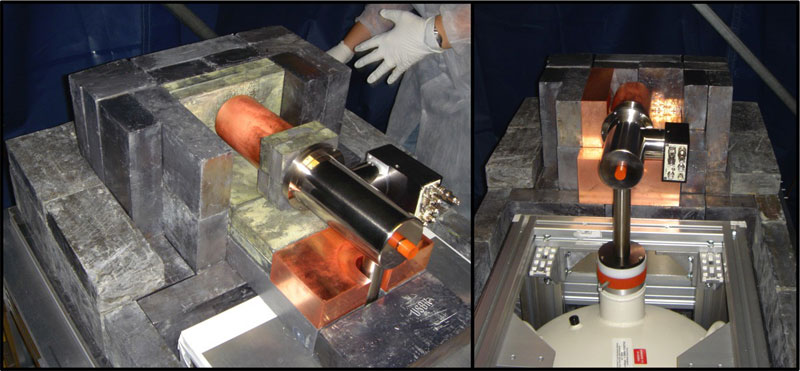
But other researchers have been more sceptical of the CoGeNT collaboration from its outset. Researchers at the XENON 100 experiment in Italy, for instance, claim that they have already ruled out the possibility of WIMPs existing within the mass range that CoGeNT is designed to consider. The XENON 100 is a liquid-xenon-based detector considered by many to be the most sophisticated experiment designed for direct dark-matter searches.

However, both Collar and Hooper believe that there are reasons to believe that a light-mass dark-matter particle could have escaped detection by XENON 100. In a separate paper submitted to arXiv, Collar questions the sensitivities of the XENON 100 detector and its predecessor, XENON 10. Collar proposes that the XENON teams have made far too many assumptions in excluding low-mass WIMPs. “XENON is tremendously biased,” he told physicsworld.com.

The debate, however, is likely to go on. Henrique Araujo, a dark-matter researcher at Imperial College London remains open to the idea that CoGeNT has seen dark matter but he expects that other detectors should have seen the CoGeNT signal. “Bearing in mind that CoGeNT has a very small target mass of 440 g and that it actually claims to see quite a large total number of ‘light WIMP’ events, other detectors should find plenty of recoils creeping up at the energy threshold,” he said.
Evidence mounts for previously unseen neutrino oscillation

Physicists at the Tokai-to-Kamioka (T2K) experiment in Japan claim to have measured, for the first time, muon neutrinos changing into electron neutrinos. The effect could allow researchers to pinpoint the final undetermined neutrino “mixing angle” as well as provide a clue toward solving the mystery of why matter, rather than antimatter, dominates the universe.

Neutrinos exist in three “flavours” – muon, electron and tau – that change or “oscillate” from one to another as they travel in space and are very hard to detect because they interact weakly with matter. Researchers at T2K generate neutrinos at the $1.5bn Japan Proton Accelerator Research Complex (J-PARC) based in Tokai on the east coast of Japan. The facility accelerates protons to around 30 GeV and then fires them into a graphite target to produce pions, which then decay into muons – heavier cousins of the electron – and muon neutrinos.

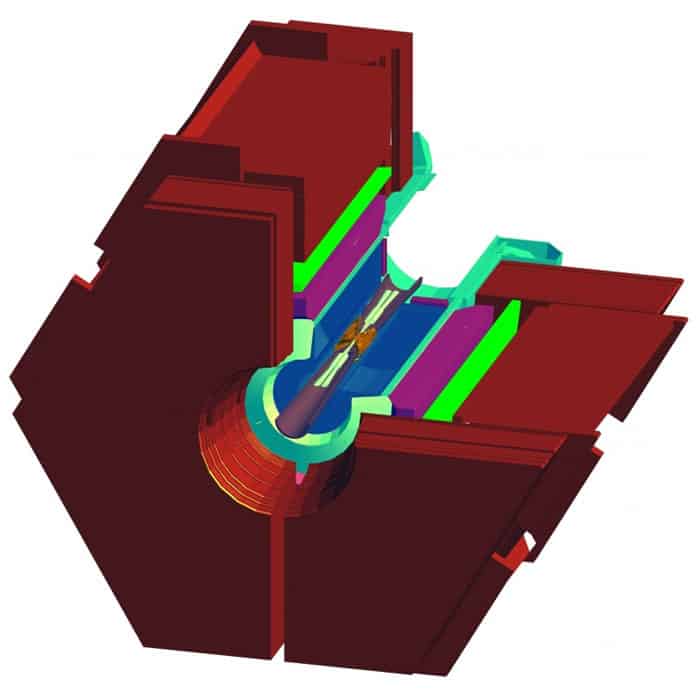
After passing through a detector that determines how many muon neutrinos are in the beam, the particles are sent underground to the vast SuperKamiokande detector in Hida, some 300 km north-west of Tokai on Japan’s west coast. SuperKamiokande consists of 50,000 tonnes of water surrounded by 11,146 photomultiplier tubes, each 50 cm in diameter. The photomultiplier tubes pick up the radiation emitted when a neutrino interacts with a water molecule.

Changing flavours

The oscillation strength between different types of neutrino is characterized by three “mixing angles” – known as theta-12, theta-23 and theta-13. T2K’s predecessor, the KEK to Kamioka (K2K) experiment, as well as the KAMland experiment in Japan and the Sudbury Neutrino Observatory in Canada, have already measured theta-12 and theta-23. Theta-12 was estimated from the difference in the number of electron neutrinos ought to originate from the Sun and the smaller numbers actually detected, which were presumed to have oscillated into other flavours as they travel to Earth. Similarly, for theta-23, researchers looked at atmospheric neutrinos and observed a deficit in the expected number of muon neutrinos.

Now, researchers at J-PARC have made a step towards measuring the final mixing angle – theta-13 – by measuring muon neutrinos oscillating into electron neutrinos. From January 2010 until March this year, the SuperKamiokande detector observed 121 neutrinos that clearly originated from the J-PARC neutrino beam. The background signal, which could mimic a signal from electron neutrinos that are present anyway, was estimated to be around 1.5 events. However, over 13 months, researchers at T2K, which has more than 500 researchers from 12 countries, spotted six events arising from muon neutrinos turning into electron neutrinos. The probability of observing, by chance, six events when only 1.5 are expected is 0.7%, or a little less than 1 in 100.

“The result is not enough to claim a discovery, but it is important for not only T2K but also high-energy physics in general,” says Koichiro Nishikawa, former spokesperson for the T2K experiment and based at the KEK particle physics lab in Tsukuba. “This result is also, except for one ‘tau event’ in the OPERA experiment at Gran Sasso in Italy, the first time that anyone has shown that neutrino oscillations occur as a change of flavour.”

Data collecting at Kamioka, however, was cut short due to the Tohoku earthquake that struck north-east Japan on 11 March and which badly hit the J-PARC facility, affecting roads and buildings. J-PARC will remain closed until later this year when lab officials hope to start powering up the accelerators again. “It is very unfortunate that we lost most of this year’s running, as otherwise (assuming we aren’t the victim of a statistical fluke) we would have something pretty convincing by now,” says Dave Wark of Imperial College London and former international co-spokesperson for T2K.

When J-PARC restarts, Nishikawa adds that physicists on T2K should be able to get a good estimate for theta-13 by “summer 2013”. After a few years, researchers will also switch to generating anti-muon neutrinos that could oscillate into anti-electron neutrinos. As the initial and final states can be measured this could give a clear indication if there is any difference between the behaviour of matter and antimatter particles. The experiment will then also search for “charge-parity” violation in different kinds of leptons, which could help us better understand why there is much more matter than antimatter in the universe.

The work has been submitted to Physical Review Letters.

Italy picks site for SuperB collider

The SuperB particle collider will be built at the University of Rome, Tor Vergata. Located on the outskirts of the Italian capital, the site will be called the Cabibbo Laboratory in honour of the particle physicist Nicola Cabibbo, who died in August 2010. The experiment is expected to start collecting data in 2017.

The €500m SuperB facility will be built by Italy’s National Institute for Nuclear Physics (INFN) with funds provided by the host nation and several other countries. It will consist of a 2 km circumference ring with two accelerators – one for electrons and the other for positrons. Collisions will occur within a large detector and produce extensive numbers of B-mesons, D-mesons and tau-leptons. The detector will track the decay products from these particles and measure their energy.

Change of location

The original plan was to locate SuperB at the INFN’s Frascati campus just outside Rome. However, a decision taken in 2010 to include a synchrotron-radiation facility within SuperB meant that the Frascati site was too small.

Now, the INFN has decided to locate SuperB on a 30 hectare site at Tor Vergata, which is about 4.8 km from the Frascati lab. The larger site will make it much easier to include up to six synchrotron beam lines and associated experimental halls.

The next step for SuperB physicists is to set up a European Research Infrastructure Consortium (ERIC) to build the facility. ERIC is a new organizational structure available to European physicists and SuperB will be the first project to create such a set-up.

Watching tau leptons

According to Adrian Bevan of Queen Mary University of London – who is part of the UK’s SuperB contingent – the collider will produce about 100-times more data than other “B factories” such as BaBar in the US, which stopped running in 2008, and Belle in Japan.

SuperB will produce large numbers of tau-leptons – and one of the first things physicists will look for is “charged lepton flavour violation” such as a tau-lepton decaying into three muons without producing any neutrinos. The observation of such decays would point to new physics beyond the Standard Model.

Bevan told physicsworld.com that SuperB should be completed in 2016 and start taking data in 2017. He expects the experiment to run for about 10 years before the facility is converted into a dedicated synchrotron light source that could run for an additional 20 years.

Introduced the “Cabibbo angle”

Cabibbo was best known for his work on the weak interaction in quarks and was recognized for his contribution to “quark mixing” between different favours of these particle. In 1963 he introduced the “Cabibbo angle” that is related to the relative probability that down and strange quarks decay into up quarks. Cabibbo’s 2 × 2 quark-mixing matrix was later extended to include a third generation of quarks by the Japanese physicists Makoto Kobayashi and Toshihide Maskawa, who then shared the 2008 Nobel Prize for Physics together with theorist Yoichiro Nambu.

Weird Kansas weather

heatburst_new.jpg
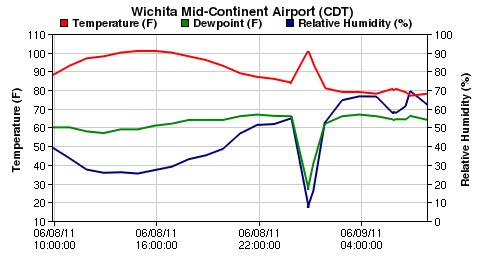
Temperature and humidity graph from Wichita, Kansas (Courtesy: AccuWeather)

By Margaret Harris

I grew up in Kansas, where unusual weather isn’t so much a conversation topic as a spectator sport. But even by Kansas standards, what happened in Wichita (the state’s largest city) last Thursday night was decidedly weird.

As the graph shows, shortly after midnight on 9 June, the temperature in Wichita jumped from 85 to 102 °F (roughly from 30 to 40 °C) in less than 20 minutes. At the same time, the relative humidity plunged, dropping from 55% to a desert-like 7%. Two hours later, both readings had returned to “normal” – or at least, as normal as Kansas weather ever gets.

What happened in Wichita is known as a “heat burst”, and it occurs when a pocket of air in the upper atmosphere collapses, producing a hot, dry downdraft and winds in excess of 60 miles per hour. Such bursts can be seriously damaging: when a meteorologically similar (but colder and wetter) event called a microburst hit a neighbourhood in my hometown back in the late 1990s, it flattened houses as efficiently as any tornado. But how did the air pocket get there in the first place?

The answer (courtesy of this excellent post from John Rennie of The Gleaming Retort blog) turns out to involve one of my favourite weather phenomena: virga, the high-altitude rain that leaves grey streaks across the sky as the moisture evaporates before reaching the ground. This evaporation process pulls heat out of the surrounding air, leaving it colder and denser. If this pocket of air becomes more dense than the air below it, it falls.

But as Rennie notes, that doesn’t explain the heat and low humidity in Wichita’s heat burst. For that, we need some more physics. As a parcel of cold, dense air falls, it becomes even more dense because it gets squeezed by the higher-pressure air present at lower altitudes. This squeezing does work on the parcel, heating it adiabatically. But of course, heating air causes it to expand, and as a result, most potential bursts never hit the ground. Instead, the competing influences of pressure and temperature cancel each other out, the parcels reach an equilibrium at some altitude, and any excess heat is absorbed by the surrounding air. Wet air is particularly good at this, thanks to the high heat capacity of water vapour.

In Wichita, however, the air seems to have been falling too fast to achieve any kind of equilibrium. It was also falling through a relatively dry layer of atmosphere, so there wasn’t much water vapour around to absorb the heat it generated as it fell. The result was the hot, dry “whoosh” shown in the graph.

I should warn you that there are probably some holes in this explanation, since downbursts of all types (wet, cold, hot, dry) are still poorly understood. But the next time you wake up hot and thirsty in the middle of a strange wind storm, relax:it may just be Kansas weather up to its usual tricks.

Nanotransfer makes large-area NIMs

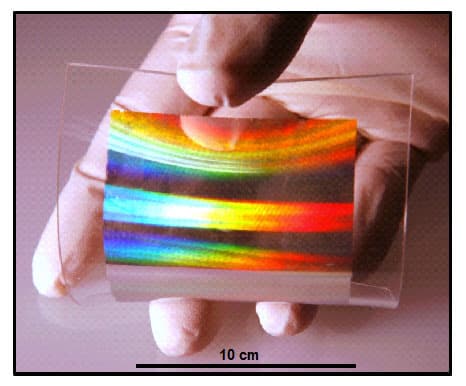
Researchers at the University of Illinois at Urbana-Champaign have figured out a way to fabricate 3D “negative index” metamaterials (NIMs) by the square foot. The feat is a real advance over traditional fabrication techniques that are slow and which can only make such materials over small areas.

Metamaterials are man-made structures that have very different properties to those of naturally occurring materials. For example, NIMs are structures artificially engineered to have a negative index of refraction. This means that light travelling through such materials is bent in the “wrong way” compared with that in normal materials, which have a positive index.

NIMs have a number of desirable properties that do not exist in normal materials, including the ability to focus light to a point smaller than its wavelength. Scientists have already used these structures to make novel devices such as “invisibility cloaks” and hyperlenses – devices that can image objects much smaller than is possible using an optical microscope.

Until now, however, techniques to produce NIMs were limited to micron-sized surface areas. John Rogers and colleagues’ new method, which is based on nanotransfer printing, overcomes this problem. “The advance is important because such an approach will be required for any practical applications of these materials,” said Rogers.

The researchers begin by making a high-resolution stamp comprising “hills” and “valleys” on the surface of a moulded polymer. By then depositing alternate layers of materials using an evaporation process, they are able to coat the entire surface (both the raised and depressed regions) with precise multilayer stacks. By peeling off the stacks from just the raised regions allows them to produce a thin film structure that looks like a fishnet, which can be transferred to other substrates such as glass or plastic.

The stamp can be used again for another fabrication cycle and the multilayer fishnets can be designed to have a negative index of refraction. Rogers and co-workers showed that this was possible by detailed optical measurements and modelling studies on the structure.

New applications

“Conventional methods use a focused beam of electrons or ions to fabricate the fishnets in a serial, slow process that are typically applied over areas of a fraction of a square millimetre,” Rogers said. “Our structures are formed in parallel and we can make fishnet structures at the scale of 10 × 10 cm, limited only by the tooling in our academic cleanroom facilities.”

Scientists are very much interested in artificial metamaterial structures that have a negative index of refraction. Applications range from ultrathin, high-performance lenses, to photonic device components, sensors and the famous invisibility cloaks.

The team is now busy working on scaling down the feature sizes of its structures so that they operate in the visible wavelength range. Operation in the visible has been difficult to achieve so far because the structures in the metamaterials must be about the same size as the wavelength of the radiation – for light, this is hundreds of nanometres. “We are also exploring applications of large-area sheets of flexible NIMs,” revealed Rogers.

The work was published in Nature Nanotechnology.

EPL – the first 25 years

The Internet has had a profound impact on many areas of modern life, and that includes the traditionally cosy world of journals publishing. With anyone able to “publish” their own work by uploading it to a free-to-access preprint server or onto their own website, the once-dominant role of the traditional scientific journal is under threat. And with library budgets being squeezed around the world, publishers have needed to come up with clever strategies to maintain their publications’ profitability and circulation.

In this special video report, Michael Schreiber, editor-in-chief of the letters journal EPL, describes some of the challenges facing such scientific publications. The video was filmed in Munich at a special 25th-anniversary meeting of the journal, which was originally known as Europhysics Letters before being rebranded as EPL in 2007. The journal was originally set up in 1986 as a collaborative venture among the French and Italian physical societies, the UK’s Institute of Physics (which publishes physicsworld.com) and the European Physical Society (EPS).

But despite the pressures on publishing imposed by the Internet, traditional journals such as EPL are alive and well. As Schreiber explains, one key reason for their continued success is that the material they publish is peer reviewed, which imposes rigorous quality control and means researchers know that what is in the journal is worth reading. “There is so much dubious research on the Internet nowadays”, Schreiber explains, “that it’s not possible to have an overview or a feeling of what is good or bad, but with a journal [you] can rely on [what it contains].”

As for the future of EPL – what Schreiber calls “the flagship journal of the European Physical Society” – he is sure that by the time the journal celebrates its 50th anniversary, it will be purely online, have gone completely global, and contain many more good papers than it does now. A quarter of papers published in EPL are already from the US, with many from other growing scientific superpowers such as India, China and Brazil. But Schreiber – a physicist from the University of Chemnitz in Germany – is looking forward to receiving papers from an even more unusual source, as you can find out by watching the video.

Conference report: 25 years of EPL

The Bavarian Academy of Sciences and Humanities in Munich was the setting last month for a special event to mark 25 years of the research journal EPL. The academy, which is housed in one wing of the grand Residenz complex, was an appropriate and symbolic venue for the conference. Just as the Residenz buildings were entirely rebuilt after the Allied bombing of the Second World War, so EPL is playing its own part in restoring European physics to its former glory.

Originally known as Europhysics Letters (it was rebranded in 2007), EPL was set up to promote and showcase the very best of European physics research by publishing short “letter” articles exploring the frontiers of physics. To mark the anniversary, the organizers invited a string of top speakers and flew in more than 100 students and postdocs from across Europe to create a lively, international feel. The video above includes soundbites from seven delegates, speakers and those involved in journal itself.

  • Katherine Richardson, University of Copenhagen, Denmark
  • Elinor Bailey, University College London, UK
  • Ivan Gnesi, University of Turin, Italy
  • Angela Oleandri, Italian Physical Society
  • Marcel Hoffmann, Gymnasium Höchstadt an der Aisch, Germany
  • Jonathan Payne, University College London, UK
  • David Lee, European Physical Society

Don’t miss the shots of the conference dinner, which was held in one of Munich’s best known restaurants – the atmospheric Hofbräukeller – which included a fabulous four-course buffet. You will spot the familiar cracking open of a Bavarian beer barrel to launch the dinner, which was performed by Martin Huber, chairman of the EPL Association’s board of directors. Who says physicists have it tough?

Physicists create a living laser

To date, lasers have been built from inanimate materials, such as purified gases, synthetic dyes or semiconductors. But now physicists in the US have shown how to induce lasing in a single living biological cell. By shining intense blue light onto fluorescent protein molecules in a cell, the team made the molecules generate intense, monochromatic, directional green light. This phenomenon could potentially be used to distinguish cancerous cells from healthy cells, claim the researchers.

The material used in the latest work is the green fluorescent protein (GFP), which is found in the jellyfish Aequorea victoria and has been used to image live cells since the 1960s. By combining the gene that encodes GFP with the DNA of any other protein, the GFP can be attached to that protein. The light it gives off can then be used to track the protein in living cells.

The natural fluorescence of GFP is incoherent, just like the light emitted by a normal light bulb. But physicists Malte Gather and Seok Hyun Yun, at the Massachusetts General Hospital and Harvard Medical School in Boston, thought it might be possible to amplify the protein’s light and so build a biological laser. A tantalizing prospect because almost any organism, from a bacterium to a cow, can be programmed to synthesize GFP.

Between two mirrors

Gather and Yun put human embryonic kidney cells into a Petri dish and then added the DNA that encodes for GFP to the cells. They then attached a drop of solution containing these re-programmed cells onto a mirror with a diameter of about 3 cm. They placed another, equal-sized, mirror above the solution, leaving a gap of about 200 μm between the mirrors. They then focused nanosecond-long blue laser pulses onto the space between the mirrors and moved the mirrors around, with the aid of a microscope, until they were able to shift a single cell into the beam’s focus.

With the cell in place, the researchers gradually increased the power of the blue laser and watched how the green fluorescence changed as a result. Above a certain threshold – when the blue pulses had an energy of about 1 nJ – the energy of the emitted green light increased sharply and its spectrum narrowed to just a few well-defined peaks. This, the researchers say, is a clear signature of lasing because above this threshold there are enough protein molecules in an excited state to generate stimulated rather than spontaneous emission. The emitted green light is amplified as it bounces back and forth between the mirrors, as occurs in a conventional laser cavity.

Gather says that, to the best of his knowledge, this is the first time that a laser has been made from a living material. He mentions that scientists have previously mixed dead tissue with inorganic laser materials and seen coherent emission from the composite. But this latest material is made entirely from living tissue, and this remains alive even after emitting hundreds of laser pulses.

Searching for cancer

Gather believes that the latest work could eventually have important practical applications. Conventional machines, called cytometers, that analyse large numbers of cells usually provide just one parameter for each cell – brightness. More can be learned by studying cells under a microscope, but the long exposures required mean that this is a time-consuming process. In the GFP cell-laser, variations in intercellular structure, which introduce slight changes to the refractive index of the cell, alter both the spatial output of the laser light and its spectrum. Gather says that this additional information “might make it easier to distinguish between a cancerous cell and a benign cell, or a cell that has become infected with a virus”.

The next step, says Gather, is to shrink the mirror cavity so that it is small enough to fit inside a cell, the typical diameter of which is between 10 and 20 μm. This may then allow imaging of cell-lasers inside a living animal, rather than having to extract cells for investigation in the lab. In this case the pumping laser could be supplied either from the outside by shining it through the body or by injecting light through optical fibres inserted into the body.

However, Gather emphasizes that it is difficult to predict precisely what applications could follow and adds that the motivation for the experiment was “largely basic scientific curiosity”. The researchers were trying to answer the basic question, why do lasers not exist in nature? “Some astronomers claim there are star clusters that produce coherent light,” Gather says, “but as far as I know, there is nothing on Earth that does so.”

Writing in a “News and Views” commentary piece to accompany the paper, Steve Meech, a chemist at the University of East Anglia in the UK, says that “it is currently unclear what applications lie in store for cellular lasers”. But he adds that “whatever the eventual applications, the advent of GFP in photonics certainly marks an exciting new avenue of research for this extraordinarily versatile protein”.

The research appears on the website of Nature Photonics.

D0 fails to reproduce CDF's mysterious bump

By James Dacey

In April the CDF collaboration at the Tevatron triggered excitement and frantic speculation when it announced the discovery of a mysterious bump in its data that could not be explained by the Standard Model of particle physics. But alas, it appears that this mysterious bump will now fade into the night, following the announcement today by the D0 collaboration – CDF’s sister experiment – that it has failed to reproduce the result.

Two months ago the CDF collaboration reported the unexplained signal, which was spotted in a study of W and Z boson pairs that are created when protons and antiprotons collide in Fermilab’s Tevatron collider. The researchers noted a bump between 120 and 160 GeV /C2 in the jets of W bosons with a statistical significance of about “three sigma”.

Within days, speculation surrounding CDF’s bump was rife. People quickly ruled out the possibility that this was the elusive Higgs boson, but some were suggesting that it could be explained by a kind of hybrid force dubbed “technicolour”. A separate theory, proposed by Dan Hooper at Fermilab, was that the excess of events could be explained by a new force responsible for interactions between dark matter and normal matter.

And excitement grew even stronger last week when further analysis by the CDF collaboration saw the significance of its result upgraded to almost five sigma. In everyday terms, this means that there was just a one-in-a-million chance of the bump being due to a statistical fluke.

But earlier today, the D0 collaboration may have killed the party following its analysis of a similar data selection. Publishing a related paper on their website and on arXiv, the researchers report that they find no evidence for the same rare boson production in the mass range 110–170 GeV/c2.

In a statement published on Fermilab’s website, D0 co-spokesperson Dmitri Denisov is quoted as saying: “Our data for collisions that produce a W boson plus two jets are in agreement with the predictions from the Standard Model.

“We have looked among two hundred trillion particle collisions, and we don’t see the excess reported by CDF.”

The D0 collaboration will report its result and the details of its analysis at 4 p.m (CDT). today at a seminar at Fermilab. You will be able to watch a live webcast.

So is this the end of the bump? I’m not sure but it will be very interesting to hear what CDF makes of the developments.

Graphene integrated circuit is a first

IBM researchers have made the first graphene circuit in which all of the circuit elements are integrated on a compact single chip. The new circuit is another important step forward for graphene-based electronics and potential applications include wireless communications and amplifiers.

Despite much progress in recent years and the fact that scientists have already made some high-performance graphene-based devices, it still remains challenging to integrate graphene transistors with other components on a single chip. This is mainly because graphene does not adhere very well to the metals and oxides traditionally used in semiconductor-manufacturing processes and because there are no reliable and reproducible techniques yet to make such circuits.

Integrated inductors

Now, Phaedon Avouris and colleagues at IBM’s T J Watson Research Center in Yorktown Heights, New York, may have overcome this problem with their new integrated circuit that consists of a graphene transistor and a pair of inductors compactly integrated on a silicon carbide (SiC) wafer. The wafer-scale fabrication process the team developed is compatible with conventional semiconductor-fabrication methods and can be used to produce circuits in high yields.

The researchers synthesized their graphene by thermal desorption of silicon from SiC wafers to form uniform graphene layers on the insulating SiC surface. They then defined the transistor channel using electron-beam lithography, removing graphene outside of channel regions with an oxygen plasma. Inductors were defined by electron-beam lithography and formed by depositing micron-thick aluminium metal onto the wafers. Finally, a 120 nm thick layer of silicon dioxide, deposited by electron-beam evaporation, was used to isolate the inductor loops from the underlying metal interconnects.

The circuits operate as radio-frequency “mixers” up to 10 GHz, says team member Yu-ming Lin. As the name suggests, mixers produce output signals with mixed frequencies and are fundamental components of many electronic communications systems. In their device, the researchers apply two high-frequency signals to the gate and the drain of the graphene circuit. The graphene transistor is modulated by both signals and produces a drain current that contains the mixed frequencies.

Wireless communications

“The circuit, as it stands, could already be used for wireless communications,” Lin told physicsworld.com. “And by further optimizing the performance of the graphene transistors, it might be used as an amplifier.”

The importance of the work goes beyond the actual circuit demonstrated and other circuits can be made using the same technique, he adds. It could also be applied to different types of graphene materials, including chemical vapour deposited (CVD) graphene films created on metal films. Most importantly, it could be used on silicon and other semiconductors to form hybrid circuits with new functionalities.

The team is now busy working on improving the performance of the transistors by optimizing device structure, graphene quality and the gate dielectric. “We are also developing more complex graphene circuits for even more sophisticated devices,” says Lin.

The work is detailed in Science 332 1294.

Copyright © 2026 by IOP Publishing Ltd and individual contributors