D-Wave sells its first quantum computer

PW2011-05-12-dwave-rose-th.jpg

By Hamish Johnston

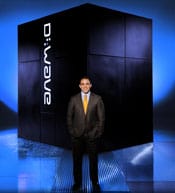
I’ve just received a press release from Canada’s D-Wave Systems saying that the firm has sold its first quantum computer.

The buyer is the US-based defence and security contractor Lockheed Martin and the company will use the system to address some of its “most challenging computation problems”, according to D-Wave. “The multi-year contract includes a system, maintenance and associated professional services,” says the company.

You may recall that earlier this month D-Wave scientists published a paper in Nature that showed that certain aspects of the firm’s “quantum annealing” scheme for quantum computation worked as predicted.

D-Wave was founded in 1999 and for many years the efficacy of the firm’s technology was a matter of much debate in the physics community.

Now it seems that things are looking up for the Vancouver-based firm.

Quantum computers tackle chemistry and biology

Physicists around the world are working very hard to develop practical devices for quantum computing and have already managed to perform a few very basic calculations. But what problems could scientists solve if they had access to more sophisticated quantum computers?

In this exclusive video interview Alán Aspuru-Guzik of Harvard University explains how quantum computers could solve a range of chemistry and biology problems much more efficiently than the best supercomputers of today.

Aspuru-Guzik explains how important questions such as how drugs bind to proteins or how proteins fold could be solved by quantum computers. While he is looking forward to doing calculations using an eight-quantum-bit computer developed by colleagues, he explains why at least 100-quantum-bit devices are needed to outperform classical computers at some tasks related to drug discovery.

Physicists find a new angle on blood spatter

If you are a fan of CSI or other forensic-investigation TV dramas, you could be forgiven for thinking that all the minute details of a violent crime can be deduced simply by looking at the pattern of blood spatter. The reality, however, is that investigators are often unable to work out important details like whether the victim was standing or sitting when attacked – a distinction that can be crucial to a claim of self-defence.

Now, though, physicists Fred Gittes and Chris Varney from Washington State University in the US have devised a new technique for analysing blood spatter that – under certain conditions – gives the height at which the blood emanated from a victim. That information could, in principle, be used to conclude that a person was sitting, standing or lying on the floor when stabbed or shot. Gittes and Varney add that even when conditions are not appropriate for using their method, it fails in a very specific way that would alert investigators.

Projectile motion

Forensics investigators study the elliptical shapes of blood stains, which reveal the angles at which blood droplets impacted the floor or other surfaces. By tracing back from several different stains, it is possible to conclude where on the floor a person was standing when they were shot. However, finding the height from which the blood emerged is more difficult because the velocity of the blood is not known and it may have been launched in one of many vertical trajectories.

Gittes and Varney have been able to work around this problem by considering the Newtonian equations of motion of the droplets under gravity and simplifying the problem by assuming that the blood spurts out of the body over a narrow range of polar angles (the angle between the horizontal and the initial trajectory of the blood). They calculated that the tangent of the impact angle, θ, should vary linearly with 2/r, where r is the horizontal component of the distance that that the blood has travelled. When θ versus 2/r is plotted, the slope of the graph is equal to the height at which the victim was shot.

To test their analysis technique, the pair built a “clapper” device – similar to those used in forensics training – that creates blood spatter by placing a pouch of liquid between two boards and slapping them together. Rather than using real blood, which would have been impractical and unpleasant, Gittes and Varney used a mixture of chicken-wing sauce and dishwashing liquid to simulate its properties.

“The [analysis] method worked so well, in fact, that we did some numerical simulations to see why aerodynamic drag was not a problem,” Gittes told physicsworld.com, referring to the researchers’ initial assumption that they would have to adjust their technique to incorporate drag. The simulations showed that the technique was, Gittes adds, “relatively insensitive to drag”.

Failing in a good way

Their method does fail, however, if the blood is launched over a wide range of polar angles. Gittes says that he and Varney had expected to see a series of parallel lines in their graphs of θ against 2/r – each for a different launch angle – but none was visible, possibly because they did not have enough data to go on. “Such an approach might work in plots with an enormous number of data points,” Gittes speculates. Still, the null-result even with limited data is useful because it means that an erroneous height will not be calculated.

So have Gittes and Varney been hailed as heroes by forensic scientists? Not yet, according to Gittes. “We were a bit surprised by the difficulty of initiating physics discussions with the forensics community,” he says. “A great deal seems to be at stake regarding what is or is not considered acceptable practice.” However, Gittes is not deterred and calls for “other physicists and students of physics” to take his ideas further.

The research is reported on arXiv and has been accepted for publication in the American Journal of Physics.

High-voltage beats

By Michael Banks

If my memory serves me right, my first introduction to physics came via a demonstration of the Van der Graaf generator.

Situated in the middle of the classroom one day stood a scary-looking contraption consisting of an upright metal stand with a large silver ball on top.

However, once our teacher stood up to give the hair-raising demonstration of the device, the fear of it being used as some kind of torture tool soon eroded.

While Van der Graaf generators are still widely used to teach students about static electricity, researchers at Case Western Reserve University in the US have now used a similar contraption – a Tesla coil – for an altogether different reason.

They have formed the Tesla Orchestra, which uses Tesla coils to convert music into lightning and sound.

In their set-up, an alternating current (AC) is used to generate each bolt of lightning produced by the Tesla coil. As it is made by AC, the bolt has a certain frequency, which can then be tuned to reproduce all of the notes on a keyboard.

Last month the group invited musicians to submit music so they could convert the tunes into sparks and the accompanying sounds. You can see the results in the video above.

On 11 June the Tesla Orchestra will select some of the best songs and perform them in a live show in the Masonic Auditorium in Cleveland.

If you are in the area that day don’t miss out on what is sure to be an electrifying show!

Snake venom gets into the groove

If you are ever unlucky enough to have a snake sink its fangs into your leg, then you might take a second to marvel at the clever mechanism behind its venom delivery. Indeed, according to biophysicists in Germany and the US, many venomous reptiles do not inject their poison, as you might think. Instead, they rely on a toxic mix of surface tension and “tomato ketchup” physics. “Until we did, nobody had ever bothered about the question of why snake envenomation happens the way it does,” says team member Leo van Hemmen of the Technical University of Munich.

A few snakes do inject their venom, the rattlesnake being a well-known example. A rattlesnake’s fangs are like hypodermic needles, shooting venom into prey at high pressure from a poison gland in the snake’s head. But many venomous snakes and other reptiles do not have tubes in their fangs, and so cannot deliver pressurized venom. Often their fangs just have a single groove, running top to bottom.

Hydra-dynamics

Van Hemmen and his colleagues at Munich together with Bruce Young at the University of Massachusetts wanted to understand whether these grooves help in the venom delivery. To do so, the researchers milked some venom from a pair of snakes, then mixed it with equal parts of saliva, as would usually happen. Next, they measured the venom–saliva mixture’s viscosity for different values of shear rate – that is, the viscosity of the venom when it is between two surfaces that are moving relative to each other at a certain rate.

This process revealed an interesting fact about snake venom: it is a bit like tomato ketchup. Unlike water, which flows regardless of the forces acting on it, ketchup gets less viscous – or more able to flow – as the shear forces acting on it increase. This trait makes ketchup a “non-Newtonian” fluid.

Van Hemmen’s group believes snake venom’s non-Newtonian behaviour is integral to its delivery. When the venom is in the fang grooves, exposed only to air, the lack of shear forces means that it has a high viscosity. However, when the fangs penetrate skin, the shear forces increase, the viscosity decreases, and the venom can flow freely.

Surface tension draws venom

But there is more to a snake bite than non-Newtonian physics. Van Hemmen’s group also measured the venom mixture’s surface tension, a property that acts to minimize surface area and energy – by forming a fluid into droplets, for example. The researchers then used computer software to analyse how surface energy would be minimized in different groove shapes. In general, the researchers found that when the fangs are in air, surface tension keeps the venom in the groove. However, when the fangs penetrate flesh, the grooves and tissue form a tubular shape that increases surface area and minimizes surface energy, thereby drawing the venom in.

“I find this a very interesting study,” says Wolfgang Wüster of Bangor University in Wales, who is a biologist and expert on venomous snakes. “For many years, biologists have wondered about the function of the grooved rear fangs of many snakes. As a delivery system, it has often been dismissed as inefficient…This new study shows that a grooved fang is in fact an effective venom-delivery system that can introduce toxins into a bite wound fairly rapidly and effectively.”

However, Kenneth Kardong, a biologist who studies reptiles at Washington State University in Pullman, US, is not convinced that the grooves are there to deliver venom. He says the secretions of reptiles are a “cocktail of chemicals” with a variety of functions, including digestion. Although “the physics is interesting” , he says, the grooved fangs may only shift the fluid to the prey’s skin, and not further down, directly into the prey’s bloodstream where it would be most effective as a poison. “All roads may lead to Rome, but not all reptile secretions lead to venom,” he adds.

Even if grooved fangs are an efficient deliverer of venom, evolution suggests that they are probably not as effective as the rattlesnake’s tubular fangs. Hans Sues, a palaeontologist at the Smithsonian National Museum of Natural History in Washington, DC, has performed studies revealing that enclosed tubes developed from open-grooved fangs in reptiles during the Triassic period, more than 200 million years ago. “Such a transition had long been hypothesized as the tubular fangs in snakes develop by infolding during embryonic development,” he says. “Thus, despite the efficacy of open grooves, there was still development of fully enclosed canals.”

The research is published in Phys. Rev. Lett. 106 198103.

Has Fermi glimpsed dark matter?

New results from NASA’s Fermi Gamma-Ray Space Telescope appear to confirm a larger-than-expected rate of high-energy positrons reaching the Earth from outer space. This anomaly in the cosmic-ray flux was first observed by the Italian-led PAMELA spacecraft in 2008 and suggests the existence of annihilating dark-matter particles.

Physicists believe that about 80% of the mass in the universe is in the form of a mysterious substance known as dark matter. Unable to observe dark matter using light or other forms of electromagnetic radiation, researchers are attempting to find direct evidence of it on Earth using either heavily shielded underground detectors or with particle accelerators. But they also have a third, less direct, option – using satellites or balloon-based instruments to detect the particles that some theories predict are created in space when two dark-matter particles collide and annihilate.

The Payload for Antimatter Matter Exploration and Light-nuclei Astrophysics (PAMELA) mission caused excitement in 2008 after it found significantly larger numbers of positrons (anti-electrons) at energies 10–100 GeV than expected. Taking into consideration only positrons produced when protons interact with the interstellar medium, physicists had calculated that at higher energies there should be a gradual drop in the number of positrons reaching the Earth. However, dark-matter collisions are expected to produce equal numbers of electrons and positrons over a given energy range. This would boost the ratio of positrons to electrons detected because positrons are substantially less abundant than electrons in the universe as a whole.

Positrons or protons?

The PAMELA results, however, were not watertight, mainly because of the possibility that the mission was confusing positrons with the far larger numbers of protons reaching its detectors. But the latest results from Fermi appear to remove these doubts. Although it is a gamma-ray telescope, Fermi in fact works by detecting electron–positron pairs and so is also well suited to studying cosmic rays. Unlike PAMELA it does not include a magnet to distinguish between electrons and positrons, but the Fermi scientists realized they could use the Earth’s magnetic field instead. This bends electrons and positrons in such a way that certain patches of the sky will contain just one kind of particle but not the other. So by totting up the signals coming from these regions, the researchers were able to separately measure the electron and positron fluxes, and hence work out the fraction caused solely by the latter.

The team observed a significant increase in the positron fraction at higher energies. This coincides with the PAMELA results, to within the errors on the Fermi measurements. The results of this analysis were presented at a conference in Rome last week by Fermi collaboration member Warit Mitthumsiri. Mitthumsiri’s colleague Stefan Funk of the SLAC National Accelerator Laboratory in California believes that the results constitute “a very nice confirmation” of the observations from three years ago, and maintains that the background noise has been properly accounted for. “There will be a small fraction of protons that will look like electrons,” he says, “but we are quite positive that we have subtracted that fraction correctly.”

PAMELA’s principal investigator, Piergiorgio Picozza of the University of Rome Tor Vergata, agrees. He says that, barring some unknown source of protons, the Fermi results “strongly support the positron excess at higher energy”, adding that the agreement is all the more compelling because the two data sets were derived using “different analysis, different detectors, and completely different experimental conditions”.

We can confirm the PAMELA result but it is still puzzling where these additional positrons come from Stefan Funk, SLAC

However, even if the results themselves are now on a firmer footing, their interpretation is still open to debate. In principle, the positron excess could point to a misunderstanding in how protons interact with the interstellar medium, but Funk believes that it is unlikely. What is more likely, he says, is the existence of some other, primary, source of positrons, but that could be either annihilating dark-matter particles or some more mundane astrophysical process, such as acceleration by pulsars. “We can confirm the PAMELA result,” he explains, “”but it is still puzzling where these additional positrons come from.”

AMS or Planck could provide answers

John Wefel, an experimental astrophysicist at Louisiana State University in the US, believes that the Alpha Magnetic Spectrometer (AMS) could help to establish what is causing the excess. The AMS has just become operational on the International Space Station and Wefel points out that it has a more powerful magnet than PAMELA and will therefore be able to probe positron fluxes at higher energies. “What AMS ‘sees’ may be very important in deciding between different models,” he says.

Neal Weiner of New York University believes instead that NASA’s Planck mission might provide the answer; he argues that if the positron excess really is due to dark-matter annihilation, then that annihilation should alter the cosmic microwave background. “Some people will jump and say this is clearly dark matter, and some will dismiss this as messy astrophysics,” he says. “But I think both reactions miss the point. This is science after all, so no-one’s gut feeling is really the question – we simply need more data, and we shall have more data.”

Quantum landscaping

USPS.jpg
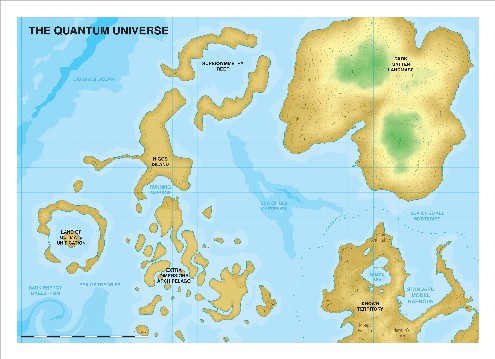
Artist’s impression of a map of the Quantum Universe (Graphic courtesy of “ILC — form one visual communication”)

By Tushna Commissariat

Here’s a bit of Friday physics fun… I came across this rather interesting image that shows an artist’s impression of a map entitled “The Quantum Universe”. It includes six landmasses all floating in the Big Bang Ocean; including Dark Matter Landmass, Sypersymmetry Reef, Higgs Island and the Land of Ultimate Unification as well as others.

So go ahead and tell us which island you would like to settle down on. Be sure to look carefully at gems like Newton’s Lawn and Mount Einstein before you make your mind up!

To see a larger hi-res image follow this link.

Could Blackberry woes affect physics institute?

USPS.jpg
Artist’s impression of the new Stephen Hawking Centre at the
Perimeter Institute, which will open in September. (Courtesy: PI)

By Hamish Johnston

Over the last decade the sleepy city of Waterloo, Ontario, has become a hotbed of theoretical physicists.

About 60 miles west of Toronto, the city is home to the Perimeter Institute for Theoretical Physics (PI). The PI counts Stephen Hawking as one of its visiting fellows and is also home to about 80 resident physicists – many of whom are household names in the physics community. The PI is also taking an innovative approach to training the next generation of theorists in its Perimeter Scholars International masters level course.

All of this is possible thanks to the generosity of Mike Lazaridus, who made his money by founding and running Research in Motion (RIM). The firm makes the Blackberry smartphone and its fortunes soared in the 2000s as the Blackberry became the must-have business tool.

Lazaridus has donated a whopping $170m to the PI, which he set up in 1999, and two other RIM executives have chipped in $40m more. Compare this to the $180m donated by the Canadian and Ontario governments and it is easy to conclude that the future success of PI and RIM will be linked.

That’s worrying because it seems that company’s heyday may be over, at least according to a market analyst writing in Canadian Business. Henry Blodget points out that the firm’s market share is dropping and tries to explain why.

While I don’t wish any ill on RIM, PI or Waterloo, I’m afraid that I agree with Blodget. Indeed, next to an iPhone a Blackberry looks like something, well, from the last decade. Let’s hope the same fate doesn’t befall the PI, which has done a fantastic job of boosting the profile of physics in both Canada and beyond.

Of course not everyone agrees with Blodget and Canadian Business has published an article taking the opposite viewpoint entitled Long live RIM.

Much ado about the LHC

USPS.jpg
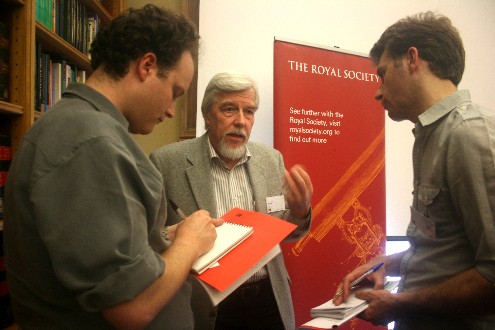
Rolf-Dieter Heuer talking to journalists at the Royal Society, London.
(Courtesy: Tushna Commissariat)

By Tushna Commissariat

The Large Hadron Collider (LHC) at CERN has had its share of good and bad press over the past few years. Controversy and rumours abounded when the machine was switched on in September 2008. The mood then turned quickly to disappointment when its magnets failed and finally to euphoria when the first beams collided at 7 TeV in March 2010.

This week, a meeting to discuss the LHC and all things related was held at the Royal Society in London. The “Physics at the High Energy Frontier – the Large Hadron Collider Project” meeting took place on 16–17 May and saw leading lights of the project come together to discuss the collider and its future.

I was at the meeting for the second day, when a press briefing was held where CERN director Rolf-Dieter Heuer, plus Fabiola Gianotti and Guido Tonelli of the ATLAS and CMS experiments respectively, answered all of the questions that the Higgs-hungry reporters could throw at them!

The three speakers described how the collider has “surpassed all expectations” – experimental and computational. Talking about how the LHC is the very essence of global co-operation, Tonelli stressed that “no country could have done it as a stand-alone”. Heuer boasted that every year about 1000 students get their PhDs thanks to the LHC, while just the ATLAS experiment involves about 3000 researchers.

Explaining how things work at the LHC, Tonelli said, “We [experimental scientists] try to test the theory without prejudice. We ask our friends the theorists to come up with something that we can observe.” The collider has already produced the top quark in Europe for the first time and now it is poised to begin a regime of “new physics”, to look for supersymmetry (SUSY), multiple dimensions, matter–antimatter disparity and, of course, the Higgs boson.

The Higgs…or something else?

“We will have an answer to the Shakespeare question for the Higgs – ‘To be or not to be’ – by the end of 2012” declared a confident Heuer. While he did show a great deal of enthusiasm about discovering the Higgs, Heuer was also keen to point out that not finding the particle would be a great result in itself. “Not finding [the Higgs] when it does not exist is a success,” he exclaimed. “If it does not exist, we need to find something else that takes up the job of the Higgs and gives mass to elementary particles,” he added.

The LHC will run until the end of 2012 without any major breaks and Heuer is confident that it will decide the fate of the Higgs by the end of this run. “Physics will not be the same after 2012.” declared Tonelli. “It will change the view of the world.”

Not amused

One of the first questions, asked by BBC reporter Pallab Ghosh, was about the recent ”leak” of an unconfirmed sighting of the Higgs by ATLAS. A sighting that was later denied by a paper released by the ATLAS team and in interviews with physicists on various media channels.

“Unfortunately we live in a world of WikiLeaks, so it leaked!” said a grinning Gianotti. On a more serious note, she explained that such leaked results have not undergone the scientific scrutiny that is necessary, and hence are almost always insubstantial.

“The CERN management was not amused by the leak” said Heuer. He went on to ask journalists not to believe leaked results in the future. “Don’t trust it on first sight” he said. Although Heuer’s displeasure was clear, the leak did put the LHC back in the public eye after a few quiet months. Also, the media interest did provide the public with a rare insight into the vetting process that all scientific discoveries undergo. So perhaps the CERN management should lighten up and enjoy the renewed interest in the LHC!
USPS.jpg
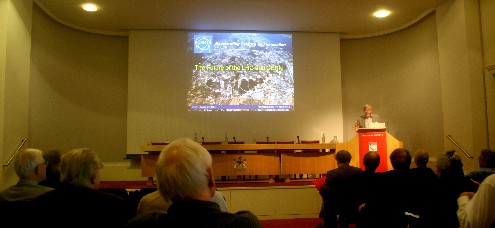
Rolf-Dieter Heuer giving a talk about the future of the LHC at the Royal Society, London. (Courtesy: Tushna Commissariat)

Bumps and jumps

When asked about the Higgs-like ‘bumps’ seen at other experiments like the Tevatron and CERN’s Large Electron Positron Collider (LEP) the panel had mixed replies. The Tevatron bump was dismissed by Gianotti and Tonelli, as they both explained that it was too small, statistically speaking, and was only seen by one of the Tevatron’s two detectors. Would the LHC have a look for the Tevatron signal? “No”, was their reply.

However, “interesting events” seen at 115 GeV by the LEP just before its closure in 2000 are of interest to them. While Heuer did say that it is very difficult to determine if it was anything more than a “hint”, the LHC will be looking for the Higgs at that energy soon.

hawking.jpg

Colliding linearly

The International Liner Collider – a possible successor to the LHC – is another project that Heuer is excited about. He feels that CERN, with the LEP and now the LHC under its belt, would be the perfect host for the collider. “I think CERN has huge potential, not only on the human side, but on its experience side. We have all the instruments. So I see CERN in a very good position.” he said.

But what about the money? “If you have an excellent science case, you will get the money. Don’t ask for the money until you have the science figured out.” he said. He pointed out that, compared to the US, in Europe the politics of funding are more stable and for that reason CERN would be a better host.

Right: prototype microwave cavity for the ILC, illuminated for a “Science Night” in Hamburg. (Courtesy: DESY)


Art and science collide at CERN

In our latest video report, Ariane Koek, head of CERN’s arts programme, takes us beyond cutting-edge science to explore the thriving arts scene at what is Europe’s foremost particle-physics lab. “The scientists here are very creative, very engaged in things other than particle physics,” she tells physicsworld.com reporter James Dacey.

Koek’s job is to shape CERN’s arts policy and the lab is already building bridges with the art world by appointing artists as creative patrons. One of these is the celebrated British artist Antony Gormley, who recently donated a sculpture to CERN in recognition of the impact that particle physics has had on his work. Just press “Play” to get up close to Gormley’s work, which is currently hidden away in one of CERN’s warehouses.

This report is the final instalment of our four-part video series from CERN. Visit the physicsworld.com multimedia page for special reports from the ALICE and CLOUD experiments, as well as a short film about the search for the Higgs boson.

Copyright © 2026 by IOP Publishing Ltd and individual contributors