Evidence that cosmic rays seed clouds

By firing a particle beam into a cloud chamber, physicists in Denmark and the UK have shown how cosmic rays could stimulate the formation of water droplets in the Earth’s atmosphere. The researchers say this is the best experimental evidence yet that the Sun influences the climate by altering the intensity of the cosmic-ray flux reaching the Earth’s surface.

The now conventional view on global warming, as stated by the Intergovernmental Panel on Climate Change, is that most of the warming recorded in the past 50 years has been caused by emissions of manmade greenhouse gases. But some scientists argue that the Sun might have a significant influence on changes to the Earth’s climate, pointing out that in centuries past there has been a close correlation between global temperatures and solar activity.

However, changes to the Sun’s brightness are believed to have altered temperatures on Earth by no more than a few hundredths of a degree in the last 150 years. Researchers have therefore been investigating ways that the Sun could indirectly modify the Earth’s climate, and one hypothesis, put forward by Henrik Svensmark of the National Space Institute in Copenhagen, posits a link between solar activity and cosmic-ray flux.

According to Svensmark, cosmic rays seed low-lying clouds that reflect some of the Sun’s radiation back into space, and the number of cosmic rays reaching the Earth is dependent on the strength of the solar magnetic field. When this magnetic field is stronger (as evidenced by larger numbers of sunspots), more of the rays are deflected, fewer clouds are formed and so the Earth heats up; whereas when the field is weaker, the Earth cools down.

Building clouds

The latest experiment provides evidence for a major component of this theory – how ionization enhances cloud formation. To be converted into droplets and form clouds, water vapour in the Earth’s atmosphere needs some kind of surface on which to condense, and this is usually provided by tiny solid or liquid particles already present in the atmosphere, including aircraft emissions. Svensmark’s theory suggests that cosmic rays can enhance this process by ionizing molecules in the atmosphere that then draw molecules of water vapour to them until the aggregate is large enough to act as a condensing surface.

To reproduce this process in the lab, Svensmark and his colleagues filled a 0.05 m3 stainless-steel vessel with a mixture of gases representing an idealized atmosphere – oxygen and nitrogen plus trace amounts of water vapour, sulphur dioxide and ozone. They then shone ultraviolet light into the vessel in order to generate the sulphuric-acid molecules around which water molecules could aggregate, and irradiated the mixture with a beam of 580 MeV electrons supplied by the University of Aarhus’s ASTRID storage ring.

By removing samples from the vessel and counting the number of gas clusters that measured at least 3 nm across, the researchers found that the beam led to a significant increase in the rate at which clusters were produced. They say that the electrons, like cosmic rays in the real atmosphere, are ionizing molecules in the air and so cause water molecules to stick together. Furthermore, the researchers found that this effect also took place when they used a radioactive sodium source, which produces gamma rays, and as such claim that similar measurements in the future will not require expensive accelerators.

Team member Jens Olaf Pepke Pedersen of the National Space Institute at the Danish Technical University explains that to prove the link between cosmic rays and cloud formation, the experiment will need to be carried out for longer in a bigger vessel. This would determine whether the clusters grow to about 100 nm, at which point they would be large enough to act as cloud-condensing nuclei. He says that the chamber being used in the CLOUD experiment at CERN, which has a volume of some 26 m3, might be large enough.

Clouded science

According to Pedersen, if it can be shown that the clusters reach the scale of micrometres, Svensmark’s hypothesis will have been proven. Then, he explains, it would be a question of finding out the significance of the effect. “There is so much that is not known about cloud formation, so it is possible that it could be an important component of global warming,” he says.

However, there are problems with the cosmic-ray hypothesis. One is that although there was a clear correlation between global temperatures and the intensity of cosmic rays reaching the Earth’s surface (as measured by neutron counters) prior to 1970, that correlation has broken down over the last 40 years. Another problem is that a claimed correlation between cosmic rays and global low cloud cover – as revealed in satellite observations – that was put forward by Svensmark to support his theory has been questioned by a number of researchers, who have found that the correlation only holds over specific regions of time and space.

Indeed, Chris Folland, a climate researcher at the UK’s Met Office, says it is not clear to what extent cosmic rays could really enhance cloud formation, given the vast numbers of naturally occurring particulates within the atmosphere that could act as cloud-condensing nuclei. He also says that even if there is a noticeable effect on cloudiness, this effect could be either positive or negative, arguing that cosmic rays might be expected to have a larger affect on higher-altitude clouds, which tend to warm the planet by preventing radiation from escaping into space. “Low-level clouds generally cool the surface climate, but it’s not clear why they should be preferentially affected by cosmic rays,” he adds, “given that there is some effect on overall cloudiness.”

The research has been published in Geophysical Research Letters.

The Big Bang on the big screen

By Michael Banks

If you are in the US and stuck for things to do this weekend, then you might well think about catching the noir film The Big Bang, which is released today.

Starring Antonio Banderas, who plays private detective Ned Cruz, and directed by Tony Krantz, the film features Cruz searching for a missing stripper named Lexie Permisson (played by Sienna Guillory) while contending with unsavoury Russian boxers and brash police detectives.

And the physics connection? Well apart from a café in the film called Planck’s Constant Café, the movie’s resident madman is Sam Elliott, played by Simon Kestral, who, with the help of a particle physicist, has built a proton collider under the New Mexico desert to search for the Higgs boson. The film then sees Cruz heading to the underground “military base” to find Permisson.

From the trailer the physics in the movie seems to be fairly accurate. “In 27 hours I am going to find something that theoretically should exist but no-one has ever seen,” says Kestral. “Funny,” replies Cruz. “That is exactly what I am looking for.”

Before heading off to the nearest cinema, however, you might want to read this less than favourable review of the film in the New York Times, which calls the movie a “jumble of notions tossed into a hat”, with the picture being a “low point for Mr Banderas”.

Well, at least it contains some accurate physics, which probably makes for a change.

N.B. The film is rated R (“under 17, requires accompanying parent or adult guardian”) so take note when watching the above trailer.

Unzipped graphene reveals its secrets

Researchers in the US have made the first precise measurements on the “edge states” of graphene nanoribbons. These states have been predicted to have extraordinary properties and the work could help build improved nanoscale devices in the future.

Graphene is a sheet of carbon just one atom thick and nanoribbons of this material are strips of graphene just nanometres across. Physicists believe that, depending on the angle at which they are cut, such ribbons should have a range of different – and technologically useful – electronic, magnetic and optical properties. These properties include band gaps, such as those found in semiconductors, that do not exist in larger sheets of graphene.

However, until now, scientists have been unable to test these predictions because they could not study the atomic-scale structure at the edges of cut nanoribbons – and therefore ensure their samples have the appropriate edges. This is because as-produced nanoribbons are typically disordered structures with only short stretches of straight edges.

Unzipping carbon

Michael Crommie’s team at the Lawrence Berkeley National Laboratory (LBNL) and the University of California, Berkeley (UCB) has overcome this problem by looking at specially made nanoribbons with smooth edges using a scanning tunnelling microscope (STM). These ribbons were obtained from Hongjie Dai’s group at Stanford University, where they were produced by chemically unzipping carbon nanotubes (rolled up sheets of graphene) – a technique that produces well-ordered, straight edges along the entire length of a nanoribbon.

The researchers discovered that these ribbons support 1D electronic edge states and that electrons in these states are confined to the nanoribbon edge and have an energy gap. “This kind of behaviour has been predicted for many years but never experimentally verified,” Crommie told physicsworld.com.

The LBNL–UCB team began by spin coating the nanoribbons onto clean gold crystals. Next, the scientists cooled the nanoribbon-decorated gold crystals down to 6 K and imaged them with an STM. “We were able to see the atomic-scale structure of the nanoribbons and use the STM to measure the local density of states of the edge states – that is, we measured ‘where’ the electrons are,” explains Crommie. “In other words, by measuring the current at the STM tip at different locations near the nanoribbon edge, we were able to determine the spatial distribution of electrons confined near the edge.”

“Nanoribbon edge states are real”

Research teams around the world have predicted that the novel electronic, optical and magnetic properties of such nanoribbons edges could be exploited, in principle, to make new types of devices – such as spin-valves, nanoribbon switches, detectors and photovoltaics from graphene. “Our new experimental results bolster the pursuit of these applications because we now know that the nanoribbon edge states are real,” says Crommie.

“The work could also help us better understand the basic physics of what happens at the edges of graphene samples”, he adds. Edges are as important and as useful as any other part of graphene, especially as the size of nanostructure-based devices is reduced to atomic length scales. “Understanding graphene edge behaviour, however, has lagged behind other graphene research because of the difficulties of preparing and probing smooth graphene edges,” says Crommie. “Our new results advance our ability to control and characterize graphene-edge nanostructures and so help to push the field forward and spur new ideas and applications.”

Xiaoting Jia of the Massachusetts Institute of Technology, who was not involved in the work, can see its merits. “This work is a big step towards understanding and controlling the unique electronic properties in graphene nanoribbon edges, and opens up many opportunities in the electronics, spintronics and optical applications of graphene nanoribbons,” he says.

Crommie’s team is now interested in modifying graphene edges in different ways – for example through electronic doping. “We want to explore nanoribbon edge behaviour under different conditions, both to test theories regarding behaviour in the materials and to perhaps discover new, unexpected phenomena,” reveals Crommie. “One of our goals is to fabricate nanoribbon devices that allow us to simultaneously probe atomic-scale nanoribbon structure and device performance, and to correlate these properties.”

The results were detailed in Nature Physics 10.1038/nphys1991.

Mysterious ‘superflares’ confound astronomers

By Tushna Commissariat

Most of us with an interest in astronomy would recognize the Crab Nebula in images and videos quite readily. The supernova remnant, first seen on Earth in the year 1054, consists of a super-dense neutron start that spins about 30 times an second, making it a pulsar that swings a beam of radiation towards Earth, like a lighthouse.

NASA’s Fermi Gamma-ray Space Telescope is one of many that look for high-energy radiation sources, and recently the Crab Nebula has caught its eye. The past seven months have seen some rather dramatic variations within the nebula, with Fermi and other telescopes noticing X-ray flares a hundred times brighter than seen ever before.

Since 2009 Fermi has detected several short-lived gamma-ray flares at energies greater than 100 million electron volts (eV), which is much higher than the flares seen before. On 12 April Fermi detected a flare that grew about 30 times more energetic than the nebula’s normal gamma-ray output and about five times more powerful than previous outbursts. On 16 April an even brighter flare erupted, which lasted for a few days before the activity died out.

“These superflares are the most intense outbursts we’ve seen to date and they are all extremely puzzling events,” says Alice Harding of NASA’s Goddard Space Flight Center. “We think they are caused by sudden rearrangements of the magnetic field not far from the neutron star, but exactly where that’s happening remains a mystery.”

When Fermi noted the variances in 2010 it alerted NASA’s Chandra X-ray Observatory, which began routinely monitoring the nebula to identify X-ray emissions associated with the outbursts. When Fermi scientists alerted the astronomers at Chandra about the spike in April, a pre-planned set of observations using the observatory was initiated.

Unfortunately, no clear evidence was seen for correlated flares in the Chandra images, so the reason for the sudden extreme variations is still a mystery. Theorists have deduced that the flares must arise within about one-third of a light-year from the neutron star, but efforts to locate them more precisely have been unsuccessful.

Scientists believe the flares occur as the intense magnetic field near the pulsar undergoes sudden structural changes. Such changes can accelerate electrons to velocities near the speed of light. As these relativistic electrons interact with the magnetic field, they emit gamma rays. To account for the observed emission, scientists say the electrons must have energies 100 times greater than can be achieved in any particle accelerator on Earth. This makes them the highest energy electrons associated with any source within our galaxy.

Take a look at the wonderful video by NASA that shows the changes as seen by Chandra, as well as some spectacular shots of the nebula.

‘Activated’ graphite oxide boosts supercapacitors

Researchers in the US have discovered a new form of carbon produced by “activating” expanded graphite oxide. The material is full of tiny nanometre-sized pores and contains highly curved atom-thick walls throughout its 3D structure. The team has also found that the material performs exceptionally well as an electrode material for supercapacitors, allowing such energy-storage devices to be used in a wider range of applications.

Capacitors are devices that store electric charge on two conducting surfaces separated by an insulating gap – the larger the surface area of the capacitor, the greater its capacity to hold charge. Charging a capacitor requires electrical energy, which is recovered when the device is discharged. Supercapacitors, also known as electric double-layer capacitors or electrochemical capacitors, store more charge thanks to the double layer formed at an electrolyte–electrode interface when a voltage is applied. Although already used in applications such as mobile phones, these devices are currently limited by their relatively low energy storage density compared with batteries.

Now, Rodney Ruoff and colleagues at the University of Texas at Austin and scientists at the Brookhaven National Laboratory, the University of Texas at Dallas and QuantaChrome Instruments have synthesized a new form of porous carbon with a very high surface area. The carbon consists of a continuous 3D porous network with single-atom-thick walls, with a significant fraction being “negative curvature carbon” similar to inside-out buckyballs. The researchers used the material to make a two-electrode supercapacitor with high gravimetric densities of capacitance, energy capacity and power per unit mass. What is more, the team claims that the process used to make this form of carbon can be scaled up to produce industrial quantities of the material.

Expanded with microwaves

Ruoff and co-workers begin by converting samples of graphite into graphite oxide, which they expand using microwaves to generate what they have dubbed “microwave-expanded graphite oxide” (MEGO). The MEGO is then treated with potassium hydroxide so that its surface is covered (or decorated) with the chemical. After heating at 800 °C for about an hour in an inert gas, “activated MEGO” or aMEGO is obtained.

“What is quite surprising is that the [potassium hydroxide] remarkably restructures the carbon so that a 3D porous structure is generated with essentially no edge atoms,” Ruoff told physicsworld.com. “Every wall in the structure is one atom thick and all the carbon atoms there are sp2-bonded.”

The researchers used aMEGO as the carbon for electrodes in a supercapacitor – mixing it with different electrolytes. They obtained “exceptional” gravimetric energy densities that are about four times higher than that of state-of-the-art conventional supercapacitors, for example those based on porous activated carbon, on the market today.

Best BET

The porous carbon produced also has a “BET” (Brunauer–Emmett&nadash;Teller) surface area of up to 3100 m2/g. For comparison, typical activated-carbon materials have BET surface areas in the range of 1000 to 2000 m2

And that is not all: the material is also very stable and continues to work at 97% capacitance even after 10,000 constant current charge/discharge cycles.

“The Texas work shows an important increase in energy capacity on a gravimetric basis, but unfortunately the graphene material has relatively low density. It will be interesting to see if further work yields higher-density materials with corresponding improvements in volumetric energy density,” says John Miller of the capacitor maker JME and Case Western Reserve University, who was not involved in the research.

Ruoff and colleagues are optimistic and now plan to further improve the new carbon and hope to obtain further funding so that they can carry on conducting more fundamental research on generating still better materials based on similar types of structures. “We also hope to optimize performance in other electrical energy-storage systems in parallel,” reveals Ruoff.

The work is reported in Science.

Einstein's landing card resurfaces after 80 years

USPS.jpg
Courtesy: National Museums Liverpool

By James Dacey

This unremarkable piece of paper belongs to a chapter in one of the most extraordinary lives of the 20th century.

It is the recently discovered landing card issued to Albert Einstein in 1933 when he arrived in Britain after fleeing Nazi Germany.

On Tuesday the card went on public display for the first time at the Merseyside Maritime Museum in Liverpool, having been stored away for nearly 80 years at Heathrow Airport.

“We were keen on acquiring any documents relating to immigration but were stunned to find paperwork relating to such a prominent historical figure as Albert Einstein,” Lucy Gardner, curator of the exhibition about customs and immigration.

The document brings proof that Einstein arrived in Dover on 26 May 1933 after sailing from Ostende in Belgium. The “professor” states that he was heading for Oxford, a city he had visited previously during stays at Christ Church College.

Einstein lists his nationality as Swiss having renounced his German citizenship only weeks earlier in angry reaction to Nazi policies. In April 1933 Hitler’s party had passed a law barring Jews from holding any official positions, including teaching at universities. And during a visiting professorship at the California Institute of Technology, Einstein – who was Jewish by birth – had learned that his name had been added to a list of Nazi assassination targets.

Upon his return to Europe Einstein resided in Belgium for a brief time before sailing to Britain. Shortly afterwards, Einstein took up his position at the Institute for Advanced Study at Princeton an affiliation that lasted until his death in 1955.

“This tiny piece of paper brings to life Einstein’s escape from the Nazis to England,” said Gardner.

USPS.jpg
Curator Lucy Gardner with Einstein’s landing card

Quantum-computing firm opens the box

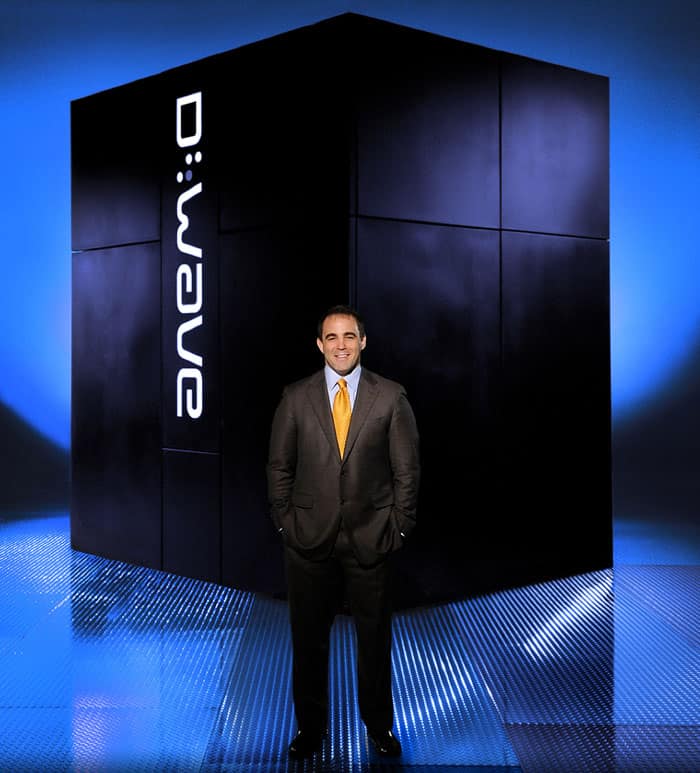
A small firm based in Canada that aims to build a commercially viable quantum computer has shown that an important part of its technology works. D-Wave Systems, which was spun-out of the University of British Columbia in 1999, has shown that a technique called quantum annealing can be used to make eight coupled quantum bits – or qubits – find their ground state. According to the firm’s chief technology officer Geordie Rose, the announcement is the first of several scientific results that D-Wave will be unveiling – including one that he claims is “mind blowing”.

Based in Vancouver, D-Wave was set up with the aim of creating a quantum computer that uses loops of superconducting wire as qubits. As the electrical current circulating within such a “flux qubit” is quantized, the two lowest states (i.e. electrons travelling clockwise and anticlockwise) can be assigned data values of “0” or “1”. The magnetic field associated with the currents is also quantized – pointing up and down for currents moving in opposite directions – and can be flipped using an external magnetic field.

Resisting heat and noise

Quantum computers could outperform a classical computer at some tasks – at least in principle – thanks to two key quantum properties. These are that a qubit can be in a superposition of two or more quantum states and that two or more qubits can be entangled. But the big challenge for D-Wave – and for everyone else trying to build a quantum computer – is how to create qubits and computing processes that are resistant to the destructive effects of heat and noise.

Using flux qubits is attractive in that quest because they are macroscopic structures that can be created using semiconductor-manufacturing processes and can be controlled using applied currents and voltages. A downside is that they have a multitude of quantum states, not just two. The task for D-Wave is how to place each qubit in a well-defined and useful quantum state without it being corrupted by heat or noise – essentially the analogue of writing data to a classical computer.

The method chosen by the firm to do this is called “quantum annealing” – and now D-Wave has shown that it can use this technique to place eight coupled qubits into the appropriate lowest energy state. The researchers began with eight superconducting flux qubits within one of D-Wave’s integrated circuits. These contain 128 flux qubits arranged into 16 units of eight. The system is then cooled to a temperature of 10 mK, which puts each qubit into a superposition of two quantum states with identical energy, i.e. current circulating anticlockwise (spin-up) and clockwise (spin-down).

Raising the barrier

This superposition is not, however, particularly useful and the next step is to manipulate each qubit into a pure spin-up or spin-down state. Each loop is broken by a structure containing two Josephson junctions and a magnetic coil. When a current is applied to the coil, an energy barrier rises between the spin-up and spin-down states. In a classical system, the loop would be forced into either the up or down state and could hop between states by absorbing heat from the surroundings. A qubit however, remains in a superposition of up and down as long as the barrier rises slowly enough.

Each qubit has a second magnetic coil, which is used to “tip” the qubit into the desired pure state. If the field is applied in the up direction, for example, the energy of the spin-up state drops below that of the spin-down state, thereby making it more likely that the qubit will become pure spin-up. The problem facing D-Wave is that this transition occurs both by quantum-mechanical tunnelling and by absorbing heat (thermal excitation). Thermal excitation destroys the quantum nature of the qubit, and so must be avoided during quantum annealing.

The two processes can be distinguished by raising the barrier until both tunnelling and heat-driven transitions stop (the qubit “freezes”) – and then repeating this process at different temperatures. The research team found that below about 45 mK, freezing is affected primarily by barrier height and not temperature, which is what is expected if annealing occurs by tunnelling alone.

Frustrated chain

The team then showed that it could anneal a unit of eight qubits. The researchers did this by adjusting the interactions between the qubits to simulate a 1D chain of magnets in which each qubit wants to point in the same direction as its two neighbours. The qubit at the right-hand end of the chain is set in the up direction and the qubit at the left-hand end in the down direction. The six qubits in the middle are then allowed to orient their spins according to that of their neighbours. The result is a “frustrated” ferromagnetic arrangement in which two neighbours must have opposing spins.

Finally, the qubits are all tilted in the same direction while the barrier is raised. This should result in the system moving towards one specific arrangement of frustrated spins – the ground state. Again, below about 45 mK, the system found its way to the ground state in a manner consistent with the spins flipping because of quantum-mechanical tunnelling, not thermal activation. “We’re very excited to see the remarkable agreement between what quantum mechanics predicts and what we see in these circuits,” says D-Wave’s Mark Johnson, who was lead scientist on the project.

Finding the ground state of an eight-spin system is a simple quantum calculation and therefore the D-Wave team has shown that its combination of hardware and annealing process is capable of the job.

“Important” first step

“This is the first time that the D-Wave system has been shown to exhibit quantum mechanical behaviour,” says William Oliver of the Massachusetts Institute of Technology, who was not involved in the research. Oliver told physicsworld.com that when combined with D-Wave’s ability to control precisely important parameters of the qubits, this latest work is “a technical achievement and an important first step”.

Looking beyond quantum computing, David Feder of the University of Calgary also sees the system as an effective quantum simulation of how electron spins interact in magnetic materials. “This work describes a nice approach to simulating the (ferromagnetic or antiferromagnetic) quantum Ising model, and this is interesting in its own right,” explains Feder. “I think that there is a lot of promise in the D-Wave architecture for simulating frustrated magnetic systems, and maybe more general strongly correlated systems, and this will benefit everyone. So, to me, it is a good step in the right direction.”

D-Wave currently employs about 60 scientists and engineers, of whom about 20 work on developing algorithms and 40 work on building hardware, according to Rose. This latest research was carried out by 25 of D-Wave’s employees along with researchers at the University of Agder in Norway and Simon Fraser University in Canada.

“This is the first time we’ve been able to open up the black box and show how [D-Wave’s devices] are harnessing quantum mechanics in solving problems,” says Rose. He told physicsworld.com that the firm now plans to do similar quantum-annealing experiments involving much larger numbers of qubits. He also says that the researchers will apply the process to “real problems” such as machine learning and artificial technology. Rose is adamant that D-Wave’s systems could be used in commercial settings as well as for doing basic research in quantum computing. “Our sales team is out selling at the moment,” he says.

According to Rose, the company will soon publish a number of journal papers about its research. However, he was unable to provide more details because the work is currently being peer-reviewed.

Massive partner flips hot Jupiter

Astronomers in the US believe they have discovered why a quarter of known “hot Jupiters” orbit their stars in reverse. The finding challenges our understanding of how planets form and may give us a clue as to how common solar systems like ours are.

More than 550 exoplanets – planets orbiting stars other than the Sun – have been discovered to date. Many of them have been dubbed hot Jupiters because they are about the same mass as the giant planet and orbit very close to their host stars. However, astronomers have wondered why one in four of these alien worlds orbit in the opposite direction to the spin of their star. This is unlike our solar system, where the planets bend to the will of the Sun, with their orbits all following its anticlockwise rotation. Now, astrophysicists at Northwestern University think they have the answer.

The team modelled a simple solar system with a Sun-like star orbited by a Jupiter-sized planet far from the star and a second large body (a planet or brown dwarf) even further away. When the model was run the gravitational interactions between the bodies began to change the orbit of the inner planet. “These are extremely weak gravitational perturbations that over millions or billions of years cause small, gradual changes in the planet’s orbit, which build up to become very large,” team member Fred Rasio told physicsworld.com.

Flipped over

Eventually, this changes the inner planet’s orbit from almost circular, like our Jupiter’s, to highly elongated – a journey that at times takes the planet very close to the host star. The gravity of the star then squeezes and heats the planet, causing it to lose orbital energy and shrinking its orbit. This part of the theory, which explains the planet’s proximity to its star, had been modelled before.

However, Rasio and his colleagues saw something new. “These perturbations also caused the inclination of the orbit to change,” Rasio explained. Inclination is the angle between the angular momentum of the spinning star and the orbital angular momentum of the planet. “In some cases the hot Jupiter became so inclined to its star that it completely flipped over it and orbited it in the other direction,” he adds.

The key player here is angular momentum – a quantity that must to be conserved. As the inner planet moves from a circular orbit to an elongated one, its angular momentum drastically decreases – in turn increasing the angular momentum of the perturbing outer body by the same amount. This loss of angular momentum makes the inner planet much easier to flip. “It only takes a relatively small force to flip a planet with a tiny angular momentum,” says Smadar Noaz, Rasio’s colleague.

‘Promising mechanism’

“This looks like a very promising mechanism,” Gordon Ogilvie at the University of Cambridge, UK, told physicsworld.com. “However, what is less clear is how often this mechanism occurs and whether this is sufficient to explain the majority of observed systems,” he adds. Other processes have also been suggested and it could turn out that a single mechanism isn’t causing all of the “flipped” hot Jupiters. “Further theoretical work is certainly needed to distinguish between these possibilities,” says Ogilvie.

The case could be settled by finding the smoking gun: the perturbing, outer planet in these systems. “It [the perturbing planet] should still be there; there is no easy way to get rid of it,” Rasio explains. “It could be very faint and hard to detect but it should be there,” he adds. Direct imaging of exoplanets, such as that of Beta Pictoris b, could find them (see “Exoplanet caught on the move”).

If confirmed, Noaz believes it tells us something important about our own solar system and our theories of planetary formation. “The picture of our solar system is very neat and beautiful. However, we see a whole zoo of different planetary systems out there, including planets that seem to flip over,” she says. “This not only means our solar system might be unusual but it emphasizes the need for a better understanding of how planets are formed,” she adds.

The findings are published in Nature 473 187.

Head in a CLOUD

Whenever you hear about CERN these days, it tends to be dominated by news about the Large Hadron Collider and its hunt for fundamental particles. But there are plenty of other experiments taking place at CERN, spanning a wide range of science.

One of them is the CLOUD experiment, designed to recreate processes in the atmosphere and their wider impact on Earth’s climate. The Cosmics Leaving OUtdoor Droplets project is designed to investigate the possible influence of galactic cosmic rays on Earth’s clouds and climate.

In this special video report for physicsworld.com CLOUD project leader Jasper Kirkby explains what his team is trying to achieve with its experiment. “We’re trying to understand what the connection is between a cosmic ray going through the atmosphere and the creation of so-called aerosol seeds – the seed for a cloud droplet or an ice particle,” Kirkby explains.

The CLOUD experiment recreates these cloud-forming processes by directing the beamline at CERN’s proton synchrotron into a stainless-steel chamber containing very pure air and selected trace gases.

One of the aims of the experiment is to discover details of cloud formation that could feed back into climate models. “Everybody agrees that clouds have a huge effect on the climate. But the understanding of how big that effect is is really very poorly known,” says Kirkby.

If you enjoyed this video, you can also learn about CERN’s hunt for the elusive Higgs boson in this recent video report from the ATLAS and CMS collaborations. Then in this separate video you can learn about how CERN’s ALICE experiment is trying to recreate the moments that existed just picoseconds after the Big Bang.

Quiz question of the week

By Matin Durrani

fermistamp.jpg

I always find it interesting when little-known anecdotes about some of the greatest figures in physics come to light.

So here’s one that I thought I’d share with you, courtesy of Uri Haber-Schaim, a retired physicist now living in Jerusalem.

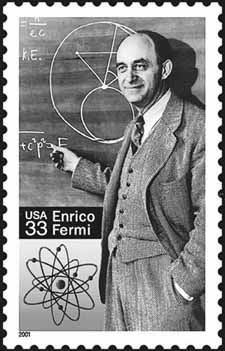
Writing in the latest issue of Il Nuovo Saggiatore – the bulletin of the Italian Physical Society – Haber-Schaim recalls a summer school in high-energy physics that took place in Varenna, Italy, in 1954, which was attended by, among others, the Italian particle physicist Enrico Fermi.

During the morning break, one of the participants from France – A Rogozinsky – posed a mathematical problem concerning a priest and a sexton on a walk who encounter three people coming towards them.

The sexton asks the priest how old the three people are and is told that “the product of their ages is 2450 and the sum of their ages is twice your [i.e. the sexton’s] age”.

The sexton, saying that he needs more information to solve the problem, is then told by the priest that he – the priest – is “older than any of them”.

So the question is: what are the ages of the three people, the priest and the sexton?

Haber-Schaim recalls that everyone at the meeting realized that writing down equations would not get them anywhere and that he then suggested to Rogozinksy that he present the problem at lunch so that everyone could tackle it together.

Fermi, however, who was a notoriously good problem solver, proceeded to answer the puzzle within a minute.

So over to you, physicsworld.com readers. Can you solve the problem or – even better – beat Fermi and get the answer in under a minute?

For the record, I still haven’t figured it out.

Copyright © 2026 by IOP Publishing Ltd and individual contributors