

Liquid crystals go with the flow

Colour displays and e-readers may become slicker and sharper thanks to a new way of shifting around “digital ink” on a screen. Researchers in the US have presented a more versatile form of electrophoresis, a technique that uses electric fields to control particles suspended in liquid. They say the breakthrough could also be developed for a number of applications such as recreating conditions within the human body.

Conventional electrophoresis works by applying a uniform electric field, generated by a direct current, to a liquid containing charged particles that are then set in motion. The technique has found a range of uses including electrophoretic displays and genetic analysis, where it is used to sort strands of DNA according to size.

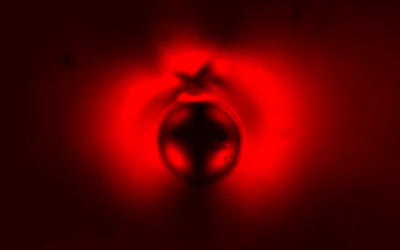
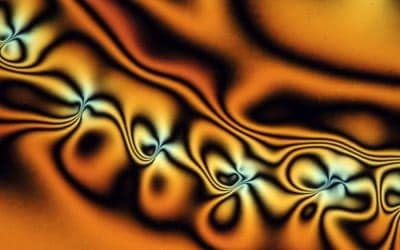
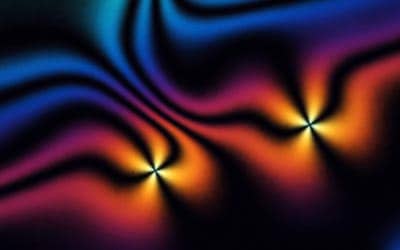
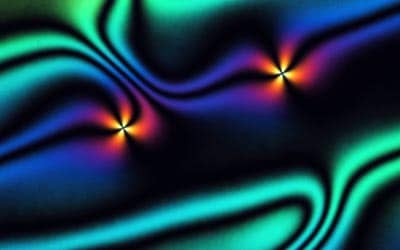
Oleg Lavrentovich and his colleagues at Kent State University, Ohio, have now developed a variant of the technique that no longer requires the mobile particles to be charged. The key to the breakthrough is to replace the liquid with a hybrid form of matter known as a liquid crystal, which displays the properties of a liquid and those of a solid crystal.

Distorted crystals

By injecting gold- and silica-based spheres, with diameters of just a few microns, Lavrentovich’s team create distortions within a common liquid crystal known as E7. These deformations, however, are asymmetric on either side of the particles and so the presence of an electric field causes free ions and their containing liquid to flow along a path connecting the two deformations. This flow can be used to shunt particles around within the liquid crystal. “These tiny distortions depend on the orientation of molecules within the liquid crystal,” explains Lavrentovich.

Another flexible feature of this transport mechanism is that it can work with an alternating as well as a direct current electric fields. According to the researchers, an AC field is more desirable within an electrophoretic system because it overcomes the problems caused by electrolysis and the absence of steady flows. They say that being able to vary the electric fields and having a wider choice of particles, could lead to electrophoretic systems with more control.

“The proposed work is very interesting because it describes how to control motion of various particles in three dimensions,” says Young Hee Lee, a nanotechnology researcher at Sungkyunkwan University, South Korea.

Lavrentovich says his team is open to offers from investors who want to develop the various applications that could stem from this research. In terms of developing the underlying physics, the researchers will try to recreate their new electrophoretic technique in water-based liquid crystals, which have structures comparable with certain conditions within the human body. Recreating these environments could, in theory, help to gain a better understanding of biological processes as well as to help with the development of drug delivery and medical tracking systems.

The research is described in a paper published in this week’s Nature.
Analogue Hawking radiation spotted in the lab

It was one of Stephen Hawking’s finest insights: the 1974 prediction that black holes are not totally black, but emit a steady stream of radiation. Experimental confirmation of Hawking radiation would probably bring the 68 year-old British cosmologist a Nobel Prize in Physics. Unfortunately, no-one has been able to detect a black-hole signal because it would be so faint compared with the universe’s background radiation.

However Hawking’s chances at a Nobel may be rising, thanks to a paper that will soon be published in the journal Physical Review Letters. In this work, Italian physicists describe what many believe to be the first measurement of Hawking radiation from a black hole “analogue” in the lab.

The research has ignited a debate over what truly constitutes Hawking radiation, and whether lab-based evidence could help make Hawking a serious contender for a Nobel prize.

“We don’t have any observational evidence from astrophysical black holes regarding the existence of the Hawking effect, and it is extremely unlikely that we will ever have such evidence, so any way of verifying Hawking’s prediction is of tremendous importance to the scientific community,” says Matt Visser, an expert in gravitational analogues at the Victoria University of Wellington, New Zealand, who was not involved with the research.

Origins in quantum mechanics

Hawking’s theory stemmed from the uncertainty principle in quantum mechanics, which tells us that pairs of particles are continually popping into existence, even in a vacuum. Most of the time these particles annihilate one another almost as soon as they are born, but this would not be true at the edge of a black hole, known as the event horizon, where gravity becomes so strong not even light can escape. If a particle pair is born straddling this point, one particle would have to be sucked in while the other would escape – and this latter one would become Hawking radiation.

Any way of verifying Hawking’s prediction is of tremendous importance to the scientific community. Matt Visser, Victoria University of Wellington

Because Hawking radiation is currently impossible to observe for real black holes, physicists have recently been looking to black hole analogues in the lab that can mimic the behaviour of their astrophysical counterparts. One type of analogue employs lasers to simulate an event horizon, because intense light can alter a medium’s refractive index, which governs light propagation speed. In simple terms, shining a powerful laser through glass creates a refractive index peak: any other photons in front this peak can travel forward, while those behind and trying to travel forward are slowed to a halt – they are trapped, as in a real black hole.

This is the type of system employed in the latest work by Daniele Faccio and colleagues of the University of Insubria and other Italian institutions. They placed a photon detector and spectrometer at right angles to the direction of the laser beam passing through the glass to catch any photons born spontaneously at the simulated event horizon. Amid noise coming from fluorescent defects in the glass, Faccio’s group was able to pick out a signal of photons with wavelengths between 850 and 900 nm. Because there is no known fluorescence emission in this window, the researchers claim, these photons must be Hawking radiation.

Some agree, but not all

Some independent researchers already agree, notably Ulf Leonhardt, a physicist at the University of St Andrews, UK, who pioneered the basis of the experiment two years ago. But others are not so sure.

One problem is that Faccio’s group cannot show that the emission is a continuous “black body” spectrum, as an astrophysical black hole’s would be – even if they did have an apparatus to make such a thorough measurement, their system is so dispersive that the black-body spectrum would likely be ruined. Another possible issue is that Hawking radiation should be emitted only in the direction of the laser and not perpendicular, although this could be because the strong refractive-index profile bends the light outwards. The question is, do shortcomings like these render the “Hawking radiation” claim untenable?

“This is partially a semantic question,” says Renaud Parentani, who specializes in Hawking radiation at Paris-Sud 11 University, France. Parentani believes that no-one has yet defined what should constitute Hawking radiation proper, and that researchers should concentrate on pinpointing which aspects of the phenomenon an experiment has succeeded in demonstrating. “We have to somehow make a list of specific properties that characterize standard Hawking radiation,” he adds.

Entanglement could be the clincher

One way to convince doubters might be to measure the photons generated on both sides of the refractive-index peak simultaneously. If they are entangled in the quantum-mechanical sense, this would be solid evidence that they were born together at the horizon. Leonhardt told physicsworld.com that he expects to have results for such an experiment in a year or less.

As for Hawking’s chances of a Nobel prize, physicists seem almost unanimous in thinking it’s too soon to tell. But with the near-impossibility of making an astrophysical measurement of Hawking radiation, and the official clause that bars posthumous nominations, there is the chance – albeit remote – that the Swedish committee rules laboratory proof of Hawkins’s theory sufficient for a decoration. Already, one group based in Canada has found evidence for what it claims is Hawking radiation in a classical, water-based system (see arXiv: 1008.1911), and many other experiments are likely to shore up lab evidence over coming months.

A preprint of the article is available at arXiv: 1009.4634.

Graphene single-transistor amplifier is a first

Researchers from the University of California – Riverside and Rice University have made the first single-transistor amplifier from graphene. The device is better than conventional amplifiers thanks to the “ambipolar” nature of graphene, which means that it could find use in wireless and audio applications. It might also be used to design simpler analogue circuits for communications.

A single-transistor amplifier, which consists of one transistor and one resistor, is one of the most basic building blocks in analogue circuits. There are three types of single-transistor amplifiers: common-source, common-drain and common-gate. Each of these has different characteristics that depend on the small-signal voltage gain in the device (ΔVout/ΔVin). The common-source amplifier provides negative gain while the other two provide positive gain.

Different applications call for different types of amplifier, but the ideal device should be one that can be configured into more than one type after fabrication – something that is impossible to do with conventional silicon-based metal-oxide semiconductor field-effect transistor (MOSFET) technology.

Graphene amplifiers
Amplifiers made from graphene could come into their own here, say Alexander Balandin and colleagues. Graphene – a 2D sheet of crystalline carbon just one atom thick – could be ideal for future nanoelectronics devices thanks to its unique properties, which include the fact that it is an excellent conductor of electricity and heat. Transistors made from graphene also have a very high cut off frequency above 100 GHz and show low levels of noise.

Graphene is “ambipolar” too. This means that electrical current in the material can be carried by both electrons and holes, and the type of carrier utilized can be switched by simply applying a gate bias. This is somewhat different to conventional semiconductors, explains Balandin, where the type of carrier is pre-determined by the doping in the device.

“The fact that the type of carrier can be switched by the gate is reflected in the well-known ‘V-shaped’ current-voltage characteristic of graphene,” he said. “We are capitalizing on this to achieve greater functionality from graphene transistors and use it in the amplifier design.”

Triple-mode
The UCR – Rice University team made a “triple-mode” device, which means that the amplifier can operate in one of three modes (common-source, common-drain or frequency multiplication) depending on where exactly the transistor is biased in the V-shaped ambipolar curve. “The three points one can choose are some place on the left branch of the V, some place on right branch or on the minimum conduction point where the branches meet,” said co-team leader Kartik Mohanram of Rice. “Each operating point has different characteristics and we took advantage of the ability to switch between these bias points during operation when designing our amplifier.”

Such triple-mode devices could lead to simpler circuits that show lower parasitics, have a larger bandwidth and consume less power. And being able to switch between the three modes this way will be important for “phase shift keying” and “frequency shift keying”, processes that are widely used in wireless and audio applications, including Bluetooth, RFID and ZigBee.

The team now plans to employ more advanced top-gate transistors, which will allow for higher gain because of the much smaller gate thickness. Balandin and Mohanram’s group has already built such transistors with low flicker noise, something that is crucial for graphene transistors in any analogue and communication application. “Now we have to put them to work in amplifiers,” added Balandin.

“Our result is a major step forward in graphene technology because it marks the transition from making individual graphene devices to making fully fledged graphene circuits and chips. Clearly, there are several challenges ahead and the community as a whole is actively working on developing solutions.”

The work was reported in ACS Nano. It can also be seen on arXiv.

A fusion physicist with a passion for communication

By James Dacey

Scientific outreach is a noble activity and if done well it can be equally exhilarating for both scientists and their audiences. One young physicist with a natural flair for communication is Melanie Windridge, a nuclear fusion researcher who recently worked at the Culham Centre for Fusion Energy (CCFE) in Oxfordshire, UK.

Melanie has been chosen as the 2010 schools lecturer by the Institute of Physics (which publishes Physics World), a role that sees her travelling the UK, delivering talks to more than 13,000 students between the ages of 14 and 16.

In this special video report, I caught up with Melanie at a school in Derbyshire, a recent stop on the school lecture tour. Melanie talks passionately about why she chooses to devote her time and energy to scientific outreach and the people that have inspired her along the way.

Describing her experiences of being on the road giving the 2010 IOP lecture tour, Melanie believes that she is lucky with her area of expertise. “Fusion is inherently very interesting and energy is a very emotive subject, so it’s relevant to people’s lives,” she says

Melanie then talks me through one of her favourite plasma demonstrations, and provides some practical advice for other researchers who want to engage in outreach activities. “The first thing – people always mention it, but it is really important – is to think about your audience. To think about what age group they are and so what they will understand…but also think about their attention spans.”

Music for the video was kindly supplied by my brother’s up-and-coming electro-rock band, the Spires.

And if the video has whetted your appetite for nuclear energy, you can also download a free PDF of October’s Physics World magazine, a special issue on nuclear power.

Calendar geeks

By Hamish Johnston

Just a very quick blog to point you towards images from a photo-shoot for a “geek calendar” that’s being sold to raise money for the Libel Reform Campaign.

Models include particle physicist and TV presenter Brian Cox and science journalist Simon Singh – who has been involved in a high-profile libel case.

Brian seems to own the same toaster that we have at home – c’mon Brian, my five-year-old daughter can make perfectly good toast with that make and model!

The Libel Reform Campaign believes that England’s libel laws must be changed because they are skewed towards rich plaintiffs and this is stifling science journalism.

I happen to agree and donated a tenner to their cause, and now they seem to have put it towards making this calendar!

A passion for fusion: nuclear research and science communication

Scientific outreach is a noble activity and if done well it can be equally exhilarating for both scientists and their audiences. One young physicist with a natural flair for communication is Melanie Windridge, a nuclear fusion researcher who recently worked at the Culham Centre for Fusion Energy (CCFE) in Oxfordshire, UK.

Melanie has been chosen as the 2010 schools lecturer by the Institute of Physics (which publishes Physics World), a role that sees her travelling the UK, delivering talks to more than 13,000 students between the ages of 14 and 16.

In this special video report, Physics World reporter James Dacey catches up with Melanie at a school in Derbyshire, a recent stop on the school lecture tour. Melanie talks passionately about why she chooses to devote her time and energy to scientific outreach and the people that have inspired her along the way.

Fusion is inherently very interesting and energy is a very emotive subject, so it’s relevant to people’s lives.

Describing her experiences of being on the road giving the 2010 IOP lecture tour, Melanie believes that she is lucky with her area of expertise. “Fusion is inherently very interesting and energy is a very emotive subject, so it’s relevant to people’s lives,” she says

Melanie then talks James through one of her favourite plasma demonstrations, and provides some practical advice for other researchers who want to engage in outreach activities. “The first thing – people always mention it, but it is really important – is to think about your audience. To think about what age group they are and so what they will understand…but also think about their attention spans.”

The video is soundtracked by music from up-and-coming electro-rock band, the Spires.

If the video has whetted your appetite for nuclear energy, you can also download a free PDF of October’s Physics World magazine, a special issue on nuclear power.

UK science spared from budget cuts

Physicists in the UK have today breathed a sigh of relief over the settlement for the country’s science budget. It had been feared that cuts of up to 25% could have been made to the science budget in today’s Comprehensive Spending Review (CSR) but that figure will now be frozen at £4.6bn for the next four years. However, physicists are still cautious of how this money will filter down into the individual research councils that fund physics projects and give grants to physicists.

The long-awaited CSR details departmental spending for the four years from 2011 to 2015. Speaking in the House of Commons, Chancellor George Osborne announced that the £21bn budget for the Department of Business Innovation and Skills (BIS) – which is responsible for funding science and research – will be cut by around 7.1% a year for the next four years. However, the science budget in BIS will not see any cuts and will be kept constant at £4.6bn over the next four years. This will still mean a reduction of around 10% once inflation is taken into account, which currently stands at 3.1%.

The announcement also comes with a guarantee that the science budget will the “ring-fenced” meaning that the money allocated for the science budget cannot be spent elsewhere. “Britain is a world leader in scientific research and this is vital to our future economic success,” Osborne said in his budget statement. “I am confident that our [scientific] output can increase over the next few years.” Osborne also singled out the Diamond Light Source synchrotron in Oxfordshire as a facility that has economic benefit for Britain and announced £69m of funding that will enable it to construct more experimental beamlines.

Challenging years ahead

“It is good news for UK science.” says Marshall Stoneham, president of the Institute of Physics, which publishes physicsworld.com. “I am confident that we will have the skill and determination to weather the next few years, and to contribute to the re-growth of our economy. In the longer term, I hope we will see a return to a steady increase in the level of funding for research, both by the public and the private sectors.”

“[But] make no mistake,” he adds. “Even with a flat cash settlement, the next few years will be challenging ones.” Stoneham warns that the science community will need to work “very hard” to retain the best young researchers and avoid any damage to the UK’s international reputation given that other countries are increasing their investment in research.

It is now expected that Research Councils UK (RCUK) – an umbrella organization of the UK’s seven research councils – which distributes the science budget, will start negotiating with the individual councils about how the £4.6bn is divided between them over the next four years. That process is expected to take until mid-December. “At this time we cannot speculate about the allocation that will be made to individual councils or the impact on specific disciplines,” says an RCUK statement.

Some physicists fear that even though the science budget will be kept constant, some councils, including the Science and Technology Facilities Council (STFC), which supports key science facilities as well as astronomy, particle physics, nuclear physics and space research, may still see its annual £490m budget cut. Indeed, BIS will allow the £525m annual budget for the Medical Research Council to rise with inflation over the CSR period, which will put some pressure on the budgets of the other six research councils. “This means that some research councils will see a cut of around 13% in real terms,” says physicist Philip Moriarty from the University of Nottingham.

The STFC’s budget has been hammered over the last few years due to a £80m hole in its finances, which was discovered in late 2007. Any further cuts to the squeezed STFC budget would likely do further harm to grants for UK physicists because the bulk of the STFC’s budget goes on subscriptions to multinational labs such as CERN, which are difficult to reduce or pull-out from entirely. “We have seen before with the STFC that a flat-cash settlement can result in grant reductions of 25–40%,” says particle physicist Mark Lancaster from University College London.

Some fear that RCUK’s Large Facilitates Capital Fund, which typically has a budget of £100m per year to go on the construction of new facilities or on upgrading existing facilities, could be cut by as much as 50%. Indeed, a statement from RCUK released today says that the cut in capital funding will present “significant challenges to research”.

As some of the budget for the ISIS neutron scattering centre in Oxfordshire and part of the CERN subscription comes from the capital fund, any money to pay for those facilities would likely have to be found elsewhere. “It is likely that any shortfall will end up coming out of grants for researchers,” says Lancaster.

A cross-disciplinary melting pot

BARC
Learning and networking at the COMSOL
short courses.

By Joe McEntee, group editor, Boston

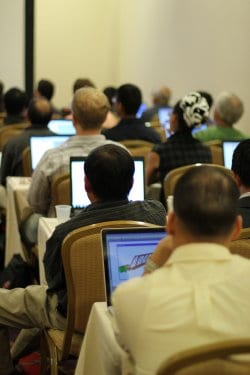
Earlier this month, I spent a day at the sixth annual COMSOL User Conference in Boston, Massachusetts. For those who don’t know, COMSOL is the company behind the COMSOL Multiphysics software platform for the modelling and simulation of all manner of physics-based systems.

The conference, like COMSOL’s customer base, isn’t short on variety. With more than 350 attendees, 150 user presentations and 20 short courses, the programme ranges across many areas of academic and industrial research, among them acoustics, bioengineering, heat transfer, electromagnetic fields, microfluidics, fuel cells and photonics.

The keynote presentations reinforced the multidisciplinary feel. Thomas Dreeben of US lighting company OSRAM SYLVANIA, for example, explained how his team is using multiphysics modelling to study energy-efficiency improvements in high-intensity discharge lamps that exploit “acoustic streaming”.

Dreeben and his colleagues hope that one day their endeavours will yield an “increase in lamp efficiency over current technology”, and in turn put a significant dent in global electricity consumption – 20% of which is currently used to keep the lights on.

Meanwhile, fellow keynote speaker Mihan McKenna of the US Army Engineer R&D Center put the focus on the here and now – and specifically the use of COMSOL in a disaster-prevention context for civil and military geophysics applications ranging from modelling of water intrusion in levees to evaluating the structural integrity of bridges.

Lest anyone forget, COMSOL is in business to shift product and the wide-ranging scientific programme is ultimately a means to that end. To oil the wheels of commerce, each conference delegate got to play with the pre-release of COMSOL Multiphysics version 4.1, with “enhanced productivity” billed as the headline selling point.

For Bernt Nilsson, COMSOL’s senior vice-president of marketing, the User Conference works on a number of levels, but most important is the “deeper engagement” it provides with scientific and industrial researchers. “This is a cross-disciplinary melting pot where high-end users can come together to network and learn from each other,” he explained.

“We’re seeing more users wanting to present too. It’s become a notable career event because we promote the content so widely. Your presentation in the conference proceedings alone means that it reaches more than 100,000 engineers and scientists worldwide.”

• The proceedings of the COMSOL User Conference will be available in December. Readers interested in ordering a free copy can register here.

In nature, number one dominates


What was once regarded as simply a mathematical curiosity could become a powerful scientific tool. That is the view of a group of geophysicists, who have found that Benford’s law – which predicts a non-uniform distribution of first digits in real-world observations – does in fact hold true across a wide range of different kinds of scientific data. The researchers believe that searching for departures from this distribution within observational data could, for example, enhance earthquake identification and improve computer simulations of the climate.

In 1938 Frank Benford generalized a proposition originally put forward by 19th-century astronomer Simon Newcomb that the first digits of numbers generated by real-world observations occur with a probability log10(1 + 1/D), where D is the value of the digit. This means that numbers beginning with the digit 1 should occur about 30% of the time in nature, while the fraction for those starting with a 2 should be about 17% and those starting with a 9 just 4%. Benford said that the prevalence of lower digits holds true no matter which base the numbers are written in and went on to show that the law, which now bears his name, applies to data describing everything from city populations to the lengths of rivers.

Malcolm Sambridge, a seismologist at the Australian National University in Canberra, says that in general the law applies to lists of numbers that are formed by some kind of additive process, in which larger numbers are less likely to occur than smaller ones. Defying many peoples’ intuitive expectation that the distribution of first digits is uniform, Benford’s law has in fact found practical application as a means of detecting fraud (since doctored numbers tend not to follow the law). “When I first tell people about the law often their reaction is that it must be a hoax,” says Sambridge. “It’s so simple that it’s bizarre, but it is in fact true.”

Gamma rays to greenhouse emissions

In the latest work, Sambridge, working with Australian National University colleague Hrvoje Tkalcic and Andrew Jackson of ETH Zürich, studied the distribution of first digits from 15 sets of data containing a combined total of more than 750,000 numbers. These data were drawn from across the sciences, ranging from the photon fluxes from distant gamma-ray sources to national greenhouse-gas emissions and the numbers of people infected with various diseases. Every one of the data sets was found to follow Benford’s law.

According to Sambridge, the law could be used to improve computer simulations of complex physical processes whose data follow the Benford distribution, such as those underlying the Earth’s climate. The researchers also believe the law could help to distinguish between earthquakes and other sources of tremors such as nuclear explosions. They found that seismic data from the earthquake behind the Asian tsunami of December 2004, collected in Peru, followed the Benford distribution, whereas the background noise preceding the earthquake did not.

Further, by analysing data collected by a seismometer in Canberra, they were able to identify a previously unobserved tiny earthquake that occurred in the Australian capital at the same time as the Asian quake. “It turns out you might not need to study seismic waveforms in detail,” adds Sambridge. “Just the first digits of the displacement data will do.”

It could apply to your data

Sambridge and colleagues urge other scientists to also scrutinize their data for the tell-tale surplus of ones. Indeed, they say, Benford’s law “is likely to hold across the sciences for data sets with sufficient dynamic range”; in other words those with a range of values that spans at least several orders of magnitude, as was the case with the data that they studied.

However, mathematician Theodore Hill of the Georgia Institute of Technology in the US sounds a note of caution. He says that Sambridge’s group provides “additional convincing evidence that Benford’s law applies across much of the sciences”, but he does not believe that dynamic range is enough to determine whether or not a data set will follow the law. Hill proved mathematically in 1995 that Benford’s law is the only possible universal law describing the distribution of digits that is invariant under changes of scale (for example, it doesn’t matter whether units are stated in metres or kilometres). But neither he nor anyone else has discovered a general principle that can predict a priori which kinds of data sets should obey the law. “The ubiquity of Benford’s law,” he says, “especially in real-life data, remains mysterious.”

This research is described in a paper recently accepted by Geophy. Res. Lett.

Green light for Indian neutrino observatory


Particle physicists in India have cleared a major hurdle in their plans to build a new facility for studying neutrinos after a site for the $167m Indian Neutrino Observatory (INO) was approved yesterday by the Indian Ministry of Environment and Forests. If final clearance is given by India’s Atomic Energy Commission, the INO will be built at Bodi West Hills in Theni district, southern India, with construction starting in 2012.

The observatory will be built by the Tata Institute of Fundamental Research (TIFR) in Mumbai and 20 other scientific institutions. The INO was originally planned to be located in the Nilgiri Hills at Singara in southern India. Singara was the prime site choice for the INO because the thick granite of the mountain would have helped to shield the experiment from cosmic rays that could overwhelm the signal from the neutrinos. But last year the INO suffered a major setback when the site was rejected due to the presence of elephants that use the land as a migration corridor and because it is near to the Mudumalai Tiger Reserve.

The new site in Bodi West Hills will be used to house the neutrino detector in a cavern some 1000 m below ground. The INO will consist of a massive 50,000 tonne detector – made from layers of magnetized iron and glass – that will be used to detect the neutrinos and antineutrinos produced when cosmic rays interact with the Earth’s atmosphere. The detector could also be adapted later on to record beams of neutrinos fired from a distant accelerator to study how neutrinos change, or “oscillate”, from one of their three possible forms to another.

“We are certainly very happy to get this important clearance. INO is an important basic science project in this country,” physicist Naba K Mondal, INO spokesman and a researcher at the TIFR, told physicsworld.com. “[The INO] is well poised to provide great opportunities for achieving scientific success at the international level.”

However, government approval for the Bodi West Hills site is subject to conditions that construction of the project does not entail cutting down trees or causing damage to the forest cover.

Copyright © 2026 by IOP Publishing Ltd and individual contributors