Tevatron still churning out exciting physics


Fermilab’s ageing Tevatron may be due to cease operations at the end of September but for the time being it continues to produce new physics results. Researchers have found that pairs of top quarks and anti-top quarks are produced at the Tevatron with a greater spatial asymmetry than is expected from theory. The result suggests the existence of particles outside of the Standard Model, but this will need to be backed up with more data before physicists overhaul their current theories.

The Tevatron, located at the Fermilab near Chicago, collides protons with antiprotons. Among the many different kinds of particle produced in these collisions are pairs of top quarks and anti-top quarks, generated via the strong force. Detailed calculations reveal that charge should introduce a slight asymmetry when these particles are produced. The reason for this is that the positive charge of a quark contained within an incoming proton tends to repel a top quark very slightly while attracting an anti-top quark, and vice-versa for an incoming antiproton, thereby introducing a small asymmetry into the distribution of outgoing top quarks and anti-top quarks.

Analyses published in 2008 by the CDF and D0 collaborations at Fermilab did indeed provide evidence for this asymmetry. In fact, by carefully measuring the momenta of the particles into which the top and anti-top quark pairs decay, the researchers found that this asymmetry was larger than predicted by the Standard Model. But the discrepancy between theory and experiment was not that significant – the measured value of the asymmetry lying within two standard deviations, σ, of the predicted value.

Now, however, having accumulated a lot more data in the last two years, CDF has found the discrepancy to be more substantial. In particular, the collaboration studied how the asymmetry varies according to the total energy of the top/anti-top pair. At energies of less than 450 GeV (gigaelectronvolts), they found the asymmetry to actually be slightly negative, at –12±15%, but still therefore in line with the Standard Model prediction of 4%. Above 450 GeV, in contrast, they measured an asymmetry of 48±11%, compared with 8% predicted by theory. This anomaly, say the researchers, has a statistical significance of 3.4σ, or less than a 1 in 100,000 chance that it is simply a statistical fluctuation.

Wouldn’t bet their house on it

Despite the apparently very slim chance of the result being a fluke, CDF co-spokesperson Robert Roser says that no-one in the collaboration is “prepared to bet their house on it”. He points out that “sometimes three sigma results turn into five or six sigma whereas others turn into zero sigma”, adding that theorists are publishing new papers every day regarding the possible new particles that might be able to explain this result, but refusing to be drawn into theoretical speculation himself.

Indeed, Tommaso Dorigo, a member of the CMS collaboration at CERN in Geneva, which is also concerned with the analysis of symmetry in particle decays, cautions that the anomaly might not be so large if the uncertainty in the predicted asymmetry has in fact been underestimated. One potential cause of such an underestimation could be the modelling of how quarks and gluons are distributed within the colliding protons and antiprotons. So-called parton distribution functions, he points out, are measured in other experiments and then extrapolated to the energies at which the Tevatron operates and it is possible, he says, that this extrapolation produces a larger uncertainty than estimated. “The predicted asymmetry is just like a soup,” he adds, likening the soup’s recipe to the Standard Model. “There are many ingredients in the soup, and if the soup tastes bad, this may mean that one ingredient was not fresh; it does not necessarily mean that the recipe is wrong.”

Establishing whether or not the latest result is watertight will require collecting more data at the Tevatron, says Roser. As he points out, the Tevatron is ideally suited to studying this asymmetry because the proton/anti-proton collisions automatically lead to pairs of top quarks and anti-top quarks. Producing anti-top quarks at the LHC, in contrast, requires collecting huge amounts of data because the accelerator’s collision energy must be just right to produce an anti-top quark out of the vacuum. Roser adds that he is “disappointed but not surprised” that the Tevatron has not been granted a hoped-for extension beyond September, but expects the US collider to “still dominate the physics landscape for the next year to 18 months”.

The results are presented in a paper submitted to the arXiv preprint server.
Astronomers say goodbye to the ‘millicrab’

X-ray astronomers have for decades calibrated their detectors using the Crab Nebula – a supernova remnant that appeared to have an extremely steady brightness. But now an international team of astronomers has discovered that the X-ray output of the Crab has dropped by 7% in the last two years. Although astronomers may now have to look elsewhere for X-ray calibration, the discovery could help astrophysicists to gain a better understanding of how the Crab and similar structures generate vast amounts of high-energy radiation.

One of the most studied objects in the sky, the Crab Nebula is the remnant of an exploded star 6500 light-years away from Earth. At its core is a neutron star that spins 30 times per second, driving processes that are responsible for it X-ray and gamma-ray emissions. Until recently the X-ray intensity of the Crab was considered to be so stable that it is used as a “standard candle” to judge the relative brightness of other objects in the sky. Indeed, X-ray brightness is often expressed in units of “millicrab”.

Steady decline

But now Colleen Wilson-Hodge at NASA’s Marshall Space Flight Center and colleagues have published a painstaking study using data from five different instruments that clearly shows variability in the Crab’s output. Team members first became suspicious when they analysed recent data from the Fermi space telescope’s Gamma-ray Burst Monitor (GMB). It revealed a clear and steady decline in the intensity at X-ray energies between 15 and 50 keV.

Not convinced that the decline was real, the team then looked at data from four other instruments – some of which stretched back as far as 1999. The measurements suggest that the intensity increases before dropping by 7% in just two years (see figure). “We’re clearly seeing how much our candle flickers,” said Wilson-Hodge who was at the 217th Meeting of the American Astronomical Society in Seattle.

Giant slinky

Also at the meeting was Roger Blandford of Stanford University, who believes that the variability could be related to the rapid motion of magnetic field lines surrounding the spinning neutron star. Electrons spiral around these field lines, creating synchrotron X-rays. The high energy of this radiation suggests that these lines are moving close to the speed of light, Blandford reckons.

“The magnetic field lines resemble a giant slinky,” he says, “and anyone who has played with a slinky knows how unstable they are”. Blandford believes that such instabilities could lead to variations in the X-ray intensity.

Until recently, astronomers had also believed that the Crab was a very steady source of gamma rays. But last week Marco Tavani of the University of Rome and colleagues published a paper in Science showing that the nebula has produced two powerful gamma ray flares since 2007. Both flares contained radiation in the 100 MeV – 10 GeV range and were about three times the normal intensity of the Crab in that energy range.

The flares both lasted for several days and were spotted by the Italian Space Agency’s AGILE probe. The gamma rays from the Crab are produced by electrons accelerated to extremely high velocities and Tavani said that the flares show that the Crab is a “very efficient” particle accelerator. “We have lost a standard candle for astrophysics but have gained insight into the acceleration process,” he says.

The X-ray study is described in Astrophysical Journal Letters (727 L40).

Gulf Stream edging northwards along Canadian coast

The Gulf Stream off eastern Canada appears to have advanced northward of its historical position in recent decades, possibly in response to anthropogenic climate change. That is according to researchers in North America and Switzerland who say that the changes could have some profound implications for marine life off the coast of Canada.

The new study focuses specifically on a region just off the coast of Nova Scotia. This section of the Atlantic is fed from the north by the cold waters of the Labrador Current, and from the south by the warmer waters of the Gulf Stream. The mixing of these two water flows creates a nutrient-rich ecosystem for species such as cod, which has attracted a large fishing industry.

By analysing micro-organisms preserved in deep-sea sediment, scientists have suspected for several years that the balance between the Labrador Current and the Gulf Stream waters has been changing. Water from the Gulf Stream tends to be more stratified and richer in nutrients so it leaves a different signature in the sediment record than the waters coming from the north.

A smeared record

The trouble with these studies, however, is that their temporal resolution has been poor so researchers have only been able to attribute changes to some point in the past 150 years. “The limitations are partly because there are a lot of organisms down there that stir the sediments, smearing the historical records,” explains Owen Sherwood of the Memorial University of Newfoundland in Canada, the lead author of the new study.

Sherwood’s team has now managed to improve this resolution by turning its attention to corals, which exist in abundance in this part of the north-west Atlantic. Because these organisms – which can live for thousands of years – extract nitrogen from the ocean, they document the changes in the balance between the waters of the Gulf Stream and the Labrador Current, which contain differing nitrogen signatures.

The analysis involved determining the 15N/14N ratio within individual amino acids taken from gorgonian corals. As these deep-sea corals grow new rings in their endoskeleton every year, Sherwood’s team was able to determine annual variations in water composition stretching back 1800 years. According to Sherwood, one of the big challenges his team faced was collecting corals for analysis, but these were collected by remotely operated vehicles and others were supplied by the fishing industry, which accidentally scoops up corals in its nets.

Recent climate changes

Reporting their findings in Proceedings of the National Academy of Sciences, the researchers say that the dominance of the warm Gulf waters since the early 1970s appears to be largely unique within this bimillennial period. Although Sherwood’s team links these changes with recent changes in global climate, it says that further analysis is need to investigate the effects on wider ocean circulation. “These water masses do appear to have changed significantly in recent years, though I must emphasize that we have only looked at a very specific region off the coast of Nova Scotia,” says Sherwood.

This is a very exciting result, and one of the nicest demonstrations of the importance of cold-water corals of archives of environmental change Murray Roberts, Heriot-Watt University

Murray Roberts, a bioscientist at Heriot-Watt University in the UK, is impressed by the experimental work. “This is a very exciting result, and one of the nicest demonstrations of the importance of cold-water corals of archives of environmental change,” he says. “[The researchers] have uncovered new evidence that the recent warm and nutrient-rich conditions in the north-west Atlantic off Nova Scotia may be rather different to earlier times – and this change seems to be related to anthropogenic climate change.”

Roberts warns that ecologists cannot make specific predictions about how these changes will impact on local marine life. “Any broad changes in seawater temperature and nutrient supply are very likely to affect sedentary species like cold-water corals and sponges,” he says. “In simple terms they can’t get up and crawl or swim away if conditions become less suitable for them.”

The research group intends to develop its study and has recently obtained a grant from the US National Science Foundation to study the coral record in this part of the Atlantic in more detail.

How do supermassive black holes form?

greaves-495px.jpg
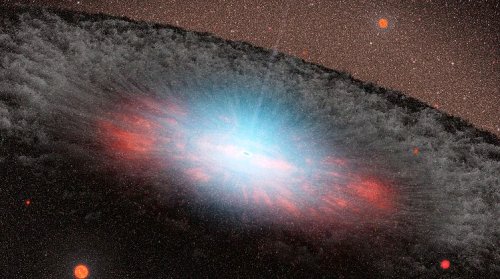
A supermassive black hole could look like this: but how did it form? (Courtesy: NASA)

By Hamish Johnston at the AAS meeting in Seattle

The universe is full of supermassive black holes (SBHs). Indeed, they make up the core of just about every galaxy. These monstrosities can be a billion times more massive than the Sun. But despite their size and ubiquity, astrophysicists don’t really understand how they are formed.

That was the topic of a fascinating talk by Mitch Begelman of the University of Colorado, who is an expert on SBH formation.

According to Begelman there are two competing theories – the small seed that takes a long time to grow, and the large seed that grows quickly.

The small seed refers to the collapse of a massive star of about 100–1000 solar masses to form a black hole that grows slowly by sucking in surrounding gas and merging with other structures until it is an SBH.

The large seed refers to the direct collapse of a huge cloud of gas to create a supermassive star that could be heavy as a billion Suns. According to Begelman, such stars would be very fragile and would only last a few million years until their cores collapsed to create a black hole.

But instead of exploding in a supernova like much smaller stars, the remaining matter would puff out to become a “quasistar” – resembling a red giant. This surrounding matter is rapidly sucked in and what remains is a black hole that Begelman believes could be as large as one million solar masses. This is around the lower limit of an SBH, and it could keep growing.

Sounds great, but is there any chance of seeing a supermassive star or quasistar?

Unlikely for supermassive stars, says Begelman, because they would be very hard to distinguish from clusters of hot stars. He is a bit more hopeful about quasistars, because they could stand out in the optical and infrared wavelengths. However, he concedes that this would be a tough job, even with the upcoming launch of the James Webb Space Telescope.

To paraphrase Begelman’s conclusion, SBH formation models are getting more sophisticated but the problem has not yet been solved.

Quantum communications boosted by solid memory devices

Two independent groups have demonstrated how a pair of entangled photons can transfer their entanglement to and from a solid – the process that should one day form the backbone of so-called quantum memories or repeaters. These devices would enable quantum communication systems to transmit information over larger distances, with significantly reduced degradation.

“While I was sceptical a few years ago that a useful quantum repeater or quantum network could be built, I am now very confident…that this goal can be achieved in the next five to ten years,” says Wolfgang Tittel of the University of Calgary, Canada, an author of one of the papers that appear in Nature today.

Quantum communication is a means of sending information that is fundamentally secure from eavesdroppers. Two photons must be entangled – that is, have their quantum states inextricably linked – at either end of a channel, over which a “key” for decoding encrypted information can be established. Thanks to the uncertainty principle in quantum mechanics, it is impossible to intercept this key without corrupting it, so the official communicators can always tell if a third party has tried to eavesdrop.

One of the limitations to quantum communication, however, is signal degradation. In conventional information networks, engineers get around this problem by installing repeaters, which record a decaying signal and then re-emit it at its optimum strength. Yet, because it is impossible to record a quantum signal without corrupting it, a quantum repeater must be able to absorb and re-emit the entangled photons without disturbing the entangled state. Quantum memories, a more primitive form of repeaters, have been demonstrated before in single atoms or atomic vapours but not, until now, in the solid state, as is required in a robust communications system.

Choose your crystal

This is the advance made by Tittel’s group, which includes members at the University of Paderborn, Germany; and, similarly, by Nicolas Gisin and colleagues at the University of Geneva in Switzerland. Both groups have shown how one photon in an entangled pair can be absorbed by a crystal doped with a rare-earth ion, so that its quantum state becomes stored as an atomic excitation. A fraction of a second later, a new photon is emitted with that entangled state intact.

There are differences between the group’s demonstrations. For crystals, Tittel’s group used thulium-doped lithium niobate, whereas Gisin’s group opted for neodymium-doped yttrium silicate. In addition, a different type of laser set-up has favoured Gisin’s group, which reports a maximum storage time of some 200 ns at an efficiency of more than 20%; Tittel’s group reports a storage time of 7 ns at an efficiency of 2%. On the other hand, the quantum memory of Tittel’s group functions at a bandwidth of 5 GHz – some 40 times greater than Gisin’s group – which means, potentially, far more information could be sent in the same time.

Val Zwiller, a quantum physicist at the Delft University of Technology in the Netherlands, says the two groups have made “clearly important steps” towards quantum repeaters, but notes several limitations that suggest engineering challenges still lie ahead. One of these is the low efficiency, and the fact that the storage times are not variable, as would be required in a practical device. Another is that the wavelength of the stored photons is not the international standard used in telecommunications, around 1300 nm. “The work presented in these two articles still lacks on several fronts,” Zwiller concludes.

Members from both groups admit there is some way to go before quantum memories or repeaters can be implemented in practical systems, but believe there are no insurmountable hurdles. “Several solutions are already actively pursued in the world, and the rapid progress that has been achieved recently leads us to believe that these will be significantly improved in the coming years,” says Mikael Afzelius, a member of Gisin’s group.

Spreading the word: why science outreach matters

Amy Moll is a scientist on a mission to inform. A professor in the department of materials science and engineering at Boise State University, Idaho, she’s also chair of the Materials Research Society (MRS) public outreach committee, a role that sees her “bringing science and materials science to the general public”.

In our latest video report, Moll acknowledges that fear is a big issue for many scientists wary of communicating their research to a wider audience. “It’s sometimes hard to talk to the general public about your science, and it can be difficult to communicate with folks when you don’t know where they’re coming from or you don’t know what their background is.”

Nevertheless, she argues that outreach is not optional, rather that scientists have a duty to spread the word about their work. “These are the folks that vote, that make decisions, that are active in their local community…It’s their tax money that’s paying us to do research, so we have an obligation to tell them about it.”

This interview forms part of a series filmed at the MRS Fall Meeting in Boston. See also “Living in a material world” and “Funding the frontiers of materials science”.

Moon outshines the Sun…

By Hamish Johnston at the AAS meeting in Seattle

You know it has been a good day when you learn a new amazing fact.

Today I discovered that the Moon is brighter than the Sun when it comes to gamma radiation.

How can a cold lump of rock give off more gamma radiation than a seething fusion reactor?

The answer, according to NASA’s Julie McEnery, is that both bodies glow with gammas because they are illuminated by cosmic radiation. The Sun’s strong magnetic field deflects much of this radiation away from the star. The Moon, however, has an extremely weak field that is not much use at deflecting cosmic rays.

Planck discoveries run hot and cold

Scientists working on the Planck microwave probe have presented the mission’s first scientific results here at the 217th meeting of the American Astronomical Society meeting in Seattle. The results include the discovery of thousands of new cold cores in the Milky Way and a new way of spotting extremely hot galaxy clusters.

The European Space Agency’s Planck probe was launched in April 2009, and is designed primarily to map the cosmic microwave background (CMB) – a remnant of the Big Bang that pervades the universe. However, the mission’s two instruments are also proving very useful at studying smaller structures such as stars and galaxies. Many of these new data will be used by astrophysicists to inform studies that use a number of other ground-based and space telescopes.

Introducing the results in Seattle, Planck scientist Charles Lawrence of the Jet Propulsion Laboratory described these structures as “bugs on the windshield” in the Planck data. So far, Planck scientists have written 18 scientific papers describing these bugs, as well as the first catalogue of objects seen by the probe – including a large number of never-before-seen structures.

‘Teetering on the edge of star formation’

These include 10,000 cold, dense clouds of gas in the Milky Way called cold cores. They are thought to be some of the coldest objects in the universe and form when diffuse clouds of gas cool and contract. According to Planck scientist George Helou of Caltech, cold cores are “teetering on the edge of star formation”. Therefore, the study of cold cores could provide important information about how stars form. “It’s always coldest just before a star is born,” said Helou.

One early finding is that cold cores can be up to 30 light-years across and weigh in at 1000 solar masses. This came as a surprise, according to Helou, because larger cores were not expected to survive being jostled about by the rotation of the Milky Way. Planck also found cold cores with temperatures as low as 7 K, which Lawrence described as “gratifying”, because such temperatures had been predicted by theory.

Hotter than the Sun

Planck has also proven itself to very useful in the study of massive galaxy clusters, which can contain hundreds of galaxies and are the largest structures in the universe that are held together by gravity. These are mostly invisible dark matter but also contain large amounts of extremely hot gas at 107 Kelvin – which is much hotter than the Sun.

Indeed, the gas is so hot that it emits mostly X-rays and can’t be seen with an optical telescope. However, it can be seen by Planck because microwave radiation passing through a cluster is given an extra energy “kick”. This is called the Sunyaev-Zel’dovich (SZ) effect and can be detected by Planck.

According to Planck scientist Elena Pierpaoli of the University of Southern California, the probe has already discovered 12 new galaxy clusters. Many of these have dim X-ray signals and therefore would not have been spotted by X-ray telescopes. Another benefit of Planck, according to Pierpaoli, is that the SZ effect is not affected by long distances and so the probe can look back further in time.

What about the CMB data?

Although these dead bugs are very useful to astrophysicists, the main prize from Planck will be a much better insight into the early universe brought by its superior CMB measurements. Unfortunately cosmologists will have to wait another two years before these data are released – despite the fact that Planck has already produced the best map of the CMB yet. The reason, according to Lawrence, is that more measurements of the CMB intensity and polarization are needed before cosmologists can differentiate between various phenomena in the early universe.

Tevatron reaches the end of the road

Fermilab’s Tevatron particle accelerator will cease operations at the end of September as originally planned, despite calls to extend operations for a further three years. The decision – made by the Department of Energy (DoE) – means that the search for the elusive Higgs boson is now likely to become a one-horse race involving the Large Hadron Collider (LHC) at CERN.

The DoE had been considering whether to let the Tevatron run until the end of 2014 after an extension proposal was submitted to it last October by the independent High Energy Physics Advisory Panel (HEPAP). The panel had concluded that the Tevatron could continue to produce physics of significant value to complement research at CERN and should continue for three more years. But a sub-panel, referred to as P5, had advised that extension of the Tevatron’s operation should be approved only if additional funds were made available to high-energy physics.

“Unfortunately, the current budgetary climate is very challenging and additional funding has not been identified,” writes William Brinkman, director of the DOE’s Office of Science, in a letter to HEPAP. “Therefore, based in part on the P5 recommendation, operation of the Tevatron will end in FY 2011, as originally scheduled.” Keeping Tevatron running was expected to cost at least $60m a year.

All eyes on the LHC

Brinkman acknowledges that the baton in the race for the Higgs has now been handed over to CERN, but he is keen to stress that the US will continue its involvement at the LHC. “US scientists play a major role in the ATLAS and CMS collaborations at the LHC, with both experiments publishing early results that clearly demonstrate the impressive capabilities of these detectors,” he writes.

In response to the news, Lisa Randall, a particle physicist at Harvard University, posted a message on the social networking site Twitter yesterday expressing her disappointment. “Very sad. Tevatron will be turned off at end of year. All eyes on LHC for Higgs discovery and more. Good news is that LHC doing great,” she wrote.

Randall was among 38 US physicists, unaffiliated with Fermilab, who sent a letter in July to the US energy secretary Steven Chu, urging him to support a three-year extension of the Tevatron. The researchers argued that the machine’s recent successes and the 15-month shutdown at the LHC planned for 2012 presented a good opportunity for the Tevatron to continue to rival its European counterpart.

Towards the Intenstiy Frontier

For other researchers in the US, however, the decision to close the Tevatron may be a cause for celebration because it will enable Fermilab’s Intensity Frontier programme to go ahead as planned in 2012. One such project is NOvA, which is designed to study neutrinos produced when a 700 kW beam of protons from Fermilab’s Main Injector accelerator collides with a graphite target.

Had the Tevatron, which collides protons with antiprotons, still been running when NOvA starts in 2013, the available beam power would drop to about 400 kW, thereby sharply reducing the amount of data NOvA collects in its first 18 months.

Rob Roser, co-spokesperson on CDF, one of Fermilab’s two main detector experiments, says that the news should not be viewed as a failure of the Tevatron programme. “I think the community, through the process, agreed that there is a compelling physics case to run this program longer but in our current economic climate – tough decisions have to be made.

“[Tevatron’s] been tremendously successful – with CDF alone publishing over 500 papers, many discoveries and important limits. I am very proud of our accomplishments.”

Thunderstorms hurl antimatter into space

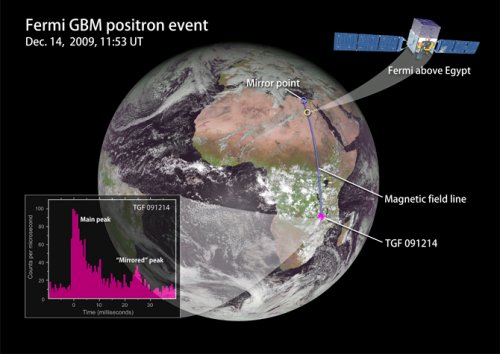
thunder.jpg


By Hamish Johnston at the AAS meeting in Seattle

Everyone likes a good thunderstorm – the spectacular flashes, crashes and wind, and then calm, clear air. But for the past few years physicists have begun to realize that thunderstorms can generate very-high-energy gamma rays – 100 MeV being the highest seen so far.

Now, researchers have discovered that these gamma rays are creating beams of positrons (the antimatter version of electrons) and hurling them into space!

These bizarre discoveries have come about thanks to the Fermi gamma ray telescope – the primary mission of which is to scan the heavens for gamma ray bursts. However, the satellite can’t help detecting terrestrial gamma ray bursts (TGBs) and once it determined that they are a regular occurrence over the tropics it was optimized to look down as well as up.

While most TGBs last about a millisecond, Fermi has seen events that last for much longer. What’s more intriguing is that one of these events appeared to occur over southern Egypt, where there was no thunderstorm activity.

Loving a good mystery, Michael Briggs at the University of Alabama and colleagues decided to investigate. One thing that they noticed was a preponderance of gamma rays at 511 keV, which are produced when electrons and positrons annihilate.

The positrons are created when high-energy gamma rays scatter off atoms in the atmosphere, converting into electron–positron pairs. Even more electrons are created by other scattering processes and, being charged particles, the electrons and positrons travel along Earth’s magnetic field lines. As they travel, they collide with gas atoms and can emit gamma rays.

So what does this have to do with the TGB over Egypt? What Briggs and colleagues think is that the initial TGB occurred thousands of miles away in southern Africa, sending a beam of electrons and positrons hurling up and over Egypt, where collisions produced gamma rays. See the above figure.

The charged particles kept going to a mirror point, where they were reflected back down over Egypt – creating a second pulse. This entire process took less than 30 ms.

Amazingly, physicists have only known about these high-energy bursts for a decade or so. The problem, according to Briggs, is that they are difficult to detect here on Earth because the gamma rays are absorbed by the dense lower atmosphere. However, they have been seen at certain high-altitude facilities and at sea level in Japan, where thunderstorms are believed to occur lower in the sky than in most places.

The big mystery, however, remains how such high-energy gamma rays are created in the first place.

Copyright © 2026 by IOP Publishing Ltd and individual contributors