The search for other planets

corot.jpg
It’s out there

By Michael Banks in Miami, Florida

We need to better understand how other stars behave before we start looking for planets orbiting around them. That was the message from astronomers speaking in a session on searching for exoplanets at the 216th American Astronomical Society meeting in Miami, Florida.

Annie Baglin from the Observatoire de Paris, France, spoke about the $160m Convection Rotation and Planetary Transits (CoRoT) mission, built by the French Space Agency, which launched in 2006.

CoRoT has two objectives: to study the solar variation in other stars as well as searching for exoplanets via a technique known as “transiting”, where a planet passing in front of the star causes its solar output as seen by the satellite to dim slightly.

Indeed, CoRoT has already had breakthroughs in studying solar variations in other stars including hot stars and red giants. Yet the science that gets the most attention is CoRoT’s search for exoplanets.

Although CoRoT lost the use of two of its detectors last year, the craft is still going strong and has managed to detect a range of exoplanets.

Most of the exoplanets spotted by CoRoT are big, hot planets such as CoRoT-3b, which has a mass 21 times that of Jupiter.

On 17 March CoRoT discovered CoRoT-9b, which has a radius similar to Jupiter and a temperature of 350 K. “If it has moons, then they would be habitable,” says Baglin. But getting to the planet is another matter as it is lies 1500 light-years away.

The biggest find to date is possibly CoRoT-7b, discovered in February 2009, which has a similar diameter and mass to Earth.

Baglin outlined in her talk how difficult it is to spot such small planets saying that constant changes in the star’s activity makes it very difficult to detect planets orbiting them. “Once we have a better understanding of a star’s cycle then we will be better placed to start to look for exoplanets,” says Baglin.

CoRoT still has another three years to run, but it has already been superseded somewhat by NASA’s Kepler mission, which launched in March 2009 to look for Earth-like planets. “Kepler will do more than what we have,” says Baglin.

Black holes: not where they ought to be

By Michael Banks in Miami, Florida

The common view of black holes residing at the centre of their host galaxies might not be completely true, according to astronomer Daniel Bacheldof, from the Florida Institute of Technology.

Speaking today at the 216th American Astronomical Meeting in Miami, Florida, Bacheldof and colleagues used old data taken from the Hubble Space Telescope to show that the supermassive black hole at the centre of the M87 galaxy is slightly displaced from its centre.

The fact that a supermassive black hole – black holes that are millions or billions time the mass of the Sun – can be displaced from the centre of a galaxy is not new, but the fact that astronomers have spotted such a small displacement means that small off-sets could be more common than previously thought.

The explanation for the displacement comes from the fact that the supermassive black hole in M87 was a merger between two smaller black holes. When they merged, the emission of gravitational waves “kicked” the newly created black hole, knocking it slightly off-centre. “What we are seeing in M87 is in effect indirect evidence for gravitational waves,” notes Bacheldof.

The fact that many other supermassive black holes show similar properties to M87 could indicate that such off-sets are common in the universe. “No longer can it be assumed that all supermassive black holes reside at the centres of their host galaxies,” says Bacheldof, who is looking at other such systems to spot similar effects. Time to re-write those astronomy textbooks?

Two screens are better than one

DSCN1903.JPG
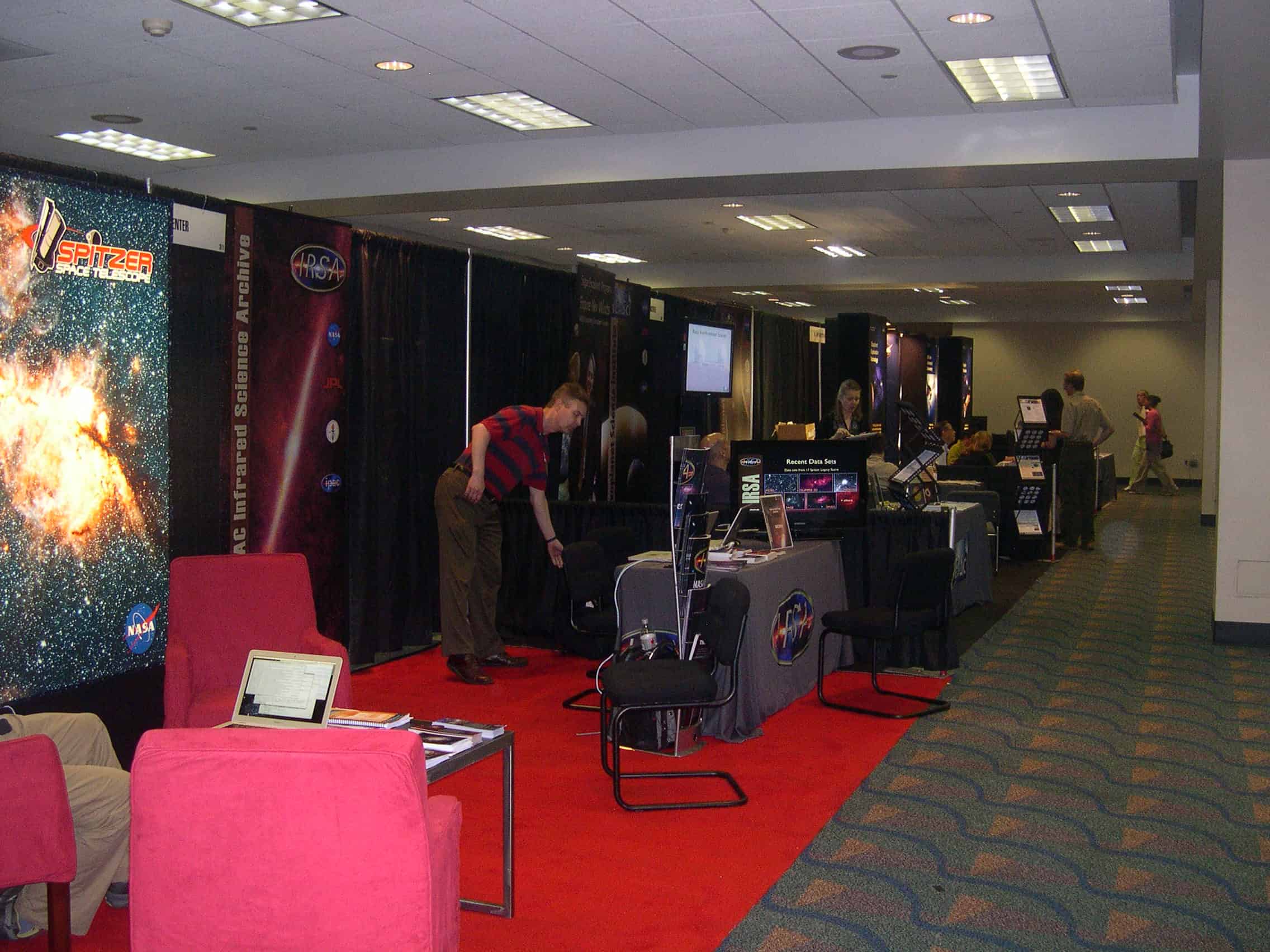
Exhibitors at the 216th American Astronomical Meeting

<img alt=DSCN1913.JPG
src=”http://physicsworld.com/blog/DSCN1913.JPG” width=251 height=320>
Out now: the Solar Dynamics Observatory movie

By Michael Banks in Miami, Florida

Walking into the exhibition hall at the 216th American Astronomical Meeting in Miami, Florida, it seems like this year’s must-have is a TV screen.

That is, of course, to show all the awe-inspiring images and movies that their missions are just releasing, be it from the Herschel mission, the Wide-field Infra-red Survey Explorer or the Solar Dynamics Observatory (SDO).

My favourite is the SDO booth and not just because of the free 3D glasses, but because of the quality of the images that the mission has just started to release (though they did give me a nice coaster).

The SDO booth also has two TV screens, obviously one is not enough.

With the enticement of tortilla chips, I also caught some of the poster session, which did not seem overly subscribed. Maybe people were instead enjoying the Miami sun outside.

Physics could help to replace U2 at Glastonbury

chair.jpg
Bono was due to grace the iconic Pyramid Stage. Credit: James Dacey

By James Dacey

The colossal Irish rock group U2 broke thousands of hearts this morning when they announced that they can no longer play their headlining slot at this year’s Glastonbury festival, a result of Bono putting his back out during rehearsals last week. The big question now is – who will replace them?

Well, if festival organizer Michael Eavis is willing to put reputations aside and choose a replacement purely on their musical similarity to U2, he may enlist the help of physicists in Brazil.

Luciano da Costa at the University of Sao Paulo and her colleagues have developed a new way of grouping music based on the subtle differences in rhythm between musical genres.

The researchers studied four musical genres – rock, blues, bossa nova and reggae – looking at 100 songs from each category, analysing the most representative sequences of each rhythm.

They then represent the rhythms as a Markov chain where the nature of each beat depends only on the preceding beat. “Basically, this means that we consider the time duration of each of two subsequent notes in order to obtain the probability transition between each type of notes (duration) in each given composition,” explains Costa.

Costa and her co-author Debora Correa are both classical pianists and they say that this has been an influence on their work. “We wanted to investigate how computing, maths and physics could be used to help us characterize and understand music and music genres,” says Costa.

So okay, I think we can be fairly certain that Michal Eavis will not involve Markov chains in selecting his U2 replacement, but this research could potentially have a far wider impact in the music industry. The researchers believe it could help to improve music platforms, such as Apple’s iTunes, which can group music to make recommendations based on the kind of music you regularly play.

You can read about the method in this open-access paper published recently in New Journal of Physics.

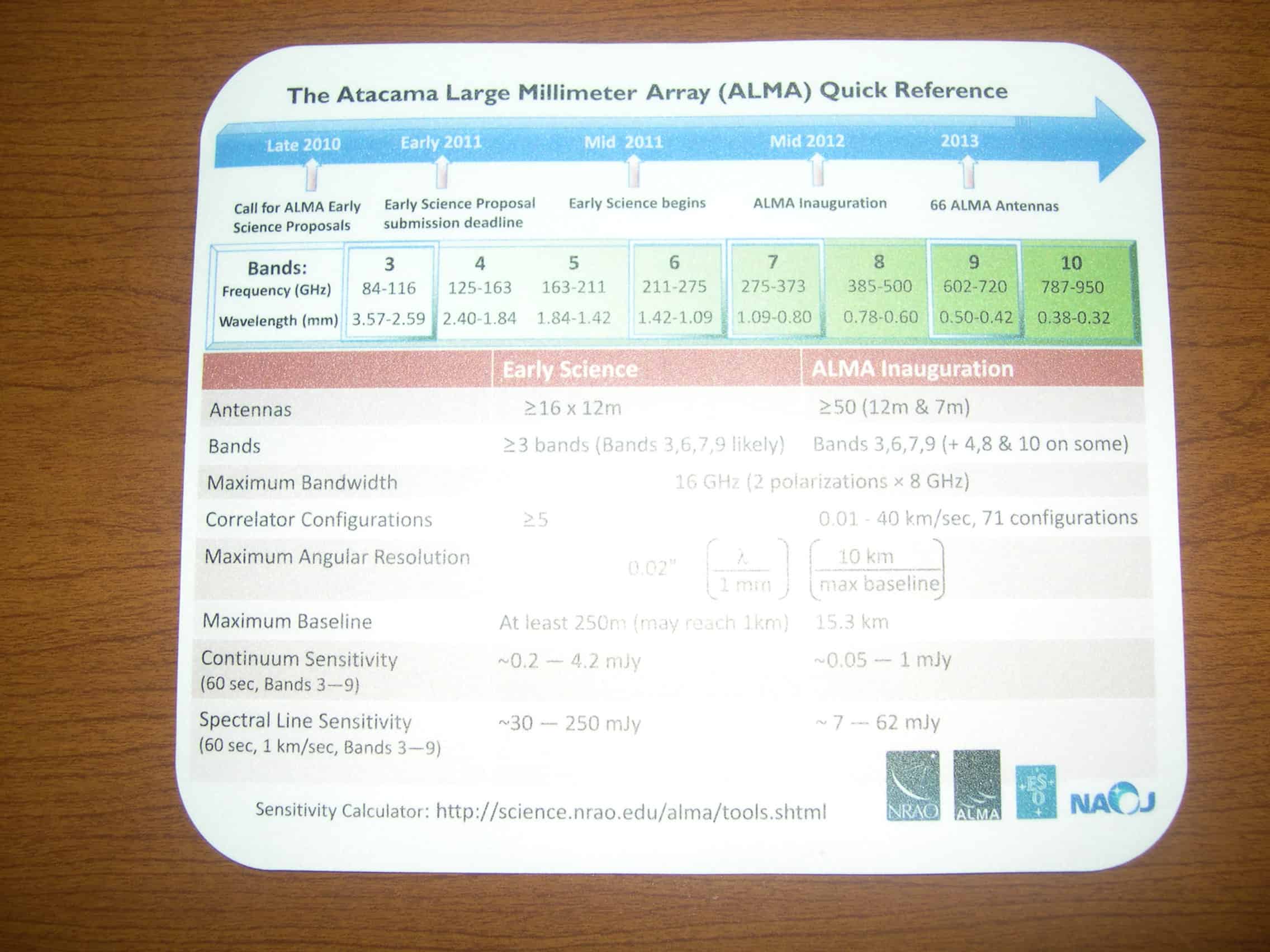
ALMA sharpens its vision

DSCN1910.JPG
Does what it says on the mouse mat

By Michael Banks in Miami, Florida

I was wondering how long it would be before I heard Will Smith’s 1998 hit song “Miami”, but I didn’t expect it while walking into a session at the 216th American Astronomical Society meeting.

This evening I attended a special symposium on the status of the Atacama Large Millimeter/submilliter Array (ALMA, which is currently being constructed in the Atacama desert in Chile.

Built by the European Southern Observatory and the US National Radio Astronomy Observatory (NRAO), when fully complete in 2013, ALMA will contain 66 antennas in total and be 100 times more sensitive than other millimetre telescopes.

ALMA will allow astronomers to study a range of phenomena including planetary and star formation.

There are currently four antennas up and working, with another 12 planned before ALMA begins science operations, which is expected to happen in early 2011.

Al Wootten, from the NRAO, who has been involved with planning ALMA for the last 20 years, says that the sensitivity together with the large bandwidth will make it a unique facility.

Speakers at the symposium were encouraging astronomers to submit ideas for using time on the telescope. “What ALMA will excel at is exploring the unexpected,” says astronomer Kelsey Johnson from the University of Virginia.

Oh, and if you are an engineer or scientist really interested in working at the ALMA telescope then they are currently recruiting and apparently want to hear from you.

Supermassive black holes reveal a surprising clue

Astronomers in Germany and the US have uncovered a startling correlation that could provide important insights into how galaxies form and evolve. The scientists found that the bigger the black hole at an elliptical galaxy’s centre, the more globular star clusters the galaxy has.

Most large galaxies, including our own, have a supermassive black hole at their centre. They also have globular clusters – tight-packed spheres of ancient stars. But the clusters usually lie far from the centre, so discovering a link between the two is akin to finding that the height of a city’s tallest skyscraper matches the number of trees in the surrounding countryside.

“People have tried to make correlations of black hole mass with obvious properties,” says Andreas Burkert at the University of Munich. “And then we thought, `Why not try something which is out of thin air – where nobody would think there should be any correlation?'”

‘Just for the fun of it’

Burkert and Scott Tremaine at the Institute for Advanced Study in Princeton, New Jersey, studied 13 galaxies “just for the fun of it,” he says. Nine were giant elliptical galaxies, including M87, the central galaxy in the Virgo cluster. One galaxy was a tightly wound spiral, and three others were S0 galaxies – which are crosses between elliptical and spiral galaxies.

To the scientists’ surprise, all 13 galaxies obeyed a correlation between black hole mass and globular cluster number that was even tighter than other known correlations with black hole mass.

“I think this correlation is telling us something fundamental,” says John Kormendy of the University of Texas at Austin, who was not involved with the work. “That it’s such a good correlation suggests that the formation of globular clusters and the growth of black holes were connected.” Because globular clusters and giant elliptical galaxies are made of ancient stars, Kormendy says the link between them likely originated in special conditions that existed shortly after the Big Bang.

Colliding galaxies

Burkert and Tremaine suggest that the correlation may arise from galactic collisions. When gas-rich galaxies collide, gas falls into the central black holes, upping their mass. Such collisions also create globular clusters, as astronomers see in the constellation Corvus, where two spiral galaxies named the Antennae are smashing together.

“I find this very exciting,” says Jeremiah Ostriker of Princeton University, another astronomer not involved with the new work. “It may be giving us a clue as to how black holes are formed at the centres of galaxies.”

Ostriker offers a different theory to explain the correlation. As globular clusters revolve around a galaxy, they pass through its dark matter, which robs them of orbital energy via a process called dynamical friction. Ultimately the globular clusters sink into the galaxy’s central black hole, increasing its mass. Thus, says Ostriker, the more globular clusters a galaxy has to begin with, the more get destroyed and the greater should be the mass of its central black hole, just as Burkert and Tremaine have found.

Size doesn’t matter

Burkert and Tremaine say that the correlation is not merely a reflection of a galaxy’s size or luminosity. For example, M87 has a huge black hole weighing 6 billion times more than the Sun, and an equally impressive number of globular clusters – a whopping 15,000 – spread over hundreds of thousands of light-years. In contrast, another giant galaxy, Fornax A, emits as much light as M87, but its central black hole has only 150 million solar masses and its globular clusters number just 1200.

The newfound correlation does not apply to our galaxy, however, because the Milky Way is a loosely wound spiral. As a result, its modest, 4 million solar-mass black hole implies far fewer globular clusters than the approximately 160 it possesses. By contrast, Burkert and Tremaine say the more tightly wound spiral galaxy Andromeda, which was not part of their original sample, does obey the correlation.

This work has been submitted to The Astrophysical Journal and a preprint is available at arXiv: 1004.0137.

Copernicus reburied by Catholic church

By James Dacey

In his time his views may have shocked the Catholic church to its core, but on Saturday Nicolaus Copernicus was blessed and reburied by some of Poland’s highest-ranking clerics, nearly 500 years after he was laid to rest in an unmarked grave.

The ceremony came five years after what were believed to be the remains of the great astronomer were discovered beneath the floor of the cathedral in Frombork, on Poland’s Baltic coast.

Subsequent DNA analysis has confirmed the discovery after an amount of Copernicus’ hair was discovered inside a copy of his 16th century astronomy reference book Calendarium Romanum Magnum.

This short film describes Saturday’s events and how the Catholic church has tried to patch things up with the scientific community in recent years.

NASA's WISE eyes on the universe

wise heart and soul.jpg
The heart and soul of the universe (credit: NASA/JPL-Caltech/UCLA)

By Michael Banks in Miami, Florida

It’s a hard task to walk into a session here at the 216th American Astronomical Society meeting in Miami, Florida, and not see amazing images of the universe.

But probably one of the best was issued today by researchers working on NASA’s Wide-field Infrared Survey Explorer (WISE).

Wise is an infrared telescope that was launched in December to probe the coolest stars in the universe and the structure of galaxies at four wavelengths between 3 and 25 µm.

Costing $320m, WISE circles the Earth’s poles at an altitude of 525 km scanning the entire sky one-and-a-half times in nine months.

Ned Wright, WISE’s principal investigator, said that the satellite has already taken over a million images and surveyed about three-quarters of the sky. By the beginning of November its objectives should be complete as the solid-hydrogen coolant is exhausted.

The image shows the so-called heart and soul nebula, which lies 6000 light-years away from Earth. WISE allows us to probe this star-making factory in unprecedented detail, letting us see the gas and dust that are just about to form stars.

Breakthrough in the matter–antimatter divide

Particle physicists at Fermilab’s Tevatron accelerator in the US have found an exciting new result that could explain one of the big mysteries of cosmology – why there is matter in our universe. The findings come from Fermilab’s D0 experiment, designed to study the precise interactions of protons and antiprotons as they collide at velocities close to the speed of light.

The researchers, led by Guennadi Borissov of Lancaster University in the UK, were looking for a feature known as charge-parity (CP) violation, which helps to explain the fundamental difference between the behaviour of a particle and its antiparticle. It explains why matter survived in the universe after the Big Bang, when matter and antimatter were created in equal amounts and should have annihilated completely.

To catch a glimpse of CP violation, many experimentalists look to the decay of mesons at large B-factory meson experiments such as BELLE in Japan and BABAR in the US. Indeed, the results so far have been consistent with predictions from the Standard Model of particle physics. However, this is not nearly enough to explain the full extent of matter-antimatter asymmetry in the universe and this has sustained a divide between theory and experiment in particle physics.

Spotting the asymmetry

With this latest research, Borissov and his team are finally starting to see a clearer asymmetry by looking to the decay of the neutral mesons, B_s and B_d. Researchers at BELLE and BARBAR have constrained CP violation previously in the decay of B_d mesons but never before in B_s mesons – largely because they have not had access to electron-positron collisions of a sufficient energy to produce these particles. This is now possible at the D0 experiment.

To see whether CP violation is present, the researchers looked to the meson decay products. One complication is that neutral mesons, such as the B_s and B_d, tend to oscillate between their particle and antiparticle making it difficult to tell which meson has decayed. Borrisov’s team can decipher this, however, by looking to the charge of the decay particles.

“Each [meson] could decay into a muon, a neutrino and, say, a charm-flavour meson”, Borissov explains. Asymmetry between the B and anti-B is then measured as an overall preferred charge for the measured muon-pairs, with the final measured asymmetry deviating from the Standard Model prediction by 3.2 standard deviations.

A tricky experiment

Borissov was keen to emphasize, however, that this process was not as straightforward as it sounds, warning that many muons can also result from kaon decays that occur in the experiment. This background is serious because kaons have an artificial preference over anti-kaons for decaying in the D0 detector, so that if they were mistaken for B mesons a fake asymmetry would be seen. The asymmetry in control samples of kaon decays was measured and removed.

Terry Wyatt of University of Manchester, former spokesperson of the D0 experiment, is impressed by the robustness of these results, saying there is only a “one in one thousand” chance of this being a statistical fluctuation. He concedes, however, that more work will need to be carried out to confirm that the deviation is real. “We hope to increase the collected data set by about a factor of 2. In addition, we can hope for improvements in the analysis techniques that could reduce the uncertainty further,” he says.

Perhaps the biggest opportunity to develop these results will come at the LHCb at CERN, another B-physics experiment that can record up to 2000 of these meson decays every second. “For many studies LHCb expects to surpass the sensitivity of the Tevatron experiments rather early in this, the first LHC run, of 2010-11,” says Guy Wilkinson, LHCb’s physics co-ordinator.

Particle physics researcher Tim Gershon of Warwick University believes that B factories like those at Fermilab and CERN are very promising places to look for CP violation. “Results from both CDF and D0 have hinted at new physics effects before, causing great excitement in the community,” he says. “Measurements from the B factories have placed stringent limits on many of the possible deviations from the Standard Model.”

This research is detailed in a preprint on the D0 experiment website.

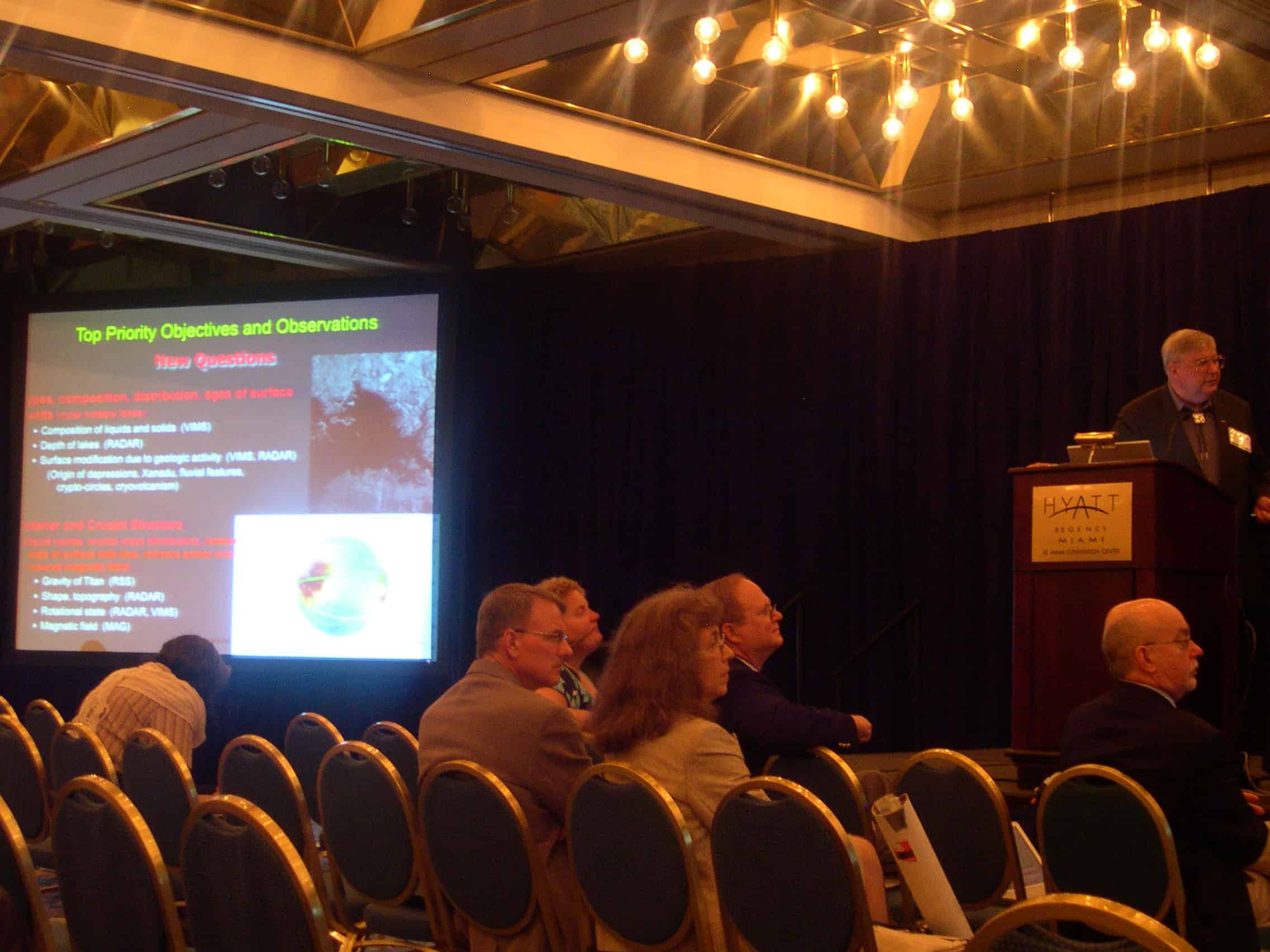
What is next for Titan?

DSCN1888.JPG
Look this way: Dennis Matson telling us all about Titan

By Michael Banks in Miami, Florida

I was up bright and early this morning to attend the opening symposium at the 216th American Astronomical Meeting in Miami, Florida.

The talk was about Titan, the largest moon of Saturn, and was given by Dennis Matson from NASA’s Jet Propulsion Laboratory, a project scientist for the Cassini-Huygens mission that launched in 1997.

Huygens, a European Space Agency mission, was launched together with NASA’s Cassini satellite for a seven-year trip to Saturn. While Cassini travelled off to orbit Saturn, Huygens separated to head to Titan where it landed in 2004.

You might think Titan is a lifeless body orbiting Saturn, but Matson showed it to be anything but. With lakes of Methane on the north pole of the moon – some as large as Lake Superior – as well as evidence for plate tectonics, volcanoes and sand dunes forming on the surface, the moon is very much alive.

That is not all, as Matson flashed images of methane clouds and possible deposits of lava. There is even a claim that an ocean of liquid water exists underneath the rocky surface.

Even with our knowledge of Titan, there is still a lot to find out, including whether the moon has a magnetic field.

After five years on Titan, Huygens has now delivered most of its objectives so astronomers are planning what the next mission could be to Saturn’s sixth moon.

Matson outlined two possible missions astronomers are looking into. One is using a probe attached to a balloon that would circumnavigate the moon at an altitude of 10 km. This would allow scientists to get a global picture of the moon closer to its surface.

The other possible mission is an 85 kg probe that would float on one of Titan’s lakes, which could, for example, probe its depth.

Astronomers probably have other ideas up their sleeves, but in the end they may be constrained by technology. “We even had some people who thought about sending some sort of submarine to Titan to explore the lake,” says Matson.

Copyright © 2026 by IOP Publishing Ltd and individual contributors