

By James Dacey
Early one morning in October 2001 Eric Cornell’s life was about to change forever; he was about to receive a call from Sweden to inform him that he had been awarded that year’s Nobel Prize in Physics.
The University of Colorado physicist shared the prize with Wolfgang Ketterle and Carl Wieman for the achievement of Bose-Einstein condensation in dilute gases of alkali atoms, and for early fundamental studies of the properties of the condensates.
Nine years later, Cornell is giving a talk here in Glasgow as part of Laserfest, an event to mark the 50th anniversary of these really useful devices, which, of course, helped Cornell to cool his atoms into his condensate.
I just caught up with Cornell in his hotel before the event to find out a bit more about his big discovery and how it has changed his life. “The day we saw [the condensate], we really believed it…it was a very clear signature,” he said.
While Cornell admits to having had an inkling that the discovery could bring the Nobel, he was shocked to get the prize after just six years, and he admits that this has affected the way he does physics. “Before the prize I was a young, slightly brash, not particularly cautious physicist…now when I say something, it’s like ‘oh, Cornell says it’s wrong’.”
We also talked about Cornell’s interests outside of physics, one of which is politics – and he will be closely following events tomorrow as Obama fights to keep his support in the mid-term elections. “I like to follow the game and of course tomorrow is the big game,” he says.
But it seems unlikely that Cornell will make the transition from spectator to player any time soon. “My wife is much more involved in politics than me…I could be a sort of Dennis Thatcher or Michelle Obama.”
One physicist who has made the move is 1997 Nobel-prize winner, Steven Chu, the US secretary of energy. Chu is also talking today at Laserfest about quantum optics, so I’d better go take my seat in the auditorium.
• For more on the 50th anniversary of the laser, check out our video with Tom Baer in which the executive director of the Stanford Photonics Research Center outlines the many current and future uses of the laser.
• Meanwhile, don’t miss Sidney Perkowitz’s great article From ray-gun to Blu-ray on the impact of the laser on culture, science and everyday life.
Living with a star
The Sun is at its most beautiful when it is at its most dangerous. That beauty is visible down here on Earth in the form of the northern and southern lights, which appear when charged particles from the Sun strike the Earth’s upper atmosphere. But out in space, the consequences of Sun-caused “space weather” are not so benign: the high-energy particles, X-rays and gamma rays that the Sun emits can damage sensitive electronics, crash computers and have dangerous (possibly even fatal) effects on astronauts.
Most of the time, the Earth’s atmosphere and magnetic field protect us from the more violent events that occur in the solar atmosphere, such as explosions near the Sun’s surface (known as solar flares) or eruptions of huge bubbles of gas from inside the Sun (called coronal mass ejections, or CMEs). Even so, when charged particles from the Sun hit the Earth’s magnetic field, the field gets distorted and compressed. The resulting changes in the densities of charged particles in the Earth’s upper atmosphere can produce significant effects. Radio communications can be disrupted and, sometimes, such changes can induce damaging currents in long power lines, buried cables and oil pipelines. Giant flares have even destroyed power transformers and brought down electrical grids.
Yet like the auroral displays, the solar processes that cause space weather are also stunningly beautiful. The image on the left shows a ring-shaped prominence erupting from the surface of the Sun, sending a pulse of plasma rushing outwards at a speed of about 300 km s–1. Before the eruption, this prominence existed as a long tube of relatively cool, magnetically contained material just above the visible surface. It was then destabilized by mechanisms that are not completely understood. Such mechanisms are important because they can produce CMEs, which can launch up to 10 billion tonnes of hot plasma into the heliosphere – with serious consequences for any object, human or otherwise, that happens to be in the way.
One of the major goals of NASA’s new Solar Dynamics Observatory (SDO) mission is to understand these destabilization mechanisms. To learn more about them, and the phenomena they produce, we need to be able to observe solar events as they happen. This is not easy. Flares and CMEs can occur nearly anywhere at any time, so we need a monitoring system that can observe the entire Sun’s surface continuously. Moreover, solar explosions are fast – speeds of 1000 km s–1 are not uncommon – so images must be obtained at a rate and with exposure times that can capture the evolution of these complex events. Sending the data from so many images back to Earth and distributing then to the scientific community is also difficult. Finally, there are all the usual problems associated with working in space: you only get one shot, so if equipment does not work, then you cannot fix it; all equipment has to be as light as possible because it costs £200,000 per kilogram just to launch an experiment; and the sensitive instruments and computers must be able to withstand the very space weather they are meant to study, without the protection of the Earth’s magnetic field.

All of these factors posed a challenge for those of us who designed the instruments on the SDO. As the first mission in NASA’s “Living with a star” programme, the SDO’s purpose is to help us to gain a better understanding of how solar events, such as the ring prominence shown in figure 1, affect the heliosphere and, in particular, how they cause space weather. In doing so, the SDO is building on earlier missions such as SOHO and STEREO, which were launched in 1995 and 2006, respectively. These two missions are still operating, adding to our knowledge of solar events by collecting additional data on the outer corona and, in the case of STEREO, providing additional views of solar eruptions. Similarly, TRACE, which was launched in 1996 and turned off in September, provided high-resolution images of selected regions of the solar atmosphere.
The results from these earlier missions offered a tantalizing glimpse of how the Sun operates. However, this new mission will tell us much more about the Sun than its predecessors ever could. All previous images of the solar corona suffered from three major limitations. One is that they did not combine high spatial resolution with observations that covered the full disk of the Sun. Second, the instruments could not take lots of images in quick succession (known as “high cadence” operations) because of limitations to the rate that data could be sent back to Earth. And finally, because previous instruments could not take images across a range of different wavelengths, and at a rate comparable to coronal evolution, it was impossible to distinguish whether the observed events were due to heating, cooling or density changes.
A solar-observing trio
The SDO was launched from the Kennedy Spacecraft Center on 11 February and carried into a geosynchronous orbit 36,000 km above the Earth by an Atlas V rocket. The three instruments on board were designed to complement each other. The Heliospheric and Magnetic Imager (HMI), which was developed by researchers at Stanford University and the Lockheed Martin Space Astrophysics Laboratory (LMSAL), will study the behaviour of magnetic fields at the surface of the Sun. To do this, every 30 s the HMI makes maps of material flowing in the solar surface. It also maps the “line-of-sight” magnetic field every 45 s and the vector magnetic field every 15 min. The surface-flow maps let us infer some of what is going on below the surface of the Sun, because patterns in the surface flow can reveal the behaviour of magnetic fields even before they appear on the visible hemisphere. The vector-field maps, meanwhile, show the direction and strength of the magnetic field that emerges through the solar surface. As for the line-of-sight maps, they reveal the magnetic flux in the direction of the Earth. The vector field offers more information, but the line-of-sight measurements are more sensitive.
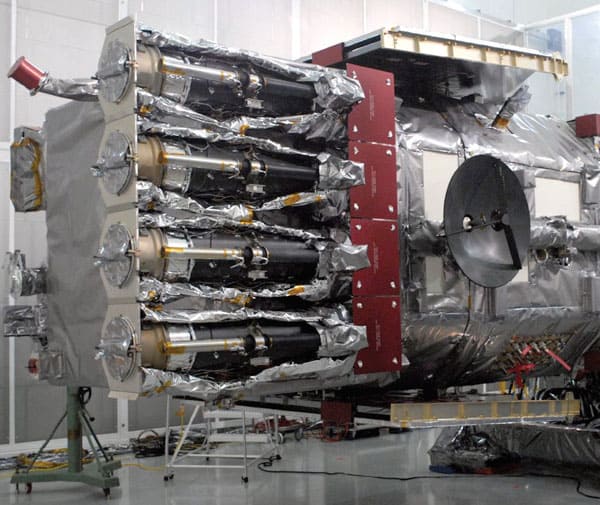
The second instrument on the SDO is the Atmospheric Imaging Assembly (AIA), which was also developed at the LMSAL (figure 2). Its task is to study how the solar corona responds to the magnetic fields that the HMI observes near the Sun’s surface. The AIA’s four telescopes (see box) direct light onto four CCD cameras, which take images of the Sun’s atmosphere at wavelengths that correspond to ionization states of iron and helium, as well as three spectral bands in the ultraviolet region of the spectrum. Data from the iron spectral lines allow us to map the temperatures of the corona in a band from 700,000–20 × 106 K, while the helium data probes temperatures from 30,000–100,000 K.
The final instrument aboard the SDO is the Extreme Ultraviolet Variability Experiment (EVE). Developed by staff at the University of Colorado’s Laboratory for Atmospheric and Space Physics, EVE consists of an array of spectrometers that measures the total solar irradiance over wavelengths between 0.1–105 nm. Because EVE and the AIA are flying together, it is usually possible to associate changes in the Sun’s irradiance with specific solar events, by comparing the timing of changes in EVE’s measurements with the spectral-band data in the AIA’s images.
Dealing with the data
The requirements for high imaging rate, high spatial resolution and broad spectral coverage drove the design of all three instruments, as well as the properties and orbit of the spacecraft that carries them. The observatory’s geosynchronous orbit, for example, offers two significant advantages for studying the Sun. First, such orbits are high enough above the Earth that the planet only blocks out the Sun for one hour a day at the most – and even then only for two, two-week periods each year, in September and March. Second, geosynchronicity means the SDO spacecraft is always over the same latitude, so it can broadcast data and receive commands continuously from a single ground station near White Sands in New Mexico.
Being in continuous contact with the ground station is vital for the SDO, thanks to the sheer volume of data it produces. There are a total of six CCD cameras on the SDO – two on the HMI and four on the AIA – and almost every second a 4096 × 4096 pixel (16 megapixel) image from one of them must be read out and transmitted back to Earth. The actual pixels are big by the standards of commercial camera CCDs (13 × 13 µm).
Because the number of photons that can be detected in a single exposure scales with the pixel size, the CCDs on the AIA have a big dynamic range – from 1 to 10,000. (The cameras were designed and manufactured by scientists and engineers at the Rutherford Appleton Laboratory near Didcot, while the special CCD detectors were made by e2v, also in the UK.) This is wonderful for covering the broad range of intensities in a solar flare, but it also means that each image contains a quarter of a terabit of data. Indeed, the total amount of data sent from the AIA and the HMI to the New Mexico ground station is about 1.8 terabytes per day, or 67 megabits per second. To get an idea of the scale of data involved, consider that each image would fill 6.25 DVD discs, so it would take about 540,000 DVDs to hold all the images obtained in a single day.
This high data rate had a significant impact on the design of the Joint Science Operations Center for the HMI and the AIA (EVE, with a much smaller data rate, has its own data centre), the data-distribution system and the system the rest of the scientific community uses to access the data. This last feature is particularly important, given that if you ask a scientist what data they want to see, their first response is usually “All of them!” Unfortunately, the awful truth is that once the images are uncompressed, the AIA alone generates about 3.5 terabytes of data per day – equivalent to downloading about 700,000 high-sound-quality MP3 files.
To make life easier for solar scientists, a number of utilities have been developed that allow them to mine the SDO archive for data that contribute to specific science objectives. For example, some questions that scientists are investigating include whether flares are associated with CMEs, what types of flares are associated with specific features in the EVE spectra, and what the statistical relations are between filament ejections and magnetic-field configurations. We have also produced a data viewer, which allows scientists to view the archive using compressed data. This greatly reduces the number of data that must be collected before precise science evaluations can begin. Other data-processing tools include a “Sun Today” webpage (sdowww.lmsal.com) that shows samples of the AIA images and HMI magnetograms, updated every five minutes, as well as daily movies of solar events.
What we are learning
In late March, we opened the doors of the AIA’s telescopes for the first time. The first images were beautiful. All the delicate front filters on the telescopes had survived the launch and all the instrument functions were working perfectly. A few days after we started taking data, the Sun rewarded us with a huge eruptive prominence on its east side – a wonderful start to our planned five-year mission.
Since then, we have been observing the Sun almost continuously, with only minor breaks for calibrations. During this period, the Sun has presented us with a number of CMEs, filament eruptions, small flares and even a few moderately large ones. As a result, we are now beginning to appreciate just how much of the Sun is impacted by a magnetic rearrangement in a very local region. For example, areas without spots can create disturbances that impact 30–60% of the visible surface.
Taking images at a high cadence has also been richly rewarding. At the beginning of a filament activation or CME, some features occur at speeds of 100–600 km s–1. At the onset of a flare, there are occasional “puffs” of plasma that move at speeds of 1000–2000 km s–1. When such events are captured, part of their diffuse appearance is caused by motion blur; a typical 3 s exposure taken by the AIA, for example, blurs the image of a 2000 km s–1 structure by 4–8 pixels. A 30 s exposure typical of earlier spacecraft would cause five or more times more blurring and make the event appear 25 times fainter – so faint, in fact, that the event might not have been detected at all. We also see wave patterns that move along magnetic field lines at 1000–2000 km s–1 as the flare event evolves. These fast waves had never been seen before and we do not yet know the mechanism that produces them or their role in the flare process.

Although some of these data are better interpreted numerically, the multiple temperature images taken by the AIA can also be combined to make several types of false-colour temperature maps, like those shown in figure 3. Movies of such colour maps allow solar scientists to study how temperature patterns evolve when the Sun is quiet, as well as when it is active. These movies provide a visual picture of the relations between events on the Sun that are quite distant from one another. For decades there have been arguments about whether flare or filament eruption can cause another distant event. Now, after only a few months of observations, the AIA movies have clearly established causality on distances of a solar diameter and more. Even though we are currently experiencing the deepest minimum in solar activity for more than a century, the Sun still has plenty to tell us.
The AIA telescopes: a fourfold challenge
NASA’s Solar Dynamics Observatory carries three instruments, one of which is the Atmospheric Imaging Assembly (AIA). Designing its four telescopes presented us with four main challenges, the first of which is caused by sunlight itself. The amount of light that reaches a typical extreme ultraviolet (EUV) channel is a billion times weaker than the sunlight that falls on the front of the telescope. To reject the visible light, the front of each EUV channel is covered with a metal filter that is only 150 nm thick, or about 0.2% the diameter of a human hair – thick enough to block visible light, but thin enough to pass the desired EUV light.
Manufacturing such filters is challenging, but designing mounts for them is even harder. These mounts must be sturdy enough to survive the vibrations and pressure changes they are subjected to at launch, but they cannot block a significant fraction of the EUV light. The image shows one of many filters that failed while we were testing various designs to determine which one would survive the launch environment.

The second challenge is making sure that the EUV light will be reflected from the telescopes’ mirrors. EUV light does not reflect from the single layer of silver or aluminium that suffices for the mirrors of visible-light telescopes, so instead we had to coat the mirrors with a series of thin alternate layers of silicon and molybdenum. These coatings are not removable, so a failure in the coating ruins a mirror. The mirrors also have to be the right shape, and because the wavelength of EUV light is so short, they must also be extremely smooth, with root-mean-square variations of about 0.3 nm.
The third challenge is that EUV light is easily absorbed by contaminates such as the silicon and hydrocarbon compounds used to hold the AIA telescope together. A coating of contaminates just 50 nm deep would be enough to lower the telescope’s transmission by 50%, and the AIA telescopes have 11 different surfaces where such contaminates can settle, including multiple filters, the telescopes’ primary and secondary mirrors, and the surface of the CCD camera itself. This means that less than 5 nm of contaminates could be allowed to collect on any given surface, either during the fabrication process or from the outgassing of components after the AIA goes into orbit.
Finally, there is the question of stability. Each pixel on the AIA’s CCD cameras samples light from a cone about 0.6 arcseconds wide, which corresponds to about 730 km at the centre of the solar disk. To produce sharp images, the motion induced by the spacecraft must be limited to about 0.02 arcseconds, or about 14 km on the solar surface. This requires a system of active stabilization, where signals generated by the telescopes themselves are used to control the angles of secondary mirrors that are mounted on piezoelectric actuators. The result is so stable that it is like being able to keep a laser pointed at a 1 mm-diameter target circle from a distance of 10 km. For golf fans, this is equivalent to a player making a hole in one on the Old Course in St Andrews while standing in Piccadilly Circus.
Bronx physics
Every morning about 3000 students at the Bronx High School of Science in New York pass beneath a huge mosaic that hangs over the school’s entrance. It shows a Moses-like figure – representing “the humanities” – rising over a rainbow, beneath which are tile depictions of Pythagoras’s theorem, surveying gear, a Benjamin Franklin-like key and kite, and more old stuff. The students rushing to class hardly notice. They are into calculus, photodetectors and robots.
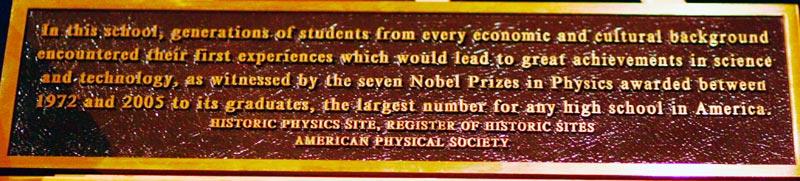
On 15 October this year, Bronx Science, as it is colloquially known, was officially designated a “historic physics site” in a ceremony organized by the American Physical Society (APS). The high school joins an imposing list of 18 other landmarks with that status. They include Bell Labs in New Jersey, where the transistor was discovered, the Massachusetts Institute of Technology’s Radiation Laboratory, which helped to develop radar, the University of Chicago site where Robert Millikan measured the charge on the electron, and the spot outside Cleveland, Ohio, where Albert Michelson and Edward Morley did their epochal ether-drift experiment.
Located in the northwest corner of New York City, Bronx Science owes its historic status to the fact that seven future Nobel-prize-winning physicists went through its doors – more than any other high school in the world and more than most countries have ever achieved. The school, which opened in 1938, was founded by the educator Morris Meister, who believed that if a school put bright students together, it would kindle ill-defined but valuable learning processes. The school seems to have proved him right: according to the Bronx laureates, their physics learning took place mainly outside the classroom.

Roy Glauber, who shared the 2005 Nobel prize for his work on quantum optics, entered in 1938 in the school’s initial class. The first physics course was not taught until 1939, and its textbook did not even mention atoms. That subject was addressed in the chemistry textbook, which did not even say that atoms contained neutrons, despite their discovery in 1932.
A Bronx mathematics teacher changed Glauber’s life by giving him a book on calculus for summer reading, and the sophomore was thrilled to find he understood it. Glauber went to Harvard in 1942, skipped the intermediate physics courses, discovered that advanced courses were cancelled because the teachers were doing war work, and was catapulted into graduate physics. His outstanding performance caught the attention of well-connected scientists, and in 1943 – age 18 – he was spirited to the top-secret Los Alamos laboratory to help build the atomic bomb.
Leon Cooper, who shared the 1972 prize for work on superconductivity, recalls physics lessons as boring, and was far more enchanted by his biology classes, which lured him to stay late after school designing and running experiments “until they threw me out”. Indeed, the school’s basic-physics textbook was written by a certain Charles E Dull, whose work, though widely used in US high schools, lived up to his name. The future particle physicist Melvin Schwartz, who shared the 1988 Nobel gong, once told me his classmates’ excited discussions – not his teacher – were what first awakened his interest in physics.

The class of 1950 – the year below Schwartz – included Sheldon Glashow and Steven Weinberg, who shared the 1979 Nobel prize with Abdus Salam. Glashow recently told me that he cannot remember learning anything much from his introductory-physics class. At the time, the school offered only two advanced-physics courses. One was in “radio technology”, in which students built crystal radio sets, while in the “automotive physics” they took apart and reassembled an old aeroplane engine.
Neither Glashow nor Weinberg bothered with either. Far more exciting was the science-fiction club – whose members clustered around lab tables to talk about physics – and afterschool trips to the used bookstores that then populated lower Manhattan.
Particle theorist David Politzer, who shared the 2004 Nobel prize and who spoke at last month’s APS ceremony, described the school’s spirit by citing a transport strike that took place in 1966 – the year he left Bronx. The strike paralysed the city for almost two weeks and in most schools attendance plummeted; in some, nobody turned up. “[But] at Bronx Science, attendance was normal,” Politzer recalls. “We walked, bicycled and hitchhiked to school. We wouldn’t miss it!” Politzer’s classmate Russell Hulse, who shared the 1993 Nobel prize for discovering the first binary pulsar, recalled that his favourite afterschool activity was building various antennas, including a radio telescope. As Hulse told me, “It was very special to me to finally be in a place that focused on what I found most interesting and compelling in life, namely science.”

Much has changed in recent years. The advanced-physics labs were renovated last year, and “we try to instil an inquiry mindset”, says Jean Donahue, the assistant principal for science. In one physics classroom, I saw the teacher illustrate a talk on vectors by having a student navigate a blindfolded companion around the room by shouting directions and magnitudes; in another, the teacher taught the same principle by asking students how far fish swim in currents of various strengths heading in different directions.
The school’s most fearsome physics module – Advanced Placement Physics C – is tougher than most college-physics courses. Its dynamic instructor is Ghada Nehmeh, who was born in Lebanon and studied nuclear physics. Diminutive – smaller than most of her students – and scarf-clad, she jumps rapidly from lab table to lab table, helping piece together equipment and analyse results. Famous for being ruthlessly demanding, she tests the students on their first day by assigning them 40 calculus problems, due back the next day. “I’d never seen derivatives before,” says Kezi Cheng, a senior interested in theoretical physics. So Cheng did what most Bronx Science students do – she asked her classmates to give her a crash course on the subject. “They’re always willing to help.”
After last month’s ceremony, Bronx students now have a new plaque to walk past. My guess, though, is that they will be too busy scurrying to the next class to notice.
Weighty matters
In a dusty display cabinet in the museum of the University of Cambridge’s Cavendish Laboratory there sits a curiously shaped glass container with a few electrodes inside, like a ship in bottle. It is a replica of the first particle accelerator, used by J J Thomson to liberate electrons from atoms in 1897. Thomson’s breakthrough was the first step on the long quest to crack open the atom and reveal its inner workings. More than a century later, that same quest has produced the multibillion-pound experiments at the CERN lab in Geneva, which are poised to explore new territory in their search for the long-awaited Higgs boson, and to test whether our current understanding is only a shadow of a much richer reality.
The story of what came in between has all the makings of a Hollywood movie, and Massive: The Hunt for the God Particle could be the screenplay. The grand narrative in Ian Sample’s book sweeps from the earliest speculations on the nature of matter; through the Second World War and the dawn of nuclear weapons; the paranoia of the Cold War (during which science was seen as a source of national security); rival efforts by the US and Europe to lead the world in times of peace; and the eventual emergence of worldwide scientific co-operation. Swept along on that tide are the individual scientists who struggle to make sense of their equations and measurements while marrying, having children and fighting off both the manoeuvrings of their political funders and low blows from their rivals. This story is far from the stately intellectual progress by heroic lone geniuses that gets portrayed in some histories of science.
Massive carries the reader though the epic using individual episodes from the lives of some of the participants. These passages often read like a fast-paced novel, as, for example, when an aeroplane carrying evidence of the latest breakthrough “touched down with a brief screech of rubber” at a wintry Heathrow airport. This makes for an appealing read that is quite unlike a textbook narrative. The uncertainty faced by the scientists as they explore new theories and the agonizing decision to shut down the LEP collider at CERN just when the Higgs boson appeared to be in reach are brought to life by these human touches.
The central character is Peter Higgs, whose life story runs through the book. His early work, the famous publication suggesting the particle that now bears his name, and his subsequent career are all dealt with sympathetically, and reveal much about the scientific process. The real difficulties in knowing which directions to pursue, the dead ends, fears and frustrations are all covered. Like Higgs himself, Sample is careful to give due credit to all those involved in the development of electroweak theory. The gradual development of the theory, and particularly the way that multiple insights contributed to the solution, are both well covered. Sample also makes it clear that finding the boson will not signal the end of the story: in an excellent and topical chapter, he ad_dresses the implications of the Higgs mechanism for other new physics, tackling supersymmetry, extra space dimensions and hidden worlds with great clarity. This is a useful counter to the popular perception that particle physics is simply about the search for the Higgs.
The book avoids tackling the science head-on with long discussions of theory (or even any equations beyond E = mc2), and relies instead on straightforward descriptions of the key points backed up by lots of illustrative analogies. This works rather well, since the analogies are usually well chosen and there is no sense that the science has been over-simplified. Sample’s experience as a science correspondent for the Guardian newspaper pays off here.
A parallel narrative follows the development of the accelerators themselves, from table-top devices funded by small laboratories to vast international facilities. The rivalry between the US and Europe makes a fascinating sub-plot, and shows how much the science has been at the mercy of political events on both sides of the Atlantic. UK Prime Minister Margaret Thatcher, for example, was much criticized in the scientific community, but she nevertheless prevented the death of British particle physics, and thereby ensured the future of CERN. Meanwhile, her transatlantic counterpart President Ronald Reagan approved the Superconducting Super Collider (SSC) so that the US would have “the most powerful…gun in the world” – only for it to founder in the pork-barrel politics of Washington.
Many of the factors behind the SSC’s demise are well known, but, strangely enough, it seems that both the first President Bush’s illness at a state banquet in Japan (which cast a pall over US efforts to get the Japanese to join the SSC collaboration) and the Arab–Israeli peace talks that took place during Bill Clinton’s presidency (which forced a campaign to save the collider off the news agenda) also contributed to its downfall. However, the final blow came from the Congressional allocation process, which ensured that support melted away once a decision had been taken on which state would host the facility, and hence receive the bulk of the funding. The benefit to Europe of having a recognized shared facility at CERN becomes very clear.
Sample’s account of the public reaction to events in particle physics is also fascinating. Initially, such an esoteric subject was portrayed as being of no conceivable use, and celebrated as a purely intellectual pursuit. The atomic bomb put paid to that view, and physicists became the focus of nationalistic and military aspirations. Now that the projects are too expensive for any single nation to fund, particle physics is seen as a shining example of international co-operation. The book is particularly strong on the supposed threat to the existence of the planet, or even the entire universe, posed by colliders, and the ensuing media debate.
The scene is now set for the final denouement, where the Higgs is either captured or revealed to be a chimera. The new heavyweight Large Hadron Collider at CERN is the favourite to win this final round, but the old champ, Fermilab’s Tevatron, is making is one last bid for the title. So the screenplay ends on a cliffhanger, leaving the audience ready for the sequel.
Since CERN has become the last word in geek-chic, every practising particle physicist has at some time been cornered by a friend or relative with a demand to “explain what is going on”. Now, at last, there is a simple answer: buy them this book, and get a copy for yourself.
Beware delay
What should we do about the dangers posed by global warming? Judging by the collective actions of society, so far the answer has been “nothing”. Frustrated by this lack of progress and deeply worried about the future, several prominent climate scientists have written books in the past year describing their views of the problem, in which they try to tell their personal stories, educate the public and stimulate action by governments. Stephen Schneider, who died suddenly (and far too early) in July, told his part of the story in Science as a Contact Sport (see our review from September). James Hansen warned of the dangers of global warming in Storms of My Grandchildren. And in Merchants of Doubt, Naomi Oreskes and Erik M Conway described how fossil-fuel companies are using the same tactics and “scientists” that cigarette and chemical manufacturers once used to obscure and deny the dangers posed by tobacco, acid rain and ozone depletion in an attempt to confuse the public about the science of global warming and delay regulation of greenhouse-gas emissions.
In this crowded field, Coming Climate Crisis? Consider the Past, Beware the Big Fix stands out. Written by Claire L Parkinson, a distinguished NASA sea-ice researcher and a member of the US National Academy of Engineering, it differs from the others in its attitude towards those who deny the reality of global warming, or humanity’s role in causing it. Although Parkinson does not share the sceptics’ views on climate change, one of the messages in her book is that global-warming deniers are legitimate scientists who need to be taken seriously.
At this point, I should probably mention that Parkinson is a friend of mine. In fact, the copy of the book I used in preparing this review is a personal, signed gift from her. But friends are allowed to disagree sometimes, and in this case I definitely do. To be blunt, Parkinson’s interpretation of the action of global-warming deniers strikes me as subjective and wrong, and it conflicts with the scholarship of Oreskes and Conway, who document the organized campaign to confuse the public about climate science so as to delay action. I agree with Lonnie Thompson, the Ohio State University palaeoclimatologist who has written the book’s unusually critical foreword: “the major issue I [Thompson] have with the book is that [Parkinson] ascribes nearly equivalent validity of the contributions of those in the climate-change community who rely on the peer-review system to disseminate ideas and the smaller group of ‘climate sceptics’ or contrarians. Many in the latter group are not climate scientists, and their ideas and work are often disseminated in white papers, editorials, privately funded foun_dation documents, blogs and other attention-getting media outlets.”
That said, most of the book is not controversial, and it makes some excellent points. For example, its first four chapters describe the climate system in a way that is easily accessible for non-specialists, going through the history of climate change on Earth for the past 4.6 billion years and describing how the carbon dioxide, methane and other greenhouse gases we are now spewing into the atmosphere at an unprecedented rate will produce rapid global warming in the future. Parkinson also gives many examples of how humans have inflicted significant environmental damage on local and regional scales.
Towards the end of the book, the sections on geoengineering – the “big fix” referred to in the title – are likewise spot-on. The term “geoengineering” refers to a number of proposed techniques for managing solar radiation, such as deliberately introducing light-scattering aerosols into the stratosphere. Parkinson rightly points out that there are many potential risks associated with such schemes, and gives multiple examples of smaller-scale efforts of environmental modification that have gone wrong. She is far from alone in these views. I have personally published 20 reasons why geoengineering may be a bad idea, and the Royal Society, the American Meteorological Society and the American Geophysical Union have all advised that much more research is needed on the benefits, risks and costs involved before society can make an informed decision about whether to even consider it in the event of a planetary emergency. Whatever its merits, geoengineering is certainly no substitute for reducing greenhouse-gas emissions.
However, in the middle part of the book, Parkinson devotes a lot of effort to raising doubt about the consensus of scientists on global warming by criticizing the validity of “scientific consensus” in general. To support the latter argument, she gives a number of examples from the past – from the heliocentric model of the universe to the supposedly unsinkable Titanic – in which a prevailing viewpoint was later overturned. However, I think there are probably many more examples of a consensus – like the fact that volcanic aerosols cool the planet – being correct and only modified in rather minor ways as knowledge has progressed. The global-warming community consists of thousands of people who have been working for decades on this problem, and the consensus only gets stronger. There is no scientific analysis of that process in this book.
Parkinson also goes along with Richard Lindzen, a prominent denier (and atmospheric scientist), whom she quotes as complaining about “alarmists”. She then uses the term herself. However, this is confusing advocacy with science. Scientists whose results support global warming are not being alarmists – they are merely presenting the results of their scientific investigations. Advocates of particular actions who use science in a dishonest way are the real alarmists, and there are those on both sides of the issue. Those who honestly present their results are doing their duty to society by warning others about the dangers that they find. It would be irresponsible to do otherwise. If people find those results alarming, Occam’s razor tells me that this is because the science itself is alarming, not because of some vast conspiracy of scientists to exaggerate their results. In fact, an individual scientist would be much more strongly motivated to find a fundamental flaw in the theory of global warming. That is what would make them famous and bring in grants and money – not yet another paper that supports the consensus.
In the book, Parkinson writes that she is afraid she will anger a number of her professional colleagues in publicizing her views. In my case her fears were partially justified: I was indeed a little angry and frustrated after I read her book, although I felt better after I had communicated my thoughts (many of which are reproduced here) to her. But the fact is that when “sceptical” scientists misrepresent the science on purpose, they are doing a disservice to our profession and to the planet, and they should be condemned – not have their specious arguments accepted uncritically, as in this book.
Between the lines

A guide to music physics
Authors of books on “the physics of x” have some tough choices to make. If their physics explanations are too technical, they risk alienating experts on x. Assume too much foreknowledge of x, though, and physicist readers will stay away in droves. The safest approach is probably that taken by John Powell, a classically trained composer and Nottingham University laser physicist whose book How Music Works is aimed squarely at people who are neither musicians nor physicists. Aside from an appendix entitled “Fiddly details”, there are no equations. Instead, the physical aspects of vibrations and harmonics are explained using simple diagrams and thought experiments. Powell also claims that readers need no musical talent beyond an ability to hum the first four notes of “Baa Baa Black Sheep”. However, he wisely suggests reading the book in close proximity to a music library (YouTube will do in a pinch), as he frequently mentions specific songs as examples of one principle or another. Writing with plenty of self-deprecatory humour, Powell is refreshingly unfussy about such music-geek minutiae as the purported difference in sound quality produced by vinyl records and CDs. Better still, his taste in music is remarkably catholic: there cannot be many books that reference Beethoven’s Fifth Symphony and Wheatus’ indie-pop song “Teenage Dirtbag” in consecutive paragraphs. About the only thing Powell does not like about music, it seems, is the decibel system, which he blames on “a committee of drunken electrical engineers who wanted to take revenge on the world for their total lack of dancing partners”. Touché.
- 2010 Particular Books £12.99 pb 272pp
New horizons for Pluto research
We don’t know much about Pluto. However, we know more than we used to, and we will learn still more when NASA’s New Horizons spacecraft flies past it and its medium-sized moon Charon in 2015. Such is the message of Pluto: Sentinel of the Outer Solar System, in which Open University astronomer Barrie Jones describes how everybody’s favourite not-quite-planet fits into our picture of the solar system. Despite the relative paucity of information available about Pluto, there is still quite a bit to discuss. Studies of light reflected off Pluto’s surface, for example, have told us that this distant body is reddish in colour, while the discovery of Charon in 1978 helped refine our estimates of its mass. Quite often, the “how” of such findings is more interesting than the finding itself. Clyde Tombaugh’s use of a “blink comparator” to discover Pluto in the 1930s was amazing enough, but even in an era of giant space telescopes, it seems that imaging an icy rock from a vantage point almost 40 astronomical units away is actually rather difficult. Unfortunately, despite being written for an audience with a very basic level of physics knowledge (there are separate boxes intended “for those comfortable with algebra”), Pluto is not always an easy read. It is repetitive in places – the term “albedo”, meaning reflection, is defined at least three times – and an uneven chronological structure makes it hard to keep track of who discovered what and when. Still, for those with the patience to follow it, Jones’ slim primer offers a useful distillation of eight decades of research into Pluto, and an intriguing preview of more findings to come.
- 2010 Cambridge University Press £25.00/$35.99 hb 244pp
A noble story
William Ramsey, who won the 1904 Nobel Prize for Chemistry for his work on the noble gases, is almost certainly the only laureate to thank his own thumb in his acceptance speech. Yet his unusual tribute was at least partially justified. As author David Fisher notes in Much Ado About (Practically) Nothing: The History of the Noble Gases, Ramsey’s large, flat thumb made an excellent impromptu vacuum-tube seal, and this “equipment” proved invaluable in his efforts to isolate the noble gases. Anecdotes such as this are ten a penny in Fisher’s irreverent book, which also features a balloon-borne dust collector known as the “vacuum monster” and a practical joke that involved swapping a priceless meteorite for some rusty iron filings. Yet to call the book a history is a misnomer. Although it contains some information about applications of noble gases – describing how argon is used in neutrino detectors, and how radioactive xenon helps diagnose pulmonary embolisms – it is really more like a memoir, since it draws half of its material from the author’s own career. The combination does not always work, especially when Fisher gives in to the memoirist’s penchant for settling scores and rehashing old gossip. Yet conflicting personalities and dead ends are also part of science, and to be fair to the author, he would be the first to admit as much. At one point, Fisher even describes a particular chapter as “a tale of things gone wrong and ideas that didn’t pan out”, and advises readers to skip it if they just want to learn about the universe. As a history, this book is uneven, but as an account of one scientist’s stormy love affair with noble-gas research, it is worth a second look.
- 2010 Oxford University Press £15.99/$24.95 hb 288pp
Neutron star is most massive yet
Using a technique that exploits general relativity, astronomers in the US and the Netherlands have identified a neutron star that has a mass nearly twice that of the Sun. The object is the most massive neutron star ever determined with reliable precision, and its existence, say the researchers, rules out much of the exotic matter hypothesized to occur inside these ultra-dense burnt out stars.
Neutron stars form when stars exhaust all of their nuclear fuel and implode under their own weight. The immense gravity forces protons and electrons together, leaving a ball made up largely of neutrons that has a density up to ten times that of atomic nuclei. Theorists have proposed that the huge pressure inside such an object could lead to a number of different forms of exotic matter. One of these is a material known as a Bose–Einstein condensate, in which particles act together as a single quantum entity. Alternatively, the neutrons might split to form a “soup” of free quarks and create what is known as a “quark star”.
The bigger the better
One way to discriminate between these different hypotheses is to look for the existence of very massive neutron stars. Exotic particles (if they existed) would repel each other less than neutrons do, and so would provide less resistance against gravitational collapse. This means that the mass value at which an exotic neutron star implodes to form a black hole would be lower than that of a conventional neutron star. In other words, an object of this composition could not exist above a certain mass.
Astronomers have previously identified neutron stars that might weigh as much as 2 solar masses, which is significantly greater than the 1.4–1.5 solar masses considered typical of neutron stars. However, such mass measurements have been imprecise. The new work, carried out by Paul Demorest of the National Radio Astronomy Observatory (NRAO) in Virginia and colleagues, takes advantage of an effect of general relativity known as the Shapiro delay, which is the delay experienced by a radio signal as it passes through the gravitational potential of a massive object.
The idea is to measure very precisely the arrival time of radio waves from a spinning neutron star known as a pulsar, which is in orbit around a centre of gravity shared by a companion star. The pulsar emits bursts of radio waves separated by a very well defined interval – generally a few thousandths of a second – and this interval will be delayed very slightly as the companion star passes between it and the Earth, owing to the companion star’s gravitational field. The exact shape of the curve that describes how this delay varies throughout the cycle of the binary system reveals the inclination of the orbital plane compared to the Earth’s line of sight, while the magnitude of the delay tells us the mass of the companion star. Combining these data with measurements of the orbital period and the pulsar line-of-sight speed yields a value for the pulsar mass.
A clean way to measure
Demorest and co-workers point out that this approach is a very “clean” way of measuring the pulsar mass because, unlike alternative methods, it relies on a single type of data. But the Shapiro delay is a very weak effect. The researchers were able to optimize their measurements by using a binary system, known as J1614-2230, in which the orbital plane is almost exactly edge-on as seen from the Earth and in which the companion star is comparatively massive – both characteristics that increase the magnitude of the delay. They observed the system over the course of one complete nine-day orbit in March this year using an instrument known as GUPPI on the NRAO’s Green Bank radio telescope. From these observations they calculated the pulsar to have a mass of 1.97 solar masses, with error bars of ±0.04 solar masses (Nature 467 1081).
This figure is significantly higher than the previous record for precisely measured neutron star mass – 1.67±0.01 solar masses. And it is, say the researchers, high enough to rule out a wide range of models positing the existence of exotic matter inside neutron stars. Feryal Ozel of the University of Arizona, lead author of a companion paper to be published in Astrophysical Journal Letters, says that among the exotic particles to get the chop are hyperons, kaon condensates and free quarks. She says that if quarks are to exist in the core of neutron stars then they must strongly interact with one another, as they do inside normal matter, in order to withstand the star’s huge gravitational field.
Frits Paerels of Columbia University in New York, who was not involved with the work, agrees. “This measurement really does not appear to leave a lot of wiggle room for models of neutron stars that involve exotic condensates,” he says. “It also starts to close in on the models based on quark matter. Indeed, it comes very close to ruling out quark stars.”
Molecular magnets stand in line
Researchers in Europe have succeeded in creating molecular magnets capable of adopting a preferred orientation on a gold surface. The result is an important advance for the burgeoning field of spintronics – in which electronic devices exploit the spin of an electron as well as its charge. Such devices are of great interest because they could be smaller and more energy efficient than conventional electronic circuits.
Single-molecule magnets are paramagnetic materials that can switch their magnetization between two states, from “spin up” to “spin down”, for example. At low temperatures, the magnetic state of the molecule persists even in the absence of a magnetic field. This memory effect could be exploited to make high-density information storage devices for computing applications.
Last year Roberta Sessoli of the University of Florence and colleagues in Modena and Paris showed that clusters of four iron atoms (Fe4) incorporated into the structure of a complex molecule could retain their magnetic memory when chemically attached to a gold surface. Now, the same team has gone a step further in its work by chemically tailoring these Fe4 molecules to orient themselves in a preferred way on the gold. The magnetism of the molecules was studied using synchrotron light.
Resonant quantum tunnelling
The new result allowed the researchers to observe resonant quantum tunnelling of the magnetization in single-molecule magnets on a surface for the first time. Quantum tunnelling, a process whereby quantum particles can penetrate energy barriers normally insurmountable to classical objects, is a rather fragile phenomenon. It can easily be destroyed by external effects – for example, through the connections needed to connect the magnets electronically within practical devices.
“The fact that we observed quantum tunnelling in molecular magnets tethered to a gold surface demonstrates that molecule–surface interactions are not detrimental to such a delicate aspect of magnetism,” says Sessoli.
The researchers joined the four coplanar iron ions by adding two new connecting molecules, or “ligands”, derived from a trialcohol that has just the right geometry to bind the ions at opposite ends of the iron plane. Such an arrangement means that the iron molecule is highly stable.
“The trialcohol has an aliphatic chain terminated with a sulphur-containing group, which represents a key ingredient in our approach,” explained Sessoli. “In fact, we exploited the pronounced affinity of sulphur atoms towards gold to chemically anchor the molecular magnets on the gold surface.”
Better memory effect
The team then found that the way the molecular magnets orient themselves onto the gold surface could be controlled by changing the length and flexibility of the alkyl chain. For instance, when the chain length is reduced from nine to five carbon atoms, molecules are forced to bind to the surface via a single “alligator clip” and thus adopt a preferential alignment as opposed to a random one. When the molecules are aligned, they show wider magnetic hysteresis loops and a better memory effect, with clear quantum tunnelling signatures.
“Our work proves that a multidisciplinary approach, combining synthetic chemistry, experimental physics and theoretical modelling, is needed to advance nanoscience,” added Sessoli. “Although applications for this technology won’t be seen in the near future because of the low working temperatures of single-molecule magnets, this kind of fundamental investigation paves the way for future spin-based technologies.”
The work is described in a paper in this week’s Nature.
‘Best evidence yet’ for dark matter comes from Milky Way centre
Energetic radiation pulsing from the belly of the Milky Way is the clearest signal yet of dark matter. That is according to a pair of astrophysicists in the US who reach this conclusion after scrutinising the public data collected by NASA’s orbiting Fermi Observatory. “I certainly think it’s the best evidence we’ve seen so far,” says Dan Hooper, one half of the team, based at the University of Chicago.
It is a huge claim because for over 70 years astrophysicists have debated the existence of dark matter, which is thought to make up 80% of the universe’s mass, yet they have failed to gather any definitive evidence, either direct or indirect, for its existence. But with several hints for dark matter published in recent years – all received with scrutiny by the wider astrophysics community – the US pair will have a hard time convincing others that their signal is what they think it is.
Hooper and his colleague Lisa Goodenough of New York University have analysed the spectra of gamma rays coming from the centre of our galaxy, as collected by the Large Area Telescope onboard the Fermi observatory. Although dark matter does not couple to light, it should annihilate with itself to produce gamma rays, and the amount of annihilation should increase rapidly towards the galactic centre as dark-matter density increases.
Excess gamma rays
Last year Hooper and Goodenough compared the Fermi spectra of gamma rays with a simple computer model of dark matter, and suggested that an excess of gamma rays coming from the galactic centre might be evidence of dark-matter annihilation. At that time other researchers weren’t convinced because there were other possible origins for the signal, such as high-energy photons striking interstellar gas. In their latest analysis, however, Hooper and Goodenough have tried to allay these concerns using a far more complex methodology that looks at specific components making up the background of gamma rays.
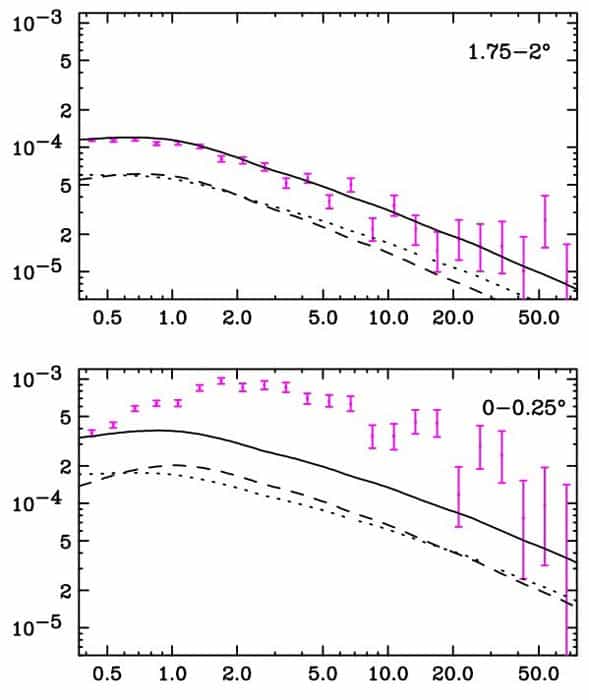
The US pair break down the gamma-ray background into three parts: a narrow emission from the galaxy’s disc; an emission from known point sources; and a spherical or “bulge” emission around the galactic centre. According to their model, no matter what parameters one chooses for dark matter, there should always be a threshold within the bulge emission where dark-matter annihilation begins to outshine other gamma-ray sources. This is because – unlike other sources – emission from dark-matter annihilation follows a square law, so that doubling the density increases the annihilation four-fold.
Hooper and Goodenough examined the Fermi spectra at many regions inside the gamma-ray bulge, and found the data always matched the model’s prediction of normal emission – except right at the galactic centre. Here, in a narrow region spanning less than one-quarter of a degree, the emission was far stronger than the model predicted, and had a more lopsided spectrum. Those characteristics, the US pair claims, point to a dark-matter particle – a weakly interacting massive particle, or WIMP – in a mass range of 7.3–9.2 GeV.
A familiar mass
This light mass is partly what lends the analysis credence. For years physicists working on the DAMA experiment in Italy claim to have found WIMPs colliding with sodium-iodide nuclei, while those working on the CoGeNT collaboration in the US have tentatively revealed similar WIMP signals coming from germanium detectors – and many believe the only way to reconcile these signals is to assume a WIMP with a mass around 8 GeV.
“Until I had seen this latest paper from Hooper and Goodenough, I was kind of thinking with the light WIMP scenario – nah,” says Alex Murphy, a particle astrophysicist who works on the ZEPLIN-III dark-matter experiment in the UK. “But now I’ve seen it, I’m starting to think – hmm, maybe. Perhaps now we should be looking at other ways to confirm or disprove this proposal.”
Murphy voices scepticism about the strength of the claim, however, because he is not convinced Hooper and Goodenough understand the idiosyncrasies of the Fermi instrumentation sufficiently well. Although the Fermi team has published its own preprint revealing an excess of gamma rays near the galactic centre, it has so far stopped short of interpreting this as dark matter.
Still prone to misinterpretation
Ronaldo Bellazzini, the principal investigator on Fermi’s Italian team, warns that Hooper and Goodenough’s analysis of the galactic centre could still be prone to misinterpretation. “Unfortunately, this region, and whatever [Fermi] observes along the line of sight to it, is rich with astrophysical sources that can mimic signals similar to dark-matter annihilation, like pulsars and supernovae remnants” he says.
Meanwhile, Michael Kuhlen, a dark-matter theorist at the University of California at Berkeley, believes there is “probably a good reason” why the Fermi collaboration has held back from making conclusions on the gamma-ray excess. “They’re certainly aware of it, but probably just haven’t been able to convince themselves that they fully understand the instrument’s behaviour, or the backgrounds, or the kinds of possible astrophysical sources that could produce the signal,” he says.
But Kulen adds: “Really they’re just trying to stir the pot, and get people to seriously consider the possibility that Fermi may have already detected a dark-matter annihilation signal. This is a good thing.”
A preprint of the paper is available at arXiv: 1010.2752.
Earth-sized planets may be more common than we thought
Almost one in four stars like the Sun could harbour an Earth-mass planet, according to US researchers. Their finding questions conventional models of planetary formation, which suggest that it is rare to find low-mass planets close to their parent stars, implying that solar systems like ours could be more common than we thought. The result also suggests that NASA’s Kepler mission, currently hunting for Earth-like planets, could discover more than 250 “plausibly terrestrial worlds”.
The population of known alien worlds, a total of almost 500 discovered since the mid-1990s, is currently skewed towards the more easily detectable Jupiter-mass planets that orbit close to their host stars. It is only recent advances in technology that have allowed the search for planets with similar masses to the Earth. Yet existing models of solar-system formation predict a “planetary desert” close to the star: a lack of planets with 1–30 times the mass of Earth and an orbital period of less than 50 days. Now, a team of astronomers, including Geoff Marcy at the University of California at Berkeley, is challenging this received wisdom.
“This is the first time anyone has measured the fraction of stars that have smaller planets,” Marcy, often credited as the most prolific planet hunter of all time, told physicsworld.com. His team used data from the Keck telescope in Hawaii relating to 166 stars between 0.54 and 1.28 solar masses, all within 80 light-years of Earth. Doppler shifts in the starlight, the result of the star wobbling under the gravitational influence of an orbiting exo-planet, revealed a total of 33 planets around 22 of the stars.
Don’t forget the missed planets
Marcy’s team also made an attempt to account for any planets that might have been missed due to limitations in the sensitivity of their equipment. “We asked what would be the maximum planet mass that could hide in our data. If there were a more massive planet than that we would have seen it,” Marcy explained. This statistical sampling analysis enabled them to infer the “missed” planets that sit alongside the confirmed planets.
This information, from both the confirmed and inferred cases, was used to model the likelihood of close-by planets as a function of a planet’s mass. It turned out that a power law was the best fit to the data, one that implied that the smaller the mass of the planet, the more likely it was to exist. This suggests the “planetary desert” is far from the desolate wasteland previously envisioned. “Our observations don’t agree with theoretical predictions. We now know that the universe has more Earth-mass planets than Jupiter-mass planets,” said Marcy. His power law predicts the chances of a Sun-like star having a one Earth-mass planet to be 23% – almost one in four. The findings are published in Science.
However, the research was limited, by current technology, to only modelling planets orbiting at less than one quarter of the Sun–Earth distance. So Marcy’s finding could still be promising in the hunt for Earth’s “twin”: a one Earth-mass planet orbiting at an Earth–Sun distance. “Current models suggest most planets form far away from their stars; you should find more planets at longer orbital periods,” Coel Hellier, an exo-planet researcher at Keele University, told physicsworld.com. “This research predicts a 23% chance of finding short period Earth-mass planets, so there should be even more further out; perhaps then nearly all solar-type stars have an Earth-mass planet,” he added.
Searching for a second Earth
However, just because a planet has near Earth-mass, doesn’t necessarily mean it is Earth-like. “Planets with a few Earth masses may be qualitatively different from one Earth-mass planets. They might be much larger, more like mini-Neptunes, with a lot more water and a lot less rock,” Marcy warned.
But early results from NASA’s Kepler space telescope, which measures a planet’s radius rather than its mass, are promising. “Many of Kepler’s planet candidates appear to have small radii, which is consistent with our research; they could be Earth-like after all,” said Marcy. The team predicts that Kepler could find 120–260 “plausibly terrestrial worlds”. “We are starting to see suspicious signs that Earths are out there in large numbers,” he added.
Meanwhile, a pair of researchers based in the US and Switzerland has begun to study a contender Earth in more detail. Kevin Heng at ETH Zurich and Steven Vogt at the University of California have simulated atmospheric circulation on Gliese 581g, a “super Earth” discovered in 2009. Publishing their findings in a paper submitted to the arXiv preprint server, the researchers argue that the specific locations for habitability depend on whether the planet is tidally locked and how fast radiative cooling occurs on a global scale.