New twist to electron beams

Physicists in Japan have for the first time generated beams of electrons displaying the fundamental physical property of orbital angular momentum. Like light beams before, these electron beams have had their wavefronts distorted so that they spiral through space and create a “phase singularity”. They could be used to make more powerful electron microscopes.

Beams of light possess a property known as spin angular momentum, which is associated with the direction in which the light is polarized. However, light can also carry “orbital” angular momentum. This comes about from twisting a beam’s wavefront, the imaginary locus of points on a wave possessing the same phase. In contrast to the simple plane wavefront of a collimated beam, this kind of wavefront rotates around a central axis and leads to what is known as a “phase singularity” at the centre of the beam, a type of vortex where the intensity of the wave is zero and its phase is undefined. Such spiral-like waves have been used in a number of applications, including the “optical spanner” – a light beam that traps and rotates particles – and higher-dimensional encoding in quantum optics.

Spiral phase plate

Plane waves can be converted into these spiral waves by passing them through a tiny curved ramp known as a “spiral phase plate”, with the height at any point on the ramp proportional to the angle at that point. Building this structure for light waves is relatively straight forward, since it can be carved out of silicon using the lithographic techniques employed by the semiconductor industry.

But doing the same for electron beams is more difficult. Quantum mechanics tells us that electrons, like any other kind of particle, have an associated wave, but their wavelength will tend to be much smaller than that of light. This means that the phase plate also needs to be smaller. Electrons with an energy of 300 keV would require a ramp made of silicon to be just 100 nm high.

Masaya Uchida and Akira Tonomura of the RIKEN institute in Wako, Japan, have used an alternative approach. Rather than attempting to build a smooth spiral they instead built a step-like structure – the equivalent of a miniature spiral staircase.

They crushed graphite from a pencil into fine fragments and laid them on a copper grid coated with a carbon film. The result is a graphite square made up of a number of smaller squares of varying thickness, with the top-left square being the thickest, the top-right square being the second thickest and so on in a descending clockwise spiral. The typical difference in thickness of adjacent squares, in other words the typical thickness of their graphite films, was between 10-100 nm (Nature 464 737).

Screw-type phase singularity

To demonstrate their phase plate, they accelerated a beam of electrons to an energy of 300 keV (corresponding to a wavelength of about 0.002 nm) and then split the beam in an electron biprism. One half of the beam was sent through the phase plate and the other half remained as a reference plane wave. Directing the two beams to a screen and observing the interference pattern, the researchers saw the tell-tale sign of a screw-type phase singularity – a Y-shaped defect in which a new fringe started at the location of the phase singularity.

Miles Padgett of Glasgow University describes the research as “highly interesting” and says it could lead to enhanced electron microscopy. He points out that low image contrast in optical microscopy can be partly overcome by exploiting the phase rather than the intensity of the light transmitted by an object, and believes that the new work might “create new opportunities for the use of phase imaging in electron microscopy”.

Uchida acknowledges that while their spiral-staircase technique has allowed them to demonstrate the reality of twisted electron waves, and therefore of electron orbital angular momentum, it is not precise enough to reproduce such waves reliably. He says that focused ion beams might be capable of producing spiral wave plates of sufficient precision.

Indeed, he looks forward to the production of a variety of differently-shaped electron wavefronts, comparing the waves generated in the current work to the corkscrew-shaped fusilli pasta. “Just as there are many types of pasta, so there are many shapes of electron wave,” he says, “such as double-helix or U–shaped wavefronts.”

The work is described in Nature 464 737.

Science meets innovation at Stanford Photonics Research Center

It’s 50 years since the birth of the laser and to mark the imminent anniversary physicsworld.com will be cranking up its coverage of photonic science, technologies and applications over the coming weeks.

For starters, there’s our latest video exclusive, a vox pop with faculty and students at the Stanford Photonics Research Center (SPRC), part of Stanford University in California and home to one of largest photonics research programmes in the US.

SPRC’s Ginzton Laboratory is the focal point for that programme and an interdisciplinary research team that comprises around 40 professors and 200 graduate students and postdocs. Theirs is a wide-ranging brief – SPRC working groups span information technology, telecommunications, integrated photonics, microscopy, neuroscience and solar cells – though with a common objective: to partner with industry to bring innovative photonic technologies to market.

With innovation a defining metric, a sizeable slice of SPRC’s activity comprises contract research funded by industry. The centre has 20+ commercial partners, among them the likes of SONY, Agilent Technologies, Lockheed Martin and NTT Communications.

Partnership is the key word here. The affiliates don’t just give their name to SPRC or sponsor a meeting, they actively support the research programme. Tom Baer, executive director of SPRC, reckons the affiliates are a “unique interface” between industry and the science and engineering taught at Stanford.

“SPRC provides the opportunity for students to work closely with our [industry] affiliates…and helps the students become exposed to scientific and technical problems that are current and relevant to the commercial sector,” he told physicsworld.com.

Equally significant, the SPRC reflects the research culture at Stanford, which has been cross-disciplinary for many decades. And that multidisciplinary effort is more than just a bunch of people from different disciplines working together, it’s about nurturing teams of “multidisciplinarians”.

“You really need to encourage the physicists to learn the biology, the engineers to learn the chemistry and so on,” Baer explained. “Something I instill in SPRC students from the off is that the more unique fields of enquiry you have knowledge of, the more you become unique in the eyes of your employers.”

Applying physics to biology: optical tweezers and single-molecule biophysics

Steven Block’s team at the Stanford Photonics Research Center (SPRC) is pioneering a new area of biology known as single-molecule biophysics. Underpinning that endeavour are laser-based optical tweezers (also known as optical traps) used to capture, measure and manipulate proteins and nucleic acids one molecule at a time.

Bright stuff: LCLS ready to shine

Stanford’s Linac Coherent Light Source (LCLS) is an X-ray free-electron laser that produces X-ray pulses more than a billion times brighter than the next brightest synchrotron sources. As atomic physicist Phil Bucksbaum explains, LCLS is also “the world’s first laser able to interrogate atoms and molecules simultaneously on their natural time scale and length scale”.

Spin-squeezed atoms boost interferometry

Physicists in Germany are the first to use “spin-squeezed” atoms to boost the precision of an interferometer based on interacting atoms. Their work involves entangling several hundred atoms in a way that reduces the noise in a measurement of their spin along a certain direction. If the technique can be scaled up to work with millions of atoms, it could help to boost the precision of atomic clocks.

When measuring the internal spin of an atom, the noise in the measurement obeys Heisenberg’s uncertainty principle of quantum mechanics. In other words, the noise in, say, the y component of the spin (Jy) multiplied by the noise in the z component (Jz) must always be greater than a fundamental value. If the atoms do not interact with each other, however, the noise is the same in both directions and increases as the square root of the number of atoms. This is called the “classical limit” because it resembles the noise seen in non-quantum or classical systems.

It is possible, however to, “spin-squeeze” the atoms to reduce the noise in one direction (say Jy) at the expense of boosting the noise in the other direction (Jz). This squeezing can be useful if the atoms are used to measure a particular physical quantity – such as a magnetic field – that interacts with the squeezed component of the collective atomic spin. Squeezed states of photons are already being used to boost the performance of optical interferometers.

Bose-Einstein condensate

Christian Gross and colleagues at the University of Heidelberg began their experiments with an ensemble of several hundred rubidium atoms trapped in a 1D optical lattice. The atoms are chilled to a few tens of nanoKelvin to form a Bose-Einstein condensate (BEC), in which all the atoms are in the same quantum state – and interactions between atoms become important.

The BEC is then subjected to a carefully chosen magnetic field that tunes the interaction between the atoms via a “Feshbach resonance”. This interaction causes the spins of the atoms to become correlated – a phenomenon called entanglement.

The entangled atoms are in a superposition of internal atomic states that can be used in a Ramsey inferometer, which measures the interference between two different quantum states of a system. The Heidelberg researchers then applied a phase shift to the entangled atoms, which is analogous to the application of a magnetic field.

When the two states are recombined, the resulting interference pattern differs from that created in the absence of a magnetic field. This is measured as an imbalance in the number of atoms with spins pointing up and down. Because the states are squeezed, the noise is –8.2 dB below that in the same measurement made without spin squeezing.

More precise atomic clocks

Spin-squeezed states could in future be used to boost the precision of atomic clocks. However, Gross told physicsworld.com that the measurements were made using about 170 entangled atoms – which is much less than the millions of atoms used in an atomic clock. Another problem is that the quantum states used in the Heidelberg experiment are very sensitive to magnetic fields, which is a big drawback for atomic clocks.

The work is described online at Nature doi:10.1038/nature08919, where an independent group of physicists at the Ludwig-Maximilians-Universitaät in Germany and the Laboratoire Kastler Brossel in France report the creation of a spin-squeezed BEC condensate in a device fabricated on a silicon chip (Nature doi:10.1038/nature08988). Although Max Riedel and colleagues did not do interferometry measurements, they found that the spin noise was reduced by –3.7 dB and suggest that such chips could find use in atomic clocks.

Physics at the end of the Earth

One sunny November day when I was an undergraduate, a classmate of mine turned up to a quantum-mechanics lecture wearing an enormous pair of thick, black boots. He had been offered the chance to do PhD research in Antarctica, he explained, so was graduating early in order to start before the brief southern summer ended. Oh yes, and his expedition boots had arrived that morning. Pretty cool, huh?

I was insanely jealous – although not, it must be said, jealous enough to apply to a similar PhD programme. A few years later, while working in the snug confines of an English atomic-physics lab, I felt a related pang of envy after talking to an astronomer who had just returned from observations in Namibia. Clearly, some people have all the fun. But my latest attack of jealousy is the worst ever, and I blame Anil Ananthaswamy for it. Or, rather, I blame his book The Edge of Physics: Dispatches From the Frontiers of Cosmology – which is, quite simply, the ultimate physics-adventure travelogue.

Popular-science books about cosmology tend to be long on ideas and short on means of testing them. Their subject matter is, of course, partly to blame. As the theoretical physicist Ruth Gregory noted in these pages a year ago, when it comes to the universe, “we cannot be independent external observers, and we can hardly run the experiment again!”. Yet recent years have seen the development of a new generation of experiments that promise to test, if not the universe itself, then at least some of our theories about it. A number of publications (including Physics World) have already covered these advances for a specialized audience. However, the experimental-cosmology story has been crying out for a good popular treatment too – and, for the most part, Ananthaswamy delivers it.

A London-based science journalist with a background in engineering, Ananthaswamy set out to tell this story by visiting a handful of facilities and talking to the people who work there. The book begins at one of astronomy’s most iconic locations: California’s Mount Wilson Observatory. There, in the late 1920s, Edwin Hubble discovered that light from distant galaxies was more red-shifted than light from galaxies nearby – a sign that the universe is expanding. After a short sojourn in Hubble’s monkish retreat (now mostly used for public-outreach events), Ananthaswamy travels to a wide range of exotic locales. These include Lake Baikal, Russia, home of the Baikal Deep Underwater Neutrino Telescope; Cerro Paranal Observatory, Chile, site of some of the world’s largest visible and infrared telescopes; the MeerKAT radio-telescope array in South Africa’s Karoo desert; and the IceCube neutrino telescope in Antarctica.

There are a handful of more accessible stopovers as well, such as CERN and Minnesota’s Soudan Mine, where members of the Cryogenic Dark Matter Search (CDMS) team are working more than half a mile below the Earth’s surface on an experiment designed to detect dark matter. After setting such a peripatetic precedent in the first part of the book, it is almost surprising that Ananthaswamy neglects to visit the facilities he describes in the final chapter. However, given that the Herschel and Planck observatories are currently orbiting the Earth at a distance of 1.5 million kilometres, the omission is, perhaps, understandable.

The fact that there are scientists – and not just biologists but physicists and astronomers too – who will literally trek to the ends of the Earth for their research is an inspiration for many. It is also an important link to the “heroic age” of scientific exploration, and to the brave individuals who hauled samples from the South Pole and collected rocks from the Moon. Yet for the most part, Ananthaswamy’s descriptions of the people he meets tend more towards “quirky” than “lionizing”. Thus we learn that CDMS team member Richard Gaitskell wears pink socks, and that two of the Lake Baikal physicists, Vasily Prosin and Leonid Kuzmichov, share the author’s passion for Bollywood cinema.

Some readers will, no doubt, find such details a distraction. Yet for those whose curiosity extends not just to the research itself, but also to what it is like for the people who do it, Ananthaswamy’s tales of science on icebergs and in deserts are a real treat. It is also refreshing to read that he spent significant chunks of time talking to the technicians and postgraduate students who pour sweat, tears and sometimes blood into each project, not just to those higher up the chain. The result is an account stuffed with the kind of stories that experimentalists relish – like the difficulty of finding 18th-century lead for dark-matter detector shields (needed because old lead is less radioactive than newly mined stuff), and the fact that, because bizarre names are more memorable than serial numbers, somewhere under the Antarctic ice is a neutrino detector called Salmonella.

So, as an adventure story and a fly-on-the-wall account of remote places that most of us will never visit, The Edge of Physics is brilliant. The scientific explanations that encompass each anecdote are clear and coherent, and Ananthaswamy excels at weaving together historical information, pithy quotes from scientists and vivid descriptions of what each site is like. There is one problem, though, and it lies in the author’s efforts to fashion his travels into something more than a round-the-world jolly. In the final two chapters, Ananthaswamy moves away from experiments and onto a discussion of string theory and the multiverse. These are both fascinating topics, and I can appreciate the appeal of tying everything together with a neat, theoretical bow. But unlike neutrinos or even dark matter, the experiments in this book will never detect strings, and other universes will almost certainly prove impossible to detect, even in principle.

In a book that addresses a lot of big topics, enough should have been as good as a feast. Still, it would be churlish to protest too much about The Edge of Physics. Ananthaswamy has uncovered some intriguing stories and told them well, and his book goes some way towards redressing the theory/experiment imbalance in the popular-physics literature. Plus, having read how much he missed the simple smell of damp earth after just a few days at the South Pole, I no longer envy my former classmate who spent three months there. At least, not as much.

A remade tapestry

Beehives, butterfly and shell markings, tree branches, snowflakes and cloud formations: the natural world is filled with patterns. Many of these patterns may appear to be unrelated, yet hints of similarities between them suggest that we ought to be able to trace their origins to a few common sources.

In some cases, the source of the pattern may be a purely physical process, one that can be reproduced in a lab under controlled conditions and analysed in clean, mathematical terms. But for structures formed in biological and social systems, pattern-generating mechanisms are harder to pinpoint. Natural selection (or its analogue in social or economic systems) may have so many tricks up its sleeve that it can create patterns of arbitrary form. Still, if natural selection favours particular types of complex structures, then there may be general laws at work that we can discern by applying techniques similar to those developed for physical systems. Much current interdisciplinary research focuses on the extent to which observed, selected patterns can be understood as resulting from relatively simple physical processes.

In Nature’s Patterns Philip Ball describes how scientists have approached the pattern-formation problem and explains a number of their successes. In a series of case studies he illustrates how physical and chemical processes can account for certain observed patterns in geological and biological systems. The examples he selects come from a wide range of fields, including condensed-matter physics, physical chemistry, fluid dynamics, biophysics, physiology, geology and even social-network theory. The result – though not always an easy read – is a fascinating window onto the surprisingly complex structures that emerge from simple physical principles.

Nature’s Patterns is presented as a trilogy, with separate volumes entitled Shapes, Flow and Branches each concentrating on a different aspect of pattern formation. Taken together, the three books constitute a substantially revised and expanded edition of Ball’s earlier book The Self-made Tapestry. In the preface to Shapes, part one of the trilogy, Ball states that the new format does the subject more justice, but does not say how. I agree that organizing the material into three broad categories was a good move. However, there would have been a distinct advantage to collecting all three in a single volume: the communities working on these problems overlap substantially, and the results are more satisfying when viewed as a coherent body of work.

As a science journalist, Ball’s approach is to develop historical storylines that anchor each scientific explanation to a particular researcher. His writing inspires confidence that he is getting the science right, and he works hard to show how the modern explanations were motivated, enabled and sometimes anticipated by previous work. This does serve a pedagogical purpose: in many cases the older work is easier to grasp and therefore provides a useful entree to the issue at hand. So, for those who want a general sense of how far science has come in explaining patterns and what kinds of questions arise – and who are not ready to tackle any of the mathematics – the stories that Ball presents may be just the right vehicle.

For me, however, the effect was a bit overwhelming. Each book reads more like a history of ideas than a set of scientific results, and I found it hard to keep the relevant science in mind while following long tangents of primarily historical interest. To get the full benefit, readers must be prepared to pause frequently to refresh their memory about how the current discussion fits into the developing storyline. Ball suggests that readers also take time to perform some experiments of their own. I heartily agree, and I particularly recommend making the soap-film structures. There is no substitute for watching the real process by which patterns form, seeing them in 3D, and viewing how robust or fragile they are – all of which help clarify the science that Ball is trying to explain.

While experts may find a few points where they would have chosen to emphasize different features or draw finer distinctions between systems Ball takes to be analogous, he has on the whole done an excellent job of including relevant caveats and avoiding false conceptual impressions. He does miss some important opportunities, however. It struck me as odd, for example, that Shapes includes no mention of the ordering of atoms in solids or of molecules in liquid crystals, or of the faceted shapes of crystals. In all three cases, the physics is well understood, and any of them could have provided a clean illustration of fundamental concepts like symmetry breaking and long-range order. Including them would also have strengthened the message that conceptual approaches developed in the context of traditional physics have contributed greatly to the broader field. My suggestion would have been to cut out half of the 80 pages on bubbles and beehives to make room for crystals.

Ball’s choices of which researchers to highlight are reasonable, though not comprehensive. The fact is that the broad scientific themes have been pieced together by many researchers rather than investigated definitively by one person, so Ball’s story-based approach demands that he pick from among many alternatives. He has done a good job of balancing theory and experiment, covering work done around the world and representing the relevant scientific disciplines. The net effect, however, can be a bit disorienting to someone familiar with the science. The actual development of ideas about patterns involved multiple storylines playing out in parallel, and it would be interesting to know how Ball settled on the results he chose to highlight. Given his attention to many of the historical aspects of the science, a brief discussion of his own methodology would have made a nice addition, perhaps as an expanded preface.

A deeper problem is that it is hard to articulate a clear take-home message after reading one of the books. Following Ball’s train of thought requires great powers of concentration, as one must keep hold of not only the scientific thread but also the names and contributions of numerous individuals. In the end, this makes it hard for either experts or novices to locate the big scientific themes. One way to alleviate this problem might be to read the epilogue at the end of Branches (the series’ final book) before starting out. There, Ball provides a useful guide to the overarching scientific threads that tie the topics together – competition, symmetry breaking, non-equilibrium processes, dissipation, instabilities, correlations and defects.

In the past, I have used The Self-made Tapestry as one of several textbooks for a first-year undergraduate course on self-organization and the emergence of complex structure. In a seminar course for 15 students with varying backgrounds in mathematics and a teacher there to guide them, Ball’s earlier book worked well, and I was happy to see that he has added a considerable amount of material in Nature’s Patterns to flesh it out and bring it up to date.

I would like to think that there are a number of readers who would find the trilogy an exciting and rewarding project to tackle on their own, even outside a classroom setting. This is not the type of work, however, that will be devoured by teenagers who later cite it as their motivation to pursue a career in science. Such books are often inspirational precisely because they are not really comprehensible. Ball’s trilogy is written instead for sophisticated readers who wish to expand their scientific horizons and learn new ways of appreciating the structures they encounter in everyday life.

Web life: Just A Theory

So what is the site about?

After a few months of physics videos, amateur science sites and educational games, the website we are highlighting in this month’s column is a straightforward blog. Just A Theory was started in 2008 by freelance science journalist Jacob Aron while he was studying for a Master’s degree in science communication at Imperial College London. The blog’s title, Aron explains, reflects a popular misconception that scientific theories are “dreamed up by mad scientists in laboratories somewhere” rather than well-crafted explanations based on observations and experiments. To combat this impression, the site aims to highlight good and bad science coverage in the mainstream media, and to provide original commentary on current scientific events.

What topics does it cover?

Just A Theory’s net is pretty wide, but there is a strong physics thread thanks in part to the blog’s second author, London-based astrophysicist-cum-journalist Colin Stuart. In a typical month, you will find links to science demonstrations, discussions of recent discoveries and a modicum of silliness – like the London Underground-style map of the Milky Way created by Harvard University complexity scientist Samuel Arbesman. Like a lot of blogs, this one contains a sidebar with a list of post “categories”, such as physics, mathematics, and health and medicine, that lets you pick out particular topics of interest. Be sure to visit the “Yes, But When?” category, which pokes gentle fun at the breathless reports of running robots, bacterial computers, space stations and other wonders that generally turn out to be available n years in the future (n > 10).

How often is it updated?

At the moment, posts appear once or twice a week on average. Most are written by Aron, with regular contributions from Stuart and occasional offerings from other writers, most of whom are alumni or current students on Imperial’s science-communication course. Some posts are round-ups of the week’s news, with three or four different topics discussed in a single entry.

Why should I visit?

Just A Theory offers a moderately UK-centric perspective on science news for interested members of the public and busy professional researchers alike. You will not find too many detailed, hard-science articles here, but sometimes that is not the point. As a student or professional physicist, it is easy to develop tunnel vision as you dig ever deeper into a relatively narrow research topic, but keeping the “bigger picture” in sight can be a time-consuming process in an ever-more-crowded media world.

Can you give me a sample quote?

From Aron: “I don’t know why, but I just love clever ideas for electricity generation. Maybe it’s because I’m a great big nerd with vague but constant guilt about how the energy I used is produced. The latest idea I’ve seen comes from researchers at the City College of New York, who’ve developed a way to literally suck energy from the air flow around cars and planes. They’re using materials with piezoelectric properties, which convert physical movement into electricity to generate a form of wind power…I think that ideas like this are the future of electricity generation. It’s not a very sexy solution to the problems of climate change, and you won’t see any politicians crying ‘let’s all attach small things to our cars!’, but if we can come up with loads of small ways to produce clean power, it could add up to a significant carbon saving.”

Science in the Muslim world

There are more than a billion Muslims in the world today – over a fifth of the world’s total population – spread over many more than the 57 member states of the Organisation of the Islamic Conference (OIC) in which Islam is the official religion. These include some of the world’s wealthiest nations, such as Saudi Arabia and Kuwait, as well as some of the poorest, like Somalia and Sudan. The economies of some of these countries – such as the Gulf States, Iran, Turkey, Egypt, Morocco, Malaysia and Pakistan – have been growing steadily for a number of years, and yet, in comparison with the West, the Islamic world still appears somewhat disengaged from modern science.

The leaders of many of these countries understand very well that their economic growth, military power and national security all rely heavily on technological advances. The rhetoric is therefore often heard that they require a concerted effort in scientific research and development to catch up with the rest of the world’s knowledge-based societies. Indeed, government funding for science and education has grown sharply in recent years in many of these countries and several have been overhauling and modernizing their national scientific infrastructures. So what do I mean when I say that most are still disengaged from science?

Current state of research

According to data from the United Nations Educational, Scientific and Cultural Organization (UNESCO) and the World Bank, a group of 20 representative OIC countries spent 0.34% of their overall gross domestic product on scientific research between 1996 and 2003 – just one-seventh of the global average of 2.36%. Muslim countries also have fewer than 10 scientists, engineers and technicians per 1000 of the population, compared with the world average of 40, and 140 for the developed world. Between them they contribute only about 1% of the world’s published scientific papers. Indeed, the Royal Society’s Atlas of Islamic-World Science and Innovation reveals that scientists in the Arab world (comprising 17 of the OIC countries) produced a total of 13 444 scientific publications in 2005 – some 2000 fewer than the 15 455 achieved by Harvard University alone.

But it is the quality of basic scientific research in the Muslim world that is of more concern. One way of measuring the international prominence of a nation’s published scientific literature is via its relative citation index (RCI): this is the number of cited papers by a nation’s scientists as a fraction of all cited papers, divided by its own share of total papers published, with all citations of its own literature excluded to prevent bias. Thus, if a country produces 10% of the world’s scientific literature but receives only 5% of all citations in the rest of the world, its index will be 0.5. In a league table compiled in 2006 by the US National Science Board of the world’s top 45 nations ranked by their RCI in physics, only two OIC countries even register – Turkey with 0.344 and Iran with 0.484 – and only the latter shows a marked improvement between 1995 and 2003.

These bald statistics reveal how far scientists in Muslim nations are languishing behind the rest of the world. But there have been some outstanding Muslim scientists, not least the Pakistani theoretical physicist Abdus Salam (1926–1996), who dreamed of a scientific renaissance in the Islamic world. One of the greatest scientists of the second half of the 20th century, Salam shared the 1979 Nobel Prize for Physics, with Sheldon Glashow and Steven Weinberg, for his part in developing the electroweak theory: one of the most powerful and beautiful theories in science, it describes how two of the four fundamental forces of nature (the electromagnetic force and the weak nuclear force) are connected.

Although Salam was a pious Muslim, he was excommunicated by Pakistan in the 1970s because of his non-orthodox religious convictions and adherence to a relatively obscure Islamic sect called the Ahmadis (Physics World August 2009 pp32–35). Despite this, he remained loyal to his country and worked tirelessly to promote science in the Islamic world. But Salam’s dream was never realized and he left behind the following damning indictment: “Of all civilizations on this planet, science is weakest in the lands of Islam. The dangers of this weakness cannot be over-emphasized since the honourable survival of a society depends directly on its science and technology in the condition of the present age.”

Obstructive attitudes

One problem is that too many Muslims see modern science as a secular, even atheist, Western construct, and have forgotten the many wonderful contributions made by Muslim scholars during the height of a golden age that began in the first half of the 9th century and continued for several centuries. Brilliant advances were made in everything from mathematics, astronomy and medicine, to physics, chemistry, engineering and philosophy. It was an age epitomized by a spirit of rational enquiry at a time when most of Europe was stuck in the Dark Ages.

But this freethinking, curiosity-driven quest for knowledge slowly went into decline. I should make it clear that this downturn took place several centuries later than many in the West think, for original advances in medicine, mathematics and astronomy continued to be made well into the 15th century. The gradual decline that nevertheless took place did so for a variety of reasons, mainly due to the political fragmentation of the Islamic empire and weaker rulers no longer being interested in patronage of scholarship and learning. All of this coincided with the Renaissance in Europe moving in the opposite direction, which triggered the scientific revolution of the 16th and 17th centuries. Add to this the later effects of colonialism that led to a kind of malaise and collective amnesia within the Muslim world about its own rich cultural heritage, and one can see the weakness and intellectual laziness of the argument that the decline should be blamed on an anti-science backlash from a more conservative Islam.

Nevertheless, it is sad but true that today many religions around the world see modern scientific disciplines such as cosmology or evolution as undermining their belief systems. Compare their view with that of the great Persian polymath al-Biruni (973–1048): “The stubborn critic would say: ‘What is the benefit of these sciences?’ He does not know the virtue that distinguishes mankind from all the animals: it is knowledge, in general, which is pursued solely by man, and which is pursued for the sake of knowledge itself, because its acquisition is truly delightful, and is unlike the pleasures desirable from other pursuits. For the good cannot be brought forth, and evil cannot be avoided, except by knowledge. What benefit then is more vivid? What use is more abundant?” Thankfully, enough Muslims now reject the notion that science and Islam are incompatible. In fact, given the current climate of tension and polarization between the Islamic world and the West, it is not surprising that many Muslims feel indignant when accused of not being culturally or intellectually equipped to raise their game when it comes to scientific achievements.

Reform required

Far more telling than the argument that it is religious conservatism that impedes scientific progress in the Muslim world are the antiquated administrative and bureaucratic systems many OIC countries inherited long ago from their colonial masters that have still not been replaced. This is compounded by a lack of political will to reform, to tackle corruption and to overhaul failing educational systems, institutions and attitudes. Thankfully, things are changing fast.

It is crucial that both Muslims and non-Muslims are reminded of a time when Islam and science were not at odds, albeit in a very different world. This is important not only for science to flourish once again in the Islamic world, but also as one of the many routes towards a future in which Muslims see the value of curiosity-driven scientific research, just as they did 1000 years ago.

As for how this can be achieved, the obvious first step is serious financial investment. It has been shown time and time again that bigger science budgets encourage greater scientific activity, and many Muslim governments, from Malaysia to Nigeria, are currently investing quite astonishing sums of money in new and exciting projects in an attempt to create world-class research institutions. For instance, the rulers of several of the Gulf States are building new universities with labour imported from the West for both construction and staffing.

But it is not simply a matter of throwing money at the problem. Even more important is having the political will to reform and to ensure real freedom of thinking. For example, Nader Fergany, lead author of the United Nations’ 2002 Arab Human Development Report, has stressed that what is needed above all else is a reform of scientific institutions, a respect for the freedoms of opinion and expression, ensuring high-quality education for all, and an accelerated transition to knowledge-based societies and the information age (Nature 444 33).

Forward-looking projects

Let us look briefly at the Middle East, where one can find a number of exciting new projects that have received considerable publicity within the region. The first is a new science park that opened in the spring of 2009 in a sprawling metropolis called Education City on the outskirts of Doha, the capital of Qatar, which is home to a number of branch campuses of some of the world’s leading universities, including Carnegie Mellon, Texas A&M and Northwestern. The Qatar Science and Technology Park, also based at Education City, hopes to be a hub for hi-tech companies from around the world that, one imagines, will try to emulate the success of California’s Silicon Valley.

Just as ambitious is the new $10bn King Abdullah University of Science and Technology (KAUST), just completed on the west coast of Saudi Arabia near the city of Jeddah (Physics World November 2009 pp12–13). Incredibly, the vast campus of this international research university, complete with state-of-the-art labs and a $1.5bn budget for research facilities over its first five years, was built from scratch in less than three years. In a pioneering move, it is the first fully co-educational institution in Saudi Arabia, allowing women to sit alongside men in lecture halls rather than in separate rooms. The university promises to offer researchers the freedom to be creative and to embody the very highest international standards of research and education. The research programme has been tailored to support the country’s post-oil future in key areas such as exploiting solar energy and developing crops that can survive the country’s hot, dry climate. Many of the top universities in Europe and the US have been clamouring to be associated with it for – one hopes – scholarly rather than financial motives.

The final example is a project called SESAME (Synchrotron-light for Experimental Science and Applications in the Middle East) (Physics World April 2008 pp16–17), which will be the region’s first major international research centre as a co-operative venture by scientists and governments in the region. When, in 1997, Germany decided to decommission its synchrotron research facility BESSY, it agreed to donate its components to the SESAME project, which was quickly developed under the auspices of UNESCO. It is now being built in Jordan, which had to fight off strong competition from other countries in the region. The research to be carried out at SESAME will include materials science, molecular biology, nanotechnology, X-ray imaging, archaeological analysis and clinical medical applications. Its current membership, along with the hosts, includes Israel, the Palestinian National Authority, Egypt, Turkey, Iran, Pakistan, Bahrain and Cyprus, and this group is likely to expand as several other countries join the collaboration. New science should start in 2012.

Facing the future

So, is there a brighter future ahead for science in the Islamic world? Of course scientific researchers require adequate financial resources, but to compete on the world stage requires more than just the latest, shiniest equipment. The whole infrastructure of the research environment needs to be addressed, from laboratory technicians who understand how to use and maintain the equipment to the exercise of real intellectual freedom on the part of the scientists, and a healthy scepticism and courage to question experimental results. This culture change will not happen overnight and requires not only political will, but also an understanding of the true meaning of both academic freedom and the scientific method itself. Sadly, this can often be somewhat lacking, even in the West.

A cultural renaissance leading to a knowledge-based society is urgently required if the Muslim world is to accept and embrace not only the bricks and mortar of modern research labs along with the shiny particle accelerators and electron microscopes that they house, but also that spirit of curiosity that drives humankind to try to understand nature, whether it is to marvel at divine creation, or just to know how and why things are the way they are.

A golden age of science

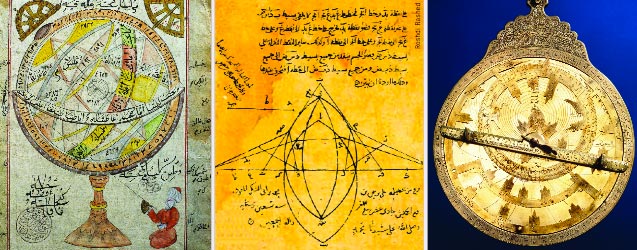
The greatest period of sustained scientific advances during the 1500 years between the time of the Ancient Greeks and the European Renaissance took place in the great centres of learning across the medieval Islamic empire, such as Baghdad, Cairo, Cordoba and Samarkand. For instance, it is in Baghdad that we find the very first book on algebra (called Kitab al-Jebr, from which we derive the word “algebra”). It was unlike anything seen before, and a paradigm shift from the work of the Greek number theorist Diophantus. Written by the 9th-century mathematician al-Khwarizmi, it sparked many great advances in mathematics, all the way to the 15th-century Persian al-Kashi in Samerkand (who, among other achievements, calculated π to 16 decimal places), before the Europeans regained the lead in mathematics once again. The Abbasid caliph al-Ma’mun created a new academy in Baghdad – the House of Wisdom – and built observatories in Baghdad and Damascus. He sponsored huge science projects that made vast improvements on the astronomical and geographical works of Greek scholars such as Ptolemy, which the Muslim, Christian and Jewish scholars of the Baghdad academy had translated into Arabic.

Advances in medicine and anatomy would lead to Arabic texts by scholars such as al-Razi (Razes) and Ibn Sina (Avicenna) replacing the Greek works of Galen and Hippocrates in the libraries of medieval Europe. The philosophical work of Ibn Sina and Ibn Rushd (Averroës) influenced later European scholars such as Roger Bacon and St Thomas Aquinas. The Cordoban physician al-Zahrawi (Abulcasis) invented more than 200 surgical instruments – many of which are still in use today, such as forceps and the surgical syringe. At about this time, we also witness the birth of industrial chemistry, with remarkably sophisticated scientific methods being employed over the haphazard practice of alchemy, and advances in fields such as optics by the likes of Ibn al-Haytham (Alhazen) that would not be matched until Newton. For a period spanning over half a millennium, the international language of science was Arabic.


Graphene photodetector is a first

Researchers at IBM have made the first photodetector from graphene – a sheet of carbon just one atom thick. The device, which can accurately detect optical data streams at speeds of 10 Gbit/s, could be used to create new types of circuits that use both light and electrical current to process and transmit information.

Photodetectors are devices that detect light by converting optical signals into electrical current. They are widely employed in both science and technology, for communications, sensing and imaging.

Modern light detectors are usually made using III-V semiconductors, such as gallium arsenide. When light strikes these materials, each absorbed photon creates an electron-hole pair. These pairs then separate and produce an electrical current.

Good at absorbing light

Graphene has many unique physical and mechanical properties that make it suitable for detecting light. One benefit is that electrons and holes move much faster through graphene than through other materials. Also, graphene is very good at absorbing light over a very wide range of wavelengths, ranging from the visible to the infrared. This is unlike III-V semiconductors, which do not work over such a wide range.

Despite all these advantages, graphene suffers from one serious flaw – the electrons and holes created in the bulk of the material normally recombine too quickly, which means no free electrons to carry current.

But now Phaedon Avouris and colleagues at the IBM TJ Watson Research Center in New York have overcome this problem by separating the electron-hole pairs using internal electric fields so that the electrons and holes are separated.

Separating electrons and holes

The researchers did this by placing palladium or titanium electrodes on top of a piece of multilayered or single-layered graphene. The metal “fingers”, which have different work functions, produce electric fields at the interface between the electrodes and graphene. The field effectively separates the electrons and holes, and a photocurrent is produced when light is shone onto the device.

“In this arrangement, the resulting ‘built-in’ fields act on the entire area of the device,” explains Avouris. “Moreover, we do not need to apply a bias voltage for the device to operate, which also allows us to eliminate unwanted noise at the same time.”

At present, the graphene photodetector can achieve the error-free detection of optical data streams at rates of 10 Gbit/s, a figure that compares well to that of optical networks made of other materials, like III-V semiconductors.

The IBM team is now working on optimizing the photodetector’s performance and integrating it with other optical devices. “We expect that graphene-based integrated electronic-photonic circuits could find a wide range of applications,” Avouris told physicsworld.com. “The graphene photodetector would be particularly competitive in the long wavelength range of the electromagnetic spectrum and for ultrafast measurements.”

The work was reported in Nature Photonics.

Copyright © 2026 by IOP Publishing Ltd and individual contributors