Vacuum Expo 2010 launches in the UK


Simon Mansbridge of the Switzerland-based exhibitor and Expo stakeholder VAT Vacuum says that the event, for which Physics World is a sponsoring partner, “is an exciting opportunity to be involved in the creation of a new conference and exhibition dedicated to vacuum technology in the UK”. Bringing together representatives from industry, research and development, academia and the key suppliers in the industry, Mansbridge adds that Vacuum Expo “will be a valuable platform for exchanging information and establishing new links and contacts for all”.

The conference programme for Wednesday 3 November includes a meeting entitled Innovations in Vacuum Deposited Functional Metal Oxide Coatings, which will run from 10.00 a.m. to 5.00 p.m. The meeting will open with a session on “novel deposition techniques and processes”, which will include presentations from leading academics and members of industry. The session will kick off with a lecture by Andrew Flewitt of the University of Cambridge, who will speak on the low-temperature deposition of metal oxides for transparent microelectronics. Other speakers in that session will include Alistair Kean of Mantis Deposition Ltd, who will talk about the production and application of thin film nanoparticle coatings.

Running concurrently on Wednesday from 11.00 a.m. to 3.30 p.m is the Optical Micro & Nano Fabrication meeting, which is organized by the Optical Group of the Institute of Physics, which publishes Physics World. Speakers at this event include Patrick Salter of the University of Oxford who will describe the parallel optical fabrication of 3D micro-structures. A series of business seminars on innovation and investment will also be held on Wednesday.

Leak detection and RGAs

Anyone running a vacuum system needs to know about leak detection and residual gas analysers (RGA) – which is why the Institute of Physics Vacuum Group and RGA User Group have joined forces to organize a meeting on leak detection and RGA that will run from 10.30 a.m. to 3.10 p.m. The gathering includes an invited lunchtime lecture on “vacuum in the semiconductor industry” by Alan Webb of the optical components manufacturer Oclaro. Other speakers include Hugo Shiers of Diamond Light Source who will talk about the role of RGAs at the UK synchrotron lab and consultant David Hucknall of Low Pressure, who will provide an introduction to leak detection.

Doors to the trade exhibition open at 10.00 a.m. on Wednesday 3 November and firms with products and services on show will include UK-based Chell Instruments, which will be exhibiting a wide range of products including its precision CMV needle valves. Chell’s engineers have been designing and building custom UHV chambers and systems for over 30 years, and the firm has produced vacuum solutions for some of the most demanding applications. Chell also supplies thermocouples and cold cathode gauges from Hastings Instruments and capacitance manometers made by Barocel. These products are supplied complete with ISO17025 calibration in Chell’s UKAS laboratory, which the firm says has the lowest uncertainties for vacuum in the UK.

Manipulating and cooling

Also on hand will be UK-based UHV Design, which will be showcasing its instrumentation for the manipulation, heating and cooling of samples and devices within ultrahigh vacuum environments. UHV Design specializes in the development and manufacture of instrumentation for the manipulation, heating and cooling of samples and devices in ultrahigh vacuum environments. UHV Design’s product range includes linear shift mechanisms; magnetically coupled rotary drives; sample transfer probes; XYZ stages, analysis stages; and deposition stages for sputtering, CVD and MBE. All stages are available with manual or motorized actuation.

The Kurt J Lesker Company (KJLC), which is a manufacturer and global distributor of vacuum technology, will also be at Vacuum Expo 2010. UK-based customers of the firm are served by its European Headquarters in Hastings, UK, and the company has five global warehouse locations and a broad network of dedicated sales staff through the world. KJLC will showcase its new products and as well as its customization capabilities. KJLC’s experts will be on hand to answer questions about the company’s vacuum solutions.

MDC Vacuum Products LLC will be represented at the expo by its European division, UK-based MDC Vacuum Ltd. The company will be exhibiting its vacuum products worldwide including flanges, fittings, and valves. MDC staff will be on hand to discuss the firm’s manipulators, electrical feed-throughs, view ports, electron-beam evaporation and special fabrication technologies.

The exhibition runs until 5.00 p.m. on Wednesday 3 November and from 10.00 a.m. to 4.00 p.m. on Thursday 4 November.

Vacuum Expo 2010 will run alongside the Photonex Exhibition, which will play host to over 100 suppliers of photonics technology and services. Also running at the same time are a number of photonics-related meetings, a “technology investment forum” and the Machine Vision and Imaging Sciences (MVIS) meeting and exhibition.

Does dark matter trigger strange stars?

The energy needed to convert a neutron star into a so-called strange star may come from annihilating dark-matter particles. That is the conclusion of a new study by physicists in Spain, the UK and the US, who propose that this conversion mechanism may be a good way to put a lower limit on the mass of weakly interacting massive particles (WIMPs), a leading candidate for dark matter.

Once their nuclear fuel has burnt up, stars below a certain mass collapse to form neutron stars. These incredibly dense objects consist almost entirely of neutrons, the gravitational collapse having forced protons and electrons to merge. It has been proposed, however, that, given some kind of source of additional energy, neutron stars can convert to strange stars, objects consisting of strange matter – a soup of unbound up, down and strange quarks.

The idea is that adding this energy to a certain limited volume of the neutron star will unlock the up and down quarks confined inside the neutrons. Some of these quarks will then naturally convert into strange quarks, producing a region of strange matter known as a strangelet. If, as has been hypothesized, strange matter is in fact more stable than normal, nuclear, matter it will exist a lower energy. The excess energy given off by the conversion of normal matter into strange matter then unlocks more up and down quarks, leading to the creation of more strangelets.

A little energy is enough to transform a neutron star into a strange star Joseph Silk, University of Oxford

The result is a runaway process capable of converting an entire neutron star into strange matter within a second or less. “The neutron star is metastable, like someone on a mountain ledge,” explains Joseph Silk of the University of Oxford who was involved in the work. “Just as a little kick can push that person off the ledge and send them to the bottom of the mountain, so a little energy is enough to transform a neutron star into a strange star.”

Does strange matter exist?

While there is no clear evidence that strange matter actually exists, the observation of extremely brief but ultra-bright bursts of gamma rays from the cosmos suggests the existence of strange stars. Researchers have proposed that the enormous power needed to produce a gamma-ray burst could come from the formation of a black hole, but the large numbers of particles of normal matter surrounding a black hole could absorb much of that energy. The conversion of a neutron star into a strange star, however, could provide the required energy but without the surrounding matter.

However, that still leaves the question of where the neutron star gets its initial spark of energy. Some have suggested it simply comes from the energy of collapse or from very high-energy cosmic rays colliding with the star. Silk, however, points out that the former mechanism requires neutron stars to have a minimum mass and maintains that the latter mechanism is problematic because, he says, it would be unlikely to dump energy in the middle of the star, which is where it is needed to initiate the chain reaction.

Instead, Silk, Angeles Perez-Garcia of the University of Salamanca and Jirina Stone of the University of Tennessee, have calculated that annihilating WIMPs, which can accumulate in the centre of stars, could provide this energy. If confirmed, the mechanism would provide a new, independent lower limit for the mass of a WIMP. This is approximately 4 GeV (gigaelectronvolts), half of the minimum energy that the trio calculate is needed to initiate the neutron star conversion in this way (with each WIMP providing half of the mass-energy in each collision).

New way to find WIMPs

With direct, ground-based dark matter searchers able to go down to about 50 GeV, Silk says that this new approach could provide a useful complement to existing experiments. He points out that theory does not favour a WIMP mass of between 4 and 50 GeV but that a figure of about 10 GeV has been suggested by the recent, contested, results from ground-based detectors.

The team claims that two lines of observation could support their thesis and thereby help place a new limit on the mass of WIMPs. One would involve measuring the mass and radius of a strange star, obtained by studying the radiation of pulsars, and comparing these values with the predictions made by their model and those of alternative models. Evidence could also be obtained by creating and then measuring strangelets at the Relativistic Heavy Ion Collider in the US or in the Large Hadron Collider at the CERN laboratory near Geneva.

Paolo Gondolo of the University of Utah in the US believes that the new mechanism is plausible but has his doubts as to whether it could be used in the search for dark matter. “Even if a strange star is detected it might be hard to tell if it was formed by dark matter annihilation,” he says.

Cautious support for the dark-matter mechanism also comes from Dejan Stojkovic of the State University of New York in Buffalo, who says that this process “might be realized in nature”. But he maintains that the stability of the strange star in this scenario must be investigated. “If WIMP annihilation is too quick or too slow, the star may never reach thermodynamic equilibrium,” he says.

The work is described in Phys. Rev. Lett. 105 141101.

100 top UK scientists revealed

hawkingobama.jpg
Credit: Official White House photo by Chuck Kennedy

By Matin Durrani

The Times newspaper has today drawn up a list of the UK’s “100 most important scientists”.

If you haven’t seen the list, which appears in the paper’s excellent Eureka! monthly science magazine, I can reveal that the list is topped by the Nobel-prize-winning geneticist Sir Paul Nurse, who discovered the genes that control cell division. The Times dubs him the UK’s “superman of science”.

Second up is Sir Mark Walport, director of the biomedical charity the Wellcome Trust, which doles out a tidy £600m a year on research. According to the paper, Walport “sports a moustache to rival the legendary handlebars” of the trust’s founder Sir Henry Wellcome.

And if you’re wondering if there are any physicists on the list, don’t worry: there are plenty. In third place is Stephen Hawking, who needs no introduction to physicsworld.com readers, although in case you’re wondering, he’s the “cosmologist and best-selling author”.

The other physicists on the list are the president of the Royal Society Martin Rees (8th), who took part in a physicsworld.com video interview last February, Andre Geim, who only two days ago won this year’s Nobel Prize for Physics for his discovery of graphene (9th) and Philip Campbell, editor of Nature and founding editor of Physics World magazine (13th). (Eureka! obviously went to press before Geim scooped the Nobel gong as the entry on him doesn’t mention the award. Still it shows the list can’t be totally unreliable.)

Next up, in 15th, is Jocelyn Bell Burnell, who last week completed her two-year term as the first female president of the Institute of Physics, which publishes physicsworld.com.

In 17th you’ve got Cambridge University physicist Richard Friend, the “plastic electronics pioneer” whose work on light-emitting polymers has “contributed more to our enjoyment of life than almost any living physicist”. Apparently.

Popping up in 18th is another Cambridge physicist – David Mackay, chief scientific adviser to the UK’s Department of Energy and Climate Change. In case you missed it, check out our review of Mackay’s excellent book on the energy challenge.

Next on the list is Brian Cox – Manchester University particle physicist and TV presenter – who is in the 25th spot. Cox is so well known he even featured in physicsworld.com‘s own April fool earlier this year.

Still in the top 30, we find “alien hunter” Paul Davies (27th), who wrote a great feature for us and presented a superb webinar on the search for extraterrestrial life earlier this year, followed by the Nobel-prize-winning Sir Peter Mansfield (28th), who co-invented MRI.

Further down is the science writer and libel-reform campaigner Simon Singh (33rd), Peter Higgs (34th), climate scientist Sir John Houghton (42nd) and the Imperial College London invisibility-cloak inventor Sir John Pendry (48th).

In 51st is entrepreneur and founder of Acorn Computers Hermann Hauser, followed by Tim Berners-Lee (52nd), optical-fibre expert David Payne (56th) and Steven Cowley (58th) – the head of the Culham Centre for Fusion Energy and author of an excellent article in the October issue of Physics World on the prospects for fusion.

I hope you’re not nodding off by now, but in 62nd is Imperial College’s Jim Virdee – spokesperson for the Large Hadron Collider’s massive CMS experiment and who features in this physicsworld.com video. In 67th is Virdee’s Imperial colleague and all-round optics nice-guy Sir Peter Knight.

In 68th we find Lord John Browne – the former boss of oil giant BP turned “super adviser”, who wrote for us on the challenges of climate change. Cambridge University dark-matter expert George Efstathiou, meanwhile, is 69th, one place ahead of Robin Millar from the University of York in 70th, who is also the only science educator on the list and a winner of the Bragg medal of the Institute of Physics two years back.

Next up is Mark Welland, who makes an appearance in 85th as chief scientific adviser to the UK’s Ministry of Defence. Bringing up the rear in 99th is Steve Bramwell, “inventor of magnetricity” at the London Centre for Nanotechnology.

Right, and if you’re wondering who is responsible for this list, which no doubt you either strongly agree or disagree with, step forward The Times‘ four-strong panel. It is made up of Cambridge University physicist Athene Donald (and my former PhD supervisor), ex-UK science minister William Waldegrave, Imperial College science-communication lecturer Alice Bell and former Liberal Democrat MP Evan Harris.

They ranked a list of top scientists from a long-list drawn up by The Times‘ staff based on recommendations by the great and good in academia, business and public life.

So what do you think of the top 100? Comment below if you think the placings are all wrong, or if you think there is someone else from the physics community who should have made it onto the list. No doubt you’ll have your views.

Electrostatic trap catches tiny particles

Researchers in Switzerland have demonstrated an innovative way of trapping tiny objects using electrostatic fields. The device could allow scientists to scrutinize much smaller biological molecules than is possible with the more established trapping technique known as “optical tweezers”.

The ability to hold individual molecules in fixed positions can allow scientists to look in unprecedented detail at certain chemical processes and how single particles evolve over time. For instance, it can allow single binding events to be distinguished in chemical reactions, and it enables biologists to study processes occurring within basic biological structures. Engineers are also interested in these tools because they can enable them to fashion nanostructures with high precision.

Currently, the most popular trapping technique is optical tweezing, which works by steadying particles with beams of laser light. Since their invention about 40 years ago this technique has been used with great success in biophysics, helping researchers to unravel the complex elasticity and folding dynamics of DNA, for instance. But, because optical tweezers struggle to hold on to objects that are significantly smaller than the wavelength of light, they cease to work for objects that are smaller than 100 nm.

Charge rather than size

Now, a group at ETH Zurich has developed an alternative mechanism for trapping particles that does not suffer from the same limitation. The device works by suspending particles within an electrostatic field, whereby a particle’s susceptibility to becoming trapped is dependent on its charge rather than its size.

The device is 2 × 4 mm in its 2D profile, and comprises two parallel glass plates separated by a thin film of fluid, where one of these plates is flat while the other has little indentations on the surface. Glass surfaces are negatively charged when in contact with water and, since like charges repel, a negatively charged object in the gap feels strong repulsions from both the top and the bottom walls causing it to “wander around” in the gap.

However, when a particle glides past an indentation it experiences a decreased push from the walls causing it to remain at that spot. “Once there, the object hovers in space for several hours, giving us plenty of time to study its behaviour,” explains Madhavi Krishnan, lead author of the related research paper.

Assembling arrays

Once there, the object hovers in space for several hours, giving us plenty of time to study its behaviour. Madhavi Krishnan

The researchers have already tested their device by trapping several types of particles with diameters of just tens of nanometres, including gold nanoparticles and polymer beads. This concept could open a number of opportunities for biomolecular science, especially because it provides a way to sort proteins and macromolecules using an external driving force. It might also enable researchers in the physical and materials sciences to assemble rewriteable arrays of metal and dielectric objects for applications in photonics.

One major limitation of the device, as described in a related commentary article in Nature, is that the trapped particles remain at fixed locations that cannot be changed at will, as can be done with optical trapping. One other drawback is that the trapping mechanism requires extremely low salt concentrations in the particle carrying liquid to avoid trapping the wrong particles. Given that biological fluids tend to have high salt concentrations this might restrict applications.

Krishnan could not provide a timeframe for the commercialization of her group’s device, but she says the relative simplicity of fabrication and ease of operation are big advantages.

The research is described in a letter in this week’s Nature.

Andre Geim explores the flatland

geims.jpg

By Hamish Johnston

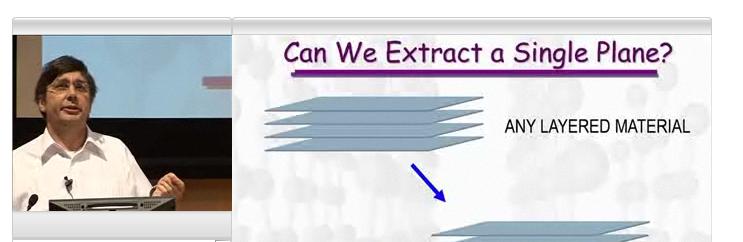
In 2008, Nobel laureate Andre Geim gave a lecture about graphene at the annual conference of the Condensed Matter and Materials Physics division of the Institute of Physics.

The lecture is called “Graphene: exploring carbon flatland” and you can watch it here.

Dear Guardian editor: that's the wrong Manc!

mancs.jpg

By Hamish Johnston

It used to be called the Manchester Guardian, so you would think the newspaper would be keen to feature two University of Manchester physicists who have just won the Nobel prize for discovering graphene.

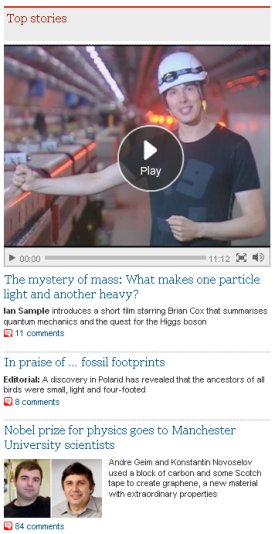
This morning there is a Manchester physicist on the top slot of the Guardian‘s science webpage, but it’s not laureates Andre Geim or Konstantin Novoselov.

And the Nobel news has been relegated to the third slot.

I suppose I should be heartened by the fact that the Nobel story has far more comments than the piece on particle physics – and I know that Brian Cox does a great job at communicating science to the public.

Maybe I’m asking too much for the rest of the UK to get excited about this Nobel prize. And perhaps here at physicsworld.com we give too much coverage to graphene – 82 articles and counting.

Of course it’s not the Guardian‘s job to promote UK science, but I can’t help thinking that this editorial decision is a reflection of how science is seen in the UK (and elsewhere).

We tend to be interested in a few flashy projects like the LHC and indifferent to scientists like Geim or Novoselov, who toil away in tiny labs making big discoveries with the potential of changing all our lives.

Upcoming lecture on many-worlds theory

BLOGmany-worlds.jpg
Credit: Detlav van Ravenswaay, Science Photo Library

By Margaret Harris

Like many physicists, I understand quantum mechanics only if I don’t actually think about it. Once I dig a bit deeper, I soon find myself scrabbling at the edges of some very big questions. Like, what does it actually mean for a wavefunction to “collapse”? And what role does the “observer” really play?

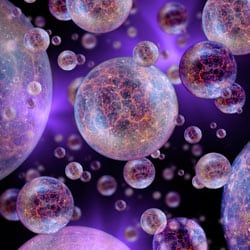
The so-called “many worlds” interpretation of quantum mechanics offers an intriguing answer to such questions. As postulated by the American physicist Hugh Everett III back in 1957, this theory suggests (among other things) that whenever we perform a quantum-mechanical experiment, the world splits into many alternative futures – as many futures, in fact, as there are possible outcomes of the experiment.

One advantage to this interpretation is that it bids a tidy goodbye to paradoxes like Schrodinger’s cat. Under many-worlds theory, there exists one universe in which the mind-boggling moggy is dead, and another in which it’s mewing its head off for supper. Simple. But given that the theory also suggests a riotous proliferation of probably-unobservable alternate universes, it is perhaps unsurprising that Everett initially struggled to get it taken seriously.

If this were a Hollywood movie, Everett’s life post-1957 would have been a noble (and ultimately successful) battle for recognition. In one of his possible worlds, perhaps that’s exactly what happened. In this one, however, Everett quit physics in disgust; took a job in military research; became an alcoholic; and died of a heart attack in 1982 – just when his theory was beginning to gain traction in the physics community.

To learn a bit more about Everett and his theory, I’d urge you to sign up for the latest in physicsworld.com‘s lecture series. In “Many Worlds: How Hugh Everett III Changed Quantum Mechanics”, Everett biographer Peter Byrne will describe the ways in which many-worlds theory evolved over the course of its inventor’s often-troubled life.

The lecture is free and will take place on Thursday 14 October at 4.00 p.m. BST. You’ll also be able to view the lecture afterwards. For more details, please see the registration page.

Free papers by 2010 Nobel-prize winners

paper6.jpg

By Hamish Johnston

As you might imagine we’re all rather chuffed here in the UK after two physicists at the University of Manchester won the 2010 Nobel Prize in Physics.

To celebrate, IOP Publishing (which brings you physicsworld.com) has made all papers published in its journals by Andre Geim and Konstantin Novoselov free to download.

You can dig into the papers here.

Clippers set sail for space

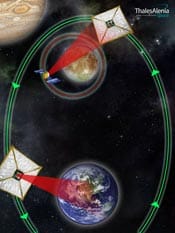
Artist's impression of the Thales Alenia Space interplanetary clipper

Engineers at Thales Alenia Space in France say it is possible to slash the amount of time needed to transport planetary data back to Earth by using spacecraft propelled by solar radiation. These “data clippers” could in principle shuttle continuously between Earth and the outer planets, returning large volumes of data decades earlier than is possible with conventional radio transmissions.

Satellites studying planetary bodies that are relatively nearby, such as the Moon and Mars, can transmit data back to Earth fairly quickly via a radio link. Missions observing more distant planets, however, face a problem because the 1/r2 attenuation in radio waves over these greater distances renders the signal sufficiently weak that transmission must be slowed down in order to guarantee that radio antennas on Earth can intercept the data.

As an example, says Thales’ Joël Poncy, a full high-resolution map of Jupiter’s moon Europa or Saturn’s moon Titan would require about 10–20 terabytes worth of data. However, data could not be sent via a radio link faster than about 1 gigabyte per day, which, he points out, means a transmission time of around half a century. More advanced optical links would be a little quicker, he says, perhaps taking around 20 years to complete the dispatch.

Sailing on a photon breeze

Poncy and colleagues at Thales have studied an alternative – data clippers. These spacecraft would use large lightweight “sails” that are pushed forward by the very slight but continuous radiation pressure of the photons emitted by the Sun. With onboard steering devices these clippers could be directed around the solar system so that they pass close to conventional spacecraft orbiting distant planets or moons, upload data from the spacecraft to an onboard flash memory using a laser beam and then perform a flyby of Earth, during which they download the data, again using the laser, to a ground station.

By passing within a few tens of thousands of kilometres of the orbiting spacecraft and of Earth, the divergence of the laser beam would be small enough to guarantee a fast data transmission rate – up to 1 gigabyte per second – and the data transport would therefore be limited simply by the time that it takes the clipper to travel from the planetary body back to Earth.

Speaking to delegates at the European Planetary Science Congress in Rome recently, Poncy said that he and his colleagues have proved the viability of data clippers by carrying out orbital mechanics calculations. He said they worked out that a data clipper could reach Europa, after accelerating by making several orbits close to the Sun, within about six years and it would then take three years to put itself on the right trajectory to be able to make a flyby of Earth. As he pointed out, that figure of three years compares favourably to the roughly 50 years that would be possible using current radio technology. The clipper could then in principle perform many more such upload and download cycles, visiting a different planetary orbiter each time.

Strong sailcloth needed

The Japanese Space Agency currently has a solar-sail-powered spacecraft, known as IKAROS, cruising towards Venus. According to Poncy, however, several technological hurdles need to be overcome in order to make solar sails suitable for data clippers. These include the development of a lightweight but strong material from which to make the sails – one possibility being a woven mesh of carbon nanotubes. Among the other challenges are how to unfold the huge 150 × 150 m sails in space and how to make the spacecraft sufficiently manoeuvrable so that they can approach the planetary orbiters but do so without propellant.

The development of data clippers is likely to take about 20 years and cost between €100m and €200m. Poncy says that government support will be essential; although he points out that his company has yet to make a formal request for funding from the European Space Agency. Speaking to physicsworld.com, ESA’s director of science and robotic exploration David Southwood described data clippers as “an interesting concept” but one “for the day after tomorrow rather than tomorrow.” He also queried Poncy’s claim that downloading data is “the major design driver” for interplanetary missions, maintaining that it is, in fact, “one problem of quite a few.”

Graphene pioneers bag Nobel prize


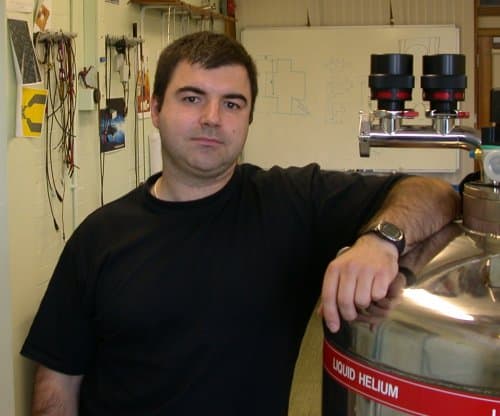
The 2010 Nobel Prize in Physics has been awarded jointly to Andre Geim and Konstantin Novoselov “for groundbreaking experiments regarding the two-dimensional material graphene”.

Both physicists work at the University of Manchester in the UK.

In a telephone interview with Swedish journalists minutes after the announcement, Geim said that he was answering e-mails when he found out about the award. “When I got the call, I thought ‘oh shit’, because it is a life-changing exercise.”

Graphene is a sheet of crystalline carbon just one atom thick. Many physicists believed that a 2D crystal like graphene would always roll up rather than stand free in a planar form, but in 2004 Geim and Novoselov brought to an end years of unsuccessful attempts to isolate graphene, and were able to visualize the new crystal using a simple optical microscope.

The material is very strong and an excellent conductor of heat and electricity. As such it is often described as a “wonder material” with many possible technological applications from ultra-fast transistors to DNA sequencing. When asked what is his dream application for graphene Geim replied, “That’s a difficult question…I don’t want to pick out any particular applications, there are so many.”

Ahead on intuition

“[Novoselov and Geim] really deserve the prize,” said Andrea Ferrari of Cambridge University, who started working on graphene shortly after its discovery. “They are way above other people in terms of their intuition and they have done key work in all the main subfields – looking at graphene’s electronic, mechanical and other properties.”

Ferrari also told physicsworld.com that the two physicists were very generous about sharing their discovery with other scientists. “From day one they were completely open about how to make graphene,” he said. “They trained the first generation of physicists in how to make graphene by inviting scientists to Manchester.”

The two researchers discovered the material by using a piece of adhesive tape to peel a single atomic layer off a piece of graphite – a process known as micromechanical cleavage or the “Scotch tape method”.

The pair then worked out how to make field-effect transistors using the material and discovered that electrons in the device were able to travel ballistically – that is, without being scattered – from the source to the drain electrode at room temperature.

As famous as silicon

In principle, ballistic transistors could operate much faster than conventional devices made of silicon and this discovery led to a flurry of research into the electronic properties of graphene that shows no signs of abating.

In 2005 Geim and Novoselov showed that the electrons in graphene behave like relativistic particles called “Dirac fermions” that have no rest mass. The pair also observed a new “half-integer” quantum Hall effect in the material.

More recently, Geim and Novoselov have shown that graphene has the ideal optical properties to form the transparent electrodes in liquid-crystal displays (LCDs); fabricated tiny quantum dots from graphene; and developed a new way of manufacturing sizable quantities of graphene. Just last year the pair created a new material called graphane by adding hydrogen atoms to their original discovery.

Surge of interest

The discovery of graphene triggered a surge of interest in the wonder material. Other researchers, for example, have found that graphene not only conducts heat very well but is also the “strongest material in the world”.

At a practical level, one team of scientists has created a new kind of chemical sensor by combining graphene with DNA, while another group used the material to gain a better understanding of surface-enhanced spectroscopy.

Novoselov was born in the Soviet Union in 1974 and did a PhD at the University of Nijmegen in the Netherlands before joining the University of Manchester in 2001, where he is Leverhulme Research Fellow. He is a British and Russian citizen.

Born in the Soviet Union in 1958, Geim did a PhD at the Institute of Solid State Physics in Chernogolovka, Russia. He was associate professor at the University of Nijmegen in the Netherlands before joining the University of Manchester in 2001, where he is director of the Centre for Mesoscience and Nanotechnology. He is a Dutch citizen.

‘We’ve struck gold’

Speaking to physicsworld.com in 2006 Geim said, “In the different areas that I’ve worked in for the last 20 years I’ve been searching for something big. I think with graphene at last I’ve found it. Before I relied on professionalism or hard work but never had the luck. Now at last I think I’ve been lucky and that we’ve struck gold.”

Geim is also famous for his 1997 “flying frog” experiment in which he and his colleagues in Nijmegen levitated a frog using a powerful magnet. He shared the 2000 “IgNobel” prize (with Michael Berry of the University of Bristol) for his efforts and is the first individual to win both awards.

Berry told physicsworld.com, “I’m delighted that my fellow IgNobelist has been Stockholmed. I knew it was only a matter of time, and it’s good they didn’t make him wait decades. Knowing him, it won’t spoil his scientific creativity – he has a great deal of science left in him.”

The prize is the second in as many days for UK-based scientists and comes at a time when British science is under threat from funding cuts. Marshall Stoneham, president of the UK’s Institute of Physics said that the physics prize shows the “strength of the British science base. It confirms at the highest level the excellence of UK physics”.

The Nobel prize is worth SEK10m and will be presented at a ceremony in Stockholm on 10 December.

Further information

Download three feature articles about Geim, Novoselov and their work on graphene here:

“Beyond the wonder material” by Konstantin Novoselov (PDF, 1 MB)
The Nobel winner describes the amazing properties of graphene’s chemical cousin graphane

“A physicist of many talents” (PDF, 140 KB)
Andre Geim talks to Physics World about his wide-ranging career

“Drawing conclusions from graphene” (PDF, 1.6 MB)
Antonio Castro Neto, Francisco Guinea and Nuno Miguel Peres explore the fascinating structure of graphene

Watch a lecture by Geim on graphene

“Graphene — exploring carbon flatland”
Andre Geim gives a video lecture on the importance of graphene at the 2008 Condensed Matter and Materials Physics conference of the Institute of Physics

Copyright © 2026 by IOP Publishing Ltd and individual contributors