Vote for your favourite accelerator photos

desyphoto.jpg

By Hamish Johnston

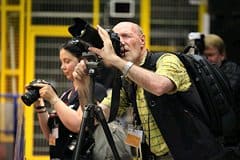
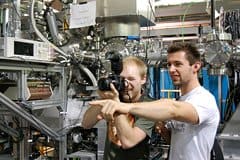
On 7 August five of the world’s leading accelerator labs opened their doors to amateur photographers in an event called the Particle Physics Photowalk.

The participating labs were CERN in Switzerland, DESY in Germany (pictured top right), Fermilab in the US, KEK in Japan and TRIUMF in Canada (bottom right).

The photographers were then invited to submit their best photographs and each lab selected three works to submit to the public.

You can vote for your favourite photos here.
triumfphoto.jpg

The winner will be announced after the voting closes on 8 October.

Which photo is my favourite?

I’m torn between Ali Lambert’s arrangement of paper clips standing up on what must be a very powerful magnet, and Hans-Peter Hildebrandt’s study of…well, I’m not sure what it is but it looks very nice!

Carl Wieman accepts White House science post

The Nobel-prize-winning physicist Carl Wieman has accepted a job with the Obama administration after being confirmed by the US senate as associate director for science in the White House Office of Science and Technology Policy (OSTP). Wieman, 59, reports to fellow physicist and OSTP director John Holdren, who joined the White House in 2009 from Harvard University. Wieman is the second physics Nobel laureate to be appointed by Barack Obama – the other being energy secretary Steven Chu.

The role of the OSTP is to advise the US president on the effects of science and technology on domestic and international affairs. Wieman, who shared the 2001 Nobel Prize for Physics with Wolfgang Ketterle and Eric Cornell for his work on atom optics, heads the OSTP’s science division. It comprises eight staff members, most of whom are science policy analysts.

Wieman is taking unpaid leave from the University of British Columbia (UBC), where he is director of the Carl Wieman Science Education Initiative (CWSEI). The 59-year-old physicist set up the CWSEI in 2007 to change the way that science is taught at UBC and other universities. Wieman thinks that a radical overhaul is essential because almost all the data from research in science education suggest that students in traditional lecture courses learn very little.

Testing physics education

The CWSEI is a test bed for Wieman’s idea that physics teaching must become more “scientific”. He believes that theories about how students learn and what can bring out the best in them must be based on proper quantitative measurements. Speaking in an interview with Physics World magazine in January 2007, Wieman warned that “if students go to classes and they sit there watching the lecturer writing equation after equation on the board, we know that they are going to leave science in droves, thinking this is really tedious stuff”. But, he added, a different result would be obtained through good teaching that requires students “to reason through ideas and argue their points of view”.

Wieman also maintains a research lab at the University of Colorado, where in 1995, he and Cornell coaxed a gas of ultracold rubidium atoms into a Bose–Einstein condensate – a state of matter in which all of the atoms condense into the same quantum ground state. This breakthrough has spurred the work of dozens of other research groups around the world, and could have implications across physics, from superconductivity to quantum computers.

Should we attach any weight to what Stephen Hawking says about God?

rees.jpgBy Hamish Johnston

“I know Stephen Hawking well enough to know he has read very little philosophy.”

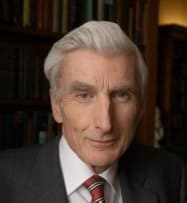
So says Martin Rees (pictured right), who as president of the Royal Society is seen by many as the voice of British science.

Rees – who like Hawking is a cosmologist – was speaking to the Independent‘s Steve Connor about politics, the fate of mankind and Hawking’s views on the existence of God.

You can read Connor’s piece here.

Relativity with a human touch

In the famous twin paradox, a sibling who journeys in a fast-moving spacecraft will return home younger than the sibling who remained on Earth. While this apparent slowing of time occurs whenever a body is set in motion, it had been much too small to be detected for movement on a human scale.

But now physicists in the US have used two of the world’s most accurate optical clocks to see this and other relativistic effects at speeds and distances on a human scale. The team has seen time slow down in a clock moving less than about 35 km/h relative to its twin. It has also showed that time speeds up in a clock that is hoisted a mere 33 cm above the other.

James Chin-Wen Chou and colleagues at the National Institute of Standards and Technology (NIST) in Boulder, Colorado used two clocks – each based on just one aluminium ion – to do their time dilation experiments. The first such clock was unveiled by the team earlier this year and has the ability to remain accurate to within one second in 3.7 billion years and the second has a similar accuracy.

Quantum logic readout

In both clocks the ion is trapped and cooled using electric fields and laser light. The frequency of the clock is given by a specific optical transition of the ion, which is measured by firing a laser at the ion and locking the laser onto that frequency at which the light is absorbed. This is done with the help of a single magnesium ion (beryllium in the second clock) that is entangled with the aluminium in a process called quantum logic spectroscopy (QLS).

To observe the time dilation at the heart of the twin paradox, the team set one of the aluminium ions into a slow oscillatory motion by adjusting the electric fields used to trap it. The ion in the other clock remained more or less stationary and when the team compared the frequency of the clocks it found that time on the moving ion slowed by a factor of about 10–16 when its average speed was about 10 m/s (35 km/h). The team repeated its measurements at different speeds between 0 and 40 m/s and found that the time dilation occurred exactly as predicted by special relativity.

The team then did a second experiment to try to see a consequence of Einstein’s general theory of relativity called “gravitational time dilation”. This occurs when one clock is elevated with respect to another and is therefore at a different value of Earth’s gravitational potential energy.

Jacking up a clock

This effect was measured by first running the clocks at a vertical difference of 17 cm and then jacking one of the clocks up by 33 cm and running them again. This revealed a shift of about 4 × 10–17 in the frequencies of the clocks – in agreement with general relativity. In human terms, this time difference adds up to about 90 billionths of a second over an 80-year life span.

To make these measurements, the team must run its clocks for tens of hours to get the required accuracy. Chou told physicsworld.com that the team is now trying to reduce this time. If successful, the clocks could be used to detect tiny variations in Earth’s gravitational potential. A network of such clocks placed around the world could, for example provide valuable information to geophysicists.

Gerald Gwinner of the University of Manitoba believes that such a network would be very useful. “The ability to connect such clocks via long-distance fibre links would indeed allow us to create a real-time network of gravitation monitors,” he explained. “Geophysics and environmental sciences could benefit enormously from such tools.”

Gwinner added that the NIST demonstration could help physicists explain time dilation to the public. “I will be able to tell the audience that now we can even see time dilation at the speed of waving an arm. Just like I waved my arm, they waved their ions back and forth.”

The work is reposted in Science 329 1630.

Graphene makes ‘supercapacitor’

Researchers in the US have made the first high-frequency AC “supercapacitors” containing graphene electrodes. The devices, which are much smaller than conventional capacitors, could be used in applications like computer processing units and other tiny integrated circuits.

Capacitors are devices that store electric charge. “Supercapacitors”, more accurately known as electric double-layer capacitors (DLCs) or electrochemical capacitors, can store much more charge thanks to the double layer formed at an electrolyte-electrode interface when voltage is applied.

Commercial DLCs are extremely powerful when compared with batteries but they are essentially DC devices – that is, they take several seconds to fully charge and then several seconds to fully discharge again. They operate efficiently at frequencies below about 0.05 Hz and are therefore good for applications like hybrid vehicles, which can take up to 10 seconds to charge (when braking) and 10 seconds to discharge (when accelerating). However, at higher frequencies, they become much less efficient and start to behave like resistors rather than capacitors. This is because the devices usually contain porous electrodes made from a high-surface-area conductive material, such as activated carbon, and the pores increase the resistance of devices.

Now, John R Miller and colleagues of JME Inc. in Shaker Heights and Case Western Reserve University, Cleveland, both in Ohio, have overcome this problem by developing the first DLC that contains vertically oriented high-surface-area graphene electrodes that aren’t porous at all. The device pushes the operating frequency of an electric double layer capacitor to well beyond 5000 Hz, which is a factor of 105 better than commercial DLCs. What’s more, it is six times smaller than low-voltage aluminium electrolytic capacitors and can be charged and discharged at high efficiency in times much shorter than 1 ms.

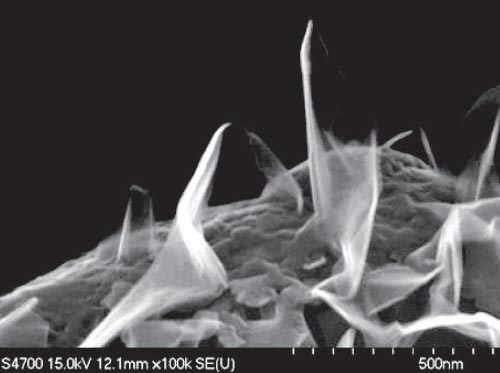
The researchers grew the graphene – 2D sheets of carbon just one atom thick – on a metal using a plasma-assisted chemical vapour deposition process.

Such vertically oriented graphene sheets are ideal in terms of structure for high-frequency DLC electrode applications, says the team. They have many edge planes that can provide between 50 and 70 µF/cm2 of capacitance compared with basal planes, which only provide 3 µF/cm2. These charge-storage edge planes are highly exposed and can thus be accessed directly, which means that charge can be stored over precise areas rather than being dispersed over larger regions. And last but not least, the nanosheet “stacked” structure ensures that pores are reduced – so minimizing resistance – and the sheets themselves are highly conducting.

“The bottom line is that these devices could lead to smaller higher-frequency capacitors for applications in low-voltage systems like CPUs and similar integrated circuits,” Miller said.

The research might also enable new classes of electronic circuit that use the much higher levels of capacitance that these devices make available, he adds.

The team, which includes scientists from the College of William and Mary in Williamsburg and the Defense Advanced Research Projects Agency, both in Virginia, now plans to improve how the graphene electrode material is grown and optimize the design of the capacitive devices.

The work was published in Science.

The Feynman Variations

By Hamish Johnston

imagine.jpg

The BBC has a wealth of archive material at its disposal – everything from Led Zeppelin performances to television programmes featuring the late physicist Richard Feynman.

The latter was featured earlier this week on the BBC Radio 4 show The Archive Hour, presented by particle physicist and media darling Brian Cox.

“As curious as he was clever”, is how Cox describes Feynman. In an archive recording, Hans Bethe calls Feynman “a magician”.

Feynman (1919–1988) is widely celebrated as the greatest physicist of his generation – the first generation after the founding of quantum mechanics.

Heisenberg, Shrödinger and Dirac were a tough act to follow, but Feynman did so with remarkable flair. He developed the path integral formulation of quantum mechanics, shared the 1965 Nobel prize for his work on quantum electrodynamics, and brought us Feynman diagrams.

Feynman was also a keen teacher and populizer of physics, which is what much of the BBC programme focuses on. It includes contributions from Steven Weinberg, Freeman Dyson and the filmmaker Christopher Sykes. In the 1980s, Sykes made a series of television programmes with Feynman called The Pleasure of Finding Things Out and Fun to Imagine, which you can also watch on the BBC website .

A fascinating insight into how Feynman explains science can be had from an exchange in which Sykes asks Feynman a simple question about why magnets repel each other. Feynman admits that there is no simple way of explaining why and trying to simplify the problem would do the questioner no service.

But the highlight of the programme is listening to Feynman speaking enthusiastically in his “Noo Yawk” accent about why he is curious about science – sounding more like a Borscht Belt comedian than one of the 20th century’s greatest thinkers.

There were no mother-in-law jokes, but Feynman did tell a funny story about his childhood summers in the Catskills.

Curious correlations seen by CMS


A subtle and unexpected signal in data from the Large Hadron Collider (LHC) in Geneva could mean that the proton accelerator is capable of creating a “hot soup” of interacting particles called a quark–gluon plasma.

The result comes as a surprise because physicists had believed that colliding protons at the LHC should not create such a plasma – hints of which have already been spotted by the RHIC accelerator in the US, which smashes heavy ions such as gold together.

Hundreds of particles

When two protons collide at 7 TeV at the LHC, hundreds of particles can sometimes be produced and detected. In order to understand the underlying physics, physicists look for correlations between the angles at which pairs of particles fly away from the point of impact.

Researchers using the Compact Muon Solenoid (CMS) experiment at the LHC had expected that a plot of the correlations would show a peak where the angles are zero, which would mean that the particles are leaving the collision point in a jet pointing in a specific direction. Instead, the peak seems to be riding on top of a ridge-like structure. This suggests that some particles are heading off in completely different directions – and correlations between pairs of these wayward particles are set by some sort of interaction between the particles when they were created in the collision.

One possible interpretation of the ridge is that the collision creates a dense fluid of many quarks and gluons – a quark–gluon plasma – which then condenses to produce the detected particles. The collective motion of the plasma could be transferred to the particles, resulting in the mysterious correlations. The problem with this explanation is that protons in the LHC shouldn’t create such a plasma.

New physics?

Another possibility is that CMS has caught sight of a hitherto unknown collective process that occurs when protons collide – something that would require a significant revision of our understanding of such collisions.

“Now we need more data to analyse fully what’s going on, and to take our first steps into the vast landscape of new physics we hope the LHC will open up,” said CMS spokesperson Guido Tonelli.

The exact nature of the quark–gluon plasma is of great interest to physicists because the universe is believed to have been such a hot soup shortly after the Big Bang.

The results are described in a preprint on the arXiv server.

Nano pioneers give food for thought

By Louise Mayor

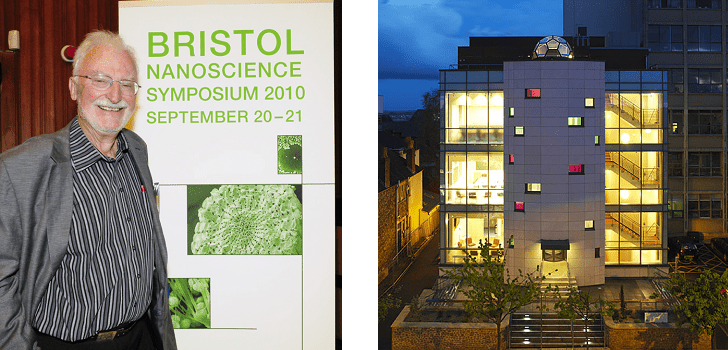
This week I was at the scientific opening of the Centre for Nanoscience and Quantum Information (NSQI) at the University of Bristol. The event coincided with the Bristol Nanoscience Symposium 2010, and featured great talks from some of the pioneers of nanoscience and nanotechnology.

Rohrer_NSQI.PNG
(Left) Nobel Laureate Heinrich Rohrer declared the centre officially open. Photo credit: Jesse Karjalainen. (Right) The NSQI centre itself – the labs are out of sight and sound in the basement. Can you spot the nano-inspired architectural feature?

At the opening event on Monday evening, IBM Fellow Charles Bennett talked about how to make quantum information “more fun and less strange”. His educational analogies included the idea of monogamy in quantum information – that the more entangled two systems are with each other, the less entangled they are with any others. “The lesson is this: two is a couple, three is a crowd”, he said. He also talked about how information doesn’t get lost in quantum systems but does in classical ones – how it’s like there are eavesdroppers, and it’s harder to factorize when someone’s looking over your shoulder.

The stage was then passed over to Heinrich Rohrer (pictured), a figure revered by many in the audience. It was Rohrer, along with Gerd Binnig, who invented the scanning tunnelling microscope – an instrument that can image and manipulate single atoms – for which they were co-recipients of the Nobel Prize in Physics in 1986. Rohrer was at the time at IBM’s Zurich lab.

Rohrer commented about the “nano” revolution – that some say it’s hype, while others are more relaxed about it. “Let us not make a discipline out of ‘nano’ ”, he warned. He also said that the new trend is for people to operate using claims and catchphrases rather than careful explanations; he noted that in all his reading of Einstein’s papers he never once found words such as “new” or “unique”.

In his closing comments, Rohrer proposed a litmus test for the centre’s success. He said that if the NSQI can attract a good number of female nanoengineers and nanomechanics then it is a good sign of interesting research being done at the centre – and then you’re on the right track for the future. He then declared the centre officially open, and we all piled in to the centre for champagne and a tour of the labs, which are described in a previous blog entry: Visiting the quietest building in the world.

But for me, the most exciting talk was given the following day by Stanley Williams of Hewlett-Packard (HP)…

(more…)

Fresh water may have cooled North Atlantic

The decrease recorded in the Earth’s temperature between the 1940s and 1970s was caused by a sudden cooling of the oceans in the northern hemisphere. That is the verdict of climate researchers in the US and UK, who have found that that much of this cooling could have been brought about by a rapid influx of fresh Arctic water into the North Atlantic. Others, however, dispute this finding, arguing that the temperature drop can be explained by longer-term ocean phenomena and human pollution.

Although the surface of the Earth is some 0.8 °C warmer than it was at the beginning of the 20th century, that rise in temperature has not been steady. Increasing until the 1940s, it then fell slightly over the next 30 years, before climbing again from the mid-1970s onwards. This pattern is widely regarded as an underlying warming of the planet by increased concentrations of atmospheric greenhouse gases, combined with a mid-20th century cooling brought about by a rise of sulphate aerosols in the troposphere – which reflect some solar radiation – as well as fluctuations in the world’s oceans that take place over decades. The fact that mid-20th century cooling was confined to the northern hemisphere seems to support the aerosol hypothesis, given that the fastest rise in emissions of sulphate aerosols was seen over North America, Europe and Asia.

However, David Thompson of Colorado State University and colleagues believe that this analysis is based on a flawed reading of changes to the temperature of the northern hemisphere’s oceans. They point out that identifying trends in surface temperatures requires removing the effects of short-term events that are cyclical or random, such as the El Niño oscillation and volcanic eruptions. But they maintain that this removal usually involves smoothing out temperature fluctuations, which means that brief, but non-cyclical, changes are also erased.

Too much smoothing?

Team member John Wallace of the University of Washington in Seattle likens this to a simplification of stock market data. “To see the longer-term market trends it is better to smooth out much of the daily ups and downs,” he says. “But if you smooth the data too much you do not see sudden changes such as stock market crashes.”

The researchers devised a new data analysis technique that they say gets rid of the unwanted cyclical phenomena while preserving any rapid fluctuations that contribute to longer-term change. They found that the sea-surface temperatures in the northern hemisphere did not decrease gradually in the decades following the Second World War, as would be expected if aerosols were principally responsible for the northern hemisphere cooling, but that temperatures fell very rapidly – by about 0.3 °C between 1968 and 1972.

The team has found this sudden drop both in the temperature data of the northern hemisphere in isolation and in the difference between the northern and southern temperatures. It also established that it could not be a mere artefact of the measurement process, as it says is the case for a sudden drop in global sea temperatures recorded immediately after the Second World War, which they attribute to a change in the relative numbers of British and American ships at sea. The rapid dip around 1970, it says, is present in all available historical data sets of sea-surface temperature and cannot be linked to any known biases in temperature measurements.

Outpouring of cold, fresh water

As to what caused this sudden drop in temperature, Wallace says that it might have been partly due to an outpouring of relatively cold, fresh water from the Arctic into the Atlantic that was known to have taken place about the same time. But he is reluctant to attribute all of the cooling to this process. He and his colleagues found that most of the cooling took place in the Atlantic but that some also occurred in the Pacific, which would not have received any of the fresh water.

Dan Hodson of the University of Reading in the UK points out that some climate models also predict rapid hemispheric cooling as a result of fresh water being deposited in the north Atlantic. He describes the latest research, which he was not involved in, as “another piece of the puzzle in the ongoing effort to decipher the 20th century climate record” and says that it will “improve our understanding of the underlying detailed mechanisms of climate change”. And he warns that “we should be especially vigilant” if Arctic fresh water can indeed cause rapid ocean cooling. He says that the freshwater released from a rapidly melting Arctic might mitigate some of the impacts of global warming but points out that a very rapid melting could have widespread negative effects such as reducing crop yields.

However, Michael Mann of Pennsylvania State University in the US is not convinced. He believes that some scientists have overestimated the significance of multidecadal ocean oscillations on global temperatures but maintains that these oscillations can explain the rapid temperature drop around 1970 identified by Thompson’s team, adding that fairly abrupt temperature changes earlier in the 20th century can also be explained purely in terms of such oscillations.

The work is described in Nature.

Surprises from Planet Mercury

By Margaret Harris in Rome

The European Planetary Science Congress is taking place this year just a stone’s throw from Rome’s Imperial Forum, so it’s appropriate that the scientific programme is speckled with Roman gods and goddesses – specifically Mercury, Venus, Mars, Titan and Saturn. With missions to all these heavenly bodies dominating the agenda, picking a session to attend wasn’t easy, but in the end I plumped for Mercury, hoping to learn more about the smallest, hottest planet in our solar system.

I wasn’t disappointed. It turns out that NASA’s Messenger mission is already reshaping our understanding of Mercury, even though the spacecraft isn’t due to enter Mercury’s orbit until 18 March 2011. Prior to that momentous date, however, the spacecraft performed three flybys, and the data collected during those intentional near-misses have revealed – among other things – a planet that was far more volcanically active, for far longer, than scientists had previously thought.

An earlier mission, Mariner 10, had helped define the image of Mercury as a dead, cratered lump of rock, more like the Earth’s Moon than a “proper” planet. Now that the Messenger flybys have mapped over 90% of its surface (compared to Mariner 10’s 50%), a more complex picture is emerging. Mercury did, in fact, have active volcanoes early in its history; indeed, volcanic activity was so extensive that the top 5 km of the planet’s crust is mostly the remains of pyroclastic flows, with some impact ejecta (stuff kicked up when meteors and so on hit) thrown in. And some of these flows are quite recent, at least by Mercury’s standards – less than 1 bn years old, which makes it younger than some rock formations on Earth.

Later talks in the same session added to the impression of a surprisingly complex planet, and it’ll be interesting to see whether the surprises keep coming once Messenger gets into its stride next year.

Copyright © 2026 by IOP Publishing Ltd and individual contributors