‘Self-repairing’ photovoltaics not damaged by the Sun

The test cell the team built to measure the properties of the self-assembling photosynthetic system

Researchers at the Massachusetts Institute of Technology have fabricated the first synthetic photovoltaic cell capable of repairing itself. The cell mimics the self-repair system naturally found in plants, which capture sunlight and convert it into energy during photosynthesis. The device could be 40% efficient at converting solar power into energy – a value that is two times better than the best commercial photovoltaic cells on the market today.

During photosynthesis, plants harness solar radiation and convert it into energy. Scientists have been trying to mimic this process in synthetic materials, but this has proved difficult because the Sun’s rays damage and gradually destroy solar-cell components over time. Naturally occurring plants have developed a highly elaborate self-repair mechanism to overcome this problem that involves constantly breaking down and reassembling photodamaged light-harvesting proteins. The process ensures that these molecules are continually being refreshed, and so always work like “new”.

Michael Strano and colleagues have now succeeded in mimicking this process for the first time by creating self-assembling complexes that convert light into electricity. The complexes can be repeatedly broken down and reassembled by simply adding a surfactant (a solution of soap molecules). The researchers found that they can indefinitely cycle between assembled and disassembled states by adding and removing the surfactant, but the complexes are only photoactive in the assembled state.

Light reaction centre

The complexes are made up of light-harvesting proteins, single-walled nanotubes and disc-shaped lipids. The proteins (which are isolated from a purple bacterium, Rhodobacter sphaeroides) contain a light reaction centre (carried by the lipids) comprising bacteriochlorophylls and other molecules. When the centre is exposed to solar radiation, it converts the sunlight into electron-hole pairs (excitons).

The excitons then shuttle across the reaction centre and subsequently separate back out again into electrons and holes. The nanotubes – which act as wires – channel the electrons, so producing a current. The nanotubes also serve to align the lipid discs in neat rows, ensuring that the reaction centres are uniformly exposed to sunlight.

“The beauty of this system is that a jumbled solution of components can spontaneously arrange itself into highly organized structures, containing thousands of molecules in a specific arrangement, by simply removing the surfactant,” team member Ardemis Boghossian explained.

Apples and oranges

“Using the regeneration process, we are able to prolong the lifetime of our solar cell indefinitely, increasing our efficiencies by more than 300% over 164 hours of continuous illumination compared to a non-regenerated cell,” added Boghossian. “If we were to increase the concentration of these complexes to make a completely stacked, highly packed formation, we could approach the theoretical limit of 40% – which is well beyond the efficiencies we see in commercial solar cells on the market today.”

Comparing the MIT complexes to existing solar cells is like “comparing apples to oranges” though, she insists. “Most solar cells are static because they are made of solid slabs of silicon or thin films. Our solar cells are dynamic, just like plant leaves that can recycle their proteins as often as every 45 minutes on a really sunny day.”

“We’re basically imitating tricks that nature has discovered over millions of years – in particular ‘reversibility’, the ability to break apart and reassemble,” added Strano.

The work was reported in Nature Chemistry.
M-theory, religion and science funding on the BBC

singh2.jpg
Vince Cable believes in cuts, but what about God and M-theory?

By Hamish Johnston

This morning there was lots of talk about science on BBC Radio 4’s Today programme – but I think it left many British scientists cringing under their duvets.

Stephen Hawking was on the show explaining why M-theory – an 11-dimensional structure that underlies and unifies various string theories – is our best bet for understanding the origin of the universe.

Hawking explained that M-theory allows the existence of a “multiverse” of different universes, each with different values of the physical constants. We exist in our universe not by the grace of God, according to Hawking, but simply because the physics in this particular universe is just right for stars, planets and humans to form.

There is just one tiny problem with all this – there is currently little experimental evidence to back up M-theory. In other words, a leading scientist is making a sweeping public statement on the existence of God based on his faith in an unsubstantiated theory.

This, and other recent pronouncements from Hawking in his new book The Grand Design were debated in a separate piece on Today by brain scientist Susan Greenfield and philosopher AC Grayling. Neither seemed too impressed with many of Hawking’s recent statements and Greenfield cautioned scientists against making “Taliban-like” statements about the existence of God.

That brings me to another bit of news making the headlines in the UK – huge and looming cuts in science funding.

The cuts will be implemented by Vince Cable who is the UK’s secretary of state for business, innovation and skills.

He was interviewed in a third piece on Today and made the remarkable claim that “45% of research grants [in the UK] go to research that is not of an excellent standard”.

Ouch…and to save money, the government will soon be “rationing funds by quality”.

So what does this have to do with Stephen Hawking and M-theory?

Physicists need the backing of the British public to ensure that the funding cuts don’t hit them disproportionately. This could be very difficult if the public think that most physicists spend their time arguing about what unproven theories say about the existence of God.

The challenge, of course, is how to make the public aware of all the fantastic work done by other British physicists.

Filaments swarm and swim in circles


Swarms of insects and flocks of birds are examples of natural systems in which individual components act independently, yet together display complex collective motion. Scientists have extensively modelled such systems theoretically but have lacked the experimental apparatus to put their theories to the test. Now, a group of biophysicists in Germany has studied a simple biological “active system” in the laboratory and has shown that collective motion kicks in when the system becomes dense enough.

Active systems occur when a source of energy keeps groups of particles away from thermal equilibrium. Those of greatest interest consist of entities that are self propelled and orientable, such as the actin filaments that make up the skeleton of biological cells. Powered by myosin proteins, these filaments allow cells to move and divide coherently.

In 1995 the theoretical physicists John Toner and Yuhai Tu put forward a model to describe the collective motion of large groups of organisms, and other researchers have since expanded it to cover active systems more generally. However, experimentalists have so far been unable to create systems in the laboratory that are simple and adjustable enough to test the models.

Thrusting proteins

Now Andreas Bausch of the University of Technology, Munich (TUM) and colleagues have created such a system in a sample made up of actin and the myosin. One end of each of the myosin molecules was connected to a glass slide immersed in water with the other end free to bind with 10 µm long actin filaments. A thrusting movement of the myosin then set the actin in motion.

Such samples have been prepared by biologists since the 1970s, but these studies have focused on the behaviour of the myosin. This latest breakthrough came one Friday afternoon when Bausch and colleagues decided to see what would happen when they increased the density of actin filaments in the sample by up to a factor of 1000.

The researchers found that the filaments move around randomly in samples with an actin density less than about five per square micron. But above this critical density, the filaments form distinct clusters between 20–500 µm across that move around erratically and endure for several minutes.

Spiral and bands

Things get even more interesting at densities greater than about 20 filaments per square micron, where the filaments group together in bands that move across the sample as waves. These bands remain stable for as long as the observations are carried out (up to half an hour) and span several centimetres. In addition, the researchers found that at all densities above the critical density the filaments can also create spiral patterns lasting up to 10 minutes.

To try and understand the origin of this collective motion Bausch, together with Erwin Frey of the Ludwig Maximilians University in Munich and colleagues, carried out a computer simulation of the system. This involved the simple assumptions that filaments repel each other when they get close enough – without specifying the mechanism responsible for the repulsion – and that filaments tend to align themselves along the average direction of neighbouring filaments. The simulation successfully reproduced the cluster motion and the waves but not the spiral patterns. They think that the spirals are caused by longer-range interactions brought about by the flow fields set up in the water by each of the filaments, and which were not included in the simulation.

The work is reported in Nature 467 73. Writing in the “News and views” section of the journal, physicists Jean-François Joanny of the Institut Curie in Paris and Sriram Ramaswamy of the Institute of Science in Bangalore, India, describe the work as a “crucial quantitative, experimental demonstration” of collective motion in a biological system.

The physicist’s approach

The researchers maintain that the close similarity between the patterns seen in the experiments and those predicted by simple theoretical models underlines the value of what they call “the physicist’s approach” to studying such systems; in other words, the strategy of ignoring chemical and biological details. They propose building up a phase diagram of filament behaviour by systematically varying the density and activity of the motor molecules in future experiments, and then testing the universality of this diagram by comparing it to the results of experiments carried out on real systems.

Graphene transistor beats speed records

Researchers in the US have developed a new way of making transistors from graphene – a sheet of carbon just one atom thick. The technique overcomes a major obstacle facing those who want graphene to replace silicon as the material of choice in future electronic devices. It has also been used to make the highest-speed graphene transistors ever.

The semiconductor graphene is seen by many as an ideal material for electronic devices because it is extremely thin yet has high electrical and thermal conductivity and great physical strength. Unfortunately, however, the processing techniques currently used by the semiconductor industry cannot be applied to graphene because they introduce defects into the material, which ultimately deteriorate device performance.

Now, Xiangfeng Duan and colleagues the University of California at Los Angeles have developed a new fabrication technique that involves employing alumina-coated nanowires as the gate electrode in a graphene transistor. The device’s source and drain electrodes are then made using a self-aligning process using the nanowires as “masks” – a process that also minimizes resistance in the transistor, so improving its performance even further.

Graphene consists of a single, flat sheet of carbon arranged in a honeycombed lattice. Since the material was first created in 2004, its unique electronic and mechanical properties have amazed researchers, who have been eyeing it up for a host of device applications. In particular, it could be used to make ultrafast transistors because the electrons in graphene behave like relativistic particles with no rest mass. This means that they whiz through the material at extremely high speeds.

There are still lots of challenges to be overcome, however, before the dream of all-graphene electronics becomes reality. One of these is to develop a fabrication technique that produces nearly defect-free devices, something never achieved until now.

Conventional processing methods to make state-of-the-art silicon metal-oxide-semiconductor field-effect transistors (MOSFETs) involve using a self-aligned gate structure to ensure that the edges of the source, drain and gate electrodes are precisely positioned. This avoids any overlapping between the electrodes, thus minimizing resistance in a device. (High resistance is a bane for nanoscale devices since it slows them down). The same technique does not work for graphene though because the technique unavoidably introduces defects into the material’s lattice.

Duan and colleagues have instead used a cobalt-silicide-alumina core-shell nanowire as the top gate in their graphene transistor. This dielectric nanostructure is made in a separate step and then simply placed on top of a monolayer of graphene afterwards. Such an approach does not introduce any appreciable defects into the material, says Duan.

Nanowire mask

The researchers then place a thin layer of platinum on top of the graphene – across the nanowire such that the wire separates the thin film of graphene into two isolated regions. These two separate areas then form self-aligned source and drain electrodes next to the nanowire gate. In this work, the nanowire mask also defines the gate length of the device, in this case about 140 nm.

The finished devices have the highest transconductance value ever reported for such devices, of 1.27 mSµm–1. The transconductance of a transistor determines how well it performs. Microwave measurements on the transistors also show they have a record-breaking intrinsic cut-off frequency in the range of 100–300 GHz, which is about twice as fast as the very best silicon MOSFETs of a similar size. Finally, the mobility of the devices (which determines how fast electrons move through them) is about 20,000 cm2/Vs – a value that is around two orders of magnitude better than that of similarly sized commercial silicon transistors.

“Demonstrating graphene transistors with a cut-off frequency comparable to the very best transistors out there marks an extremely important step in graphene research,” Duan said. “This clearly demonstrates the exciting potential of graphene-based electronics for future high-frequency circuits.”

The team now plans to fabricate transistors with smaller gate lengths to push the cut-off frequency even higher – perhaps towards 1 THz. “We also hope to scale up the approach to fabricate big arrays of high-speed graphene transistors on large-area substrates, including flexible substrates,” revealed Duan.

The work was published in Nature.

Will a new law stifle physics in Canada?

By Hamish Johnston

UPDATE: A tentative agreement has been reached by CAP and PEO on the natural sciences exemption.

Professional engineering is a closed shop and rightly so – you wouldn’t want to fly in an aeroplane designed and built by someone with no knowledge of aeronautical engineering principles. As a result, many jurisdictions use laws to define a set of tasks that can only be done by professional engineers.

But could this prevent physicists from doing their jobs? Yes, according to the Canadian Association of Physicists (CAP), which is trying to stop changes to the Ontario Engineering Act in Canada’s most populous province.

The offending revision ensures that only a professional engineer can apply engineering principles to an activity that “concerns the safeguarding of life, health, property, economic interests, the public welfare or the environment”.

The problem is that many engineering principles are also principles of physics (or chemistry, biology etc.). Here’s an example…

F = ma is an engineering principle and it makes perfect sense that only a professional engineer should be allowed to approve a bridge design based on such principles.

However, F = ma could also be used by a physicist to design an ion-trap-on-a-chip for a commercial quantum computer. Because economic interests are involved, the new act would require that an engineer “sign off” on the physicist’s design before it is implemented – even if the engineer knows little or nothing about quantum computing.

CAP president Henry van Driel says that such restrictions “could make it impossible for many, if not most, natural scientists to practice their professions in industry, government and universities”.

In the past, CAP and other scientific societies have negotiated with lawmakers and provincial engineering bodies to win exemptions for natural scientists. Indeed, these are spelled out in guidelines that can be downloaded from the website of Engineering Canada, Canada’s national engineering association

But now in a letter to its members, CAP is claiming that the professional body of Ontario engineers (PEO) is intent on removing the exemption and did not consult with Canada’s scientific societies while the new legislation was being drafted.

As a result, CAP had been in the dark about the changes until the bill had made significant progress through the Ontario legislature.

Now, van Driel has called on the Ontario government to make a last minute amendment to the bill that exempts natural scientists. You can read his letter here.

Each of Canada’s 10 provinces has its own engineering laws and professional bodies, so the PEO is probably in its right to ignore the Engineering Canada guidelines. However the affair doesn’t reflect well on relations between the nation’s engineers and physicists.

I’m also surprised that CAP seems to have been caught out by the revisions. The organization has been fighting this battle for nearly 30 years, so it should have seen this coming.

Talking Hawking and God

By James Dacey

It hasn’t even been released yet but the media is awash with commentaries about Stephen Hawking’s new book, The Grand Design. People are jumping on the astrophysicist’s assertion that we no longer need a God to explain our existence because M-theory – a unified version of string theory – can now explain how the universe emerged from the vacuum.

“Because there is a law such as gravity, the universe can and will create itself from nothing. Spontaneous creation is the reason there is something rather than nothing, why the universe exists, why we exist. It is not necessary to invoke God to light the blue touch paper and set the universe going,” writes Hawking in an extract from The Grand Design, published yesterday in The Times.

“M-theory is the most general supersymmetric theory of gravity. For these reasons, M-theory is the only candidate for a complete theory of the universe. If it is finite – and this is yet to be proved – it will be a model of the universe that creates itself. We must be part of this universe, because there is no other consistent model.”

But the backlash from certain religious spokespeople has already begun, including the chief rabbi, Lord Sacks, who wrote an accompanying opinion piece in the The Times warning of the dangers of overvaluing scientific knowledge. “There is more to wisdom than science. It cannot tell us why we are here or how we should live. Science masquerading as religion is as unseemly as religion masquerading as science,” he writes.

The story was also covered in detail last night by the UK’s Channel 4 News (see video above) who hosted a discussion between Jon Butterworth, a particle physicist at University College London, and Alister McGrath, the chair of theology, religion and culture at King’s College London.

McGrath, a Christian theologian who previously studied physics at the University of Oxford, unsurprisingly points out that M-theory may hold all the answers to all fundamental questions. “All [Hawking] has done really is to simply move things one step into the distance…where do all these laws come from given they are of such importance?” he asks.

Butterworth, a self-professed atheist, agrees that M-theory is far from a grand unified theory of everything, but questions the need for a deity to fill in the gaps to reveal the origin rules of physics. “Whether you find it helpful to label the primary cause as God or some form of ‘pre M-theory quantum vacuum’ doesn’t really have much impact on our understanding of the universe to me, and it doesn’t really have much impact on my life as far as I can see.”

The Grand Design is published on 7 September.

Brazilian wondergoal was no fluke, say physicists

By James Dacey

By many fans it is considered to be one of the most brilliant (soccer) goals ever scored, but by others it is dismissed as a bizarre fluke probably caused by rare atmospheric conditions.

The free kick scored by Brazilian fullback Roberto Carlos against France in 1997 is said to have “defied physics” on account of its wicked late swerve that stunned both the French goalkeeper and thousands of fans.

Now, 13 years on, physicists in France say that they can finally explain what happened and they believe that the wonder strike was no fluke.

On that early summer night in Lyon, Carlos struck the ball at around 35 m from the French goal. It was heading so far to the right that it initially cleared the wall of defenders by at least a metre and made a ballboy, who stood metres from the goal, duck his head. Then, almost magically, the ball curved to the left and entered the top right-hand corner of the goal.

In all the talk over the years, pundits and the occasional scientist have suggested a number of possible causes. They range from a gust of wind, to a materials effect in the ball, to unusually dry localized conditions as explained in this Physics World feature article from 1998. But the case has never been closed.

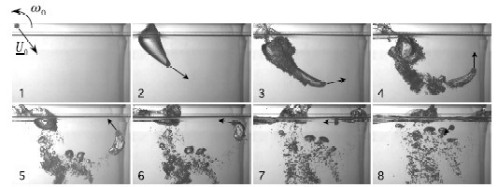
Guillaume Dupeux and his colleagues at the Ecole Polytechnique in Palaiseau have taken a more practical approach by modelling the flight of the football in a more controlled environment, firing tiny polymer spheres through water using a slingshot.

The lightness of the balls and the density of water enabled them to track the tiny spheres as they moved through a spiral which rotates in progressively smaller orbits. The researchers dub this the “spinning ball spiral effect” and explain that we only see this when friction allows the spin effects to become comparable with the forwards trajectory.

planeterellasmall.jpg
Tracking the trajectory of plastic spheres in water

Dupeux’s group argues that, before it smashed into the back of the net, Carlos’ free kick had also begun to follow a spinning ball spiral, which accounts for the fact that it seemed to bend significantly more at the end of its flight. The Brazilian skill came in because Carlos had kicked the ball with enough power and spin, from far enough out, for the spiral to take effect.

It’s a shame Carlos never quite managed to repeat the trick, but at least now we know it was worth him trying!

The research is published today in New Journal of Physics.

Changes spotted in fundamental constant

Billions of years ago the strength of the electromagnetic interaction was different at opposite ends of universe. That’s the surprising conclusion of a group of physicists in Australia, who have studied light from ancient quasars. The researchers found that the fine-structure constant, known as α, has changed in both space and time since the Big Bang.

The discovery – dubbed by one physicist not involved in the work as the “physics news of the year” – is further evidence that α may not be constant after all. If correct, the conclusion would violate a fundamental tenet of Einstein’s general theory of relativity. The nature of the asymmetry in α – dubbed the “Australian dipole” – could also point scientists towards a single unified theory of physics and shed further light on the nature of the universe.

A constant that varies?

The fine-structure constant, about 1/137, is a measure of the strength of the electromagnetic interaction and quantifies how electrons bind within atoms and molecules. It is a dimensionless number, which makes it even more fundamental than other constants such as the strength of gravity, the speed of light or the charge on the electron.

Despite being dubbed a constant, there are, however, good theoretical reasons why α might vary with space or time. A changing α could, for example, help solve the biggest mystery of physics – how to formulate a single unified theory that describes the four fundamental forces: gravity, electromagnetism, and the strong and weak nuclear forces. The leading contender for a unified theory, for example, requires extra spatial dimensions beyond our familiar three – and the existence of extra dimensions could be inferred from changes in α.

In 1998 John Webb, Victor Flambaum and colleagues at the University of New South Wales began looking for evidence of variations in α by studying light coming from distant quasars. Radiation from these extremely bright objects has travelled for billions of years before reaching Earth and will have passed through ancient clouds of gas along the way. Some of the light is absorbed at specific wavelengths that reveal the chemical composition of the cloud. Within the absorption spectrum is the eponymous “fine structure” from which the value of α can be extracted.

The team has so far studied hundreds of quasars in the northern sky and concluded that billions of years ago α was about one part in 100,000 smaller than it is today. This, however, remains a controversial result that is not accepted by all physicists.

Surprise in the southern sky

Now, Webb and colleagues have analysed 153 additional quasars in the southern sky using the Very Large Telescope (VLT) in Chile and have made an even more startling discovery. They found that in the southern sky, α was about one part in 100,000 larger 10 billion years ago than it is today. The value in the northern sky was still smaller, as found before.

This asymmetry in the two hemispheres – dubbed the “Australian dipole” by the researchers – has a statistical significance of about four sigma. This means that there is only a one in 15,000 chance that it is a random event.

This spatial variation in α is further evidence that the electromagnetic interaction violates Einstein’s equivalence principle – one of the cornerstones of relativity that says that α must be the same wherever and whenever it is measured. Such a violation is good news for those seeking unification because many leading theories also go against the equivalence principle.

Big breakthrough?

Wim Ubachs, a spectroscopist at the Free University of Amsterdam in the Netherlands, described the finding as “the news of the year in physics”, adding that the result both backs up previous findings and gives “a new twist to the problem”.

The fine structure and other fundamental constants determine the masses and binding energies of elementary particles – including dark matter. If these constants vary, the relative abundances of normal matter, dark matter and dark energy could be different in different parts of the universe. This could be seen as an additional anisotropy in the cosmic microwave background or as an asymmetry in the rate of expansion of the universe.

Perhaps the most intriguing aspect of the finding is with regards to the anthropic principle, which points out that we owe our very existence to the fact that the fundamental constants have values that allow matter and energy to form stars, planets and ultimately our own bodies. If α varies throughout space and time, it is possible that we owe our existence to a special place and time in the universe.

A paper describing the results has been submitted to Physical Review Letters.

In a separate preprint, Flambaum and UNSW colleague Julian Berengut argue that the Australian dipole is consistent with other measurements of the variation of α. In 2008, for example, studies with an atomic clock at the National Institute of Standards and Technology in the US suggested that α is constant to within about one part in 1017 in the course of a year. During that time, Earth moved a certain distance along the dipole, and Flambaum and Berengut calculate that this should have changed α by about one part in 1018 – well within the NIST limit.

The Sun’s magnetic field warps its environment


The Sun’s extended magnetic field provides a vital shield for astronauts; without it they would be left exposed to potentially deadly cosmic rays entering in from outside the solar system. Now, a group of researchers in the UK and the US offers an explanation of how this protective field is generated and sustained by violent processes at the surface of the Sun. The findings provide another insight into the solar magnetic field – an incredibly complicated physical system.

Like the Earth, the turbulent motion of the Sun’s interior generates a large-scale magnetic field whose main component is a dipole. But whereas the Earth’s dipole field reverses its polarity roughly once every million years, the Sun’s field is far more dynamic, with its north and south poles flipping roughly every 11 years.

The presence of the Sun’s magnetic field also creates the heliosphere, an immense bubble-like structure surrounding the Sun. The heliosphere is controlled and maintained by the solar wind, which emerges as a constant stream of charged particles from the Sun’s upper atmosphere. Magnetic flux is also dragged into the heliosphere with the solar wind, creating what astrophysicists refer to as the Sun’s “open” magnetic field.

Pattern-searching

For more than 50 years spacecraft have been able to directly observe the open magnetic field, enabling solar physicists to search for patterns in its variation. Researchers have been looking, in particular, for a link between the changing magnetic flux and the 11-year solar cycle. Over the course of the solar cycle, the amount of radiation emitted by the Sun varies from a quiet period to a spell of increased activity, at the height of which the Sun’s magnetic field is observed to reverse its polarity.

Now, a team led by Mathew Owens at the University of Reading in the UK has taken a step towards this goal by establishing a link between the emerging magnetic flux and the prevailing conditions at the surface of the Sun. They approached the problem by combining a model of the corona with land- and space-based observations of the heliosphere collected over the past solar cycle by missions such as the Solar and Heliospheric Observatory (SOHO).

Owens’ team discovered that the rate at which flux is lost from the corona seems to be regulated by how “clean” the magnetic divide is between the north and south sides of the heliosphere. Where the divide becomes warped it leads to more flux being dragged out into the heliosphere. “Most novel in this paper is that they are taking into consideration how the three-dimensional global morphology of the solar wind structure affects variation of solar wind magnetic field strength,” says Sarah Gibson, a researcher at the National Center for Atmospheric Research (NCAR) in Colorado.

No clear link with sunspots

The research does not, however, link conditions in the heliosphere with sunspots, which are regions on the Sun’s surface where magnetic field has emerged in large bundles. Sunspots are most common during the Sun’s active period when it is at its most intense and they often lead to solar flares that can be a potential hazard to communications on Earth. There is still much debate in the scientific community about why the recent quiet spell in solar activity, which ended in the past year or so, was roughly two years longer than usual.

Owens believes that we are headed for a generally quieter Sun over the next solar cycle with fewer magnetic storms, reducing the hazard to communication. On the downside, however, there will be less magnetic flux available to replenish the heliosphere, giving astronauts and space-based equipment a reduced shield from galactic cosmic rays. “So while there will probably be fewer large solar-driven events, there will likely be a higher constant ‘dose’ of radiation from outside,” Owens tells physicsworld.com.

In the short term, Owens’ group will look at more examples of previous solar cycles, which will require some reconstruction of historic datasets. “Ultimately, the goal is to figure out how the internal plasma circulations, the photospheric features and the upper solar atmosphere observations all fit together over the huge range of spatial and temporal time scales involved,” says Owens. “That should keep us busy for some time.”

This research has been submitted to the Journal of Geophysical Research.

God and the god particle

By Hamish Johnston

“Can we see the reflection of God in the laws of physics?”

That was one of the questions put to three physicists and a comedian by Ernie Rea in his radio programme Beyond Belief, which aired earlier this week on BBC Radio 4.

Rea gathered Middlesex University physicist and imam Usama Hasan Durham University theologian, Methodist minister and former astrophysicist David Wilkinson and University of Manchester Higgs hunter Jeff Forshaw.

Representing atheists is the comedian Robin Ince, who has presented several programmes about science.

Rea himself is a Presbyterian minister from Belfast – but definitely not of the fire-and-brimstone variety. Indeed, his soothing brogue and gentle interviewing style are perfect for getting to the bottom of the subtle religious topics he covers every week.

“Does the Big Bang origin of the universe leave room for a religious view of creation?” asks Rea, who also wonders if physics has replaced God in some people’s lives?

Rea’s final question is “What is the one discovery that [the Large Hadron Collider] might make that would alter your perception of the universe?”.

You can listen to the programme here – the editing isn’t the greatest so you have to wait about a minute or so for the previous show to end.

In other religious news, Stephen Hawking has declared in his new book “It is not necessary to invoke God to light the blue touch paper and set the universe going”.

The book is called The Grand Design and is co-written by Caltech physicist Leonard Mlodinow.

The book will be published next week and you can read an excerpt in The Times – but you will have to pay.

Copyright © 2026 by IOP Publishing Ltd and individual contributors