Higgs, Higgs, glorious Higgs

By Hamish Johnston

“What actually goes on
when hunting a boson.”

If that’s the sort of rhyming couplet that tickles your fancy, you will love this music video from CERN.

It features the CERN choir performing “The particle physicists’ song”, a variation on the Flanders and Swann classic “The hippopotamus song”. The new words are by Danuta Orlowska, who is a clinical psychologist in London.

Other memorable lines include:

“They all thought of SUSY with love in their eyes”

and “Those physics professors were no idle guessers”.

And if you think you can do better than that, the choir suggests you e-mail your own verses to cern.song@hotmail.co.uk

If particle physics isn’t your bag and you’d prefer a song about nuclear power, then check out this reworking of “Yankee doodle dandy” from the American Nuclear Society. It’s from 2002 but a bit of a gem.

An aurora in the laboratory

planeterellasmall.jpg
The planeterrella in action. Courtesy: Guillaume Gronoff

By Margaret Harris

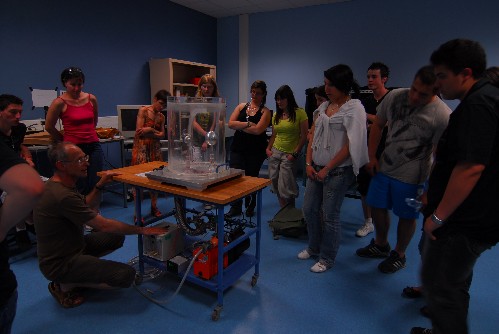
Earlier this month, lucky observers in the northern reaches of Europe and North America saw an unusually big burst of aurora activity after a large coronal mass ejection from the Sun collided with the Earth’s magnetic field, sparking a geomagnetic storm on 3–5 August. But the glowing plasma shown here does not come from the Sun; instead, it is produced by a tabletop device called a “planeterrella” – the round object in the middle of the photo.

Inspired by the early 20th century Norwegian physicist Kristian Birkeland, who used a similar device to explain the aurora borealis, or Northern Lights, the modern planeterrella is the brainchild of Jean Lilensten of the Laboratoire de Planetologie de Grenoble, France. You can read a bit more about how it’s constructed here.

In July, Lilensten won the first Europlanet Prize for Excellence in Public Engagement with Planetary Science for developing planeterrellas that can be used to demonstrate the workings of planetary aurorae for members of the public. You can see him and his prizewinning device a bit better in the photo below, which was taken by Cyril Simon.

planeterellagroupsmall.JPG

CERN faces €250m budget cuts

The CERN particle-physics lab near Geneva is to cut around CHF330m (€250m) from its budget for 2011–2015. The cut, which was announced by CERN boss Rolf-Dieter Heuer yesterday, will require the lab to scale back research into future particle accelerators. However, Heuer insists that the reduction will not affect the operation of the Large Hadron Collider (LHC) or force CERN to lose any of the 2000 or so staff it currently employs. CERN’s council is expected to meet on 16 September to approve the new plan.

The €250m cut is most likely to hit future upgrades and accelerators, which will now “proceed at a slower pace”. Also cut in the new budget – dubbed the medium-term plan – is the operation of CERN’s accelerators during the planned year-long shutdown of the LHC in 2012 when it will then prepare the LHC to go straight to maximum-energy 14 TeV collisions. A few accelerators were planned to be used during the shutdown period to study new detector techniques, but under the new plan all of CERN’s accelerators will now not operate in 2012.

“All our member states are making significant budget cuts at the national level, and it is difficult to argue why intergovernmental organizations such as CERN should be exempt,” says Heuer in a memo to staff. “I firmly believe that basic science budgets must be protected even in, and perhaps particularly in, times of economic downturn. But as a publicly funded body, we have to be realistic.”

Future plans

Worst hit could be work on the Compact Linear Collider (CLIC) – CERN’s own blueprint for a future electron–positron collider – that could be built once the LHC reaches the end of its life. Although research on CLIC and a “higher-energy proton machine” will continue, CERN’s contribution to CLIC will be held at around €16m and not be increased as was previously proposed. “In the present financial and political climate, I think it was inevitable that CLIC would be among the programmes to suffer,” particle theorist John Ellis told physicsworld.com.

Ellis told physicsworld.com that resources already made available by CERN will, however, allow an upgrade to the CLIC test facility to go ahead. But the budget cut means that an engineering demonstration facility called CLIC0, which would have to be built before CLIC could be approved, will not now go ahead unless external funds are sought. CLIC0 is supposed to demonstrate beam acceleration to around 6.5 GeV.

Ellis notes that the recent decision to open membership to CERN to countries outside Europe could mean that the extra funds are instead provided by these nations.

Belt tightening

“The cuts at CERN are very depressing news,” says Tim Gershon, a particle physicist from Warwick University in the UK who works on the LHCb experiment at CERN. “Although CERN’s management has succeeded to find a way to make the savings without any permanent scientific loss, the productivity of the laboratory will be significantly slowed.”

Others, however, are taking the news as an expected consequence of countries around Europe tightening their belts. “In the current financial climate these cuts are not unexpected and while they will slow down some of the longer-term projects they will not put in jeopardy any of CERN’s scientific objectives,” says Mark Lancaster, a particle physicist from University College London who works on the Compact Muon Solenoid detector at the LHC.

Supermassive black holes spawned by galactic merger

Lurking at the centre of nearly every galaxy and gobbling up stars in their vicinity, supermassive black holes are a truly menacing feature of the universe. Now, an international team of astronomers claims to have solved the mystery of how legions of these galactic monsters were born during the early history of the universe.

Supermassive black holes (SMBH) are thousands or even millions of times more massive than our Sun. We know that they exist from the impact they have on their surroundings: causing nearby stars to orbit galactic centres at breakneck speeds, for instance. Once SMBHs reach a critical size they can transform into quasars, which are extremely bright objects as small as a star but as luminous as an entire galaxy. But the relative abundance of quasars in the first billion years of the universe has puzzled astrophysicists.

This is because the “seed” for a blackhole is believed to take at least 108 years to form and then several more billion years to grow into a SMBH, followed in some cases by quasars. This was based on the assumption that SMBHs form in a similar way to stellar-mass black holes, marking the final phase in the lifespan of massive stars that have exhausted all their fuel for fusion.

Galaxies merging

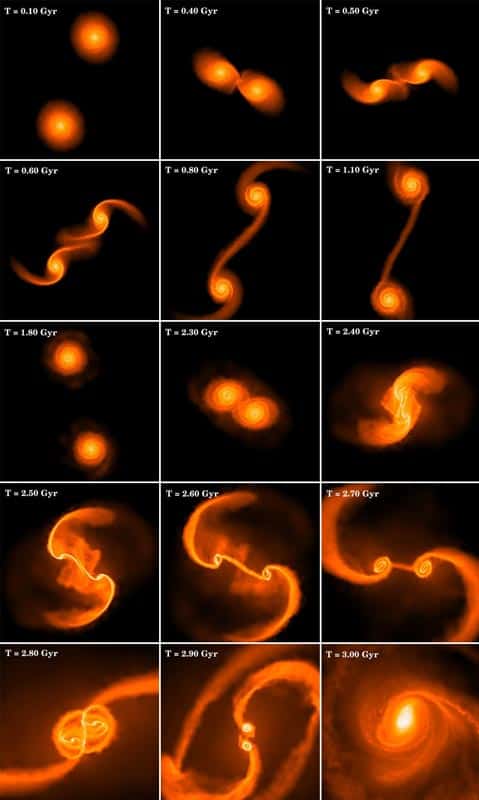
Lucio Mayer at the University of Zurich, working with colleagues in Chile and the US, now offers an alternative exploration for how these SMBHs formed. The group proposes that the right conditions for black hole formation could have been created by the merging of two or more galaxies during their primordial stages when they were still emerging from vast clouds of dust.

Our result shows that big structures – both galaxies and massive black holes – build up quickly in the history of the universe Stelios Kazantzidis

Using computer simulations, involving more than 3 million computing hours, Mayer’s team found that when two young galaxies come together it can cause dust to spiral rapidly towards to a confluence at the centre. For galaxies above a critical size, more than 100 million solar masses of dust can be channelled towards the centre within just 100,000 years, creating a dense cloud in the centre.

“The high concentration of gas at the disk-like nuclei of the interacting galaxies causes tidal forces that cause the gas to effectively lose angular momentum and spiral to the centre,” explains Mayer. Shortly after this, the core of the cloud collapsed to form the seed of a black hole, and after 108 years the supermassive blackhole had grown to a billion solar masses.

Contradicts prevailing wisdom

If the findings are accepted by the community, they will turn around the prevailing wisdom among astronomers that galaxies evolved hierarchically – that is, gravity drew small bits of matter together first, and those small bits gradually came together to form larger structures.

“Our result shows that big structures – both galaxies and massive black holes – build up quickly in the history of the universe,” says Stelios Kazantzidis, another member of the team based at Ohio State University. “[The findings] add a new milestone to the important realization of how structure forms in the universe.”

The model does not, however, explain how smaller galaxies such as our own have evolved to contain an SMBH at their centre. In the case of the Milky Way, Mayer speculates that a similar gas-consuming process could have occurred later in its history when it had reached a critical mass after three to four billion years.

Further testing required

Andrew Jaffe, an astrophysicist at Imperial College London agrees that it would be useful to extend this model to cover a wider range of galaxy types. “As a further test of their modelling, it would be very nice to see whether they reproduce the dynamics of merging galaxies in other, more well-studied, situations – such as mergers of modern-day galaxies.”

The research may aid astronomers who are searching the skies for gravitatational waves, which would provide direct evidence of general relativity. According to Einstein’s theory, any ancient galaxy mergers would have created massive gravitational waves – ripples in the space–time continuum – the remnants of which should still be visible today.

Over the coming decade, several space-based missions have been planned to search for these elusive phenomena using interferometry equipment. “As the authors correctly point out, the way their blackholes form from direct collapsing has a profound impact on the gravitational wave signal expected in missions such as LISA,” says Francesco Haardt an astronomer at the University of Insubria.

The Laser Interferometer Space Antenna (LISA) is a joint mission between NASA and the European Space Agency scheduled for launch in 2025.

This research is described in Nature.

Pakistan flood disaster imaged by NASA satellite

27117_2.JPG
Courtesy: NASA/GSFC/LaRC/JPL, MISR team

By James Dacey

The flooding in Pakistan triggered by heavy monsoon rains at the end of July has killed more than 1200 people and affected more than 15 million others across the country, according to government estimates. The country’s president, Asif Ali Zardari, said yesterday that it will take up to three years to recover from the natural disaster, as quoted by the Associated Press.

This pair of images shows the extent of the floodwaters within the central and southern parts of Pakistan, where the image on the left is from 8 August 2009 and the one on the right is from 11 August 2010. They have been captured by the Nadir (vertical viewing) camera on the Multi-angle Imaging SpectroRadiometer (MISR) instrument aboard NASA’s Terra spacecraft, which was launched in 1999.

The Indus River can be seen meandering across the image from upper right to lower left. But in the later view, flooding can be seen clearly in much of the surrounding region, particularly in the Larkana District to the west of the river. Each image is 300 × 425 km and false colours have been employed to enhance the contrast: water appearing in shades of blue and cyan; vegetation as red; clouds as white; and sediment as tan.

Since this image was captured, the floodwaters have spread further south into the Sindh province, which lies in the bottom half of this image. The United Nations warned yesterday of thousands more imminent evacuations, along with the threat of waterborne diseases, food shortages and lack of shelter.

Solar system older than we thought


The solar system is up two million years older than previously thought, according to a pair of researchers in the US. Their work, which is based on dating a meteorite found nestled in the Sahara desert, also provides clues about the birth of the solar system, lending weight to the theory that a nearby supernova explosion triggered its formation

Most meteorites, other than the ones known to come from the Moon or Mars, are relics from the formation of the solar system. This latest example, labelled “Northwest Africa 2364”, has a mass of 1.5 kg and was purchased by a private dealer from a local in Morocco in 2004. Part of it ended up in the hands of Audrey Bouvier at Arizona State University in the US who found it to be 4568.2 million years old – the oldest solar system object ever discovered, and 0.3–1.9 million years older than the previously accepted age of the solar system.

Bouvier, along with co-author Meenakshi Wadhwa, also at Arizona State, analysed several radioisotope chains associated with elements found in the sample. Using the decays of 238U–206Pb and 235U–207Pb, which have half-lives of ~4.47 Gyr and ~704 Myr respectively, the pair were able to pin down the age of the space rock. “Radiogenic decay is at a constant rate over the aeons, which can be measured by physically counting particles,” explained Bouvier. This age was fine-tuned using the decay of 26Al–26Mg, which has a much shorter half life of ~0.73 Myr.

In the beginning, there was iron

The discovery of Northwest Africa 2364 is also helping to firm up scientists’ understanding of how our local neighbourhood formed. Conventional theory used to suggest that the Sun and its family of planets formed in near isolation, far away from other stars. However, in the last five years researchers have begun to suggest that this might not be the case due to high amounts of daughter isotopes from the decay of 60Fe found in previous meteorite samples. 60Fe can only be formed in the core-burning stage at the end of a star’s life before it goes supernova. This means that if 60Fe was present in the early solar system it had to be seeded there by a nearby supernova and the Sun couldn’t have formed in isolation after all. Bouvier and Wadhwa’s result only enhances this possibility.

“This research pushes back the start of the solar system by around a million years, so if you work backwards using radioactive decay there must have been a higher concentration of 60Fe at the beginning than previously thought, by about a factor of 2,” explained Jamie Gilmour, who researches solar system formation at the University of Manchester. “This makes it more necessary for a supernova to have seeded the solar system with it,” he added.

The findings are described in Nature Geoscience.

Antenna directs light at the nanoscale


Nanotechnology offers the promise of a new wave of sensors and optical components, but the tiny sizes involved can make it difficult for users to exchange information with these devices. Now, researchers in Spain have demonstrated a novel solution to this problem that involves fixing an “antenna” to nanoscale objects that can send and receive optical data with high precision.

physicsworld.com first reported this idea earlier in the year when researchers in Japan announced that they had created a nanoscale version of the famous “Yagi Uda” antenna. This device was invented in the 1920s to overcome signal degradation, which caused radio signals to lose quality over distance. It was used by the British with radar during the Second World War and went on to become the standard antenna for transmitting and receiving television signals.

Key to the classic design is its “parasitic elements”, made from strips of electrical conductors. These elements induce currents in the presence of a radio signal, which, in turn, generate secondary radio signals that can be transmitted in the same direction as the original signal. The same principle works in reverse so the antenna can boost a signal when receiving information.

Honey I shrunk the antenna

In the nanoscale version of the Yagi Uda antenna, the conducting strips are replaced by an array of gold nanorods. The nanorods are aligned in such a way that incoming light manages to trigger plasmons in the gold surface – that is, collective wavelike motions of billions of electrons – to resonate and emit secondary light in the same direction. The researchers in Japan argued that their device could lead to new sensors – providing that it could be coupled to light-emitting particles.

This feat has now been achieved by Niek van Hulst and colleagues at the Institute for Photonic Sciences (ICFO) in Barcelona together with researchers at the Catalan Institute for Research and Advanced Studies (ICREA). They fabricated a number of nanoscale Yagi Uda antennas containing the tiny parasitic elements made from gold using lithography to etch the devices onto a glass substrate. The total length of individual antennas was 830 nm where individual feeds were just 145 nm, each separated by 175 nm.

To integrate the antennas with particles, Van Hulst’s team then used lithography a second time to decorate the substrate with quantum dots – nanosized pieces of semiconductor in which electrons (or holes) are confined in 3D such that their electronic properties can be controlled by changing the size of the dots. By positioning the quantum dots close to the gold feed elements, the researchers were able to couple the quantum dots with the near field of the nanoantenna.

A narrow angular cone

With this configuration, Van Hulst’s team was able to show that light emitted from the quantum dots, in the form of luminescence spectra, was being transmitted by the Yagi Uda antennas in a narrow angular cone. “The direction of the interaction between light and matter can now be controlled in an asymmetric way,” says Alberto Curto, a member of the Barcelona-based team. “This step forward in the field of nano-optics has potential applications in quantum optical technologies and the detection of minute amounts of chemicals, for example.”

The researchers also show that it is important to tune the system by creating parasitic elements that match the luminescence spectrum. “We fabricated various antennae of different dimensions and show that resonant tuning between quantum dots and the antenna is important to get the right directivity, just like tuning the classical TV antenna,” Van Hulst told physicsworld.com.

Yutaka Kadoya – a member of the Japanese team that published earlier in the year – is impressed by the speed of this new development and views it as a victory for experimental research. “Nowadays computer simulation is widespread and easily used while the experiments have become tougher and tougher. I think actual progress cannot be expected without experimental investigations.”

Kadoya believes that the next stage in the research is to home in on the quantum dot to investigate the luminescence dynamics.

This research is described in Science.

Astronomers discover the Moon is shrinking

Freshly discovered scars on the face of the Moon reveal that this rocky satellite is shrinking at a relatively rapid pace, say researchers based in Germany and the US. Images collected by NASA’s Lunar Reconnaissance Orbiter show surface faulting that, they say, reflects significant contraction in the Moon’s recent geological past.

The research team used the Lunar Reconnaissance Orbiter Camera (LROC), launched in 2009 aboard the Lunar Reconnaissance Orbiter, the first spacecraft to be launched as part of NASA’s “return to the Moon” initiative. It contains three different cameras designed to deal with both narrow and wide angle high-resolution photography. This high level of detail revealed 14 lunar landforms known as lobate scarps, similar to thrust faults on Earth that result from compressional forces such as plate tectonics.

Half of the located scarps are at high latitudes (±60°), proving that they are globally distributed and not clustered near the equator as previously thought. These factors indicate “recent contraction of the whole Moon, likely due to cooling of the lunar interior,” says Thomas Watters of the Smithsonian Institution’s National Air and Space Museum, lead author of the paper.

I think there is a general impression that the Moon is geologically dead Thomas Watters

A squeezed body

Lobate scarps occur when the surface of the body experiences a compressional force, causing one part of the upper surface to fold and fracture above the other part. In the absence of significant tectonics on the Moon, the researchers believe this is due to cooling of the lunar core. As the core of the Moon cooled it also shrunk, applying surface stress to the brittle lunar crust and causing it to rupture and split.

“On relatively small planetary bodies, like Mercury, the Moon, and possibly some of the icy satellites, it’s long been thought that the original cooling of the body very early in its history could cause a global contraction in the size of the body,” explains Dr Peter Grindrod of the Department of Earth Sciences at University College London, who was not involved in this report. “This is a fairly easy concept, as it’s just to do with the volume decreasing as the temperature decreases.”

However, in the case of the Moon, this faulting appears to have been delayed. Through analysis of the scarps’ interaction with other nearby surface features of known age, including craters, the researchers infer that the Moon has contracted radially by 100 m in the past 1 billion years. This is in keeping with the “crisp, un-degraded appearance” of the scarps, which Watters says is the strongest evidence of their young age.

More comprehensive picture

Lobate scarps have been observed on the surface of the Moon before, from images taken by the panoramic cameras aboard the Apollo 15, 16 and 17 missions. However, these earlier missions were confined to the equatorial zone of the Moon’s surface. Using the LROC the team has managed to acquire comprehensive images of the lunar surface at higher latitudes.

The Moon’s surface is stressed and marked by many different geological features. Most large-scale crustal deformation is associated with surface features such as basins and maria – dark, basaltic plains formed by ancient volcanic eruptions. The lunar lobate scarps are generally found outside of these mare-filled basins, and they are the most common tectonic landform on the far side of the Moon. They are relatively small-scale structures with a maximum relief of less than 100 m, unlike those found on Mercury and Mars.

“I think there is a general impression that the Moon is geologically dead – that everything of geologic significance that happened to the Moon happened billions of years ago,” says Watters. “Our results suggest this is not the case. The Moon may still be geologically and tectonically active and still contracting today.”

This research is described in Science.

NASA collaborates with Mary J Blige

By James Dacey

In one of the less predictable pairings of the year, NASA has teamed up with Mary J Blige, the singer, actor, producer and all-round US megastar.

The pairing has come about in an attempt to encourage more young women in the US to pursue careers in science, technology, engineering and mathematics (STEM).

Blige co-founded the Foundation for the Advancement of Women Now (FFAWN) in 2008 to “inspire women from all walks of life to gain the confidence and skills they need to reach their individual potential”.

FFAWN has now joined forces with NASA’s Summer of Innovation (SoI) project, which started earlier this summer to help keep students engaged in STEM-related activities during the school break – part of Obama’s Educate to Innovate Campaign.

Blige is joined in this short video by NASA space shuttle astronaut Leland Melvin to explain the motivation behind the project.

‘Quantum simulators’ revealed in fresh detail


Physicists in Germany have used fluorescence imaging to identify individual particles in an optical lattice for the first time. The breakthrough could allow researchers to create more advanced simulations of quantum phenomena and it might help in the quest for practical quantum computing.

Optical lattices are regular arrays of identical energy wells created by criss-crossing laser beams. By injecting ultracold atoms into the energy wells, the lattices can be used to create and study a range of materials and they are used to create large-scale replicas of quantum systems.

In this new research, Stefan Kuhr and Immanuel Bloch of the Max Planck Institute of Quantum Optics in Garching, together with colleagues at Ludwig-Maximilians University in Munich, created an optical lattice to contain a type of ultracold gas known as a Bose-Einstein condensate (BEC). These systems are formed when identical atoms with integer spin are cooled until all the atoms are in the same quantum state, meaning they behave as if they were a single quantum particle.

‘Dark and bright’ regions

Kuhr’s team created its BEC by cooling several thousand rubidium-87 atoms to close to absolute zero, and then configured the optical lattice to form a series of “dark and “bright” areas. Due to the energy levels, the rubidium atoms are much more likely to settle in the dark regions, and to hop into neighbouring sites each atom would have to overcome a significant energy barrier. This configuration is known as a Mott insulator, named after British physicist and Nobel prize winner Sir Neville Mott, because it resembles a solid in which conduction electrons are localized due to the strong interactions between the atoms.

According to theory, the number of atoms varies between lattice sites in a BEC. In the case of a Mott insulator though, this number is predicted to approach a fixed value at very low temperatures close to zero Kelvin – with the atoms arranged regularly in each lattice site. Kuhr’s team has now been able to directly observe this behaviour in an experiment for the first time.

Scientists regularly cool atoms using laser beams in quantum optics systems. But the key was to fire laser pulses at the system and then directly detect the atoms using a specially designed high-resolution microscope that collects the fluorescence photons from the atoms as they cool. It was using this technique that the researchers were able to count single atoms on each individual lattice site – a “sensational result”, says Kuhr, “and a prerequisite for using these systems as quantum registers with individually addressable quantum bits in future quantum computers”.

A quantum register

“A Mott insulator with exactly one atom per lattice site represents a very promising candidate for a quantum register of up to a few hundred atomic quantum bits,” adds Kuhr. “However, we needed to show that we really are able to manipulate each individual atom in the structure. This is crucial for encoding and reading out qubits and we are now at the beginning of setting up the first experiments of this kind.”

These studies might not only lead to quantum computers; they could also help to develop fundamental models of condensed matter physics. This is because the atoms in an optical lattice are analogous to the electrons in a solid state crystal. “Such investigations could aid in our understanding of unusual magnetic and electric phenomena, such as high-temperature superconductivity, and may even pave the way towards ‘tailor-made’ materials,” said Kuhr.

The work is described in Nature.

Copyright © 2026 by IOP Publishing Ltd and individual contributors