Huge telescope will struggle to find extraterrestrial life

The largest radio telescope ever to be constructed will struggle to listen in on extra-terrestrial civilizations like our own, according to two astronomers in the UK. Their calculations suggest that when the Square Kilometre Array (SKA) starts work in 2022 it will find it difficult to tune into radio signals from alien civilizations with Earth-like technology. The finding, they say, is further evidence that scientists must take a multidisciplinary approach to the hunt for intelligent life that doesn’t just rely on detecting radio signals.

The Search for Extra-Terrestrial Intelligence (SETI) has been patiently eavesdropping on the galaxy for potential alien signals for over 50 years, so far without success. As one of its many scientific objectives, the SKA will join the search in 2022, hoping to answer the age-old question of whether our civilization really is unique.

However, research by Duncan Forgan, at the University of Edinburgh, and Bob Nichol, at the University of Portsmouth, suggest that its chances of finding human-like civilizations are slim: just one in 10 million.

They built a computer model of a mock Milky Way galaxy to see how many intelligent civilizations it could likely support. “We wanted to give as strong as an assessment as we could for using the latest radio telescopes for SETI,” Forgan told physicsworld.com. The pair threw into the mixing pot the latest data on, among other things, stellar evolution, planetary system formation and habitable zones – the area around a star warm enough for a planet to have liquid water on its the surface.

10,000 civilizations per galaxy

To calculate the best-case scenario for SKA success, they optimistically assumed that if an Earth like planet sits in the habitable zone it would always go on to host intelligent life. From this they were able to populate the galaxy with intelligent life by assigning stars random properties from a statistical distribution. Having run the model 30 times they found the average galaxy would be home to about 10,000 intelligent civilizations.

“We now have a data set of galactic civilizations over time and space,” said Forgan. “But there are factors which can prevent a civilization from being eavesdropped on: the civilization could destroy itself or be extinguished by an asteroid impact. However, more likely is that an advance in technology could make them harder to detect, ” he added.

On Earth, we have been leaking radio signals into space for almost a century and any nearby civilization could eavesdrop on our signals. Indeed SKA could detect us if it were placed anywhere up to 100 parsecs – 326 light-years – away. However, as our technology is improving, and the power required to generate such signals is decreasing, we are moving from a “radio loud” to a “radio quiet” planet.

Too old for loud radio

With these factors in mind Forgan and Nichol combined their galactic population findings with the constraints on mass extinction, based on the Earth’s fossil record, and the idea that a civilization is only “radio loud” for its first 100 years. They found the chances of radio communication between us and an Earth-like or a short-lived civilization, within the 100 parsec sensitivity limit of the SKA, to be one in 10 million.

However, this finding only applies to civilizations with technology akin to our own; it does not rule out stumbling across signals from a more highly developed civilization. “This is only one small part of SETI. Other SETI searches work on the assumption that they are looking for longer lived civilizations that emit, for whatever purpose of their own, rather stronger radiation,” stressed Alan Penny, a SETI researcher at the University of St Andrews.

Forgan would like to see more resources put into other methods to sit alongside and complement conventional radio SETI searches. “The way we are approaching SETI is quite one-dimensional. There will always be a place for radio communication but we are getting close to its limit and we should find other ways to try as well,” he said.

The research has been accepted for publication in the International Journal of Astrobiology and a preprint is available on arXiv.


The beat goes on at DAMA/LIBRA

dama.jpg


By Hamish Johnston

For more than a decade physicists working on the DAMA/LIBRA experiment (and its predecessor DAMA/NaI) in Italy have collected and analysed data that show an annual oscillation in the signal from their dark matter detector.

The team argues that this is the first direct detection of dark matter particles – and that the yearly variation in the number of detections (see image above) is caused by Earth’s motion through the halo of dark matter that surrounds the Milky Way.

While no-one argues with the existence of the annual signal – after 13 years of data collection it has a whopping “nine sigma” statistical significance – there have been many arguments over whether the signal is related to dark matter.

For one thing, DAMA/LIBRA appears to be at odds with several other experiments that are also trying to detect dark matter – and this has led some physicists to dismiss the oscillation as the result of a yet-to-be discovered systematic error in the experiment.

However, these dissenting experiments are different from DAMA/LIBRA, and so far have only yielded null results. It’s possible, therefore that DAMA/LIBRA has managed to succeed where others have failed.

The latest addition to the debate comes from DAMA/LIBRA scientists who have posted a vigorous defence of their measurements and analysis on the arXiv preprint server. In the paper the team argue that there are “no systematics or side reactions” that are able to mimic the annual signal that they see.

There are several other experiments that may have caught tantalizing glimpses of dark matter. The latest is the CoGeNT collaboration in the US, which earlier this year reported seeing a number of events in their germanium detectors that could be dark matter.

While these results are very preliminary, and have been questioned by those working on other experiments, some scientists believe that CoGeNT could be seeing the same dark matter particles as DAMA/LIBRA. Your can read a preprint of their analysis, where they argue that the DAMA/LIBRA and CoGeNT results can both be explained by a dark matter particle with a mass of approximately 7 GeV.

Meanwhile at DAMA/LIBRA, the team is set to install new photomultiplier tubes that will boost the sensitivity of the experiment. The group has also secured funds to do research and development on a next-generation detector.

Graphene soaks up arsenic

Researchers have found yet another use for the wonder material graphene. A composite material made from reduced graphene oxide and magnetite could effectively remove arsenic from drinking water, according to new work done in South Korea.

Graphene is a sheet of carbon just one atom thick that also exists as an oxide. Reduced graphene oxide (RGO) is a chemical state of the material that has gained electrons. The purification process works by dispersing a magnetite-RGO composite in water, where it soaks up arsenic. The composite is then quickly and efficiently removed from the water using a permanent magnet.

Arsenic is one of the most carcinogenic elements known and is toxic above 10 ppb. Drinking water contaminated with the element is a dangerous everyday reality for many people across the world and it can lead to chronic illness and death. The arsenic mainly comes from naturally occurring arsenic-rich rocks through which the water has filtered but it may occur in areas where arsenic is mined as well. Scientists also suspect that changes in agricultural practices, such as using groundwater wells for irrigation rather than surface water sources like rivers and ponds, may also be to blame.

Arsenic can be removed from drinking water by using activated carbon or precipitating it out with iron minerals, such as iron oxides – for example, magnetite (Fe3O4) nanocrystals. However, such particles cannot be used in rivers, or other environments where water flows, because of their small size and the fact that magnetite rapidly oxidizes when exposed to the atmosphere. Researchers have recently overcome the latter problem by combining iron oxides with carbon and carbon nanotubes, and graphene-based materials such as graphene oxide.

Superparamagnetic hybrid

Building on this work, Kwang Kim, In-Cheol Hwang and colleagues at Pohang University of Science and Technology have created a new type of magnetite composite based on RGO. The hybrid material, which is superparamagnetic at room temperature, can remove over 99.9% of arsenic in a sample and reduce its concentration to below 1 ppb.

The composite is ideal for removing arsenic (and perhaps other heavy metals) compared with bare magnetite because the presence of the graphene flakes among the magnetite particles increases the number of arsenic adsorption sites. “The reduced graphene oxide also increases the stability of magnetite so that it can be used in continuous-flow systems for longer periods,” says Kim.

The researchers made their composite by first creating graphene oxide via Hummer’s method. Next, the graphene oxide sheets are added to water to produce a suspension. A mixed suspension of FeCl3 and FeCl2 was then added slowly to the graphene oxide solution, and ammonia quickly introduced to precipitate Fe2+ and Fe3+ ions for creating the magnetite nanoparticles. The graphene oxide was reduced using hydrazine hydrate and the dark black coloured solution filtered, washed with water/ethanol and dried in vacuum.

The team is now looking into other large-scale graphene synthesis methods as well as making graphene-based hybrid materials for various environmental and biological applications.

The work is described in ACS Nano.

Une conférence de physique fondamentale à Paris

By Louise Mayor

Louvre.jpg
A visit to the Louvre before heading off to Paris Diderot University for the conference

This week I was in Paris at the Eleventh International Symposium on the Frontiers of Fundamental Physics.

It was an intimate affair with only 145 participants, 20 of whom were invited speakers from the forefront of such research areas as dark energy, dark matter, supersymmetry and the LHC.

I was the only member of press, and several high-profile physicists were kind enough to explain their research fields to me over a coffee and mini pain au chocolat.

On Wednesday, I learned about inflationary models of the universe over lunch with Paul Steinhardt, Albert Einstein Professor of Science at Princeton University and co-author of the popular science book Endless Universe: Beyond the Big Bang. I was soon brought up to speed with the basics: inflation is the idea that shortly after the Big Bang the universe underwent rapid expansion over a very short space of time.

As an experimental physicist, I was interested to hear Steinhardt comment about how the roles of theory and experiment in cosmology have reversed: while cosmology used to be theory driven, technology has evolved to such a degree that, just using data from the last 10 years, we can test all the theories conceived over the course of human history to this point, and eliminate nearly all of them. “There are only two survivors capable of describing the current data in full detail – the inflationary model and the cyclic theory,” explained Steinhardt.

He also noted that it’s important to think of cosmology as a very new experimental science – all we really know comes from less than a century of measurements. For example, we only discovered the existence of galaxies and the expansion of the universe in the early 1920s.

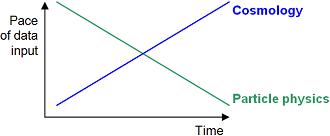
Graph.JPG

Steinhardt also remarked that the rate at which we’re acquiring data about cosmology has now outpaced that of particle physics. (See my schoolgirl representation of this, right.)

There’s a phrase floating around that people use to describe this burgeoning area of physics: “precision cosmology”. I asked Steinhardt what he thinks of it. He said that he doesn’t use the phrase himself, because it implies that we have settled on the underlying theory and we’re down to measuring the detailed values of the underlying parameters. However, there is a real chance that the underlying theory is incorrect. “We might be precise – but precisely wrong,” he stressed.

Steinhardt explained that while we do know a few things reasonably precisely, such as the matter density, there are still deep questions about the underlying theory – both the inflationary and cyclic models are better described as “scenarios” with some details, but many parts that are sketchy and questionable. “For example, the more we have learned about the inflationary theory over the last 30 years, the more we have to question whether it really makes the predictions that it is credited to make,” he said.

Steinhardt went on to describe the inflationary model of the universe and its problems to me in more detail, and while I followed it to some extent, if you want to hear a good explanation then I would direct you to his book!

X-rays reveal origin of Dead Sea Scroll

Physicists in Italy have provided further clues as to the origin of the Dead Sea Scrolls using a new method that relies on emissions from a radioactive source. The portable technique, known as XPIXE, could be used to complement analyses of ancient artefacts currently carried out at particle accelerators.

PIXE – particle-induced X-ray emission – involves firing protons at a sample and then measuring the X-rays emitted by specific elements excited within the material, with the energy of the X-rays identifying the elements in question. First proposed in the 1970s, PIXE has undergone several developments but in general requires a particle accelerator.

XPIXE, developed by Giuseppe Pappalardo and colleagues at the labs of the Italian National Institute of Nuclear Physics (INFN) in Catania, Sicily, instead uses the radiation from a source of curium-244, which emits both alpha particles and X-rays. Alpha particles stimulate emission from light elements within a sample while X-rays cause emission from heavier elements. Measuring just 30 cm across, the XPIXE device is portable and has previously been used to analyse wall paintings and decorated vases.

Oldest known biblical texts

Pappalardo and colleagues analysed four centimetre-sized fragments from one of the Dead Sea Scrolls, a set of about 900 documents found in several caves near the Dead Sea half a century ago that constitute the oldest known biblical texts, dating back to between 200BC and 70AD. The actual scroll studied by Pappalardo’s group is not part of the Biblical narration but instead describes the construction and life of a temple and the communication of laws.

Like other parchments, this “Temple scroll” was made from animal skin and was washed extensively during its production. The researchers used a combination of XPIXE and PIXE (with a 1.3 MeV proton beam) to establish that all of the fragments contained chlorine and that the ratio of bromide to chlorine within the fragments was about three times higher than is normally found in sea water. They therefore concluded that the scroll was made from water from the (very salty) Dead Sea – in other words that the scroll was made close to where it was found, in Qumran.

Plans to look at ink

Determining where the scroll was made is important, says Pappalardo, because it could reveal trading links between different regions in the past (were the scroll to have been made in one place and then used in another). Although that was not the case with the Temple scroll he regards it as an achievement to have used his technique to analyse such an important artefact. He adds that his team now plans to analyse the ink used to write the scroll, which he says should reveal where the documents were written rather than where the parchment was made.

In general, Pappalardo envisages XPIXE being used on site in museums and other places to provide a “screening” of the elements contained within an artefact. This initial analysis could then be complemented by a more in-depth study using accelerators, which operate at a much higher intensity than the XPIXE radioactive source and can therefore identify elements at very low concentrations.

The results were presented at the PIXE 2010 conference in Surrey, UK.

Canada aids search for the African Einstein

The Canadian government has pledged C$20 million to help develop a network of specialized science and technology centres across Africa. Canadian Prime Minister, Stephen Harper, made the announcement on Tuesday during a special visit to the Perimeter Institute for Theoretical Physics in Waterloo.

The money will be used to expand the African Institute of Mathematical Sciences (AIMS), which exists to recruit and train African researchers and to promote mathematics and science across the continent.

“Just as ideas and innovation are the foundation of Canada’s new economy, they will be the basis of Africa’s future economic, educational, scientific and governance self-sufficiency,” said cosmologist Neil Turok, director of the Perimeter Institute, speaking yesterday.

Looking for the next Einstein

Turok, who was born in South Africa, founded the original AIMS in 2003 – a small postgraduate centre in Cape Town. In 2008 he went on to instigate the Next Einstein Initiative, which led to the opening of a second institute in the Nigerian capital, Abuja. The initiative seeks to create a network of 15 centres across the African continent by 2020, enabling 750 extra African scientists to complete courses each year at postgraduate level.

The money donated by the Canadian government will support a planned network of five postgraduate schools across Africa, including new centres in Ethiopia, Ghana and Senegal. In his presentation yesterday, the Canadian Prime Minister explained the motivation behind the investment.

“Humanity’s ascent from ignorance and barbarism to enlightenment and equality has been a fitful and uneven process. If there is, however, a universal constant in human affairs, it is that the expansion of knowledge and technology has continuously made life better for more people. That’s why our government is supporting scientific and technological research, as well as development at home and abroad.”

Connecting Africa

I believe that connecting Africans to each other and to the world through science is one of the best investments one can make in Africa’s future. Stephen Hawking

Also in attendance yesterday was cosmologist Stephen Hawking, an AIMS patron as well as a research chair at the Perimeter Institute. “I was lucky to visit AIMS in South Africa, in 2008, to enjoy the remarkable atmosphere, filled with the students’ enthusiasm for math, science and the future of Africa,” he said. “I believe that connecting Africans to each other and to the world through science is one of the best investments one can make in Africa’s future.”

This announcement came on the same day that Mohamed Hassan, the executive director of the Academy of Sciences for the Developing World (TWAS) called for a renewed focus on developing science capacity in Africa. “Africa needs urgently to revitalise its school and university education systems to develop a pool of skilled scientists in partnerships with European universities,” he said during his keynote speech at the Euroscience Open Forum in Turin, Italy.

Hassan believes that the development of scientific academies and electronic libraries will play an important role in developing African science as well as protecting African ideas and traditional knowledge from piracy.

Have you ever wanted to photograph a particle accelerator?

photowalk.jpg
Photograph taken at the 2009 Photowalk at DESY (Courtesy: interactions.org)

By Hamish Johnston

Today I received a press release for an event called the Particle Physics Photowalk.

The idea is that amateur photographers are given access to five of the world’s leading accelerator labs for a day – a “rare opportunity to photograph state-of-the-art accelerators and detectors in all their beauty and complexity”, says the release.

The participating labs are CERN in Switzerland; DESY in Germany; Fermilab in the US; KEK in Japan; and TRIUMF in Canada.

How generous, I thought, for CERN to shutdown the LHC for a day to let in a gaggle of shutterbugs!

I forwarded the press release to a colleague who is a keen amateur photographer and he was on the phone immediately to CERN.

It is bad news, I’m afraid – the LHC will be completely off limits, including the control room.

Of course it’s silly to expect CERN to shutdown the LHC for a bunch of amateur photographers, but barring them from the control room seems a bit mean!

You can register for the Photowalk here.

NRU update: reactor okay to restart

NRU.jpg
Inspection work at NRU: the reactor will restart shortly (Courtesy: AECL)

By Hamish Johnston

There must have been a collective sigh of relief from North American medical physicists yesterday when the Canadian Nuclear Safety Commission said that the NRU reactor can resume operations.

Located at Atomic Energy of Canada’s Chalk River, Ontario lab, the ageing reactor makes Mo-99, which is used to make the medical isotope Tc-99m. NRU normally supplies North America with Tc-99m and accounts for a significant chunk of world production.

Over the past few years the supply of Tc-99m has been interrupted by two unscheduled safety-related shutdowns – with the current shutdown lasting over one year. Yesterday’s announcement means that production should resume by the end of this month.

As well as causing delays for medical procedures the debacle has also had political consequences, with the president of the Canadian Nuclear Safety Commission being sacked in 2008.

It has also encouraged Canadian physicists to think of new ways of making medical isotopes that don’t involve ancient and unreliable reactors. Indeed, the TRIUMF accelerator lab in Vancouver has just announced that it will build an electron linear accelerator that will produce radioactive isotopes. You can read all about the C$63m ARIEL facility here.

Proton is smaller than we thought

The radius of the proton is significantly smaller than previously thought, say physicists who have measured it to the best accuracy yet. The surprising result was obtained by studying “muonic” hydrogen in which the electron is replaced by a much heavier muon. The finding could mean that physicists need to rethink how they apply the theory of quantum electrodynamics (QED) – or even that the theory itself needs a major overhaul.

A proton contains three charged quarks bound by the strong force and its radius is defined as the distance at which the charge density drops below a certain value. The radius has been measured in two main ways – by scattering electrons from hydrogen and by looking very closely at the difference between certain energy levels of the hydrogen atom called the Lamb shift. Until recently the best estimate of the proton radius was 0.877 femtometres with an uncertainty of 0.007 fm

This Lamb shift is a result of the interactions between the electron and the constituent quarks of the proton as described by QED. These interactions are slightly different for electrons occupying the 2S and 2P energy levels and the resulting energy shift depends in part on the radius of the proton.

The heavier the better

However, in muonic hydrogen the Lamb shift is much more dependent on the proton radius because the much heavier muon spends more time very near to – and often within – the proton itself.

Now an international team led by Randolf Pohl at the Max Planck Institute for Quantum Optics in Garching, Germany has measured the Lamb shift in muonic hydrogen for the first time and found the proton radius to be 0.8418 fm with uncertainty 0.0007 fm. While this is by far the most precise measurement to date, it is in striking disagreement with previous measurements, being well outside the error bars of earlier results.

The team measured the shift using a proton accelerator at the Paul Scherrer Institute in Switzerland to create a beam of muons, which was then fired at hydrogen gas. Whenever a muon collides with a hydrogen molecule, it knocks the molecule apart and replaces the electron to create muonic hydrogen. About 1% of the time the muon finds itself in the 2S state, where it can be excited to the 2P state by absorbing a photon from a laser pulse. The 2P state then decays with the emission of an X-ray.

Complicated calculation

By counting the number of such X-rays while scanning the frequency of the laser pulse, the team could make a very precise measurement of the photon energy required to drive the 2S-2P transition. This is then fed into a complicated QED calculation to obtain the radius of the proton.

Pohl told physicsworld.com that the team has been working on the measurement for the past 12 years and got the first inklings of the anomalous result about six years ago. Since then, the researchers have reviewed, repeated and improved their measurements so that they are confident that the results are correct.

According to Jeff Flowers of the UK’s National Physical Laboratory there are three possible explanations for the discrepancy. The most likely is that QED is correct, but has been misapplied in what he describes as a “very difficult calculation”. Alternatively there is a problem with the experiment – but Flowers, who was not involved in the measurement, believes that Pohl’s team has done an excellent job. The least likely – but most exciting explanation – according to Flowers is that there is something wrong with QED.

‘Big philosophical change for physicists’

While QED rests on a weak mathematical foundation, it has been extremely successful in predicting the outcome of experiments. “Changing QED would be big philosophical change for physicists”, says Flowers.

The result has already caused a flurry of experimental and theoretical activity, with some physicists carefully redoing Lamb shift calculations and others trying to improve electron-based measurements of the proton radius.

Meanwhile, Pohl’s team will repeat its experiment and do a new series of measurements on muonic helium to measure the radius of the helium nucleus.

The research is described in Nature.

Efficient nano motor cleverly harnesses light

Researchers at Lawrence Berkeley Labs and the University of California have made a new nanoscale motor that can drive a disc 4000 times bigger than itself. It is powered via the so-called “plasmonic effect” and could be used to manipulate ultra-small objects like DNA and for powering nanoelectromechanical machines (NEMS). At merely 100 nm across the motor looks like a tiny windmill, inspiring the researchers to dub it a “light mill”.

Scientists have long known that light can be used to move nano-objects thanks to the fact that photons have both linear and angular momentum. Transferring the linear momentum from photons to an object results in an optical force that can be exploited for trapping (for example, in “optical tweezers”) and cooling. And the angular momentum carried by photons can induce a mechanical torque via light scattering or absorption.

Being able to generate large optical torques at the nanoscale could benefit a host of applications such as nanomechanical transducers in energy conversion, and also for manipulating and detecting tiny biological molecules. However, the main hindrance is that light–matter interactions are very weak because of the small optical constants of the dielectric materials used in such devices. This means that micron- or even millimetre-sized objects are required to generate a useful amount of torque.

Increasing interaction

In recent years researchers have discovered that they can increase the interactions between light and matter by taking advantage of the electrons that oscillate collectively at the surface of metals – called “surface plasmons”. Light fields are enhanced when they are resonant with these plasmons – an effect that has already been successfully used in techniques like single-molecule detection and surface-plasmon enhanced Raman spectroscopy (SERS).

The Lawrence Berkeley team – led by Xiang Zhang – has now exploited this effect to make a nanoscale plasmonic motor directly driven by light. The motor is made from gold structures that comprise four small circuits whose resonant frequencies depend on the geometry and dielectric properties of the metal. The 100 nm sized device can rotate a silica disc that measures 2 µm across thanks to its strong interactions with light via the plasmonic effect.

By tuning the wavelength of the light used, the motor can be made to rotate in a certain direction or at certain speeds. For example, when illuminated with a 1 mW power light beam at a wavelength of 810 nm, the disc rotates in an anticlockwise direction at a rate of 0.3 Hz. When illuminated by the same power beam but at a wavelength of 1700 nm, the disc rotates clockwise at the same speed.

Simplifying the process

Since the torque results solely from the shape of the plasmonic structure itself (which was a metamaterial-type structure carefully designed by the Berkeley researchers) and its enhanced interaction with light, the device does not require light beams with a predefined angular momentum to work. This is in contrast to previous devices in which the illuminating beam’s polarization had been adjusted for it to be able to rotate objects. Any simple light source, such as linearly polarized or unpolarized beam can thus be used to drive the new set-up.

The motor could be ideal for powering NEMS and for bio-applications, such as DNA winding and unwinding. It might also be useful for harvesting solar energy, after some modifications in design to optimize its performance for such an application – for example, making it more susceptible to a broader spectrum of light wavelengths. “Several motors can also be easily combined for larger power, like the cylinders in a car motor,” team member Ming Liu told physicsworld.com.

The research, which was funded by the US Department of Energy and the National Science Foundation, was published in Nature Nanotechnology.

About this video

Filmed through water, a silica microdisc embedded with a gold, gammadion-shaped light mill nanomotor rotates in one direction under illumination from laser light at 810 nm wavelength. When the wavelength is switched to 1715 nm, the rotational direction is reversed. Torque is produced when the laser light frequencies resonate with the frequency of the metal’s plasmons. (Video courtesy of Zhang group)

Copyright © 2026 by IOP Publishing Ltd and individual contributors