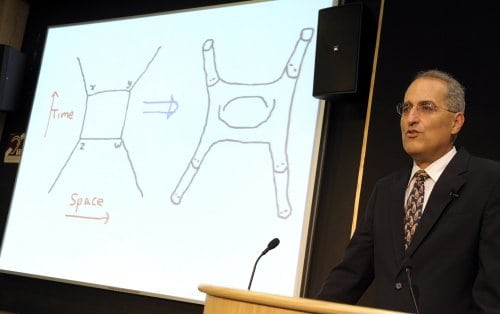
Witten is Charles Simonyi Professor of Mathematical Physics at the Institute for Advanced Study in Princeton, New Jersey and a pioneer in what must be the most controversial theory of modern physics.
Instead of plunging the audience into all 10 – or is that 11? – dimensions of the theory, Witten took a very gentle and historical approach to its development.
I entered the lecture hall knowing very little about string theory, so do I feel enlightened?
Well I suppose I have a better understanding of how and why the theory emerged and the various twists and turns it has taken. But I was continually frustrated by a lack of connection to measurements that can be made in the lab or with a telescope. I suppose this could be just a cultural issue – my background is in experimental condensed-matter physics.
The dearth of experimental evidence could soon be over with the emergence of “precision cosmology” – the latest example being the Planck mission’s unprecedented measurements of the cosmic microwave background, which could help to refine string theory.
Witten’s lecture was filmed and this, along with an interview, will soon be released by the IOP. Stay tuned for more.
Rome is famous for its huge flocks of starlings that swerve through the evening sky as if directed by a collective intelligence. While these spectacular displays have fascinated Romans since ancient times, they have yet to be described effectively by a mathematical model.
Now physicists in Italy have analysed 3D photographs of the Eternal City’s famous flocks using techniques borrowed from statistical mechanics. They found that a change in direction of one bird can affect the behaviour of all its companions – regardless of the size of the flock. This, argue the physicists, ensures a maximal response to environmental perturbations such as attacks by predators.
The work is part of an international collaboration between biologists, ornithologists and physicists called StarFlag, which aims to understand the rules of collective animal behaviour.
“Although it is possible to construct models that reproduce flocking behaviour, typically these are not based on an empirical analysis of observational data,” explains StarFlag member Irene Giardina, from Istituto Sistemi Complessi, Consiglio Nazionale delle Ricerche (CNR). “We felt the scientific dialogue between theory and experiment was missing.”
Bird watching in 3D
Even with the latest digital cameras and image-processing software, analysing flocks of birds is no easy task. In order to collect 3D data of the birds, the team used stereoscopic photography. This in itself presented a challenge. “Imagine the difficulty of taking high-resolution photos of thousands of far-away objects that are continually moving,” says Andrea Cavagna, also a physicist at CNR. “Now imagine doing this simultaneously with two fixed cameras you can’t move. Once we were set up, we could only fish in one place.”
You have two pictures, both essentially full of black dots, and you have to tell who is who Andrea Cavagna, CNR
The biggest obstacle, however, was matching data from both cameras. “You have two pictures, both essentially full of black dots, and you have to tell who is who,” says Cavagna. “This problem has arguably held up the entire field for 50 years.” By approaching the issue as an optimization problem, the scientists were able to develop algorithms based on statistical physics, and successfully match thousands of birds.
The result is a large data set describing the motions of individual birds, which was then studied using the mathematics of statistical physics to quantify the interactions among the starlings. Previous flocking models had assumed that an individual bird only interacts with others within a certain radius, but the Italian team found that an individual interacts with a fixed number of nearest neighbours, regardless of the distance to those neighbours. This means that information about the change of direction of any individual is quickly shared throughout the entire flock, and its transmission is not limited by a fundamental distance scale.
The critical point
This “scale invariant” correlation is significant because it is indicative of critical behaviour that occurs at a phase transition – when a material spontaneously transforms from being solid to liquid, for example. At a critical point, the smallest of perturbations can push the system into either one of the two states. In most physical systems, a critical point is reached by changing an external parameter, such as temperature. Cavagna and colleagues speculate that for the birds to flock at a critical point, the relevant external parameter must be evolutionarily hard-wired into the birds’ behaviour to help the creatures avoid predators.
Frank Heppner, an ornithologist from the University of Rhode Island in the US, finds the work of the physicists “remarkable”. He points out, however, that starlings typically do not fly in the spectacular formations seen at sunset at Rome. “Although it is absolutely legitimate to ask ‘How do they do it?’, an equally interesting point from a biological perspective is, ‘Why don’t they do it more often, and why do few bird species do it?'”
Cavagna acknowledges that, as well as contributing to the understanding of collective animal behaviour, his team has a lot to learn from biologists. He told physicsworld.com that he now hopes to apply its methodology to other members of the animal kingdom, such as insects.
Last year, we askedphysicsworld.com readers to submit their best names for element 112, which was discovered in 1996 by Sigurd Hofmann and his group at the Centre for Heavy Ion Research (GSI in Darmstadt, Germany.
The responses ranged from Unobtanium, Collossium and Planckium to Fibonaccium (which was my favourite).
Now, the International Union of Pure and Applied Chemistry (IUPAC, which develops standards for naming new elements and compounds, may be looking for a name for element 114 after researchers at GSI observed 13 atoms of Ununquadium.
Ununquadium was first synthesized in 1999 when Sergey Dimitriev and his team at the Joint Institute for Nuclear Research in Dubna, Russia, claimed to have produced a handful of atoms.
IUPAC states that the production of any new element must be independently verified at another lab first before it can be officially recognized. That happened at the GSI lab last month as well as at the Lawrence Berkeley National Laboratory in the US, which produced two atoms of element 114 in September last year.
IUPAC has not yet officially recognized the element, but when it does it will invite the team in Dubna to submit a name. IUPAC will then publish the name on its website, giving scientists and the public six months to scrutinize and comment on it.
After all the suggestions Hofmann received last year for element 112 he submitted Copernicium, in honour of the astronomer Nicolaus Copernicus. The IUPAC then approved the name and gave it the symbol Cn.
So, physicsworld.com readers, what are your suggestions for element 114?
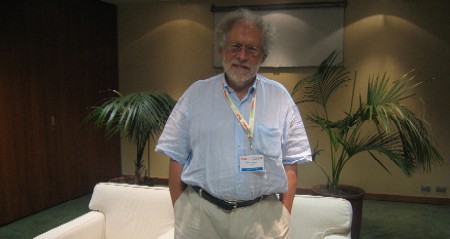
Anton Zeilinger, before giving today’s plenary lecture
By James Dacey in Torino
It’s the end of my third and final day here at the Euroscience Open Forum in Torino and I’m reaching that point of exhaustion you get to after dashing around a huge conference centre for several days straight. These things would be so much easier if you could somehow turn up at several sessions simultaneously. But that’s just the tiredness making me silly, right?
Well one man who would never say the word impossible is Anton Zeilinger, the quantum information luminary from the University of Vienna.
Zeilinger was giving the evening’s plenary lecture and he used the platform to wax lyrical about the beauty of quantum mechanics, but also to remind everyone that no theory is ever perfect and that we always need to think outside the bounds of accepted logic.
Zeilinger of course has been a pioneering figure in many areas of quantum information science including quantum cryptography, teleportation and quantum computing.
Before his lecture the free-thinking Austrian was generous enough to give me an hour of his time for an interview, and it proved most enlightening. He is one of those academics who will happily let his ideas run away with him as he always seems to be looking beyond your question to the bigger implications.
In the hour we discussed many things including Zeilinger’s admiration for Einstein’s stubbornness (even when he was wrong), and his desire for children to be exposed to quantum mechanics from a young age, perhaps through incorporating the concepts into computer games.
The full interview will appear on physicsworld.com in the near future. For now though, from me in Torino, it’s arrivederci.
The American Physical Society (APS) is urging the US Nuclear Regulatory Commission (NRC) to change its licensing rules over fears that smaller, more efficient ways of enriching uranium will increase the risk of nuclear proliferation. The APS wants the NRC to force anyone applying for licences to submit a “proliferation review” as part of their submission. The NRC, which over the next few years is expected to be reviewing new licence applications for new nuclear technologies including the use of lasers to separate uranium isotopes, has given no immediate reaction. “It usually takes 30 days [to respond] once we receive a petition,” NRC spokesperson Ivonne Couret told Physics World.
The APS’s concern stems from a report – Technical Steps to Support Nuclear Arsenal Downsizing – that its Panel on Public Affairs issued in February. The group put particular emphasis on the separation of isotopes by laser excitation (SILEX) which, the petition states, “is both 75% smaller and substantially more energy efficient than centrifuge technology”. Few details exist on how SILEX works but it involves shining laser light on uranium hexafluoride (UF6) molecules, which then absorb the incoming photon, causing the UF6 molecules to separate to leave a uranium-235 nuclei.
“The study group found that some of the new technologies could represent proliferation game changers because they would lead to smaller, more efficient methods for production and use of nuclear materials that would be more difficult to detect,” the APS’s petition to the NRC states. Other organizations have also recognized the danger. Both the International Atomic Energy Authority and the US National Nuclear Security Agency have established programmes to spot new technologies, including laser enrichment, that have proliferation potential.
It is possible there have been advances that make it a significantly easier prospect for potential proliferators Richard Lester, a nuclear engineer at Massachusetts Institute of Technology
The fact that the SILEX process has only now come close to commercialization indicates that “it is not necessarily an easy technology for countries or sub-national groups to abuse,” says Richard Lester, a nuclear engineer at Massachusetts Institute of Technology, who supports the APS’s recommendation. Lester says he did his PhD on laser enrichment more than 30 years ago just when people were beginning to be concerned with the proliferation risks associated with laser technology. “It is possible there have been advances that make it a significantly easier prospect for potential proliferators so it is entirely appropriate that the NRC pay attention to proliferation possibilities,” he says
But it is not only SILEX that the APS is worried about. “The committee’s concern was not just to identify one technology,” says Francis Slakey, associate director of public affairs at the APS. “We did not identify particular technologies apart from lasers, but we looked at the technology trend: reactors out there will be smaller, more efficient, and more prone to proliferation.”
The APS calls for the NRC to require that licence applications for fuel cycle facilities contain a “proliferation review” that should include “sufficient technical information to permit an assessment of the risks that construction and operation of the proposed facility might pose.” If the NRC accepts the petition, it will probably call for public comments on the proposed new rule. The commission will then analyse the comments and forward the final rule for approval by the five NRC commissioners.
ESA’s Planck mission has released its first full-sky map. The image shows the cosmic microwave background (CMB) in higher resolution than ever before and it may help cosmologists to develop a much clearer picture of the early universe.
“This is the moment that Planck was conceived for,” says David Southwood, who is ESA’s director of science and robotic exploration. “We are opening the door to an Eldorado where scientists can seek the nuggets that will lead to deeper understanding of how our universe came to be and how it works now.”
The Planck mission was launched in May 2009 with the main goal of mapping the CMB, the primordial radiation leftover from the Big Bang. Slight variations in the temperature of the CMB are believed to reflect fluctuations in the early universe from which large structures such as galaxies would later evolve.
The CMB was initially detected in the 1960s and its study in the 1990s using NASA’s Cosmic Background Explorer (COBE) satellite won George Smoot and John Mather the 2006 Nobel Prize in Physics.
Ancient polarizations
In 2003 the first full-sky survey of the CMB was produced by NASA’s Wilkinson Microwave Anisotropy Probe (WMAP). In addition to temperature, WMAP also measures the degree of polarization of the ancient microwave photons – providing more information about the early universe.
The Planck mission is expected to surpass WMAP by detecting a so-far unobserved type of polarization known as “B-modes”, which are believed to date back to the period of inflation and are determined by the density of primordial gravitational waves.
The image released today is generated from six months’ worth of data, and ESA is expected to release the first scientific analysis of the image within two years.
This first image is proof that the instruments are working perfectly Nazzareno Mandolesi, INAF
“This first image is proof that the instruments are working perfectly,” said Nazzareno Mandolesi of the Italian National Institute of Astrophysics (INAF), speaking this morning at the Euroscience Open Forum in Turin, Italy. “We can say that just 15 days of Planck are much better than five years of WMAP,” he added.
One of the main scientific goals of the Planck mission is to investigate what happened during the inflationary period shortly after the Big Bang, when the universe expanded by 1028 within just 10–36 of a second. This process is necessary in all mainstream models of the universe, but the details of the expansion are still debated. “The Planck data will provide our first realistic test of inflationary models ” explained Norma Sanchez, a cosmologist at the Observertoire de Paris, also speaking in Turin.
Predicting epidemic spread based on transport networks (Courtesy: B Goncalves et al., Indiana University)
By James Dacey
So it’s my second day here in Torino at the Euroscience Open Forum and I’ve just about got my bearings now, helped by forking out five euros to take the “panoramic elevator” to the top of the city’s National Museum of Cinema where I was treated to a fantastic view over the city and the surrounding Alps.
As its name suggests this conference is all about scientists and science communicators coming together from across the continent to discuss their research and can apply their discoveries to the real world.
Naturally I am interested in the way physics fits into all of this and to suss out what particular research fields are coming into bloom.
The thing that has struck me so far is the way physics and mathematics are now really starting to stretch beyond their traditional academic boundaries to interact with other more “human” research domains that were previously considered off-limits.
For instance, I saw a fascinating talk yesterday afternoon about how stochastic models could be applied to cancer treatment to model the spread of the disease and ways to optimize the delivery of drugs. After the talk I caught up with one of the speakers, Jean Clairambault of France’s National Institute for Research in Computer Science and Control, who told me his vision to find a way of personalizing drug treatments to reflect patients’ genetic differences.
Another area where physical models are being applied to the human sciences is to study the movement of people and things across the globe. This topic was discussed this morning in a session dedicated to these “complex networks”, which include the flow of people along transport networks and the flow of money across the US.
This idea of modelling human-interest systems as complex networks has been knocking around for quite a few years now, but early research only looked at evolving processes retrospectively. It was interesting, therefore, to hear Dirk Brockmann of Northwestern University describe how these tools were used for the first time last year as a way of predicting behaviour – in the spread of the H1N1 flu pandemic. Indeed, you can read about this particular research in this special Physics Worldfeature.
Right, all this talk of networking – I should probably go do some myself. Where was that free stall again??
It’s home to the Italian football giants Juventus and of course the famous shroud with the stain that looks like Jesus, but apart from that I must confess to knowing very little about Torino before I arrived here late last night.
I’m in town for the Euroscience Open Forum – a biannual international meeting celebrating science, technology and culture, with an obvious leaning towards all things European.
With such a broad scope, I was a bit concerned that the events might be a bit lightweight and sanitized. But fortunately my fears were allayed by the first session this morning, which dived in by looking at some of the fundamental concepts of quantum mechanics and their philosophical implications. Okay, so there was a little bit of naval-gazing, but there were also some really fascinating discussions.
One of the speakers was physics Nobel laureate, Gerard ‘t Hooft, who was looking at local determinism. He was comparing the theory of quantum mechanics with the manner in which Maxwell formulated his celebrated equations of electromagnetism. His conclusion being (as far as I understood!) that critics of quantum mechanics cannot make such a clear distinction between the accuracy of ‘deterministic’ approaches like electromagnetism and the “non-deterministic” theory of quantum mechanics.
‘t Hooft described how Maxwell had visualized space as being filled at all points with gears and switches, which all had an effect on each other. The laureate’s argument was that, while this approach worked for electromagnetism, quantum mechanics is a far more encompassing theory. He believes this approach is simply not feasible in the search for equations of the entire physical universe – there is too much going on that we will always have to break things down into estimates and probabilities.
In a (slightly) lighter talk, logician Marisa Dalla Chiara of Italy’s University of Firenze made the argument that quantum computing is much closer to human reasoning than classical computing is. She compared the supposition of quantum states with personality traits, declaring that people are neither “fully generous” nor fully “not generous”. We are always a supposition of the two.
Chiara believes that if we can develop practical quantum computers we could start to address some of the areas beyond the capability of classical computers. This might include the formal analysis of music to work out how it can create different moods within different contexts.
To bring her argument to life, Chiara even treated us to a quick rendition of Monteverdi’s Lamento di Arianna. Very eccentric but a nice touch.
Quantum mechanics and its applications is one of the 10 main themes of the conference and it will also include a keynote speech from Anton Zeilinger, the Austrian physicist famous for teleporting information over increasingly large distances. I’m hoping to catch up Zeilinger for a chat on Monday so I’ll let you know how that goes.
Right, I’m off to grab a slice from one of the city’s many takeaway pizza outlets before rushing back for the afternoon’s sessions.
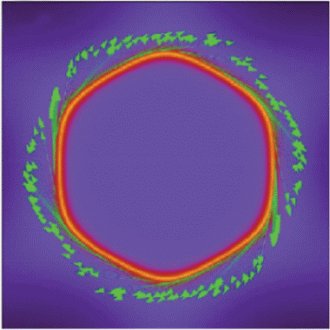
The spin-resolved Fermi surface of surface states of a topological insulator away from the Dirac point. Figure taken from Wei Zhang et al. 2010 New J. Phys.12 065013.
By Hamish Johnston
If someone asked me, “what is the most fascinating topic in physics today?”, I would have to say: “topological insulators”.
I can appreciate why some people get excited by the prospect of knowing the mass of the Higgs boson, or understanding the true nature of dark matter – but to me such mysteries pale in comparison with the wonders to be found in a chunk of solid matter.
I think I find condensed-matter physics so fascinating because it manages to describe the messy interactions of billions upon billions of electrons, atoms and photons using elegant concepts such as quasiparticles.
And perhaps the most interesting of all quasiparticles could be lurking in topological insulators – a particle reminiscent of “Majorana fermions”, which were predicted in 1937 by the Italian theorist Ettore Majorana but which have yet to be seen.
Majorana fermions are electron-like particles that are their own anti-particles. Unlike more familiar fermions like electrons, they obey “non-Abelian statistics” – which should make them resistant to environmental noise, which is the bane of anyone trying to build a practical quantum computer.
If you want to know more about topological insulators then you are in luck because the New Journal of Physics has just published a focus issue on that very topic.
For people in the developed world, being a bit short- or long-sighted might prevent them from being a fighter pilot, but not having perfect vision is unlikely to crush their life’s ambitions. A trip to see the optician is all it takes to bring the world back into focus, and life proceeds as planned. In many parts of the developing world, however, poor sight can have much more serious consequences. There, eye-care professionals are scarce, and spectacles are rare and often prohibitively expensive. People who rely on good vision for their income, such as machinists or carpenters, may therefore find that as their sight changes with age they cannot work effectively, if at all, and a life of poverty can ensue. Poor eyesight can also affect children – if they cannot see the blackboard clearly at school, their education will be compromised and so will their career prospects.
Figures suggest that in the developed world, more than 60% of the population need and have their vision corrected. However, in rural parts of developing nations not served by optometrists, barely 5–10% of people wear glasses. Assuming that there is no significant physiological difference between people in the developed and developing worlds, the unmet global need for vision correction is about three billion people. If we accept that contact lenses and corneal refractive surgery are probably not appropriate solutions to the problem for people in developing nations, this means that three billion people need to be supplied with glasses.
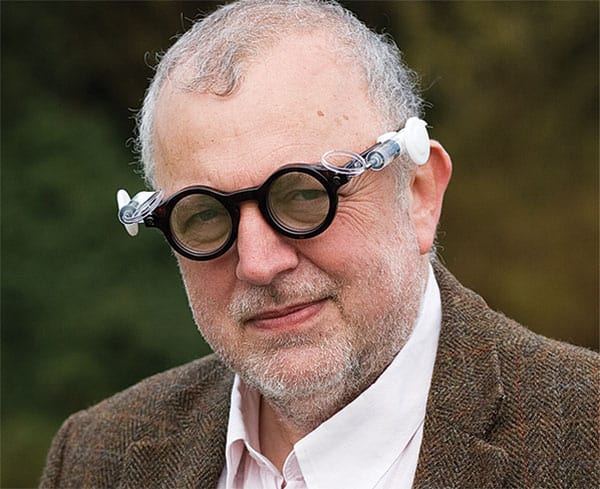
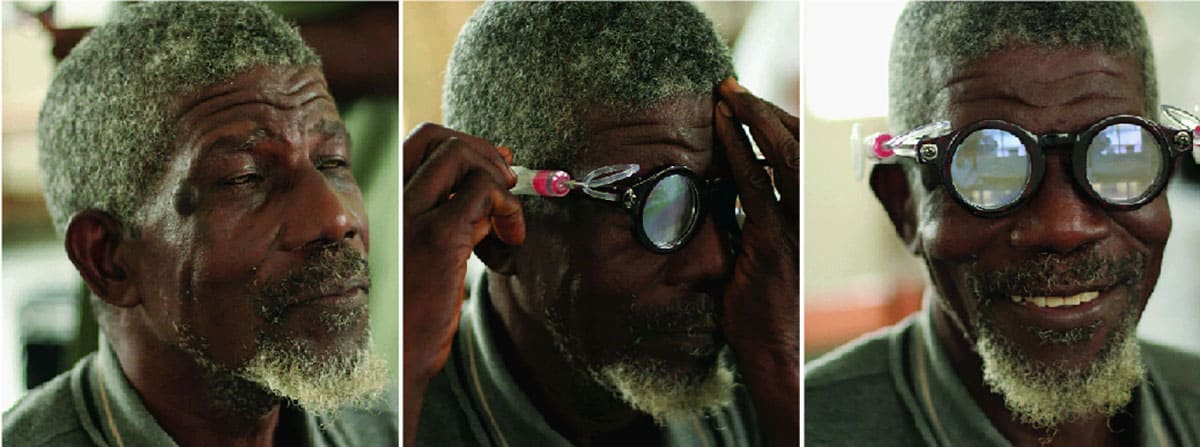
But for the unspectacled and poor-sighted, help may be at hand from Josh Silver. When working as an atomic physicist at Oxford University in the 1980s, he came up with a simple but effective invention: glasses that can be self-tuned to one’s own prescription. Each lens consists of two flexible membranes filled with liquid. By adding or removing fluid to make the lens more convex or concave, the shape and thus power of each lens can be set by the wearer. But the glasses are not just simple to use, they are cheap too, costing just $19 a pair – a price that it set to fall soon. However, the real beauty of the invention is that while fitting the glasses in the presence of an optometrist is ideal, it is by no means essential. In areas of sub-Saharan Africa that are served by only one optometrist per million people, this ability to self-adjust the power of each lens is key. Silver’s invention has now been manufactured and distributed to more than 30,000 people, but his ambition is far greater: his “global vision for vision” is to try to ensure that one billion people have the glasses they need by the year 2020.
The very idea
Silver’s story started as a 10-year-old boy in East London, playing with a plate, some aluminium foil, a 10 cm-diameter ring made of phenolic resin and his mother’s red nail varnish. With this collection of household objects, the young Silver made his first variable optic device – a “membrane” mirror. He attached a circle of foil to one side of the ring and the plate to the other, using the nail varnish as glue. The plate had a hole in the middle which he blew into to change the shape and thus power of the foil mirror.
By the mid-1970s Silver had gained a degree from Oxford University and was playing with more advanced equipment, in his job there as an experimental physicist in the department of atomic and laser physics. In experiments to measure X-rays arising from atomic transitions, he used to attach thin metallized polyester film to vacuum chambers and detectors. It was important that the film was uniformly tensioned, as it formed the canvas for the X-rays being measured. Silver discovered that double-O-ring seals worked particularly well at sealing and stretching these films.
Fast-forwarding a decade to the 1980s, Silver found himself trying to answer a question posed by a colleague: could he create a variable-focus lens? Silver’s solution was to fill a lens made of two circular membranes with a liquid that could be pumped in or out to change the power of the lens. The first model had a poor surface and hence optical quality, but after a little thought, the nugget of double-O-ring know-how from the 1970s came back to Silver. He applied this knowledge to a revised design, which was much improved.
For Silver, who is short-sighted himself, this second lens was a key step towards creating variable-power glasses. He found that by looking through the new lens while changing its power, he could tune it so that he could see extremely well. Silver says that this got him thinking about “first, roughly how many people in the world need corrective eyewear, and second, whether people could use inexpensive variable-power lenses to essentially make their own corrective glasses”.
A clear vision Josh Silver – atomic physicist and the brains behind Adspecs. (Courtesy: Centre for Vision in the Developing World)
The case for adjustable spectacles
Silver continued his career in atomic physics – he went on to publish roughly 100 papers and to supervise about 30 doctoral students, mostly seeking to determine whether relativistic quantum mechanics and quantum electrodynamics can predict the energy levels in simple atomic systems. But all the while he found himself unable to shake off his interest in vision correction. Having estimated that three billion people in the world have an unmet need for vision correction, Silver began collaborating with colleagues at Oxford to investigate whether people could tune a variable-focus lens to their own prescription. “We undertook a long programme of research before I was confident enough to say ‘we know self-refraction for adults works reasonably well’,” he recalls. At the time, Silver’s group was alone in looking into this, but the technology has recently been tested independently by Kyla Smith and colleagues at the New England College of Optometry in the US (Optometry and Vision Science 2010 87 E176). The study endorses Silver’s invention as a feasible alternative where subjective refraction in a controlled clinical setting is not available.
Silver says that his work began in earnest in 1994 when he spoke to Björn Thylefors – at the time director of the World Health Organization’s Programme for the Prevention of Blindness. Explaining that about a billion people needed glasses in the developing world, Thylefors said that if Silver could do something about it, he should. And the more Silver learned about the consequences of uncorrected vision in developing nations, the more worthy a cause it seemed. “It’s about education, economics and quality of life,” says Silver. “If a child is short-sighted in the classroom, it’s difficult for them to take advantage of what they are being taught. We’re talking here about hundreds of millions of schoolchildren.”
It’s about education, economics and quality of life. If a child is short-sighted in the classroom, it’s difficult for them to take advantage of what they are being taught. We’re talking here about millions of schoolchildren
A study in the Shunyi district of China in 2000, for example, looked at 6134 children and found that by the age of 15, almost half (46%) were short-sighted and could benefit from prescription glasses. A short-sighted (myopic) eye cannot correct itself and external vision correction is needed in order to focus images on the retina. Hyperopic (long-sighted) eyes in children are able to correct themselves automatically to some extent, in a process called accommodation. But while a hyperopic child may not struggle to see at school, vision correction matters for them too – there is evidence that if these children do not get their vision corrected, they are more likely to develop sight problems later in life.
However, children are not the only ones affected. Most of the world’s population that are aged 45 or older develop a condition called presbyopia, which is where the lens loses its elasticity and therefore its ability to focus on near objects. It is a completely uniform symptom of aging; essentially, everyone becomes presbyopic when they get older. In sub-Saharan Africa, the onset of presbyopia appears to start earlier and can happen to people in their 30s. People who rely on near vision for their income but do not get vision correction can therefore find that the quality of their work deteriorates and, indeed, that they may have to stop working altogether. Adults are thereby excluded from productive working lives through lack of vision correction, and individuals and families can fall into a cycle of poverty.
To find out more about the practicalities of his invention being used in the field, Silver developed a robust and affordable product (see box “The invention: Adspecs”) to use in a wide study. With a successful pair of adjustable spectacles – or Adspecs – now in hand, things really took off. In 2003 Silver and his colleagues carried out a study funded by the UK government’s Department for International Development to find out how effective the Adspecs were (South African Optometrist62 126). They looked at 213 participants, who had been selected by local agencies in Ghana, Malawi, Nepal and South Africa. Silver found that 78% of the sample could not obtain 20/20 vision without the use of glasses – but that their eyesight was transformed when they tried on Silver’s spectacles. (Someone with 20/20 vision is able to resolve lines and spaces that are an angle of one arcminute wide – one 60th of a degree.) “With the use of Adspecs, more than 80% would be able to pass a UK driving vision test,” Silver claims.
The invention: Adspecs
(Courtesy: Centre for Vision in the Developing World)
The lenses of these peculiar-looking spectacles are made not of glass but of two thin membranes sealed and stretched to a diameter of 42 mm and filled with silicone oil. The oil has a refractive index of 1.58 – within the 1.5–1.7 range used in glass and plastic ophthalmic lenses. The amount of liquid in each lens is controlled by turning a dial on each fluid-filled pump. The lenses can be made convex and thus more powerful by fattening them, or concave by drawing liquid out. They are able to give a remarkable prescription range from +6 D to –6 D. Power here is measured in dioptres (D), and is the inverse of the lens’ focal length in metres. Once the correct prescription has been found, the sealing valves are engaged and the pump and tubes can be removed.
The more than 30,000 pairs of these adjustable spectacles that have so far been distributed to people requiring vision correction in developing countries may have spawned an army of Harry Potter lookalikes. But to those for whom it means being able to benefit fully from their education by seeing the blackboard, or to continue working and supporting their family after deterioration of eyesight in middle age, this is a small price to pay. Josh Silver, who first thought up these adjustable spectacles and is a proponent of their use, acknowledges that the current design is “a bit clunky”, but new, more attractive devices are likely to be in production soon.
Distribution projects
To date, more than 30,000 pairs of Adspecs have been distributed globally in over 20 countries. The largest scheme so far has been headed by US Navy Marine Major Kevin White, who was in charge of a humanitarian aid programme in 2005 when he read about Silver’s glasses. Impressed with the Adspecs initiative, White arranged to meet Silver and later got approval from the US Department of Defense to buy and distribute 20,000 pairs. White has since set up Global Vision 2020, a US not-for-profit organization that is delivering corrective eyewear throughout the developing world. It has recently finished a successful project in Cameroon and currently has another ongoing in Liberia.
There are many inspirational stories of people whose lives have been touched by Silver’s technology. One such account from a Global Vision 2020 scheme in Kakata, Liberia, is that of father of nine Arthur Walker. As the sole head of the household, his wife having died a few years earlier, Walker supported his family through his job as a carpenter with the help of two sons. Recently one of these sons died, and with the added problem of deteriorating vision meaning that Walker was finding it harder to see his work and so could do less, he was under a lot of pressure.
Seeing clearly Carpenter and father of nine, Arthur Walker went to his local eyewear distribution session in Liberia after having trouble seeing his work and even walking around. Volunteers fitted him with Adspecs for near-sight and glasses for distance vision. He went away happy, with nearly 20/20 vision. (Courtesy: Global Vision 2020)
Although Silver’s line of work would appear to be beyond reproach, given that it can offer people a cheap and easy way of correcting their vision, others in optometry, ophthalmology and the eyewear industry are keeping a close and sometimes critical watch on these developments. After all, the eyewear industry sells $50bn worth of products each year. But Silver stresses that adjustable spectacles will definitely not replace the need for people to see eye-care professionals who can diagnose conditions associated with eye health such as glaucoma and cataracts.Volunteers at the distribution session diagnosed Walker with both hyperopia and presbyopia. For the hyperopia, Walker fitted himself with a pair of Adspecs for close work and reading, and a pair of off-the-shelf glasses were perfect for his distance vision. Reading down the vision chart, where originally he could barely make out the second line, Walker could now see line eight and had almost 20/20 vision. Glasses in hand, Walker could return to his work with renewed vigour, and support his family where otherwise failing vision may have made this an increasingly uphill struggle.
The ideal solution would be to provide the same standards of eye care that exist in the developed world across the globe, but, in the short term at least, this is not feasible. In the UK, one optometrist cares for about 8000 people, but in sub-Saharan Africa this figure can be as high as one for every 1,000,000 people. An extra 125,000 practitioners would therefore have to be trained and retained to meet the need in this region alone. “There really ought to be a global standard for acuity,” adds Silver. “In the developed world, an optician would be expected to correct a patient’s vision to 20/20 if they are capable of this acuity. Yet globally, there appear to be no consistent standards. People in populations that are underserved cannot currently point to a standard and say ‘I want to be able to see that well.’ ”
It was to meet the need for vision correction worldwide that prompted Silver to set his target of supplying a billion people with the glasses they need by the year 2020. According to Silver, there are a number of different devices in production, but far fewer than a million are being produced in total each year. To meet his goal, 100 million pairs would need to be produced each year for next 10 years. Moreover, the cost would have to be cut by a factor of about 10 – Silver’s goal is $1 per pair.
Scaling up the Adspecs initiative will be a challenge – the investment needed to develop products is usually attracted by the promise of profits, but Silver’s aims are in essence charitable. A related concern of his is what might happen if the variable-lens technology becomes a success in the developed world. “I don’t want to see a situation where the poor in the developing world don’t get access to the technology because it is controlled by people determined to make money out of it,” he says. In fact, in 2009 Silver left a company he himself founded, which develops new self-refraction eyewear, to set up the non-profit Centre for Vision in the Developing World in Oxford.
The ability to improve the lives of thousands of people has clearly been rewarding for Silver, but that does not mean that his vision research is more rewarding than his work in atomic physics. “It’s just different,” he says. “It’s good to do research for curiosity and it’s also good to do something with an immediate technology. I encourage others to think in the same way.”
This article first appeared in the July 2010 issue of Physics World. Since then the Centre for Vision in the Developing World has designed an upgraded set of spectacles called “New Adspecs” manufactured by Contour Optik in China. Some 500 pairs were distributed to Syrian refugees in Jordan in late 2014. Josh Silver explains more about his work in this video lecture.