Short-lived tin is doubly magic

Researchers in the US and UK have confirmed that a short-lived isotope of tin is the latest member in an exclusive club of “doubly magic” nuclei, a nuclear equivalent to the noble gases. This is only the seventh of these rigidly spherical nuclei to have its magical qualities measured. And the experiment could provide clues to how heavy elements are created in the supernova explosions of massive stars.

Physicists have long known that protons and neutrons in nuclei occupy discrete orbital shells – in much the same way as electrons do in atoms. Indeed, when this idea was developed into the “nuclear shell model” it won Maria Goeppert-Mayer and J Hans D Jensen a share of the 1963 Nobel Prize for Physics.

Magic nuclei are those having the precise number of protons or neutrons required to fill each orbital shell to full capacity. Nuclei with magic neutron or proton numbers tend to be characterized by a stronger binding, greater stability, and are, therefore, more abundant in nature. In doubly magic nuclei, both proton and neutron shells are filled, which can make the binding even stronger.

Double the magic

To date, researchers have discovered just six doubly magic nuclei by confirming the spherical nature of their outer shells. Five of these – including helium-4 and oxygen-16 – are among the most common isotopes found in nature on account of their stability. But in 1998 researchers discovered the latest doubly magic nucleus, nickel-56, which is much less stable. It has a half life of 5.9 days on account of it having two neutrons fewer than nickel-58, which is far more abundant in nature.

People thought this wouldn’t be possible until the next generation of facilities come along Kate Jones, the University of Tennessee

Now, a group of researchers at the Oak Ridge National Laboratory in Tennessee have confirmed the existence of a seventh doubly magic nucleus, which is far more unstable still. Tin-132, with its 50 protons and 82 neutrons, was predicted to be doubly magic by the nuclear shell model but it has been very difficult to prove this because it decays with a half life of just 40 seconds.

To get around this, Kate Jones of the University of Tennessee has led a novel experiment, which turned standard procedures on their head. One favoured approach to identifying doubly magic nuclei is to strip neutrons from the target isotope and infer the structure of the doubly magic nucleus from properties of these dislodged neutrons. This can be done by creating a film of the target material and hitting it with a beam of deuterium, which is an isotope of hydrogen comprising one proton and one neutron.

Aggressor becomes the target

However, given that tin-132 is too short-lived to produce a substantial film, Jones’ team decided to switch the target with the firing beam. Using Oak Ridge’s Holifield Radiation Isotope Beam Facility (HRIBF), they accelerate a beam of tin-132 to a velocity of about 10% the speed of light and direct this at a target of polyethalene that has been deuterated: its hydrogen-1 atoms replaced with hydrogen-2. As the tin-132 isotopes collide with the target some of them could split the deuterium molecules by stripping a neutrons to form the heavier nuclei of tin-133, while the proton fell back towards the target.

The clever part is that the researchers can study the motion of these recoiling protons to reveal information about the structure of the tin nuclei. By analysing properties such as energy and angular distribution of these particles, the researchers could confirm that the stripped neutron rests in a separate orbital above the closed inner structure of the tin-132. The fact that the neutron falls into this “single particle state” is confirmation that tin-132 must have the robustly spherical nature reminiscent of a doubly magic nucleus.

Jones says that it is the “purity” of the single particle states that makes these results so convincing. “People thought this wouldn’t be possible until the next generation of facilities come along, but we are really excited to have managed it using our cyclotron accelerator whose design dates back to the 1950s.”

Short-lived nuclear landscape

Rituparna Kanungo, an experimental nuclear physicist at St Mary’s University in Halifax, Canada, is impressed by the inverse kinematics technique employed by the Holifield team. “This is a powerful but quite challenging experimental tool to study single-particle states,” she says. “These observations are important for developing the nuclear shell model in regions of the nuclear landscape where isotopes start to become short-lived.”

One fascinating area of physics that may benefit from this field of research is the study of how heavier elements are formed in highly explosive conditions. More than half of the elements heavier than iron are believed to originate from something known as the “R process”, which involves a succession of rapid neutron captures on seed nuclei, typically nickel-56. “The main contender for the site of production is supernova or neutron star mergers, but given the explosive nature of these sites it is very difficult to reproduce this process in the laboratory,” says Jones.

This research is published in Nature.
Eyjafjallajökull’s plume is electrified

Ash from the Icelandic volcano Eyjafjallajökull was electrically charged as it wafted over Scotland last month, according to researchers in the UK who launched instruments into the plume. The team believes that collisions between ash particles maintain the charge and suggest that the effect could be used to detect the otherwise elusive ash particles, which have caused major disruptions to air travel since the eruption began on 14 April.

Volcanic eruptions are often accompanied by spectacular displays of lightning, so it’s not surprising that ash can be electrically charged as it spews out of a volcano. However, scientists know that the charge dissipates rapidly as the ash moves away from the volcano. This means that no measurable charge should have remained in the ash above south-western Scotland that was studied by Giles Harrison and Keri Nicoll of the University of Reading and colleagues.

Racing to Scotland

In April Harrison and Nicoll raced northwards to launch a balloon-borne collection of instruments into a plume of ash from Eyjafjallajökull that was drifting over Scotland. The kit, which is usually used to study clouds of sand kicked up by desert storms, included a spherical electrode exposed to the air. During the flight, the electrode voltage was set to 4 V every 60 s and the charge density in the air is determined by the rates of change of the voltage and altitude during that period. Another instrument measured the concentration and size of the particles by scattering laser light from the ash.

The balloon entered the plume at an altitude of about 3.7 km and found it to be about 500 m thick with sharp boundaries. The charge density was fairly uniform within the cloud, having a value of about 0.5 pC/cm-3.

The team found that most ash particles were less that 2.6 µm across, with the average diameter being about 1.4 µm. The instrument also determined that the ash concentration was less than 100 particles per cubic centimetre.

These parameters allowed the team to calculate the charge relaxation time of the plume, which was about seven minutes. However, the ash had left the volcano about 32 hours before reaching Scotland, and therefore the team is confident that the measured charge was much too large to have been created during the eruption.

‘Fair weather charging’ ruled out

A cloud of airborne particles can also experience “fair weather charging”, which is caused by the tiny vertical electrical current that is always present in the atmosphere. When this current crosses the boundary between clean air and particle-laden air, charge builds up at the top and bottom of the cloud but not in the middle. However, Harrison and colleagues measured charge within the ash cloud, suggesting that fair weather charging was not responsible for the ash’s electrical properties.

Harrison said that the charging is likely to be “a result of particle–particle collisions, which has been reported before as a possible charging mechanism for volcanic plumes”. This “triboelectric” effect is familiar to anyone who has experienced an electric shock after dragging their feet across a carpet.

He also told physicsworld.com that the charged nature of the ash cloud “might be useful is in detecting the ash remotely from an aircraft, as the small particles are difficult to detect with standard instruments such as radar”.

The work is reported in Environ. Res. Lett. 5 024004.

Next stop: Seattle

By Michael Banks in Miami, Florida

So that was this summer’s American Astronomical Society (AAS) meeting. We had some nice talks about NASA’s Solar Dynamics Observatory (SDO), the CoRoT exoplanet hunter and the Herschel satellite as well as how to destroy asteroids and unexpected results from research into supermassive black holes.

I would say it was SDO that stirred the most interest, and talks about the mission were usually given to a packed auditorium. Indeed, SDO’s booth in the exhibition centre was always busy with people staring in awe at the new images of the Sun the satellite has recently produced.

One thing you always probably take away with you when attending talks on astronomy is the sheer scale of the universe. For example, in a talk on Herschel today (see previous entry) even when zooming into an average image taken by the satellite three or four times there are still more than 6000 galaxies in the picture possibly containing millions of stars and thousands of planets.

And that brings in another aspect of astronomy – handling the huge amounts of data that missions are now producing second by second. The Wide-field Infrared Survey Explorer (WISE), for example, is taking an image every few seconds transmitting terabytes of data every day. Astronomers think it will take at least 20 years before they have analysed all of WISE’s data.

Hopefully astronomers working on missions such as SDO, WISE and Herschel will be able to tell us even more about our Sun and the universe when the next AAS meeting is held in Seattle starting on 9 January. See you there!

Mapping the cosmos

hershchalimage.jpg
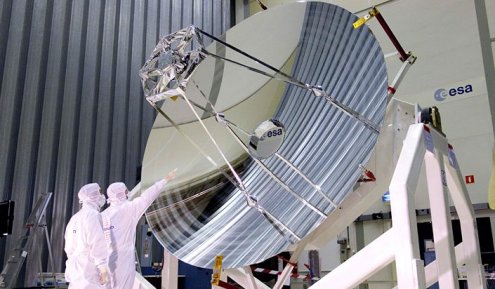
Inspecting the 3.5 wide mirror of the Herschel telescope

By Michael Banks in Miami, Florida

It seems I have something (rather tenuously, I admit) in common with the European Space Agency’s Herschel mission: we were both “born” in 1982. (Although I am not sure what else I could have in common with a space satellite.)

Goran Pilbratt from the European Space Agency (ESA) told delegates today at the 216th American Astronomical Society meeting in Miami, Florida, all about the Herschel mission that was first proposed way back in May 1982 at an ESA workshop.

Herschel features two cameras (named PACS and SPIRE) and a spectrometer (HIFI) to study star formation in our galaxy and galaxy formation across the universe.

Herschel also has a dewar of liquid helium that cools its detectors down to 2 K so that it can better measure objects in the sky in infrared via its 3.5 m wide mirror.

With 30 years invested in the instrument, you could perhaps forgive astronomers for being nervous when Herschel launched on 14 May 2009. “Herschel has no moving parts, so if there is something wrong after it launches we can’t do anything about it,” says Pilbratt.

Herschel in the end made a “perfect launch” and it even started taking data only 30 hours after launching.

But not everything has been plain sailing since then. In August 2009 HIFI stopped working and its software had to be rebooted taking around five months in total to fix.

Once back online in January, astronomers are now really reaping the rewards of HIFI. Pilbratt showed some spectroscopy data taken from the Orion constellation that contained more than 100,000 spectral lines originating from signatures of specific elements or compounds. That’s likely to take some time to trawl through.

Indeed, although the Herschel mission has only been going for around a year, astronomers have already written more than 120 research papers, which will be published in an upcoming special issue of Astronomy and Astrophysics. With another three years to run, that is likely to only be the start.

Avoiding asteroid Armageddon

DSCN1914.JPG
Impact zone That’s a lot of dots

By Michael Banks in Miami, Florida

We all know the plot for the film Armageddon starring Bruce Willis. An asteroid the size of Texas is on a collision course with Earth, and the US government sends a bunch of astronauts to plant a nuclear device underneath the asteroid to blow it to pieces, thus saving humanity.

Well that is how it goes in Hollywood. But what would we do if we suddenly found a large asteroid that would hit the Earth within the next 50 years?

Last night David Dearborn, a physicist at Lawrence Livermore National Laboratory in California, gave a talk here at the 216th American Astronomical Society meeting in Miami, Florida, about the best technologies to avoid an asteroid extinction event.

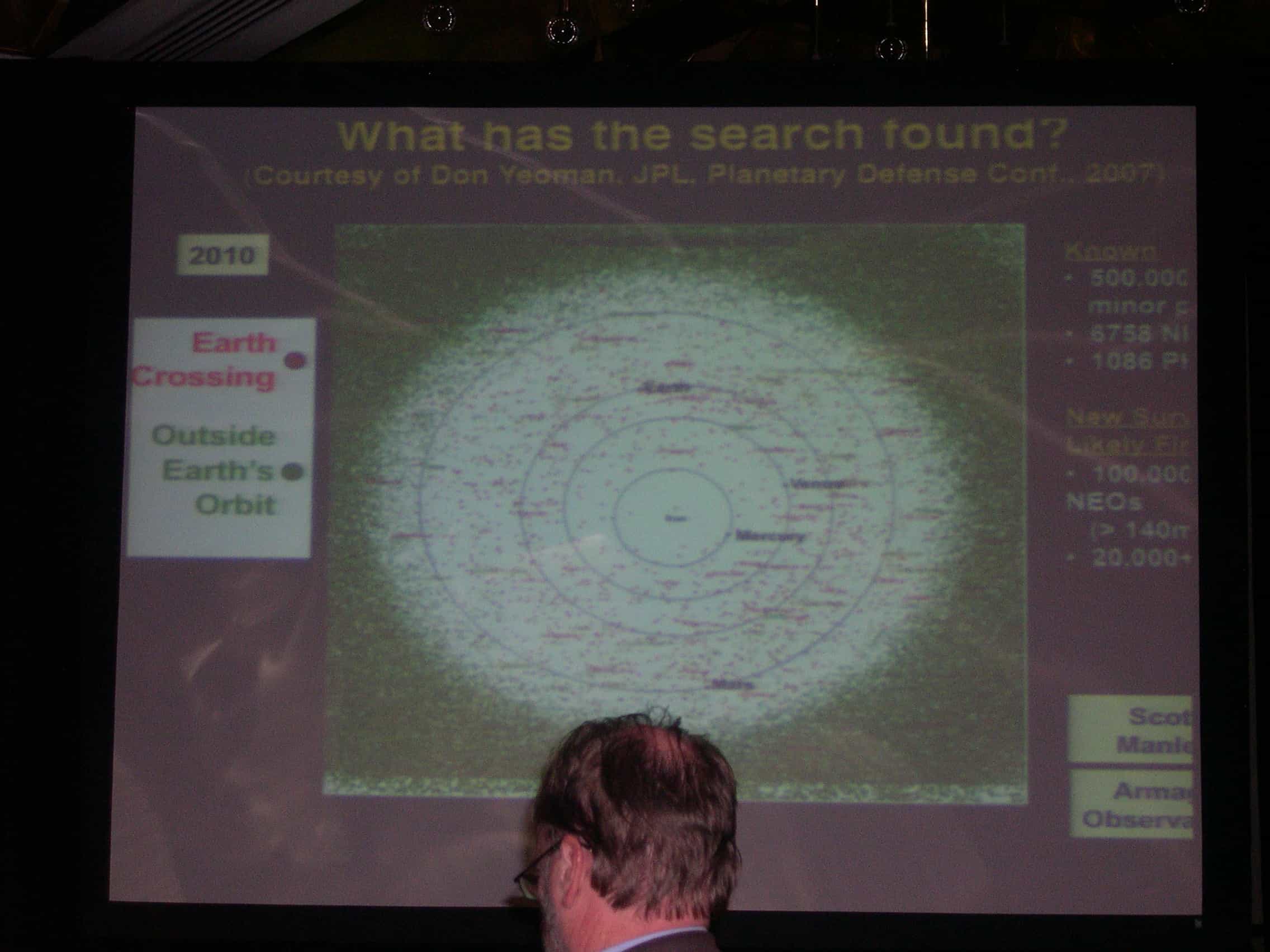
In 1998 NASA started a project named Spaceguard with the aim of cataloguing 90% of all asteroids in the solar system larger than a kilometre before 1998. Currently the project has detected around 80%, mainly because, rather unsettlingly, astronomers are finding more and more of them.

Then, in 2005, Congress asked astronomers to catalogue 90% of asteroids greater than 140 m by 2020 using a number of telescopes including the Large Synoptic Survey Telescope, which is currently being built in Chile and is expected to come online in 2015.

If an asteroid is on a collision course, Dearborn says that it is important to know its composition, whether it is made up of rubble, has a solid core, or even if it is a collection of solid rocks held together by rubble.

One point Dearborn reiterated is to deflect an asteroid only when we are 100% confident that it will hit the Earth. “You have to leave it alone until you know if it is going to be a problem,” says Dearborn.

So how do you blow up an asteroid or at the very least deflect it out of harms way? One option is painting the asteroid white, which would change its albedo and slowly start to change its orbit. Given that Dearborn says it would take decades to carry out this paintball exercise on a celestial scale it is perhaps not the best option.

Another is firing a high-powered laser pulse at the asteroid, but this again would take around 6000 years to change its speed by around 1 metre per second. “The National Ignition Facility is not really designed for shooting asteroids,” says Dearborn.

So the best technique for deflecting them is via a nuclear explosion. Two options are to activate a nuclear device just before impact or attempting to strike the object with a nuclear weapon. Dearborn presented a variety of models showing how an impact would break up an asteroid depending on its composition. “Current nuclear technology could handle most possible threats,” concludes Dearborn.

I guess Bruce Willis had it right all along.

NASA probe spots huge plasma ejections

NASA‘s Solar Dynamics Observatory (SDO) has taken the first clear images of huge ejections of plasma from the Sun’s surface. The images were shown yesterday at the 216th American Astronomical Society Meeting in Miami by Alan Title of Lockheed Martin. The ejections are so powerful that they sweep over halfway across the star’s face, and the ability to study them in such clear detail could help our understanding of how solar activity affects satellites orbiting Earth.

The $850m SDO was launched in February and it uses a suite of extremely sensitive instruments to make a wide range of measurements of the Sun. As such, the mission can chart solar disturbances from their origins deep inside the core of the star to their appearance on the surface and their rapid ejection into space. SDO started science operations on 14 May after a calibration period.

Four-telescope array

The SDO craft sits in a geosynchronous orbit, which enables the satellite to continuously observe the Sun and makes it easier to transmit data to a ground-based station. It carries three instruments, including the Atmospheric Imaging Assembly (AIA), which is an array of four telescopes that will observe electromagnetic radiation from the Sun over 10 different wavelength bands.

Although astronomers have already taken clear images of smaller coronal mass ejections – expulsions of plasma threaded with magnetic fields – the studies have never covered such a large scale. Indeed Title, principal investigator for the AIA, showed images of the mass ejections that are so large they travel over halfway across the Sun’s face.

‘Not rare at all’

Title says SDO scientists have now spotted four such ejections. “For the first time we can clearly see these huge ejections,” Title told physicsworld.com. “What we have also found is that they are not rare at all.”

The ejections are likely to travel around 500 kilometers per second and as a result astronomers have found it difficult to clearly observe such huge ejections. “All we could previously do is see just a blur of this phenomena,” says Title.

Appreciating the Sun

Seeing events like this gives you a great appreciation of the Sun Alan Title, Lockheed Martin

Scientists will now try to understand how such huge ejections occur to provide an early warning system for satellites as well as planes that are flying over the poles, which are regions most affected by geomagetic storms. “Seeing events like this gives you a great appreciation of the Sun,” says Title.

The SDO is the first mission in NASA’s Living With a Star programme, which was established in 2001 to try to obtain a better understanding of how the Sun’s activity can impact on life on Earth.

The search for other planets

corot.jpg
It’s out there

By Michael Banks in Miami, Florida

We need to better understand how other stars behave before we start looking for planets orbiting around them. That was the message from astronomers speaking in a session on searching for exoplanets at the 216th American Astronomical Society meeting in Miami, Florida.

Annie Baglin from the Observatoire de Paris, France, spoke about the $160m Convection Rotation and Planetary Transits (CoRoT) mission, built by the French Space Agency, which launched in 2006.

CoRoT has two objectives: to study the solar variation in other stars as well as searching for exoplanets via a technique known as “transiting”, where a planet passing in front of the star causes its solar output as seen by the satellite to dim slightly.

Indeed, CoRoT has already had breakthroughs in studying solar variations in other stars including hot stars and red giants. Yet the science that gets the most attention is CoRoT’s search for exoplanets.

Although CoRoT lost the use of two of its detectors last year, the craft is still going strong and has managed to detect a range of exoplanets.

Most of the exoplanets spotted by CoRoT are big, hot planets such as CoRoT-3b, which has a mass 21 times that of Jupiter.

On 17 March CoRoT discovered CoRoT-9b, which has a radius similar to Jupiter and a temperature of 350 K. “If it has moons, then they would be habitable,” says Baglin. But getting to the planet is another matter as it is lies 1500 light-years away.

The biggest find to date is possibly CoRoT-7b, discovered in February 2009, which has a similar diameter and mass to Earth.

Baglin outlined in her talk how difficult it is to spot such small planets saying that constant changes in the star’s activity makes it very difficult to detect planets orbiting them. “Once we have a better understanding of a star’s cycle then we will be better placed to start to look for exoplanets,” says Baglin.

CoRoT still has another three years to run, but it has already been superseded somewhat by NASA’s Kepler mission, which launched in March 2009 to look for Earth-like planets. “Kepler will do more than what we have,” says Baglin.

Black holes: not where they ought to be

By Michael Banks in Miami, Florida

The common view of black holes residing at the centre of their host galaxies might not be completely true, according to astronomer Daniel Bacheldof, from the Florida Institute of Technology.

Speaking today at the 216th American Astronomical Meeting in Miami, Florida, Bacheldof and colleagues used old data taken from the Hubble Space Telescope to show that the supermassive black hole at the centre of the M87 galaxy is slightly displaced from its centre.

The fact that a supermassive black hole – black holes that are millions or billions time the mass of the Sun – can be displaced from the centre of a galaxy is not new, but the fact that astronomers have spotted such a small displacement means that small off-sets could be more common than previously thought.

The explanation for the displacement comes from the fact that the supermassive black hole in M87 was a merger between two smaller black holes. When they merged, the emission of gravitational waves “kicked” the newly created black hole, knocking it slightly off-centre. “What we are seeing in M87 is in effect indirect evidence for gravitational waves,” notes Bacheldof.

The fact that many other supermassive black holes show similar properties to M87 could indicate that such off-sets are common in the universe. “No longer can it be assumed that all supermassive black holes reside at the centres of their host galaxies,” says Bacheldof, who is looking at other such systems to spot similar effects. Time to re-write those astronomy textbooks?

Two screens are better than one

DSCN1903.JPG
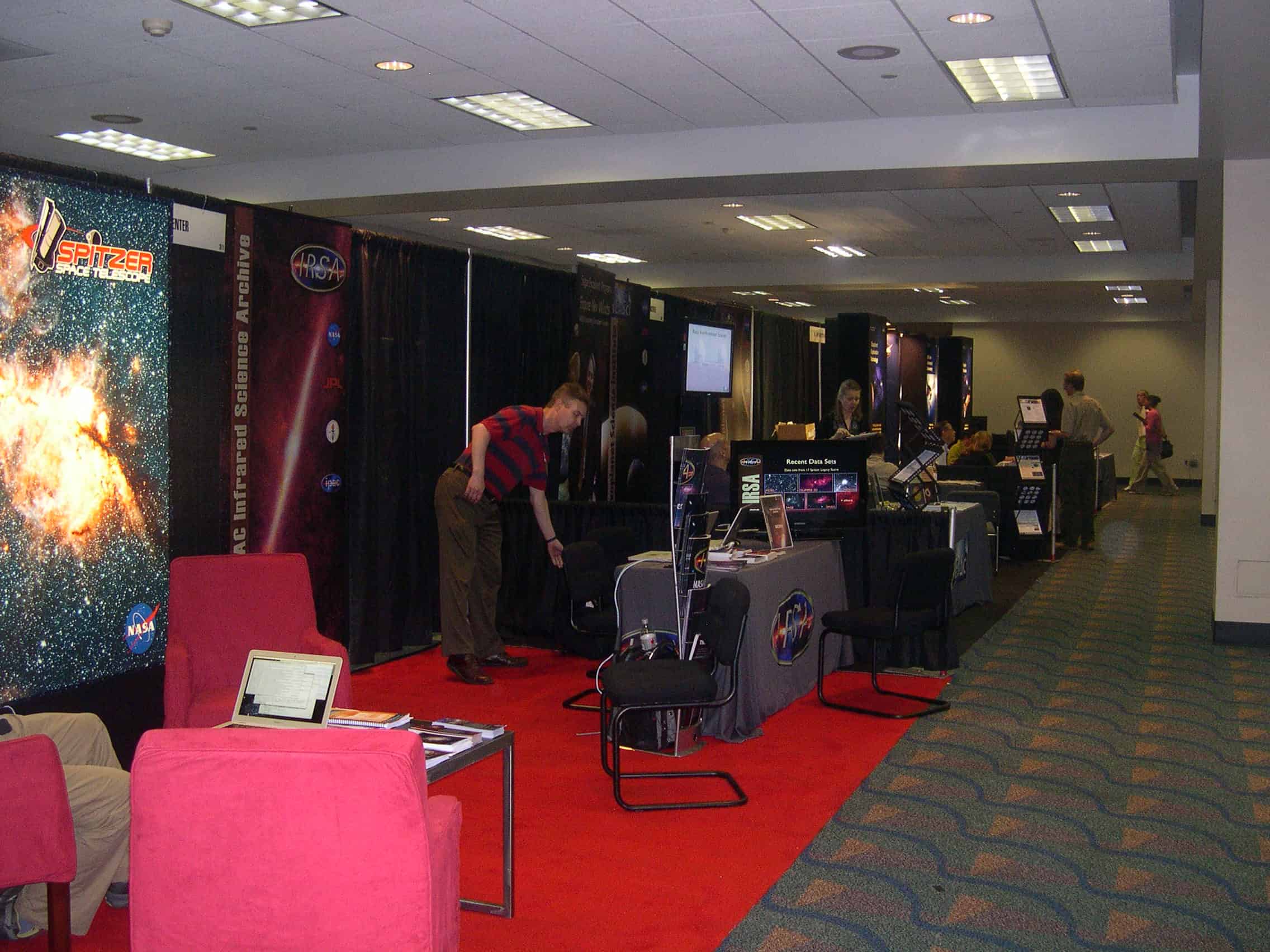
Exhibitors at the 216th American Astronomical Meeting

<img alt=DSCN1913.JPG
src=”http://physicsworld.com/blog/DSCN1913.JPG” width=251 height=320>
Out now: the Solar Dynamics Observatory movie

By Michael Banks in Miami, Florida

Walking into the exhibition hall at the 216th American Astronomical Meeting in Miami, Florida, it seems like this year’s must-have is a TV screen.

That is, of course, to show all the awe-inspiring images and movies that their missions are just releasing, be it from the Herschel mission, the Wide-field Infra-red Survey Explorer or the Solar Dynamics Observatory (SDO).

My favourite is the SDO booth and not just because of the free 3D glasses, but because of the quality of the images that the mission has just started to release (though they did give me a nice coaster).

The SDO booth also has two TV screens, obviously one is not enough.

With the enticement of tortilla chips, I also caught some of the poster session, which did not seem overly subscribed. Maybe people were instead enjoying the Miami sun outside.

Physics could help to replace U2 at Glastonbury

chair.jpg
Bono was due to grace the iconic Pyramid Stage. Credit: James Dacey

By James Dacey

The colossal Irish rock group U2 broke thousands of hearts this morning when they announced that they can no longer play their headlining slot at this year’s Glastonbury festival, a result of Bono putting his back out during rehearsals last week. The big question now is – who will replace them?

Well, if festival organizer Michael Eavis is willing to put reputations aside and choose a replacement purely on their musical similarity to U2, he may enlist the help of physicists in Brazil.

Luciano da Costa at the University of Sao Paulo and her colleagues have developed a new way of grouping music based on the subtle differences in rhythm between musical genres.

The researchers studied four musical genres – rock, blues, bossa nova and reggae – looking at 100 songs from each category, analysing the most representative sequences of each rhythm.

They then represent the rhythms as a Markov chain where the nature of each beat depends only on the preceding beat. “Basically, this means that we consider the time duration of each of two subsequent notes in order to obtain the probability transition between each type of notes (duration) in each given composition,” explains Costa.

Costa and her co-author Debora Correa are both classical pianists and they say that this has been an influence on their work. “We wanted to investigate how computing, maths and physics could be used to help us characterize and understand music and music genres,” says Costa.

So okay, I think we can be fairly certain that Michal Eavis will not involve Markov chains in selecting his U2 replacement, but this research could potentially have a far wider impact in the music industry. The researchers believe it could help to improve music platforms, such as Apple’s iTunes, which can group music to make recommendations based on the kind of music you regularly play.

You can read about the method in this open-access paper published recently in New Journal of Physics.

Copyright © 2026 by IOP Publishing Ltd and individual contributors