Breakthrough in the matter–antimatter divide

Particle physicists at Fermilab’s Tevatron accelerator in the US have found an exciting new result that could explain one of the big mysteries of cosmology – why there is matter in our universe. The findings come from Fermilab’s D0 experiment, designed to study the precise interactions of protons and antiprotons as they collide at velocities close to the speed of light.

The researchers, led by Guennadi Borissov of Lancaster University in the UK, were looking for a feature known as charge-parity (CP) violation, which helps to explain the fundamental difference between the behaviour of a particle and its antiparticle. It explains why matter survived in the universe after the Big Bang, when matter and antimatter were created in equal amounts and should have annihilated completely.

To catch a glimpse of CP violation, many experimentalists look to the decay of mesons at large B-factory meson experiments such as BELLE in Japan and BABAR in the US. Indeed, the results so far have been consistent with predictions from the Standard Model of particle physics. However, this is not nearly enough to explain the full extent of matter-antimatter asymmetry in the universe and this has sustained a divide between theory and experiment in particle physics.

Spotting the asymmetry

With this latest research, Borissov and his team are finally starting to see a clearer asymmetry by looking to the decay of the neutral mesons, B_s and B_d. Researchers at BELLE and BARBAR have constrained CP violation previously in the decay of B_d mesons but never before in B_s mesons – largely because they have not had access to electron-positron collisions of a sufficient energy to produce these particles. This is now possible at the D0 experiment.

To see whether CP violation is present, the researchers looked to the meson decay products. One complication is that neutral mesons, such as the B_s and B_d, tend to oscillate between their particle and antiparticle making it difficult to tell which meson has decayed. Borrisov’s team can decipher this, however, by looking to the charge of the decay particles.

“Each [meson] could decay into a muon, a neutrino and, say, a charm-flavour meson”, Borissov explains. Asymmetry between the B and anti-B is then measured as an overall preferred charge for the measured muon-pairs, with the final measured asymmetry deviating from the Standard Model prediction by 3.2 standard deviations.

A tricky experiment

Borissov was keen to emphasize, however, that this process was not as straightforward as it sounds, warning that many muons can also result from kaon decays that occur in the experiment. This background is serious because kaons have an artificial preference over anti-kaons for decaying in the D0 detector, so that if they were mistaken for B mesons a fake asymmetry would be seen. The asymmetry in control samples of kaon decays was measured and removed.

Terry Wyatt of University of Manchester, former spokesperson of the D0 experiment, is impressed by the robustness of these results, saying there is only a “one in one thousand” chance of this being a statistical fluctuation. He concedes, however, that more work will need to be carried out to confirm that the deviation is real. “We hope to increase the collected data set by about a factor of 2. In addition, we can hope for improvements in the analysis techniques that could reduce the uncertainty further,” he says.
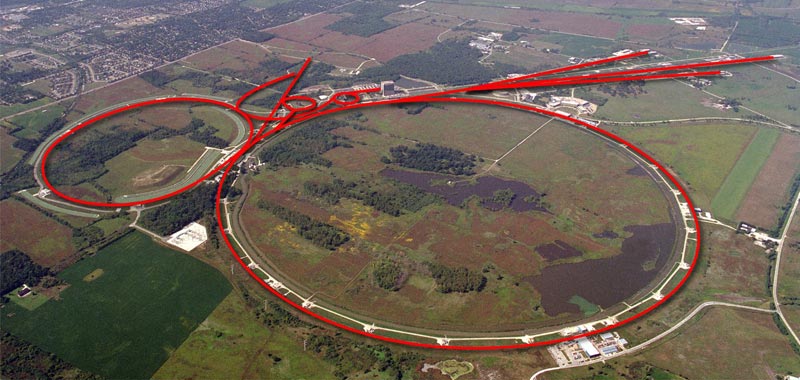
Perhaps the biggest opportunity to develop these results will come at the LHCb at CERN, another B-physics experiment that can record up to 2000 of these meson decays every second. “For many studies LHCb expects to surpass the sensitivity of the Tevatron experiments rather early in this, the first LHC run, of 2010-11,” says Guy Wilkinson, LHCb’s physics co-ordinator.

Particle physics researcher Tim Gershon of Warwick University believes that B factories like those at Fermilab and CERN are very promising places to look for CP violation. “Results from both CDF and D0 have hinted at new physics effects before, causing great excitement in the community,” he says. “Measurements from the B factories have placed stringent limits on many of the possible deviations from the Standard Model.”

This research is detailed in a preprint on the D0 experiment website.
What is next for Titan?

DSCN1888.JPG
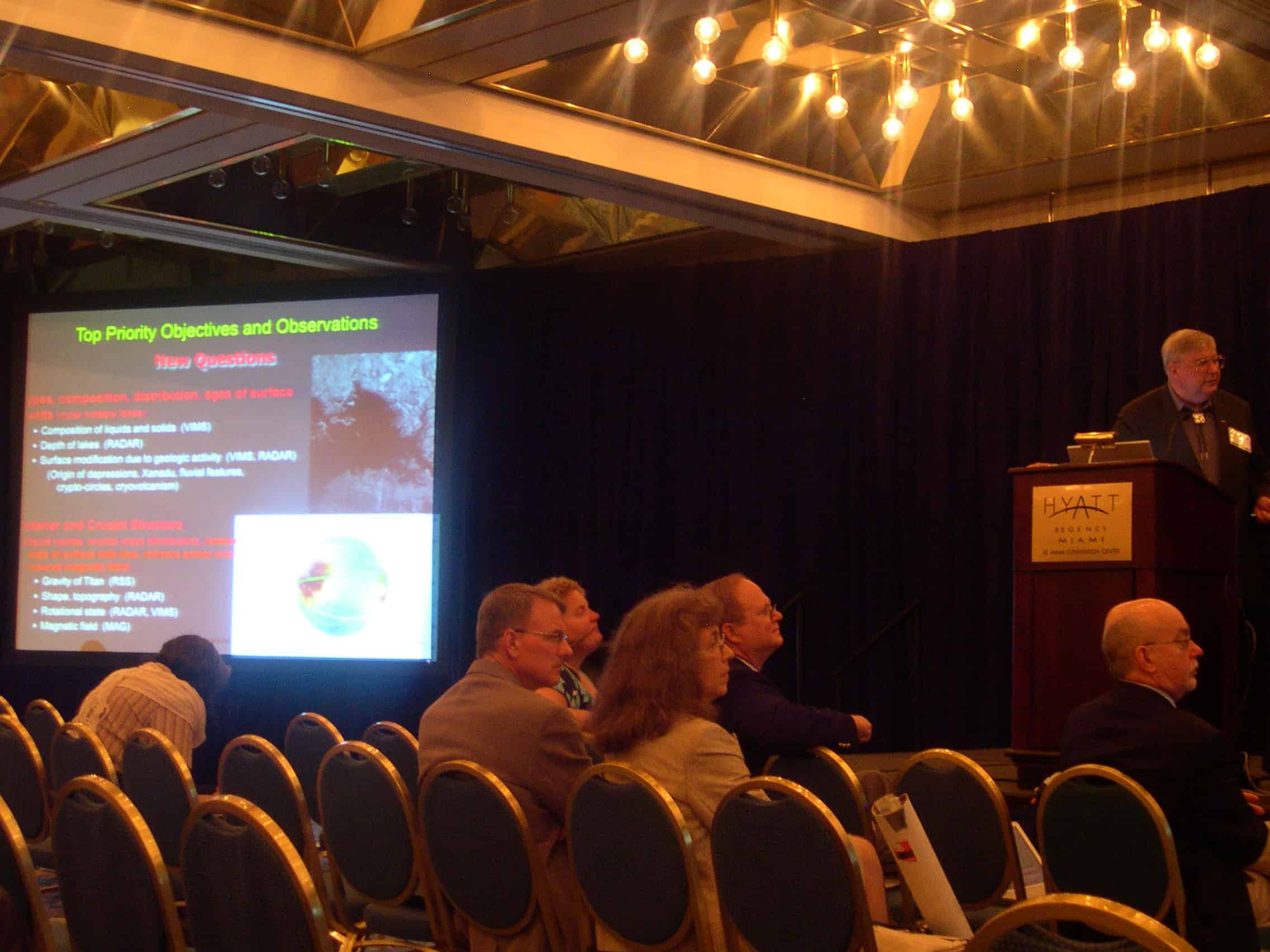
Look this way: Dennis Matson telling us all about Titan

By Michael Banks in Miami, Florida

I was up bright and early this morning to attend the opening symposium at the 216th American Astronomical Meeting in Miami, Florida.

The talk was about Titan, the largest moon of Saturn, and was given by Dennis Matson from NASA’s Jet Propulsion Laboratory, a project scientist for the Cassini-Huygens mission that launched in 1997.

Huygens, a European Space Agency mission, was launched together with NASA’s Cassini satellite for a seven-year trip to Saturn. While Cassini travelled off to orbit Saturn, Huygens separated to head to Titan where it landed in 2004.

You might think Titan is a lifeless body orbiting Saturn, but Matson showed it to be anything but. With lakes of Methane on the north pole of the moon – some as large as Lake Superior – as well as evidence for plate tectonics, volcanoes and sand dunes forming on the surface, the moon is very much alive.

That is not all, as Matson flashed images of methane clouds and possible deposits of lava. There is even a claim that an ocean of liquid water exists underneath the rocky surface.

Even with our knowledge of Titan, there is still a lot to find out, including whether the moon has a magnetic field.

After five years on Titan, Huygens has now delivered most of its objectives so astronomers are planning what the next mission could be to Saturn’s sixth moon.

Matson outlined two possible missions astronomers are looking into. One is using a probe attached to a balloon that would circumnavigate the moon at an altitude of 10 km. This would allow scientists to get a global picture of the moon closer to its surface.

The other possible mission is an 85 kg probe that would float on one of Titan’s lakes, which could, for example, probe its depth.

Astronomers probably have other ideas up their sleeves, but in the end they may be constrained by technology. “We even had some people who thought about sending some sort of submarine to Titan to explore the lake,” says Matson.

Let the astronomy begin

photo.jpg
Yacht a lot of people: the opening reception at the American Astronomical Society’s meeting in Miami

By Michael Banks in Miami, Florida

“Did I just hear him say Stephen Hawking?”; said a fellow passenger queuing behind me at Heathrow airport.

I was checking into my flight to Miami as a call for Hawking was made over the loudspeaker. Of course, it could have been someone else, but I wondered if it was indeed the Cambridge-based physicist.

Could Hawking be attending the 216th American Astronomical Society (AAS) meeting in Miami I thought? Or maybe the 68-year-old theoretical physicist was instead going to Canada to take up his position as Distinguished Research Chair at the Perimeter Institute for Theoretical Physics in Waterloo.

Hawking was not on my flight, where after a 22 hour door-to-door trip I finally arrived in Miami. The AAS meeting kicked off tonight with the opening reception, so feeling a little jet-lagged, I walked over the Miami Regency Hotel where 1000 physicists will tomorrow convene for four days discussing all things astronomy.

At the reception we were reminded that we were in Miami as, every few minutes, a yacht would go past the hotel blaring loud music with people dancing on board cheering towards unsuspecting astronomers. “We don’t usually get this at the AAS,” noted one participant.

Oh, and Hawking was not in attendance at the reception tonight, so I guess he may have been on that flight to Canada after all.

Welcome to Miami

By Michael Banks

I will be leaving for Florida tomorrow morning for the 216th American Astronomical Meeting (AAS) in Miami, which begins next week.

After promising my colleagues that I will be attending the talks and not spending most of my time blogging from Miami beach, I have just put the finishing touches on the schedule for what promises to be an intensive week of astronomy.

Top of the agenda are early results from the European Space Agency’s Herschel satellite and NASA’s Wide-field Infrared Survey Explorer as well as the status of the European Southern Observatory’s Atacama Large Millimeter/submillimeter Array, which is currently being built in northern Chile.

But that’s not all; there will also be a whole host of talks on NASA’s Solar Dynamics Laboratory as well as the continuing search for exoplanets.

So keep tabs on physicsworld.com for all the latest news from the AAS meeting.

Mechanical butterfly takes its first flight

By James Dacey

Fans of Radiohead may think this is straight out of the band’s video to their beautifully haunting single, Street Spirit (Fade Out), released back in 1996.

It is actually a demonstration of how the swallowtail butterfly manages to overcome the odds and fly in a straight line despite its unfavourable body shape. (Very Radiohead!)

Hiroto Tanaka at Harvard University and Isao Shimoyama at the University of Tokyo have built a model to mimic the wing motion and wing shape of the swallowtail, which even includes the thin membranes and veins that cover its wings.

Found on all continents except Antarctica, swallowtails are unique among butterflies because their wing area is very large relative to their body mass. This, combined with their overlapping fore wings, means that their flapping frequency is comparatively low and their general wing motion severely restricted.

As a result, swallowtails’ ability to actively control the aerodynamic force of their wings is limited. Their body motion is a passive reaction to the simple flapping motion, and not – as is common in other types of butterfly – an active reaction to aerodynamics.

Using motion analysis software, the researchers were able to monitor the ornithopter’s aerodynamic performance, showing that flight can be realized with simple flapping motions without feedback control, a model that can be applied to future aerodynamic systems.

This research was published yesterday in the journal Bioinspiration & Biomimetics.

Fighting terrorism with lasers

xenon.jpg
Decomposing VX nerve agent with ultraviolet laser light (Courtesy: INL)

By Margaret Harris

Here’s one possible laser application that didn’t make it into this month’s special issue using lasers to remove chemical contaminants after a terrorist attack.

According to a press release from the US Department of Homeland Security, researchers at Idaho National Laboratory (INL) have successfully used ultraviolet-wavelength lasers to remove samples of mustard gas and the nerve agent VX from porous surfaces like concrete. One of the scientists involved, INL chemist Bob Fox, compared the process to “laser steam-cleaning”.

As you might expect, the details in the press release are a little sketchy, but it appears that UV light from the laser is breaking molecular bonds in the VX, causing it to decompose into non-hazardous daughter products – and leaving behind the “harmless” (if rather nasty looking) brown stain shown in the photo.

This isn’t an entirely new idea; instead, it’s an adaptation of older procedures that use lasers to scrub soot off buildings and unwanted tattoos off human flesh. The INL team has also studied ways of using lasers to remove radioactive contamination, and might move on to biological contaminants in the future. “I’m willing to shine my light on anything,” says Fox.

Lasers make measurement Einstein called ‘impossible’

Researchers in the US have done what Albert Einstein thought was impossible – measure the instantaneous velocity of a particle undergoing Brownian motion. The measurements, performed on micron-sized suspended glass beads, prove directly that a Brownian particle’s kinetic energy is independent of its size, as is the case with atoms and molecules, and suggest a way of studying the quantum properties of macroscopic particles.

In 1905 Einstein published a mathematical description of Brownian motion – the random movement of small particles held in a liquid or gas as a result of their continuous bombardment by the molecules in the fluid. This work cleared up earlier controversial studies of Brownian particles, which suggested that the particle’s velocity would approach infinity when measured over very short periods.

By combining thermodynamics and statistical mechanics, Einstein showed that the displacement of a particle continuously subject to random collisions is proportional to the square root of time and not to time, as would be the case for a particle following an undisturbed, or “ballistic”, trajectory. The experimenters had therefore been measuring the wrong quantity – velocity in this case was not simply displacement divided by time.

Impossible to follow

Einstein’s prediction was verified experimentally a few years later by the physical chemist Jean Perrin. However, Einstein knew that his formulation only applied above a certain length scale – at the smallest distances even Brownian particles should show ballistic motion. But he believed that it would be impossible in practice to track this motion, given the incredibly short timescales over which the Brownian fluctuations take place. For example, a silica sphere with a diameter of 1 µm immersed in water has a velocity that changes both in direction and magnitude every 100 ns (10-7 s), requiring that a detector system have a response time of less than about 10 ns.

Now, Mark Raizen, Tongcang Li and colleagues at the University of Texas at Austin have found a way round this problem by studying particles in air rather than a liquid. Because air is much less dense than water its molecules are farther apart and therefore the distance, and time, between Brownian collisions is much greater. Indeed, velocity of a Brownian particle changes about once every 100 µs in air.

Air, however, is not dense enough to support even the lightest of particles against the force of gravity. Instead, Raizen’s team suspended a micron-sized silicon-oxide bead in air using the radiation pressure of a pair of laser beams known as an optical tweezer. As the bead was battered to and fro by air molecules its slight displacement from the centre of the laser trap was measured by the tiny deflection of one of the beams, this beam having been split and the difference in power between the two halves then measured.

Ballistic trajectories right on target

The researchers plotted graphs of how the displacement varied with the measurement timescale. As expected, they found that on the microsecond scale this relationship obeyed the straight proportionality predicted for ballistic trajectories. They then calculated the instantaneous velocities along these ballistic trajectories (simply from dividing displacement by time) and found them to follow a Maxwell-Boltzmann distribution, as predicted by kinetic theory.

The average instantaneous velocity was found to be very close to that calculated using the equipartition of energy theorem, which states that in thermal equilibrium each degree of freedom of a particle has the same average kinetic energy – ½kT – no matter how massive the particle. The experiment therefore provides direct verification of this theory for Brownian particles, says Raizen, and proves, as he puts it, that a micron-sized glass bead has the same average kinetic energy as a single air molecule.

The researchers say that their technique can also be used to reduce the motion of a suspended particle in a vacuum, by applying a force of just the right strength in the opposite direction to the instantaneous velocity at every moment. In fact, they believe that it will be possible to cool a particle down all the way to its quantum ground state. At this point, they say, the energy equipartition theorem will no longer hold true because the existence of zero-point energy means that the kinetic energy of the particle will not approach zero even at 0 K.

‘Important step forward’

Mark Haw of the University of Strathclyde in the UK describes the work as “an important step forward” in our understanding of Brownian motion, adding that it could have important applications in systems that are strongly affected by such motion, including living cells and nanoscale machines. But he cautions that it will be difficult to reach the quantum regime. “The necessary refinement in precision may take some time,” he explains.

The research has been published in Science.

Japan launches mission to Venus

The Japanese space agency JAXA has launched its first mission to Venus. The Akatsuki craft, which means “dawn” in Japanese, took off at 21.58 GMT yesterday from the Tanegashima Space Center on the island of Kagoshima, south-west of mainland Japan. Akatsuki will study the planet’s violent atmosphere and could confirm if there are active volcanoes on its surface.

Known as the Earth’s “sister planet” due to its similar mass and size, Venus orbits closer to the Earth than any other planet in our solar system. However, Venus’s climate is very different from Earth’s. Its atmosphere contains mostly carbon dioxide and is a sultry 460 °C, with the high temperatures believed to be due to a “runaway greenhouse effect”. And while Venus rotates at around 6.5 km per hour, its atmosphere rotates at a violent 360 km per hour.

Weighing 500 kg and costing around $220m, Akatsuki will operate for the next four and a half years and has five onboard cameras. Two of these instruments operate in the near-infrared regime and will study the planet’s surface and the motion of clouds, as well as the size of particles that make up the clouds. A long-wave infrared camera, meanwhile, will measure the temperature at the “cloud top”, which lies around 65 km from the planet’s surface.

The final two cameras are an ultraviolet imager to measure sulphur dioxide at the cloud top and a lightning and airglow camera, which will capture lightning flashes that have never been observed on the planet before.

Akatsuki will join the European Space Agency’s Venus Express satellite, which launched in 2005 and has been orbiting the planet since 2006. “Akatsuki will be in position to give new information on cloud formation and its dedicated camera will hopefully be able to detect lightning in the optical,” says Håkan Svedhem, project scientist for Venus Express. “We have plans of doing many different types of joint observations between the two spacecraft.”

Some of these could include, for example, the two craft making the same observation of a lightning storm – Akatuski in the optical and Venus Express in the electromagnetic regime – as well as the two being able to track super-rotating clouds over a much longer timescale with Venus Express taking over when Akatsuki disappears behind the horizon.

Also being launched with Akatsuki is JAXA’s Interplanetary Kite-craft Accelerated by Radiation Of the Sun (IKAROS), which will test the possibility of using the Sun’s rays for propulsion. The 14 m wide square solar power sail, only 7.5 µm thick, is built from thin-film solar cells and a material called polymide. The mission will be the first spacecraft to use both solar-power generation via its onboard solar cells and propulsion from the force on its sail of the Sun’s rays.

Condensed matter heaven

npl.jpg

By Hamish Johnston

clock.jpg

I had a fantastic day out yesterday at the National Physical Laboratory (NPL) on the outskirts of London.

The 20th of May is, of course, “World Metrology Day” and NPL bravely threw open its doors to the public, who could wander freely through many labs and chat to the researchers.

Well that was just heaven for me – lasers, vacuum chambers and enthusiastic physicists around every corner, and all the coffee and biscuits you could manage!

So what did I see? A caesium fountain atomic clock for example (right) – okay, the gubbins are covered, but at least you can see the size of the thing. I got to speak to Witold Chalupczak and Krzysztof Szymaniec, who built the clock and did a great job of explaining how it works.

josephson.jpg

When you think of Josephson junctions and metrology, magnetic field measurements probably spring to mind. However, the tiny superconductor-insulator-superconductor junction can also be used in devices for measuring DC and AC voltages. I learned that from Jonathan Williams (right) and Dale Henderson, who are using microwave guides made from 8192 tiny junctions to create voltage standards with quantum accuracy.

Jonathan was just about to leave for London, where he was being interviewed for BBC Radio’s Material World programme, which you can listen to here. Jonathan chips in about 22 minutes into the show.

It wasn’t all condensed-matter physics, by the way. Here’s a health physics question: What type of radiation is the biggest worry for those setting exposure levels for aircrews?

The answer is neutrons. Apparently there are lots of high-energy neutrons whizzing around up there, created by collisions between air molecules and particles from the Sun and the cosmos.

If such a neutron happens to smash into hydrogen or another light nucleus in your body, the nucleus will recoil as a high-energy charged particle that will cause damage to living cells.

neutron.jpg

That’s why Graeme Taylor (above left) and Neil Roberts (above right) have developed both hardware and software to work out how neutrons contribute to the overall dose received by aircrews. Between Graeme and Neil you can see their cylindrical detector, which spends much of its time on commercial airliners.

gerkin.jpg

The scientists had great stories of trying to get their instrument on an airliner to coincide with a solar outburst, only to discover that the plane was in a hangar when the fireworks kicked off.

Graeme and Neil explained why crew flying over the poles tend to get higher doses than those flying over the equator. I also asked them if crews could exceed cumulative exposure guidelines when the sun comes out of its current lull in activity. Apparently it’s possible.

It wasn’t all fun and games for me at NPL. I sat down with several leading scientists to do formal interviews, which we will publish shortly. One interviewee was Michael de Podesta (right), who told me all about an extremely smooth copper sphere that he hopes to fill with sound and use as a temperature standard.

Michael also enthused about how he encourages adults to think about physics in his Protons for Breakfast programme. One of the highlights is the “gherkinator”, where he passes an electrical current through pickled cucumber until it glows. Sadly, I had to leave before Michael’s demonstration.

Quantum cryptography system hacked

It is supposed to be absolutely secure – a means to transmit secret information between two parties with no possibility of someone eavesdropping.

Yet quantum cryptography, according to some engineers, is not without its faults. In a preprint submitted late last week to arXiv, Hoi-Kwong Lo and colleagues at the University of Toronto, Canada, claim to have hacked into a commercial quantum cryptography system by exploiting a certain practical “loophole”. So does this mean high-profile users of quantum cryptography – banks and governments, for example – are in danger of being eavesdropped after all?

Quantum cryptography works because a system’s quantum state cannot be observed without changing it. In the standard protocol, two users, typically known as Alice and Bob, openly share encoded information. They can only decode the information once they also share the secret quantum “key”. But they will always know if another party, typically known as Eve, tries to eavesdrop on the key, because by observing it she will always change its state.

Finding the loopholes

At least, that’s how it should work in theory. Lo’s group is one of several to look for faults in such quantum key distribution (QKD) in practice. “Our work is not bad news for QKD,” says Lo. “By discovering and plugging loopholes in practical QKD systems, we make QKD more secure in the future.”

The loopholes Lo refers to concern noise. It is impossible to shield out all environmental noise in a QKD system, so manufacturers have to tell the “Alice” and “Bob” receivers to tolerate a small error level, while still ensuring the system is secure from Eve. In past proofs, physicists have shown the maximum error level to be 20%.

Lo’s group, however, attack a different source of noise: the inherent noise Alice introduces when she prepares quantum states for Bob to generate the secret key. By exploiting this additional leeway, Eve can learn sufficient information about the key without increasing the error level above the critical threshold. Indeed, on experiments with the commercial “ID-500” QKD system built by the Swiss company id Quantique, the Toronto researchers claim they can hack the key with an error level of just 19.7%.

No cause for alarm

The study would suggest that customers using QKD systems ought to beware, although id Quantique sees no cause for alarm. “It’s important and interesting in the sense that quantum cryptography is just like any other security technology – you must test it to know that it is secure,” explains Gregory Ribordy, an engineer who works at the company. “Where I’m less happy is with the buzz that it generates. [The preprint is] a bit overblown, and the claims that are derived from this research are completely exaggerated.”

Ribordy points out that the ID-500 system is “old”, having been manufactured in 2004. Moreover, he says it was only ever sold for research evaluation purposes. “This particular attack would not work in commercial applications or non-R&D applications,” he adds.

The founder of id Quantique, Nicolas Gisin of the University of Geneva, is also sceptical about the preprint’s merits. “The claim is largely oversold because the found error rate of 19.7% is largely above the alarm level of 8% that is implemented in id Quantique’s commercial system,” he says. “Consequently, the claim that a commercial QKD system has been hacked is simply wrong.”

More testing

So are users of QKD systems being fooled by the theoretical promises of security? Despite the criticisms of the Toronto group’s preprint, everyone seems to agree that quantum cryptography – a field only just beginning to mature – will always require practical testing. “More and more groups try to find weaknesses in the implementation of QKD – [although] no one questions its principle,” says Gisin. “Thoroughly testing QKD systems by independent groups is indeed a must and id Quantique is collaborating with several university groups on this.”

The research can be found online at arXiv:1005.2376.

Copyright © 2026 by IOP Publishing Ltd and individual contributors