A statistical-physics-based model may shed light on the age-old question “how can morality take root in a world where everyone is out for themselves?” Computer simulations by an international team of scientists suggest that the answer lies in how people interact with their closest neighbours rather than with the population as a whole.
Led by Dirk Helbing of ETH Zurich in Switzerland, the study also suggests that under certain conditions, dishonest behaviour of some individuals can actually improve the social fabric.
Public goods such as environmental resources or social benefits are often depleted because self-interested individuals ignore the common good. Co-operative behaviour can be enforced via punishment but ultimately co-operators who punish will lose out to co-operators who don’t punish because punishing requires time and effort. These non-punishing co-operators then lose out to the non co-operators, or free riders. With free riders dominant the resource is depleted, to the detriment of everyone – a scenario known as “tragedy of the commons”.
How, then, does co-operation arise? Some researchers have proposed that co-operators who punish could survive through “indirect reciprocity”, the idea that working for the common good will enhance a person’s reputation and ensure that they benefit in the future. Helbing’s group, however, has shown that this is not needed for co-operation to flourish.
Emergent phenomena
They came to this conclusion by focusing on how individuals behave with their nearest neighbours, rather than a wider group that is representative of the entire population. Like nearest-neighbour models of magnetism – which are often more realistic than mean-field approximations – they say that this approach captures “emergent” phenomena that would otherwise be lost.
Their game-theory-based model comprises a square lattice of tens of thousands of points, each representing an individual. Each individual could adopt one of four strategies – co-operate without punishing free riders; co-operate and punish (“moralist”); free ride; or free ride but also punish other free riders (“immoralist”). Initially, the four strategies are distributed randomly among individuals and the system evolves to find out which behaviour wins in the long run.
This evolution is influenced by three variables – the fines that penalize free riders; the cost of administering punishment; and the “synergy factor”, which stipulates how much the sum of individual contributions is enhanced by collective action.
The computer program picks an individual at random and calculates how much it stands to gain relative to its four nearest neighbours, given the strategies employed by each neighbour. The exercise is then repeated for the neighbours themselves. The strategy employed by each individual was then modified in light of the success of their neighbours, so that individuals could imitate those who performed better than themselves.
Intriguing results
Running the simulation for up to 10 million iterations yielded some intriguing results. As expected, if the punishment fine to cost ratio and synergy factor were low then everyone would eventually become a free rider, just as moralists would prevail if the fine was set high enough. However, they also found that moralists could win out over non-punishing co-operators even if the cost of administering punishment was relatively high. This was because imitation of better-performing neighbours soon led to small clusters of both co-operators and moralists in a sea of free-riders. With moralists better than co-operators at dealing with free riders they came to dominate, even though they would lose out if placed in direct competition with the non-punishers.
An “unholy collaboration” between moralists and immoralists was also seen whereby individuals adopting these strategies could coexist at the expense of both co-operators and free riders. This, the researchers found, would occur if the cost of punishment was low, the synergy not particularly high, and the fines moderately high. As they point out, this scenario is supported by the real-life existence of immoralists.
New type of collective behaviour
Helbing’s colleague, Attila Szolnoki of the Institute for Technical Physics and Materials Science in Budapest sums up the work, “The contribution of statistical physics to this research field could be to realize that large numbers of players can result in a new type of collective behaviour that cannot be derived from two-player analyses. Computer models can therefore be considered as pre-experiments that help to design more sophisticated lab experiments.”
The team is currently building a laboratory capable of carrying out game-theory experiments with up to 36 people, which should allow them to test the predictions of their model.
Herbert Gintis, an economist and game-theory expert at the Santa Fe Institute and Central European University in Budapest, believes that Helbing and colleagues are right to incorporate small-scale interactions into their model. But he says that they should also factor in genetic relations between people because individuals’ behaviours depend on whether or not they are dealing with a close relative.
Tomorrow the UK will have a general election and while physicsworld.com does not endorse a particular party, we have put together some of the science-based pledges from the three main parties – Conservative, Labour and Liberal Democrat.
In March, the campaign for science and engineering in the UK (CASE wrote to the main parties to ask them to set out their policies for science and engineering in advance of the election. Here are some of the responses as well as what the parties’ manifestos and their science representatives have to say.
So if you are still undecided about who to vote for then maybe the parties’ science policies will help you to decide where to put that cross on the ballot paper tomorrow.
Conservatives led by David Cameron
Response to CASE: “To provide real incentives to get more good science teachers into out school, we will pay off the student loan obligations of top STEM graduates for every year they spend in the classroom.
“We will postpone the Research Excellence Framework by up to two years, while we review the evidence behind the new system.
“I want the next Conservative government to act early, sensitively and intelligently so that scientific research can move forwards within the boundaries set by Parliament.”
What Adam Afriyie, shadow minister for innovation, universities and skills, says: “Our science base is a valuable national asset. Economically, politically and socially, it underpins the prosperity and wellbeing of our nation.”
What the Conservative manifesto says: “Initiating a multi-year science and research budget to provide a stable investment climate for research councils.”
Labour led by Gordon Brown
Response to CASE: “We will continue to support curiosity driven research, which has underpinned the breadth and excellence of UK science over the last ten years. In setting research priorities, we respect the Haldane principle.
“The success of UK science has also been underpinned by a ring-fenced science budget and a ten-year framework.
“Scientific advice should be at the heart of government and society. We have chief scientific advisers in almost all government departments. And for the first time the science minister sits at the cabinet table.”
What Paul Drayson, minister for science and innovation, says: “Science isn’t peripheral to the decision facing the country. It is central: to growth, to prosperity and well-being.”
What the Labour manifesto says: “We are committed to a ring-fenced science budget in the next spending review.”
Liberal Democrats led by Nick Clegg
Response to CASE: “Liberal Democrats would abolish tuition fees over a six year period. We see them as unfair and a regressive tax on education.
“We are committed to not cutting science spending in the first year of a new parliament. We are also committed to not allowing the science budget to be raided once it is fixed for the given Comprehensive Spending Review period.
“Liberal Democrats believe that public policy should be evidence-based as far as possible. Advisers must feel able go give their advice without fear of being bullied if it is not what a minister or tabloid newspaper editor wants to hear.”
What Evan Harris, Liberal Democrats spokesperson for science, says: “We recognize that science, technology, and engineering have to be key drivers of our economy as we move out of recession.”
What the Liberal Democrat manifesto says: “In the current economic climate it is not possible to commit to growth in spending, but Liberal Democrats recognize the importance of science investment to the recovery and to the reshaping of the economy.”
Firing extremely powerful laser pulses through humid air can stimulate the formation of clouds, according a team of European scientists. They say that the effectiveness of this method is much easier to gauge than traditional cloud-seeding techniques and that it could provide a practical means of triggering rainfall.
Cloud seeding is practised in many countries around the world and usually involves adding small particles to the atmosphere from ground stations, aircraft or rockets, in order to increase rainfall or reduce hail. This can be done by using molecules of silver iodide as nuclei around which supercooled water in higher-altitude clouds freezes, forming ice crystals that fall from the sky when heavy enough. Alternatively, compounds such as sodium, lithium and potassium salts can be released into lower altitude clouds in order to encourage the aggregation of small water droplets.
Although cloud seeding could have major practical benefits, it remains controversial because scientists have not been able to establish whether it really does change rainfall significantly. Among the many uncertainties are limitations in both our understanding of natural rainfall fluctuations and our knowledge of the extent to which pollutant aerosols stimulate precipitation.
Filaments of light
Philipp Rohwetter of the Free University of Berlin and colleagues in Germany, Switzerland and France believe that they can overcome these problems to some extent by seeding clouds using laser beams. To demonstrate their idea they used the portable Teramobile infrared laser with beam pulses lasting just 10–13 s and a power of 5 × 10¹² W. Such pulses are intense enough to modify the refractive index of air, which causes the beam to focus itself. This further increases the intensity, producing filaments of light that are intense enough to ionize the air and initiate condensation.
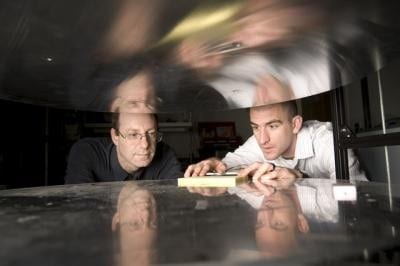
The researchers fired the laser into both the atmosphere and into a controlled environment – a cloud chamber filled with ambient air. In both cases they illuminated the trajectory of the beam with a second, lower-powered laser, which would experience greater scattering if more droplets were present.
That is indeed what they found – the scattering of the second laser increased each time a pulse from the first laser was fired. They observed this pattern in over 900 laser flashes, providing, they say, a clear proof of the pulsed laser’s cloud seeding capability that cannot be established for traditional seeding techniques.
Sweeping the beam
According to team member Jerôme Kasparian of the University of Geneva, several years will be needed to turn this physical demonstration into a practical technique. In particular, he says, a more powerful laser will probably need to be developed to take advantage of a sweeping effect that they have noted – that ionization continues for a few seconds after the laser has stopped flashing and so by sweeping the beam it should be possible to seed a larger volume of air.
More importantly, the researchers need to establish the physics behind the effect in order to know how to optimize the laser’s wavelength, pulse duration and other parameters. They are certain that the ions in the laser-induced plasma contribute to condensation but they also believe that condensation might occur on molecules of sulphuric acid and nitric acid, which are formed when electrons from the plasma generate the OH radical that then oxidizes sulphur dioxide and nitrogen, respectively.
The experiments, however, do not convince other researchers. Bill Cotton of Colorado State University in the US describes the results as “intriguing” but maintains that Rohwetter and colleagues have “grossly overstated their case for impacts on real cloud formation and, especially, on precipitation”. In particular, he points out that the air in the cloud chamber had a relative humidity of 230% whereas that in the atmosphere rarely exceeds 101%, meaning that droplet formation in the chamber would not necessarily imply droplet formation in the atmosphere.
This view is supported by Dan Breed of the National Center for Atmospheric Research in Colorado, who says that, on the other hand, laser-enhanced condensation in air with a relative humidity of less than 100% would be very transient and therefore unlikely to generate significant amounts of new cloud droplets, let alone precipitation. “The leap to modifying clouds and even larger jump to influencing precipitation is very speculative and I believe fairly unrealistic,” he claims.
David Smith (left) is philosophical about metamaterials
By James Dacey
In March, a group of researchers in the UK and Germany grabbed the science headlines when they unveiled the world’s first optical cloak that could hide an object in three dimensions. Okay, the thing they hid may only be a microscale bump but the researchers say their design could in principle be scaled up into a full Harry Potter-style invisibility cloak.
A new paper, however, on the arXiv preprint server has poured cold water on the breakthrough by pointing out a slight flaw in the cloak design – namely that it doesn’t really hide things.
Cloaking requires special materials known as metamaterials, which possess unique optical properties. The trick is to create a material whose optical properties are constantly changing so that it “steers” waves around an object as if it were not there.
This recent breakthrough involves a type of cloak known as a “carpet cloak” because it involves smoothing out a bump on a surface as if flattening out a ruck in a rug. The researchers stacked nanofabricated silicon wafers on top of one another to produce a distribution of refractive indices. As light reflected off the surface, it appeared as if the device (and the bump it was hiding) was not there.
To engineer the carpet cloak, the researchers had to modify a conducting surface to create a grid in which the mechanical and optical properties are uniform in all directions. And this is the point where the technology breaks down – claim a trio of researchers in this arXiv paper.
Bae-Ian Wu and his colleagues at Massachusetts Institute of Technology are concerned that a cloak that is isotropic could never truly hide an object. Instead, it shifts an object to the side by an amount related to the angle of incoming light: change your viewing angle, you still see the object.
To illustrate their point, they trace a ray of light as it approaches a bump of 0.2 units from an angle of 45 degrees. According to the calculations, the ray is shifted laterally by 0.15 units.
The solution, they say, is to create a cloak whose optical properties are anisotropic, i.e. they vary depending on orientation.
I got in touch with John Pendry of Imperial College in London who was involved in the recent cloak design to get his reaction. “We already knew that the isotropic cloak was not exact, the question is by how much,” he said. “The first step [in the research] was the exact specification of the cloak which made objects truly invisible when viewed against a mirror background. However this exact prescription requires anisotropic optical materials and would be very difficult to manufacture.”
I also got in touch David Smith, at Duke University in the US, who is credited with creating the first metamaterial cloak back in 2006. “The carpet cloak is not really a cloak, as we know, but a different example of a transformation optical structure,” he said.
Smith was philosophical, however, about the achievements in metamaterial research so far. “The optics world has lived for 100s of years with imperfect optics! If our goal is not to make something perfect, but make something that is less poor than what exists, our chances of success are much greater. Transformation optics and quasi-conformal techniques help us do just that.”
The real thing Ted Maiman with the first laser prototype. (Courtesy: Theodore Harold Maiman)
The race to make a laser began with Bell Laboratories. In the late 1950s the then Bell Telephone Laboratories was a well-funded research institute in Murray Hill, New Jersey, that already had a string of high-profile achievements to its name – including the transistor, which was invented in 1947 by John Bardeen, Walter Brattain and William Shockley. A few years later, a Bell Labs research group led by Charles Townes proposed a device that could produce and amplify electromagnetic radiation in the microwave region of the spectrum. By 1953 the researchers had turned their theory into a working device, which they called a maser – an acronym for microwave amplification by stimulated emission of radiation. And in December 1958, Townes and his brother-in-law Arthur Schawlow wrote a famous paper (Physical Review112 1940) describing how the maser concept could be extended into the optical regime, to make the first “infrared and optical maser” – in other words, a laser.
So if there was going to be a race to build a laser, it was a race that Bell Labs fully expected to win. But the favourites quickly faced competition. Townes had been consulting at Bell Labs, but by the time his 1958 paper was published he was back at Columbia University. There, he began trying to make a laser using hot potassium vapour – the medium described in the paper. Schawlow decided not to go into direct competition with Townes, and so selected ruby as an alternative potential laser material, in part because Bell Labs had a good supply of synthetic rubies for maser research. A second Bell Labs team was studying visible emissions from calcium-fluoride crystals doped with various rare-earth metals; a third, led by Townes’ former graduate student Ali Javan, was trying to build a gas laser using helium and neon.
Beyond Bell Labs, other research institutes around the world soon joined the race. In the US alone, there were major research efforts going on at General Electric, IBM, the Massachusetts Institute of Technology’s Lincoln Laboratory, RCA Laboratories and Westinghouse Research. Another strong contender was Townes’ former student Gordon Gould, who had independently come up with an idea for a sodium-vapour-based device in 1957 – coining the term “laser” in the process. The following year Gould abandoned his PhD thesis and joined TRG, a private research company, so he could pursue his ideas. The company won a $1m grant from the defence-related Advanced Research Projects Agency to work on the laser, but Gould was barred from taking part in the project because it was classified and he could not get security clearance.
Late entry
The dark horse in the race was Theodore Harold Maiman, who was then at Hughes Research Laboratories, the research arm of the Hughes Aircraft Company. Maiman was an engineer by training who had switched to physics, studying the fine-structure splittings of energy levels in excited helium atoms at Stanford University under Willis Lamb, who had won the 1955 Nobel Prize for Physics. In the quest to make a laser, Maiman’s engineering and physics experience would both prove essential.
Maiman entered the race late, at the point when many researchers appeared to be on the point of giving up. Moreover, Hughes took some persuading to fund his interest in lasers. After all, it was in the aerospace business. What would it do with a beam of light? However, Hughes did have a contract with the US Army Corps of Engineers to make a maser. This turned out to be Maiman’s opportunity.
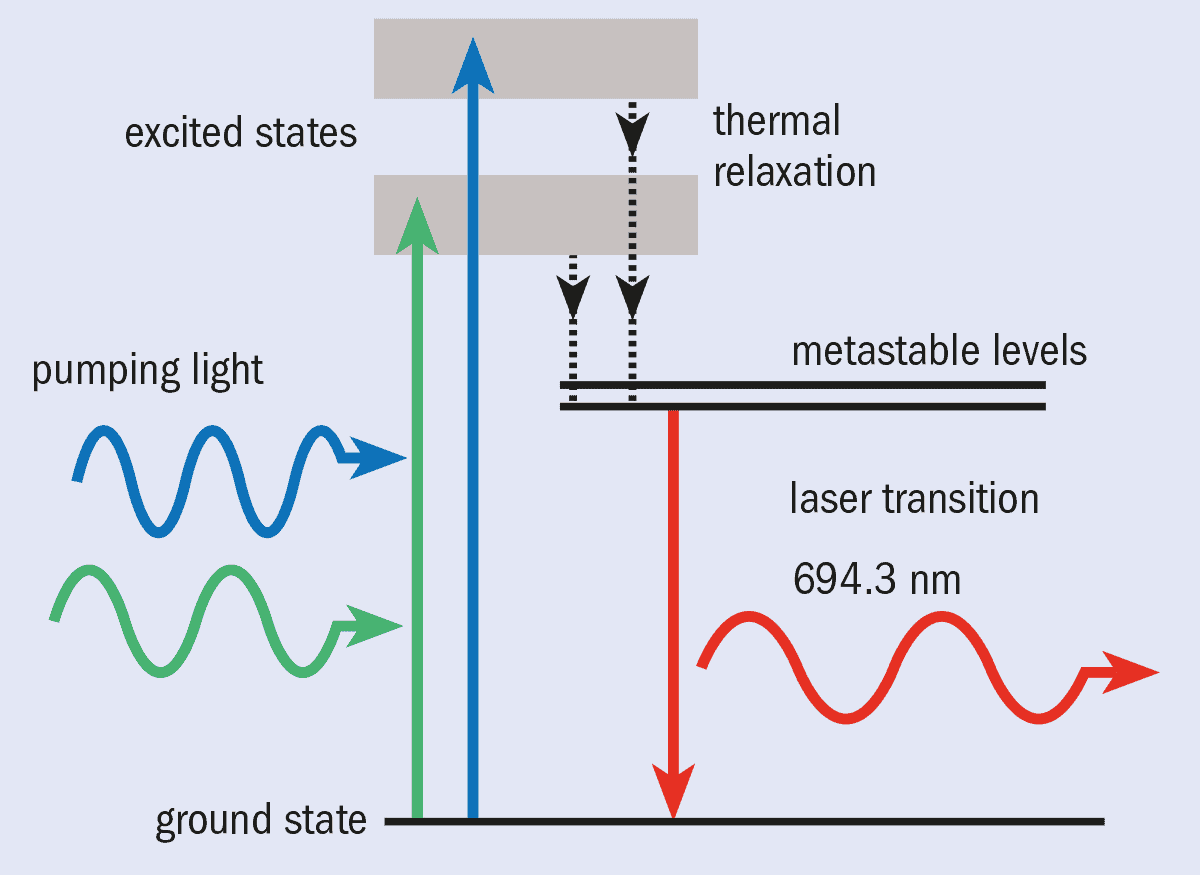
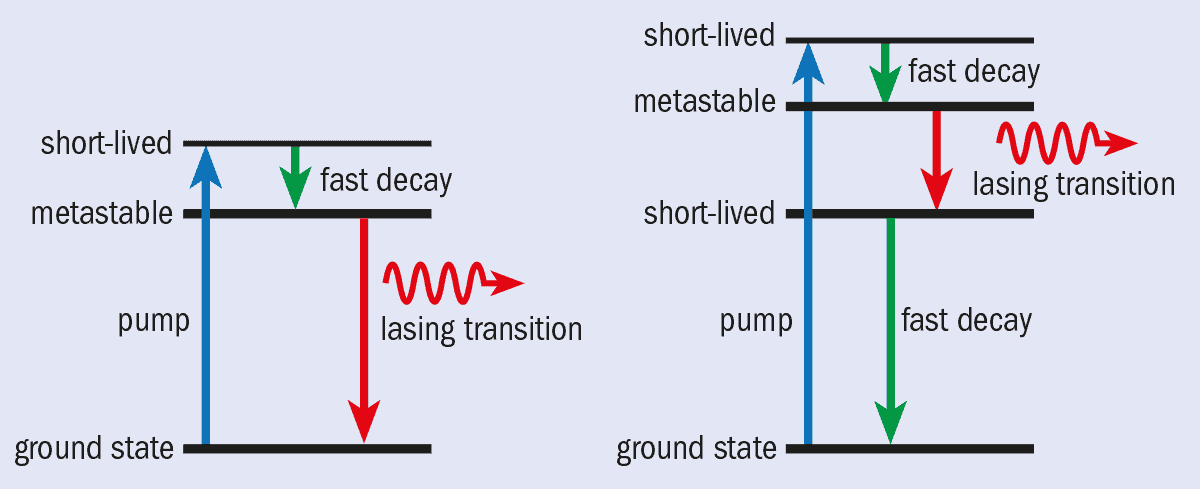
1 A three-level system in pink ruby Chromium ions in pink ruby absorb light in the green and blue regions of the spectrum. In the presence of this pumping light, electrons in the ions are promoted to excited states, where they then rapidly decay to one of two metastable levels. The unusually long lifetime (about 4 ms) of these levels allows more than half of the available electrons to build up there, creating a population inversion – the condition needed for lasing to occur.
“Ted struck an agreement with Hughes,” Maiman’s wife Kathleen recalled during an interview with Physics World (Maiman died in 2007, aged 79). “If he was successful in delivering the maser for the Army Corps of Engineers, he would be given nine months and $50,000 to actually make coherent light. He went to work to make the maser more practical, and took it from 5000 lbs to 2.5 lbs and also improved the linewidth. Because of that, he was able to do a dedicated project on the laser.”
Like Schawlow, Maiman started investigating ruby as a laser material because he was familiar with its properties from his maser work. Ruby is a crystal of aluminium oxide containing a tiny amount of chromium – about 0.5% in the case of gemstone ruby, and about a 10th of that in “pink” ruby used for industrial applications. As well as emitting microwaves, pink ruby also strongly absorbs light in the green part of the optical spectrum, and fluoresces in the red. Such behaviour is a consequence of pink ruby’s three-level energy system (figure 1). When pink ruby absorbs green light, electrons are promoted from the ground state to a higher energy level. The electrons then lose energy through thermal relaxation (lattice vibrations), ending up in an intermediate, metastable energy level. Decay from this metastable level back to the ground state is responsible for the red fluorescence, and this was the transition Maiman hoped to use in his laser.
But in September 1959, shortly after Maiman started his project, Schawlow publicly declared that pink ruby could not possibly work as a laser. For stimulated emission to occur, more electrons need to reside in the upper energy level than a lower one – a condition known as a population inversion. Schawlow argued that it would be too difficult to achieve this inversion in a three-level system because the ground state in such a system is usually full of electrons. He maintained that it would be much easier to achieve population inversion in a four-level system containing an empty energy level between the ground state and the metastable level (figure 2).
With respected scientists counselling against pink ruby, Maiman’s employer was reluctant to continue funding his idea, which it was doing out of its own pocket. But Maiman was not deterred, because it was clear from Schawlow’s comments that he was considering a cryogenically cooled laser. As Maiman wrote in his memoirs, The Laser Odyssey (2000 Laser Press), “the possibility of room-temperature operation had been dismissed out of hand”.
2 Three- and four-level laser systems In a three-level laser system, more than half of the particles in the laser medium must be pumped out of the ground state and into the metastable state (via the short-lived excited state) for a population inversion to occur. Achieving this requires a very intense pumping light. Population inversion in a four-level laser system, in contrast, occurs whenever the population of the metastable state exceeds that of the lower short-lived state. Hence, only a few particles need to be excited before stimulated emission can take place.
Maiman’s only moment of real doubt came when a scientist he had personally trained, Irwin Wieder, published a paper claiming that the quantum efficiency of ruby fluorescence was just 1% – in other words, only one absorbed photon in 100 results in an emitted photon (Review Scientific Instruments30 995). If true, this would mean it would be impossible to pump enough energy into ruby to achieve stimulated emission. But instead of giving up, Maiman devised experiments to determine why the quantum efficiency of ruby fluorescence should be so low, in order to guide his search for a suitable alternative. Finding no answers, in the end he made his own measurements on ruby, which showed that the quantum efficiency was actually closer to 75%.
This was typical of Maiman’s approach to research, according to Kathleen. “Ted was a very, very careful scientist, and very precise in his work,” she says. “He didn’t take anything at face value. He calculated and recalculated until he was absolutely sure it was correct.”
Even with 75% quantum efficiency, Maiman’s calculations indicated that he would need a very bright pump light to deliver enough energy to the pink ruby to achieve stimulated emission. His “eureka” moment came from reading an article about photographic strobe lamps, which could achieve “brightness temperatures” of 8000 K, albeit only for a moment. (Brightness temperature is a measure of radiation intensity in terms of the temperature of a hypothetical black body. For reference, the Sun’s brightness temperature is about 5500 K.) This was a departure from the methods of other researchers, who were working with continuous illumination.
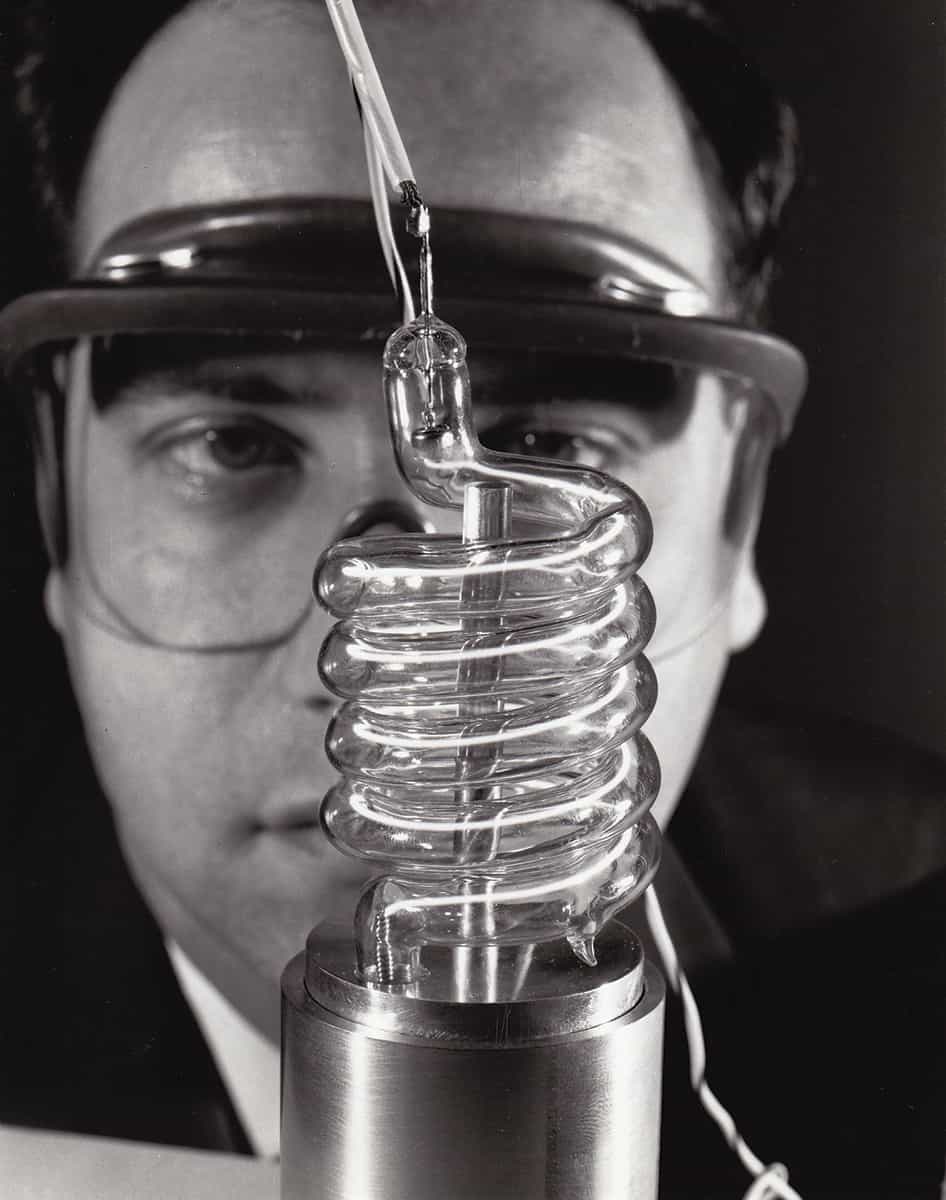
The next problem was how to concentrate the light onto the ruby. According to Maiman’s calculations, lamps shaped like straight tubes – which could be positioned at the focus of an elliptical mirror – would not be powerful enough. The most powerful strobe lamps of the time had a spiral shape, and so he decided to “stick with what was available”. The spiral shape of the lamp meant he could not use a simple lens to focus the light onto the ruby crystal, so Maiman positioned the ruby as close to the light source as possible. This meant putting the 1 × 2 cm ruby inside the lamp spiral, and placing the entire arrangement inside a polished aluminium cylinder to help gather the light (see image at top of article). Thick silver coatings on the ends of the ruby were used to create the optical cavity, leaving a small hole in the coating at one end to allow light to escape.
On 16 May 1960 his work paid off. Maiman and his assistant Irnee d’Haenens observed the first evidence of laser action: a large decrease in the ruby’s fluorescence lifetime as seen in the device’s spectral output, once the flash-lamp input was increased to more than 950 V. Below this threshold, the only light-emission mechanism is normal fluorescence. Above it, however, stimulated emission becomes the dominant process, and the metastable energy level empties much faster, leading to a reduction in the fluorescence lifetime.
In a second experiment performed a few days later, Maiman used a spectrograph to measure narrowing in spectral linewidth above the laser threshold – another characteristic of stimulated emission. Furthermore, pink ruby’s red fluorescence consists of two closely spaced spectral lines, and Maiman had calculated that only one of these lines would actually lase – and that is exactly what he saw.
Into the limelight
Having fought to obtain funding to carry out his research in the first place, Maiman then faced an uphill struggle to get his discovery acknowledged. When he submitted a paper to Physical Review Letters, it was rejected as “just another maser paper”. Maiman quickly penned a shorter, 300-word version of his article and sent it to Nature, where it was accepted (187 493). Before it could be published, however, Hughes decided to hold a press conference. As a scientist, Maiman wanted to publish first, but Hughes was becoming nervous: the Bell Labs groups might be really close, and there would be no prize for second place.
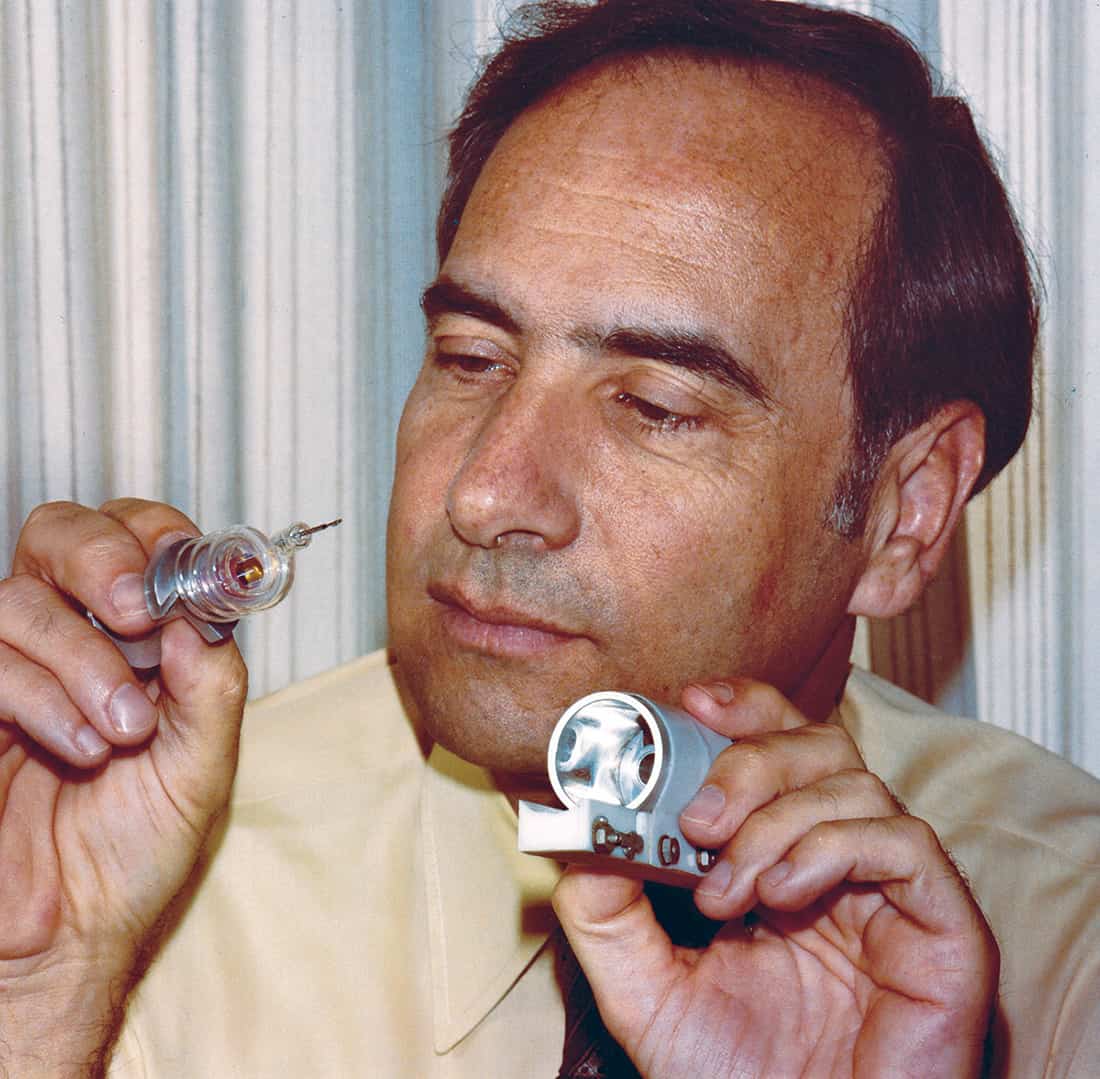
The Hughes public-relations machine swung into action ahead of the press conference, which it had scheduled for 7 July 1960. The photographer hired to take the shots was not impressed by the first laser – it was too small (see image at top of article). Looking around the lab, he picked up a later prototype with a medium-sized flash lamp and 5 cm-long ruby rod, telling Maiman to “Hold this in front of your face and I know this will be picked up by every news outlet, but if we print this, this first laser, it won’t go anywhere.” The photographer was right. The day after the press conference all the major newspapers carried the photograph – along with, in one case, the melodramatic headline “LA man discovers science-fiction death ray”.
Better than the real thing? The photograph issued at the 7 July 1960 Hughes press conference showing Maiman with a later prototype laser – not the first one – led to melodramatic newspaper headlines and confusion among other researchers. (Courtesy: Hughes Research Laboratories)
Within the academic community, though, there was a certain amount of scepticism and confusion about what Maiman had achieved. The optical quality of the crystal in his first laser was poor and so he had not observed the characteristic “pencil beam”. Instead, his early results were based on sensitive spectroscopic measurements. Maiman also faced some degree of prejudice: people expected the advance to come from Bell Labs or one of the other well-funded research efforts, not from an unknown working for an aircraft company. The biggest problem, however, was that Maiman’s detailed scientific results were not available for scrutiny when the press conference was held. Worse, the Nature paper – when it was finally published on 6 August – was so brief that it failed to convince his critics.
Despite the uncertainty, Hughes’ press conference infused the laser research community with new vigour and new funding. Scientists around the world returned to their work with fresh conviction that it was actually possible to make a laser. In fact, the concept and design of Maiman’s laser proved so simple that it was only a matter of weeks before his results had been reproduced by several other researchers – most prominently those at Bell Labs, who demonstrated a pencil beam from their ruby device on 1 August 1960. Taking their cue from the publicity photograph showing “not the first” laser (see image left), the Bell Labs researchers used a 5 cm-long ruby rod with an identical model of strobe lamp.
By then, Maiman had also observed a pencil beam, thanks to three new ruby crystals that had been specially grown to the dimensions he required (the ruby in the first laser, by contrast, had been cut from a larger boule). On the day the new crystals arrived, 20 July 1960, Maiman inserted them into his device and observed sharp threshold behaviour and a bright spot on the wall.
First light: key dates in the invention of the laser
15 December 1958 Arthur Schawlow and Charles Townes’ paper on “Infrared and optical masers” appears (Phys. Rev. 112 1940)
15 July 1959 Ali Javan publishes his proposal for making a gas laser (Phys. Rev. Lett. 3 87)
16 May 1960 Theodore Maiman observes pulsed lasing in pink ruby
7 July 1960 Hughes Research Laboratories holds a press conference announcing Maiman’s laser
20 July 1960 Maiman improves his ruby laser design and observes a pencil beam
1 August 1960 Donald Nelson and colleagues at Bell Labs create a pulsed laser beam from a ruby rod in a configuration similar to the one shown in press photographs of Maiman’s device
6 August 1960 Maiman’s short letter “Stimulated optical radiation in ruby” is published (Nature187 493)
25 September 1960 Nelson and his team at Bell Labs flash a laser beam 25 miles from Crawford Hill to Murray Hill in New Jersey
1 October 1960 Publication of Bell Labs’ ruby-laser paper (Phys. Rev. Lett. 5 303)
5 October 1960 Bell Labs holds a press conference to announce its ruby laser
12 December 1960 Javan and his team create the first gas laser
30 January 1961 Javan’s paper on the gas laser appears (Phys. Rev. Lett. 6 106)
31 January 1961 Bell Labs holds a press conference announcing the gas laser
1961 Willard Boyle and Nelson create the first continuously operating ruby laser (Appl. Opt. 1 181)
Still controversial
In the years that followed, Bell Labs researchers achieved many laser “firsts”, including the first gas laser, which Javan and co-workers demonstrated successfully in December 1960. Other successes included the first continuously operating ruby laser, made by Willard Boyle and Donald Nelson in 1961; the first carbon-dioxide laser, invented by Kumar Patel in 1964; and a string of other innovations, including refinements to the now-ubiquitous semiconductor diode laser.
Maiman, for his part, left Hughes in 1961 to join a venture-capital-funded start-up called Quanatron, where he was in charge of laser activities. The following year Union Carbide provided the funds to set up his lab as an independent business. Thus Maiman became president of the newly formed Korad Corporation, which invented the Q-switched laser and became a supplier of the highest power lasers in the industry.
Over the laser’s 50-year history, Maiman’s place as inventor of the laser has sometimes been acknowledged. In 1984 he was inducted into the National Inventors Hall of Fame – meeting Kathleen, who became his second wife, on the flight home afterwards. Most significantly, in 1987 he was awarded the Japan Prize, which is often considered the Eastern equivalent of the Nobel.
But at other times, Maiman felt his role was downplayed. It was Townes who shared the 1964 Nobel Prize for Physics with two Russian theorists, Nicolay Basov and Aleksandr Prokhorov, for “contributions to fundamental work in quantum electronics leading to the development of the maser–laser principle”. And in 1998, Bell Labs honoured Townes’ work again with a major celebration to mark “the 40th anniversary of the laser” – a reference to the 1958 “optical maser” paper, rather than to the invention of a working device two years later.
For Maiman, the lack of recognition hurt, and it prompted him to write a memoir presenting his side of the story. “Ted wrote his book because he felt that his place in history was not being properly addressed,” explains Kathleen. “And I still offer [anyone who asks] The Laser Odyssey because it was directly from him and it’s correct.”
In the book, Maiman hits back at his critics, asserting that Bell Labs has little claim on inventing the laser because its proposal never worked: nobody has ever been able to make a potassium-pumped potassium-vapour laser as described in Schawlow and Townes’ 1958 paper, and the patent based upon it never earned any money. Indeed, Maiman attributes his success to the fact that he did not follow the teachings of Schawlow and Townes; if he had, he would never have considered pink ruby as a suitable laser medium.
Maiman’s attitude may sound harsh, but the uncomfortable truth is that for some of the people involved, even 50 years after the fact, the invention of the laser is still controversial. In a feature article published in the January issue of Physics Today magazine, Nelson, Robert Collins and Wolfgang Kaiser – three Bell Labs researchers who worked on early laser projects – describe “the work at Bell Labs in the summer of 1960 that led to the creation of the first ruby laser”.
Those claims disconcert Kathleen, who believes that Maiman’s position as creator of the first laser is beyond dispute. “The Bell Labs scientists had a photo of Ted’s laser from the newspaper [and] the account that his pink ruby crystal worked,” she says. “And Schawlow had obtained from Ted a copy of his unpublished submission to Physical Review Letters describing the construction of his laser. All of these facts combined would clearly mean that any subsequent construction and operation of a laser at Bell Labs was purely imitating what Ted had already done.”
Kathleen still keeps a notebook from the day, 16 May 1960, when Maiman made his laser breakthrough. She acknowledges there have been some “sour grapes” over the years. Yet she has even stronger feelings about the positive contribution Maiman made to society.
“I had great appreciation for Ted Maiman the man, a loving husband and a delightful companion,” she says. “But what I’m really finding extraordinary right now is Ted Maiman the scientist. I’m beginning to appreciate how there are moments in the history of humanity when an advance occurs that is so extraordinary and unexpected that the world for better or worse is changed forever. I think the invention of the laser on 16 May 1960 marks one of these times.”
Physics World’s Laser at 60 coverage is supported by HÜBNER Photonics, a leading supplier of high performance laser products which meet the ever increasing opportunities for lasers in science and industry. Visit hubner-photonics.com to find out more.
Who uses lasers? What can we do with them? How have they changed physics? And what’s in store for their future?
Here at Physics World, we have been thinking about these questions for months now, as we prepared to celebrate an important milestone in the history of science and technology: the 50th anniversary of the invention of the laser.
In our search for answers, we spoke to more than 20 experts in a wide variety of disciplines, including astronomy, biophysics, communications, defence, manufacturing, medicine, optics and space science (to name just a few).
You’ll find some of their responses in our May special issue – which you can download for free here – but for a more personal look at how lasers are shaping different areas of science and technology, check out our series of five exclusive video interviews:
above, Tom Baer of the Stanford Photonics Research Center reviews 50 years of laser physics, and makes some predictions about the next 50;
Tom Hausken of the market-research firm Strategies Unlimited discusses how lasers are used in optical communications;
medical physicist Brian Pogue of Dartmouth College describes laser-based cancer treatments and the rewards of working with lasers in an interdisciplinary field;
Andreas Tünnermann explains how researchers at the Fraunhofer Institute for Applied Optics and Precision Engineering are developing fibre lasers for use in manufacturing;
Narasimha Prasad of NASA’s Langley Research Center talks about using space-based lasers to gather data about the climate on Earth – and perhaps beyond.
All of the interviews were filmed during the 2010 Photonics West conference, which saw more than 20,000 photonics scientists and engineers from all over the world gather in San Francisco to share their latest results.
Stay tuned for more laser coverage over the next few weeks as we continue to celebrate 50 years of an amazing technology and its contributions to the world of physics.
The laser at 50: the laser is a major force in medicine, with clinicians exploiting the technology across all manner of cosmetic, therapeutic and diagnostic applications. Right now, one of the biggest growth areas is in vivo diagnostics – the use of laser-based technologies to diagnose early-stage disease and treat that disease before it becomes incurable. Brian Pogue, professor of engineering at the Thayer School of Engineering, Dartmouth College, US, explains what laser scientists and innovators can do to ensure that today’s ground-breaking research makes it out of the laboratory and into the hospital.
The laser at 50: cutting, drilling, welding, materials processing – the laser is ubiquitous in modern manufacturing. Andreas Tünnermann, director of the Fraunhofer Institute for Applied Optics and Precision Engineering, Germany, reckons that the “next big thing” in laser manufacturing will be the ultrafast fibre laser, a technology that’s been successfully transferred out of the research laboratory and on to the factory floor.
The laser at 50: semiconductor lasers and optical fibres are the core building blocks of today’s optical communications networks, the physical layer that supports the Internet. With more and more data being squeezed down those fibres, Tom Hausken, lead analyst at US technology consultancy Strategies Unlimited, argues that fundamental science and basic research remain crucial differentiators for laser manufacturers working on the next generation of optical devices.
The laser at 50: what can you do with a laser in space that you can’t do on the ground? Narasimha Prasad, aerospace technologist at NASA Langley Research Center, US, explains how lasers can be used for planetary studies and deep-space communication to help us better understand our place in the solar system.