Top South African astronomer reinstated

One of South Africa’s top astronomers, Phil Charles, has been reinstated as director of the South African Astronomical Observatory (SAAO) having been cleared of sharing confidential information with “outsiders”. Charles had been suspended last month by the National Research Foundation (NRF) of South Africa for “leaking” parts of “confidential foundation documents”.

Physicsworld.com has learned that these documents concerned plans to restructure the management of national facilities such as the SAAO, and plans for the site of the operations centre for the forthcoming MeerKAT radio telescope.

On 12th March, however, an independent hearing found Charles not guilty of the charges, because the “outsiders” – who turned out to be senior South African and US astronomers – had a right to know. Sources close to Charles say that the matter began in December with an e-mail to him from the vice-president of the NRF, Gatsha Mazithulela.

In the e-mail – which apparently was not marked confidential – Mazithulela detailed the restructuring of national facilities and the newly selected site of the operations centre of MeerKAT, which is currently being built in South Africa as a prototype of the Square Kilometer Array (SKA). SKA, which will be built in either Australia or South Africa, will combine the signals from thousands of small antennae spread over a distance of more than 3000 km to make a radio telescope capable of extremely high sensitivity and angular resolution.

‘Immense damage’

Recognizing that the information had consequences for the facilities and for local university astronomers, Charles shared it with other senior colleagues in the hope that a formal announcement could be delayed until the astronomical community had had a chance to discuss the matter. These senior colleagues included astronomers at the University of Cape Town and Ted Williams, the US astrophysicist who chairs the board governing the SAAO’s SALT telescope.

“It was clear with the MeerKAT centre that immediate action was required to avoid embarrassment to the minister [of science and technology] if the choice of site was disputed after the announcement, which was quite likely as it appeared that no astronomers had been consulted,” says one of Charles’s close colleagues who did not want to be named.

Another colleague says that the NRF’s “head-in-the-sand attitude” had caused “immense damage” to South Africa’s scientific reputation. “Had this been handled in an open and consultative manner, instead of adopting a secretive and intimidating approach, all of this could easily have been avoided,” he says. Charles could not be reached for comment.

Still ongoing
However, it appears as though the matter may still not be settled. Patrick Thompson, group executive of stakeholder relations at the NRF, said in a written statement: “The NRF believes that the issues that gave rise to these proceedings may still exist and that they still require [to] be dealt with. Be that as it may, the NRF accepts the verdict of the independent chair, and will therefore not contest its final conclusion.”

Yesterday the Royal Society of South Africa issued a statement criticizing the NRF’s actions. “The major charge [Charles] faced was that he had shared ‘secret information’ with colleagues regarding decisions the NRF had taken in connection with the future of astronomical facilities in South Africa,” it read. “However, this was information that these very colleagues should have been given by the NRF and indeed, because they are stakeholders, they should also have been party to the process that led to these decisions.”

“The action taken against Prof. Charles has disturbed the international scientific community and placed a grave question mark against South Africa’s international scientific reputation,” it adds. “Corporate governance would appear to be lacking and clear policy direction ignored.”
Heads in the clouds

clouds.jpg
Fluffy simulations

By Hamish Johnston in Portland, Oregon

Have you ever wondered why clouds are fluffy?

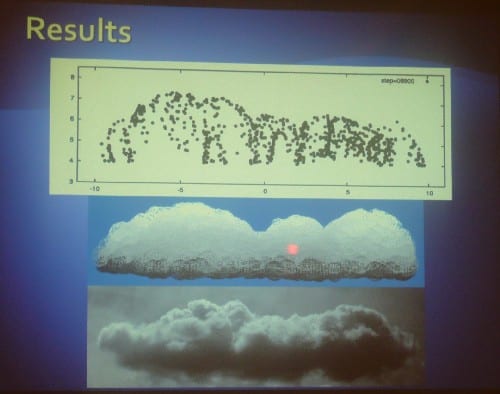
Well, it’s not an easy question – according to Yong Wang at UCLA. Wang was here at the APS March Meeting to talk about his simulations of cumulus clouds, the fluffy ones that tend to appear after about noon on a sunny day and don’t tend to spoil the rest of the day.

Wang says that these clouds are droplets supported by thermal convection, and their shapes arise because this is a “complex non-linear system” that is driven by thermal plumes.

The simulation begins with a homogeneous layer of water droplets into which small thermal plumes rise. After a while, the jostled droplets look a lot like fluffy cumulus clouds (see above).

Wang didn’t seem to think that there were any practical applications for his work – but I would have thought this could help climate physicists understand why certain clouds form.

You can read more about Wang’s simulations here.

What is the most powerful accelerator in the world?

recordbreak.jpg
Record breaking accelerator

By Hamish Johnston in Portland, Oregon

Here’s a question for you, what is the most powerful accelerator in the world?

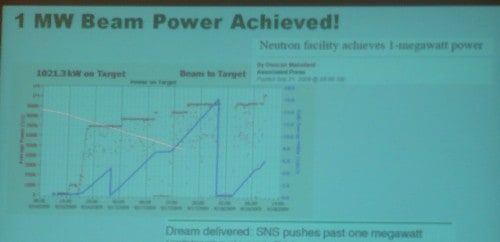
No, it’s not the LHC – that holds the record for energy – the answer is the Spallation Neutron Source (SNS) at the Oak National Lab in Tennessee.

In September 2009 the facility delivered a pulsed beam of 1 GeV protons at a power of 1 MW.

The pulses are fired at a target of liquid mercury, creating copious amounts of neutrons, which can then be slowed down and used for studying solids and liquids.

This afternoon I saw a nice talk by Stuart Henderson of Oak Ridge about recent progress at the SNS. Since experiments began in 2006, the number of instruments attached to the neutron beamline has grown to 12 and he expects that 16 instruments will be running by 2012.

And of course, Oak Ridge hope to upgrade the facility between 2012–2017 – boosting the energy to 1.3 GeV and the power to 3 MW.

Is your hair dusty?

chair.jpg
Rising plumes

By Hamish Johnston in Portland, Oregon

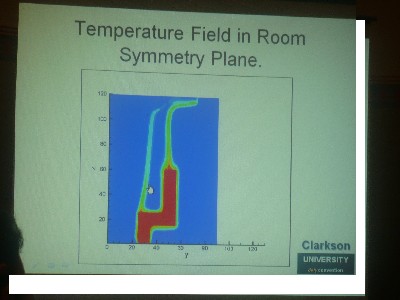
Any guesses as to what you are looking at?

The red shape is a “person” sitting in a small room. The temperature at the surface of the person is 25 degrees – the temperature of your clothes, apparently – and the temperature of the room is 20 degrees.

The image is from a huge simulation of how air circulates in a room with floor and ceiling vents that was done by John McLaughlin and colleagues at Clarkson University.

The yellow plumes are warm air rising from the sitting person – and McLaughlin looked at how tiny particles comparable to viruses or pollen behaved in the room. He found that the plumes tend to concentrate the particles over the person’s head – and then they fall down onto the poor person!

This could be bad news in a hospital, for example, where there could be lots of nasty bugs floating around.

So if your head is getting dusty, perhaps it’s because you are sitting perfectly still in a small room.

Graphene – it's still hot

geim.jpg
Packed house for Andre Geim

By Hamish Johnston in Portland, Oregon

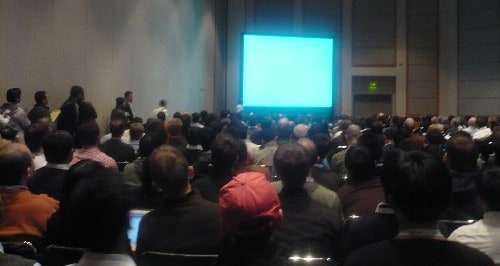
I had to push my way through the crowd here at the APS March Meeting just to stand at the back of Andre Geim’s talk called “Graphene update”. It seems that there is a still a lot of interest in the wonder material – sheets of carbon just one atom thick – that promises to revolutionize electronics.

The University of Manchester-based graphene guru spoke about a half-dozen or so open questions in the field.

Is graphene ferromagnetic at room temperature, as some have claimed?

“No,” says Geim, who explained how he and his colleagues found no evidence for ferromagnetism down to a chilly 2K.

And what about the vexing question of how to create a bandgap in gapless graphene so that it can be used to create conventional semiconductor devices?

Straining graphene by up to 10% hasn’t worked – and recent calculations suggest that you would have to have to strain the stuff by as much as 25% before a gap appears.

One way forward, according to Geim, is to somehow apply just the right amount of “non-uniform” strain to the material. While this appears to work in theory, it requires the strain to vary on length scales of about a micron – which physicists can’t do today.

A gap could also be introduced by altering the chemistry of graphene. Geim and colleagues have already hydrogenated graphene to create graphane – which has a gap. However, Geim says the material is “unstable” and not suitable for making semiconductor devices.

So if hydrogen doesn’t work, why not try fluorine to create fluorographene? That’s what Geim and colleagues have done – and although the result was a semiconductor with a great deal of disorder, he said that fluorographene could be the way forward to a gap.

Perhaps the most intriguing topic touched on by Geim is the fabrication of “quantum capacitors”, which comprise one graphene plate and one metal plate. In such a device the capacitance is a function of the applied voltage, dipping to zero at zero voltage. And the capacitance oscillates if a magnetic field is applied. I’m not sure what you could do with such a device – but it’s yet another example of the wonders of graphene.

Two quantum channels are very different than one

By Hamish Johnston in Portland, Oregon

I know it’s a cliché, but the quantum world gets weirder the more you learn about how it works.

Yesterday I went to a talk by Graeme Smith of IBM Research, whose talk was entitled “Surprises in the theory of quantum communications”.

The surprise that Smith focused on is that two transmission channels – both of which are too noisy or lossy to transmit quantum information individually – can somehow join forces to create a very good channel for transmitting quantum information.

A classical transmission channel fails if you put a signal in one end and get nothing (or just noise) out the other end. By contrast, a quantum channel can fail if you input quantum information but its quantum nature is lost when it gets to the other end – information is transferred, but not quantum information.

But according to Smith, it’s possible that each channel is capable of transmitting a certain subset of the quantum information – but not all of it. The trick is to have two or more channels combine their quantum strengths to overcome their weaknesses.

“The weakness of one is made up for by the strength of the other,” explained Smith.

While it sounds like a great way to build a robust transmission channel from a bunch of bad connections, Smith said that it is not currently clear how to decide which bad channels can be grouped together to create a good channel.

Trapped ions go for a quantum walk

Physicists in Austria have demonstrated a “quantum walk” in detail for the first time, using trapped ions. Such experiments could allow us to better understand the transition between the quantum and classic worlds, and could be applied to a variety of research including quantum computing and the study of quantum effects in nature.

The random walk can be used to describe many systems from fluctuations in the stock market to the Brownian motion of pollen grains on the surface of a liquid. It is usually described by a lost hiker who chooses his itinerary according to the toss of a coin: if he gets heads, for example, he takes one step to the right and if tails, a step to the left. After many coin tosses, the hiker’s position is random, but likely to be close to the starting point.

Quantum random walks, first proposed by Nobel laureate Richard Feynman, are, however, very different. After every toss of the coin, a quantum particle moves in both directions at the same time and adopts a “coherent superposition” of right and left. This means that there are always several possible paths the quantum walker can take to arrive at its final position.

Paths interfere

According to the rules of quantum mechanics, these possible paths interfere. Thanks to this interference, the final probability distribution describing the likelihood of finding a particle at a given location is very different to that of its classical counterpart – the quantum particle tends to move away from its original position much faster than a classical particle.

Researchers, including Christian Roos from the Institute of Quantum Optics and Quantum Information at the Austrian Academy of Sciences, have succeeded in measuring this probability distribution and show that it indeed follows the quantum behaviour expected. They demonstrate a 23-step quantum walk – the longest to date – which involves two particles for the first time. The finding builds on recent research, including work published last July that involved a 10-step quantum walk involving a single ultracold atom.

In their experiments, Roos and his team begin with a single calcium ion in an ion trap and cool it so that it is in its lowest energy state – the ground state. The researchers initiate movement by firing laser pulses that transfer momentum to the ion and, depending on the internal state of the ion, it is pushed to the left or right.

However, before each step, the researchers prepare the ion in a quantum mechanical superposition of two internal states, by firing it with a separate laser. In this way, each time the ion is pushed, each part of its wavefunction has the same opportunity to move in either direction. “These two steps – the pushing and scrambling pulses – make up one elementary step of the quantum walk,” explains Roos.

Mapping the ion’s position

The scientists repeated this process 23 times and collected data about the motion by detecting the florescence emitted by the ion. Analysing the numerous steps in this way allowed them to build up a map of the probability distribution of the ion’s position. To extend their research the scientists use two ions, giving each walker the additional possibility to stay instead of taking a step. Importantly, with one and two walkers, the researchers confirmed that the quantum walk is very different to the classic random walk, because the quantum particles spread much faster on their walks.

“These new experiments describe nicely how the quantum walk can be extended to more steps than previously demonstrated, and on two walkers at a time” says Tobias Schaetz of the Max Planck Institute of Quantum Physics in Germany, whose group also studies quantum walks.

“The results could be applied to studying natural phenomena”, says Roos. “For example, researchers have long suspected that energy transport in plants is more efficient thanks to quantum walks.” Applying quantum walks to quantum computer models could also help develop highly advanced search algorithms that would outperform their classic counterparts, because different outcomes for a given calculation could be chosen at the same time.

The work is published in Physical Review Letters.

'World's largest' Foucault pendulum

whopper.jpg
It’s a whopper

By Hamish Johnston in Portland, Oregon

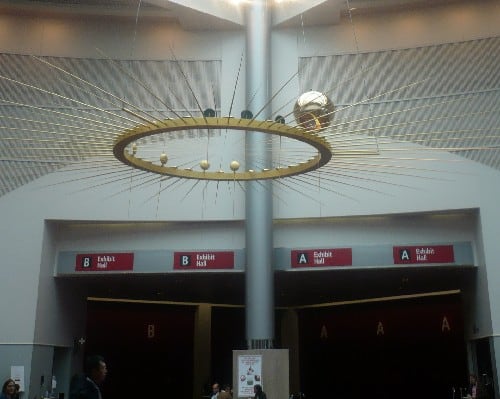
Swinging above the heads of thousands of physicists as they rush to the next session is a very large Foucault pendulum. Indeed, Wikipedia suggests that it is the world’s largest.

It’s day two here at the APS March Meeting and I’m off to hear about how electric and magnetic fields can be synthesized for ultracold neutral atoms.

Have they banned the 'physics paparazzi'?

papa.jpg
Steal a speaker’s data at your peril

By Hamish Johnston in Portland Oregon

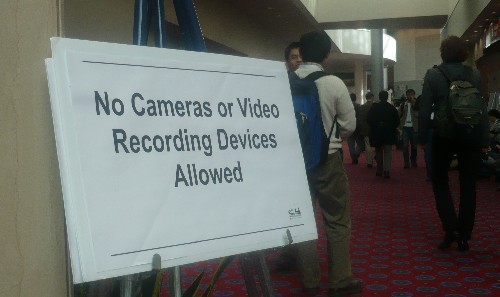
I couldn’t resist taking a cheeky snap of this sign in a corridor of the convention centre.

Is this a response to the infamous “physics paparazzi”, who take photos of other people’s data during talks and then go off and write a paper that beats the original researchers into publication?

You may recall the scandal surrounding PAMELA data a few years ago when that very thing happened.

When I asked in the press room I was assured that reputable members of the media such as myself were free to take photos – and a press officer is looking into whether there is a ban on delegates taking photos.

As I only saw one sign in the giant convention centre, a more plausible explanation is that the sign was left over from last week’s event.

Top tip…topological insulators are hot this year

topolog.jpg
Zhang (left) next to Molenkamp

By Hamish Johnston in Portland, Oregon

There was a slight panic here in the press room over lunch when we all realized that we will soon be writing about topological insulators. We weren’t exactly sure what they were – but it’s becoming clear that topological insulators are the hot topic here at the APS March Meeting.

Fortunately we received a good introduction by some of the leading lights in the field, including Shou-Cheng Zhang of Stanford University. Zhang described topological insulators as “a new state of matter that has been predicted and discovered”. The prediction – by Zhang, I believe – occurred in 2006 and the first material was made a year later by Laurens Molenkamp at the University of Würzburg, who was also at the press conference.

Topological insulators are actually pretty good conductors (more on that later) and could lead to smaller integrated circuits that run faster and cooler. There is even the suggestion that axions and Majorana fermions could be lurking in these materials.

A simple description of a topological insulator is a material that is an insulator in the bulk, but a very good conductor on the surface.

Why? Well, it seems to have something to do with the quantum spin Hall effect – the accumulation of electrons with opposite spins on opposite sides of a conductor.

Let’s say a spin-up electron is flowing along the surface and scatters off an impurity.
The scattering process involves orbital angular momentum – and thanks to spin-orbit coupling, the spin of the electron is also rotated during the scattering.

Here’s the tricky bit that I didn’t quite understand. If the electron is scattered backwards the spin rotation introduces a phase shift of –1. If you think of this scattering as wave diffraction, destructive interference means that the electron can’t propagate in the opposite direction.

No backscattering means that the resistance of the material is very low, which is very useful if you are trying to make very tiny electronic circuits.

Sounds reasonable, but there are a few things I don’t understand. For one thing, this explanation seems to hinge on the electron only being able to scatter forwards or backwards – but not off to the side.

I’d better start reading-up on topological insulators.

Copyright © 2026 by IOP Publishing Ltd and individual contributors