APS March Meeting kicks off in Portland

mount hood.jpg
Mount Hood in the distance

By Hamish Johnston in Portland, Oregon

I arrived here in Portland on Friday evening and spent the weekend sightseeing with my brother.

Spring also arrived here in the Pacific Northwest, with the daffodils up and the cherry trees in full bloom – the sort of March we’ve come to expect in England, but not this year.

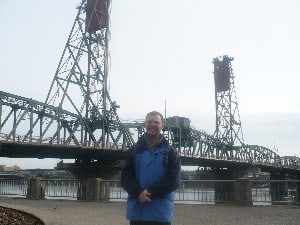
bridges.jpg
City of bridges

While it’s warm, it’s not warm enough to melt the snow on Mount Hood, which I can see from my hotel window – at least I think that is Mount Hood.

This morning I took the tram over one of Portland’s many bridges to the twin crystal towers of the convention centre for day one of the American Physical Society March Meeting – a solid week of solid-state physics.

I have sat in on two press conferences so far, one on topological insulators and the other on the physics of catastrophes. More on both later…it’s time for lunch in the pressroom.

Mysterious ‘dark flow’ at the edge of the universe

Astronomers have found that whole clusters of galaxies are moving in convoy towards a single point in the sky. This unexpected motion appears to be separate from the expansion of the universe and the researchers even suggest that a force beyond the visible universe is the culprit. The discovery has been named “dark flow”.

Cosmologists have already observed two distinct effects caused by invisible entities in the universe: dark matter is known to affect the rotation of galaxies and dark energy seems to be causing the expansion of the universe to accelerate. Dark flow is the latest addition to this shadowy family.

A new study led by Sasha Kashlinsky, of the Goddard Space Flight Center in the US, reports the discovery after analysing small fluctuations in the cosmic microwave background (CMB). The CMB is the afterglow of the Big Bang and shows that the temperature of the universe is the same wherever you look in the sky, 2.7° above absolute zero. However, surveys by NASA’s Wilkinson Microwave Anisotropy Probe (WMAP) have previously revealed small-scale variations to this uniform temperature of about one ten thousandth of a degree.

Independent motion

Kashlinsky’s work shows that these temperature fluctuations are shifted in the direction of a number of galaxy clusters. This implies that the clusters are moving with reference to the rest of the universe, a motion that is therefore independent of its expansion. The result is significant because it cannot be accounted for by the known distribution of matter; something outside of the visible universe may be pulling on the clusters.

“The motion cannot be explained within the standard framework and so has strong implications. So much so that we didn’t believe it for a long time, we were checking and re-checking,” Kashlinsky explained.

The mysterious motion, originally noted in 2008 using the three-year WMAP survey, is now confirmed by a more comprehensive five-year study. Expanding the sample size to 1000 galaxy clusters, Kashlinsky’s team measured the dark flow, at approximately constant velocity, out to 800 Mpc. Their previous study tracked motion to just 300 Mpc.

Bubble siblings

The answer to the source of dark flow might be found in the universe’s infancy. “What we believe is happening is that we are measuring the influence of the parts of space–time that were there before the inflation of the universe,” Kashlinsky told physicsworld.com.

The theory of inflation suggests that the early universe was like cosmic foam made up of many bubbles. One of these bubbles underwent a huge and rapid expansion, when the universe was just 10–36 seconds old, to become the universe that we see today. It is our neighbouring bubbles that Kashlinsky holds responsible for these migrating galaxy clusters.

“Inflation says that if you go to sufficiently large scales you should see structure that is outside this bubble, outside of our universe. If we live in such a world these structures would cause this motion and we suspect that this is what we are seeing,” he said.

The findings are published in Astrophysical Journal Letters.

Enter the ‘thermopower wave’

Researchers in the US and Korea have discovered that igniting a carbon nanotube, coated in chemically flammable material, can trigger a high-speed wave to race along the tube at 10,000× the speed of the spreading chemical reaction. The new phenomenon, dubbed a “thermopower wave”, could lead to a new way of generating electricity and may enable micro power sources to drive nanoscale devices.

These self-propagating waves, which are related to combustion waves, had previously been predicted by the same researchers in earlier papers. “This research is doubly satisfying as, usually, in nanotechnology nature is one step ahead of us and our experiments force us to rework our equations,” says Michael Strano, one of the researchers at the Massachusetts Institute of Technology.

In their experiment, Strano and his colleagues coated multi-walled nanotubes (MWNTs) – which consist of multiple rolled layers sheets of graphene – with a chemical fuel known as cyclotrimethylene trinitramine (CNT). They then fire the system with a low-power laser, which ignites the fuel to initiate a reaction in the chemical, which spreads along the nanotube. However, the burning fuel also triggers a thermopower wave, which also starts to propagate along the nanotube at 1–10 metres each second – 104× faster than the reaction itself.

Shunting electrons

The new phenomenon gets its name from the fact that high speed thermal waves energize electrons before, effectively, “pushing” them through the nanotube – establishing an electric current. It is observed here in carbon nanotubes because the low heat capacity enables a feedback system where heat escaping from the nanotube ignites more fuel and increases the speed of chemical reaction. The resulting electrical pulses can lead to a specific power as high as 7 kW/kg, which is 10× the same value associated with standard lithium batteries.

That high power density could allow such materials to be used as environmentally friendly storage devices that avoid the toxic substances, such as lithium, cadmium and lead.

“The high energy density demonstrated is especially exciting, which may revolutionize the energy storage technology,” agrees Yu-Ming Lin, a nanotechnology researcher at the IBM T J Watson Research Center in New York.

However, Strano and his team want to focus their efforts in the short term on characterizing the phenomenon in more detail. They realize that many engineering challenges will need to be overcome for designing devices for specific applications, especially in finding a way to keep heat within energy storage devices. In the long term, however, Strano says that he is interested in pursuing partnerships with industry.

Higher dimensions

Strano, who is a chemical engineer by training, says that his mathematical modelling also predicts a 2D form of these thermopower waves. Indeed, if he proves to be correct, this finding could enable engineers to start exploring applications with a much wider range of materials. This may even include the “wonder material”, graphene, consisting of single sheets of carbon just one atom thick, which has excited engineers since its discovery in 2004 on account of its unique mechanical and electrical properties.

Alexander Balandin, a materials scientist at the University of California-Riverside, agrees that it would be exciting to observe this phenomenon in 2D. “Graphene, as a planar system, may have advantages in certain applications. In essence, nanotubes and graphene seem to be complementary to each other in terms of applications”.

This research is published in Nature Materials.

Borexino bags geoneutrinos

Physicists working at the Gran Sasso National Laboratory in Italy have detected electron antineutrinos created by radioactive decays within Earth’s crust and mantle. This result builds on earlier evidence for such “geoneutrinos” obtained by a Japanese experiment five years ago and paves the way to new direct measurements of processes taking place deep inside our planet.

Physicists have long studied neutrinos emitted by the Sun and created by cosmic rays entering Earth’s atmosphere. These observations have improved our understanding of solar physics and revealed that neutrinos – chargeless, extremely inert fundamental particles – have a very tiny mass. Theory also predicts that neutrinos, or more precisely electron antineutrinos, are produced inside the Earth by radioactive decay of certain nuclei. Measuring the flux of these geoneutrinos should reveal how much of the energy generated inside the Earth is due to radioactive decays and could improve our understanding of processes that rely on that energy, such as plate tectonics and generation of Earth’s magnetic field.

Detecting geoneutrinos, however, is extremely tricky. Like any kind of neutrino, their observation requires enormous volumes of detector material and a location deep underground to prevent interference from cosmic rays. But unlike higher-energy solar and atmospheric neutrinos, geoneutrinos cannot be studied via their interaction with the nuclei of heavy water, because their signal would be swamped by the radioactivity in this liquid. Instead certain kinds of hydrocarbon are used, in which passing geoneutrinos can occasionally collide with a proton to create a positron and a neutron and in so doing generate a distinctive dual gamma-ray emission, which produces detectable light.

In 2005, researchers working on the KamLAND experiment, 1 km below the surface in Japan, reported geoneutrinos in their detector. However, to do so the team had to separate the signal from a strong background of antineutrino emission produced by a number of nuclear reactors located close by (a location chosen deliberately to study reactor antineutrinos).

Very low levels of background

The Borexino experiment, however, was designed to study low-energy solar neutrinos and therefore has very low levels of background. Located 1.5 km below the surface of the Gran Sasso mountain, it is situated hundreds of kilometres away from the nearest reactor.

Neutrinos are detected in some 300 tonnes of a doped hydrocarbon called pseudocumene contained within a nylon sphere, which is immersed within 1000 tonnes of pure pseudocumene enclosed by a stainless steel sphere, which is itself surrounded by 2400 tonnes of highly purified water held within another steel container with a diameter of 18 m. All the individual components – including the detecting medium, liquids and photomultiplier tubes used to record the gamma-ray signals – were chosen to have as low a level of intrinsic radioactivity as possible.

The experiment ran for two years ending December 2009 and the Borexino collaboration (about 80 researchers from six countries) says that it detected 9.9 geoneutrino events, with uncertainties of +4.1 and –3.4. Spokesman Gianpaolo Bellini of the University of Milan says that the result also appears to rule out a controversial hypothesis that a large part of Earth’s heat is produced by a naturally occurring nuclear reactor fuelled by uranium in the planet’s core.

No evidence for a ‘georeactor’

Such a “georeactor” would emit electron antineutrinos with roughly the same spread of energies as those emitted by nuclear power stations, but the Borexino researchers found that the experiment detected roughly as many antineutrinos as would be expected from power stations alone.

Bellini says that the Borexino results provide the first real detection of geoneutrinos, and that the results obtained by KamLAND are instead an “indication”. However, KamLAND spokesman Atsuto Suzuki at Japan’s KEK laboratory sees things differently. He congratulates the Borexino collaboration on producing “beautiful” results but says there are not “any meaningful differences” between these results and a set reported by his group two years ago. “The number of observed geoneutrino events was 73 ± 27 for KamLAND in 2008 and was 9.9 ± 4.1–3.4 for Borexino,” he points out. “This tells you everything. Physicists understand whether using words such as a ‘hint’ versus an ‘observation’ is significant or not.”

Regardless of differences of interpretation, both Bellini and Suzuki agree that more data are needed. Indeed, there are a number of larger experiments currently in the planning stages, including a 10,000 tonne detector that would be attached to the Pacific Ocean floor in order to make more precise measurements of the geoneutrinos coming up from the mantle (since the crust is very thin under the Pacific).

“KamLAND and Borexino demonstrate the potential of geoneutrinos for examining terrestrial composition and radiogenic power, leading to an improved understanding of the origin and thermal evolution of our planet,” says Stephen Dye of the Hawaii Pacific University and the University of Hawaii. “Thanks to these pioneering measurements we can plan projects that look at those questions in detail.”

The work is reported at arXiv: 1003.0284 and has been submitted to Europhysics Letters B.

Electrical signals transmitted via spin waves

Physicists in Japan have for the first time been able to transmit an electrical signal over a distance of one millimetre through an insulator using spin waves. The technique, which involves converting an electrical current into a spin signal and then back again, could be used in “spintronic” devices that exploit both the spin and charge of the electron. Such devices are of great interest because they could be smaller and more energy efficient than conventional electronic circuits.

One problem hindering the progress of spintronics is that it is hard to transfer currents of spin-polarized electrons over distances greater than a micrometre in conductors like copper. The advantage of spin waves – collective oscillations of stationary spins in a magnetic insulator – is that they can travel millimetres or even centimetres in some materials with very little loss.

Spin-Hall effect

The technique was developed by Eiji Saitoh and colleagues at Tohoku University, Keio University and the FDK Corporation. They built their device from a 1.3 µm thick rectangular strip of the magnetic insulator Y3Fe5O12. Platinum electrodes just 15 nm thick were deposited at either end of the strip, with 1 mm of bare Y3Fe5O12 between the two electrodes.

The team sent an electrical current through one of the electrodes causing “spin-up” electrons to collect at the interface between the platinum and Y3Fe5O12, while spin-down electrons collected at the opposite surface of the platinum. This behaviour is well known to physicists and is called the spin-Hall effect.

Although electrons in the platinum cannot flow into the insulator, they can exert a torque on spins in the Y3Fe5O12 that are close to the interface. These stationary spins then exert torques on their neighbours, which do the same to their neighbours and the excess spin ripples through the insulator in the form of a spin-wave.

When this wave reaches the other platinum electrode, the reverse process occurs – the spin-wave transfers spin across the interface, creating a surfeit of spin-up electrons. This creates a spin-Hall voltage that causes electrons to flow in the second electrode.

Towards ‘spin wiring’

Although the existing device does not input a spin current from an external source – nor does it output a spin current – Saitoh told physicsworld.com that the principle could be used to create devices that do both. This could be exploited to create sources of spin current, or to transfer spin current over large distances.

Saitoh also believes that the device could be used to create “spin wiring” that could someday replace conventional wires in integrated circuits. And because the spin-waves oscillate at gigahertz frequencies, the device could be adapted as a source of microwaves.

The team is now trying to optimize their design by trying different combinations of materials.

The work is reported in Nature 464 262.

Concerns raised over Institute of Physics climate submission

A statement submitted by the Institute of Physics (IOP) to a parliamentary inquiry on climate change continues to draw criticism, with one senior physicist saying that it is “not worthy” of the organization. Others have complained that the statement appears to play into the hands of climate “sceptics”, as it criticizes scientists for withholding climate data when requested using the UK’s Freedom of Information Act. The IOP, which owns the company that publishes physicsworld.com, has responded by making it clear that it believes in man-made climate change and that its submission was criticizing instead the practices of the climate scientists at the centre of the inquiry.

The IOP’s submission was sent last month to a House of Commons Science and Technology Committee inquiry into the disclosure of climate data from the Climatic Research Unit (CRU) at the University of East Anglia in the UK. The inquiry is investigating the alleged hacking of CRU servers, which resulted in hundreds of private e-mails between researchers over the last 14 years being disclosed online last November. The inquiry solicited responses about what possible implications the e-mail disclosures might have for the integrity of scientific research and whether the scope of a separate independent inquiry – led by Muir Russell, a former vice-chancellor of the University of Glasgow – into the CRU’s practices is adequate.

Some of the e-mails reveal that CRU director Phil Jones, who has since stepped down from the post until the Russell review is published, withheld data from being released even after freedom-of-information requests. One particular e-mail sent by Jones on 16 November 1999 caused a media furore when it was revealed that he wrote “I’ve just completed Mike’s Nature trick of adding in the real temps to each series for the last 20 years and from 1961 for Keith’s to hide the decline.”

The [IOP’s] evidence is both misinformed and misguided Stefan Rahmstorf, Potsdam University

“Mike’s Nature trick” refers to a paper published in the journal Nature (392 779) in 1998 by Michael Mann from Pennsylvania State University, Raymond Bradley from the University of Massachusetts Amherst and Malcolm Hughes of the University of Arizona. In the paper, the researchers sought to estimate how the mean temperature of the northern hemisphere has changed over the past millennium by combining various “proxy” temperature records, such as the diameter of tree rings and the presence of hydrogen and oxygen isotopes in ice cores, with thermometer temperature measurements.

[We] focused on the need to maintain the integrity, openness and unbiased nature of the scientific process IOP statement

The resulting “hockey stick” plot shows a relatively flat, but fluctuating, temperature for more than 900 years, from A D 1000 onwards (the shaft of the hockey stick) that then rises suddenly in the past 100 years (the blade). The hockey-stick graph, which is widely considered as a valid result in the climate-research community, was later included into the third assessment report by the United Nations Intergovernmental Panel on Climate Change (IPCC) in 2001.

The “trick”, as mentioned by Jones in one of his e-mails to Mann, Bradley and Hughes, is a statistical method that is widely accepted in the climate community and is applied to proxy measurements in the years since 1960. It deals with the problem that some tree rings in certain parts of the world have stopped getting bigger since that time, when they ought to have been increasing in size if the world is warming. According to physicist Rasmus Benestad from the Norwegian Meteorological Institute and a blogger for realclimate.org, Jones’ reference to “hiding the decline” could have involved removing some tree-ring proxy data from the analysis after 1960 to produce a curve that agrees better with the evidence for global warming.

However, sceptics of man-made climate change jumped on the phrase used by Jones saying that he and the CRU were hiding temperature decreases in their data and using certain sections of the full data set that most support the conclusions they want to report.

Under fire

The IOP’s submission to the inquiry, which was sent on 10 February following approval by the Institute’s Science Board, says that the disclosed e-mails from the CRU threaten the “integrity of scientific research in this field”. The submission argues that the integrity of the scientific process should not have to depend on appeals to freedom-of-information legislation and says that refusals to comply with such requests harm “honourable scientific traditions”. It also states that the possibility that only a part of the raw data set was included in Jones’ temperature reconstructions was “evidently the reason behind some of the (rejected) requests for further information”.

Arnold Wolfendale, who was president of the IOP from 1994 to 1996, says that the evidence is “not worthy” of the Institute and that the submission “further muddies the waters regarding global warming”. Oceanographer and climatologist Stefan Rahmstorf from Potsdam University, Germany, has gone further, calling on the IOP to retract the statement from parliament. “I was taken aback when I first read it,” he says. “The evidence is both misinformed and misguided.” Rahmstorf, who is a board member of Environmental Research Letters (ERL), an open-access journal published by the IOP, wants the Institute to withdraw the evidence or clarify who wrote and reviewed it.

In a statement, the IOP says it regrets that its submission to the inquiry has become the focus of what it calls “extraordinary media hype” and that the evidence “has been interpreted by some individuals to imply that the IOP does not support the scientific evidence that the rising concentration of carbon dioxide in the atmosphere is contributing to global warming”. The Institute adds that it has long had a “clear” position on global warming, namely that “there is no doubt that climate change is happening, that it is linked to man-made emissions of greenhouse gases, and that we should be taking action to address it now”.

The Institute says that its evidence to the House of Commons committee was “like that of other learned societies, focused on the need to maintain the integrity, openness and unbiased nature of the scientific process. The key points it makes are ones to which we are deeply committed – that science should be communicated openly and reviewed in an unbiased way, however much we sympathise with the way in which CRU researchers have been confronted with hostile requests for information.”

There have also been concerns that the IOP’s submission appears to prejudge the outcome of the inquiry. “I consider it not only inappropriate but highly irresponsible for a body like the IOP to appear to presume a judgment on what is clearly not a simple issue without having the full facts and without presumably knowing the full context,” says atmospheric physicist John Houghton, who is currently president of the educational charity The John Ray Initiative and is a former director-general of the UK Meteorological Office. Houghton has also been the lead editor of three IPCC reports.

That view is echoed by Andy Russell, a climate researcher from the University of Manchester in the UK, who has written an open letter to the Institute about the submission. “As it stands, they have written a judgment rather than an evidence statement,” he says. Russell calls on the Institute to retract its evidence and points to a statement by the Royal Society of Chemistry (RSC) that, he says, essentially makes the same points as the IOP but in what he calls a much more diplomatic way. One statement in the RSC’s submission says, for example, that “a lack of willingness to disseminate scientific information may infer that the scientific results or methods used are not robust enough to face scrutiny, even if this conjecture is not well founded”.

Process issues

Benestad, however, does not think that the Institute should retract the evidence to the inquiry, although he wants more transparency about how it submitted the evidence. “I thought the evidence sent the wrong message. Transparency should be the same for all sciences and not just single out climate change,” says Benestad. “Regarding being more open about how the submission was written, the IOP should practise what it preaches and say how this was submitted.” He wants it to be made clear who specifically wrote the document, as well as who independently checked it before it was submitted.

In its statement, the Institute says that the evidence submitted to parliament followed “the process we always use for agreeing documents of this kind”, noting that it submits 40 to 50 evidence statements to parliamentary inquiries per year. “We asked the energy sub-group of our Science Board to prepare the evidence, based on its analysis of material that is in the public domain following the hacking of the CRU e-mails last year,” says the IOP. “The draft was circulated to the Science Board, which is a formal committee of the Institute with delegated authority from its trustees to oversee its policy work, and approved. However, we are already reviewing our consultation process for preparing policy submissions, and the comments we have received on this submission reinforce the need to make sure our procedures are as robust as possible.”

The Institute also says it “strongly rebuts” accusations of “being overly influenced by one ‘climate-change sceptic’ on the energy sub-group, and then of a lack of openness about the authorship of our evidence”. It adds that “The individual in question had no significant influence on the preparation of the evidence. Responsibility for the evidence rests with our Science Board, whose members’ names are openly available on our website.”

The parliamentary inquiry came as the UK’s Meteorological Office published a review of the latest climate-change science. The report says it is “very likely” that man-made greenhouse-gas emissions are causing the climate to change and that the changes bear the “fingerprint” of human influence. The House of Commons Science and Technology Committee is expected to publish its findings in late April.


Galaxy study backs general relativity

Einstein’s general theory of relativity has been tested for the first time over distances nearly as large as the universe itself – and has, in the process, trumped most other alternative theories of gravity. The test was done by astronomers in the US and Switzerland who studied images of more than 70,000 distant galaxies.

The team also concluded that the existence of vast quantities of invisible dark matter is the best way of explaining the motions of galaxies. The work also suggests that dark energy, in the form of a cosmological constant, is the best way of understanding how the universe is expanding

Since it was first published in 1916, Albert Einstein’s general theory of relativity has had great success in describing the motions of massive objects such as planets in the solar system. While the theory should also describe observations of galaxies and galaxy clusters on much greater length scales, this has proven very difficult to test.

In order to preserve general relativity, physicists must accept that about 80% of the matter in the universe is dark matter. This substance is invisible to astronomers, who can infer its presence from its gravitational interaction with galaxies. The problem is that the visible matter in galaxies appears to cluster more than dark matter, leading to a “galaxy bias” when astronomers try to map the total matter in the universe – and accurate maps are needed to test general relativity.

Cut the bias

This bias has been very difficult to resolve, but in 2007 Pengjie Zhang at the Shanghai Astronomical Observatory and colleagues in the US and UK proposed a new way of testing general relatively without having to worry about the bias. The test involves finding the ratio of two quantities called annular differential surface densities (ADSDs) – which are derived from images of galaxies.

One ADSD is related to how light from very distant galaxies is distorted by the gravitational fields of other galaxies that it passes on its way to Earth – an effect predicted by general relativity and called gravitational lensing. The second quantity is related to the velocities of the galaxies. The beauty of the new test is that both quantities are susceptible to bias – but the effects cancel in the ratio.

Now, Reinabelle Reyes and colleagues at Princeton University and the University of Zurich have derived these parameters from data on more than 70,000 distant galaxies from the Sloan Digital Sky Survey. The average distance to the galaxies is about 5.5 billion light-years – which means that the light has covered cosmological distances on par with the size of the universe.

Goodbye TeVeS?

The observed ratio, dubbed EG, has a value of 0.39 ± 0.06. This agrees with general relativity, which predicts a value of 0.4. Crucially, the measurement rules out the tensor, vector scalar (TeVeS) model of modified gravity, which has an EG of 0.22 and does not need dark matter. The result does not, however, preclude the f(R) theory – which is more similar to general relativity and has EG values in the 0.328–0.365 range.

So far, general relativity is coming up roses Robert Caldwell, Dartmouth College

“This work takes a significant step forward in using large-scale clustering data to constrain general relativity,” says Robert Caldwell at Dartmouth College in the US. Referring to this and other recent studies that have used gravitational lensing, he said, “so far, general relativity is coming up roses”.

‘So strange’

The study backs the view that the observed acceleration of the expansion of the universe is best explained by general relativity with a slowly varying cosmological constant – rather than by an alternative theory of gravity. The cosmological constant is a term introduced to represent the energy of empty space and prevent the universe from collapsing due to self gravity. It was abandoned by Einstein when it became clear that the universe was expanding – only to come back into favour in 1998 as a way of describing the dark energy that appears to be accelerating the expansion of the universe.

However, Caldwell stresses that this is not the last word on dark energy. “A cosmological constant is so strange that some of us really need to exhaust all alternatives before accepting it,” he says.

Zhang told physicsworld.com that he is very pleased that Reyes and colleagues have managed to measure EG – and added, “EG measurements will be significantly improved by ongoing surveys, so we expect more stringent tests on general relativity based on the EG measurement.”

Reyes and colleagues are eagerly awaiting the completion of the Baryon Oscillation Spectroscopic Survey (BOSS) in 2014 – which is expected to include about 1.5 million galaxies and could possibly rule out f(R).

Science and the general election

DigitalHousesOfParliament.jpg
How will science fare in the next government?

By Michael Banks

There was the banging of a fist on the table and a heated moment (albeit brief) when government science budgets were debated.

Yesterday, the science ministers for the UK’s three main parties – Labour, Conservative and Liberal Democrat — met at Portcullis House in Westminster to attempt to put science policy on the agenda.

Science rarely enters policy debates leading up to a general election. Indeed Phil Willis, chair of the House of Commons Science and Technology Committee, who spoke before the debate, noted that some party election manifestos in the past have not even mentioned science at all.

Yet science was the only focus at the event yesterday, which was organised by the Royal Society of Chemistry and chaired by Susan Watts, science editor of the BBC programme Newsnight. It featured in the red corner, (Labour) science minister Paul Drayson, in the blue corner (Conservative) shadow science minster Adam Afriyie, and in the other corner Liberal Democrat spokesperson for science and technology Evan Harris.

“This time the parties are neck and neck [in the polls], so there is a real choice,” noted Drayson, who has been Labour science minister for the last 18 months.

There are many aspects of science policy that the three panellists seemed to agree on. All three agreed science is an important issue that should be at the heart of government, a point that was reiterated a few times by Drayson.

They also thought a long-term ring-fence of the science budget was right. This means that the treasury cannot dip into the science budget to take any money out after it has been allocated in a comprehensive spending review.

In the two hour debate, the parties also agreed to try and get a chief scientific advisor into the treasury (every other government department supposedly has one) and that they stand by the Haldane principle, in which scientists decide where research money goes rather than politicians, as well the need to get more women into science.

All very good and noble, but what are the differences in science policy for the three main parties?

Even though the three parties support the ring-fence, there are some differences in what happens for the science budget immediately after the election, which is expected to be in early May.

Drayson says that Labour will protect the ring-fence completely, while Afriyie noted that in the long term the Conservatives are committed to a “multi-year science ring-fence”, but says that the “economy has to be first fixed before we can ring fence any budget in the short term”.

So what could this mean? The Conservatives are likely to run an emergency budget if they get elected and although Afriyie didn’t prejudge the outcome, Drayson claims that the Conservatives would make “harsh, deep cuts” in this year’s science budget if they are elected. (The banging of the fist came as Afriyie asked why the government had not yet carried out a comprehensive spending review.)

Harris, meanwhile, says the Liberal Democrats would “not raid the science budget”, and would not cut the science budget this year.

The biggest difference of the night came with higher education policy. Harris said that the Liberal Democrats would scrap tuition fees amounting to £3225 a year that university undergraduates have to pay.

Afriyie says the Conservatives will repay the loans for high performing maths and science students, but Drayson was more guarded about policy saying that Labour will look at the outcome of the a review into higher education spending currently being carried out by Lord Brown. The Brown review will report after the general election.

A few differences, but it might not be such a bad thing. In the event of a hung parliament the three may well have to work together to make sure science is firmly in the government spotlight.

UK science risks relegation, warns Royal Society

The UK’s current position at the forefront of science and technology is under threat from public spending cuts that are being imposed just as other countries are boosting their own support for fundamental research. That is the view of a new report released today by the Royal Society entitled The Scientific Century: Securing our Future Prosperity. Written by an advisory group that included two former UK science ministers – David Sainsbury and William Waldegrave – as well as scientists and business leaders, the 76-page document warns that the UK faces decades of “slow economic decline” unless investment is increased.

The Royal Society report makes six recommendations to boost UK science and technology, including the need to “put science and innovation at the heart of a strategy for long-term economic growth”, “prioritize investment in excellent people”, “strengthen government’s use of science” and “reinforce the UK’s position as a hub for global science and innovation”. Published as the UK heads into a general election, the report also calls for the UK to “better align science and innovation with global challenges” and “revitalize science and mathematics education”.

They are putting science at the heart of their economic recovery and we should do the same Martin Taylor, University of Manchester

The report points out that the UK’s universities are currently ranked second only to those in the US and have been become very successful at transferring knowledge to industry. The number of patents granted to UK universities increased by 136% between 2000 and 2008, according to the report, while university spin-out companies employed 14,000 people in 2008. Many of these jobs are in hi-tech clusters in places such as Cambridge and Oxford and the report warns that some clusters are fragile and “need to be nurtured carefully” during the current economic downturn.

UK cuts while others spend

The report contrasts the situation in the UK, which is cutting university budgets by £600m and is pulling out of some 25 leading international projects in astronomy, nuclear and particle physics and space science, with investment in science in other countries. It cites last year’s €12bn increase in education and research spending in Germany, a $21bn boost for science in the US, a €35m investment in the “knowledge economy” by France and a 20% annual increase in science spending by China as reasons for concern.

If we cut science now…we will seriously damage our economic prospects William Waldegrave, former UK science minister

“It’s very striking to see how other countries are investing in science – particularly France and Germany, which are in similar situations as the UK,” says Martin Taylor, a mathematician at the University of Manchester and chair of the advisory group. “They are putting science at the heart of their economic recovery and we should do the same.”

Those thoughts are echoed by Waldegrave, who served as science minister from 1992 to 1994 and famously invited physicists to explain, on a single sheet of A4, why searching for the Higgs boson at CERN is important. “Times are tough at the moment but that is exactly when you need to invest in the future and focus spending where you already have an advantage,” he says. “If we cut science now, just as the benefits of nearly 20 years of consistent policy are really beginning to bear fruit, we will seriously damage our economic prospects.”

Measuring energy savings

By Michael Banks

Rosenfeld2.jpg
Chris Calwell (left) and Jonathan Koomey (right) present Arthur Rosenfeld (centre) with an award for his contribution to energy efficiency (the award has a 100 picorosenfeld piece of coal inside) credit: Adam Gottlieb.

When PhysicsWorld readers were asked to supply their favourite units last year we were inundated with mentions of “barns”, “sheds” and even “Ox-days”, which measures the amount of land a farmer can plough using an ox.

Now say hello to another unit — the Rosenfeld.

The unit is named after Arthur Rosenfeld, a former particle physicist who moved into energy efficiency research.

Physicists from the Lawrence Berkeley National Laboratory and Stanford University have proposed the unit as a measure of carbon reduction and energy saving.

It is defined as the energy saved over a year from not operating an average 500 MW coal plant running at 70% capacity, or saving three billion kilowatt-hours per year, which is equivalent to saving three million metric tons of carbon-dioxide per year.

The researchers, who have published their results in Environmental Research Letters, say it is easier for people to “visualize” the number of power plants that don’t need to be built through efficiency savings rather than just the number of kilowatt-hours saved.

The proposal for the Rosenfeld will be launched today in a symposium on the next generation of energy efficiency, which is being held at the Robert and Margrit Mondavi Center for the Performing Arts.

Copyright © 2026 by IOP Publishing Ltd and individual contributors