Molecular attraction keeps asteroids together

The strange shapes and composition of small asteroids could have a surprising origin – the heavenly bodies are held together by the same van der Waals forces normally associated with atoms and molecules. This is the claim of scientists in the US and UK who made the first detailed comparison of all the forces that could be involved in sticking asteroids together.

Understanding these forces could help scientists to work out how asteroids form and evolve – and even suggest how to deflect objects that threaten Earth. “This approach may also yield useful insights into other solar system environments, such as planetary rings and proto-planetary disks,” explained Daniel Scheeres, who was involved in the research along with colleagues at the University of Colorado and Michael Swift at the University of Nottingham.

Images sent back from space missions suggest that smaller asteroids are not pristine chunks of rock, but are instead covered in rubble that ranges in size from metre-sized boulders to flour-like dust. Indeed some asteroids appear to be up to 50% empty space, suggesting that they could be collections of rubble with no solid core.

Clinging on

Asteroids tend to spin rapidly on their axes – and gravity at the surface of smaller bodies can be one thousandth or even one millionth of that on Earth. As a result scientists are left wondering how the rubble clings on to the surface. “The few images that we have of asteroid surfaces are a challenge to understand using traditional geophysics,” Scheeres explained.

To get to the bottom of this mystery, the team made a thorough study of the relevant forces involved in binding rubble to an asteroid. The formation of small bodies in space involves gravity and cohesion – the latter being the attraction between molecules at the surface of materials. While gravity is well understood, the nature of the cohesive forces at work in the rubble and their relative strengths is much less well known.

The team assumed that the cohesive forces between grains are similar to that found in “cohesive powders” – which include bread flour – because such powders resemble what has been seen on asteroid surfaces. To gauge the significance of these forces, the team considered their strength relative to the gravitational forces present on a small asteroid where gravity at the surface is about one millionth that on Earth. The team found that gravity is an ineffective binding force for rocks observed on smaller asteroids. Electrostatic attraction was also negligible, other than where a portion of the asteroid this is illuminated by the Sun comes into contact with a dark portion.

Smaller particles get a grip

By contrast van der Waals forces – weak electrostatic attractions between adjacent atoms or molecules that arise from fluctuations in the positions of their electrons – seem to do the trick for particles that are less than about one metre in size. The size of the van der Waals force is proportional to the contact surface area of a particle – unlike gravity, which is proportional to the mass (and therefore volume) of the particle. As a result, the relative strength of van der Waals compared with gravity increases as the particle gets smaller.

This could explain, for example, recent observations by Scheeres and colleagues that small asteroids are covered in fine dust – material that some scientists thought would be driven away by solar radiation. The research can also have implications on how asteroids respond to the “YORP effect” – the increase of the angular velocity of small asteroids by the absorption of solar radiation. As the bodies spin faster, this recent work suggests that they would expel larger rocks while retaining smaller ones. If such an asteroid were a collection of rubble, the result could be an aggregate of smaller particles held together by van der Waals forces.

Asteroid expert Keith Holsapple of the University of Washington is impressed that not only has Scheeres’ team estimated the forces in play on an asteroid, it has also looked at how these vary with asteroid and particle size. “This is a very important paper that addresses a key issue in the mechanics of the small bodies of the solar system and particle mechanics at low gravity,” he said.

Scheeres noted that testing this theory requires a space mission to determine the mechanical and strength properties of an asteroid’s surface. “We are developing such a proposal now,” he said.

The work is described at arXiv: 1002.2478 and has been submitted for publication in Icarus.
Physics and bullying

gordonbrownpic.jpg
Gordon Brown has recently been accused of bullying staff members. Credit: Downing Street

By Margaret Harris

Workplace bullying has become a hot topic in the UK lately, following allegations that Prime Minister Gordon Brown bullied members of his staff at No. 10 Downing Street. Leaving aside the (substantial) politicking behind these particular claims and counterclaims, the debate seems to hinge on a question that is as relevant to career physicists as it is to career politicians: what, exactly, constitutes bullying?

The UK’s Advisory, Conciliation and Arbitration Service (ACAS lists several examples of bullying and harassing behaviour. Some of them seem pretty obvious. Any manager — be it a Prime Minister or a PhD supervisor — who makes unwelcome sexual advances or spreads malicious rumours about an employee is clearly bang out of order, and ought to be severely reprimanded or sacked.

But other examples are less clear. “Overbearing supervision” is on the list, as is “ridiculing or demeaning” someone. Neither of them sound like much fun, but different people react differently to criticism, and it’s at least arguable that one person’s “overbearing supervision” is another’s “making sure the job gets done right”.

There are some reasons to believe that academia is particularly prone to bullying, as one commenter on a recent BBC story suggested. The apprenticeship system for PhD students and early-career researchers gives senior academics a lot of power and influence over their junior colleagues. It also makes it difficult for victims of bullying to walk away from a bad situation, because chances are they’ll have to either start over or leave academia entirely.

But I wonder whether there’s something more subtle going on with physics in particular. The fact is that quite a few of history’s great physicists — the people many of us regard as our scientific heroes — weren’t exactly great managers. I enjoy stories about Feynman’s skirt-chasing as much as anyone, but I’d have thought twice about being his PhD student. Bohr frequently drove Heisenberg to tears. And there are plenty of horror stories out there about lesser scientists; my favourite (unconfirmed) one is of a Nobel laureate who allegedly went around urinating in other people’s experiments so that they wouldn’t work.

Can we separate these physicists’ great achievements from their personal flaws? Certainly. But perhaps we should think twice about relating these anecdotes with such gusto. After all, what was Pauli’s famous “not even wrong” jibe if not “ridiculing or demeaning” to the hapless lecturer on the receiving end?

You stay classy, San Diego

us flag.jpg
Just north of the border

By James Dacey

Well, here at the San Diego Convention Center people are starting to dismantle things around me so looks like the AAAS conference is well and truly over for this year. It’s been a fun five days and I hope this blog has given you a reasonable flavour of the theme Bridging Science and Society.

Next year’s meeting will be in Washington D.C. where the focus will be Science Without Borders – a celebration of all things multidisciplinary. If you’re interested in taking part then they’re already taking submissions for symposia.

Right, after all the big ideas and dashing around this huge convention centre, I’m off for some much needed relaxation. I leave you with a few snapshots of the hosting city.

For those of you haven’t seen the film Anchorman, I apologize but I just can’t resist it – You stay classy, San Diego.

conference centre.jpg
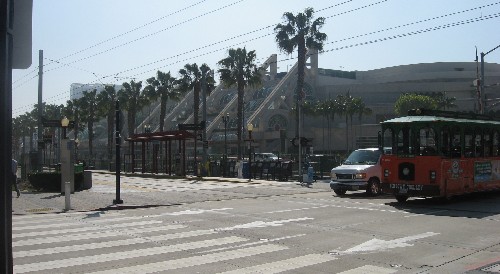
San Diego Convention Center, a large host

tribute.jpg
Tribute to the US naval military

waterfront.jpg
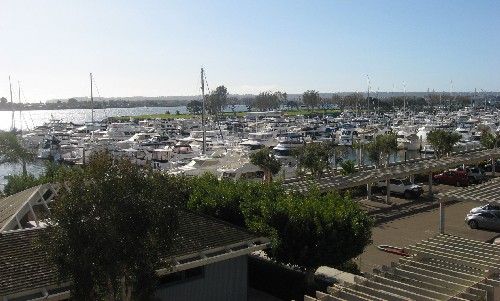
Waterfront, alongside San Diego Bay

bird.jpg
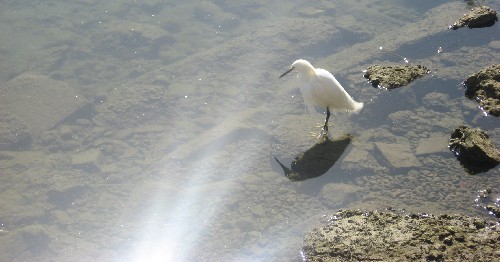
Can anybody identify this bird?

gaslamp.jpg
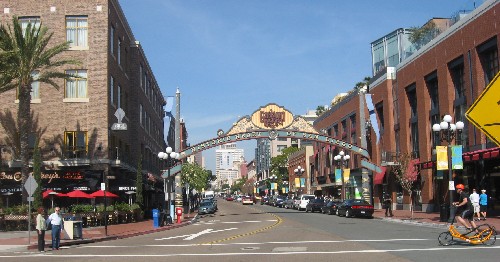
The lively Gaslamp quarter

‘Physicists are modellers too, but lousy modellers’

schneider.jpg
No flies on Stephen Schneider

By James Dacey

This great quote came on the final morning here at the AAAS conference in San Diego. Stephen Schneider, an environmental scientist at Stanford University, was lashing out at all forms of climate change denial including those physicists who make a sport of pointing out uncertainties in climate models.

Schneider’s point is that when physicists make laws and theories by studying the relationships between pairs of data, they are still modelling – just with much less data.

The main thrust of Schneider’s talk – delivered with a relish that could have garnished the Mexican burger I had last night – was that climate scientists should not shy away from entering the public debate on climate change. “Because I have a Ph.D. is not a reason to “hang up my citizenship at the door” of a public meeting—we too are entitled to personal opinions,” he said.

Schneider believes that the media’s representation of climate science is being increasingly shaped by the scientifically unqualified and “old men” who overstretch their dwindling expertise.

Breathe easy, the LHC still won't swallow the Earth

lhc.jpg
The CMS experiment

By James Dacey

“Of the billions who tuned in for the switch-on, I suspect that many were only interested in seeing whether or not we would be blown to smithereens.”

The words there are those of John Ellis, a senior research scientist at CERN, talking just now at the AAAS conference in San Diego about why the Large Hadron Collider (LHC) was never really going to destroy the planet.

I was half expecting (rather, hoping) that the talk would be gate-crashed by a gang of doomsday mongers; or perhaps even Walter Wagner, the high-school physics teacher who filed a federal lawsuit in the US District Court in Honolulu in 2008 to prevent the LHC from starting up.

Alas, they all failed to show.

Ellis, who has worked on several LHC experiments, gave an eloquent description of how CERN responded to all the scaremongering. It was the usual stuff, but it was interesting to here of how Ellis’ colleagues had taken “months” out of their research to calculate the exact nature of the tiny black holes – the ones that almost certainly wouldn’t be produced, and even if they were, would possess the “energy of a fly”.

If you’ve never really trusted those CERN guys, or you’re just really bored, you can find extensive details of all the LHC’s safety precautions here.

Despite his sensible words, I’ve got to say I was a bit surprised by Ellis’ reply to my question over whether physicists, when talking with the media, should stop discussing doomsday scenarios in terms of statistics and just say “no – there is no chance”. “I’m a scientist,” he said. “We deal in probabilities.”

Ellis was speaking as part of a larger discussion entitled Organizer: Doomsday Versus Discovery, in which other speakers discussed how the media have reacted to the developments at CERN and the historical and philosophical issues surrounding the fear of big science.

Researchers! Join the Twitterati! Or perish!

cocktail_party_1965.jpg
The Cocktail Party, 1965. Alex Katz

By James Dacey

It’s been compared to a cocktail party where multiple conversations, all taking place at once, result in that familiar cacophony of chitchat. Some people thrive in this environment, while others feel jarred, but eventually we all drag ourselves along to one because we know that’s the real place to hear the interesting stuff for our careers.

Researchers need to get themselves onto Twitter pronto because it is fast becoming the place to find out the breakthroughs in your research field. That was the take-home message from Bora Zivkovic, the online community manager of the journal PLoS ONE, who was speaking today on the penultimate morning of the AAAS conference in San Diego.

Zivkovic, who was an entertaining speaker with a nice dry sense of humour, admits that the popular microblogging site does play host to a lot of inane chitter. He insists, however, that so long as you are selective about whom you “follow”, you can build up a very helpful bunch of online colleagues. He is a bioscientist by training, and described how he uses Twitter each day to catch up on how colleagues’ research is developing and to see what key publications and events are taking place that day.

One flabbergasted member of the audience took issue with Zivkovic, saying that with “only 24 hours in a day” there is simply not enough time to uphold a professional reputation online. Zivkovic conceded that not every every social networking site is right for everyone, but he is convinced that Twitter is different, arguing that its simplicity and benefits make it worth the investment of time. “It’s just like e-mail – in 10 years you won’t remember what it was like to have lived without Twitter,” he said.

At the end of the session, entitled Science 2.0: From Tweet Through Blog to Book, you could be forgiven for thinking that Zivkovic is being paid by Twitter to say all these nice things about their site. I don’t think he is, but he’s certainly infatuated with the online cocktail party. So join him there or be square, maybe.

To Svalbard in search of little green men

svalbard.JPG
Svalbard Credit: NASA

By James Dacey

Where do we come from? Are we alone? Where are we going? They’re certainly not shying away from the big questions here at the AAAS conference in San Diego. This morning we were celebrating 50 Years of Astrobiology, which is basically the study of the origin and evolution of life on Earth and the search for signs of extraterrestrial life. The research is about as multidisciplinary as you can get drawing on expertise from astronomy, physics, biology, chemistry, geology, and the planetary sciences at the very least.

As interesting as those big questions are, however, I’m usually left frustrated by the vagueness of the actual research. The scientists seem to be staring hard at images and spectra from planets in search of signs of habitable conditions like on Earth, but they don’t really seem to know what they’re looking for. “We can’t say exactly what the conditions necessary for life are. We don’t know whether extraterrestrial life would have evolved in the same way. We don’t really know where to look,” they say.

Well this morning I was pleased to encounter one astro-scientist who seemed a lot less defeatist and was taking a much more down to Earth approach to the search for extraterrestrial life. Pamela Conrad, a planetary scientist at NASA’s Jet Propulsion Laboratory, spends her days surveying desolate places on Earth in search of key indicators of habitability. In essence, she goes out into the field and assesses the large-scale physics and chemistry of a remote location before moving in to see whether the site can support life.

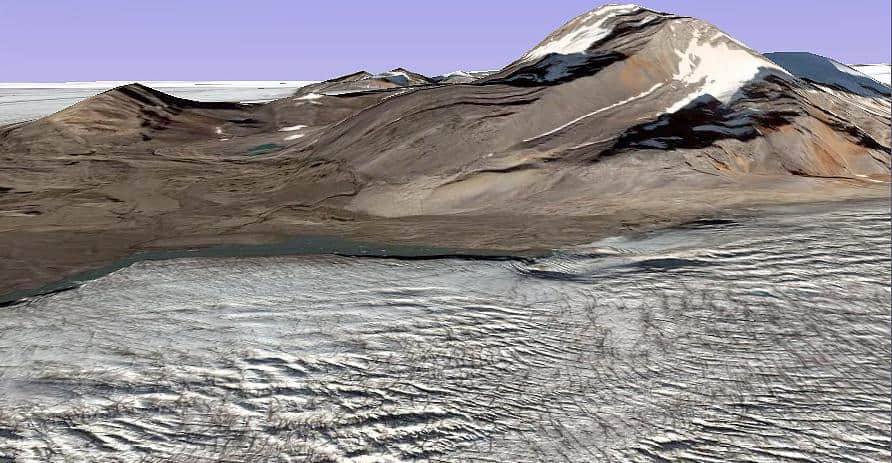
In her talk she described one adventure that took her to the remote archipelago of Svalbard, located between mainland Norway and the North Pole. After extensive surveying, Conrad came to conclude that a range of factors including temperatures, light, and even the steepness of slopes had an influence over which parts of the land could support life. One interesting factor is the type of underlying geology – dolerite, an igneous rock, is a good place for life on Svalbard because it can warm up easily then contain heat over time.

And this research is more than speculative because the findings could be used in NASA’s Mars Science Laboratory (MSL) mission, which is due to launch in 2011. Once the craft has landed, a NASA rover will collect samples to see whether the planet could have supported life at some point in its history. It is important, therefore, to choose a site that at least has a fighting chance of being habitable – that is assuming we want to find those little green men!

To prevent another 'climategate', researchers need to embrace social media

climategate.jpg
Scientists discuss the needer for greater transparency in climate research

By James Dacey

Those scientists involved were careless and, to prevent this happening again, the research community needs to deal with the threat posed by new types of media. These were the conclusions of Harvard climate scientist James McCarthy when describing two recent climate scandals, which were both fuelled by viral activity in the blogosphere. McCarthy was talking today at the annual meeting of the American association for the Advancement of Science (AAAS), which is taking place in San Diego, California.

Since that email scandal broke back in November, bloggers across the globe have chipped with strong criticisms of the scientists at the University of East Anglia (UEA) in the UK. You will remember that leaked emails revealed the researchers to have “sexed-up” certain aspects of their climate data to fit a general warming trend. Then, in January, came another blow to climate science when it came to light that the Intergovernmental Panel on Climate Change (IPCC) had included in their latest scientific report a near baseless claim that the central and eastern Himalayas could disappear by 2035.

McCarthy, who previously served as co-chair of an IPCC Working Group, strongly emphasized that these were two isolated incidents, with have no impact on the strong scientific consensus over climate change. However, he also recognises that the climate science community could have done more to deal with the allegations before the issues blew-up into fully-blown scandals. He feels that one way to do this is for researchers to start using social media themselves – which includes blogs, Facebook and Twitter – to disseminate research with the public. “I can tell you, a lot of groups are trying to think about creative ways of entering into the discussion,” he said.

The connected worlds of Japanese art and electromagnetism

hokusai.jpg
Boy Viewing Mount Fuji, Katsushika Hokusa

By James Dacey

At their foundations, physics and art are connected by form. This was the underlying message of a talk by Jack Leibowitz, a condensed matter researcher at the Catholic University of America. He was speaking today at the annual meeting of the American Association for the Advancement of Science (AAAS), which I’m currently at in San Diego, California.

Leibowitz draws an unlikely comparison between the electromagnetic equations of James Clark Maxwell and the Boy Viewing Mount Fuji, a painting by Katsushika Hokusa. The Japanese artist is perhaps better known for his work The Great Wave off Kanagawa, which decorates the living room of just about every student flat in the land.

In is talk, Leibowitz gave the standard eulogy about the irresistible simplicity of Maxwell’s equations, but he compared this with the same appreciation of design that rewards the viewer of Hokusai’s great painting. “We see the powerfully rendered apposition of shapes: the peak of Mount Fuji accentuated by placement of the dark cloud right behind it, which takes the eye to the darkest dark and the lightest light,” he said.

This was certainly high-brow stuff! Actually, if I’m being completely honest, the talk fell a little bit flat on the audience here in San Diego. Leibowitz came across as a bit aloof in his presentation style, and the formality appeared to leave the non-specialist audience despondent – not a single question was asked when things were opened up to the floor. It’s a shame because it seems like a really fascinating topic, so, if interested, I would skip the talks and pick Leibowitz’s book – Hidden Harmony: The Connected worlds of Physics and Art.

First ‘heavy-fermion’ material made in 2D

Physicists in Japan have created the first 2D “heavy-fermion” material – providing the best evidence yet that heavy fermions undergo a quantum phase transition. The material was made using molecular beam epitaxy (MBE), which also allowed the researchers to carry out the first systematic study of how the electronic properties of a heavy-fermion material change when it is made into layers just one molecule thick. The results could help physicists to understand why some other layered materials superconduct at relatively high temperatures.

Heavy-fermion materials such as cerium indide (CeIn3) are so called because their conduction electrons, which are fermions, move as if they are hundreds of times more massive than electrons in conventional metals such as copper. This large “effective mass” arises because the interactions between the electrons are very strong. Similar strong interactions are thought to play an important role in high-temperature superconductors – a class of materials that physicists have struggled to understand for nearly 25 years.

Heavy-fermion materials therefore provide a useful testbed for high-temperature superconductors. Even better, a wide range of heavy-fermion materials with slightly different electronic properties can be made by combining metals such as indium or aluminium with rare-Earth elements like cerium. High-temperature superconductors cannot be easily altered in such systematic ways.

Layered structures

Physicists are particularly keen to understand how heavy fermions behave in materials with layered crystal structures because high-temperature superconductors are also made from 2D layers. In particular, layered heavy-fermion materials would let them test the idea that high-temperature superconductivity is linked to the electrons being confined to 2D crystalline planes.

That link is backed up by the observation that some superconductors exist in states near to a quantum phase transition. Unlike conventional phase transitions, which occur at finite temperatures and are driven by thermal fluctuations, quantum phase transitions occur at absolute zero and are driven by quantum fluctuations, which are more persistent in 2D materials.

Unfortunately, while physicists have had some success in growing 3D heavy-fermion crystals, they had struggled to find materials that contain the desired 2D confinement. Now, however, Yuji Matsuda and colleagues at the University of Kyoto and Nagoya University have borrowed a technique from the semiconductor industry to create the first layered heavy-fermion materials.

Matsuda’s team used molecular beam expitaxy (MBE) to deposit 30 alternating layers of CeIn3 and lanthanum indide (LaIn3) on an atomically flat substrate. LaIn3 is used because it has a similar crystal structure to CeIn3, but is not a heavy-fermion material. The team made several different structures this way – all with LaIn3 layers four molecules thick – but with CeIn3 layers that varied from one to eight molecules thick.

2D versus 3D

The LaIn3 layers are thick enough that there should be no coupling between electrons in adjacent layers – which means that each CeIn3 layer should behave as a separate and isolated system. Furthermore, the one-molecule-thick layers should behave as a 2D material, whereas the eight-molecule-thick layers should exhibit 3D behaviour.

The team looked for evidence of a quantum phase transition as the CeIn3 layers became thinner. Although it is impossible to cool a sample to absolute zero, Matsuda and colleagues were able to chill their structures to 100 mK. They found two tantalizing bits of evidence pointing to a quantum phase transition between magnetic and non-magnetic phases of CeIn3.

First, the resistivity of the material was found to increase when exposed to a magnetic field. Second, the resistivity of the material shifted from being a quadratic function of temperature for thick CeIn3 layers to a linear function of temperature for the thinnest layers. Both of these suggest that electrons are scattering from quantum magnetic fluctuations in the CeIn3 layers.

Missing superconductivity

“This study has shown that a quantum critical point occurs in this heavy-fermion material,” says Suchitra Sebastian of the University of Cambridge in the UK. However, she points out that superconductivity was not seen in this system – something that she hopes will be seen in future MBE experiments.

Instead, the resistance of the thin layers is very large, which Matsuda and colleagues believe is related to the diffusion of lanthanum (La) atoms into the CeIn3 layers. These impurities would scatter the electron pairs needed for superconductivity. This problem could be alleviated by using a spacing material other than LaIn3.

The study is described in Science 327 980.

Copyright © 2026 by IOP Publishing Ltd and individual contributors