Fractal patterns spotted in the quantum realm

From thunderous mountain landscapes viewed from above to the erratic trajectories of Brownian motion, fractal patterns exist at many scales in nature. Physicists believe that fractals also exist in the quantum world, and now a group of researchers in the US has shown that this is indeed the case. This image shows the fractal pattern that results when the waves associated with electrons start to interfere with each other.

A fractal is a geometric entity whose basic patterns are repeated at ever decreasing sizes. For example, a river system is an approximate fractal pattern as the channels branch off into progressively narrower tributaries moving upstream; at each confluence the pattern is a smaller version of the previous branching.

A sudden transition

Ali Yazdani at Princeton University in the US and his colleagues have revealed that these patterns also exist at the scale of individual atoms in a solid. And the key to this effect is a sudden transition where a material changes from a metal to an insulator. At this transition, the waves associated with individual electrons go from being extended across the whole system to being localized at lattice sites.

We do this stuff every day, but once we managed to get the experiment to work with this material, we were confronted with what look like random patterns Ali Yazdani, Princeton University

At this metal–insulator transition the electron waves become squashed together. They begin to affect each other in a complicated network of constructive and destructive interference, which results in a fractal pattern. Yazdani and his team were able to observe this effect using a scanning tunnelling microscope (STM), which provided the atomic scale resolution.

The material used was the ferromagnetic semiconductor gallium arsenide doped with up to 5% manganese, chosen because the researchers are interested in efficient ways of turning a semiconductor into a magnet. Indeed, doping gallium arsenide in this way has become a popular approach in the burgeoning field of spintronics – electronics that exploits the spin of particles as well as their charge. Spintronics has the potential to boost the speed of computing and electronics.

Serendipitous discovery

Talking about his research, Yazdani admits that observing these fractals was not the primary aim of this research. “We do this stuff every day, but once we managed to get the experiment to work with this material, we were confronted with what look like random patterns,” he says. His group went on to develop the theory and realized that the electrons they were observing were on the brink of localization.

Yazdani and his team intend to develop their research by comparing the collective versus individual behaviour of electrons in their system and how this influences the spatial patterns. The bigger picture of this research is to connect these patterns with theories of magnetism to advance both fundamental research and the development of spintronics applications.

This research is published in Science.
Sweeping away myths about curling

curling2.jpg
TV clip about the physics of curling

By Hamish Johnston

Canadians take curling very seriously — indeed, the CBC has a website dedicated to the sport where you can catch up on the latest results.

In a few days Canada will be hosting the Winter Olympics, and to ensure a bumper crop of medals, the Canadian government has invested CDN$22 million into sports research.

Not surprisingly, some of that money has been spent on studying the physics of curling.

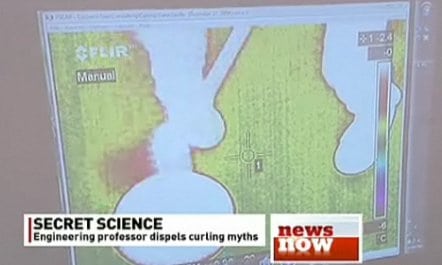
In this TV clip, you can watch Tom Jenkyn of the University of Western Ontario use an infrared camera to study the effect of “sweeping” on the temperature of ice.

For any non-curlers, the sport involves sliding large polished rocks along a sheet of ice and towards a target. Each rock is guided to the target by two sweepers who brush the ice in front of the rock. Sweeping makes the ice more slippery and is used to make the rock go further and to also to modify its “curl” — or its tendency to swerve off a straight line.

Jenkyn discovered that — contrary to popular belief — even the most vigorous sweeping does not melt the ice in front of the rock. Rather, it raises its temperature by about 1.5 degrees, which is enough to affect the motion of the rock.

In the video clip Jenkyn claims to have made dozens of other discoveries that could boost Canada’s curling fortunes at the Olympics — but he’s sworn to secrecy until June, well after the games and the curling season are over.

While most of his findings will only benefit serious competitors, Jenkyn has also designed a new type of broom that is to be commercialized and available to one and all.

Rockstar DJ airs Sagan and Hawking

By James Dacey

I was listening to the dulcet tones of Jarvis Cocker hosting his radio show last night – incidentally, the perfect way to wind down after a busy weekend – when he surprised everyone with this choice.

The song, A Glorius Dawn, features Carl Sagan and Stephen Hawking singing extracts from Sagan’s celebrated TV series Cosmos. It was produced by composer John Boswell who released the track back in November to coincide with the 75th anniversary of Sagan’s birth.

“I’m not very good at singing songs, but here’s a try…” says Sagan, before breaking into a beatbox intro.

You’ll still be laughing from the hilarious first verse when we reach the chorus:

“A still more glorious dawn awaits
Not a sunrise but a galaxy rise
A morning filled with 400 billion Suns
The rising of the Milky Way…”

Those of you familiar with Jarvis Cocker – who fronted the UK band Pulp before going solo in 2002 – will perhaps not be that surprised by his eclectic taste. Like Carl and Stephen, Jarvis is a fantastic communicator especially when it comes to the art of storytelling. His lyrics encompass everything from girls being into palaeontology to the rise of obeisity amongst children, and l remember him exploring his fascination with the cosmos on an early Pulp track Space, which featured the lyrics:

“Tonight … travelling at the speed of thought …
We’re going to escape into the stars…”

You can listen to a repeat of Jarvis Cocker’s Sunday Service here.

Is UK school physics suffering an identity crisis?

class.jpg
Physics hasn’t gone away but the students have Credit: Wikimedia Commons

By James Dacey

Just a quick question for you to ponder over the weekend: what could the UK do to improve the quality and popularity of physics in secondary education?

I ask this now because several UK newspapers have run stories this week about the decline of physics education in the UK. The headlines emerged following a meeting at the Houses of Parliament on Wednesday, the beginnings of a select committee inquiry into the teaching of science, maths and English in schools.

When it came to physics, the focus was on the decline of the A-level award, which students typically study at age 16-18, where the closest US equivalent is probably the AP higher. The two damning statistics that have been doing the rounds are:

a) More than one in four state schools are unable to offer A-level physics due to a lack of specialist teachers.

b) The number of students taking A-level physics has dropped to 29,000 from 44,000 in the 1980s.

The UK Institute of Physics (IOP) responded by pointing to six main problem areas for physics education, which included: the quality of teaching; access to learning; the nature of assessment; the ethos; and the pull of the subject.

The other category is the curriculum itself, where the Institute says that declining standards are deterring students from taking physics or leaving them woefully underprepared for a university education in physics. The Insititute believes that too much change too quickly in STEM [science, technology, engineering and mathematics] has left the curriculum piecemeal and incoherent.

“Physics should have a distinctive place in the curriculum,” reads the IOP’s statement. “The invention of a subject called science has led to a loss of identity of the sciences.”

Physicists watch entropy in action

Physicists in the US have gained important insights into the process of crystallization by studying how tiny plastic balls spontaneously form clusters. They found that highly symmetric clusters are created much less often than those with lower symmetry, which could shed light on how clusters of atoms or molecules form just before a liquid solidifies into a crystalline solid.

The conventional view of crystallization is that a material solidifies when one or more of these tiny clusters grows past a point of no return. But while the energies of possible cluster shapes can be calculated and confirmed experimentally, understanding the role that entropy plays is much harder. In an isolated system, for example, thermodynamics favours the formation of disordered clusters (i.e. those with a high entropy) – provided that the energy of these clusters is low enough that is.

The problem is that actually observing the role of entropy during crystallization is difficult because the clusters are too small and appear and vanish much too quickly to be seen. But by using clusters of much larger particles, which can be observed in real-time with an optical microscope, Vinothan Manoharan and colleagues at Harvard University in the US have been able to gain new insight into the role of entropy in the “nucleation” process.

Maximizing entropy

The team began with an array of thousands of tiny wells on a silicon chip – each well having a depth and diameter of 30 µm. The wells are filled with a mixture of water and two types of plastic balls – one type with a diameter of 1 µm and the other 80 nm. Both types of ball are jostled about by random thermal fluctuations in the water (Brownian motion).

However, when two large balls come to within about 80 nm of each other, the small balls can no longer fit between them. Because there are no small balls between the large balls to push them apart, the balls start to close in on each other. This imbalance looks like a short-range attractive force that causes the large balls to stick together in clusters – the so-called “depletion attraction”.

The team began by looking at wells containing six large balls. These tend to form clusters with either a symmetrical octahedron shape or a less symmetric complex of three tetrahedrons. Although both shapes have 12 bonds between balls, which means that they have exactly the same energy, the high-entropy tri-tetrahedron was found to be about 20 times more common than its more symmetric counterpart.

‘Ball-and-stick’ analysis

To understand why the tri-tetrahedron was more common, the physicists used a magnetic “ball-and-stick” construction toy to work out all the possible ways that the two different clusters could be oriented. From rotational-entropy considerations alone, the team expect the low symmetry tri-tetrahedron clusters to be 12 times more numerous that the octahedrons.

Although this is not the factor of 20 observed experimentally, the team believes that the remaining factor of about two can be explained in terms of vibrational entropy. The tri-tetrahedron is less rigid than the octahedron, which means that the tri-tetrahedron can flop about between different configurations – further boosting its entropy.

The researchers then turned their attention to larger clusters of up to 12 balls and found that the clusters also favoured the least symmetric and least rigid configurations. Indeed, at 12 balls the most symmetric (and least energetic) structure was never observed. As a result, most of the larger clusters looked like familiar bulk-crystal structures such as hexagonal-close-packed.

Although the study illustrates the importance of symmetry in the formation of tiny clusters, Manoharan points out that crystallization involves long-range interactions between atoms that are not reproduced by the depletion attraction. When such interactions are considered in the team’s model, the effect of entropy is not as strong. Also, the studies were done in complete isolation where the clusters could come to equilibrium without being disturbed by their surroundings, which does not apply to most real systems.

The work is reported in Science.

Graphene transistor breaks new record

Physicists in the US have made the fastest graphene transistor ever, with a cut-off frequency of 100 GHz. The device can be further miniaturized and optimized so that it could soon outperform conventional devices made from silicon, says the team. The transistor could find application in microwave communications and imaging systems.

Graphene – a sheet of carbon just one atom thick – shows great promise for use in electronic devices because electrons can move through it at extremely high speeds. This is because they behave like relativistic particles with no rest mass. This, and other unusual physical and mechanical properties, means that the “wonder material” could replace silicon as the electronic material of choice and might be used to make faster transistors than any that exist today.

Phaedon Avouris, Yu-Ming Lin and colleagues at IBM’s TJ Watson Research Center in New York began making their field-effect transistor (FET) by heating a wafer of silicon carbide (SiC) to create a surface layer of carbon atoms in the form of graphene. Parallel source and drain electrodes were then deposited on the graphene, leaving channels of exposed graphene between them.

Protecting the graphene

The next step is the trickiest – depositing a thin insulating layer onto the exposed graphene without adversely affecting its electronic properties. To do this, the team first laid down a 10 nm layer of poly-hydroxystyrene – a polymer used in commercial semiconductor processing – to protect the graphene. Then a conventional oxide layer was deposited, followed by a metallic gate electrode.

The gate length is relatively large at 240 nm, but it could be scaled down in the future to further improve device performance, say the physicists.

The graphene transistor already has a higher cut-off frequency than the best silicon MOSFETs with the same gate length (these have a cut-off frequency of around 40 GHz). The cut-off frequency is the frequency above which a transistor suffers significant degradation of its performance. The new device breaks IBM’s previous record of 26 GHz, reported on in January 2009.

‘Technologically relevant’

Unlike most other graphene FETs, which have been made from flakes of graphene, this device is made using techniques used by the semiconductor industry. “Our work is the first demonstration that high-performance graphene-based devices can be fabricated on a technologically relevant wafer scale,” Avouris said.

One shortcoming of such graphene devices, however, is that they cannot be used in digital circuits such as those found in computers. This is because graphene has zero energy gap between its conduction and valence electrons – and it is this “band gap” that allows conventional semiconductors to switch currents from off to on.

Instead, such high-frequency transistors could be used to amplify analogue microwave signals in communications and imaging applications – including high-resolution radar, medical and security imaging.

The IBM researchers now plan to scale down their transistor, improve graphene purity and optimize device architecture. “Such transistors could then far outperform conventional devices,” said Avouris.

The team is also looking at ways of creating a bandgap in a graphene transistor so that it could be used in digital applications.

The result was published in Science.

Exoplanet hunting brought down to Earth

Researchers in the US, UK and Germany have used a ground-based telescope to detect organic compounds in the atmosphere of an exoplanet – that is, a planet orbiting a star other than our Sun. The result, the researchers claim, will open up the hunt for Earth-like planets to anyone with access to a decent telescope. “We expect a massive explosion of exoplanet research because it is not limited anymore to the lucky few who have access to space telescopes,” says Pieter Deroo at the California Institute of Technology.

Since astronomers made the first discovery of a planet orbiting another star in 1992 they have gone on to catalogue more than 400 of these exoplanets. The favoured hunting technique is known as the transit method whereby astronomers monitor the light from a star and look for dips in its intensity caused by a planet sweeping in front of its parent star cutting across the line of vision from Earth.

Honing in on exoplanets

The next stage in exoplanet research is to start looking a bit more closely at the nature of these planets with the ultimate goal of discovering a planet with habitable conditions like Earth’s. The first step is to decipher the chemical composition of exoplanetary atmospheres as this could provide information about a planet’s formation and evolution; it might also reveal the signatures of life.

To date, the most popular approach has been to adapt the transit detection method to study how starlight, observed from Earth, is affected during eclipses. The idea is a relatively simple one: compare the spectrographic data of a star’s light when an exoplanet is first in front then behind its parent star in relation to our line of vision.

This exoplanetary eclipse technique is proving successful with the detection of water vapour, carbon dioxide and carbon monoxide in the atmospheres of the hot-Jupiter type exoplanets HD 189733b and HD 209458b. So far, however, these discoveries have only been possible using data from telescopes located beyond the Earth’s swirling atmosphere, which tends to distort our view.

View from Hawaii

Now Deroo and his colleagues have brought the eclipse technique down to Earth. They used NASA’s 3 m Infrared Telescope Facility (IRTF), located atop Mauna Kea in Hawaii, to study the light emitted by the well observed star system HD 189733. By looking for infrared light – the part of the spectrum not currently monitored by space-based planet hunters – the researchers used a new iterative technique for removing atmospheric distortions.

The resulting spectrum is in strong agreement with those acquired using space-based telescopes confirming the presence of water vapour, carbon dioxide and carbon monoxide. What is more, the researchers detect the presence of methane by observing a fluorescent emission, they suggest, by the planet’s close proximity to its parent star – one-tenth of the distance between Mercury and the Sun.

Deroo says that the real beauty of his technique is that it is not limited to detecting large Jupiter-like planets such as this one. “The NASA space mission Kepler will find true Earth-analogues – the new technique will give us a great tool to characterize these planets.”

This research is published in Nature.

Entanglement pioneers bag Wolf Prize

The 2010 Wolf Prize in Physics has been awarded to Alain Aspect, John Clauser and Anton Zeilinger “for their fundamental conceptual and experimental contributions to the foundations of quantum physics, specifically an increasingly sophisticated series of tests of Bell’s inequalities, or extensions thereof, using entangled quantum states”.

The trio will share the $100,000 prize, which will be presented by the President of Israel at the Israeli parliament (Knesset) on 13 May 2010. Zeilinger, 64, is at the University of Vienna, Austria; Aspect, 62, is at the Institut d’Optique in Palaiseau, France; and Clauser, 67, is at J F Clauser and Associates in Walnut Creek, California.

The winners were involved in three pioneering experiments that established the quantum property of entanglement – whereby two or more particles display much stronger correlations than are possible in classical physics. Entanglement plays an important role in quantum computers, which in principle could outperform conventional computers at some tasks.

Violating Bell’s inequality

All three experiments measured violations of Bell’s inequality, which places a limit on the correlations that can be observed in a classical system. The first was done in 1972 at the University of California at Berkeley by Clauser and Stuart Freedman, who measured the correlations between the polarizations of pairs of photons that are created in an atomic transition. They showed that Bell’s inequality was violated – which meant that the photon pairs were entangled.

There were, however, several “loopholes” in this experiment, making it inconclusive. It is possible, for example, that the photons detected were not a fair sample of all photons emitted by the source (the detection loophole) or that elements of the experiment thought to be independent were somehow causally connected (the locality loophole).

In 1982 Aspect and colleagues at the Université Paris-Sud in Orsay, France, improved on Clauser and Freedman’s experiment by using a two-channel detection scheme to avoid making assumptions about photons that were detected. They also varied the orientation of the polarizing filters during their measurements – and in both cases Bell’s inequality was violated.

Closing the locality loophole

The locality loophole was closed in 1998 by Zeilinger and colleagues at the University of Innsbruck, who used two fully independent quantum random-number generators to set the directions of the photon measurements. This meant that the direction along which the polarization of each photon was measured was decided at the last instant, such that no signal (which by necessity has to travel slower than the speed of light) would be able to transfer information to the other side before that photon was registered

The Wolf Prize is awarded by the Wolf Foundation in Israel and is often thought to be the most prestigious prize in physics after the Nobel prize. The foundation was created in 1975 by Ricardo Wolf, a German-born inventor and diplomat.

Quantum mechanics boosts photosynthesis

Physicists in Canada and Australia have shown that nature exploits quantum mechanics to make photosynthesis more efficient. By probing light-harvesting proteins within algae using laser beams, the researchers found that quantum coherence links molecules within these proteins. They say that these links improve the transfer of energy in the production of life-supporting sugars.

Photosynthesis involves using sunlight to convert carbon dioxide into chemical energy containing sugars. However, the protein complexes that carry out the necessary reactions do not absorb sunlight themselves. Instead, they rely on electrons being excited within pigment molecules housed in other proteins, with typically hundreds of pigment molecules supplying energy to an individual reaction centre. One reason for supplying energy indirectly in this way is that some photosynthetic reactions need the energy from several electron excitations in quick succession, something that would otherwise not be possible if light levels were low.

The transfer of energy from light-harvesting proteins to reaction centres is a highly efficient process. Scientists already know, for example, that the various pigments inside each protein are just the right distance from one another – close enough to enable fast energy transfer, but not so close that the molecular orbitals of the pigments overlap and quench their excited states. It is also known that the arrangement of the proteins allows the energy to be sent via many different routes.

Now, however, Elisabetta Collini of the University of Toronto and colleagues are proposing that the energy-transfer process is made even more efficient via quantum coherence. They suggest that the pigment molecules do not act entirely on their own, but interact so that when one molecule is excited by a photon from the Sun, it can to some extent share that excitation quantum mechanically with other pigment molecules. This superposition of excited states will then oscillate, shifting the excitations from one set of molecules to another and then back again on a very short timescale, allowing energy to be transferred to the reaction centres before it is released as light or heat.

In tune

Collini’s team studied this phenomenon in two kinds of light-harvesting protein found in cryptophyte algae, taking advantage of the fact that the main pigment in these proteins, known as bilin, can be tuned to absorb light across a wide range of frequencies. The researchers first exposed the proteins to a pair of short-duration laser pulses, exciting the constituent pigment molecules, before stimulating emission from these excited states by sending in a third pulse shortly afterwards.

What the team was looking for were emission frequencies that did not match the excitation frequency, because these would indicate the existence of a superposition of different states. This they did by detecting the quantum-mechanical equivalent of beats, the cyclical peak in volume produced when two sound waves of different frequency interfere with one another. The fact that they did indeed detect such beats is evidence, they say, that the algae takes advantage of quantum coherence.

The researchers also found that the oscillations of this coherent superposition lasted for over 400 femtoseconds (4 × 10–13 s), which was much longer than expected. They had thought the oscillations would last for no more than 100 fs, because this was the timescale over which they thought interference from the surrounding protein and water molecules would swamp or “decohere” the delicate quantum superposition state. “[We] never anticipated such remarkable effects,” says Collini’s colleague, Gregory Scholes of the University of Toronto, also because bilin molecules interact more weakly with one another than do other photosynthetic pigments.

Playing a role

Such oscillating coherence has been observed before when Graham Fleming of the University of Berkeley, California, and colleagues studied the light-harvesting proteins of green sulphur bacteria in 2007. That experiment, however, was carried out at a mere 77 Kelvin, significantly reducing environmental interference and therefore minimizing the problem of decoherence. The latest work, in contrast, was carried out at room temperature, suggesting that quantum coherence really does play a role in photosynthesis.

Indeed, Paul Davies, director of the BEYOND Center for Fundamental Concepts in Science at Arizona State University in the US, believes that quantum mechanics might be deployed more widely in the natural world. “My feeling is that nature has had billions of years to evolve to the ‘quantum edge’ and will exploit quantum efficiencies where they exist, even if the payoff is relatively small,” he says. “I suspect that many biological nanostructures can be understood fully only by reference to quantum coherence, tunnelling, entanglement and other non-trivial processes. The challenge is to identify such quantum goings-on amid the complex and noisy environment of the cell.”

Jacko spotted in droplet, claims physicist

polymerface.jpg
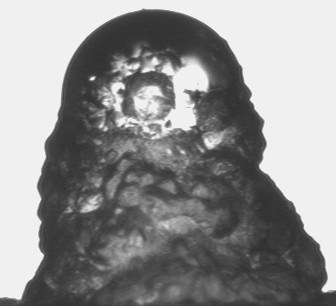
Polymer surgery Is the King of Pop in this mound?

By James Dacey

Just before Christmas, I caused a bit of a splash in the blogosphere when I spotted the face of Ringo Starr in a bouncing water droplet – an image captured by physicists at Duke University in the US.

Here is another physics experiment that contains a spooky resemblance to a human face, sent to us by David Fairhurst, a physicist at Nottingham Trent University in the UK.

The ugly-looking globular mound is a droplet of polymer solution, the kind of substance you might find in the ink cartridges of your printer. As the solution began to dry, Fairhurst noticed a number of small “spherulites” begin to crystallise on the droplet surface revealing what appears to be a tiny human face.

“I noticed it immediately and showed it to the other guys – we had a really good laugh about it,” Fairhurst told physicsworld.com.

The physicist and his group of PhD students reckon the face looks like a small girl, or possibly even the King of Pop, Michael Jackson.

I ran the image through an online face-recognition programme and the names that came out included: Rachel Carson, the American environmentalist; Marlene Dietrich the German-born actress; and (tenuously) Iggy Pop.

Oops, I think I’ve started something here!

Copyright © 2026 by IOP Publishing Ltd and individual contributors