Nanoscale light source can change its colour

An international collaboration claims to have made the first tunable nanoscale light source that is driven by free electrons. Light is created by directing a beam of electrons through a tiny aperture that has been drilled into a stack of alternating gold and silicon-dioxide layers. Interaction between the electron beam and the alternating layers generates visible and infrared light emission.

The device resembles a free-electron laser in which a beam of electrons passes through an alternating magnetic field — causing the electrons to “wiggle” and emit light.

The invention could lead to an on-chip light source for nanophotonic circuits, according to the partnership, which involves researchers at the University of Southampton, UK, National Taiwan University and theorists at CSIC in Madrid, Spain.

Lab-on-a-chip potential?

Tunability would provide a range of opportunities, such as spectroscopic lab-on-a-chip devices for medical diagnostics Kevin MacDonald, University of Southampton

“Nanoscale devices require nanoscale light sources, and tunability would provide a range of opportunities, such as spectroscopic lab-on-a-chip devices for medical diagnostics,” said Southampton’s Kevin MacDonald.

Next-generation displays could also benefit from a tunable light source, according to MacDonald. Switching to this type of device could eliminate the need for separate pixels that deliver different colours of light such as red, green and blue.

The team fabricated their “lightwells” by depositing alternating 200 nm thick gold and silicon-dioxide layers onto a silicon substrate, before a focused ion beam milled a 700 nm diameter hole in the metal-dielectric stack.

Oscillating dipoles

Researchers at Southampton then used an electron microscope to fire a beam into the device. In principle, the beam could instead be supplied by an integrated free-electron emitter — a technology that has already been developed for microelectronic and flat-panel display applications.

As electrons pass through the aperture they create a dipole, due to the presence of “image charges” in the gold layers. This dipole oscillates, producing light emission, thanks to the alternating dielectric environment encountered by the electron as it passes through the well.

By adjusting the energy of the beam from 20–40 keV, the emission is tuned from the red to the near infrared. “However, with adjustments in structural periodicity we anticipate that lightwells could operate anywhere from the ultraviolet range to the terahertz domain,” MacDonald told physicsworld.com.

Twin peaks

Two broad emission peaks were produced by the structure: one that shifted from 830–750 nm and the other 910–800 nm as the electron energy increased. The number of emission peaks depends on the physical dimensions of the device.

The emission lines are broader than 150 nm, which may be too wide for some applications. However, it should be possible to produce narrower emission lines by simply extending the length of the well.

The efficiency of the light generation process is very low, with just 2–4 photons produced for every 100,000 electrons injected. Substantial improvements are possible, however, by optimizing the lightwell geometry, material composition and pumping regime.

A fuller understanding of the emission process requires the inclusion of the more complicated interaction between the electron and the dielectric silicon-dioxide layers. Relativistic corrections also need to be included in the calculations, along with the light-guiding properties of the silicon-dioxide layers, and the interaction of metal-dielectric interfaces with surface plasmons — which are collective oscillations of electrons.

Barriers to commercialization?

Nikolay Ledentsov, chief executive of the laser manufacturer VI Systems, thinks that the development of the lightwell is an interesting piece of fundamental research. However, he says that because this emitter is a plasmonic structure, it will be hampered by losses that could prevent deployment in commercial applications. Realizing single-wavelength emission is another obstacle, alongside higher efficiencies for every part of the system.

The work can be accessed on the arXiv server. It is currently under review for journal publication.

Google Earth: a speed camera for ships?

google.jpg
Caught speeding on camera?

By Hamish Johnston

The renowned Victorian physicist Lord Kelvin spent a good deal of his life at sea and had a great interest in all things maritime. So it’s not surprising that the wedge-like pattern that follows in the wake of a slow moving ship is named in his honour.

Kelvin worked out that the pattern arises because of the interference of two distinct types of waves that are created when an object moves through the water. One type of wave diverges away from the ship, while the other follows the ship.

These two waves sum to create a distinctive wedge-shape wake, outside of which there are no significant waves created by the ship.

Apparently, these “Kelvin wedges” can be easily seen in Google Earth images and two physicists in Brazil claim that the images can be analysed to give velocity of the ship.

The paper is very brief and I’m no wave expert — but it seems to me that the trick is to spot evanescent waves, which do manage to propagate a little way beyond the Kelvin wedge before petering out.

The wavelength and direction of these waves can be extracted from the satellite image and a simple equation can be used to give the speed of the ship.

The team tested their theory on an image of a ferry boat that is known to cruise at 33 km/h — and clocked it at 31 km/h.

You can read a preprint of their paper here.

The paper is less than three pages long so I’m guessing that their analysis is highly-simplified (the aim of the paper is to encourage students to analyse boats operating near to their school). I would have guessed, for example that the shape of the boat would have some effect on the wake?

Dark energy and the balance of blogging

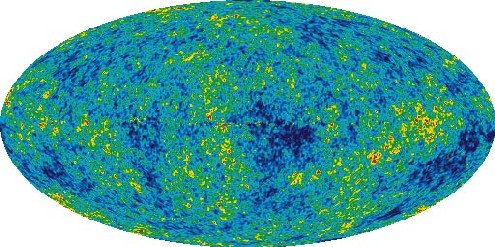
wmap.jpg
Credit: NASA/WMAP Science Team

By James Dacey

In my view, the real beauty of blogging is that it allows for a more free-flowing form of journalism in which the reporter brings him / her self into the story. If done well, a good blogger should be able to convey not only the news but also their experience of the news as it is happening.

Academic presentations are a favourite subject of science bloggers but what happens if one of the “protagonists” feels that the blogger has not quite grasped all the subtleties of their argument? Should the blogger go back and add more layers to their post or does this defeat the whole point of blogging – removing the personal touch and converting it into a more polished article all in one editorial concession?

Last Tuesday I went to Imperial College, London to watch a highly entertaining public debate on the small topic of “The Fate of the Universe”. On the train journey home my head was still spinning with some of the huge ideas so I decided to rattle off a blog about the event and my experience of attending of it.

Since publishing this blog I have been contacted by one of the speakers Subir Sarkar of Oxford University who enjoyed reading the blog BUT felt that it didn’t quite portray the full depth of his argument. Therefore, to keep in the spirit of blogging whilst doing full justice to Sarkar’s debate-winning presentation, we have agreed that the best solution is to publish these clarifications as a new blog post. And here it is:

Dear James,

I hope you don’t mind my pointing this out (it is your blog!) but the technical points you report are slightly different from what I actually said in two important respects.

Firstly, the large cosmological constant (aka vacuum energy) is predicted not by quantum mechanics but by quantum field theory (the union of qm and special relativity) when coupled to gravity as described by Einstein’s general relativity. Clearly something must give – either Einstein’s theory must be modified and/or there must be a mechanism that cancels the huge vacuum energy. No one has been able to figure out how … but Nature must know the trick otherwise we would not be here talking about it! Until we figure it out we ought to be wary of naively invoking (a relatively tiny) vacuum energy to explain cosmological observations.

Secondly, the observations may well be right but the inference of a cosmological constant (in terms of the present – probably oversimplified – cosmological model) may be wrong. No one has actually seen acceleration – this is inferred from the observation that distant supernovae are slightly fainter than would be expected for a decelerating universe. But this inference is based on the assumption of homogeneity – what if we are in a void that is expanding faster than the average rate so that distant supernovae are in a slower Hubble flow relative to the local ones and this creates the illusion of acceleration?

Also the 10122 number was quoted by Andrew, while I said 1060 since this is the expectation from the Standard Model of particle physics – our most successful quantum field theory – which has been verified to work very well up to energies of ~103 GeV. If QFT holds all the way up to the Planck scale of 1019 GeV then we would get the extra (1016)4 ~ 1064 factor (of course all these numbers are so huge that it does not really matter). My point was that Nature must have somehow solved this problem, otherwise the universe would have never got bigger than a mm (before becoming vacuum energy dominated). Interestingly enough, Wolfgang Pauli had apparently estimated that the universe “could not even reach to the moon” from a similar argument by taking the ‘cut-off energy’ to be the electron mass – this calculation was reproduced recently by Prof Norbert Straumann of Zurich. So Pauli concluded that vacuum energy does not gravitate (“as is evident from experience”) – but he did not explain why!

I am glad you liked Rachel Thomas’s article in Plus Magazine – I thought she did a great job of communicating the essential puzzles about the cosmological constant problem.

Best – Subir

Beetle has polarizing twist in its shell

A structure much like a liquid crystal allows the shell of a scarab beetle to circularly polarize light, scientists in the US have discovered.

Mohan Srinivasarao of the Georgia Institute of Technology and colleagues have used microscopy techniques to show that the iridescent green scarab beetle (Plusiotis gloriosa), has a shell that contains a helical structure, rather like a “cholesteric” liquid crystal.

“This study is important because it highlights how animals produce very complex nanostructures by self-assembly,” Srinivasarao told physicsworld.com. “The resulting structures are optically active and produce brilliant metallic green structures, [and] the optical activity results in reflected light being circularly polarized.”

Ripe for bio-mimicry?

There are many examples of insect shells, fish scales, bird feathers and other objects in the animal kingdom that have unusual optical properties. Sometimes researchers find the properties surpass those in manmade materials, in which case they can try to copy the animal’s design. In 2007, researchers discovered that a tropical beetle’s oddly bright white shell was the result of an “aperiodic” shell structure, and said it could lead to a new type of super-white, synthetic material.

Using reflected-light microscopy, Srinivasarao’s group could see how the shell of Plusiotis gloriosa changes colour at different angles, producing the iridescent colours visible to the human eye. However, using laser-scanning confocal microscopy for higher magnifications, the group could discern a helical structure. This structure resembled a cholesteric liquid crystal, which circularly polarizes light as a result of defects that twist its ordered layers of molecules with respect to one another.

Srinivasarao thinks the scarab beetle’s shell could, like other animals, be mimicked for manmade applications. “One could envision making very shiny metallic colours by taking a cholesteric fluid and varying the conditions at which the surface defects appear,” he says.

Unknown use

Biophysicists are just beginning to realize that animals can make use of circularly polarized light. Last year, researchers in Germany and Australia suggested that the “mantis shrimp” uses circular polarization for enhanced communication. However, it is not yet clear whether this scarab beetle employs the optical effect for the same purpose.

“The purpose of the shell is still under some debate,” says Srinivasarao. “Mainly it is supposed to be for mating purposes, [but] the full range of purpose is not yet known…currently there is no evidence that Plusiotis gloriosa can actually distinguish circularly polarized lights of different handedness.”

Srinivasarao adds that he and his colleagues are now investigating why the beetle evolved the polarizing property.

This research appears in the latest edition of Science.

Cloud feedback could accelerate global warming

Low-level clouds are involved in a positive feedback mechanism that could exacerbate global warming — according to a study of cloud and temperature records from the north-eastern Pacific Ocean. Scientists in the US have found that low-level cloud cover decreases when the sea surface gets warmer. Fewer clouds mean that more sunlight reaches Earth’s surface, leading to further warming.

Understanding how climate change is affected by low-level clouds is one of the key challenges facing climate scientists. Such clouds are known to have a net cooling effect — so if rising temperatures lead to more low-level clouds, this negative feedback mechanism could mitigate global warming. But if higher temperatures lead to fewer clouds, the feedback is positive and global warming could be enhanced.

Observational data linking low-level cloud cover and temperature are scarce and the formation and dissipation of clouds is notoriously difficult to model and integrate into global climate simulations.

Now, Amy Clement and Robert Burgman of the University of Miami and Joel Norris of the University of California-San Diego have done a statistical analysis of 55 years of cloud cover and temperature observations for the north-eastern Pacific Ocean. Their study provides the best evidence yet that low-level cloud cover decreases as temperature increases — that the feedback mechanism is positive.

Wrong type of clouds

When temperatures are higher, Clement believes that water rises higher into the atmosphere to create upper-level clouds at the expense of low-level clouds. These higher clouds, however, have a net greenhouse effect and therefore their creation could further boost the positive feedback.

The team compared their findings with feedback predictions made by 18 leading climate models. Only two models predicted a positive feedback and one of these — HadGEM1 from the UK’s Hadley Centre — was particularly good at reproducing the observed relationships between cloud cover, atmospheric circulation and temperature.

Clement believes HadGEM1 performed well because Hadley scientists have “spent a lot of time looking at the lower kilometre of the atmosphere”.

Clement told physicsworld.com that the strength of the positive feedback is in the upper range of that predicted by the Intergovernmental Panel on Climate Change (IPCC). An important consequence of this is that global warming could be worse than many scientists had anticipated. Indeed, HadGEM1 predicts a 4.4° average global temperature increase when carbon dioxide is doubled — compared to the 3.1° median of the 18 models.

A perfect ‘laboratory’

The team focused on the north-eastern Pacific Ocean because the average temperature in the region fluctuates significantly on a ten-year timescale — and because comprehensive cloud-cover observations have been made over the years by satellites as well as by the many ships that sail through the region. This makes it a perfect “laboratory” for studying the relationship between clouds and temperature.

Clement says that it is possible that the observed feedback is specific to the north-eastern Pacific and may be different in other parts of the world where there is significant low-level cloud cover. To test this, the team is now doing a similar study of data from the south-eastern Pacific.

Matthew Collins of the Hadley Centre said that the result sheds significant light on the role of clouds and will be used to evaluate and improve the performance of climate models. However, he cautions that cloud feedback is only part of the picture — and the type of clouds studied by Clement and colleagues are significant only in certain parts of the globe.

This research appears in the latest edition of Science.

Moonrockin' the Science Museum

apollo.jpg
Universal hit: Apollo astronauts took country music into space Credit: Nasa

By James Dacey

Question: What do David Bowie, U2, Coldplay and London’s Science Museum have in common?

Answer: They’ve all been given the “Eno treatment”.

Since quitting the art-rock group Roxy Music in the early 1970s the English musician / musical theorist / political commentator has become one of the most revered names in pop music, collaborating with some of the biggest names in the business. Brian Peter George St. John le Baptiste de la Salle Eno — as his extended name goes — is well-known for consistently pushing the boundaries of music. Many of his albums are fused with the concepts and ideals of minimalist art and his name has become a by-word for pretty much any interesting electronic music.

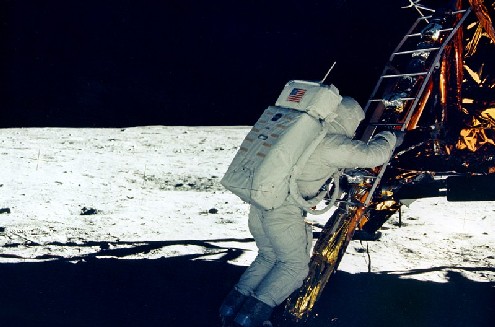
In 1980 Eno worked with his brother Roger and Canadian guitarist Daniel Lanois to create the ambient album Apollo. Inspired by hearing that some of the astronauts on the Apollo missions had taken recordings of country music with them into space, Eno set out to record a concept album of “zero-gravity country music”. My own ears have never been treated to this ambient delight but my muso colleague describes it as “alien noise that perfectly captures the spirit of the Apollo missions”.

Now, to celebrate the 40th anniversary of the Apollo 11 Moon landing, Eno has collaborated with South Korean composer Jun Lee to perform a special arrangement of the album at the London Science Museum. The shows took place on Monday and Tuesday and the music was accompanied by original footage of the Moon landings assembled by director Al Reinert projected onto the giant screen of the Science Museum IMAX cinema.

It’s not yet clear if Eno will be repeating this show in any other venues but I will keep my ears to the ground for any ambient murmurings and let you know…

Newfound order in the valleys

If you have ever gazed out of the window when flying over particularly barren landscapes you will have noticed that ridges and valleys seem to crop up at remarkably uniform spacing. This feature of the Earth’s surface has long since been recognized by geographers but they have always struggled to identify the underlying physical factors that control the distribution of these landforms. Now, however, a team of researchers in the US and Switzerland have developed the first general theory to describe and predict the mechanics of this natural phenomenon.

Taylor Perron at Massachusetts Institute of Technology (MIT) and his colleagues argue that ridge spacing represents a fundamental balance in nature between the slow “creep” of soil and the branching of water channels over the Earth’s surface. To verify their theory, the MIT scientists compared figures from their numerical model with high resolution images taken of the Earth from above. The researchers believe that a quantitative understanding of valley evolution could also yield valuable information about the nature of localized climates throughout Earth history.

Historical landscapes

Some of the early work on landscape morphology from the late 19th century was already focusing on the segmentation of landscapes into ridges and valleys. But until recently, most studies have remained qualitative, largely because we have lacked the topographic maps with sufficient resolution. Another barrier to developing numerical models is that erosion acts very slowly — just a tenth of a millimetre per year on average — and often in fits and starts, so it’s almost impossible to measure directly.

Perron and his team have overcome the mapping problem by using a relatively new technology called LiDAR, which combines GPS with aircraft-mounted lasers. This has been used to produce digital topographic maps covering large areas with resolutions of 1 m per pixel. Another useful feature of LiDAR is it can filter out the laser signals returned from vegetation, and keep only the ones that hit the exposed ground. “We can virtually deforest the landscape, and measure the ridge-valley wavelengths that were previously obscured by trees,” Perron told physicsworld.com.

The researchers have also managed get around the difficulty of measuring erosion rates in order to confirm the river incision and creep parameters in their equations. They achieved this by developing a new technique for calibrating those parameters using only the topography, so we were able to directly compare the wavelength that emerges in model landscapes observed in the field.

Shared geography

The researchers focused on regions that are soil-covered and “low relief”. These landscapes are relatively free of vegetation and the vertical height of the ridges and valleys is not too large relative to their horizontal dimensions. “Basically, this is a disclaimer that our model does not apply to landscapes that are so steep that landslides and debris flows occur frequently,” said Perron. The study was based on sites mostly in the western US but these landscapes are also common in many other regions of the world including the north-eastern US and the UK.

The purpose of collecting these images was to compare them with a numerical model put forward by the same researchers last year. To their delight the MIT scientists found strong agreement between the two sets of data and this led them to a non-dimensional quantity that gauges the balance between soil creep and channel incision — a trade-off that governs the size of ridge spacing. Their model also confirms the long-held rule of thumb that drier climates and weaker rocks are associated with closely spaced valleys in which river incision dominates over creep.

What’s more these findings could help earth scientists to develop historic climate records. “We evaluate how the time-averaged climate has varied among regions by comparing their wavelengths,” said Perron. “By comparing the topography with independent climate records, we can also start to approach the question of which aspects of a variable climate have the strongest effect on long-term erosion and sediment transport,” he added.

Kelin Whipple, an earth scientist at Arizona State University believes the impact of this research will be felt across a range of disciplines. “I think this study of ridge-valley spacing will drive further and deeper analysis of the relations among climate, climate change, and landform morphology in general.” However, he also cautions against viewing this as a key to understanding the full details of past climates. “It is certainly part of the puzzle in trying to determine how climate and climate history is reflected in the shape of landforms — there is promise here, but it’s a complex problem and not fully resolved.”

This research was published in the latest edition of Nature.

How a bat got its big nose

bat.jpg
A typical horseshoe bat (left) and Bourett’s horshoe bat

By Hamish Johnston

Most biologists believe that the giraffe’s long neck evolved to allow the creature to munch on leaves not accessible to other grazing animals. But are such extreme biological features always “optimal adaptations” to specific environmental conditions? In other words, is the giraffe’s neck simply the best possible solution for reaching those tasty treetop morsels? Or did its design come about from a complicated array of evolutionary factors, some of which had nothing to do with finding dinner?

This is an important question for evolutionary biology because the study of extreme features that are true optimal adaptations could help scientists to better understand the forces that drive evolution.

Now a physicist, biologist and mechanical engineer have joined forces to show that the unusually long nose of the Bourett’s horshoe bat is the optimal size for focusing a beam of ultrasound — which the bat uses to navigate.

Native to the rain forests of south east Asia, the bat has a nose that’s about 9 mm long — which is about twice the length of a typical horseshoe bat.

The team used a computer model to calculate the acoustic properties of the “noseleaf” — a structure that protrudes from the bat’s nose and is made of made of folded skin called “sella”

You can read their paper in Physical Review Letters.

They looked at a number of different nose lengths and “By predicting the width of the ultrasonic beam for each of these nose lengths with a computational method, we found that the natural nose length has a special value”, explained team-leader Rolf Mueller of Virginia Tech. in the US.

“All shortened noses provided less focus of the ultrasonic beam, whereas artificially elongated noses provided only negligible additional benefits. Hence, this unusual case of a biological shape can be predicted accurately from its physical function alone.”

So that’s how Bourett’s horshoe bat got its big nose.

Film review: Hawaiian Starlight

CFHT-DomeNightNorth-Cuillandre-1999.jpg
The CFHT dome at night. Credit: Jean-Charles Cuillandre

By Margaret Harris

We’ve received several more physics-related films in the months since the film review series that appeared on physicsworld.com earlier this year, so we’ve decided to run a new batch of reviews over the next couple of weeks. First up: Hawaiian Starlight by Jean-Charles Cuillandre.

With its sweeping panoramas of galaxies, nebula and the cluster of telescopes perched atop Hawaii’s Mauna Kea volcano, Hawaiian Starlight is the ultimate astronomy screen-saver. At least, that’s how it comes across if you watch it on a computer screen in a brightly-lit office. On a big screen in a dark room — perhaps with a drink, and the right group of friends — I suspect it would be a near-spiritual experience. Throughout the film’s 43-minute running time, images of interstellar objects alternate with time-lapse footage of the telescopes that took them. And that’s it. There is no voice-over, no gesturing science “personality” to ram home the significance of what you’re watching, nor even much text. It is just you, the stars, the scopes, and a curiously hypnotic soundtrack borrowed from the Halo video game series. It’s marvellous.

Part of the marvel is the sheer dedication of filmmaker Jean-Charles Cuillandre, an astronomer at the Canada-France-Hawaii Telescope who spent seven years collecting footage of telescopes and the Mauna Kea landscape. The resulting time-lapse movies make up the bulk of the film, and range from simply beautiful to delightfully whimsical. At 1000 times normal speed, a telescope dome opening and closing bears a striking resemblance to Pac-Man, and “cute” is really the only word for a sequence in which three sub-millimetre telescopes twitch in time with the music.

But for the most part, this film inspires wonder rather than giggles. We all know the official reasons for placing telescopes on remote mountaintops: clear skies, thin atmosphere, and low light pollution make for better images. Watching Hawaiian Starlight, however, one wonders whether more subtle factors could play a role: the awesome environment of Mauna Kea’s summit must surely encourage its scientific visitors to think deeply about the universe.

Asking the big questions in London

sarkar.jpg
Trivial matters: Subir Sarkar sets up for his dark energy demolition job

By James Dacey

People often ask me – usually in bewildered tones – what is was that could possibly have appealed to me about physics, let alone convinced me it was a good idea to go study this baffling subject at university.

So it goes… I normally find myself agreeing with them that school physics could be intensely dull, inaccessible, and completely disconnected from everyday life. “But“, I tell them, it was the big ideas that got me in the end – the sense that I was grappling with some of the most profound questions we could ever ask. More recently, I have developed an interest in some of the more “mundane” areas of the subject – particularly the pursuit of sustainable energy innovations – but it is still the bigger picture stuff that really feeds my passion.

I was reminded of all this last night when I popped along to Imperial College in the heart of London town to attend a public debate on “The Fate of the Universe”. The two speakers tackling this small topic were Imperial’s own Andrew Jaffe – an astrophysicist who you may know through his blog Leaves on the Line and Subir Sarkar – a theoretical physicist from the Rudolf Peierls Centre at Oxford.

Jaffe was up first and he introduced the idea of dark energy. He is a firm believer in the stuff and pitched the model as a means of explaining why the rate of expansion of the universe is speeding up when really it should be slowing down under the attractive force of gravity. The American physicist argued that, whilst not perfect, dark energy is the best model we have to fit the data.

(more…)

Copyright © 2026 by IOP Publishing Ltd and individual contributors