Taking an author's 'literary fingerprint'

literary fingerprint.jpg
Billy S A king of infinite space

By James Dacey

Imagine this: a much-celebrated author locks himself away to begin work on his masterpiece, a novel called The Meta Book that will comprise an infinite number of words all strung together in the writer’s unique literary style. While this may sound like the plotline to a short-story by one of the great magical realist authors of Latin America, it is actually the idea of a trio of physicists in Sweden.

Sebastian Bernhardsson and his colleagues at Umeå University are interested in the unique “literary fingerprint” left by famous authors. They conceptualize a writer’s use of language as a complex system in the same way that scientists model the climate, the economy or ant colonies.

By feeding an author’s entire oeuvre into their calculations, they find that each writer creates a unique curve on a graph representing the number of different words used as a function of the total number of words. What’s more, this signature curve can be detected in every single work of a particular author regardless of what they are writing about.

Publishing their findings in New Journal of Physics the authors create curves for the works of Thomas Hardy, DH Lawrence and Herman Melville. “It is like everything an author can think of writing is processed by a mental pipeline which imposes a unique fingerprint on an authors’ infinite meta-book,” says Bernhardsson. I think, what he means by this is that (statistically speaking) there is a common thread running through everything these authors wrote — as if they were plucking extracts from their infinite corpus.

Now, the literary purists out there may be reading this and seething at yet another example of uncouth physicists trying to impose rigid mathematical frameworks onto works of unquantifiable beauty, or of “unweaving the rainbow” as Keats famously accused Newton. If anything, however, the results of this research reveal the opposite. For 75 years, language analysts have assumed that all literature, regardless of author, follows the same statistical pattern when viewed as a whole. This was based on the law proposed by American linguist George Kingsley Zipf stating that the frequency of a word is inversely proportional to its occurrence.

In this new view of fiction, however, each author defines their own unique law based on non-trivial mathematics. “It shows that, even statistically speaking, our personality is not drowned by the general rules, and structure of the language itself,” says Bernhardsson.

The researchers intend to develop their work by testing their meta book concept for more authors and languages other than English. So who knows — maybe the magical literary worlds of Borges and Márquez will be next in line to have their curves exposed.

Higgs could reveal itself in dark-matter collisions

For particle physicists analysing the first data from CERN’s Large Hadron Collider (LHC) in Geneva, it is the €4.3 bn question: is there a particle known as the Higgs, which endows all others with mass? But now a study suggests that there might be a far cheaper method of finding the answer – and gargantuan particle accelerators don’t get a look-in.

According to Marco Taoso of CERN and colleagues, the famed Higgs could be leaving its imprint in the light produced in collisions of dark matter, the substance believed by most scientists to make up the vast majority of the universe’s mass. In fact, the researchers think we could be seeing the tell-tale spectral signatures of the Higgs in this way within a year – so sooner, potentially, than the LHC unscrambles data on the elusive particle.

Look to the skies instead

The LHC was built to search for a wealth of new physics but its foremost target has always been the Higgs. The only fundamental particle in the Standard Model yet to be discovered, the Higgs – or more precisely its associated field – is supposed to “stick” to other particles and thus give them the property of mass. Many particle physicists have been hoping that the LHC’s expected collision energies of 14 TeV will be powerful enough to finally unearth the Higgs, and in doing so wrap up the Standard Model.

However, Taoso’s group, which includes members in the US at Argonne National Laboratory, Northwestern University in Illinois and the University of California in Irvine, thinks experiments searching for traces of dark matter might get there first. Dark matter is thought to make up more than 80% of the matter in the universe but it does not interact with light (hence being “dark”) so its presence has only been inferred from its gravitational effects on normal matter.

Most models of the universe suggest that dark matter was more prevalent in the distant past, and this has led physicists to assume that dark-matter particles have been annihilating one another through collisions. Although dark matter itself doesn’t interact with light, such an annihilation could generate a photon and another particle, possibly the Higgs.

The researchers claim that detecting this Higgs would be a matter of spotting the partner photon with an energy reflecting the Higgs’s mass. If their calculations are correct, gamma-ray telescopes like Fermi might see the first evidence within a year.

Likely to trigger debate

“It is certainly possible to imagine that the Higgs could be produced in dark-matter annihilation,” says Andy Parker, an experimental high-energy physicist at Cambridge University. “In fact, there must be a whole range of hypothetical processes which would produce features like lines or shoulders in the gamma-ray spectrum, using Higgs or other particles to provide the fixed mass required for a spectral line,”

The idea, however, is likely to come under scrutiny from some members of the dark-matter research community. Taoso’s group has considered just one of several candidates for the dark-matter particle – the “heavy neutrino”. Other dark matter candidates would not annihilate in the right way to produce a Higgs.

For some, this issue makes the research a little too speculative. “While it is an interesting idea, I would be very surprised if the Higgs boson were actually seen in this way,” says David Miller, a theoretical physicist at the University of Glasgow.

Indeed, even if Fermi did find evidence for the Higgs, Taoso’s group admits that particle colliders would be required to “decisively” identify the particle associated with the spectral line. But with the LHC only just beginning to churn out high-energy data, particle physicists may be surprised to find that the first hints of the Higgs come not from below ground, but from far above.

A preprint of the research can be found on the arXiv preprint server.

Video imaging brings liquid friction into focus


Ask anyone who has had to drag a heavy object over a large distance – the bigger and heavier the object is, the harder it is to drag. This is because friction increases with size and weight for a solid, due to the contact area between object and surface being increased. When it comes to liquids, however, the picture is more complex. By filming a series of oil droplets on a surface, a group of researchers in the US has found that friction is increased if a droplet is hanging from a surface.

Incomplete picture

Rafael Tadmor, one of the researchers based at Lamar University in Texas, tells physicsworld.com that he was driven to carry out this research by a belief that our picture of fundamental forces in liquids is still far from complete. “Rather than measuring forces directly, many scientists deduce the force from contact angles measurements,” he says. Tadmor and colleagues became interested, specifically, in the interplay between gravity and liquid flow. “Why can a liquid system, a droplet for instance, be retained on a tilted surface and not yield to gravity?” he asks.

To investigate this question, the team set out to examine the behaviour of oil droplets on a flat surface. The researchers designed an experiment in which a number of oil droplets were positioned at the tip of a 1 m-long rotating arm that was made from a surface specially treated to prevent absorption. The droplets were enclosed within a sealed chamber that also contained a video camera. Tadmor hoped to capture any motion from the liquid droplets that may result from the arm rotating, a process which subjected the droplets to a centrifugal force.

In one of the configurations, Tadmor and his team compared the motion of droplets lying on top of the arm with the motion of droplets hanging from the bottom of the arm. Given that droplets would only start moving once the centrifugal force overcomes the frictional force, they could deduct a precise value for friction in each case. They discovered that the centrifugal force required to initiate sliding in the hanging droplets was 27% larger than the force required to move the droplets on the “right-side-up” droplets.

Aligning the bonds

The Lamar scientists believe that the enhanced friction for hanging droplets is due to the interaction between the oil droplet and the surface. The elongation of the hanging water droplet under the force of gravity causes the molecules at the surface of the oil droplet to be aligned in such a way that strengthens the interaction at the oil–surface interface. In the case of droplets resting on top of the arm’s surface, where the droplet becomes more “squashed”, gravity still enhances these forces but to a lesser extent.

“The entire way we view friction, and especially wet friction, is changed,” says Tadmor, who cites the development of nano-structures in advanced computing as a field that could benefit from this research. He also believes that further fundamental research could benefit from the introduction of a new technique to measure surface interactions.

The researchers intend to now develop this research by collaborating with scientists in different research fields including researchers at the University of Georgia who are interested in the wetting properties of nano-structured surfaces. Another project with researchers at Rice University will investigate the lubrication mechanism of slime-like liquids such as that produced by snails.

This research will appear in Physical Review Letters.

‘Quantum trampoline’ measures gravity

Physicists in France have come up with a new way of using bouncing ultracold atoms to measure the acceleration due to gravity. The technique involves firing vertical laser pulses at a collection of free-falling atoms, which bounces some atoms higher than others. When the atoms recombine at the centre of the experiment, they create an interference pattern that reveals that g is 9.809 m/s2 – just as expected for their Paris lab.

The new technique builds on pioneering work carried out earlier this year by Cass Sackett and his group at the University of Virginia in the US, who were the first to measure gravity by bouncing ultracold rubidium-57 atoms using a laser firing pulses straight up. What happens is that an atom can absorb a photon from the pulse, and then remit a photon but at a slightly different energy. If the timing of the pulses and the momentum absorbed by the atom are just right, the atoms bounce up and down like a gymnast on a trampoline.

However, as the amount of momentum transferred to the atom is quantized, an atom can sometimes receive twice the usual upward momentum – or no upward momentum at all. These breakaway atoms follow different trajectories than the main group – the double-momentum atoms bounce much higher while those that get no extra kick drop down. Although these atoms are initially lost to the main group of regular bouncers, both types can rejoin after time (see figure), creating an interference pattern when the atoms recombine.

Sackett’s team initially sought to minimize the number of atoms lost from the regular bouncers so that they could determine g classically just by measuring how fast the rubidium atoms in this group fall. Sackett’s team then carefully allowed some atoms to follow a second trajectory, and the resulting interference patterns were used to give an even more precise measure of g.

On the bounce

Now, however, Thomas Bourdel and colleagues at the University of Paris and CNRS have shown that g can also be obtained by allowing a fraction of the atoms to take lots of different trajectories and observing the diffraction patterns when they recombine. Bourdel and colleagues began with about 150,000 rubidium-87 atoms that were cooled to ultracold temperature to form a Bose Einstein Condensate (BEC) in which the atoms settle in the same quantum state. The period of the pulses was set at about 1.2 ms and each pulse lasted about 35 µs.

The atoms were bounced by a fixed number of pulses (10–30) before the interference pattern was measured. This allowed the physicists to determine the acceleration due to gravity to be 9.809 m/s2 to three decimal places. This agrees with the local gravity as measured by the World Geodetic System, and slightly more precise than Sackett’s 9.814 ± 0.008 m/s2.

Sackett told physicsworld.com that Bourdel and company were “very creative” to realize that the lost atoms could be recovered and their loss could be turned into a “benefit rather than a hindrance”.

Towards portable gravimeters

The Sackett and Boudrel teams are not the first to measure gravity using ultracold atom interferometry, but other such experiments have involved dropping the atoms in a vacuum chamber, which is limited by the length of the chamber. Although Mark Kasevich and colleagues at Stanford University in the US have built a 10 m drop, such systems are not really practical as portable gravimeters for oil and mineral exploration. Such devices would only be possible if physicists find a way of making “BEC-on-a-chip” technology.

Boudrel and colleagues are now seeking to refine their technique by increasing the number of bounces; changing the shape of the pulses to increase the number of trajectories contributing to the interference pattern; and using photons of higher energy and/or lighter atoms such as helium to increase the time between bounces.

The research will be published in the journal EPL.

Earth’s response to CO₂ underestimated

Global warming resulting from slowly changing Earth systems could be up to 50% greater than previously thought, according to research by UK and US scientists. The study reinforces the notion that certain poorly understood systems such as ice sheets or vegetation are integral to accurately predicting future temperatures. It also paints an ever-bleaker outlook for our planet at a critical time when world leaders are gathering for a United Nations conference in Copenhagen to discuss practicable ways of mitigating climate change.

“If we want to build an agreement that is going to last for many, many centuries – so for our grandchildren’s grandchildren’s grandchildren’s grandchildren – then we need to be taking in these issues,” lead author Dan Lunt of the University of Bristol told physicsworld.com.

A fiendishly complicated system

Modelling climate changes across the whole Earth system is a difficult task that requires fluid-dynamics equations to be solved all over a rotating sphere at small increments in time. The models must also account for relatively small-scale phenomena such as clouds, and interactions between, for example, the atmosphere, ocean and biosphere. One of the most challenging aspects of climate modelling is to factor in the processes that evolve over thousands, even millions, of years.

Yet with even with the best supercomputers certain systems have proved too complex to model accurately, or evolve too slowly to reach equilibrium in a simulation’s duration. As a result no one is sure what the true response of these systems might be to mounting CO2 emissions.

Lunt’s group – which also includes members from the University of Leeds, Northumbria University, the British Antarctic Survey, NASA and the US Geological Survey – has tackled this problem by trying to unravel the elements of an ancient climate retrospectively. They studied a period in the Earth’s “mid-Pliocene” period three million years ago for which they have long-term data on temperature and some of the more troublesome systems, such as ice sheets and vegetation.

Warming underestimated

The researchers discovered that the model gave the correct retrospective temperature predictions only when ice-sheet and vegetation data for the mid-Pliocene period were included. Surprisingly, when they ran the model with more modern ice-sheet and vegetation data, the retrospective predictions underestimated the mid-Pliocene period’s global warming by 30–50%.

Although this result highlights how integral some slow systems are for accurate long-term predictions, Lunt is quick to point out that his group cannot say how these factors could affect short-term predictions. “We’re not saying that in a decade the temperature will be 30–50% more than old predictions would be,” he says. “What we are saying is that the predictions of the climate’s equilibrium state are likely to be underestimates by that much.”

Reto Knutti, a climate scientist at ETH Zurich, thinks it is an “important” study, but agrees it does not tell when the extra warming would come into effect. “[It] confirms in a more quantitative way what people have been speculating: that the sensitivity of temperature to CO2 could be significantly larger if slow feedbacks are included,” he says. “What is missing at this point is an estimate of timescales, i.e. whether these slow feedbacks become important after a few centuries or after thousands of years.”

“This is certainly very exciting science,” says Gabriele Hegerl, a climate scientist at the University of Edinburgh. However, she also believes that it might have little relevance to present discussions on mitigation, because short-term climate change is likely to be governed more by our CO2 emissions. “These estimates are helpful, but they can only be guides,” she adds.

This research is published in Nature Geoscience.

The dark-matter rumour mill

DCMS.JPG
Any WIMPs in here?

By Michael Banks

You shouldn’t believe everything you read in the blogs (except this one of course).

Yesterday, the rumour mill was in overdrive as the Resonaances blog said a paper was due to be released a week on Friday in the journal Nature about a possible detection of dark matter.

What constitutes dark matter, which is thought to make up around 90% of the material in the universe, is a hot topic of research these days with researchers vying to be the first to provide direct evidence of it. If true, it would perhaps be the discovery of the year.

The new rumours are based on the latest results from the Cryogenic Dark Matter Search (CDMS located in the Soudan Underground Laboratory in Minnesota, which is searching for weakly interacting massive particles or WIMPs — a prime candidate for dark matter.

We were a little suspicious of the rumours as Nature is published on Thursday with embargos for news items about its papers on Wednesday evening at 6pm GMT. However, the paper could have been an advanced online publication in Nature or perhaps was due to be published in Science, which is published every Friday.

The rumours were also backed by a series of talks being given by various members of the CDMS team at labs such as CERN on 18 December – the same date as the paper would be published.

However, Leslie Sage, a senior editor at Nature, wrote to Resonaances saying there was no such Nature paper and the rumours were unfounded.

I contacted Priscilla Cushman from the CDMS collaboration and based at the University of Minnesota, who confirmed to me that indeed they have not submitted a paper to Nature.

So why are they presenting the results at different labs on the same day? “Since there is no major conference at this time in which to present them we are coordinating our talks,” Cushman told physicsworld.com.

CDMS researchers will, however, be publishing an arXiv paper on the morning of Friday 18 December about their latest results, so we will have to wait until then.

Cushman says the group were quite taken aback by the rumours going around. “It is certainly an interesting social phenomena [sic],” says Cushman. But ultimately it was “lots of smoke and not much fire”.

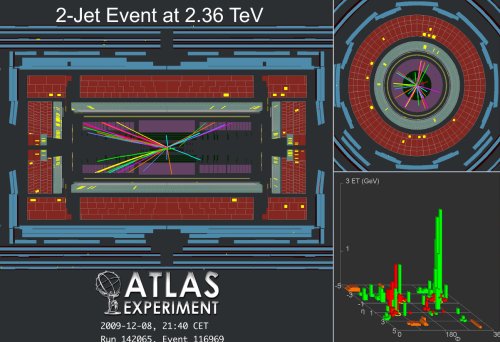
2.36 TeV collisions at LHC?

ATLAS collisionsjp.jpg
ATLAS collisions

By Hamish Johnston

According to several physics bloggers (and backed up by the above image) physicists at the ATLAS experiment have managed to collide 1.18 TeV bunches of protons to achieve the highest energy yet — 2.36 TeV.

This makes the Large Hardron Collider the most energetic particle collider, beating the Tevatron’s previous record of 1.96 TeV.

The LHC became the world’s most energetic accelerator ten days ago, when proton pulses were first boosted up to 1.18 TeV.

There hasn’t been an official statement from CERN about this — we’ll keep you updated.

Securing the supply of medical isotopes

By Hamish Johnston

Over the past few years the supply of Mo-99 — which is used to make the medical isotope Tc-99m — has been threatened by two unscheduled shutdowns of the ageing NRU reactor in Chalk River, Canada.

Normally NRU supplies North America with Tc-99m and accounts for a significant chunk of world production, so any prolonged shutdown is bad news.

That’s why the Canadian government convened the Expert Review Panel On Medical Isotope Production earlier this year to identify the most viable options for future isotope production.

The panel has just submitted its report and you can read all 135 pages of it here .

The main recommendation is the replacement of NRU with another multi-purpose research reactor that would supply isotopes as well as fulfilling other scientific functions. However, revenues from isotope production would only offset about 10-15% of the cost of such a reactor — so other research activities would have to justify the bulk of the price tag.

The panel also recommends that Tc-99m production in a cyclotron accelerator, be investigated. Although this would involve a significant amount of research and development, the infrastructure is already in place in several places in Canada.

Could we see the rebirth of the University of Manitoba cyclotron?

Nobel prizes and the credit crunch

nobel.jpg
Future winners may have to do with less

By Michael Banks

You could say physicists have much to be gloomy about these days with the Science and Technology Facilities Council in the UK cutting funding for projects to patch up its budget and scientists in Japan bracing themselves for deep cuts to the country’s science budget next year.

And now future winners of the Nobel prizes could end up feeling short changed if the Nobel Foundation, which manages the finances of the prizes, cuts the amount of money it dishes out every year.

The Foundation announced at the weekend that it might cut the $1.5m it hands out for each of the six prizes awarded each year. The reason, it says, is the credit crunch and the impending recession, which has led to losses in the foundation’s assets.

Indeed, when the credit crunch struck in 2008 the foundation’s assets lost nearly one-fifth and since then has only slightly recovered. “We have sailed the storm, but have taken on some water,” said Michael Sohlman, executive director of the Nobel Foundation, at a press conference.

So as this year’s Nobel prize winners — including US president Barack Obama who won the Nobel Peace Prize — attend the awards ceremony in Stockholm on Thursday, future winners may have to do with less.

Attacking tumours with tiny discs


Researchers in the US are developing a new way of destroying cancer tumours that involves attacking them with tiny magnetic discs. Although the research is still a long way from finding medical application, it joins a growing number of innovations that are seeking to apply fundamental physics to the treatment of cancer.

The idea that magnetic particles could be used to target cancer tumours has been in the research community for several decades. The general principle is that drugs intended to destroy targeted cells could be attached to magnetic particles and guided to the appropriate places in the human body using external magnetic fields. Given the precision promised by this approach, it could offer obvious advantages over the crude targeting of chemotherapy, which can leave patients feeling extremely unwell.

Despite their early promise, however, these therapies have yet to yield much success in the field of oncology, mainly due to a number of technical issues. First, most experimental work to date has used superparamagnetic particles, which can only be controlled with strong magnetic fields that are not available in clinical settings. If the particles are made larger to compensate, they have a remnant magnetization even in the absence of external magnetic fields, and this can cause them to aggregate in clusters. Inside the body this process would be dangerous because it could lead to an embolism.

A new spin

In this latest research an interdisciplinary team from the Argonne National Laboratory and the University of Chicago offer a new spin on this technology that could help to overcome some of these technical problems. Instead of viewing the magnetic nanoparticles as a means of transport for drugs, the materials science researchers have designed a technique in which the particles themselves attack the cancerous cells by exerting a mechanical force.

“This treatment is not being designed to replace surgery, but it could accompany an operation for a number of types of brain cancer,” Elena Rozhkova, Argonne National Laboratory

Using a gold-shelled iron-based alloy that they developed, the researchers have created tiny circular discs that are just 60 nm thick with diameters of approximately 1 µm. In this geometry, the magnetic moments are following the disc circumference and form a vortex-like structure with almost perfect closure of the magnetic flux within the disc itself. Instead of been guided by a magnetic field, the tiny discs are coated in antibodies that are able to hone in on the affected cells.

Once a disc is alongside a cancerous cell, an alternating magnetic field can be applied, which causes the vortex structure in the disc plane to shift and the magnetic disk to oscillate. Therefore the disks exert a lateral force towards the targeted cancer cell. This very small force, in the order of a few tens of pN, is strong enough to trigger the redistribution of calcium inside the cancer cell that can result in cell death known as apoptosis.

To demonstrate the technique, the team used brain cancer cells in a controlled environment outside of the body. An alternating magnetic field frequency of just a few tens of hertz was sufficient to destroy roughly 90% of the cancer cells.

Efficiency matters

Elena Rozhkova, a member of the research team, told physicsworld.com that the choice of cancer cells was something of an “arbitrary” decision. She adds, however, that a brain tumour is the sort of cancer that could benefit from this form of treatment due to the low efficiency of existing brain cancer chemo and radio therapies. “This treatment is not being designed to replace surgery, but it could accompany an operation for a number of types of brain cancer,” she says.

Rozhkova says that the Argonne–Chicago team is seeking to develop smaller discs that would be more suitable for clinical application. In the longer term, the researchers hope to test the spin-vortex discs on small animals before moving towards full clinical trials.

Jon Dobson, a biomedical engineering researcher at Keele University in the UK, believes that the innovation does indeed have the potential to solve some of the major problems involved in tumour targeting. He warned, however, of several technical hurdles that would first need to be overcome including the need for rigorous toxicological testing. Dobson also foresees an issue with the proposed down-sizing of the magnetic discs, “The discs will need to be smaller but it is not yet clear whether one would see the same effects with smaller discs,” he says.

The latest research was funded in part by the US National Institutes of Health (NIH), which last month unveiled a new five-year initiative to encourage more researchers to apply fundamental physics to the treatment of cancer. Worth $22.7m over five years, the project will include the creation of 12 new research centres that will bring non-traditional approaches to oncology by considering the physical properties and dynamics of cancer cells.

This research was published in Nature Materials.

Copyright © 2026 by IOP Publishing Ltd and individual contributors