Metal pumps liquid uphill

Researchers in the US have discovered a way of modifying metal surfaces so that they “pump” liquids uphill. The method, which involves exposing the surfaces to pulses of intense laser light, could be exploited in the future for analysing fluids “on-chip” or for biological sensing.

Earlier this week, physicsworld.com reported on research by Chunlei Guo and Anatoliy Vorobyev at the University of Rochester, New York, in which they claimed laser pulses could “blacken” a lightbulb’s tungsten filament and thereby boost its efficiency towards 100 %. Now, Guo and Vorobyev have used a similar technique to affect the surface “wettability” of platinum and gold plates.

“In a gravity-defying way, the treated metal surfaces make liquids sprint vertically uphill at an unprecedented speed of 1 cm/s,” they write.

Pits, globules and grooves

The researchers have used a horizontally-polarized laser, which sends pulses of light 65 femtoseconds (65 x 10-15 s) long at a wavelength of 800 nm onto the metal surfaces. They scanned the laser horizontally and vertically until they had treated a circular area 24 mm in diameter. Images from a scanning electron microscope showed a resultant structure of fine pits and globules superimposed on larger, periodic grooves.

Examining the surfaces with a video camera, Guo and Vorobyev found these grooves could suck up methanol when the surface was horizontal, vertical or inclined at 45°. The researchers believe the phenomenon is due to the so-called “Marangoni effect”, in which fluid flow results from a gradient in surface tension. The distance between the grooves, at just 100 µm, means that molecules in the methanol can find themselves more attracted to the metal than to neighbouring methanol molecules, and therefore tend to creep forwards.

The horizontal orientation produced the fastest speed at 1.6 cm/s, while the vertical orientation produced the slowest speed at 1 cm/s. “To our knowledge these are the highest liquid moving speeds one has observed on a metal surface,” they report in an upcoming issue of Applied Physics Letters.

Could work like a ‘microprocessor’

Applications of the treated metals could include microfluidics wherein fluids could be manipulated on sub-millimetre scales, say researchers. They also highlight a potential medical application because blood could be directed precisely along a defined path to a sensor for disease diagnosis.

“Imagine a huge waterway system shrunk down onto a tiny chip, like the electronic circuit printed on a microprocessor, so we can perform chemical or biological work with a tiny bit of liquid,” said Guo in a press statement.

Cosmic rays offer clue to lightning

It is a phenomenon that has puzzled people for thousands of years and drove Benjamin Franklin to risk his kite and life in search of answers. Now, a trio of researchers in America may have finally found a way to solve the mystery of how thunderstorms make lightning. The solution, according to Joseph Dwyer at the Florida Institute of Technology and his team, lies in using the endless rain of cosmic rays hitting the Earth’s atmosphere.

Most scientists think that lightning originates from localized pockets of intense electric fields inside thunderstorms. However, these regions are too small to be detected easily by balloons and aircraft, and the act of measuring the fields can itself initiate lightning and distort results. Currently, scientists believe that the typical electric field needed at sea level to cause a spark is about 3 MV/m but no one has yet measured a field within a thundercloud that even approaches these values.

Dwyer and his colleagues offer a solution that could instead enable scientists to study action inside thunderclouds from the ground. As cosmic ray showers — energetic protons from outer space — pass through thunderclouds, they produce a large number of electrons from hard elastic scattering with air. These electrons gain energy from the cloud’s electric fields at a higher rate than they lose it through ionization and this leads to a “runaway” of electrons.

Storming results

As these runaway electrons propagate in the strong electric field, they produce additional runaway electrons through scattering with air. A consequence of this growing “avalanche” of accelerating electrons is the emission of radio waves that can be detected from the ground. Dwyer and his team propose that these radio waves can be analyzed to reveal information about the source region.

Other researchers have welcomed the new approach. “The measurement of detailed pulse shapes in the vicinity of thunderclouds is certainly an interesting idea, despite the technical difficulties which experimentalists will encounter during this measurement,” says Nikolai Lehtinen at Stanford University in California.

Dwyer told physicsworld.com that his team is now looking to test their theory. They will be reconstructing the electric fields along the paths of cosmic rays in an attempt to identify the localized, very high field regions that give rise to lightning. To measure both the radio pulses and the electrons, the scientists will use an “air shower array” containing particle (scintillation) detectors plus a large flat plate antenna on the ground.

These experiments will be carried out at the International Center for Lightning Research and Testing at Camp Blanding, Florida. They have built an air shower array and will use sensitive electric field antennae in order to measure the air showers and the accompanying radio pulses. “We will know more by the end of this summer,” says Dwyer. “It is quite amazing to me that in 2009, we are still struggling to understand a topic pioneered by Benjamin Franklin at a time when the US was still a British colony.”

This research was published in the Journal of Geophysical Research.

Quantum physicist scoops top French award

A physicist has been awarded France’s top science prize for his work on atomic physics and quantum optics. Serge Haroche — one of the founding fathers of cavity quantum electrodynamics (CQED) — was named as this year’s “gold medal” winner by the French national research council (CNRS) at a press conference in Paris yesterday. Haroche currently heads the electrodynamics and simple systems group at CNRS’s Kastler Brossel Lab in Paris.

Previous physics recipients include the Nobel Prize winners Albert Fert and Claude Cohen-Tannoudji, who was Haroche’s PhD supervisor. “In these times of confusion and obscurity, Serge Haroche’s clarity and lucidity are indeed very welcome,” said CNRS president Catherine Bréchignac. The gold medal is awarded annually in recognition of a lifetime’s academic achievement.

Seeing in a different light

Haroche’s expertise lies in manipulating and controlling single atoms and single photons interacting in a cavity, which is a box made of highly reflecting metallic walls. By studying the behaviour of atoms and photons in this protected environment, physicists can illustrate experimentally some fundamental aspects of quantum theory, such as complementarity and decoherence. Haroche’s research has also offered insights into the physics of quantum computing.

Recently, Haroche’s team succeeded in trapping a single photon in a box on the time scale of tenths of seconds and detected this photon many times without destroying it. The researchers did this by sending atoms across the box and measuring the imprint left on the atoms by the photon. This new kind of light detection, known as ‘quantum non-demolition’ (QND), had never been achieved before because single photons had previously been destroyed before detection.

The result means that researchers can now repeatedly extract information from the same photon. Such a new way of ‘seeing’ could have implications for quantum science – for example, a photon could share its information with an ensemble of atoms to build up an ‘entangled state’ of light or matter.

A life in science

Haroche was born in Casablanca in 1944. He studied at the École Normale Supérieure, where he obtained his PhD in 1971. He then joined the CNRS before holding various teaching posts at the universities of Harvard and Yale in the US. Since 2001 he has held the Chair of Quantum Physics at the Collège de France and carried out his research at the CNRS facilities.

“Haroche has opened a new window to the world of quantum physics, enabling us to observe fundamental quantum phenomena and to witness basic measurement processes in ways previously inconceivable,” says Daniel Kleppner of the Massachusetts Institute of Technology. “Niels Bohr once argued that truth and clarity cannot be simultaneously achieved, but Serge Haroche’s work shows that they can be.”

Serge Haroche will receive his award at the end of the year during a special ceremony – the venue is still to be confirmed.

Laser boosts light bulb efficiency

The prevalence of cold, blue energy-saving light bulbs might soon begin to fade. That’s according to researchers in the US, who claim to have discovered how to make traditional incandescent bulbs 100% efficient.

“Many people still love incandescent light bulbs because they create the most pleasant light and are cheaper to buy,” Chunlei Guo of the University of Rochester, New York, told physicsworld.com. “The downside is the low efficiency of the conventional incandescent bulbs. This research addresses that very problem.”

Guo, together with colleague Anatoliy Vorobyev, made the discovery having spent several years investigating how intense laser pulses can affect the structure of metal surfaces. In 2006 the two researchers found that by applying a series of femtosecond (10-15 second) laser bursts to a metal, its surface would become pitch black. In other words, the metal’s ability to absorb light would soar.

But according to Kirchhoff’s law, at thermal equilibrium the absorptivity of a surface equals its emissivity. So Guo and Vorobyev figured the same “blackening” technique could enhance the emission, and hence efficiency, of an incandescent bulb’s metal filament.

Kirchoff’s law stands

To see if this could work, the researchers used an amplified laser to expose part of a tungsten filament to a number of 65-femtosecond pulses at a wavelength of 800 nm and a repetition rate of 1 kHz. Once they had inserted the blackened filament inside a bulb, they pre-heated it to its equilibrium temperature of 900°C before monitoring its emission with a photomultiplier tube.

Guo and Vorobyev found that the number of laser pulses given to the filaments strongly affected the emission. Up to about 500 pulses there was a sharp increase, while towards 4000 pulses the increase levelled out. The researchers also found that the enhancement depended on the wavelength of light emitted from the bulb — at 400 nm the increase was about 25% but at 800 nm the increase rose to 55%.

Scanning-electron-microscopy images showed the laser pulses had caused the tungsten surface to adopt a structure of periodic, nano-sized ridges. The researchers believe these ridges encourage thermally excited surface “plasmons” — quanta of plasma oscillations — to couple with electromagnetic emission in free space, and thereby boost emissivity.

Super efficient

Guo says that, over the entire visible spectrum, the efficiency rose from roughly 50% to 100%. However, Shawn Lin, a photonics researcher at the Rensselaer Polytechnic Institute in Troy, New York, is not so sure. “The higher emissivity is over visible and near-infrared wavelengths, which means it would generate a lot of wasted heat — 80 to 95% — in the infrared regime,” he says. If there is wasted heat, adds Lin, the researchers could reduce it by further nano-structuring.

Nevertheless, according to the researchers, the boosted efficiency is not the only benefit of the technique. Guo and Vorobyev found that the strength and duration of the laser treatment could alter the colour balance of the emission. Moreover, they found that the emission was somewhat polarized, possibly because of the direction of the surface ridges.

“Light polarization has a variety of applications, from liquid crystal displays to polarized sunglasses,” explains Guo. “If we start to illuminate with polarized light, a wide variety of perceptive effects can be achieved, such as brightness and clarity.”

However, the immediate future may not be looking too dark for today’s energy saving bulbs — the possibility of commercial devices is not yet at the front of the researchers’ minds. “The research just came out,” says Guo. “This is too early to say at this point.”

This research will be published tomorrow in Physical Review Letters.

Launch date set for new handbag

LVAstronauts_E_20090529173210.jpg
Star gazing (Credit: Louis Vuitton/Annie Leibovitz)

By Michael Banks

It is probably not what astronauts would use as their tool bag when in space, but the fashion house Louis Vuitton has launched an ad campaign for its famous handbags featuring former astronauts Buzz Aldrin, Jim Lovell and Sally Ride.

Buzz Aldrin flew on Apollo 11 and became the second man to set foot on the Moon in 1969. Jim Lovell was the commander of the ill-fated Apollo 13 mission in 1970, who guided his crew safely back to Earth while physicist Sally Ride became the first American woman to go into space in 1983 on the space shuttle Challenger.

The ad is launched to coincide with the 40th anniversary of the lunar landings in July 1969 and is the latest instalment of the French luxury brand’s “journeys” campaign that has previously featured ads featuring the actor Sean Connery and the film director Francis Coppola.

The image of the astronauts was taken in the Californian desert and shows them sitting on and standing next to an old pickup truck while looking at the stars. They are not alone as a $1500 Louis Vuitton “Icare” travel bag sits with them on the pickup’s bonnet.

The ad is due to be in magazines in July, but the website today will start showing videos of the astronauts talking about their trips to the Moon and space and how it has changed their lives.

CERN’s ATLAS detector goes on tour

Detektor.jpg
More than a cardboard cut-out (credit: DESY)

By Michael Banks

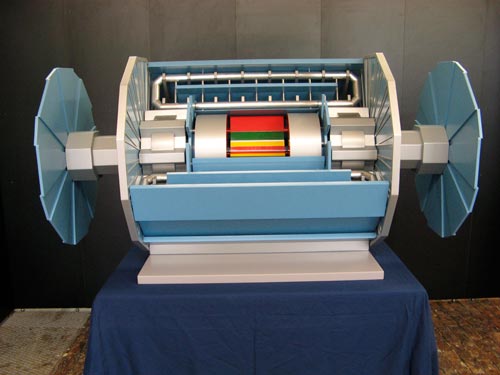
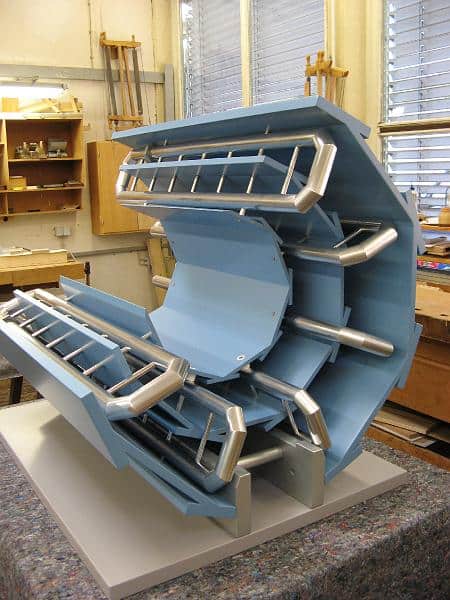
The ATLAS experiment at CERN’s Large Hadron Collider (LHC) is going on tour. Not the real one of course, but a 150 kg wooden replica of the cathedral-sized detector.

Technicians at the DESY particle-physics lab in Hamburg were commissioned last year by DESY physicist Thomas Naumann to build a model of CERN’s huge detector at 1/25th of the actual size.

Taking over seven months to build, the model is made entirely from wood with only aluminium tubes used for the six magnet coils that surround the detector. The wooden replica is almost two metres in length and one meter wide.

The model was first on show as part of the Weltmaschine exhibition that ran in a subway station in Berlin from October to November last year.

175 Modell Atlas-Detektor.jpg
(credit: DESY)

“The model helps to explain the function of the different detector components – the tracker, the calorimeters, the muon system and the large toroidal magnets,” says Naumann, who uses the model to explain the detector to DESY visitors and members of the public.

Due to popular demand the exhibition has now gone on tour. If anyone missed the opening show at the Hamburg harbour festival on 8 May, then the next tour dates are 13 June at Hamburg University, 19 June at the long night of science in Dresden and 5 July at DESY with further shows planned in Göttingen and Heidelberg later in the year.

Once the tour has finished the ATLAS replica will go back to DESY. “The model will be in the DESY foyer where it is a nice object welcoming visitors,” says Naumann.

Ultra cold atoms help share quantum information

Scientists in the US have demonstrated a novel “light-switch” in an optical fibre that could become a new tool in the communications industry. The device created by Michal Bajcsy at Harvard University and colleagues could be developed to share both classical and quantum information.

Quantum information systems could bring a revolution to global data-sharing, by encrypting, processing, and transmitting information using the properties of quantum mechanics. However, as strings of “1s” and “0s” are represented by the quantum states of individual subatomic particles, such as the polarization of photons, they are very delicate and information can be easily lost. Prototype quantum devices have been developed but the move towards commercial applications requires more robust systems to compete with established “classical” technologies.

“The challenge was to integrate the ultra cold atom technologies developed over last 20 years with the hollow optical fibre technology in one experimental system” Michal Bajcsy, Harvard University

A common approach is to transmit the quantum states of photons via their interaction with matter, which acts as a mediator. Here, photons of a particular state are absorbed by an atom before being re-emitted in the same, or a related state. A difficulty arises, however, in attempting to transmit information over significant distances as photon scattering causes very high signal losses.

It’s in the pipeline

In the past few years, several research groups have proposed a way around this problem by transmitting the photons through a hollow optical fibre, which is filled with a vapour of atoms. The state of atoms can be altered by interaction with photons to render the optical fibre either transparent or opaque to light – an optical switch. However, given the tiny ratio of atoms to empty space, the vast majority of photons never actually come into contact with the atoms and significant losses still occur.

Bajcsy and his colleagues have offered a solution to this problem by replacing the vapour with ultracold rubidium atoms. By holding the atoms in a steady configuration using a magnetic field called a “dipole trap”, they could then aim a pulse of photons at the atoms with an increased chance of hitting their target. Initially, the fibre was almost completely transparent with light passing through as if the atoms were not there. Then after a “switch” pulse, containing only 800 photons was injected into the fibre, the atoms absorb these photons and the system became completely opaque.

“The challenge was to integrate the ultra cold atom technologies developed over last 20 years with the hollow optical fibre technology in one experimental system,” Bajcsy told physicsworld.com.

The experiment was carried out at the MIT-Harvard Center for Ultracold Atoms as a collaboration between the research groups of Mikhail Lukin and Vladan Vuletic. To begin with, the cloud of super-chilled rubidium atoms was confined using lasers before the atoms were guided into the fibre using magnetic fields. “Corralling atoms is always tricky, but often the hardest part is simply knowing where the atoms are,” said Andrew Dawes a cold atom researcher at Pacific University, Oregon.

Bajcsy and his team intend to develop this research by combining their cold atom system with their technique for stopping light pulses, to move towards a means of storing quantum data.

This research was published in Physical Review Letters

Don’t panic


“Don’t panic” is a simple piece of advice, one that usually applies equally well to job-hunting, avoiding pandemic flu or, like the hapless Arthur Dent in the Hitchhiker’s Guide to the Galaxy stories, wandering the universe in search of a decent cup of tea. Yet some statistics emerging from the current job market are undeniably alarming. Postings on the recruitment website Milkround.com, which advertises jobs and internships for recent graduates, are down by about 20% compared with this time last year, while a survey earlier this year by High Fliers, a London-based research firm, found that top UK employers plan to recruit 17% fewer graduates this year than in 2008. In the same study, half of the 1017 final-year students surveyed believed they would have to take “any gradu­ate job” they were offered, regardless of their interest in the company, and a whopping 91% thought competition for vacancies would be tougher than last year.

Yet these gloomy figures can be deceptive. Although most of the 100 companies in the High Fliers survey are household names like Airbus and Rolls-Royce, they employ only 3—4% of UK graduates. Headline-grabbing cuts at the likes of Corus and Royal Bank of Scotland, while certainly indicative of a general downturn, can overshadow modest good news from some of the less high-profile employers that, together, employ the other 96%. The raw data also hide considerable variation across different fields. Sure, 2009 looks like a bad year in which to graduate if your dream job is in investment banking, for example, but prospects are brighter for those who aspire to careers in energy, transport, defence or the public sector.

The bright side

This is good news for physicists, as organizations in these four areas have long been keen to recruit bright, numerate people. “We are hiring 24/7 right now, in part to replace a work­force whose members are retiring or moving up the ranks,” says a spokesperson for the Atomic Weapons Establishment (AWE) at Aldermaston in the UK. AWE, which manages the UK’s nuclear weapons and monitors compliance with international test bans, employs more than 600 scientists, including both graduate- and PhD-level physicists.

Other employers, while not expecting major growth, remain cautiously upbeat. “Our sector is very stable, so we’re seeing little change in recruitment despite the recession,” says Emily Blacker, a recruiter for railway-maintenance firm Network Rail. Although some roles within the company require an engineering degree, many areas — including finance, operations and information management — are open to all graduates.

Even in firms planning to cut jobs, some departments may remain unscathed. For example, on 30 April, defence giant BAE Sys­tems announced it would eliminate 500 jobs from its combat-vehicles and weapons unit. But at the National Engineering and Construction Recruitment Exhibition held in Birmingham just a few days earlier, a banner above the BAE Submarine Solutions stall announced that it was recruiting new people to fill science and engineering-related posts. Claire Machin, a BAE engineer at the event, explained that the submarine division is taking on staff because business is “on the up­turn globally”, and its order book is secure until 2020. Asked if it hires physicists, Machin’s answer was unequivocal: “If we don’t, we should.”

Unsurprisingly, the Institute of Physics, which publishes Physics World, is keen to encourage such attitudes, especially among firms that do not do physics per se but are still interested in hiring physics graduates because they are bright, numerate, good at problem solving and have a proven work ethic. As part of this effort, this month the Institute’s publishing arm, IOP Publishing, has launched a new website, brightrecruits, which will replace the old Physics Jobs site (see “brightrecruits: a new jobs website”). Along with a range of new features and job listings from universities, government research labs, the nuclear industry and other traditional physics employers, the new site will also advertise career opportunities from firms seeking physics graduates to work in areas that may have little to do with their degree — at least on the surface.

“The purpose of the name change is to reposition what we’re offering from ‘jobs in physics’ to ‘jobs done by physicists’,” explains John Brindley, the Institute’s director of membership and business. “It’s a shift in emphasis, and a way to acknowledge the fact that a majority of people with physics degrees do not work in physics.”

Make a change

Such a shift is important, because surveys by organizations like the UK Higher Education Statistics Authority (HESA) and the American Institute of Physics (AIP) show that less than 15% of physicists with just a Bachelor’s degree end up working in research. In 2004, for example, HESA found that of the physicists who graduated in 2002 and were employed two years later (i.e. were not out of work or studying for higher degrees) just 10.4% had jobs in research, development or analysis; a similar number were working as managers in industry or the public sector. AIP data from the same year indicate that 31% of recent physics graduates working in the private sector were employed as engineers, while 32% had obtained posts outside science, technology, engineering or mathematics. Physics graduates, it seems, can do almost anything.

Still, the fact that their skills are generally in demand does not mean that physicists will have an easy time in a recession job market. Recent graduates looking for jobs in industry should expect stiff competition both from their peers and from experienced workers who have been made redundant — particularly from companies in the automotive, construction or financial sectors.

As these workers seek new employment, some fields perceived as more secure have seen a sharp increase in applications. “A lot of people will have gone into finance because they saw it as a way to earn a big salary, but they may now feel there’s more security in working for the public sector,” says Anne Fisher, a spokeswoman for Lincolnshire County Council’s Highways and Traffic Service, which employs about 90 scientific and technical staff, mostly as engineers. In 2007, Fisher noted, the service received only six or seven responses for each job advertisement. Now it is seeing more than 100.

However, this response is far from universal. A predicted boom in applications to teacher-training programmes, for example, has so far failed to materialize except in a few subjects — such as business studies — with strong connections to struggling industries. True, 452 people have already applied to teach physics in the UK this year, an increase of 36% compared with 2008 according to figures from the Graduate Teacher Training Registry. However, the 2008 figure of 291 applicants was abnormally low, so this year’s spike merely returns numbers to 2007 levels. Similarly, the 25% increase in numbers training as maths teachers this year will still leave 11% of teaching posts vacant — the same percentage as in 2006.

Another well-trodden path for both recent physics graduates and the newly redundant is, of course, to re-enter the academic world as Master’s or PhD students. With many governments pouring funding into the technology sector and (particularly in the US) trumpeting “shovel-ready” engineering projects as a form of economic stimulus, academia may seem like an oasis of calm in this economic storm. However, anyone pondering a Master’s or PhD course as a means of avoiding the job market for a few years should keep at least three things in mind.

First, you will not be alone: a recession almost always produces an increase in applications for graduate courses. This may not be true for every university — one contributor to the Cosmic Variance blog noted that as of January 2009, applications to her astronomy department were actually down by 15%. But it will be true for enough of them to make getting into a graduate programme more competitive, on average, than it was last year.

Second, although employers have long treated a Master’s degree or a PhD as a prominent feather in an applicant’s cap, this may be changing as higher degrees become more common. A 2009 survey by the Association of Graduate Recruiters found that only 18% of their members were willing to offer higher salaries to employees with higher degrees. Among employers that did offer financial incentives, the average bonus for a PhD has fallen from £6540 in 2008 to £3500.

Finally, the long-term prospects for jobs within academia are mixed. Most of the lecturers hired in the 1960s and early 1970s to teach the “baby-boom” generation are now retired, and their replacements are already teaching those boomers’ children and grandchildren. Fresh government funding will boost morale and prevent large-scale job losses in university research, but the demographics needed for the sector to grow significantly are simply not there.

The bottom line is that those who are keen to learn more about their subject, and who would not mind postponing their job hunt for a few years, may find that a graduate programme is a smart move. Others, however, are probably better off looking for a job outside academia, even if it means broadening their search to include options other than their ideal career.

Valuable skills

So will the credit crunch mean lean times for physicists? The short, honest answer is that it will probably mean lean times for almost everybody. However, it is important to remember that physicists have strengths that will always serve them well, regardless of the economy’s health. Physics is a relatively uncommon degree, held by only 4% of UK graduates in 2008, so recruiters have an automatic reason to remember physicists’ ap­plications. And although mathematically inclined graduates may not be able to make instant fortunes in the City or on Wall Street anymore, fundamentally the skills learned in a physics degree — logical thinking, numeracy, problem-solving ability, analytical skills and the ability to pare a problem back to its fundamentals — are still valued, and still in short supply. There is no need to panic.

brightrecruits: a new jobs website

The new brightrecruits site from IOP Publishing offers a wide variety of job advertisements for physicists interested in fields from academia and education to defence, manufacturing, finance and telecommunications. However, it is more than just a list of jobs. Unlike the Physics Jobs site it replaces, would-be employees can use brightrecruits to refine their search by sector, salary and geographic location, and to specify whether they are looking for permanent, part- or full-time posts. Job-seekers can also upload CVs and sign up for e-mails that will alert them when recruiters post vacancies that meet their desired criteria. Those at the beginning of their job search can also browse all current job listings within specific sectors, and find links to information about the Institute’s careers-related services, including an online mentor-matching service and advice on how to become a chartered physicist, engineer or scientist.
• www.brightrecruits.com

Job-hunting tips and tricks

The biggest crowds at the National Engineering and Construction Recruitment Exhibition in Birmingham in April were not gathered at the stalls advertising the most jobs or handing out the niftiest free gadgets, but at a special session on “Finding jobs in the credit crunch” run by Chris Morrall of the career-management firm Winchester Consulting. Here are a few tips gleaned from that seminar, university careers officers and other experts.
• Be serious about researching prospective employers before applying. Recruiters can spot ill-informed candidates from a great distance; moreover, once you find a job, you will be spending a lot of your time there, so it pays to make sure that you really want to work for the organization.
• Do not bother with generic applications. In a boom period, having “one size fits all” answers for common questions like how you became interested in the job or what you can offer the company might have earned you a second look if your qualifications were good enough. Now, many of these applications will go straight to the bin.
• Be flexible. If the recession has hit your preferred company or industry, think of related areas that might provide valuable experience and give you an edge when the economy picks up again.
• Consider volunteer work, unpaid internships or job-shadowing if you are unable to find a post after a few months. Some of these activities could lead to a permanent job, and all of them will help stave off the anxiety that can accompany an extended period of unemployment.
• Stand up during telephone interviews. Being vertical can give you a psychological boost, and also improves breathing so that your voice sounds more confident.
• Finally, make full use of the Internet, which has a wealth of careers-related information. The Institute of Physics is a good place to start (see careers.iop.org).


Is there really no place like home?

From zero to 350 in less than 14 years — this is the impressive track record of astronomers searching for planets orbiting other suns. In 1995 when two Swiss astronomers discovered that the star 51 Pegasi has a companion with about half the mass of Jupiter, a new field of astronomy was born: the science of extrasolar planets. Since then, the count of such planets has been increasing at an accelerating pace, passing 50 in 2001 and 100 just two years later; 14 exoplanets have been found so far in 2009 alone. However, it is not only quantity that counts. The observational techniques employed for such planet searches have been refined continuously, in order to be­come sensitive to bodies with lower and lower masses. In addition to large gas giants, several planets only five times as massive as the Earth are now known to exist.

In The Crowded Universe, Alan Boss from the Carnegie Institution in Washington, DC, takes us along to scientific conferences and press briefings where the exciting and sometimes perplexing discoveries of extra­solar planets are announced; to seminars where theories of their formation are de­bated; and to committee meetings where strategies are charted, research budgets allocated or withdrawn, and missions approved or cancelled. All these efforts have one final goal in mind: to find our cosmic neighbours.

One might assume that such committee meetings are a dull affair, but as Boss makes clear, this is a field that has known its share of controversy and unexpected twists and turns. While many new planets were being added to the official and semi-official lists keeping track of them, our own solar system ironically lost one of its own: delegates at the 2006 general assembly of the International Astro­nomical Union in Prague voted to demote Pluto from its status as a planet — much to the chagrin of scientists involved in a mission that had been launched a few months earlier with the aim of visiting Pluto and its moon Charon in 2015. In fact, Pluto’s reclassification had become necessary because several objects larger than Pluto had been discovered in the outer reaches of the solar system; these were assigned to the newly created category of “dwarf planet”, along with Pluto and the largest asteroid Ceres.

Boss chronicles these developments meticulously, and his book reads almost like a diary. If you have read Boss’s earlier book Looking for Earths, then you will be familiar with this style, and have your own opinion of it. I myself like his approach, because he succeeds in interweaving reports of historical events and personal stories with explanations of physical concepts and descriptions of observing methods. There are no formulas in the new book, and all explanations are at a level that should be easily accessible to readers without any training in physics or astronomy. However, the anecdotes, accounts of press events and details from NASA committee meetings will probably be most interesting to those who are familiar with the field and may even know some of the participants personally. For these readers, Boss’s book will pro­vide a new perspective on events that may still be fresh in their own memories.

While Boss mostly takes the viewpoint of a well-informed but dispassionate reporter, his stance becomes more personal when it comes to subjects in which he has been directly involved. One such topic is the question of the mechanism by which the giant planets formed in the disk of gas and dust that surrounded the Sun when our solar system was still in its infancy. Most experts believe that the first step in this process was the agglomeration of solid material to a core with about 10 Earth masses, followed by a second step in which this core swept up a huge amount of gas. Boss, on the other hand, is the most prominent proponent of the main alternative theory, which holds that the giant planets formed relatively quickly in one step through the collapse of a clump of gas, triggered by an instability in the disk. Not surpri­singly, the arguments in favour of this theory are given broad room in The Crowded Universe, although the alternate view is not neglected.

The other topic that seems near and dear to Boss’s heart is space policy, and the way that financial constraints and decisions driven by fiscal considerations influence the progress of science. In the book’s prologue, Boss declares that “a new space race is under way”. This is the race to find Earth-like planets — that is, planets with properties that may allow them to support life. The existence of a solid surface and liquid water (or perhaps an ocean covering the whole surface) are generally considered necessary for life to develop and to thrive. This in turn requires a relatively small planet with moderate temperatures — so that it does not attract a thick gas envelope like that of Jupiter, and so that the water does not completely evaporate. Two satellite observatories are now in orbit that can find such planets: NASA’s Kepler mission and CoRoT, which is led by France and involves a number of other Eu­ropean countries plus Brazil.

CoRoT and Kepler both look for the slight dimming of a star that occurs when a planet transits in front of it (see Physics World March p8). Such transits occur only if you happen to be located almost in the orbital plane of the planet; therefore only a small fraction of all planets are observable in this way. Together with the fact that CoRoT and Kepler can observe only a small fraction of the sky, these missions will therefore not see the ­planets that are closest to us, but rather a set of planets that are several hundred light-years away. In other words, the planets that CoRoT and Kepler discover will be unsuitable for closer study with advanced space telescopes — we can infer that such planets could support life, but for the foreseeable future we will not have any means to find out whether they actually do.

For many years, scientists and en­gin­eers at NASA’s Jet Propulsion La­boratory and across the US have been seeking to remedy this problem by designing the Space Interferometry Mission (SIM), which could actually find the habitable planets closest to us. SIM would accurately follow the paths of all nearby Sun-like stars on the sky; tiny wiggles in their motions would then betray the presence of Earth-like planets pulling on their parent stars as they orbit the common centre of mass. We could then obtain spectra of the atmospheres of these planets with specialized space telescopes, and thus find out whether they contain methane and oxygen — the telltale signatures of life on Earth.

Boss gives a vivid account of the ups and downs that have occurred in NASA’s decisions about funding for SIM — the downs triggered by funding shortfalls in other parts of NASA’s portfolio more than anything else. So, sadly, in spite of much scientific pro­gress in our quest to discover planets that are similar to our own, and of the amazing technological achievements in the development of SIM, we seem further away from the possibility of finding life on other planets now than we were a few years ago.

The blurb on the book’s inside cover claims that “The Crowded Universe will finally answer the age-old question: are we alone?”. This is greatly exaggerated, as the book makes abundantly clear: we have only just started to scratch the surface of the exciting subject that the science of extrasolar planets has become. Fortunately for all of us working in the field, many questions still remain to be answered, and we will certainly be in for many surprises if we continue our quest to find out whether the universe is indeed crowded, or empty after all.

Once a physicist: Scott Russell Sanders

Why did you choose to study physics?

I spent much of my childhood outdoors, exploring the woods, fields and creeks. I was drawn to science initially as a way of learning about the aspects of nature that I could actually see — rocks, bugs, clouds, fossils, birds, stars and the like. As I grew up in Tennessee and Ohio during the 1950s and 1960s, reading about nuclear weapons and satellite launches, I became more interested in the dimensions of nature that I could not see — the infinitesimally small and the unimaginably large — and in the evolution of the universe. This interest led me, as a high-school student, to the passionate study of physics.

Why did you decide to shift from science into literature?

Much as I relished the study of science in general and physics in particular, when I was an undergraduate at Brown University I became preoccupied with questions that science could not address. I wanted to understand why racial prejudice divided our society, why women had for so long been subordinated to men, why the US was at war in Vietnam. I brooded on questions about the ultimate source of things, about how to make ethical choices, about the meaning of life. Unlike physics, literature dealt with these messy, elusive, vital matters. I was also disturbed to learn how much of the funding for research in physics, at least in the US, is tied to the military. Militarism continues to distort our research priorities — as one sees today in the billions spent on the so-called missile shield and on the refinement of nuclear weapons.

You moved around a lot when you were young. How did that shape your career?
Thanks to a Marshall Scholarship, a gift from the British public, my wife and I spent the four years from 1967 at Cambridge University in the UK, where I earned my PhD in English literature. I had never travelled abroad before, nor had I ever encountered the depth of human presence — the strata of history — that I found everywhere we went in the UK and the rest of Europe. It was exhilarating for me to read classic works of English literature while visiting some of the places where these works were composed. Paradoxically, as much as I relished my sojourn in Cambridge, it had the effect of sharpening my awareness of myself as an American, and specifically as a Midwesterner. When I completed my degree in 1971, my wife and I returned to the American Midwest, where I took up a position at Indiana University, a position I still hold 38 years later.

Did you experience a personal “tipping point” that made you decide to write about conservation?
I have been preoccupied with environmental issues since my graduate years at Cambridge. Early on, I thought of the problems as local — pollution in a river, say — or as isolable, like the impact of DDT — and therefore as being things that we could remedy in a straightforward way. We could stop dumping toxins in the river, stop using DDT. But gradually, during the 1970s and 1980s, I came to realize that human actions were destabilizing living systems on a global scale — through acid rain, depletion of the ozone layer, pollution and overfishing of the oceans, greenhouse emissions, spreading of deserts, destruction of rainforests, the extinction of species, and so on. Through a series of books, beginning with Staying Put and continuing through Hunting for Hope, I addressed these assaults on the Earth’s living systems not as technical or economic problems but as cultural problems. My most recent book, A Conservationist Manifesto (Indiana University Press), brings these arguments together in one place, and calls for profound cultural change, above all in my own profligate country.

What advice would you give to science students today who are concerned about the environment?
I would tell them that we need all the knowledge that science can offer concerning every dimension of the planet, from tectonic plates to atmosphere, from rotifers to watersheds. So whatever domain of science you pursue, it may help us to grapple with environmental challenges. Your work is more likely to serve this larger purpose if you always bear in mind the big picture, instead of limiting yourself to a narrow specialty. Remember that our disciplinary boundaries are arbitrary conveniences; nature is a whole. Learn to work with the media to bring the widest attention to your findings. Do not be afraid to speak out about the implications of your research, even when those implications range into politics, economics and culture. The planet needs your knowledge and your voice.

Copyright © 2026 by IOP Publishing Ltd and individual contributors