Questions, questions, questions

By Matin Durrani

What big question in physics keeps you awake at night?

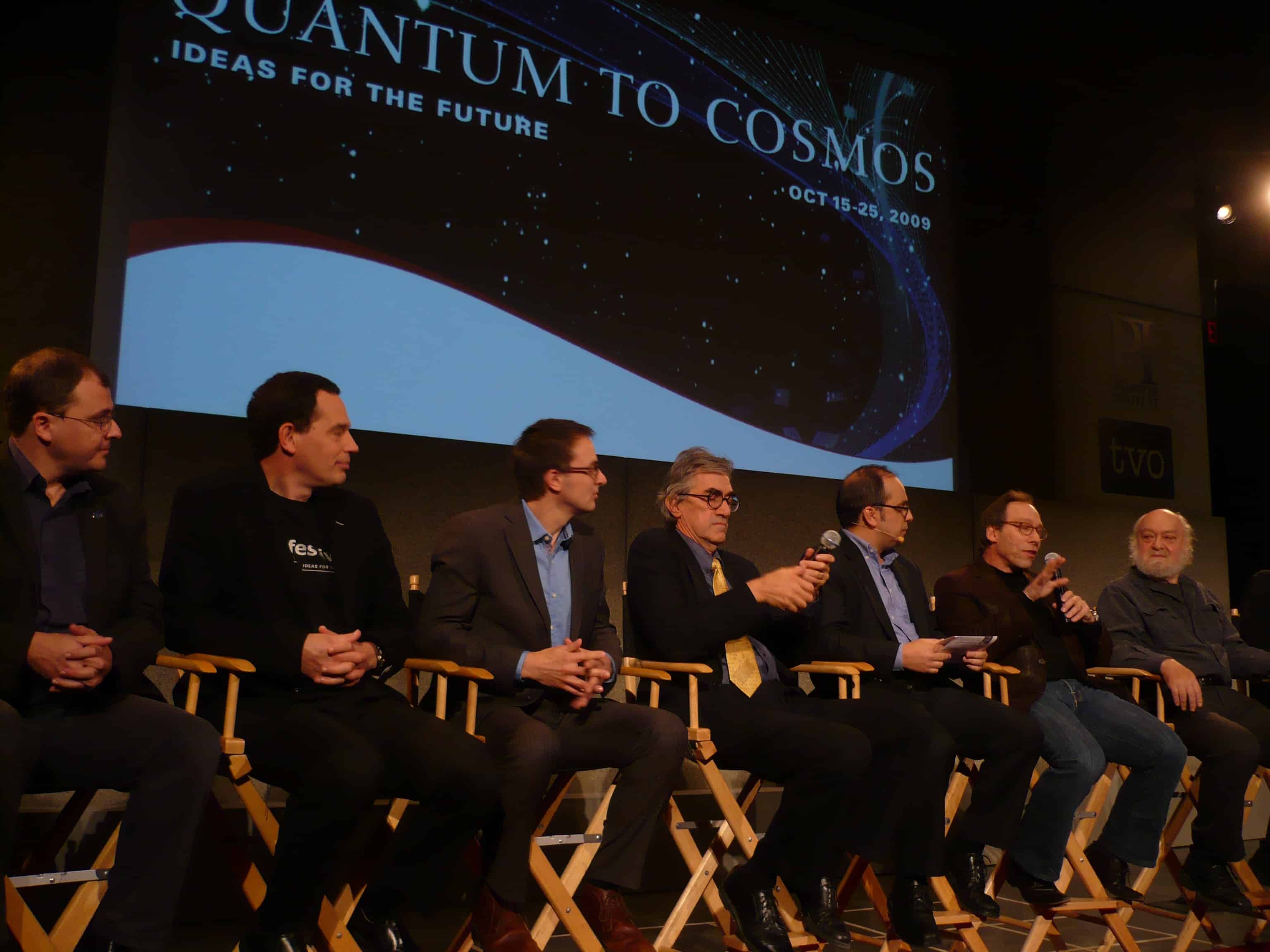
That was the poser for a nine-strong panel of top physicists taking part in yesterday’s inaugural event of the Quantum to Cosmos 10th anniversary festival here at the Perimeter Institute for Theoretical Physics in Waterloo, Canada.

Sitting in a row of directors’ chairs on the main stage in the institute’s auditorium, the panel gave a range of answers related to pretty fundamental physics — not surprising given their interests and those of the institute itself,

In a nutshell, here are their answers – and apologies in advance if I have glossed over any subtleties. The panel session was only meant to be a bit of fun, after all.

Sean Carroll, Caltech
Why are the laws of physics the way they are?

Katherine Freese, University of Michigan
What is the universe made of?

Leo Kadanoff, University of Chicago
How does complexity develop in the universe?

Lawrence Krauss, Arizona State University
Have we come to the limits of our knowledge?

David Tong, Cambridge University
How will we ever know if string theory is correct?

Neil Turok, Director, Perimeter Institute
What happened at the singularity of the Big Bang?

Andrew White, University of Queensland
What is life?

Anton Zeilinger, University of Vienna
How far are we along the road of scientific discovery?

As for the ninth member of the panel — Gino Segrè from the University of Pennslyvania — I wasn’t quite sure what his answer was. I quizzed him afterwards in the Perimeter Institute’s candle-lit “Black Hole Bistro”, where the panel and special guests, myself included, were fed by the institute’s catering staff with plates of crab cakes and bite-sized pizza slices.

I think Gino was most concerned about the world not having enough young physicists to answer all those big questions that keep the rest of the panel awake

Gino recently reviewed for Physics World a book on how Wolfgang Pauli’s dreams were analyzed by Carl Jung. That got me thinking — what would be really interesting would be to analyze the panel’s dreams after thinking all those big questions.

I just hope they’re not having nightmares.

Enter the yoctosecond

Light pulses emitted by an exotic state of matter known as a quark–gluon plasma last for just a few yoctoseconds – according to calculations by physicists in Germany. One yoctosecond is one trillionth of a trillionth of a second (10–24 s) and is comparable to the time it takes light to cross an atomic nucleus. Indeed, the researchers say that such pulses could be used to study the ultrafast processes taking place inside nuclei.

Standard ultrafast lasers can produce pulses no shorter than a few femtoseconds (10–15 s) long. It is, however, possible to generate attosecond (10–18 s) pulses by combining the frequency harmonics that result from the nonlinear interaction of femtosecond pulses with various atoms.

Now, Jörg Evers and colleagues at the Max Planck Institute for Nuclear Physics in Heidelberg have worked out that it should be possible to extend this lower limit down by a further factor of a million.

Free soup

Their approach uses the light emitted by a quark–gluon plasma, a soup of free quarks and gluons, the force carriers that normally bind quarks together inside protons and neutrons. This state of matter is believed not to have existed naturally since the universe was just a millionth of a second old but can be recreated by smashing heavy ions into one another at extremely high energies inside particle accelerators. It is currently produced by the Relativistic Heavy Ion Collider (RHIC) at the Brookhaven Laboratory in New York and will also be created inside the Large Hadron Collider, due to switch on shortly at CERN in Geneva.

Evers and co-workers argue that a quark–gluon plasma naturally generates extremely brief photon pulses as it cools down. The plasma is initially very hot but then cools rapidly as it expands to about the size of a nucleus, at which point it turns back into normal matter. High-energy photons can only be emitted by the hot plasma itself and not the resulting normal matter, which means that pulses of such high-energy photons cannot last for longer than the lifetime of the plasma itself – which is just a few yoctoseconds. The trick is to simply focus on these photons, rather than those with a lower energy.

Two pulses are better than one

Establishing whether or not a quark–gluon plasma produces yoctosecond pulses is, however, not enough to show that it could be used to actually measure such brief intervals of time. This requires a double pulse: one to prepare the system and the other to carry out the measurement. Evers illustrates this with reference to a sprint race, in which the sound of a starter pistol sets the runners off and a photograph taken a few seconds later then establishes their position after that time.

Fortunately, a quark–gluon plasma could produce such a double pulse as it expands. Evers explains that initially the plasma emits light in all directions but then a competition of two mechanisms sets in. The rapid expansion of the plasma along the original collision axis of the heavy ions dictates that after some time most of the remaining particles within the plasma should move at right angles to this axis, which also constrains the light to be emitted in this direction. But a few moments later the complex internal dynamics of the plasma renders the motion, and with it the light emission, isotropic again. This should mean that a detector placed close to the collision axis will register a signal at the beginning and end of the plasma’s expansion, but not in-between: this is the double pulse.

According to Evers, this technique could shed light on the very dynamics inside a quark–gluon plasma that generates the double pulse. He says it could also be used to study processes inside atomic nuclei, perhaps improving our understanding of the reactions inside compact stars or supernovae, or helping us to design better fusion reactors. Indeed, he notes that measurements on the femtosecond timescale have already been used in industrial applications, such as investigating combustion processes when designing new engines.

Measurement technology needed

John Tisch, a laser physicist at Imperial College London questions how easy it will be to build the technology to measure yoctosecond pulses but adds that people had similar doubts about attosecond technology. “The key to unlock attosecond science was to utilize aspects of the generation process itself to measure the pulses,” he said. “So I would anticipate that yoctosecond pulses – if they ever materialize – might be measured by turning some of the same physics governing their generation back on itself.”

Evers says that he and his colleagues are currently developing yoctosecond detector technology but are not giving any secrets away.

The research is published in Physical Review Letters.

Chemical signature could help locate Earth-like planets

New insights into the Sun’s chemical composition may provide a new way to search for Earth-like planets orbiting distant stars – claims an international team of astrophysicists.

Astronomers have already discovered hundreds of planets (called exoplanets) orbiting stars other than the Sun. However, most of the known exoplanets are gas giants like Jupiter – rather than rocky Earth-like worlds. This is probably because the two techniques currently used to find exoplanets work best on large planets.

Now a team led by Jorge Meléndez of the University of Porto believes that the Sun’s unusual chemical composition could be related to the formation of Earth and the other rocky planets – and this chemical fingerprint could be used to identify other stars with rocky satellites.

‘Excellent news’

“Very excitingly, the star most similar to the Sun in this respect that we have found so far is Alpha Centauri A, the second nearest star,” said Martin Asplund, team member and director of Germany’s Max Planck Institute for Astrophysics. He said that this is “excellent news” because, if Earth-like planets do exist in that system, it is close enough for them to be observed directly.

The team came up with this idea after comparing absorption spectra of the Sun with that of 11 “solar twins” – stars that are physically similar to the Sun – and 10 “solar analogues”, which are slightly less similar. The measurements were made using the Magellan telescope at Las Campanas Observatory in Chile and the Keck telescope in Hawaii.

Whereas previous, less accurate, studies had suggested that the Sun’s chemical composition is typical of stars, Meléndez and Asplund say that in fact the sun’s composition is “quite unusual”. Compared to the solar twins, the team found that it has about the same amount of light elements like carbon and oxygen. Heavier elements, such as aluminium, iron and nickel, show a 10–20% lower abundance.

Dust-cleansed gas

Meléndez points out that this distribution in elemental abundances correlates strongly with their condensation temperatures. He suggests that the higher condensation temperature elements – referred to as refractory elements – were involved in the planet-forming process in our solar system. “The scenario we are proposing is that during the formation of the Sun some of the gas condensed into dust and eventually became the planets,” Asplund told physicsworld.com. “The largely dust-cleansed gas then continued being sucked into the Sun.”

About 10–20% of the stars in the study have a close chemical resemblance to the Sun. However, stars with giant planets orbiting round them are not chemically similar to the Sun, according to Meléndez.

Other characteristics of the solar system add to the argument that the Sun’s lack of refractory elements could be tied to the presence of rocky planets. For example, the total mass of elements missing from the Sun is similar to the total found in its four rocky planets. Also, the Earth’s crust contains relatively fewer light elements and more refractory ones compared with the Sun.

However, José Robles, a researcher at the Kennedy Space Centre in Florida who previously worked with Meléndez to identify solar twins, calls into question how significant the difference between the Sun and the average of the 11 twins is. Together with Australian National University astronomer Charles Lineweaver he points out that the amount of lighter, more volatile, elements in stars is known to vary. “Their statement that the Sun is depleted in refractories could probably more legitimately be described as the average twin being more depleted in volatiles than the Sun is,” said Robles.

‘Work in progress’

Robles applauds the accuracy of the measurements and describes the idea that the abundance differences between the Sun and solar-twins might be explained by planet formation as “thought-provoking”. According to Robles, using this approach to spot terrestrial planets “is an interesting idea that we may be able to do someday, but not yet. It is a work in progress.”

Meléndez’s team will now go on to study a further 100 stars in search of similarities with the Sun, having been allocated three nights’ observing time with the European Southern Observatory’s Very Large Telescope in Chile.

This work was published in The Astrophysical Journal Letters.

Inside the Perimeter

By Matin Durrani

PI_design.gif
The Perimeter Institute for Theoretical Physics in Waterloo, Canada, which kicks off its 10th anniversary festival today

“Make sure you don’t blow the world up!”

That was the parting shot from one of my fellow passengers as the minibus we were sharing from Toronto airport dropped him off outside his house here in Waterloo, Canada.

It took me a while to realise what the guy was on about. You see, I had mentioned to him that I was travelling to Waterloo to attend the 10th anniversary celebrations of the Perimeter Institute for Theoretical Physics.

In passing, I had also talked about the Large Hadron Collider at CERN and it was only later that I twigged what he meant: he had obviously assumed that the only thing physicists are hell bent on doing is making potentially life-threatening black holes.

All of which underlines the importance of Perimeter Institute’s 10-year bash, which focuses on explaining to the public what the institute and its physicists are trying to do.

The festival, entitled From Quantum to Cosmos, contains a string of exciting public events, ranging from panel debates and exhibitions to film screenings and a science-fiction workshop.

The first event takes place tonight, featuring an all-star list of physicists including Lawrence Krauss, Anton Zeilinger and Sean Carroll who will discuss the small matter of “what lies ahead in physics”. It will be streamed live on the web from the festival website

The Perimeter Institute, in case you weren’t aware, was set up in 1999 by Mike Lazaridis – the man who founded the company that makes Blackberry handheld phones.

The institute focuses on basic topics like particle physics, string theory and cosmology as well as quantum information, quantum gravity and the fundamentals of quantum mechanics.

I’m here for the next few days so I’ll keep you posted on life inside the Perimeter. One thing’s for sure: there’s no-one here planning to blow up the world. I just hope that guy on the minibus is here to find out what they really do.

IBEX spies a ribbon at the edge of the solar system

A “bright narrow ribbon snaking its way through the sky” is just one of the puzzling features of the first all-sky maps of the edge of the solar system made by NASA’s Interstellar Boundary Explorer (IBEX) – according to one of the scientists working on the project.

Launched one year ago into very high altitude Earth orbit, IBEX has been busy measuring how ions in the solar wind interact with the plasma from interstellar space. IBEX will tell us more about the shape of the solar system’s protective “bubble” – called the heliosphere – which is created by the solar wind and shields us from harmful galactic cosmic rays.

‘Truly remarkable’

“The IBEX results are truly remarkable, with emissions not resembling any of the current theories or models of this never-before-seen region,” said David McComas of the Southwest Research Institute and IBEX principal investigator. “We expected to see small, gradual spatial variations at the interstellar boundary,” he explained.

The ribbon is the source of intense emissions of energetic neutral atoms (ENAs), which IBEX specializes in detecting. Its presence appears to be at odds with the current model of the heliosphere, which scientists believed is shaped like a comet by the collision of the outgoing solar wind and the galactic wind, which blows outside the heliosphere.

Origins a mystery

According to McComas, the ribbon seems to be full of charged particles, which seem to have been concentrated along its length – but how they got there is a mystery.

IBEX data suggest the alignment of the ribbon is related to the local interstellar magnetic field, which could mean that its origins lie outside of the solar system. The ribbon also appears to have a fine structure, suggesting that the ion concentrations vary along its length.

The results are published in a series of five papers in Science

Charges band together in graphene

Electrons in graphene show collective behaviour similar to that observed in superconductors, magnets and superfluids – according to experimental results published by physicists in the US. Collective behaviour had been predicted by theory and its confirmation could lead to a better understanding of the complex physical properties of graphene, which is often touted as the material of choice for replacing silicon in future electronics devices.

Graphene is a one-atom thick layer of crystalline carbon that was first isolated in 2004 by University of Manchester scientists, Andre Geim and Kostya Novoselov. Graphene is different from other materials in that its charge-carrying electrons move at extremely high speeds, behaving like relativistic particles with no rest mass. As a result graphene has all sorts of unusual properties, including the highest room temperature conductivity of any known material, extremely high sensitivity to chemicals (it can sniff out a single molecule) and optical properties that allow it to go from being transparent to opaque when a voltage is applied.

Physicists have predicted that the relativistic charge carries in graphene are correlated – that is, they interact strongly with each other. “Such correlations often lead to unexpected collective phenomena, where the whole is more than the sum of the parts, and fundamentally new properties,” explains team leader Eva Andrei at Rutgers University. “Examples of such collective effects include superconductivity, magnetism and superfluidity.”

Can relativistic particles be correlated?

Before graphene was discovered, it was difficult to observe correlations in relativistic particles. For example, collective phenomena cannot be observed in neutrinos, which come from the Sun or are produced in high-energy colliders, because they are too sparse – at least here on Earth, says Andrei. Some researchers even believe that correlations might not occur at all in these particles.

Now, Andrei’s team has confirmed that charge carriers in graphene do interact strongly with each other and show collective behaviour that can be detected as the fractional quantum Hall effect (FQHE). This effect occurs when charge carriers like electrons are confined to moving in a 2D plane, as in graphene, and subjected to a perpendicular magnetic field. The charge carriers then form new quasiparticles with a fraction of the charge on an elementary electron.

The FQHE is fundamentally different from the integer quantum Hall effect and forms thanks to strong interactions between electrons. In this state, the electrons and flux lines from the magnetic field form a coherent “liquid” of composite particles each consisting of an electron and an even number of captured flux lines.

Fractional statistics

“The FQHE represents an entire family of quantum phases, the most robust of which is the 1/3 FQHE described as two flux lines captured by each electron,” Andrei told physicsworld.com. “These fractionally charged quasiparticles obey so-called fractional statistics, a feature that may be important for developing future quantum computers.”

The researchers obtained their results by first depositing a graphene flake on a standard semiconductor wafer consisting of a silicon crystal capped with a thin silica layer. The flake was produced by rubbing graphite on the wafer – the same process that occurs when you write with a pencil. Andrei’s team then used scanning electron lithography and thin film deposition to define electrical contacts made of gold and titanium on the flake.

The next step was to expose the sample to a strong acid that etched away the silica but which did not affect the graphene, electrodes or silicon, to produce a graphene strip suspended in air. Finally, the sample was cleaned by heating it to very high temperatures to “boil off” any impurities that may have landed on it during fabrication.

Cleanliness the key to success

The FQHE is detected by measuring the resistance of graphene (cooled to about 2K and in an applied magnetic field) as a function of applied voltage. The appearance of “plateaus” in the resistance – which become more pronounced as the field increases – revealed the FQHE state.

“Suspending and cleaning graphene were crucial steps that isolated it from its environment and removed impurities,” said Andrei. “They allowed the electrons to interact with each other rather than with other charges and impurities in their surroundings, as in previous work.”

The researchers also had the bright idea of using an unconventional non-invasive two-terminal lead geometry to probe the FQHE. This configuration minimizes interference between the electrodes and the measurement process while allowing the graphene to remain mechanically stable. “We will describe our two-terminal measurement technique and how it allows us to access the Hall effect in mesoscopic-sized samples in a forthcoming publication,” revealed Andrei.

By demonstrating that relativistic particles do interact strongly, our work implies that new phases of matter will emerge that have unexpected collective properties very different to conventional materials with non-relativistic charge carriers, she added.

The work is reported in Nature.

‘Magnetic charge’ measured in spin ice

Researchers in the UK and France have measured the charge and current of “magnetic monopoles”, which were recently shown to exist in materials called spin ices. While the team didn’t actually create the magnetic analogue of an electrical circuit, they showed that magnetic monopoles respond to magnetic fields in much the same way as charged particles respond to electric fields.

Earlier this year two independent groups of physicists provided the best evidence yet that magnetic monopoles – free “north” and “south” magnetic poles – can exist in magnetic materials called spin ices.

The magnetic moments in a spin ice do not line up like those in a ferromagnet. Instead physicists believe that they join up to create magnetic flux lines within the material that resemble a knotted mess of strings. However, if a moment is flipped – a string is broken and the magnetic flux spills out in a manner resembling a monopole.

In September, teams led by Jonathan Morris at the Helmholtz Centre in Berlin and Tom Fennell at the Institute Laue-Langevin (ILL) in Grenoble measured the thermodynamic and other properties of two different spin ices – and their results suggested the existence of monopoles.

Charge and current

Now Fennell has joined forces with Steve Bramwell of University College London and Sean Giblin of Rutherford Appleton Laboratory (RAL) to make the first measurements of the magnetic charge and current associated with magnetic monopoles in the spin ice Dy2Ti2O7.

They did this by “mapping” the problem onto Lars Onsager’s 1934 theory of electrolytes – which describes how an applied electric field causes molecules in solution to ionize, thus boosting the conductivity of the solution. Working at RAL’s ISIS muon facility, the team applied a magnetic field to the spin ice, which creates north and south monopoles that drift apart to create magnetic currents in the material.

The presence of these currents was detected using muon spin resonance (µSR) – whereby a beam of muons is fired at the material and some of the particles take up residence in the crystal lattice. The muons decay to produce positrons, which exit the material and are detected. The direction of the emitted positron is related to the magnetic polarization of the muon.

Wobbling muons

In the absence of monopoles, a muon’s magnetic moment will wobble about an applied magnetic field, and the µSR signal resembles a decaying sine wave. The creation of monopoles leads to random, local magnetic fields, which disrupt the rotation and hasten the decay of the µSR signal.

The team related the µSR decay rate to the magnetic conductivity of the spin ice – which increased with stronger applied magnetic fields, just as predicted by Onsager’s theory. This allowed the team to use the theory to determine the elementary magnetic charge of the monopoles – which was in good agreement with the theoretical value.

Claudio Castelnovo of Oxford University, who was not involved in the research, described the work as “an important paradigm shift in spin ice research” and “the first step in generating a current of monopoles”.

Explaining the inexplicable

Fennell told physicsworld.com that the study could also explain the “inexplicable behaviour” that has been seen in previous µSR studies of spin ices. “The experiments could have been seeing monopoles all along,” he said.

The spin-ice monopoles have very different origins from the monopoles famously predicted by Paul Dirac’s work on quantum electrodynamics. But, because the monopoles occur in magnetic materials, understanding their properties could help with the development of magnetic memories and other spintronic devices.

The results are published in Nature.

Entangled electrons do the splits

Physicists in Switzerland and Denmark have created a device that can separate pairs of entangled electrons. The device, which is based on a superconducting “Y” junction, should pave the way for tests of the so-called non-locality of quantum mechanics in the solid state.

In the theory of quantum mechanics, when two particles are entangled the measurement of one can affect the state of the other, no matter how far they are separated. Such non-locality would seem to go against Einstein’s theory of relativity, which implies that no information can travel faster than light. Even so, tests of non-locality using entangled pairs of photons have so far shown quantum mechanics to be correct.

But tests of non-locality using electrons – that is, matter in the solid state – has proved trickier. Unlike photons, which are relatively easy to create and manipulate in isolation, electrons in materials reside en masse in a “Fermi sea”, making it difficult to isolate a well defined pair.

On solid ground

“It is important [to check non-locality] for electrons in a solid because these are so-called quasi-particles that live in an environment of many electrons,” explained Christian Schönenberger at the University of Basel. “Quantum phenomena in a background of strongly interacting matter are very different from the existing studies with photons in a vacuum.”

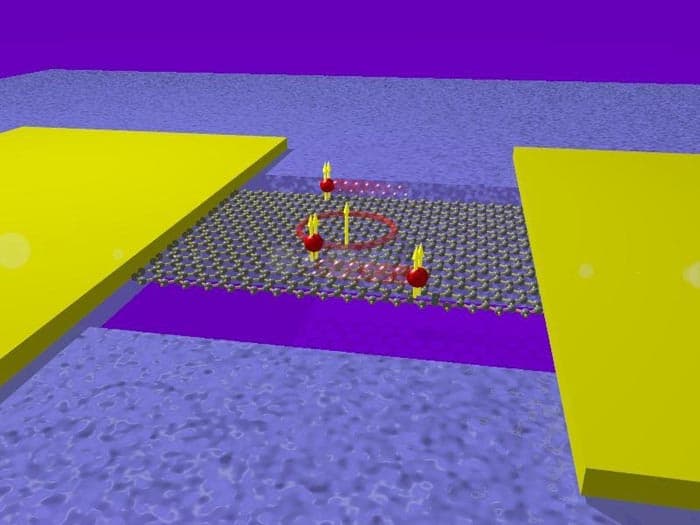
Schönenberger’s group, which includes others at Basel and at the University of Copenhagen, has found a way to extract entangled pairs of electrons, and separate them, using a superconducting Y-junction. An important property of the superconductor is that electrons can exist in entangled “Cooper pairs”. Such pairs cannot enter the Y-junction without passing through a barrier. Because of the low probability of passing this barrier, Cooper pairs tend to enter the junction one at a time.

The next step is to ensure that the pairs split, rather than having both electrons travelling down just one arm. They do this by placing a tiny piece of semiconductor – a quantum dot – at the end of each arm. A lone electron can pass through a quantum dot but it is unlikely that two electrons (which repel each other electrically) will squeeze through at once.

Non-local correlation

The team confirmed that entangled Cooper pairs were indeed being separated by adjusting the resistance of one of the quantum dots while monitoring the conductance of each arm. When the electron source was in a superconducting state, a “non-local correlation” between these parameters was seen suggesting that entangled pairs were being separated. However, when a magnetic field was applied to the electron source – destroying its superconductivity and Cooper pairs – the non-local correlation vanished.

Takis Kontos, whose group at the École Normale Supérieure in Paris has submitted a similar study to Physical Review Letters (preprint at arXiv:0909.3243) that uses carbon nanotubes in place of superconducting wires, thinks Cooper-pair splitting is “an important step forward”.

“It opens the avenue for the implementation of much more advanced quantum-optics-like experiments in electronic systems,” he said. “One could, for example, envision correlation experiments together with the use of spin filters in order to probe quantum entanglement in a very elegant way…The findings presented in this paper bring on very exciting perspectives and are very likely to generate a renewed and intense experimental and theoretical activity.”

Schönenberger told physicsworld.com that his and other researcher groups are now pursuing tests of non-locality, in particular using statistical studies of so-called Bell’s inequalities, which reveal whether the behaviour of two entangled particles is correlated.

The research is published in Nature.

Into the darkness

boulby.jpg
ZEPLIN-III lies deep in Boulby mine, Northeast England

By James Dacey

Lurking quietly in the bowels of Europe’s second deepest mine, ZEPLIN-III will come alive this month as it resumes its search for that mysterious substance called dark matter.

I recently caught up with Alex Murphy, leader of the University of Edinburgh’s contribution to the project.

Sitting in a cafe that resembled a fishtank, Murphy explained to me at length why he has placed his faith in dark matter. He also described the form he imagines this substance should take, and why he believes that ZEPLIN is now in prime position to make the first internationally-recognized detection of dark matter… possibly within months!

We wrapped things up by chatting about the aspects of his job that he loves and the aspects that he hates, as well as how he deals with the rivalry in the international search for dark matter.

You can read the full interview here.

Electrons flow forever in metal rings

If you want an electrical current to flow around a normal metal ring you have to supply enough energy to overcome the metal’s resistance – right? Not always, according to physicists in the US and Germany who have the best experimental evidence yet that currents can flow forever in micrometre-sized metal rings. The research involves measuring the tiny magnetic fields associated with the currents and validates a theory of persistent currents that was proposed in 1969.

Physicists are familiar with persistent currents in superconductors – in which electrons can flow forever, unhindered by resistance. But even the best normal conductors such as copper or gold have electrical resistance due to electrons scattering from defects, which should make persistent currents impossible.

However, if a metal ring is very small – about 1 μm diameter or less – quantum mechanics says that its electrons should behave in much the same way as electrons orbiting an atomic nucleus. And in the same way that electrons in the lowest energy configuration of an atom maintain their orbits without the constant input of energy, electrons in such “mesoscopic” rings should flow forever – even if the ring has resistance due to defect scattering.

Indeed, a 1 μm diameter ring cooled to 1 K should support a current of about 1 nA.

Breaking the ring

Nanoampere currents can be measured with an ammeter, but this would involve breaking the ring to include the ammeter in the circuit. Even if the ammeter could be shrunk down to micrometre size, its presence would destroy the quantum coherence that allows the current to flow.

Instead physicists have used superconducting quantum interference devices (SQUIDs) to try to measure the tiny magnetic fields created by persistent currents. This is very difficult because SQUIDs are sensitive to magnetic impurities in the rings. In addition, a magnetic field must be applied along the ring’s axis to cause the persistent current to flow in one direction. Such a field makes it difficult to operate a SQUID – but without an applied field some electrons would flow clockwise and others anti-clockwise, resulting in zero net current.

Because of these problems, experimental results have been inconsistent and at odds with theoretical predictions. Now, Jack Harris and team at Yale University along with a colleague at the Free University of Berlin have invented a completely new way of measuring persistent currents that is about 100 times more sensitive than SQUID-based experiments.

Tiny diving boards

The team grew aluminium rings on a silicon chip and then used lithographic processes to create 300 nm-thick diving-board-like cantilevers with one or more rings at the tips.

To measure the current in the rings a cantilever is aligned at an angle of about 45° to a strong magnetic field of several Tesla. The component of the applied magnetic field perpendicular to the cantilever causes the persistent current to flow in one direction – resulting in an additional magnetic field perpendicular to the cantilever. The parallel component of the applied field is at right angles to the field created by the persistent current, resulting in a torque on the cantilever.

The cantilever has a natural frequency of oscillation, which changes as a result of this torque. By comparing the frequencies with and without the applied field, Harris and colleagues can work out the size of the persistent currents in the rings.

The team studied several different cantilevers decorated with a single ring or arrays of hundreds or thousands of identical rings. The rings on different cantilevers had diameters varying from 616 nm to 1.59 μm.

Closing a chapter

By measuring the size of the persistent current while changing the magnetic field, the team confirmed that the persistent current is a periodic function of the magnetic flux quantum h/e – as predicted by Yoseph Imry of Israel’s Weizmann Institute and colleagues in 1969 and 1983. Imry described the study as a “very thorough study” that has “closed a chapter on persistent currents”.

He pointed out, however, that Harris and colleagues did not study persistent currents at low magnetic fields, where the currents are expected to be a periodic function of h/2e. “The explanation is akin to the simpler one involving ‘coherent backscattering’, the addition of paths encircling the ring in opposite, time reversed, orbits”, explained Imry. Imry told physicsworld.com that Harris should be able to do experiments at lower field strengths in order to see the h/2e regime.

Harris intends to do further experiments at different magnetic field strengths and angles, as well as different temperatures and ring size. He also said that he is keen to put tiny structures into the rings such as quantum dots or Josephson junctions – and study the resulting mesoscopic circuits remotely using the cantilever technique.

The work is described in Science.

Copyright © 2026 by IOP Publishing Ltd and individual contributors